

Consumer Insights
Uncover trends and behaviors shaping consumer choices today
Procurement Insights
Optimize your sourcing strategy with key market data
Industry Stats
Stay ahead with the latest trends and market analysis.
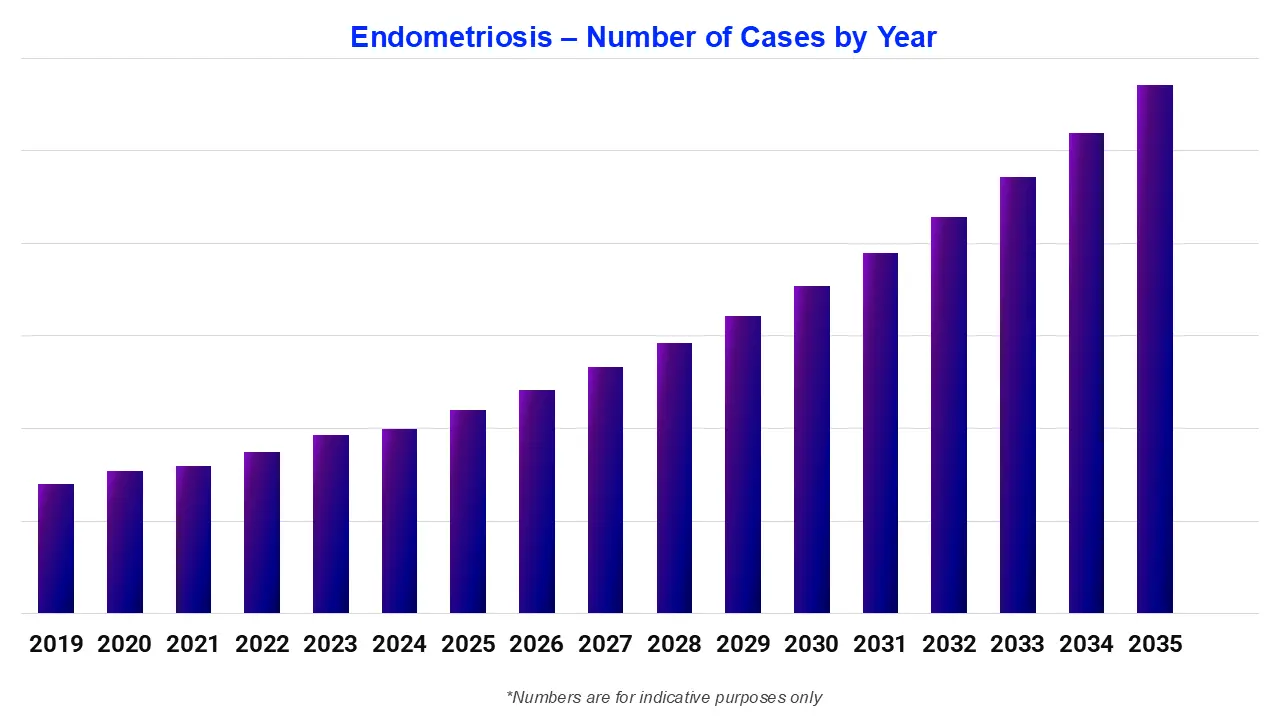
Endometriosis remains a chronic, estrogen-dependent inflammatory gynecological disorder characterized by the presence of endometrial-like tissue outside the uterine cavity, most frequently involving the pelvic peritoneum, ovaries and deep pelvic structures. According to Liu et al., a 2025 analysis using GBD 2021 data estimated 22.28 million cases of endometriosis globally among women of childbearing age in 2021, with an age-standardized prevalence rate of 1,023.8 per 100,000. According to the endometriosis epidemiology forecast by Expert Market Research, the disease continues to represent a major clinical and healthcare burden because persistent pelvic pain, infertility, recurrent disease after surgery, prolonged hormonal treatment, reduced work productivity, sexual dysfunction and psychological distress can continue over many years.
Base Year
Historical Period
Forecast Period
Read more about this report - Request a Free Sample
Expert Market Research's “Endometriosis Epidemiology Forecast Report 2026-2035” offers comprehensive information on the prevalence and demographics of Endometriosis. It projects the future incidence and prevalence rates of Endometriosis cases across various populations. The study covers age, gender, and type as major determinants of the Endometriosis population. The report highlights patterns in the prevalence of Endometriosis overtime and projects future trends based on multiple variables.
The report provides a comprehensive overview of the disease, as well as historical and projected data on the epidemiology of Endometriosis in the 8 major markets.
Regions Covered
Endometriosis remains a chronic, estrogen-dependent inflammatory gynecological disorder characterized by the presence of endometrial-like tissue outside the uterine cavity, most frequently involving the pelvic peritoneum, ovaries and deep pelvic structures. The condition is associated with dysmenorrhea, chronic pelvic pain, deep dyspareunia, cyclical bowel or urinary symptoms, fatigue and infertility, but its clinical phenotype varies substantially among individuals. Contemporary pathobiology emphasizes interactions among ectopic endometrial-like tissue, estrogen-dependent inflammation, progesterone resistance, immune dysfunction, angiogenesis, neuroangiogenesis, fibrosis and altered pain processing.
|
Parameter |
Insight |
|
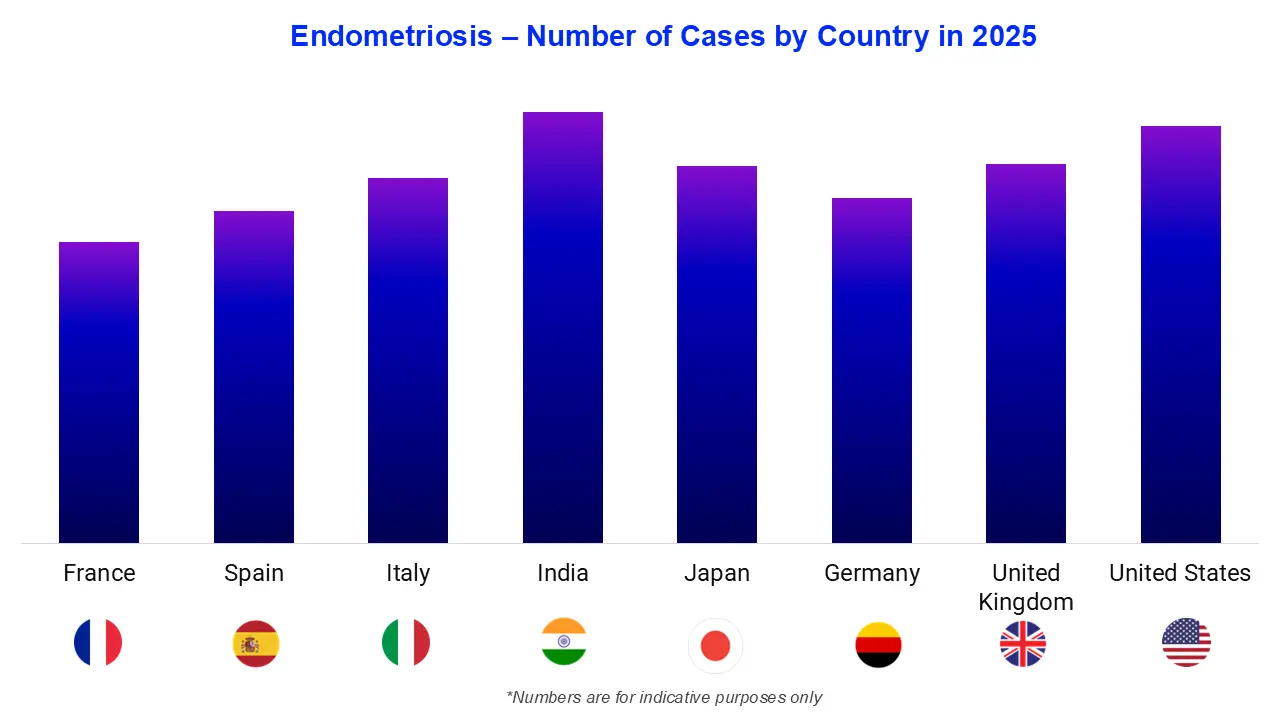
Largest Patient Pool |
United States |
|
Fastest Growing Country |
India |
|
High-Risk Population |
Women with severe dysmenorrhea, chronic pelvic pain, infertility, family history, early symptom onset, adenomyosis, recurrent disease and symptoms involving bowel or urinary function |
|
Key Diagnostic Method |
Expert transvaginal ultrasound |
|
Major Risk Factor |
Reproductive and genetic susceptibility |
|
Major gap in the market |
Diagnostic delay, absence of a validated blood-based biomarker, recurrent disease after surgery, incomplete pain control, infertility, variable response to hormonal suppression, ovarian-reserve concerns and lack of a curative medical therapy |
The Endometriosis epidemiology division offers information on the patient pool from history to the present as well as the projected trend for each of the 8 major markets. Expert Market Research provides both current and predicted trends for the Endometriosis epidemiology scenario by examining a wide range of studies. Additionally, the report covers the diagnosed patient pool for Endometriosis and their trends. The data is broken down into specific categories, such as total prevalent cases in males and females, and total diagnosed cases across different age groups and patient pools.
|
Epidemiology Segment |
Key Insights |
|
Diagnosed Prevalent Cases of the Disease |
Contemporary 2025 evidence indicates substantial global burden but continued uncertainty regarding true prevalence. Zhang et al. analyzed 198,925,726 women in 127 studies and estimated general-population endometriosis prevalence at approximately 5%, with prevalence increasing sharply in symptomatic and infertility populations. Among women experiencing infertility, pooled prevalence was approximately 38%. |
|
Gender-Specific Cases of the Disease |
Endometriosis predominantly affects women and people with functioning ovaries, and contemporary guidelines increasingly recognize the disease in gender-diverse populations as well. The 2026 Canadian guideline explicitly includes women and gender-diverse individuals in its target population. |
|
Age-Specific Cases of the Disease |
Endometriosis most commonly becomes clinically apparent during adolescence and reproductive age. Endometriosis incidence is highest among women aged 20–24 years, while mortality rates increase with advancing age. Global Burden of Disease 2021 data reported 3.45 million new endometriosis cases globally in 2021, with the highest incidence observed among women aged 20–24 years. |
|
Ethnicity-Wise Cases of the Disease |
Ethnicity-specific epidemiological data for endometriosis remain limited and inconsistently reported. A 2025 systematic review found that only 65 of 648 eligible endometriosis studies (10.0%) reported participant race or ethnicity, highlighting substantial gaps in demographic reporting and limiting reliable cross-ethnic comparisons. |
|
Mortality and Survival Analysis of the Disease |
Endometriosis is principally a chronic morbidity-producing rather than directly fatal disorder. A 2026 systematic review and meta-analysis specifically examined mortality because the long-term mortality association has remained uncertain; contemporary evidence suggests that any excess mortality risk is modest and strongly influenced by comorbid disease and study design. |
|
Disease Type |
Prevalence |
|
Superficial / Peritoneal Endometriosis |
Superficial peritoneal disease involves endometriotic lesions on the pelvic peritoneal surfaces and remains one of the most common anatomical forms. The 2025 meta-analysis estimated pooled prevalence of peritoneal endometriosis at approximately 6% across the evaluated populations, although estimates varied substantially between clinical and general-population settings. |
|
Ovarian Endometriosis / Endometrioma |
Ovarian endometriosis produces endometriotic cysts and can cause pelvic pain, infertility and potentially reduced ovarian reserve. The 2025 global meta-analysis estimated pooled ovarian endometriosis prevalence at approximately 13% in the analyzed populations. Management requires particular attention to fertility plans because surgical removal can itself affect ovarian reserve. |
|
Deep Endometriosis |
Deep endometriosis is characterized by lesions infiltrating deeply into pelvic structures and may involve the uterosacral ligaments, vagina, rectovaginal space, bowel, bladder or ureter. The 2025 meta-analysis estimated pooled prevalence at approximately 10%, while contemporary imaging literature emphasizes the importance of compartment-based preoperative mapping. |
|
Rectosigmoid / Bowel Endometriosis |
Bowel involvement is clinically important because lesions can cause cyclical dyschezia, abdominal pain, bloating and, in advanced disease, bowel obstruction or impaired intestinal function. MRI and expert transvaginal ultrasound can provide complementary information for mapping bowel-wall involvement before surgery. |
Read more about this report - Request a Free Sample
The Endometriosis epidemiology data and findings for the United States, Germany, Spain, Italy, France, the United Kingdom, Japan, and India are also provided in the epidemiology section.
|
Country |
Key Insights |
|
United States |
Contemporary U.S. epidemiological evidence includes the 2026 analysis of active-component service women, which identified an endometriosis incidence of 40.7 cases per 10,000 person-years in 2024 and documented an overall increase during the surveillance period. Because the study population consists of military service women and the longitudinal dataset extends before 2023, the 2024 rate should not be extrapolated to the entire U.S. female population. |
|
Germany |
Germany has an unusually strong contemporary guideline and epidemiological evidence base. The 2026 DGGG/OEGGG/SGGG guideline emphasizes a symptom-oriented approach and identifies transvaginal ultrasound as the central diagnostic procedure, with surgery and hormonal therapy integrated according to the individual phenotype. |
|
France |
France represents a major European market for endometriosis management, imaging and minimally invasive surgery. Contemporary European evidence continues to emphasize specialist endometriosis centres and structured imaging for deep disease. A sufficiently robust French national prevalence estimate based on observations exclusively from 2023–2026 was not identified in the reviewed literature; therefore, an older national percentage has not been substituted. |
|
Italy |
Italy has particularly relevant contemporary administrative evidence: a 2024 publication describes development of a national epidemiological register for endometriosis based on administrative data, designed to standardize case identification across regions. Because the numerical prevalence and incidence estimates in that publication derive from historical hospital records rather than 2023–2026 observations, those values are not reproduced here. |
|
Spain |
Spain remains a mature European endometriosis-management market with substantial expertise in advanced laparoscopy, endometriosis imaging and reproductive medicine. Contemporary Spanish and European evidence emphasizes expert ultrasound/MRI mapping before complex surgery and increasingly favors symptom-oriented longitudinal management |
|
United Kingdom |
The UK has some of the clearest contemporary guidance on non-invasive diagnosis. The 2024 NICE update recommends transvaginal ultrasound for everyone with suspected endometriosis, even if physical examination is normal, while specialist ultrasound or MRI is recommended for deep disease. The guideline also recognizes relugolix-estradiol-norethisterone and linzagolix with add-back therapy as treatment options after previous medical or surgical management in adults of reproductive age. |
|
Japan |
A 2026 Japanese real-world study using a large health-insurance dataset identified 285,309 women diagnosed with endometriosis between 15 and 50 years of age within the cohort and found a prevalence of 3.62% in 2022. Because the observation period ends in 2022, the prevalence number is deliberately not presented as current 2023–2026 epidemiology. The study nevertheless showed increasing endometriosis recognition and a peak incidence at approximately 26 years. |
|
India |
India represents a major emerging market for endometriosis management because of its large reproductive-age population, expanding fertility sector and increasing availability of oral GnRH antagonists. A 2026 multicentre phase III trial conducted across 19 Indian centres randomized 230 women aged 18–49 years with moderate-to-severe endometriosis-associated pain and demonstrated non-inferiority of elagolix to dienogest over 24 weeks. |
According to contemporary 2023-2026 evidence, substantial gaps remain in the epidemiological characterization, early diagnosis, phenotyping and long-term management of endometriosis. The 2025 prevalence meta-analysis estimated approximately 5% prevalence in the general population but demonstrated much higher prevalence among women with infertility and gynecological symptoms. Harder et al. further demonstrated that the apparent burden depends strongly on diagnostic modality, making direct comparison among countries difficult. A major opportunity therefore exists in earlier non-invasive diagnosis. The contemporary diagnostic paradigm is moving away from mandatory diagnostic laparoscopy toward clinical assessment plus expert imaging.
The management of endometriosis primarily focuses on reducing pain, suppressing disease activity, preserving fertility where desired, limiting recurrence, protecting organ function and improving quality of life. Contemporary treatment is increasingly individualized according to symptoms, disease phenotype, fertility priorities, previous therapy, ovarian reserve, comorbidities and patient preference rather than relying solely on anatomical stage. The 2026 German guideline explicitly recommends an individualized symptom-oriented approach integrating hormonal, surgical and multimodal management. Diagnosis and imaging have undergone an important conceptual change. The 2024 NICE update recommends transvaginal ultrasounds for all patients with suspected endometriosis, even when pelvic examination is normal. MRI or specialist ultrasound is recommended for suspected deep disease, and a normal scan does not exclude the condition.


Upto 15% Off
USD
$2699 $2429
$4299 $3869
$5799 $4949
$6999 $5949


*While we strive to always give you current and accurate information, the numbers depicted on the website are indicative and may differ from the actual numbers in the main report. At Expert Market Research, we aim to bring you the latest insights and trends in the market. Using our analyses and forecasts, stakeholders can understand the market dynamics, navigate challenges, and capitalize on opportunities to make data-driven strategic decisions.*
Explore our key highlights of the report and gain a concise overview of key findings, trends, and actionable insights that will empower your strategic decisions.
|
Report Features |
Details |
|
Base Year |
2025 |
|
Historical Period |
2019-2025 |
|
Forecast Period |
2026-2035 |
|
Epidemiology Statistics Provided |
|
|
Segmentation Provided |
|
|
Geographies Covered |
|
Datasheet
One User
USD 2,699
USD 2,429
tax inclusive*
Single User License
One User
USD 4,299
USD 3,869
tax inclusive*
Five User License
Five User
USD 5,799
USD 4,949
tax inclusive*
Corporate License
Unlimited Users
USD 6,999
USD 5,949
tax inclusive*
*Please note that the prices mentioned below are starting prices for each bundle type. Kindly contact our team for further details.*
Flash Bundle
Small Business Bundle
Growth Bundle
Enterprise Bundle
*Please note that the prices mentioned below are starting prices for each bundle type. Kindly contact our team for further details.*
Flash Bundle
Number of Reports: 3
20%
tax inclusive*
Small Business Bundle
Number of Reports: 5
25%
tax inclusive*
Growth Bundle
Number of Reports: 8
30%
tax inclusive*
Enterprise Bundle
Number of Reports: 10
35%
tax inclusive*
How To Order

Select License Type
Choose the right license for your needs and access rights.

Click on ‘Buy Now’
Add the report to your cart with one click and proceed to register.

Select Mode of Payment
Choose a payment option for a secure checkout. You will be redirected accordingly.
Strategic Solutions for Informed Decision-Making
Gain insights to stay ahead and seize opportunities.

Get insights & trends for a competitive edge.

Track prices with detailed trend reports.

Analyse trade data for supply chain insights.

Leverage cost reports for smart savings

Enhance supply chain with partnerships.

Connect For More Information
Our expert team of analysts will offer full support and resolve any queries regarding the report, before and after the purchase.
Our expert team of analysts will offer full support and resolve any queries regarding the report, before and after the purchase.
We employ meticulous research methods, blending advanced analytics and expert insights to deliver accurate, actionable industry intelligence, staying ahead of competitors.
Our skilled analysts offer unparalleled competitive advantage with detailed insights on current and emerging markets, ensuring your strategic edge.
We offer an in-depth yet simplified presentation of industry insights and analysis to meet your specific requirements effectively.




