

Consumer Insights
Uncover trends and behaviors shaping consumer choices today
Procurement Insights
Optimize your sourcing strategy with key market data
Industry Stats
Stay ahead with the latest trends and market analysis.
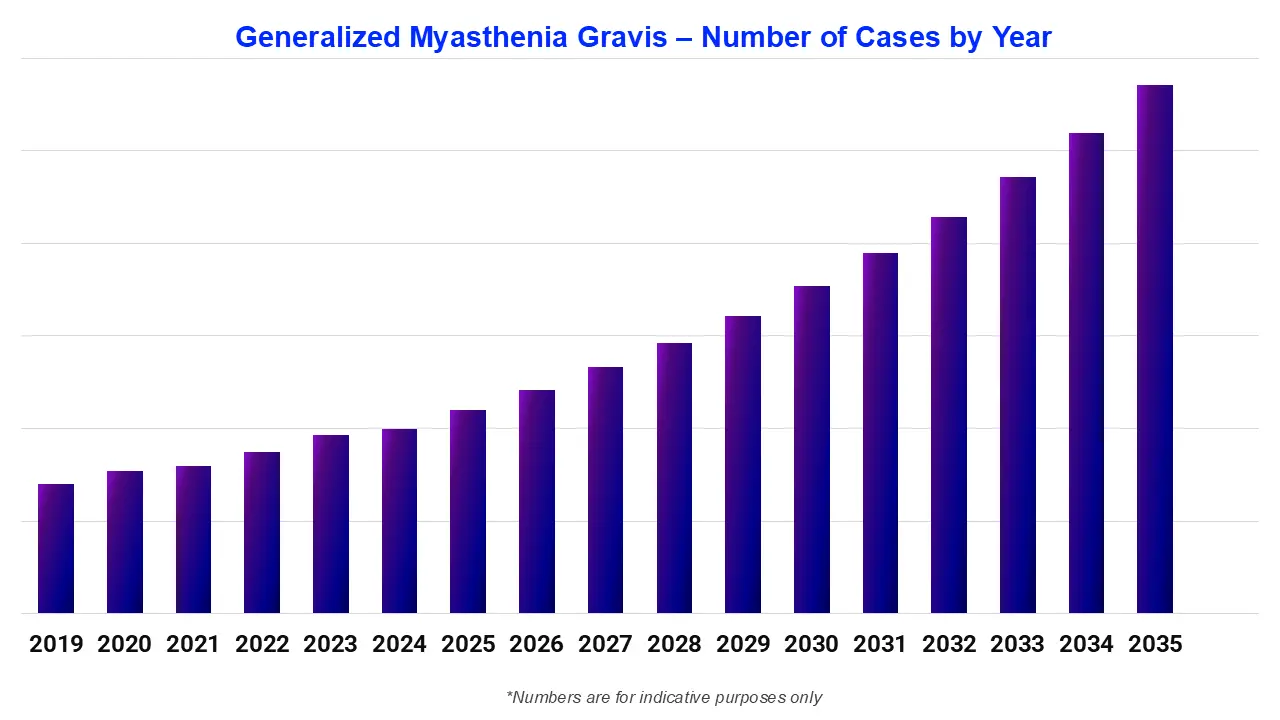
Generalized myasthenia gravis (gMG) is a chronic autoimmune neuromuscular disorder characterized by fluctuating weakness of voluntary muscles. According to UCB S.A., Belgium, myasthenia gravis has a prevalence of 100–350 cases per 1 million people. As per generalized myasthenia gravis epidemiology forecast by Expert Market Research, the neuromuscular disease burden is expected to remain clinically significant.
Base Year
Historical Period
Forecast Period
Read more about this report - Request a Free Sample
Expert Market Research's “Generalized Myasthenia Gravis Epidemiology Forecast Report 2026-2035” offers comprehensive information on the prevalence and demographics of generalized myasthenia gravis. It projects the future incidence and prevalence rates of generalized myasthenia gravis cases across various populations. The study covers age, gender, and type as major determinants of the generalized myasthenia gravis population. The report highlights patterns in the prevalence of generalized myasthenia gravis over time and projects future trends based on multiple variables.
The report provides a comprehensive overview of the disease, as well as historical and projected data on the epidemiology of generalized myasthenia gravis in the 8 major markets.
Regions Covered
Generalized myasthenia gravis (gMG) is a chronic autoimmune disorder of the neuromuscular junction in which pathogenic antibodies impair communication between nerves and skeletal muscles, resulting in fluctuating, fatigable muscle weakness. The condition commonly affects ocular, bulbar, limb, and respiratory muscles and can substantially impair physical functioning. MG is broadly classified into ocular and generalized forms based on the distribution of weakness. Generalized disease may be associated with antibodies against the acetylcholine receptor (AChR), muscle-specific kinase (MuSK), or other neuromuscular junction proteins.
|
Parameter |
Insight |
|
Largest Patient Pool |
United States |
|
Fastest Growing Country |
India |
|
High-Risk Population |
MG epidemiology varies by age and sex; US data show higher prevalence among older adults and higher rates among younger women compared with age-matched men. |
|
Key Diagnostic Method |
Serologic antibody testing and neurophysiologic testing; diagnosis generally integrates clinical assessment with AChR/MuSK antibody testing and electrodiagnostic evaluation. |
|
Major Risk Factor |
Autoimmune susceptibility. MG is primarily an autoimmune disorder, with genetic and environmental factors contributing to disease susceptibility. |
|
Major gap in the market |
Underdiagnosis and delayed diagnosis. Mild and atypical cases may be missed, while geographic differences in case finding and diagnostic practices contribute to variation in reported epidemiology. |
The generalized myasthenia gravis epidemiology division offers information on the patient pool from history to the present as well as the projected trend for each of the 8 major markets. Expert Market Research provides both current and predicted trends for the generalized myasthenia gravis epidemiology scenario by examining a wide range of studies. Additionally, the report covers the diagnosed patient pool for generalized myasthenia gravis and their trends. The data is broken down into specific categories, such as total prevalent cases in males and females, and total diagnosed cases across different age groups and patient pools.
|
Epidemiology Segment |
Key Insights |
|
Diagnosed Prevalent Cases of the Disease |
According to UCB S.A., Belgium, myasthenia gravis has a global prevalence of 100–350 cases per 1 million people. |
|
Gender-Specific Cases of the Disease |
As per AmeriPharma, generalized myasthenia gravis affects women more frequently than men, with a reported female-to-male ratio of approximately 2:1 among patients with myasthenia gravis. |
|
Age-Specific Cases of the Disease |
According to Bionews, Inc., patients developing generalized myasthenia gravis at 65 years or older may experience a more aggressive initial disease course. MJH Life Sciences reports a median onset age of 59 years in Japan. |
|
Ethnicity-Wise Cases of the Disease |
Epidemiological patterns vary across populations, reflecting differences in age distribution, disease presentation, and the proportion of patients developing generalized disease. The provided data indicate substantial geographic variation in reported disease burden. |
|
Mortality and Survival Analysis of the Disease |
According to UCB S.A., 15–20% of people living with generalized myasthenia gravis experience myasthenic crisis, which can lead to respiratory failure. Disease severity typically increases during the first two years after diagnosis. |
|
Disease Type |
Prevalence |
|
AChR-Positive gMG |
AChR-positive generalized myasthenia gravis represents the predominant antibody-defined subtype, accounting for a significant share of gMG cases, based on the provided data. |
|
MuSK-Positive gMG |
MuSK-positive gMG represents a less common subtype and is characterized by antibodies targeting muscle-specific kinase. It is associated with a distinct disease profile, particularly involving bulbar and respiratory muscle weakness. |
|
LRP4-Positive gMG |
LRP4-positive gMG is an antibody-defined subtype associated with antibodies targeting low-density lipoprotein receptor-related protein 4. It represents an additional immunological subgroup within the broader generalized myasthenia gravis population. |
|
Seronegative gMG |
Seronegative gMG represents patients with generalized disease in whom standard antibody testing does not identify detectable antibodies. This subtype contributes to the broader gMG population despite the absence of routinely detected antibodies. |
Read more about this report - Request a Free Sample
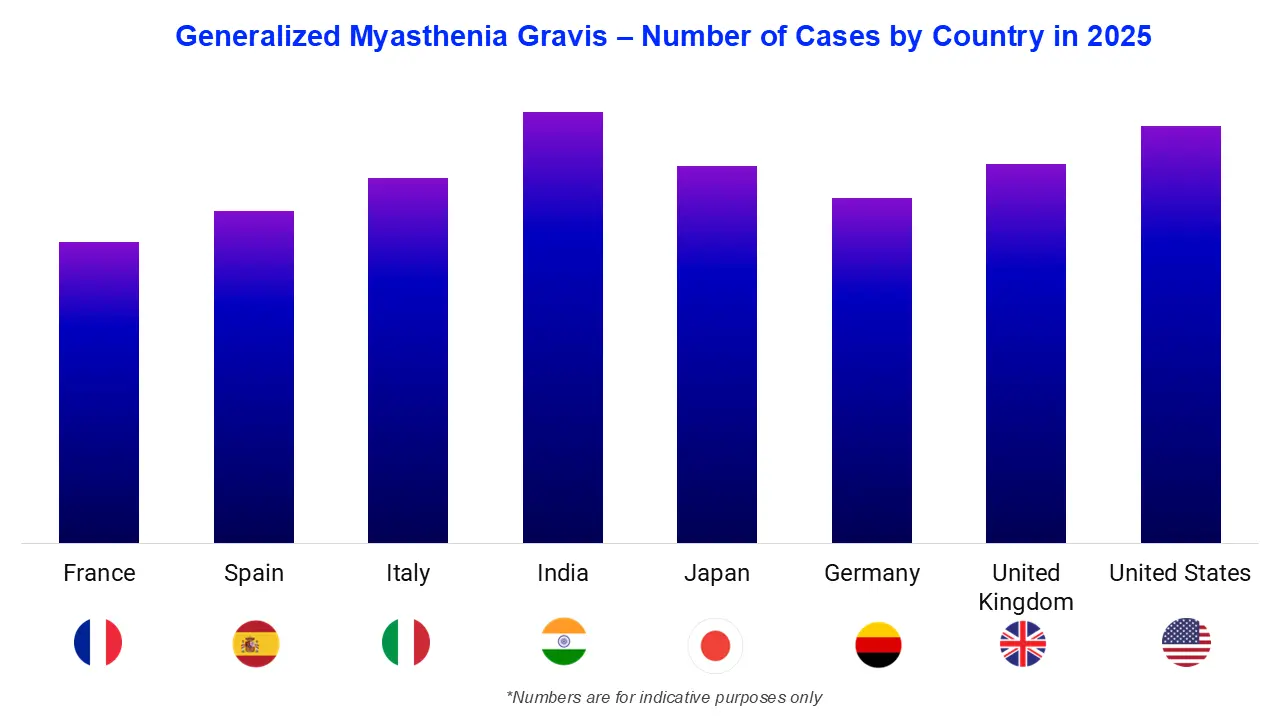
The generalized myasthenia gravis epidemiology data and findings for the United States, Germany, Spain, Italy, France, the United Kingdom, Japan, and India are also provided in the epidemiology section.
|
Country |
Key Insights |
|
United States |
According to Alexion Pharmaceuticals, Inc., generalized myasthenia gravis affects approximately 37 people per 100,000 in the United States. The reported burden indicates a measurable patient population despite the condition being classified as rare. |
|
Germany |
According to AstraZeneca, Germany is included among the five European countries with an estimated combined 82,500 people diagnosed with generalized myasthenia gravis. Approximately 66,000 patients across these countries are reported to be AChR-positive. |
|
France |
As per AstraZeneca, France forms part of the five-country European population in which approximately 82,500 people are estimated to have generalized myasthenia gravis. A substantial proportion, approximately 66,000 patients, are reported as AChR-positive across these countries. |
|
Italy |
According to AstraZeneca, Italy is included within the European five-country population with an estimated 82,500 people diagnosed with generalized myasthenia gravis. The combined population includes approximately 66,000 AChR-positive patients. |
|
Spain |
As per AstraZeneca, Spain is among the five European countries with an estimated combined generalized myasthenia gravis population of 82,500 people. Approximately 66,000 patients across Germany, France, the United Kingdom, Italy, and Spain are AChR-positive. |
|
United Kingdom |
According to AstraZeneca, the United Kingdom is included in the five European countries with an estimated 82,500 people diagnosed with generalized myasthenia gravis. Approximately 66,000 patients across these countries are reported to be AChR-positive. |
|
Japan |
According to MJH Life Sciences, a 2018 nationwide epidemiological survey estimated approximately 29,000 people with myasthenia gravis in Japan, corresponding to a prevalence of 23.1 per 100,000. The median age at onset was 59 years, with approximately 80% of cases generalized. |
|
India |
The epidemiological pattern of generalized myasthenia gravis in India is characterized by the broader disease burden, age distribution, and gender patterns observed in myasthenia gravis. The available information supports consideration of generalized disease within the overall epidemiological assessment. |
The regional epidemiology of generalized myasthenia gravis presents opportunities to improve case identification, particularly among patients with mild, fluctuating, or atypical symptoms. Variations in reported incidence and prevalence across the United States, European countries, Japan, and India partly reflect differences in case ascertainment, diagnostic tools, healthcare access, and epidemiologic methodology.
Generalized myasthenia gravis treatment aims to improve neuromuscular transmission, control autoimmune activity, reduce symptoms, and prevent exacerbations and myasthenic crisis. Symptomatic management commonly includes acetylcholinesterase inhibitors such as pyridostigmine, while corticosteroids and steroid-sparing immunosuppressants are used for longer-term disease control. Patients with severe or refractory disease may receive targeted therapies, including complement inhibitors or agents directed against the neonatal Fc receptor. Intravenous immunoglobulin and plasma exchange are used for acute worsening or myasthenic crisis. Thymectomy may be considered in selected patients, particularly those with thymoma or AChR-positive disease.


Upto 15% Off
USD
$2699 $2429
$4299 $3869
$5799 $4949
$6999 $5949


*While we strive to always give you current and accurate information, the numbers depicted on the website are indicative and may differ from the actual numbers in the main report. At Expert Market Research, we aim to bring you the latest insights and trends in the market. Using our analyses and forecasts, stakeholders can understand the market dynamics, navigate challenges, and capitalize on opportunities to make data-driven strategic decisions.*
Explore our key highlights of the report and gain a concise overview of key findings, trends, and actionable insights that will empower your strategic decisions.
|
Report Features |
Details |
|
Base Year |
2025 |
|
Historical Period |
2019-2025 |
|
Forecast Period |
2026-2035 |
|
Epidemiology Statistics Provided |
|
|
Segmentation Provided |
|
|
Geographies Covered |
|
Datasheet
One User
USD 2,699
USD 2,429
tax inclusive*
Single User License
One User
USD 4,299
USD 3,869
tax inclusive*
Five User License
Five User
USD 5,799
USD 4,949
tax inclusive*
Corporate License
Unlimited Users
USD 6,999
USD 5,949
tax inclusive*
*Please note that the prices mentioned below are starting prices for each bundle type. Kindly contact our team for further details.*
Flash Bundle
Small Business Bundle
Growth Bundle
Enterprise Bundle
*Please note that the prices mentioned below are starting prices for each bundle type. Kindly contact our team for further details.*
Flash Bundle
Number of Reports: 3
20%
tax inclusive*
Small Business Bundle
Number of Reports: 5
25%
tax inclusive*
Growth Bundle
Number of Reports: 8
30%
tax inclusive*
Enterprise Bundle
Number of Reports: 10
35%
tax inclusive*
How To Order

Select License Type
Choose the right license for your needs and access rights.

Click on ‘Buy Now’
Add the report to your cart with one click and proceed to register.

Select Mode of Payment
Choose a payment option for a secure checkout. You will be redirected accordingly.
Strategic Solutions for Informed Decision-Making
Gain insights to stay ahead and seize opportunities.

Get insights & trends for a competitive edge.

Track prices with detailed trend reports.

Analyse trade data for supply chain insights.

Leverage cost reports for smart savings

Enhance supply chain with partnerships.

Connect For More Information
Our expert team of analysts will offer full support and resolve any queries regarding the report, before and after the purchase.
Our expert team of analysts will offer full support and resolve any queries regarding the report, before and after the purchase.
We employ meticulous research methods, blending advanced analytics and expert insights to deliver accurate, actionable industry intelligence, staying ahead of competitors.
Our skilled analysts offer unparalleled competitive advantage with detailed insights on current and emerging markets, ensuring your strategic edge.
We offer an in-depth yet simplified presentation of industry insights and analysis to meet your specific requirements effectively.




