

Consumer Insights
Uncover trends and behaviors shaping consumer choices today
Procurement Insights
Optimize your sourcing strategy with key market data
Industry Stats
Stay ahead with the latest trends and market analysis.
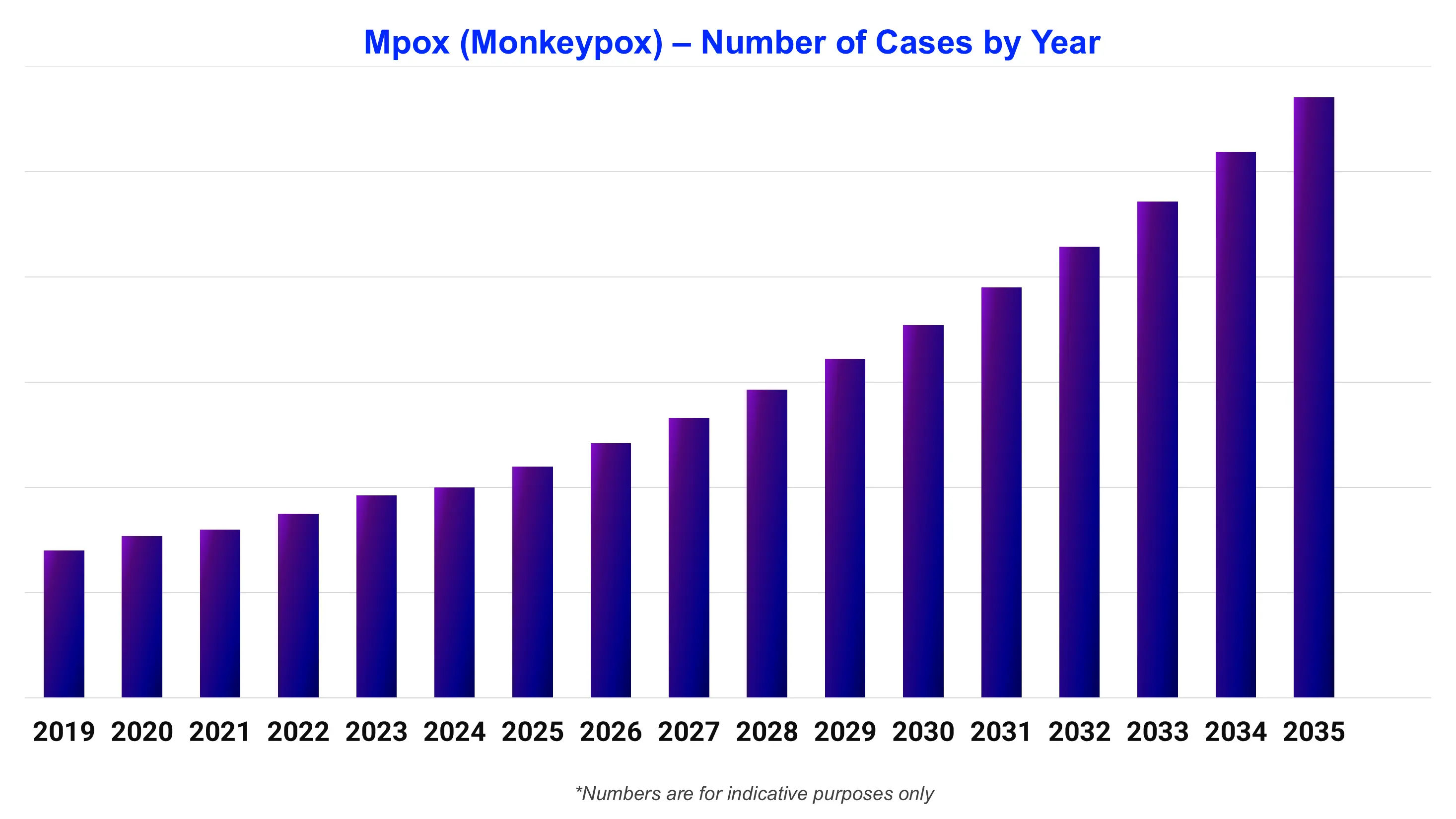
Mpox is a zoonotic viral disease caused by monkeypox virus (MPXV), an orthopoxvirus with two major clades, clade I and clade II. Clade I comprises subclades Ia and Ib, while clade II comprises IIa and IIb. The U.S. experienced one of the largest national mpox outbreaks outside Africa in 2022 and continues to report low-level clade IIb transmission; 2,803 cases were reported in 2024 and 2,519 in 2025, with 11 clade Ib cases across those two years. According to Mpox (Monkeypox) Epidemiology Forecast by Expert Market Research (EMR), Mpox does not have a conventional chronic-disease prevalence measure. Epidemiological assessment is instead based on incident confirmed cases, hospitalization, deaths, transmission setting, viral clade and vaccination status.
Base Year
Historical Period
Forecast Period
Read more about this report - Request a Free Sample
Expert Market Research's “Mpox (Monkeypox) Epidemiology Forecast Report 2026-2035” offers comprehensive information on the prevalence and demographics of Mpox (Monkeypox). It projects the future incidence and prevalence rates of Mpox (Monkeypox) cases across various populations. The study covers age, gender, and type as major determinants of the Mpox (Monkeypox) population. The report highlights patterns in the prevalence of Mpox (Monkeypox) over time and projects future trends based on multiple variables.
The report provides a comprehensive overview of the disease, as well as historical and projected data on the epidemiology of Mpox (Monkeypox) in the 8 major markets.
Regions Covered
Mpox is a zoonotic viral disease caused by monkeypox virus (MPXV), an orthopoxvirus with two major clades, clade I and clade II. Clade I comprises subclades Ia and Ib, while clade II comprises IIa and IIb. Transmission occurs through close physical contact with an infected person, including sexual contact, contact with lesions or contaminated materials, and, in endemic African settings, animal-to-human transmission. The clinical spectrum ranges from localized cutaneous disease to disseminated infection, proctitis, ocular disease, encephalitis and other severe complications. Children, pregnant women and immunocompromised individuals, particularly people with advanced HIV infection, have increased risk of severe disease.
|
Parameter |
Insight |
|
Largest Patient Pool |
United States |
|
Fastest Growing Country |
Germany |
|
High-Risk Population |
People with close physical or sexual exposure to an infected person, particularly MSM with new or multiple partners; people with advanced HIV or other immunocompromising conditions; pregnant women; children; and people with repeated occupational or household exposure. |
|
Key Diagnostic Method |
Real-time PCR of lesion, vesicular, pustular, scab or other appropriate clinical specimens, with clade-specific PCR and whole-genome sequencing increasingly used to characterize clade I/II and detect recombinant viruses. |
|
Major Risk Factor |
Close skin-to-skin or mucosal contact with an infectious person, particularly sexual contact in the current international clade IIb and emerging clade Ib outbreaks. |
|
Major gap in the market |
Uneven vaccination coverage, delayed diagnosis and incomplete genomic surveillance remain important gaps, particularly because clade Ib and clade IIb may circulate simultaneously and routine clade-differentiation PCR can fail to identify recombinant viruses. |
The Mpox (Monkeypox) epidemiology division offers information on the patient pool from history to the present as well as the projected trend for each of the 8 major markets. Expert Market Research provides both current and predicted trends for the Mpox (Monkeypox) epidemiology scenario by examining a wide range of studies. Additionally, the report covers the diagnosed patient pool for Mpox (Monkeypox) and their trends. The data is broken down into specific categories, such as total prevalent cases in males and females, and total diagnosed cases across different age groups and patient pools.
|
Epidemiology Segment |
Key Insights |
|
Diagnosed Prevalent Cases of the Disease |
A conventional prevalence estimate is not appropriate for mpox because infection is generally acute and surveillance captures incident diagnosed cases. WHO reported 190,683 confirmed cases globally from 1 January 2022 through 31 July 2026. Japan had 397 domestically reported cases by 18 September 2026, while the UK had 4,946 total confirmed cases across 2022-August 2026. |
|
Gender-Specific Cases of the Disease |
Contemporary international surveillance is strongly male-predominant outside the historically endemic African settings. In France, 283 of 320 cases reported January-July 2026 were male (88%). In the EU/EEA, 90% of clade I cases with complete sexual-behaviour information during September 2025-August 2026 occurred among MSM. |
|
Age-Specific Cases of the Disease |
Mpox affects multiple age groups, but the current international clade IIb and emerging clade Ib outbreaks outside Africa are concentrated predominantly in adults. France reported a median age of 34 years among its January-July 2026 cases; only two of 320 reported cases were children younger than 15 years. Children remain an important severe-disease population in clade I settings. |
|
Ethnicity-Wise Cases of the Disease |
Ethnicity is not a biological determinant of mpox susceptibility and comparable 8MM ethnicity-specific surveillance is unavailable. U.S. surveillance identifies substantial racial and ethnic variation in diagnosed cases, reflecting geographic, social, behavioural and healthcare-access factors; therefore ethnicity-specific case distributions should not be interpreted as intrinsic susceptibility differences. |
|
Mortality and Survival Analysis of the Disease |
WHO reported 529 confirmed deaths among 190,683 confirmed cases globally through 31 July 2026. Severity varies markedly by clade and host. EU/EEA surveillance recorded no clade I deaths during September 2025-August 2026, while two clade II deaths were reported. Severe and fatal disease remains disproportionately associated with immunocompromise, pregnancy and young age, particularly in clade I-affected African populations. |
|
Disease Type |
Prevalence |
|
Uncomplicated Cutaneous Mpox |
Acute disease dominated by localized or limited skin and mucosal lesions, often accompanied by fever, lymphadenopathy, fatigue or other systemic symptoms. |
|
Anogenital/Mucosal-Predominant Mpox |
Disease concentrated around the genital, perianal, oral or other mucosal surfaces, frequently associated with sexual transmission in the contemporary international outbreak. |
|
Mpox with Proctitis |
Rectal or anorectal inflammation causing severe anorectal pain, tenesmus, bleeding or painful defecation; an important clinical presentation in clade IIb outbreaks. |
|
Disseminated/Severe Mpox |
Extensive lesions or systemic disease with complications such as bacterial superinfection, sepsis, dehydration, respiratory involvement or multi-organ disease. |
Read more about this report - Request a Free Sample
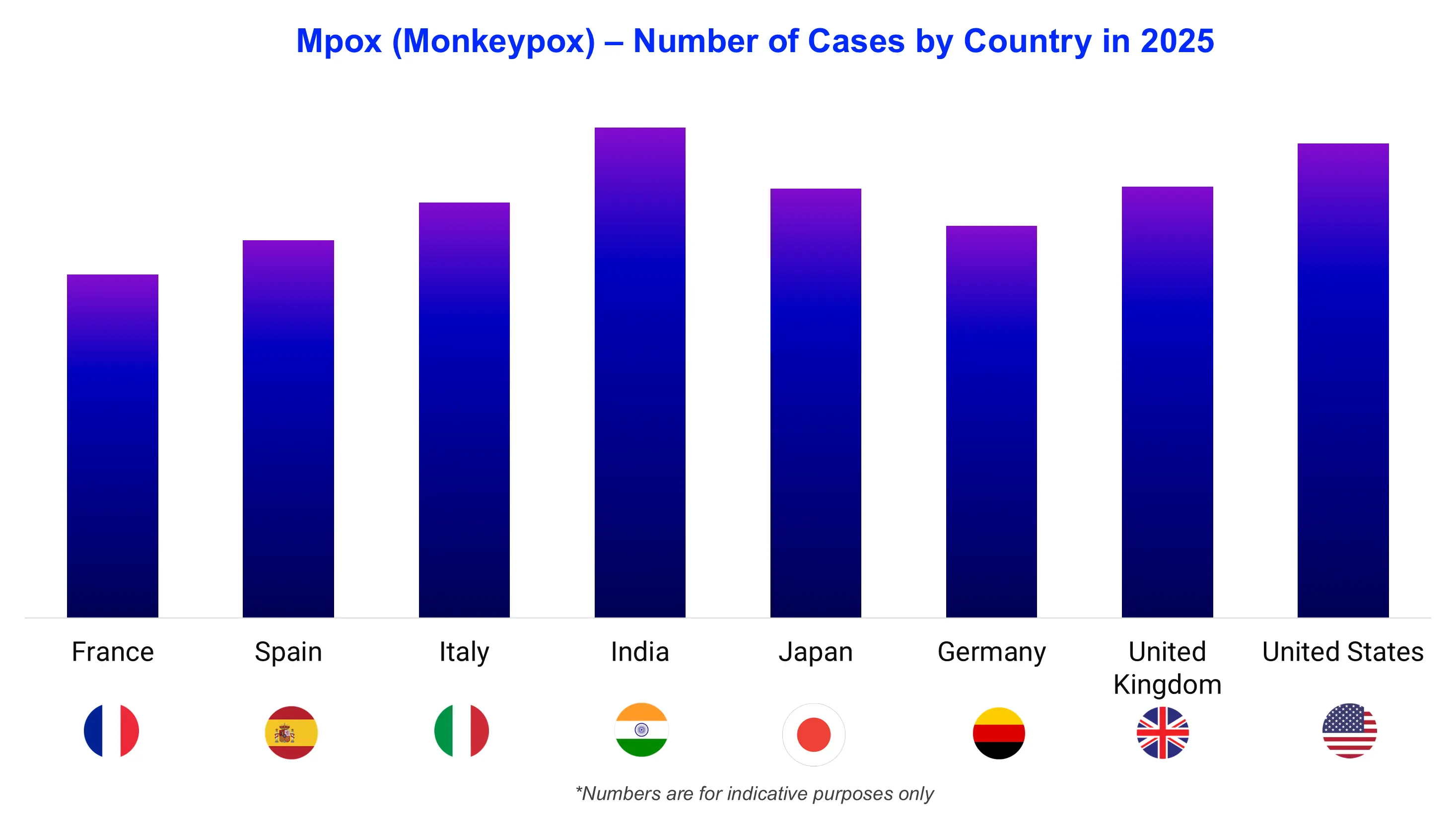
The Mpox (Monkeypox) epidemiology data and findings for the United States, Germany, Spain, Italy, France, the United Kingdom, Japan, and India are also provided in the epidemiology section.
|
Country |
Key Insights |
|
United States |
CDC reported 2,803 mpox cases in 2024 and 2,519 in 2025. One clade Ib case was identified in 2024 and 10 in 2025. By September 2026, more than 60 clade I cases had been reported across at least 20 states, and an increasing proportion had no recent international travel or known links to travelers, indicating emerging domestic clade Ib transmission. Persistent clade IIb transmission disproportionately affects MSM. |
|
Germany |
ECDC recorded 212 clade I cases and 136 clade II cases in Germany during September 2025-August 2026, with 56 clade I cases reported in August 2026 alone. Germany was among the first European countries to document clade Ib infections and household secondary transmission. |
|
France |
France reported 320 mpox cases from January-July 2026, including 305 laboratory-confirmed cases. Among 246 cases with clade information, 187 (76%) were clade Ib and 59 (24%) clade IIb. Eighty-eight percent were male, median age was 34 years, and 10% of cases with available information were hospitalized. |
|
Italy |
During September 2025-August 2026, ECDC recorded 83 clade I cases and eight clade II cases in Italy. Italy had documented locally acquired clade Ib cases by October 2025 after earlier travel-associated introductions, indicating that clade I transmission was no longer limited to imported infections. |
|
Spain |
Spain reported 446 clade I and 436 clade II cases during September 2025-August 2026, among the largest national totals in the EU/EEA during this period. In August 2026 alone, Spain reported 38 clade I and one clade II case. Spain was also among the first EU countries to identify locally acquired clade Ib infection in October 2025. |
|
United Kingdom |
By 31 August 2026, the UK had reported 168 confirmed clade Ib cases, 969 clade IIb cases during 2023-2026, 76 recombinant-clade cases and one case with clade not yet known, in addition to 3,732 clade IIb cases reported in 2022. The total across all clades from 2022-2026 was 4,946 confirmed cases. Clade Ib cases exceeded clade IIb cases in July 2026. |
|
Japan |
Japan's Ministry of Health reported 397 domestic mpox cases by 18 September 2026, excluding one separately publicized case not captured in the notification system. Mpox transmission has continued since the first domestic case in July 2022. Japan has also reported a clade Ib infection following travel to Africa. |
|
India |
India had reported 16 mpox cases by May 2025, comprising 10 clade Ib and six clade IIb cases; eight of the 10 clade Ib patients were male and nine had recent international travel. A 2026 Indian clinical-genomic study characterized 10 clade Ib cases identified in Kerala between September 2024 and March 2025; eight were male and seven had travelled to the UAE. India subsequently identified an inter-clade Ib/IIb recombinant virus in a man whose symptoms began in September 2025 after travel from the Arabian Peninsula. He recovered fully and no secondary cases were identified. |
The principal epidemiological development across the 8MM is the shift from predominantly imported clade I infections toward evidence of local transmission. In Europe, locally acquired clade Ib cases were identified in Spain, the Netherlands, Italy, and Portugal in October 2025, with subsequent surveillance indicating that many EU/EEA cases had no recent travel outside the region. The United Kingdom showed a similar pattern, with clade Ib cases exceeding clade IIb cases by July 2026 and 168 confirmed cases reported by August 2026. In India, most clade Ib cases remained travel-associated, while detection of a recombinant Ib/IIb virus highlighted challenges in molecular surveillance and clade identification.
Mpox management is primarily supportive in uncomplicated disease, including pain control, hydration, wound care, treatment of bacterial superinfection, and management of proctitis or other mucosal complications. Patients with severe disease, substantial immunocompromise, or systemic complications may require antiviral or specialist treatment. Tecovirimat may be used under applicable regulatory or emergency-access frameworks, while brincidofovir and other investigational therapies have been evaluated in selected settings. Treatment decisions depend on disease severity, immune status, age, pregnancy, organ involvement, and local availability. Vaccination remains important for individuals at increased exposure risk. In the EU/EEA, only 21% of clade I cases with known vaccination status received two doses during September 2025–August 2026.


Upto 15% Off
USD
$2699 $2429
$4299 $3869
$5799 $4949
$6999 $5949


*While we strive to always give you current and accurate information, the numbers depicted on the website are indicative and may differ from the actual numbers in the main report. At Expert Market Research, we aim to bring you the latest insights and trends in the market. Using our analyses and forecasts, stakeholders can understand the market dynamics, navigate challenges, and capitalize on opportunities to make data-driven strategic decisions.*
Explore our key highlights of the report and gain a concise overview of key findings, trends, and actionable insights that will empower your strategic decisions.
|
Report Features |
Details |
|
Base Year |
2025 |
|
Historical Period |
2019-2025 |
|
Forecast Period |
2026-2035 |
|
Epidemiology Statistics Provided |
|
|
Segmentation Provided |
|
|
Geographies Covered |
|
Datasheet
One User
USD 2,699
USD 2,429
tax inclusive*
Single User License
One User
USD 4,299
USD 3,869
tax inclusive*
Five User License
Five User
USD 5,799
USD 4,949
tax inclusive*
Corporate License
Unlimited Users
USD 6,999
USD 5,949
tax inclusive*
*Please note that the prices mentioned below are starting prices for each bundle type. Kindly contact our team for further details.*
Flash Bundle
Small Business Bundle
Growth Bundle
Enterprise Bundle
*Please note that the prices mentioned below are starting prices for each bundle type. Kindly contact our team for further details.*
Flash Bundle
Number of Reports: 3
20%
tax inclusive*
Small Business Bundle
Number of Reports: 5
25%
tax inclusive*
Growth Bundle
Number of Reports: 8
30%
tax inclusive*
Enterprise Bundle
Number of Reports: 10
35%
tax inclusive*
How To Order

Select License Type
Choose the right license for your needs and access rights.

Click on ‘Buy Now’
Add the report to your cart with one click and proceed to register.

Select Mode of Payment
Choose a payment option for a secure checkout. You will be redirected accordingly.
Strategic Solutions for Informed Decision-Making
Gain insights to stay ahead and seize opportunities.

Get insights & trends for a competitive edge.

Track prices with detailed trend reports.

Analyse trade data for supply chain insights.

Leverage cost reports for smart savings

Enhance supply chain with partnerships.

Connect For More Information
Our expert team of analysts will offer full support and resolve any queries regarding the report, before and after the purchase.
Our expert team of analysts will offer full support and resolve any queries regarding the report, before and after the purchase.
We employ meticulous research methods, blending advanced analytics and expert insights to deliver accurate, actionable industry intelligence, staying ahead of competitors.
Our skilled analysts offer unparalleled competitive advantage with detailed insights on current and emerging markets, ensuring your strategic edge.
We offer an in-depth yet simplified presentation of industry insights and analysis to meet your specific requirements effectively.




