

Consumer Insights
Uncover trends and behaviors shaping consumer choices today
Procurement Insights
Optimize your sourcing strategy with key market data
Industry Stats
Stay ahead with the latest trends and market analysis.
Tick-Borne Encephalitis (TBE) is an acute viral infection of the central nervous system caused by tick-borne encephalitis virus (TBEV), an RNA virus of the Flaviviridae family. TBEV circulates from Europe to northern and eastern Asia, with European, Siberian and Far Eastern subtypes differing in geographic and clinical characteristics. ECDC identifies Central, Eastern and Northern Europe as key TBE risk areas. In 2022, 3,650 TBE cases were reported across 20 EU/EEA countries, including 3,516 confirmed cases, with males accounting for a higher proportion of cases (male-to-female ratio 1.5:1) and adults aged 45–64 years representing the largest age group. According to Tick-Borne Encephalitis (TBE) Epidemiology Forecast by Expert Market Research, TBE is relevant to the broader encephalitis market, for which EMR identifies the United States, United Kingdom, Germany, France, Italy, Spain and Japan as major markets.
Base Year
Historical Period
Forecast Period
Read more about this report - Request a Free Sample
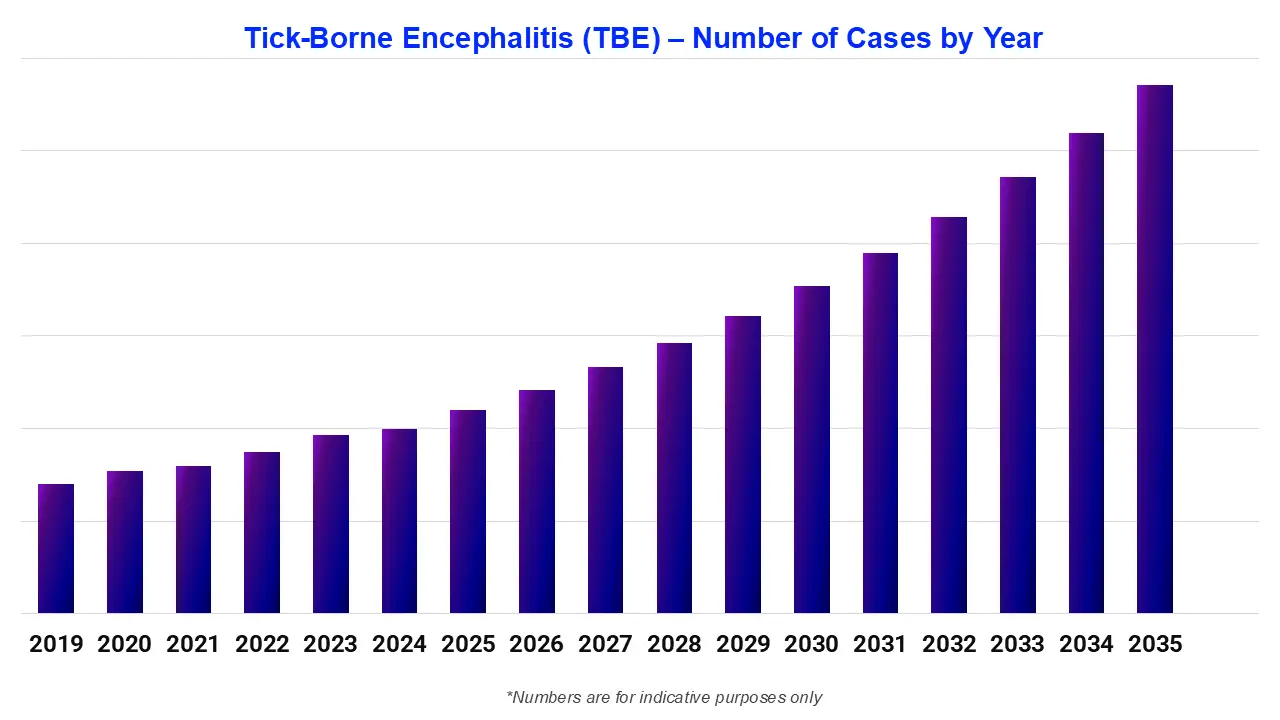
Expert Market Research's “Tick-Borne Encephalitis (TBE) Epidemiology Forecast Report 2026-2035” offers comprehensive information on the prevalence and demographics of Tick-Borne Encephalitis (TBE). It projects the future incidence and prevalence rates of Tick-Borne Encephalitis (TBE) cases across various populations. The study covers age, gender, and type as major determinants of the Tick-Borne Encephalitis (TBE) population. The report highlights patterns in the prevalence of Tick-Borne Encephalitis (TBE) overtime and projects future trends based on multiple variables.
The report provides a comprehensive overview of the disease, as well as historical and projected data on the epidemiology of Tick-Borne Encephalitis (TBE) in the 8 major markets.
Regions Covered
Tick-Borne Encephalitis (TBE) is an acute viral infection of the central nervous system caused by tick-borne encephalitis virus (TBEV), an RNA virus within the Flaviviridae family. Human infection occurs predominantly through the bite of infected Ixodes ticks, although alimentary transmission through consumption of unpasteurized milk or dairy products from infected goats, sheep or cattle is also recognized. TBEV circulates across a broad geographic belt extending from western and northern Europe through northern and eastern Asia. The European, Siberian and Far Eastern viral subtype groups differ in their geographic distribution and clinical characteristics. Contemporary European surveillance identifies Central, Eastern and Northern Europe as the principal areas of human TBE risk. TBE has a broad clinical spectrum. Many infections remain asymptomatic, while symptomatic disease can begin with fever, fatigue, headache, myalgia, nausea and other nonspecific manifestations.
|
Parameter |
Insight |
|
Largest Patient Pool |
Germany |
|
Fastest Growing Region |
France |
|
High-Risk Population |
People living in or travelling to endemic forest and grassland areas; individuals undertaking hiking, forestry, farming, hunting or other outdoor activities; and people consuming unpasteurized dairy products in areas with alimentary transmission. |
|
Key Diagnostic Method |
Detection of TBEV-specific IgM and IgG antibodies, with confirmatory neutralization testing where required; direct virus or nucleic-acid detection is primarily useful in selected early or specialized cases. |
|
Major Risk Factor |
Exposure to infected ticks in endemic environments remains the principal risk. Additional risk occurs through consumption of raw milk or dairy products from infected animals |
|
Major gap in the market |
Strong geographic heterogeneity, under-recognition of mild infections, differences in national surveillance systems and incomplete characterization of local infection foci complicate estimation of the true disease burden. |
The Tick-Borne Encephalitis (TBE) epidemiology division offers information on the patient pool from history to the present as well as the projected trend for each of the 8 major markets. Expert Market Research provides both current and predicted trends for the Tick-Borne Encephalitis (TBE) epidemiology scenario by examining a wide range of studies. Additionally, the report covers the diagnosed patient pool for Tick-Borne Encephalitis (TBE) and their trends. The data is broken down into specific categories, such as total prevalent cases in males and females, and total diagnosed cases across different age groups and patient pools.
|
Epidemiology Segment |
Key Insights |
|
Diagnosed Prevalent Cases of the Disease |
Current European transmission is concentrated predominantly in Central, Eastern and Northern Europe, with marked differences between countries and subnational regions. 686 TBE cases were reported nationally; Bavaria accounted for 312 cases. Germany had 183 designated TBE risk areas following further expansion of the recognized risk geography. France reported 39 cases in 2023 and 62 in 2024, with a further 53% increase in reported cases in 2025. A 2024 Haute-Savoie cluster involved 11 people. |
|
Gender-Specific Cases of the Disease |
Italian surveillance reported 69% male and 31% female cases in 2024. French surveillance similarly found male predominance, with 70% of 2024 cases occurring in men. |
|
Age-Specific Cases of the Disease |
TBE is strongly represented among adults. Italy reported a median age of 55 years in 2024, while the French 2024 case series included patients aged 6–90 years, demonstrating a broad age range. |
|
Ethnicity-Wise Cases of the Disease |
Contemporary European surveillance does not provide a consistent ethnicity-specific pattern that can be interpreted as an independent determinant of TBE susceptibility. Observed differences are better considered in relation to geography, outdoor exposure, vaccination, occupation and access to diagnosis. |
|
Mortality and Survival Analysis of the Disease |
TBE mortality is concentrated in severe neurological disease. Italy reported three deaths among 59 cases in 2024, while German official mortality statistics recorded nine deaths attributed to TBE in 2024. Differences between notified-case and mortality-registration systems mean these figures should not be combined into a single CFR estimate. |
Read more about this report - Request a Free Sample
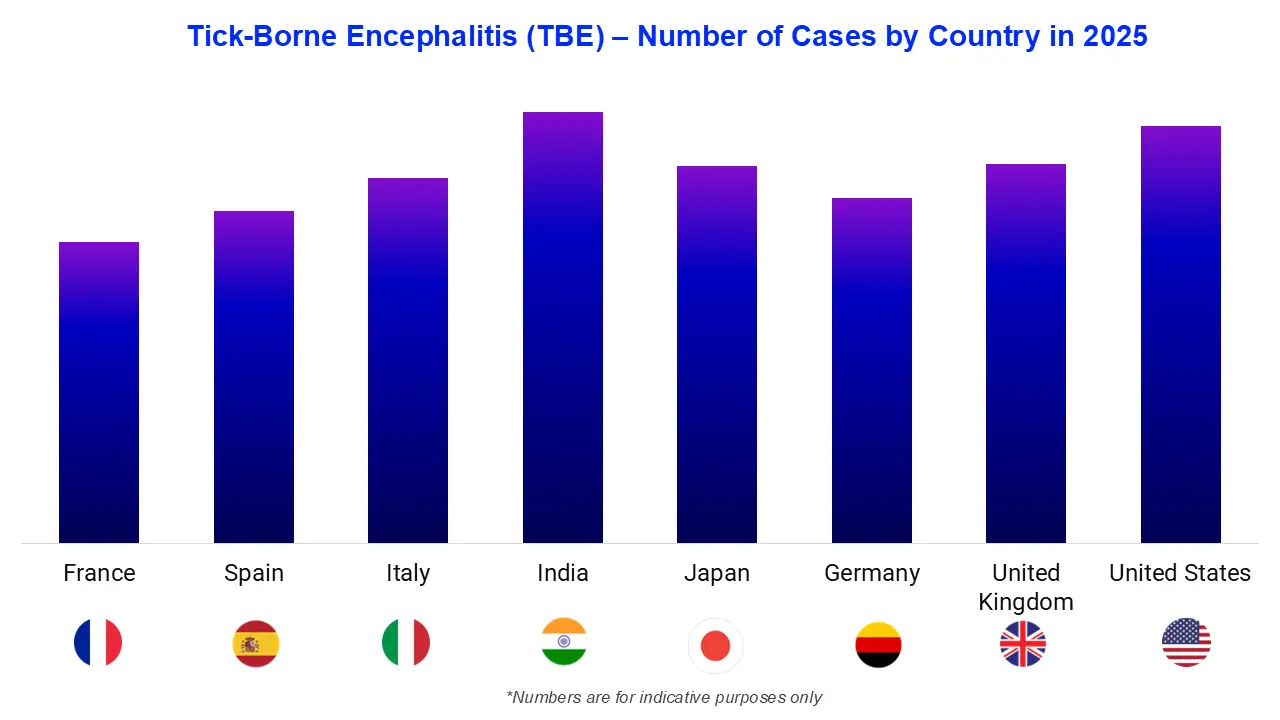
The Tick-Borne Encephalitis (TBE) epidemiology data and findings for the United States, Germany, Spain, Italy, France, the United Kingdom, Japan, and India are also provided in the epidemiology section.
|
Country |
Key Insights |
|
United States |
TBEV is not found in the United States according to CDC's current 2026 assessment. The main relevance is therefore among travelers who acquire infection in TBE-endemic regions abroad. Powassan virus, a related North American flavivirus, should not be counted as TBE. |
|
Germany |
Germany reported 686 TBE cases in 2024, with 312 cases originating in Bavaria. The country's recognized risk geography expanded to 183 designated TBE risk areas. Nine deaths attributed to TBE were recorded in German mortality statistics for 2024. |
|
France |
France reported 39 TBE cases in 2023 and 62 in 2024. In 2024, 55 cases were acquired in France, and an 11-person cluster occurred in Haute-Savoie. Reported cases increased a further 53% in 2025, although national authorities caution that improved surveillance contributed to the apparent increase. |
|
Italy |
Italy reported 49 cases in 2023 and 59 cases in 2024, of which 46 and 57 respectively were autochthonous. In 2024, males accounted for 69% of cases, the median age was 55 years and three deaths occurred. |
|
Spain |
Spain is not among Europe's highest-burden TBE countries. Contemporary epidemiological relevance is concentrated in focal risk areas and among travelers or people undertaking outdoor activities in endemic regions. No comparable national 2023–2026 case series was identified that could be reported without mixing incompatible datasets. |
|
United Kingdom |
TBEV has been demonstrated in UK ticks and locally acquired human disease has been identified. As of August 2026, UK Health Security Agency guidance reported 10 UK-acquired cases in total, while emphasizing that overall public risk remains low and geographically focal. |
|
Japan |
Japan documented two TBE cases in Hokkaido in 2024, representing continued recognition of locally acquired disease in the country. The cases reinforce the importance of clinical recognition in patients with tick exposure and neurological symptoms. |
|
India |
India is not a major documented TBE clinical surveillance setting. Recent evidence does not support a reliable national 2023–2026 TBE case estimate, and therefore no national incidence figure is inserted. The relevant epidemiological consideration is potential exposure to TBEV or related tick-borne flaviviruses in Himalayan and other tick habitats rather than an established nationwide TBE burden. |
The principal epidemiological gap in TBE is incomplete recognition of the true population burden. Clinically diagnosed cases represent only a subset of infections because many TBEV infections remain asymptomatic and mild early-stage illness is nonspecific. This creates a substantial difference between viral exposure, symptomatic infection, hospitalization and laboratory-confirmed neurological disease. The 2024 French experience, in which a rise in reported cases was accompanied by an increase in detection of clinically mild infections, illustrates how surveillance intensity itself can alter the apparent epidemiological trajectory.
The management of Tick-Borne Encephalitis primarily focuses on supportive treatment of acute infection, recognition of neurological deterioration, prevention of complications and reduction of future infection risk. There is currently no specific antiviral treatment for TBE, and clinical management remains supportive. Current CDC clinical guidance and the 2026 Yellow Book state that patients with TBE require treatment directed toward the clinical manifestations and complications rather than a virus-specific drug. Patients with the initial febrile phase may require symptomatic treatment, hydration, monitoring and clinical reassessment because early manifestations can resemble influenza-like illnesses or other infections acquired in tick-endemic regions. Persistent or recurrent fever altered mental status, severe headache, neck stiffness, focal neurological findings, weakness or seizures should increase concern for progression to central nervous system disease.


Upto 15% Off
USD
$2699 $2429
$4299 $3869
$5799 $4949
$6999 $5949


*While we strive to always give you current and accurate information, the numbers depicted on the website are indicative and may differ from the actual numbers in the main report. At Expert Market Research, we aim to bring you the latest insights and trends in the market. Using our analyses and forecasts, stakeholders can understand the market dynamics, navigate challenges, and capitalize on opportunities to make data-driven strategic decisions.*
Explore our key highlights of the report and gain a concise overview of key findings, trends, and actionable insights that will empower your strategic decisions.
|
Report Features |
Details |
|
Base Year |
2025 |
|
Historical Period |
2019-2025 |
|
Forecast Period |
2026-2035 |
|
Epidemiology Statistics Provided |
|
|
Segmentation Provided |
|
|
Geographies Covered |
|
Datasheet
One User
USD 2,699
USD 2,429
tax inclusive*
Single User License
One User
USD 4,299
USD 3,869
tax inclusive*
Five User License
Five User
USD 5,799
USD 4,949
tax inclusive*
Corporate License
Unlimited Users
USD 6,999
USD 5,949
tax inclusive*
*Please note that the prices mentioned below are starting prices for each bundle type. Kindly contact our team for further details.*
Flash Bundle
Small Business Bundle
Growth Bundle
Enterprise Bundle
*Please note that the prices mentioned below are starting prices for each bundle type. Kindly contact our team for further details.*
Flash Bundle
Number of Reports: 3
20%
tax inclusive*
Small Business Bundle
Number of Reports: 5
25%
tax inclusive*
Growth Bundle
Number of Reports: 8
30%
tax inclusive*
Enterprise Bundle
Number of Reports: 10
35%
tax inclusive*
How To Order

Select License Type
Choose the right license for your needs and access rights.

Click on ‘Buy Now’
Add the report to your cart with one click and proceed to register.

Select Mode of Payment
Choose a payment option for a secure checkout. You will be redirected accordingly.
Strategic Solutions for Informed Decision-Making
Gain insights to stay ahead and seize opportunities.

Get insights & trends for a competitive edge.

Track prices with detailed trend reports.

Analyse trade data for supply chain insights.

Leverage cost reports for smart savings

Enhance supply chain with partnerships.

Connect For More Information
Our expert team of analysts will offer full support and resolve any queries regarding the report, before and after the purchase.
Our expert team of analysts will offer full support and resolve any queries regarding the report, before and after the purchase.
We employ meticulous research methods, blending advanced analytics and expert insights to deliver accurate, actionable industry intelligence, staying ahead of competitors.
Our skilled analysts offer unparalleled competitive advantage with detailed insights on current and emerging markets, ensuring your strategic edge.
We offer an in-depth yet simplified presentation of industry insights and analysis to meet your specific requirements effectively.




