

Consumer Insights
Uncover trends and behaviors shaping consumer choices today
Procurement Insights
Optimize your sourcing strategy with key market data
Industry Stats
Stay ahead with the latest trends and market analysis.
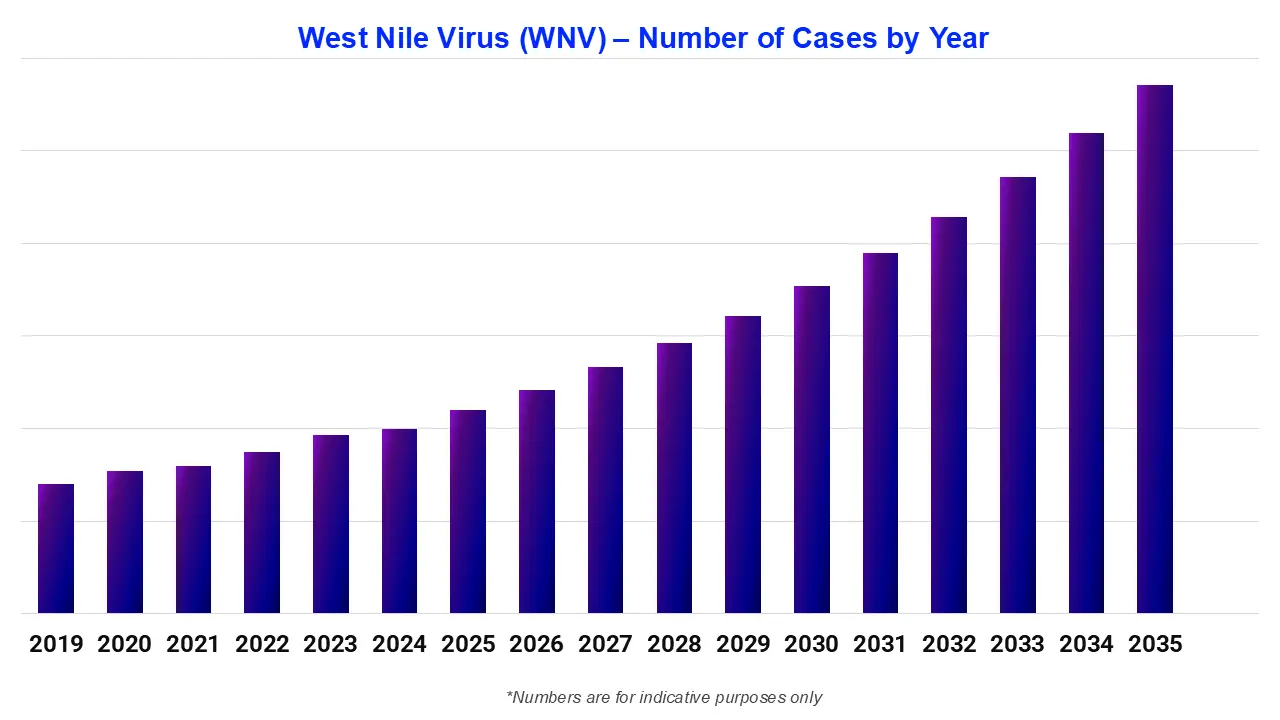
West Nile Virus (WNV) infection is an arthropod-borne viral disease caused by West Nile virus, a positive-sense single-stranded RNA virus belonging to the Flaviviridae family and Flavivirus genus. In the United States, CDC recorded 2,628 WNV disease cases in 2023, including 1,789 neuroinvasive cases and 194 deaths. In 2024, reported disease declined to 1,808 cases, including 1,347 neuroinvasive cases and 173 deaths. According to the West Nile Virus Epidemiology Forecast by Expert Market Research, West Nile Virus is relevant to the broader vector-borne and mosquito-borne disease landscape, while its clinical and public-health burden contributes to demand for surveillance, diagnostics and supportive healthcare services.
Base Year
Historical Period
Forecast Period
Read more about this report - Request a Free Sample
Expert Market Research's “West Nile Virus (WNV) Epidemiology Forecast Report 2026-2035” offers comprehensive information on the prevalence and demographics of West Nile Virus (WNV). It projects the future incidence and prevalence rates of West Nile Virus (WNV) cases across various populations. The study covers age, gender, and type as major determinants of the West Nile Virus (WNV) population. The report highlights patterns in the prevalence of West Nile Virus (WNV) overtime and projects future trends based on multiple variables.
The report provides a comprehensive overview of the disease, as well as historical and projected data on the epidemiology of West Nile Virus (WNV) in the 8 major markets.
Regions Covered
West Nile Virus (WNV) infection is an arthropod-borne viral disease caused by West Nile virus, a positive-sense single-stranded RNA virus belonging to the Flaviviridae family and Flavivirus genus. The natural transmission cycle is maintained primarily between Culex mosquitoes and birds, with humans, horses and other mammals functioning predominantly as incidental or dead-end hosts. Human infection occurs mainly through the bite of an infected mosquito, although transfusion, solid-organ transplantation and maternal transmission have also been documented. The clinical spectrum ranges from asymptomatic infection to West Nile fever and severe neuroinvasive disease, including meningitis, encephalitis and acute flaccid myelitis. Contemporary surveillance continues to identify WNV as an important seasonal arboviral disease in North America, Europe and parts of Africa and Asia.
|
Parameter |
Insight |
|
Largest Patient Pool |
United States |
|
Fastest Growing Country |
Italy |
|
High-Risk Population |
Older adults, particularly those aged 65 years and above; people with immunosuppression; individuals with chronic kidney or cerebrovascular disease; hematologic malignancies; and populations living in regions with active mosquito transmission. |
|
Key Diagnostic Method |
WNV-specific IgM testing in serum and cerebrospinal fluid, confirmatory neutralizing-antibody testing, and RT-PCR in selected patients, particularly those with immunocompromising conditions. |
|
Major Risk Factor |
Exposure to infected Culex mosquitoes in areas with active seasonal viral circulation; severe disease risk is additionally associated with advanced age and impaired immune or neurological reserve. |
|
Major gap in the market |
Clinical surveillance substantially underestimates total infection because most infections are asymptomatic and mild disease is less likely to be diagnosed and reported. |
The West Nile Virus (WNV) epidemiology division offers information on the patient pool from history to the present as well as the projected trend for each of the 8 major markets. Expert Market Research provides both current and predicted trends for the West Nile Virus (WNV) epidemiology scenario by examining a wide range of studies. Additionally, the report covers the diagnosed patient pool for West Nile Virus (WNV) and their trends. The data is broken down into specific categories, such as total prevalent cases in males and females, and total diagnosed cases across different age groups and patient pools.
|
Epidemiology Segment |
Key Insights |
|
Diagnosed Prevalent Cases of the Disease |
In the United States, CDC recorded 2,628 WNV disease cases in 2023, including 1,789 neuroinvasive cases and 194 deaths. In 2024, reported disease declined to 1,808 cases, including 1,347 neuroinvasive cases and 173 deaths. In Europe, ECDC reported 709 locally acquired cases and 67 deaths during the 2023 transmission season, increasing to 1,436 locally acquired cases and 125 deaths in 2024. |
|
Gender-Specific Cases of the Disease |
U.S. surveillance documented 63% male patients in both 2023 and 2024. Contemporary cohort analysis also found male sex independently associated with greater risk of neuroinvasive disease. |
|
Age-Specific Cases of the Disease |
Severe diseases are strongly age-associated. The U.S. median age was 63 years in 2023 and 64 years in 2024, while neuroinvasive disease incidence was highest among people aged 70 years or older in 2024. |
|
Ethnicity-Wise Cases of the Disease |
Recent U.S. studies indicate that WNV burden can differ among racial and ethnic population groups, but these differences are difficult to interpret as intrinsic susceptibility because exposure, socioeconomic conditions, residential environment, healthcare access and underlying comorbidities are potential confounders. A 2024 U.S. analysis therefore supports interpreting racial/ethnic differences primarily in the context of social and environmental determinants of exposure and diagnosis, rather than assigning a biological susceptibility. |
|
Mortality and Survival Analysis of the Disease |
In the United States, 194 deaths occurred among 2,628 reported cases in 2023, while 173 deaths occurred among 1,808 cases in 2024. Europe reported 67 deaths in 2023, 125 in 2024 and 97 in 2025. Mortality is concentrated predominantly among patients with neuroinvasive disease and increases substantially with advanced age and certain comorbidities. |
|
Disease Type |
Prevalence |
|
Asymptomatic Infection |
Approximately 80% of WNV infections are clinically silent according to current CDC clinical guidance. Consequently, notified clinical cases substantially underestimate total infection. |
|
West Nile Fever / Non-neuroinvasive Disease |
Symptomatic but non-neurological infection generally manifests as an acute febrile illness with headache, fatigue, myalgia, arthralgia, gastrointestinal symptoms or rash |
|
Neuroinvasive Disease |
Less than 1% of infected people develop neuroinvasive disease, which includes meningitis, encephalitis and acute flaccid myelitis. |
Read more about this report - Request a Free Sample
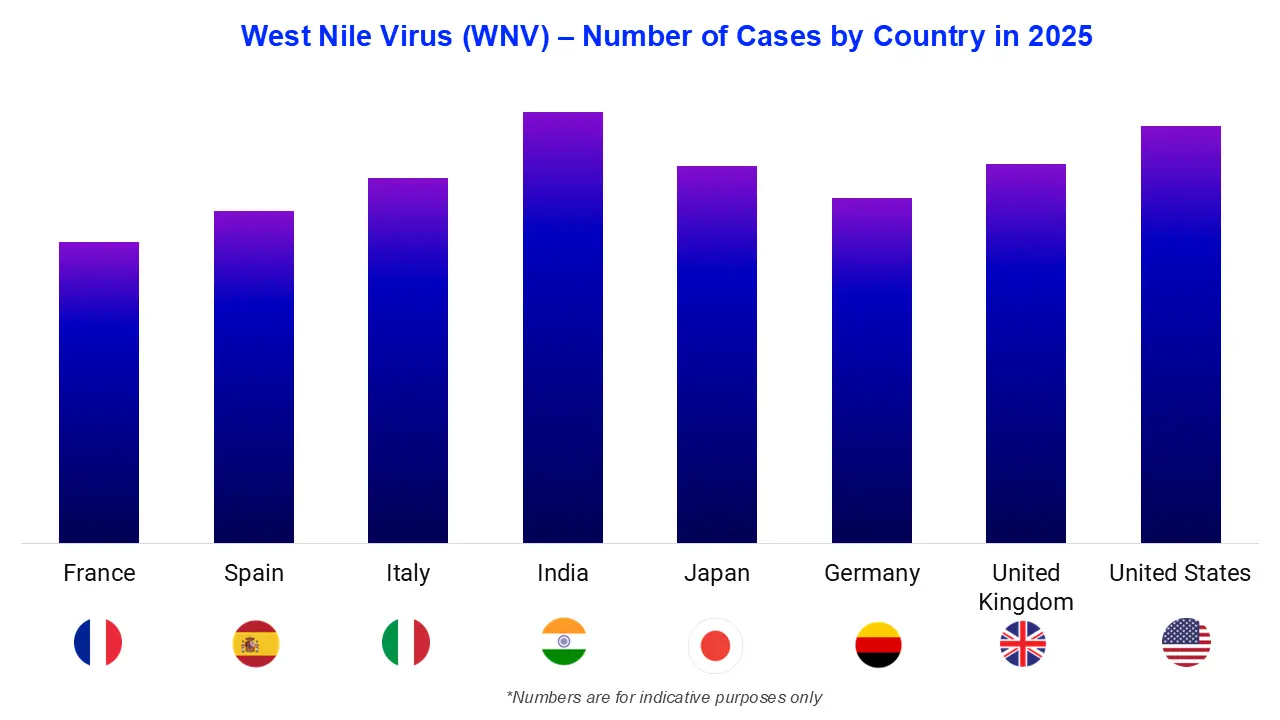
The West Nile Virus (WNV) epidemiology data and findings for the United States, Germany, Spain, Italy, France, the United Kingdom, Japan, and India are also provided in the epidemiology section.
|
Country |
Key Insights |
|
United States |
The United States represents the largest recent single-country surveillance population. CDC reported 2,628 WNV disease cases in 2023, including 1,789 neuroinvasive cases and 194 deaths, followed by 1,808 cases in 2024, including 1,347 neuroinvasive cases and 173 deaths. Cases occur throughout the contiguous United States, with substantial year-to-year geographic variability. |
|
Germany |
Germany reported 6 locally acquired cases in 2023, 27 in 2024 and 2 in 2025. One locally acquired case had been reported by 5 August 2026. The recent pattern demonstrates intermittent rather than uniformly increasing transmission. |
|
France |
France remains an important European transmission setting. ECDC recorded 43 locally acquired cases in 2023, 39 in 2024 and 62 in 2025. Four locally acquired cases had been reported by 5 August 2026, indicating continuing but relatively limited early-season activity in the 2026 dataset. |
|
Italy |
Italy is the largest recent European WNV focus. Reported locally acquired cases increased from 336 in 2023 to 455 in 2024, and then to 779 in 2025, when 72 deaths were recorded. By 5 August 2026, Italy had already reported 139 locally acquired cases and five deaths. |
|
Spain |
Spain reported 19 locally acquired cases in 2023, 138 in 2024 and 36 in 2025, illustrating substantial seasonal variability. As of 5 August 2026, 17 locally acquired cases had been reported. |
|
United Kingdom |
The United Kingdom is not considered a major endemic WNV transmission setting. Current European surveillance does not identify sustained locally acquired human transmission comparable with Italy, Greece, France or Spain during the 2023–2026 period considered. Epidemiological relevance therefore remains principally associated with travel-associated infection and preparedness for imported cases. |
|
Japan |
Japan has not been identified as a major sustained human WNV transmission setting in the contemporary 2023–2026 international surveillance datasets reviewed. Epidemiological concern remains principally associated with travel-related exposure rather than a substantial established domestic human case burden. |
|
India |
Kerala experienced a clinically significant WNV episode in 2024, with 27 confirmed neuroinvasive cases between January and May. A contemporary serosurvey of 751 residents from affected communities found 29.96% WNV seropositivity, indicating broader exposure than clinical surveillance alone would suggest. |
The principal epidemiological gap in West Nile Virus (WNV) remains the disconnect between viral circulation and timely detection. WHO's contemporary surveillance assessments show that transmission can persist in rural populations for extended periods before clinically recognized clusters emerge, particularly where laboratory capacity and routine surveillance are fragmented. The 2025 WHO diagnostic target-product profile therefore identifies standardized molecular testing, standardized IgM assays, rapid IgM tests and rapid antigen tests as explicit development priorities. This creates a direct opportunity for decentralized diagnostic platforms capable of distinguishing West Nile Virus (WNV) from dengue and other flaviviruses in resource-constrained settings.
The management of West Nile Virus disease primarily focuses on recognition of neuroinvasive disease, symptomatic treatment, prevention of complications and supportive care during neurological deterioration. There is currently no specific antiviral treatment and no licensed human WNV vaccine. CDC's current clinical guidance states that treatment remains supportive, with the intensity of care determined by the clinical phenotype and severity of neurological or systemic involvement. Patients with uncomplicated West Nile fever are generally managed with rest, adequate hydration and symptom control. Fever, headache, nausea and other systemic manifestations can usually be managed conservatively in the absence of neurological or hemodynamic complications. Because WNV overlaps clinically with other mosquito-borne infections, particularly dengue and other viral febrile illnesses, treatment decisions should also reflect the differential diagnosis and local epidemiological context.


Upto 15% Off
USD
$2699 $2429
$4299 $3869
$5799 $4949
$6999 $5949


*While we strive to always give you current and accurate information, the numbers depicted on the website are indicative and may differ from the actual numbers in the main report. At Expert Market Research, we aim to bring you the latest insights and trends in the market. Using our analyses and forecasts, stakeholders can understand the market dynamics, navigate challenges, and capitalize on opportunities to make data-driven strategic decisions.*
Explore our key highlights of the report and gain a concise overview of key findings, trends, and actionable insights that will empower your strategic decisions.
|
Report Features |
Details |
|
Base Year |
2025 |
|
Historical Period |
2019-2025 |
|
Forecast Period |
2026-2035 |
|
Epidemiology Statistics Provided |
|
|
Segmentation Provided |
|
|
Geographies Covered |
|
Datasheet
One User
USD 2,699
USD 2,429
tax inclusive*
Single User License
One User
USD 4,299
USD 3,869
tax inclusive*
Five User License
Five User
USD 5,799
USD 4,949
tax inclusive*
Corporate License
Unlimited Users
USD 6,999
USD 5,949
tax inclusive*
*Please note that the prices mentioned below are starting prices for each bundle type. Kindly contact our team for further details.*
Flash Bundle
Small Business Bundle
Growth Bundle
Enterprise Bundle
*Please note that the prices mentioned below are starting prices for each bundle type. Kindly contact our team for further details.*
Flash Bundle
Number of Reports: 3
20%
tax inclusive*
Small Business Bundle
Number of Reports: 5
25%
tax inclusive*
Growth Bundle
Number of Reports: 8
30%
tax inclusive*
Enterprise Bundle
Number of Reports: 10
35%
tax inclusive*
How To Order

Select License Type
Choose the right license for your needs and access rights.

Click on ‘Buy Now’
Add the report to your cart with one click and proceed to register.

Select Mode of Payment
Choose a payment option for a secure checkout. You will be redirected accordingly.
Strategic Solutions for Informed Decision-Making
Gain insights to stay ahead and seize opportunities.

Get insights & trends for a competitive edge.

Track prices with detailed trend reports.

Analyse trade data for supply chain insights.

Leverage cost reports for smart savings

Enhance supply chain with partnerships.

Connect For More Information
Our expert team of analysts will offer full support and resolve any queries regarding the report, before and after the purchase.
Our expert team of analysts will offer full support and resolve any queries regarding the report, before and after the purchase.
We employ meticulous research methods, blending advanced analytics and expert insights to deliver accurate, actionable industry intelligence, staying ahead of competitors.
Our skilled analysts offer unparalleled competitive advantage with detailed insights on current and emerging markets, ensuring your strategic edge.
We offer an in-depth yet simplified presentation of industry insights and analysis to meet your specific requirements effectively.




