

Consumer Insights
Uncover trends and behaviors shaping consumer choices today
Procurement Insights
Optimize your sourcing strategy with key market data
Industry Stats
Stay ahead with the latest trends and market analysis.
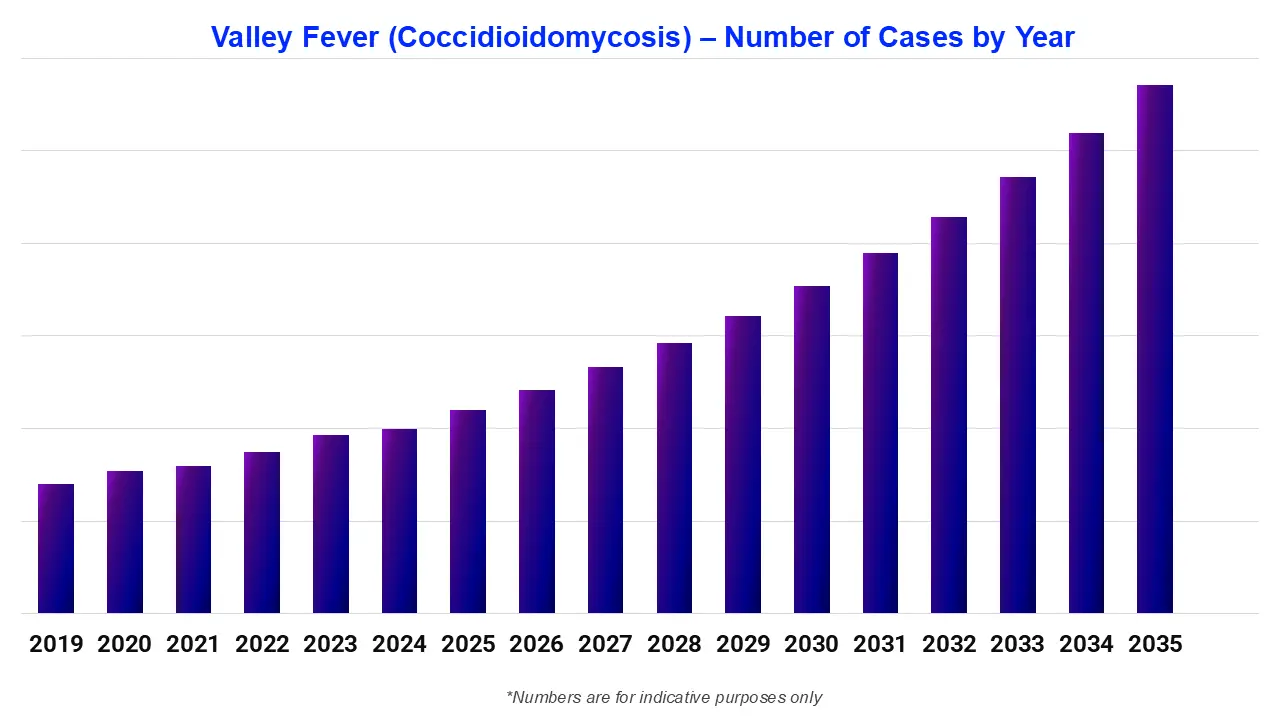
Valley Fever, or Coccidioidomycosis, is an endemic systemic fungal infection caused by the dimorphic fungi Coccidioides immitis and Coccidioides posadasii. U.S. surveillance recorded 21,037 reported Valley Fever cases in 2023, while a 2025 CDC-led modelling study estimated that approximately 273,000 symptomatic incident infections occurred nationally in 2019, with a credible interval of 206,000-360,000. According to Valley Fever (Coccidioidomycosis) Epidemiology Forecast by Expert Market Research (EMR), the epidemiological measurement of Valley Fever differs from that of many communicable diseases because routine national surveillance captures only a fraction of symptomatic infections.
Base Year
Historical Period
Forecast Period
Read more about this report - Request a Free Sample
Expert Market Research's “Valley Fever (Coccidioidomycosis) Epidemiology Forecast Report 2026-2035” offers comprehensive information on the prevalence and demographics of Valley Fever (Coccidioidomycosis). It projects the future incidence and prevalence rates of Valley Fever (Coccidioidomycosis) cases across various populations. The study covers age, gender, and type as major determinants of the Valley Fever (Coccidioidomycosis) population. The report highlights patterns in the prevalence of Valley Fever (Coccidioidomycosis) over time and projects future trends based on multiple variables.
The report provides a comprehensive overview of the disease, as well as historical and projected data on the epidemiology of Valley Fever (Coccidioidomycosis) in the 8 major markets.
Regions Covered
Valley Fever, or Coccidioidomycosis, is an endemic systemic fungal infection caused by the dimorphic fungi Coccidioides immitis and Coccidioides posadasii. Infection follows inhalation of airborne arthroconidia from disturbed soil and is concentrated in arid and semi-arid regions of the southwestern United States, with additional endemic areas in Mexico and parts of Central and South America. Most infections are pulmonary and self-limited, but a proportion progress to persistent pulmonary disease or disseminated infection involving the skin, bones, joints, lymph nodes, or central nervous system.
|
Parameter |
Insight |
|
Largest Patient Pool |
United States |
|
Fastest Growing Country |
United States |
|
High-Risk Population |
People living or working in endemic regions, individuals exposed to dust or soil disruption, agricultural and outdoor workers, people with immunosuppression, pregnant women, and certain racial/ethnic populations including Filipinos and African Americans who have increased risk of severe or disseminated disease. |
|
Key Diagnostic Method |
Diagnosis combines Coccidioides-specific serology with fungal culture, histopathology, antigen detection or molecular testing according to clinical presentation. Culture and histopathology are particularly important when disseminated or atypical disease is suspected. |
|
Major Risk Factor |
Inhalation of airborne Coccidioides spores following environmental soil or dust exposure in endemic areas is the principal risk factor. Immunosuppression, pregnancy and certain host characteristics increase the risk of severe or disseminated disease. |
|
Major gap in the market |
Delayed recognition and inadequate testing remain major gaps because Valley Fever clinically resembles bacterial or viral pneumonia and tuberculosis. Limited national surveillance outside the U.S. further obscures the international burden. |
The Valley Fever (Coccidioidomycosis) epidemiology division offers information on the patient pool from history to the present as well as the projected trend for each of the 8 major markets. Expert Market Research provides both current and predicted trends for the Valley Fever (Coccidioidomycosis) epidemiology scenario by examining a wide range of studies. Additionally, the report covers the diagnosed patient pool for Valley Fever (Coccidioidomycosis) and their trends. The data is broken down into specific categories, such as total prevalent cases in males and females, and total diagnosed cases across different age groups and patient pools.
|
Epidemiology Segment |
Key Insights |
|
Diagnosed Prevalent Cases of the Disease |
Point prevalence is not a reliable measure because Valley Fever is generally an acute infection and many infections are never diagnosed. The United States reported 21,037 cases in 2023. CDC's 2025 modelling study estimated 206,000-360,000 symptomatic incident cases in 2019, demonstrating substantial under-ascertainment. India had seven laboratory-confirmed coccidioidomycosis cases among 893 proven endemic-mycotic cases identified in a systematic review covering 1960–August 2025. |
|
Gender-Specific Cases of the Disease |
In the Indian systematic review, all seven documented coccidioidomycosis patients were male, with a median age of 31 years (IQR 22–65). This is a literature-derived case distribution and should not be interpreted as a population sex ratio. U.S. epidemiology also demonstrates demographic variation by occupation, exposure and underlying host factors. |
|
Age-Specific Cases of the Disease |
Valley Fever occurs across the age spectrum. CDC surveillance indicates that reported U.S. rates are highest among people aged ≥60 years. In the Indian literature review, the seven documented cases had a median age of 31 years, reflecting the small, selected nature of published cases rather than population incidence. |
|
Ethnicity-Wise Cases of the Disease |
U.S. epidemiological studies identify increased risk of disseminated disease among certain racial and ethnic populations, particularly Filipinos and African Americans. These associations are not established as population-level risk estimates for the other 7MM countries and should not be extrapolated across national populations. |
|
Mortality and Survival Analysis of the Disease |
Most uncomplicated pulmonary infections resolve without mortality, but disseminated and CNS disease can be life-threatening. CDC's 2025 model estimated approximately 700-1,100 coccidioidomycosis-associated deaths in the U.S. in 2019. In the European systematic review, overall mortality among historical published cases was 7%, increasing to 24% among immunocompromised patients; these figures are based on cases published through 2022 rather than current population surveillance. |
|
Disease Type |
Prevalence |
|
Primary Pulmonary Coccidioidomycosis |
The commonest clinically recognized manifestation following inhalation of Coccidioides arthroconidia. It ranges from asymptomatic infection to an acute community-acquired-pneumonia-like illness with fever, cough, chest pain, fatigue and dyspnea. |
|
Uncomplicated Pulmonary Coccidioidomycosis |
Mild-to-moderate pulmonary disease that generally resolves with supportive management and clinical observation in otherwise healthy individuals. Some patients experience prolonged constitutional or respiratory symptoms despite microbiological control. |
|
Chronic Pulmonary Coccidioidomycosis |
Persistent pulmonary infection characterized by chronic symptoms and radiographic abnormalities such as nodules, cavities or progressive infiltrates. It may require prolonged antifungal therapy. |
|
Cutaneous Coccidioidomycosis |
Disseminated or, rarely, primary cutaneous disease involving the skin. Lesions can include papules, plaques, ulcers, nodules and draining lesions. |
Read more about this report - Request a Free Sample
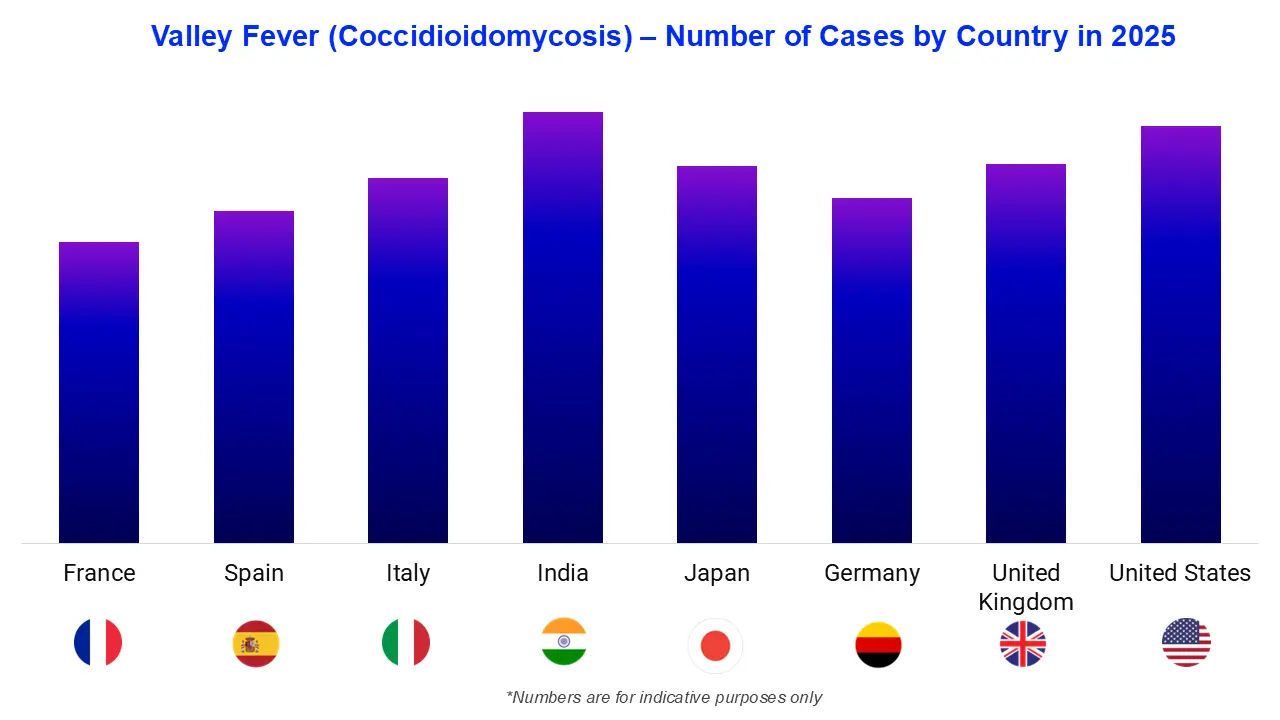
The Valley Fever (Coccidioidomycosis) epidemiology data and findings for the United States, Germany, Spain, Italy, France, the United Kingdom, Japan, and India are also provided in the epidemiology section.
|
Country |
Key Insights |
|
United States |
CDC surveillance recorded 21,037 Valley Fever cases in 2023, including 10,990 in Arizona and 9,060 in California; these two states accounted for approximately 95% of reported U.S. cases. CDC's 2025 burden analysis estimated 273,000 symptomatic incident cases in 2019, with 206,000–360,000 as the 95% credible interval, 23,000 hospitalizations and approximately 900 deaths. The modeled burden therefore substantially exceeds routine surveillance. |
|
Germany |
A 2026 Robert Koch Institute-associated study identified 15 culture- or histology-confirmed travel-associated human cases diagnosed in Germany during 2011-2023. Ten were caused by C. posadasii and two by C. immitis; six had pulmonary disease, two CNS disease and three disseminated disease. Most infections originated from travel to Arizona. The study demonstrates established imported disease but not endemic German transmission. |
|
France |
France has documented imported coccidioidomycosis, primarily associated with travel or migration from endemic regions. A 2025 European systematic review identified 20 historical French cases through 2022, but no contemporary national surveillance denominator is available. The French burden therefore cannot be converted into a reliable 2023-2026 population incidence estimate. |
|
Italy |
Coccidioidomycosis remains rare in Italy and is predominantly imported. A systematic review of Italian endemic mycoses identified 10 published coccidioidomycosis cases, including infections acquired in the United States and South America, with no deaths reported among the cases reviewed. Because the underlying literature extended back decades, these data are not used as a contemporary national incidence estimate. |
|
Spain |
Spain has historically contributed the largest number of published European coccidioidomycosis cases. The 2025 European systematic review identified 96 cases from Spain among publications covering 1948-2022, largely associated with travel or migration. No national 2023-2026 surveillance series establishing a population incidence rate was identified. |
|
United Kingdom |
Coccidioidomycosis is rare in the United Kingdom and is principally encountered as an imported travel-associated infection. Contemporary UK population surveillance does not provide a dedicated national incidence series comparable with U.S. Valley Fever surveillance. European systematic evidence identifies travel and migration as the principal mechanisms through which cocci appears outside endemic areas. |
|
Japan |
Japan is a non-endemic setting in which coccidioidomycosis is principally travel-associated. A 2026 Japanese case report described chronic pulmonary coccidioidomycosis complicated by meningitis, illustrating the possibility of severe imported disease requiring prolonged antifungal management. No population-level Japanese incidence estimate for 2023-2026 was identified. |
|
India |
A 2026 systematic review of laboratory-confirmed endemic mycoses identified seven coccidioidomycosis cases among 893 proven endemic-mycotic cases reported from India through August 2025. The seven cases were reported from New Delhi (4), Karnataka (2), Andhra Pradesh (1) and Tamil Nadu (1); all seven documented patients were male, with a median age of 31 years. Coccidioidomycosis accounted for 0.8% of all proven endemic-mycotic cases in the review. The evidence remains case-based rather than population-based, consistent with rare imported disease and substantial potential underrecognition. |
The principal diagnostic challenge is clinical overlap with bacterial pneumonia, tuberculosis, and other fungal infections. In a 2025 enhanced-surveillance investigation in Riverside County, California, the median interval from the first healthcare encounter to coccidioidomycosis testing was 55 days. Among interviewed patients, 41.1% had received antibiotics, while 50.9% had been hospitalized, highlighting delays in diagnostic recognition even in highly endemic settings. Outside the United States, a 2025 European systematic review identified 197 published cases across 20 European countries from 1948–2022. Most cases were associated with migration or travel from endemic regions, and pulmonary disease predominated, while diagnostic delays reflected limited clinical familiarity.
Treatment depends on disease severity, host factors, and anatomical involvement. Mild uncomplicated pulmonary disease in immunocompetent patients may be observed, while symptomatic or progressive disease commonly requires oral azoles such as fluconazole or itraconazole. Severe pulmonary or disseminated disease may require amphotericin B followed by prolonged azole therapy. Coccidioidal meningitis generally requires prolonged, often indefinite, fluconazole therapy because relapse may occur after discontinuation. Osteoarticular, cutaneous, and disseminated disease may also require prolonged antifungal treatment and, in selected cases, surgery. Diagnosis combines exposure history with laboratory confirmation, including serology, culture, histopathology, and molecular testing, depending on presentation.


Upto 15% Off
USD
$2699 $2429
$4299 $3869
$5799 $4949
$6999 $5949


*While we strive to always give you current and accurate information, the numbers depicted on the website are indicative and may differ from the actual numbers in the main report. At Expert Market Research, we aim to bring you the latest insights and trends in the market. Using our analyses and forecasts, stakeholders can understand the market dynamics, navigate challenges, and capitalize on opportunities to make data-driven strategic decisions.*
Explore our key highlights of the report and gain a concise overview of key findings, trends, and actionable insights that will empower your strategic decisions.
|
Report Features |
Details |
|
Base Year |
2025 |
|
Historical Period |
2019-2025 |
|
Forecast Period |
2026-2035 |
|
Epidemiology Statistics Provided |
|
|
Segmentation Provided |
|
|
Geographies Covered |
|
Datasheet
One User
USD 2,699
USD 2,429
tax inclusive*
Single User License
One User
USD 4,299
USD 3,869
tax inclusive*
Five User License
Five User
USD 5,799
USD 4,949
tax inclusive*
Corporate License
Unlimited Users
USD 6,999
USD 5,949
tax inclusive*
*Please note that the prices mentioned below are starting prices for each bundle type. Kindly contact our team for further details.*
Flash Bundle
Small Business Bundle
Growth Bundle
Enterprise Bundle
*Please note that the prices mentioned below are starting prices for each bundle type. Kindly contact our team for further details.*
Flash Bundle
Number of Reports: 3
20%
tax inclusive*
Small Business Bundle
Number of Reports: 5
25%
tax inclusive*
Growth Bundle
Number of Reports: 8
30%
tax inclusive*
Enterprise Bundle
Number of Reports: 10
35%
tax inclusive*
How To Order

Select License Type
Choose the right license for your needs and access rights.

Click on ‘Buy Now’
Add the report to your cart with one click and proceed to register.

Select Mode of Payment
Choose a payment option for a secure checkout. You will be redirected accordingly.
Strategic Solutions for Informed Decision-Making
Gain insights to stay ahead and seize opportunities.

Get insights & trends for a competitive edge.

Track prices with detailed trend reports.

Analyse trade data for supply chain insights.

Leverage cost reports for smart savings

Enhance supply chain with partnerships.

Connect For More Information
Our expert team of analysts will offer full support and resolve any queries regarding the report, before and after the purchase.
Our expert team of analysts will offer full support and resolve any queries regarding the report, before and after the purchase.
We employ meticulous research methods, blending advanced analytics and expert insights to deliver accurate, actionable industry intelligence, staying ahead of competitors.
Our skilled analysts offer unparalleled competitive advantage with detailed insights on current and emerging markets, ensuring your strategic edge.
We offer an in-depth yet simplified presentation of industry insights and analysis to meet your specific requirements effectively.




