Distribution and Retail Access Are Reframing the India Gaming Console Market
Distribution has emerged as a decisive growth variable in the India gaming console market. While product performance and pricing shape demand, access determines conversion. Console manufacturers are increasingly aware that India’s retail landscape does not support a single-channel strategy. Rather, it is based on multi-layered distribution channels that provide a strategic balance between the e-commerce business and physical retail.
The entire process of shifting the console from storage to living rooms has been transformed by major players like Sony, Microsoft, and Nintendo. This evolution does not imply unchecked expansion, instead, it reflects a more disciplined approach where companies are intentionally focusing on optimizing existing space. The purpose of evolving their distribution process would be infrastructure that manages peak cycles, pricing, and branding.
E-commerce Has Become the Primary Sales Engine
Online marketplaces now account for the majority of console sales in India. Platforms such as Amazon and Flipkart have evolved from optional partners into core distribution channels.
At Sony, there has been a strategic focus on online launches that are curated. There are time-bound exclusive offers, early starts, as well as bundle offers that are specific to platforms. Companies are now controlling peak sales as well as subsequent resale pricing of their products.
Microsoft’s Xbox strategy is even more digitally oriented. Xbox consoles are frequently positioned as online-first products, with pricing and subscription bundles optimized for e-commerce visibility. This reduces dependence on physical retail negotiations and allows faster response to demand fluctuations. In November 2025, Amazon started rolling out Xbox Cloud Gaming support on select Fire TV devices in India.
E-commerce also offers manufacturers valuable consumer data. Purchase timing, accessory attachment, and financing preferences are tracked closely. These have become significant for into product and pricing decisions.
Physical Retail Is Becoming More Selective
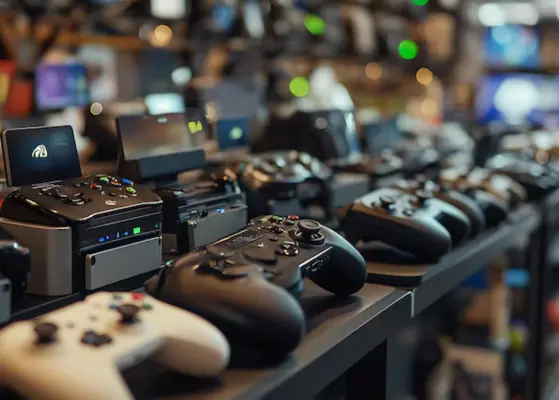
Although e-commerce is dominant in the market, traditional retail is also regionally significant. Large-scale electronic retailers and gaming specialty stores are considered significant for branding and experience marketing. Companies are developing strong ties with high-end electronic retailers and conducting in-store demonstrations at these stores.
Inventory Management Has Gained Strategic Weight
Supply consistency has become a competitive advantage. Post-pandemic supply chain disruptions exposed vulnerabilities in console availability. Since then, manufacturers are investing in tighter inventory planning for the Indian market.
Across the industry, console makers are now prioritizing supply stability after several years of constrained availability. Inventory availability has visibly improved across both online and offline retail channels, allowing companies to shift focus from allocation management to demand stimulation and lifecycle optimization.
With supply constraints easing, players have been able to execute pricing-led promotions and marketing campaigns more effectively, particularly for value-oriented console variants. Consistent product availability has reduced the risk of promotional disruptions. It has enabled firms to align discounting strategies with broader ecosystem growth objectives rather than short-term inventory clearance.
Quick Commerce and Logistics Are Emerging Factors
An unexpected development in India’s console distribution landscape is the growing relevance of quick commerce. While still limited, select urban users now expect faster delivery even for high-value electronics. Some platforms have experimented with same-day or next-day delivery for consoles during peak sales.
This trend pressures manufacturers to improve last-mile logistics coordination. Faster delivery enhances purchase satisfaction and reduces cart abandonment, particularly during time-sensitive sales events.
Accessory brands are already leveraging this shift. Controllers, headsets, and gaming peripherals are increasingly becoming available through rapid-delivery platforms, strengthening ecosystem engagement even when console delivery timelines remain longer.
For analysis of retail channels, distribution strategies, and market trends, explore the India Gaming Console Market Report.
Strategic Implications for Market Participants
Distribution strategy in the India gaming console market is no longer about choosing between online or offline. Manufacturers that align inventory planning, e-commerce partnerships, and selective physical presence are better positioned to capture demand without margin erosion, during the forecast period.
For retailers, consoles remain a traffic growth contributor rather than a margin-heavy product. Value is increasingly created through bundles, accessories, and financing services. Retailers that integrate these elements are becoming preferred partners for console brands.
Distribution efficiency now influences competitive positioning as much as hardware specifications. Companies that treat India as a complex retail ecosystem rather than a simplified emerging market are already seeing stronger returns.











Share