Use of VR Gloves in Medical Training and Rehabilitation Programs
The medical education and rehabilitation sectors, in the present-day, do not perceive virtual reality technology as an experimental option. Virtual reality gloves, which were previously only used in a scientific environment as a precursor to larger projects, are now being tested as a viable medical device. The use of these devices in a hospital setting, a medical university, and a rehabilitation facility stems from performance, cost-effectiveness, and faster training time.
The main reason for the increasing awareness about such offerings is the rise in the use of haptic-enabled wearables, especially gloves that provide resistance, pressure, as well as movement. Medical institutions are no longer satisfied with visual simulation alone. They are investing in tactile realism because it directly impacts skill transfer.
Surgical Training Is Becoming More Data Driven
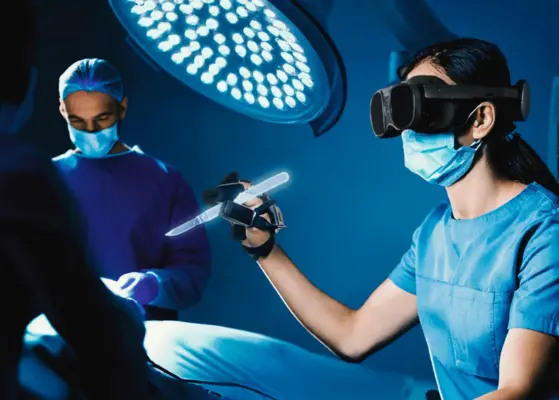
Training in surgery is one of the most prevalent applications of VR gloves. The conventional method of surgery training involves a lot of supervised learning and practical simulations, which can be costly and less accessible. With the VR glove, surgery can be rehearsed as many times as one wants without any physical resource constraint.
Companies developing these solutions for medical training are also working closely with medical device firms. Rather than offering generic gloves, they are tailoring hardware profiles to replicate specific instruments. This alignment increases credibility with hospital boards and accreditation bodies. It also positions VR gloves as extensions of existing medical ecosystems rather than standalone gadgets. In June 2024, VirtualiSurg and J&J MedTech France developed an XR training module for Anterior Lumbar Interbody Fusion (ALIF) surgery, using a VR headset, VR controllers, and a haptic Geomagic Touch robot by 3D Systems to simulate surgical navigation.
Rehabilitation Programs Are Driving Long-Term Adoption
Apart from the area of training, the market for rehabilitation is turning out to be a consistent demand growth factor for VR gloves. These include stroke rehabilitation, orthopedic therapy, and neurologic therapy, wherein the therapy involves repetitive and controlled movements. Using the VR glove, the physical therapy professional can assess the movements of the hand, grip, and coordination.
Manufacturers of gloves can tap into the recurring revenue stream offered through rehabilitation. As opposed to training facilities which acquire machines in bulk, rehabilitation centers have continuous needs. Equipment suppliers such as Auroro Biosurgery are increasingly bundling proprietary software alongside their hardware offerings, allowing customers to deploy integrated systems rather than standalone devices.
Technology Companies Are Targeting Clinical Validation
Companies that sell VR gloves are largely investing in validation studies, as they often team up with universities and hospitals. For instance, Meta Platforms has broadened their collaborations in the healthcare industry through their enterprise VR efforts. Meta Platforms, though not manufacturer of the gloves, enables the development of medical-grade wearables through their platforms.
At the same time, companies that supply hardware parts are optimizing sensors and actuators according to medical standards. A low latency and consistent feedback system is required within a rehabilitation setting. Suppliers offering these standards are entering into longer research contracts, which in turn develops into longer terms.
Cost Efficiency Is Influencing Procurement Decisions
Healthcare budgets continue to be a challenge, as decision-makers not only assess VR gloves in terms of their performance but also their cost benefits. Simulation tools and training programs with trainers are costly and time-consuming. VR gloves cut down on the reliance on physical tools and enable remote training.
Internal cost evaluations within large groups of hospitals are inclined towards immersive surgical training using VR that can cut costs significantly. With such cost savings in consideration, purchasing departments have become more amenable to purchasing VR gloves.
Several manufacturers are redesigning their VR gloves to minimize maintenance work and make them more durable. These can be disassembled so that the faulty part can be substituted without having to replace the whole set.
Rehabilitation Data Is Becoming a Strategic Asset
One of the highly valuable aspects of VR glove adoption in rehabilitation is data generation. Gloves capture detailed metrics on movement range, pressure application, and progress over time. This data supports evidence-based therapy planning and outcome reporting.
Some vendors are integrating analytics dashboards that allow clinicians to track patient improvement session by session. From a company perspective, data capabilities differentiate products in a crowded market. Vendors that can translate raw sensor data into clinically meaningful insights are gaining preference.
For in-depth analysis on healthcare adoption, competitive positioning, and growth, refer to the Virtual Reality Glove Market Report.
Outlook for Medical VR Gloves
VR gloves are now entering a new level of implementation in the area of medical training and rehabilitation. This has been made possible through results and price efficiencies, apart from patient engagement insights.
Companies with an alignment strategy for product development in line with medical needs, regulations, and manufacturing scalability are poised to lead the way in this category, during the forecast period.











Share