Difference Between VR Gloves and Traditional VR Controllers
With the increasing adoption of virtual reality across enterprise settings, the selection of interaction hardware is becoming more strategic. For several years, traditional controllers were immutable in terms of user interaction with virtual environments. These were cost-effective, sturdy, and easily replicable. But as the applications for virtual reality advance, especially within the aspect of training, health, or industrial design, the suitability of controllers is no longer clear, leading to the importance of VR gloves.
The difference between VR gloves and traditional controllers goes far beyond the form factor. It reflects a deeper change in how enterprises expect digital tools to replicate real-world actions. For B2B buyers, this comparison is about performance outcomes, scalability, and long-term return on investment.
Controllers Were Built for Navigation, Not Precision
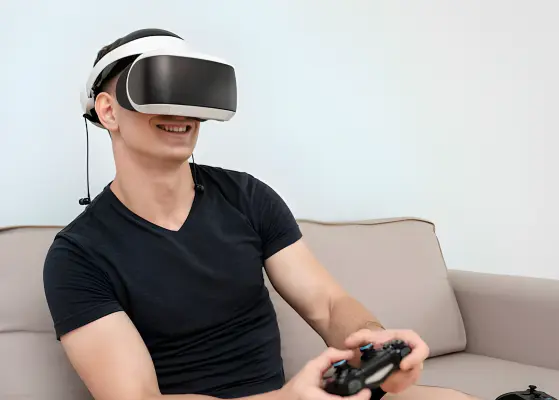
Traditional VR controllers were originally designed to support gaming and entertainment. Their strength lies in navigation, object selection, and basic interaction. Buttons, triggers, and joysticks offer clear input signals that software systems can easily interpret. This simplicity made controllers ideal for early VR deployments.
However, enterprise use cases expose their limitations. In industrial training, users are often required to simulate complex hand movements. Controllers reduce these movements to abstract inputs. This abstraction can distort muscle memory and reduce training effectiveness. Several manufacturing firms that piloted VR training programs reported that controller-based simulations improved conceptual understanding but failed to translate fully into real-world task performance.
Despite these limitations, controllers remain widely deployed. Companies such as Sony Interactive Entertainment and HTC continue to refine controller ergonomics and tracking accuracy. Controllers still offer a lower-cost, standardized solution for large-scale rollouts. For basic enterprise training and visualization, they remain sufficient.
VR Gloves Focus on Natural Interaction
VR gloves approach interaction from a different perspective. Rather than interpreting hand movements to simplify inputs, gloves focus upon recreating actual hand activity within virtual space. This enables tracking of fingers, force feedback, and touch so that users can touch, manipulate, and press with the same sensations experienced in reality. For example, the adaptive smart glove, introduced by MIT CSAIL researchers in February 2024, can send tactile feedback to teach users new skills, guide robots with more precise manipulation, and help train surgeons and pilots.
It has specific industrial uses as well, especially in areas that require accuracy. For aerospace assembly training, for example, trainees have to master the exact way of placing hands and the amount of force used, which is possible with the use of VR gloves.
Data Depth Is a Key Differentiator
One of the most significant differences between gloves and controllers lies in data generation. Controllers provide limited interaction data, as they track position, orientation, and button inputs. VR gloves capture far more granular information along with finger articulation, grip strength, motion velocity, and resistance levels.
Companies developing the use of VR gloves are aggressively touting analytics capabilities as part of the product offerings. There is an increased emphasis on providing the hardware with the necessary software analytics capabilities in the form of dashboard-driven analytics or analytics reports. However, the revenue streams for controllers are largely dependent on the sales of the hardware product itself.
Platform Compatibility Influences Adoption
Platform alignment plays a major role in enterprise purchasing decisions. Traditional controllers benefit from deep integration with established VR ecosystems. Headsets from major players are optimized for their native controllers, reducing setup complexity.
Cost and Scalability Remain Key Barriers
Despite their advantages, VR gloves face adoption challenges. Gloves are significantly more expensive than controllers. For enterprises planning large deployments, this price difference continues to be critical, while controllers remain attractive for pilot programs and basic training modules.
Manufacturing complexity also affects scalability, as high-precision sensors and actuators increase production costs. Lead times can be longer, which complicates further procurement planning. Some enterprises adopt a hybrid approach when they use controllers for general training, while gloves are reserved for high-precision tasks. This strategy allows companies to balance cost and performance.
User Learning Curve Impacts Deployment
Another distinction lies in user onboarding. Controllers are familiar to many users, especially younger employees with gaming experience. VR gloves require adjustment. Users must learn how to interact without physical buttons or triggers. While this learning curve is manageable, it affects deployment timelines.
Enterprises with structured training programs tend to adopt gloves more successfully. They can allocate time for onboarding and calibration. Vendors are responding by improving usability and reducing setup complexity. Faster calibration and adaptive software are quickly becoming selling points.
This focus on ease of use highlights a broader trend. VR interaction hardware is evolving from experimental tools into operational equipment. Reliability and consistency matter more than novelty.
For insights into hardware segmentation, enterprise strategies, and positioning, explore the Virtual Reality Glove Market Report.
Strategic Implications for Enterprises
The difference between VR gloves and traditional controllers reflects a broader shift in how enterprises approach immersive technology. Controllers offer simplicity, affordability, and scalability. On the other hand, gloves deliver realism, precision, and data depth. The right choice depends on use case complexity and performance requirements.
For companies investing in VR, the decision is becoming more nuanced. As immersive workflows become more critical to operations, interaction hardware are posed to play a central role during the forecast period. Vendors that align product development with enterprise outcomes rather than consumer trends are likely to shape the next phase of the market.











Share