From Rings to Brain Monitors: The Startups Rewriting Healthcare Wearables
Not long ago, most wearables were primarily focused on wellness. They tracked steps, encouraged better sleep habits, and provided users with a user-friendly dashboard for heart rate and activity. While this model still exists, it is no longer the complete picture. A new generation of startups is advancing wearables beyond simple lifestyle tracking toward a more significant purpose: continuous health intelligence. This development has the potential to enhance prevention, manage chronic diseases, support remote care, and even enable early clinical interventions.
The momentum in the fitness and wellness sector is evident. In 2025, investors invested approximately $2 billion into startups in this field, with wearables being among the biggest beneficiaries. A notable example is Oura, which raised $900 million, helping to establish its smart ring as a prominent symbol of modern digital health hardware. What makes this moment more interesting than previous consumer tech cycles is the focus on innovation. Startups are now targeting deeper physiological signals, more clinically relevant endpoints, and care models that extend far beyond mere device sales.
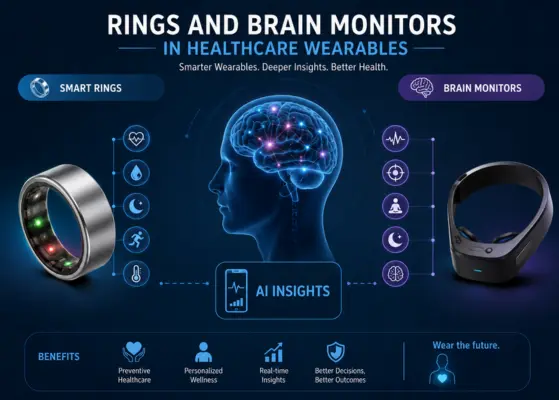
At the heart of this transformation is a straightforward yet powerful concept: the future of healthcare wearables will not be dominated by companies that simply collect the most data, but rather by those that gather the right types of data in forms that people are willing to wear. Moreover, these companies need to translate that information into meaningful actions. This is why some of the most exciting players in this field today are not major corporations, but startups creating innovative products like rings, temple-mounted brain monitors, intradermal glucose patches, and AI-driven remote patient monitoring systems. These advancements aim to shift healthcare from hospital settings into everyday life.
Oura is a prime example of how a startup can transform expectations within its industry. Initially launched as a discreet ring for tracking sleep and recovery, it has evolved into one of the most impactful platforms in connected health. Oura integrates data on heart rate variability, temperature, respiration, sleep, and activity to create a comprehensive view of overall readiness and well-being. The significance of its funding scale goes beyond just the amount of money raised; it confirms that users are willing to view a ring as a legitimate health device. Additionally, it shows that investors are willing to support hardware that occupies the space between wellness, prevention, and healthcare services.
Ultrahumandemonstrates how rapidly the smart ring model is becoming more global, competitive, and focused on health. The India-based company has expanded its offerings from metabolic health tracking to a broader platform that includes ring-based monitoring for sleep, performance, and blood markers. Additionally, Ultrahuman is regaining traction in the U.S. after redesigning its product amid a patent dispute with Oura. The key takeaway is strategic: Ultrahuman's growth indicates that the smart ring is no longer just a novelty. Instead, it is evolving into a reliable tool for continuous health engagement, particularly when paired with software that helps users make informed daily decisions based on the data collected.
If rings represent one branch of the next wave of wearable technology, Temple may represent a completely different aspect. Founded by Deepinder Goyal, Temple is developing a wearable device designed to sit on the side of the head near the temple. This device will monitor cerebral blood flow and other physiological signals related to brain health and aging. The company has raised approximately $54 million in seed funding, achieving a post-money valuation of around $190 million. Temple's initial focus is on transforming brain perfusion into a measurable and continuously trackable dimension of health, rather than leaving cognition and aging as vague concepts that are only addressed after symptoms manifest.
Temple is still early, but that is part of what makes it so important. It suggests that the next battles in wearables may be fought over entirely new anatomical territory and new categories of biomarkers. Early reports indicate that Temple’s heart-rate performance during exercise may outperform common wrist-based trackers, reinforcing a broader point that the wrist is not necessarily the best sensing surface for every health use case. Regardless of whether Temple’s long-term thesis on aging fully holds or evolves over time, it already broadens the discussion by making brain-related monitoring a prominent startup category.
Some startups are redefining the purpose of wearables while others are innovating their design. One notable example is Biofourmis. Instead of merely selling sensors, the company has developed an AI-enabled remote patient monitoring and virtual care platform specifically designed for managing complex chronic conditions like heart failure, hypertension, diabetes, and hyperlipidemia. Their medical-grade biosensor continuously captures physiological signals, and the accompanying software interprets these signals in a way that allows clinicians to assess the risk of deterioration and make early interventions.
The significance of this model lies in its potential to create a more sustainable future for the industry. For both providers and payers, the value of a wearable device extends beyond the hardware itself. It depends on the device's ability to integrate into care workflows, facilitate remote monitoring, and improve health outcomes on a large scale. Biofourmis has been advancing the role of wearables by transforming sensors into an integral part of a comprehensive virtual care system, rather than allowing them to remain as a disjointed source of patient-generated data.
Biolinq is pushing in a different but equally important direction: making continuous metabolic sensing less invasive and more accessible. The company’s intradermal glucose monitoring patch is designed to sit just under the skin rather than deeper in subcutaneous tissue, creating a smaller and potentially more user-friendly sensing experience. That approach has now moved beyond concept. Biolinq’s Shine device received FDA clearance, a milestone that shows startups can still create meaningful differentiation in a market already crowded with established continuous glucose monitoring players.
The significance of Biolinq is larger than glucose alone. If startups can make metabolic sensing easier, lighter, and more intuitive, they open the door to broader use of continuous biomarkers in populations that were never going to adopt traditional medical devices. That matters not only for diabetes management but for obesity, cardiometabolic prevention, and the emerging consumer-healthcare middle ground where people increasingly want real-time physiological feedback without the burden of overtly clinical hardware.
Cardiosense applies innovative startup principles to the field of cardiology, where the stakes are significantly higher and meeting clinical standards is more challenging. Its CardioTag wearable device integrates ECG, photoplethysmography, and seismocardiography technologies into one unit, aiming to deliver a more comprehensive view of cardiovascular health than standard consumer trackers can provide. The company has also received FDA Breakthrough Device designation for an algorithm designed to identify patients at risk of decompensated heart failure by estimating pulmonary capillary wedge pressure from wearable signals.
That is a striking example of where the field is heading. The next generation of healthcare wearables is not content with simply describing health status. It is trying to estimate hidden physiology, predict worsening disease, and support much earlier intervention. In that sense, Cardiosense is not just building another sensor. It is testing whether startups can use multimodal data and clinical algorithms to push wearables into territory once reserved for specialized hospital tools.
Taken together, these startups reveal a category that is expanding in three directions at once. First, wearables are becoming more discreet and more wearable, moving from bulky wrist devices to rings, skin-level patches, and even temple-mounted systems. Second, the underlying signals are becoming more clinically useful, from continuous glucose and deterioration risk to advanced cardiovascular metrics and brain-related physiological monitoring. Third, business models are moving beyond one-off device sales toward subscriptions, virtual care, remote patient monitoring, and service-based healthcare integration. The next era of healthcare wearables will be defined by who can make continuous sensing credible, clinically relevant, and easy enough to disappear into daily life.









Share