Introduction: Obesity’s Global Challenge and Significant Pharmaceutical Disruption
The global obesity epidemic is immense and unprecedented in terms of scale and severity. As per WHO estimates, in 2024, 35 million children under the age of 5 were overweight. Between 2010 and 2030, the number of adults with obesity is expected to increase by more than 115% from 524 million to 1.13 billion. This health crisis is the progenitor of substantial market opportunity at the intersection of pharmaceuticals, nutrition, and consumer goods, further accelerated by the emergence of GLP-1 receptor agonists, such as semaglutide, tirzepatide, which have shown impressive efficacy in weight reduction and management. Such medications have changed consumption patterns and compelled rapid adaptation across the food and nutrition industry.
The economic impact of obesity is profound, with higher-than-optimal BMI causing an estimated 3.7 million deaths every year from noncommunicable diseases and global costs are likely to rise to USD 3 trillion per year by 2030. For the food industry, the increase in GLP-1 medications presents substantial challenges and opportunities. Research indicated that households with a GLP-1 user will reduce grocery spending by 5.3% within six months, a number that changes to 8.2% for higher-income households. These spending reductions are most pronounced for processed snacks, sugary beverages, and baked goods, with projections suggesting overall calorie consumption in the United States could go down by 1-2% by 2035, and specific categories will face higher impacts, for example confectionery (-3%), baked goods (-3%) and salty snacks (-3%).
The GLP-1 Revolution has Changed Consumption Patterns
| Food Category |
Consumption Change |
Timeframe |
Primary Mechanism |
| Processed Snacks |
-6% to -8% |
6 months post-initiation |
Reduced craving response |
| Sugary Beverages |
-5% to -7% |
6-12 months post-initiation |
Reduced preference for sweetness |
| Alcohol |
-4% to -6% |
12 months post-initiation |
Diminished reward response |
| Fresh Produce |
+3% to +5% |
12 months post-initiation |
Shift toward nutrient density |
| Protein Foods |
+2% to +4% |
6-12 months post-initiation |
Focus on satiety preservation |
Table: Impact of Weight Loss Medications on Food Categories
GLP-1 medications have emerged as the most significant pharmaceutical advancement in obesity treatment, sharply altering consumer eating behaviors and nutritional requirements as well. These medications imitate the activity of endogenous GLP-1, enhancing glucose-dependent insulin secretion, reducing glucagon release, diminishing gastric emptying, and reducing appetite via central nervous systems modulation. The net effect is less calorie intake of 20-30% without conscious restriction, creating substantial challenges for food companies that rely on volume sales. Research from the University of Arkansas’ Agricultural Experiment Station found that consumers on GLP-1 drugs consume 700 less calories everyday and show unique changes in food preferences. They tend to avoid processed foods, sugar-sweetened beverages, refined grains, and beef, while only fruit, leafy greens, and water show overall increases in consumption. This is a sea change from previous weight loss strategies which focus primarily on calorie restriction rather than altering food preferences.
While the consumption of certain categories has gone down, the consumer desire for indulgent foods has not disappeared. This creates opportunities for food companies to satisfy dual consumer desires for nutrition and indulgence. This paradox represents a crucial opportunity for product developers, creating foods that provide fulfillment in smaller portions while also not compromising nutrition.
Strategic Response of Corporations by Reformulating and Shifting Portfolios
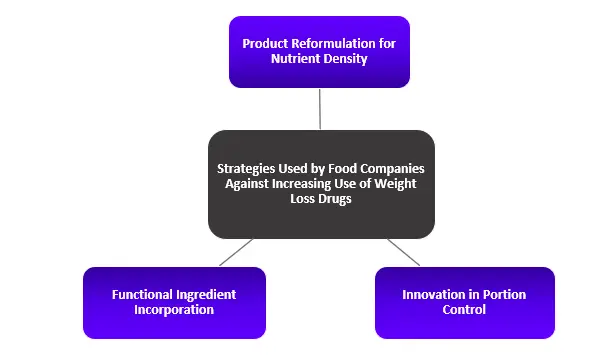
1. Product Reformulation for Nutrient Density
Food companies have developed comprehensive adaptation strategies to respond to emerging nutritional needs of consumers using weight management medications. This primary approach involves product reformulation to increase protein fiber, and micronutrient content while reducing sugar, refined carbohydrates, and unhealthy fats. Nestlé has emerged as a first mover in this space, launching the Vital Pursuit product line designed to meet the needs of GLP-1 users. Consumers who take weight loss medications have distinct nutritional needs, users of the GLP-1 drugs need to focus more on protein intake to retain muscle mass and ensuring sufficient vitamins and micronutrients are absorbed. This insight has shaped product development in addition to portion-restricted options.
2. Innovation in Portion Control
The shift towards portion control represents a significant area of innovation across the food industry. For individuals on GLP-1 medications, appetite suppression is a common side effect, meaning that traditional portion sizes may feel excessive and even discourage consumption. In response, food companies are innovating not only in packaging size but also in how products are designed to deliver maximum nutritional value and satiety in smaller servings. This has led to a surge in single-serve packaging formats, including resealable pouches, mini-sized versions of popular products, and ready-to-eat snack packs. These formats align with the needs of consumers who are eating less at one sitting but want convenience, freshness, and portion precision. Beyond packaging, companies are also rethinking nutrient density per calorie, ensuring that even a reduced serving can meet daily protein, fiber, and micronutrient requirements.
3. Functional Ingredient Incorporation
Beyond macronutrient manipulation, companies incorporate functional ingredients that support weight management and overall health. These include green tea extract which has been proven to inhibit lipase and amylase activity with moderate-quality evidence. Soluble fibers like psyllium, glucomannan, and Beta-glucans increase satiety and reduce nutrient absorption. Vitamin and mineral fortification address potential nutrient deficiencies that often occur with less food intake. The systematic incorporation of these ingredients enables food companies to create products that provide added functional advantages supplementary to basic nutrition, this positions them as force multipliers to weight management regimens rather than opponents.
Nestlé’s Comprehensive GLP-1 Strategy
Nestlé has adopted a comprehensive and methodical approach to respond to the market shift born out of weight management drugs. The multiple components of their strategy include product development, marketing positioning, and strategic communication designed to position the company as a leader in nutritional support for consumers using GLP-1 medications. Nestlé’s most direct response to the GLP-1 trend is the Vital Pursuit line. It was launched in late 2024, and includes pastas, pizzas, and sandwich melts that are portion-controlled and fortified with important nutrients like calcium or iron. Disputing initial assumptions, the line includes conventional indulgent categories recognizing that consumers on weight-loss medications will still seek variety and enjoyment from food, just in different formats and portions.
The products are explicitly marketed as GLP-1 friendly and include several key design elements. These elements are briefly described below:
1. Portion control – All meals are made with right portion sizes for consumers with less appetite.
2. Nutrient density – Each meal includes at least one essential nutrient such as calcium or iron.
3. Protein emphasis – Formulations prioritize protein content to support muscle retention during weight loss.
4. Indulgence preservation – Inclusion of traditionally indulgent categories like pizza acknowledges that consumers still seek enjoyment from food.
Mark Schneider , the former CEO of Nestle, had underlined in May 2024 that these product offerings are companion products which address distinct consumer desires during weight-loss treatment. He has also noted that these products may appeal to consumers using other weight management approaches beyond GLP-1 medications, as the fundamental nutritional principles including protein preservation, micronutrient adequacy, portion control common to all weight-loss methodologies.
Nestlé’s marketing approach can be summarized as science-based nutrition, positioning food as an essential component of successful weight management rather than only a source of calories. David Despain, senior principal nutritionist at Nestlé Health Science, explains that philosophical change, “It’s important to make more use of your calories, making sure that each calorie counts for nutrition. Maybe moving on from the past of working on foods that are craveable and more producing foods that are delicious and yet intentional”.
The new approach positions Nestlé as a solutions provider in the weight management ecosystem rather than merely a food manufacturer. For instance, Nestlé’s ALDO system was initially launched in 2019, and it provided a compelling example of portion control innovation. This dispensing system allows out-of-home businesses to provide powdered beverages without single-use packaging, reducing waste while allowing careful portion control. The system has enabled consumer-control of portion sizes while reducing packaging waste. At present, more than 16,500 ALDO units are in use across nearly 40 countries, dispensing products like Nescafe, Milo, and Coffee-Mate in offices, hotels and corporate events. This framework is supportive of Nestlé’s broader packaging sustainability strategy while addressing evolving consumer needs for portion controls.
Danone’s Integrated Nutritional Strategy
Danone is developing into a forward-thinking player in the GLP-1 era founding its approaches on its core strengths in health-focused nutrition and scientific innovation. The company responds to the specific nutritional challenges that GLP-1 users must tackle. Principal among these is muscle loss and nutritional deficiency, both serious issues ripe for targeted product development. It has launched Oikos Fusion, a dairy beverage containing an admixture of whey protein, leucine, vitamin D, and prebiotic fiber. It is scientifically formulated to help build and retain muscle mass during weight loss, mitigating a concerning side-effect. Danone’s thorough analysis of consumer data and clinical research is to be credited for this excellent product. Their research showed that GLP-1 users often struggle to meet protein, and essential nutrient needs due to their sharp loss of appetite. Their contributions aren’t limited to product innovation, they are also extremely keen on consumer education and expert partnerships aiding its intent to position itself as a trusted resource.
Conagra’s Value-Conscious Portfolio Adaptation
Comparable to Danone, Conagra is undertaking a strategic adaptation of its portfolio to the nutritional tides driven by GLP-1 medications. The focus, however, is distinct with value-oriented frozen food segment alongside clear on-pack labeling. The company has begun marketing its Healthy Choice frozen meals as “GLP-1” friendly, which is a direct appeal to consumers who want convenient, portion-controlled, and nutrient dense options. These novel preferences are a consequence of their reduced appetites and unique needs associated with these drugs. The strategy essentially involves the reformulation of existing products to enhance protein content and more compact portions. This responds well to the desires of those who still prefer traditional formats like pizzas and pasta bowls but in more nutrient-enhanced alternatives. The approach works well for Conagra due to its well-established brands and vast distribution network. Product details are less publicized, but it is quite clear that Conagra’s target is to address the socioeconomic disparities of GLP-1 access.
Conclusion: Broader Implications on the Industry and Future Outlook
The economic implications of GLP-1 adoption are profound. An estimated 6 million U.S adults use these medications with 137 million more medical eligible hence potential users. The market growth potential is massive. According to EMR estimations, the United States glucagon-like peptide-1 (GLP-1) agonists market is anticipated to grow at a CAGR of 17.12% during the forecast period of 2026-2035, with the values likely to reach USD 138.60 Billion by 2035. This will also alter food consumption patterns substantially. The impact will vary by income levels. Premium food categories will be disproportionately affected requiring tailored strategies for value and premium brands.
Successful food companies must position products as components of holistic health solutions. This likely involves the formation of partnerships with healthcare providers, digital platforms, or pharmaceutical firms to create comprehensive weight management strategies. This will likely involve the creation of partnerships with healthcare providers, digital platforms, or pharmaceutical firms to create comprehensive weight management strategies. The rise of GLP-1s occurs amidst insufficient policy responses globally. Most countries lack key obesity policies, and 7% have health systems prepared for rising obesity levels, creating challenges and opportunities in equal measure.








Share