

Consumer Insights
Uncover trends and behaviors shaping consumer choices today
Procurement Insights
Optimize your sourcing strategy with key market data
Industry Stats
Stay ahead with the latest trends and market analysis.
The Middle East energy storage market was valued at USD 822.94 Million in 2025. The market is expected to grow at a CAGR of 15.30% during the forecast period of 2026-2035 to reach a value of USD 3417.13 Million by 2035. Renewable tenders being accelerated in Saudi Arabia and the UAE are driving utilities to require solar and storage projects that are dispatchable, hence developers are being compelled to integrate advanced battery management systems and secure long-term lithium supply contracts.
Utilities are being compelled to install large-scale utility storage to avoid the expansion of gas-fired peaker plants, owing to grid congestion and the volatility of peak demand during extreme summer loads. On the other hand, utilities backed by sovereign wealth are aiming at the domestic manufacturing and system integration parts of the chain. Local plant engineering companies in the region are forming joint ventures for the localization of battery pack assembly, driving growth in the Middle East energy storage market. Hence, energy storage is turning into a strategic industrial segment associated with the modernization of the power grid, the production of hydrogen, and the export of renewables.
The Saudi Arabian Ministry of Energy made an official announcement that the renewable capacity that has been connected to the grid reached 3.7 GW by 2024, which has led to frequency management issues that only peaker plants could help to solve but in an insufficient way. The storage is not being viewed as just another component of the grid, but more as an essential element of the grid itself, thus boosting the Middle East energy storage market value. In February 2025, Saudi Power Procurement Company (SPPC) issued an RFP to qualified bidders for Group 1 Battery Energy Storage Systems, targeting 2,000 MW/8,000 MWh to scale renewables integration. Along with ACWA Power, developers supporting these projects included one of the largest purchases of standalone storage in the area.
Throughout the Gulf region, storage technology is being integrated with renewable IPP tenders to the extent that it is no longer considered as a pilot technology. Developers are now focusing on operational efficiency competition. Solar plants are being combined with storage capacities to deliver power that can last for a longer time. Hybrid solar-plus-storage structures are changing how PPAs are structured, with developers absorbing performance risks to secure multi-year contracts. In February 2026, Al-Gihaz Holding announced that the company will develop a 210 MW solar plant paired with an 827 MWh BESS, boosting power reliability by storing excess energy for evening and peak demand use. This Middle East energy storage market trend has compelled battery manufacturers to shorten their supply chains to the local level and to sign long-term agreements for lithium cells.
Compound Annual Growth Rate
15.3%
Value in USD Million
2026-2035
|
Middle East Energy Storage Market Report Summary |
Description |
Value |
|
Base Year |
USD Million |
2025 |
|
Historical Period |
USD Million |
2019-2025 |
|
Forecast Period |
USD Million |
2026-2035 |
|
Market Size 2025 |
USD Million |
822.94 |
|
Market Size 2035 |
USD Million |
3417.13 |
|
CAGR 2019-2025 |
Percentage |
XX% |
|
CAGR 2026-2035 |
Percentage |
15.30% |
|
CAGR 2026-2035 - Market by Country |
Saudi Arabia |
15.8% |
|
CAGR 2026-2035 - Market by Type |
Batteries |
16.0% |
|
CAGR 2026-2035 - Market by Connectivity |
On-Grid |
15.9% |
Egypt outlined plans to add 3 GW of solar power in 2026, reinforcing grid expansion targets and accelerating storage-linked renewable integration across MENA power markets. Such developments in the Middle East energy storage market create strong opportunities for storage developers to offer hybrid solar-plus-BESS solutions, ensuring dispatchability and improving grid reliability.
GFCL EV announced its entry into Oman, introducing advanced battery materials and energy solutions to support electric mobility and localized energy storage deployment. New battery material investments open avenues for regional storage integrators to form supply partnerships and strengthen localized manufacturing ecosystems.
CATL inaugurated the Middle East’s largest new energy aftermarket facility in Riyadh, strengthening battery servicing, diagnostics, and lifecycle management capabilities across the region. Such Middle East energy storage market trends enable storage operators to secure long-term O&M contracts and improve investor confidence in utility-scale deployments.
Trina Storage introduced a next-generation integrated energy storage platform in Saudi Arabia, optimized for desert climates and enhanced grid-forming capabilities. Advanced grid-forming platforms allow regional utilities and EPC firms to differentiate bids through resilient, high-temperature optimized storage technologies.
Energy storage is no longer brought in separately for Saudi giga-projects. Under the National Renewable Energy Program, solar plant developers above 1 GW bidding have been increasingly judged on their dispatchability. In February 2025, BYD Energy Storage signed contracts with Saudi Electricity Company for 12.5 GWh of grid-scale BESS across five sites, reinforcing utility storage scale for renewable integration. This means that the approach not only cuts down the curtailment risk but also boosts the project bankability. Developers like ACWA Power are formulating their EPC contracts so that they will be able to accommodate the production of long-duration lithium iron phosphate battery systems that can last for over four hours, thereby propelling demand in the Middle East energy storage market.
Dubai Electricity and Water Authority has not only become the first one to show the large-scale battery deployment at the Mohammed bin Rashid Al Maktoum Solar Park but also now the strategy is giving the priority to hybridization. High ambient temperatures in the Gulf mean thermal management systems need to be advanced. The battery manufacturers are coming up with new plans for their enclosures so that their products can be more compatible with the desert environment, accelerating the overall Middle East energy storage market value. For example, in January 2026, Voltalia began constructing the Artemisya hybrid renewables-plus-storage cluster with 100 MW/200 MWh BESS and 100 MW wind to boost grid flexibility and clean power dispatchability.
Jubail and Abu Dhabi-based heavy industries are deploying storage to go with their captive solar generation. Aluminum and petrochemical companies are adding battery systems to their operations to level out load changes and cut down on their diesel backup usage. Industrial energy audits of Saudi free zones showed that demand charges went up during the peak cooling months. System integrators at the regional level are increasingly inclined to offer performance-based contracts instead of merely selling equipment. This emerging trend in the Middle East energy storage market is important for industrial clients as it gives them better visibility of their ROI. In February 2026, Brenmiller Energy marked a construction milestone for the Wolfson Medical Center clean heat and thermal storage system, improving energy resilience and emissions reduction.
To lessen their dependence on imports, governments are facilitating domestic battery assembly. The industrial strategy of Saudi Arabia is calling for joint ventures between local conglomerates and Asian cell manufacturers as one of the measures to achieve this. Industrial cities allocate lands for energy storage manufacturing clusters at a quick pace. Localization lessens the risk involved in the logistics and at the same time, it helps the supply chain resilience of the country thereby making it a sovereign supply chain. Besides, it enables the project to be commissioned faster, creating major Middle East energy storage market opportunities. In January 2026, Cornex and GCL committed USD 700 million to build energy storage and solar manufacturing facilities in Egypt, boosting regional clean energy supply chains.
Green hydrogen ambitions at NEOM and Abu Dhabi require a stable renewable energy source. Energy storage is becoming the balancing tool between solar power output and electrolyzer operations. Developers consider long-duration energy storage technologies beyond lithium-ion, such as flow batteries and thermal storage, redefining the Middle East energy storage market dynamics. Pilot demos aim at testing multi-hour discharge cycles that fit hydrogen production timings. Financial players supporting hydrogen exports are progressively demanding in their models a storage integrated with feasibility. In February 2026, GreenZo Energy and Lords Mark signed an MOU to develop 60 MW green hydrogen projects in Uttar Pradesh, linking renewable generation to hydrogen production.
The EMR’s report titled “Middle East Energy Storage Market Report and Forecast 2026-2035” offers a detailed analysis of the market based on the following segments:
Market Breakup by Type
Key Insight: Batteries continue to be the frontrunners mainly because of the modularity and flexibility in providing grid services. Pumped-storage hydroelectricity can only be increased to a certain extent because of geographical limitations, however, it remains a potential solution for mountainous areas. Thermal energy storage is gaining rapid popularity as it helps to optimize district cooling and manage industrial heat. According to the Middle East energy storage market analysis, thermal batteries are capable of slashing annual cooling energy consumption by 54% and reducing overall cooling demand by 24.3%. Flywheel systems are mostly used in specific cases that require ultra-fast response and high cycling durability, especially in microgrids. Other technologies like flow batteries are being experimented with for long-duration use cases related to hydrogen projects.
Market Breakup by Connectivity
Key Insight: On-grid systems secure a substantial share of the Middle East energy storage market as they are driven by renewable integration mandates and grid modernization plans. Off-grid installations are growing in industrial complexes and remote areas where diesel is not only expensive but also unreliable. On-grid projects are mainly focused on meeting compliance requirements and optimizing dispatch, whereas off-grid systems are more concerned with autonomy and fuel displacement. Hybrid solutions are being introduced, which combine the advantages of grid connection and the ability to island for resilience.
Market Breakup by Application
Key Insight: As per the Middle East energy storage market report, grid-scale utility projects dominate the industry due to renewable integration and system reliability needs. Residential behind-the-meter adoption remains modest but is rising in premium housing developments. Commercial and industrial users deploy storage to manage demand charges and ensure continuity. Data centers and critical facilities expand at the fastest pace as uptime standards tighten. Other niche applications include telecom towers and remote infrastructure.
Market Breakup by Country
Key Insight: Saudi Arabia leads with giga-scale renewable integration and localization goals. The UAE follows closely with rapid deployment linked to hybrid parks and smart infrastructure. Other Middle Eastern countries are exploring pilot storage projects aligned with grid upgrades and industrial diversification. National strategies influence procurement speed and technology choice. Saudi projects emphasize scale and localization, while UAE initiatives focus on efficiency and digital optimization. Regional Middle East energy storage market dynamics indicate that storage is tied to renewable targets, industrial reliability, and long-term energy transition frameworks rather than isolated pilot programs.
By type, batteries account for the largest share of the market due to renewable integration and fast response
Battery energy storage systems are leading the Middle East energy storage market growth because utilities prefer modular deployment and faster commissioning cycles. Lithium iron phosphate chemistries are being selected for high-temperature resilience across Gulf climates. Project developers are demanding four-hour discharge configurations to support solar-heavy grids. Regional EPC firms are partnering with Asian cell suppliers to localize pack assembly and reduce logistics delays. In May 2025, ABB introduced BESS-as-a-Service to simplify renewable integration, offering subscription-style storage deployment with reduced upfront risk for project developers.
Thermal energy storage is growing at the same pace as per the Middle East energy storage market share as district cooling networks gain momentum across Saudi Arabia and the UAE. Those constructing large-scale residential and commercial developments are using chilled water storage tanks to relocate their electricity usage from peak hours. TES systems reduce strain on grids and cut peak tariffs for operators. Industrial clusters are also exploring molten salt storage for process heat stabilization. EPC contractors are customizing tank designs for desert conditions and high ambient temperatures. Compared to electrochemical storage, TES offers longer operational life with lower fire risk.
By connectivity, on-grid systems register the dominant market share due to utility-scale solar integration
On-grid storage systems largely contribute to the Middle East energy storage market revenue as utilities prioritize grid stabilization amid rising renewable penetration. Solar parks in Saudi Arabia and the UAE require rapid-response assets to balance midday generation spikes and evening demand surges. Transmission operators are embedding storage into substations to manage voltage fluctuations. Developers bidding for IPP contracts must now include storage modeling within grid compliance frameworks. This has created a competitive advantage for integrators offering advanced energy management software. On-grid systems also benefit from clearer regulatory frameworks and structured PPAs. In December 2025, Sungrow and Al Gihaz commissioned 7.8 GWh of BESS connected to Saudi grids, enhancing renewable dispatch and peak-load support across regions.
Off-grid storage is gaining traction across remote mining sites, tourism developments, and giga construction zones. Developers are combining solar arrays with battery storage to reduce fuel logistics costs and carbon exposure. In desert locations where grid extension is costly, standalone microgrids are becoming permanent infrastructure. Contractors are installing containerized battery units with integrated inverters and smart controls. These systems support 24-hour construction activities and remote hospitality resorts.
By application, grid-scale utility secures a substantial share of the market through hybrid renewable procurement
Front-of-meter storage secures the leading application position as governments push renewable-heavy energy targets, propelling the Middle East energy storage market opportunities. Utilities are embedding battery systems into solar and wind IPP contracts to ensure dispatchable output. These projects support frequency regulation and peak shaving at scale. Developers are optimizing battery sizing to align with evening load curves rather than oversizing capacity. Revenue stacking strategies are becoming common, combining capacity payments with ancillary services participation. EPC contractors are focusing on fire suppression design improvements suitable for desert heat. In December 2025, a 7.8 GWh Saudi energy storage system was officially grid-connected, improving renewable reliability and evening peak load support across national grids.
Data centers in the UAE and Saudi Arabia are integrating advanced battery storage to secure uptime commitments. Hyperscale operators require millisecond response backup beyond traditional UPS systems. Storage systems are being combined with purchases of renewable energy to fulfill sustainability commitments. Players in the Middle East energy storage market are experimenting with lithium-ion and other battery chemistries, having better thermal management. Major facilities like hospitals and telecom centers are moving away from the diesel-only backup model. Energy storage cuts down on fuel consumption and helps to react faster. There is increasing demand for those service providers who can provide predictive monitoring platforms.
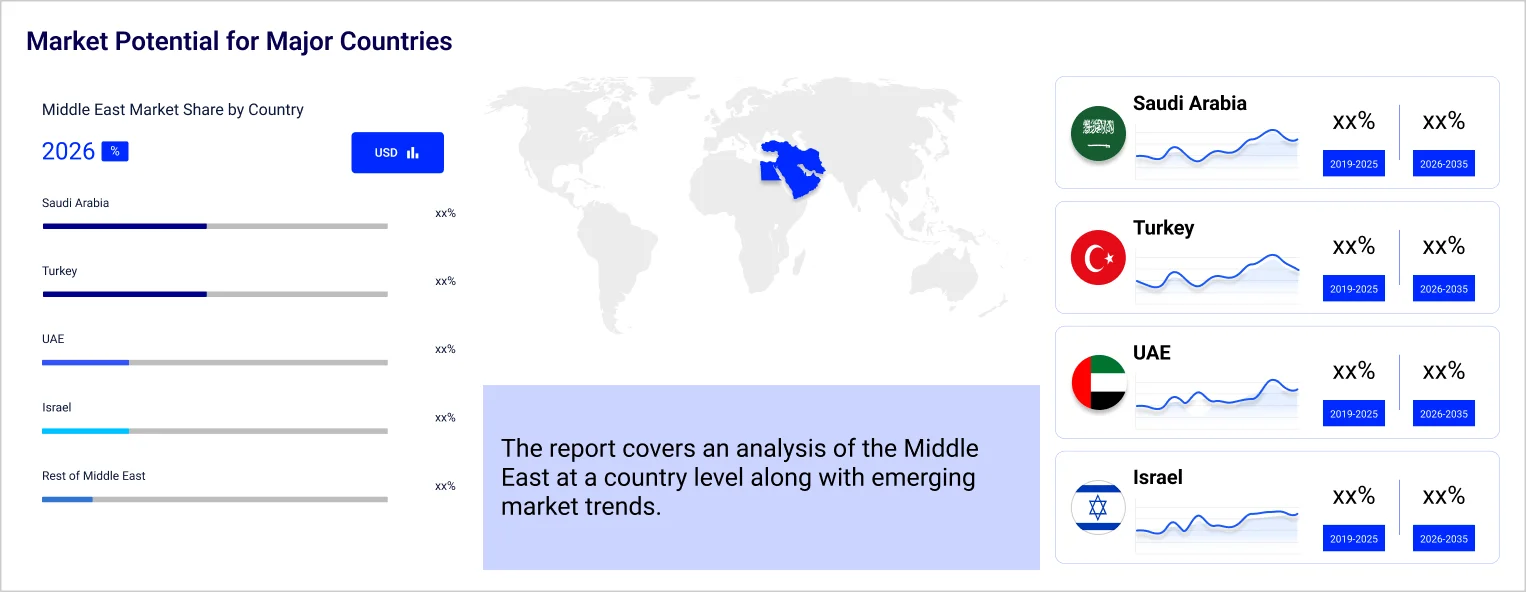
Saudi Arabia secures the leading market position driven by giga renewable programs
Saudi Arabia, powered by its large-scale renewable procurement strategy under Vision 2030, sustains its dominance across the Middle East energy storage market scope. Hybrid solar-plus-storage tenders are becoming standard in national programs. Developers are required to demonstrate dispatchable capacity rather than intermittent supply. Industrial cities such as NEOM are embedding storage within smart grid blueprints. Localization initiatives are encouraging joint ventures for battery assembly and system integration. Utilities are upgrading substations to accommodate storage-ready infrastructure.
The UAE is expanding its share in the Middle East energy storage market through structured clean energy strategies. Hybrid solar parks are incorporating battery systems to optimize evening peak supply. District cooling networks are integrating thermal storage to reduce load pressure. The regulatory environment is relatively clear, enabling faster private sector participation. Data center expansion in Dubai and Abu Dhabi also accelerates demand for resilient storage systems. Utilities are piloting advanced battery management software to improve asset life cycles. The country’s focus on smart city development makes storage integration smoother.
The industry is moving towards a more organized and competitive structure. Battery producers are collaborating with local EPC companies to win utility contracts on a large scale. Differentiating through localization is becoming a crucial factor. Those Middle East energy storage companies who are ready to face the harsh conditions of the desert with special enclosures and sophisticated thermal controls are getting the utility sectors' confidence. Another aspect is the integration of software. Energy management tools that can efficiently plan the distribution of energy and can also foresee wear and tear are more becoming common in bids.
Competition is also a matter of long-term service agreements. Middle East energy storage market players who acknowledge the lifecycle of their products rather than selling the equipment are the best choice for investors. Industrial customers want turnkey solutions that not only cover engineering and installation but also maintenance. The most lucrative opportunities are in hybrid renewable tenders and critical infrastructure projects. Those companies which comply with the sovereign energy transition plans are getting contracts on a regular basis.
The company BYD, which was founded in 1995 and is based in Shenzhen, China, is a major supplier of lithium iron phosphate battery systems especially designed for high-temperature environments. The company is catering to the utility projects in the Middle East by offering containerized storage solutions and deeply integrated battery management platforms.
With its establishment in 2019, and having its head office in Riyadh, Saudi Arabia, Afaq Energy puts its main emphasis on solar-plus-storage solutions for commercial clients. They incorporate battery systems in industrial and retail projects providing engineering and long-term maintenance contracts.
LG Energy Solution which was founded in 2020 and has its main office in Seoul, South Korea, is a provider of advanced lithium-ion cells as well as grid-scale storage systems. The company is focusing on utility-scale and data center applications which require high cycle life and safety compliance.
GS Yuasa, a company from Japan, mainly provides industrial battery systems for critical infrastructure. The company, founded in the year 2004, has been in the telecom, data center, and backup application sector for the Middle Eastern markets for a while.
*Please note that this is only a partial list; the complete list of key players is available in the full report. Additionally, the list of key players can be customized to better suit your needs.*
Other key players in the market include Sungrow Power Supply Co., Ltd., Hitachi Energy Ltd., Wärtsilä Corp., Algihaz Holding, JinkoSolar Holding Co., Ltd., and GCL Holding Co. Ltd., among others.
Explore the latest trends shaping the Middle East energy storage Market 2026-2035 with our in-depth report. Gain strategic insights, future forecasts, and key market developments that can help you stay competitive. Download a free sample report or contact our team for customized consultation on Middle East energy storage market trends 2026.


Upto 15% Off
USD
$2499 $2249
$3999 $3599
$4999 $4249
$5999 $5099


*While we strive to always give you current and accurate information, the numbers depicted on the website are indicative and may differ from the actual numbers in the main report. At Expert Market Research, we aim to bring you the latest insights and trends in the market. Using our analyses and forecasts, stakeholders can understand the market dynamics, navigate challenges, and capitalize on opportunities to make data-driven strategic decisions.*
In 2025, the Middle East energy storage market reached an approximate value of USD 822.94 Million.
The market is projected to grow at a CAGR of 15.30% between 2026 and 2035.
The key players in the market include BYD Co. Ltd., Afaq Energy Company (Sky Energy), LG Energy Solution Ltd., GS Yuasa International Ltd., Sungrow Power Supply Co., Ltd., Hitachi Energy Ltd., Wärtsilä Corp., Algihaz Holding, JinkoSolar Holding Co., Ltd., and GCL Holding Co. Ltd., among others.
Forming joint ventures, localizing assembly operations, securing lithium supply contracts, integrating advanced thermal controls, and offering long-term performance guarantees are strengthening market positioning and winning utility tenders.
High ambient temperatures, supply chain localization pressures, evolving grid codes, financing complexities, and performance warranty risks are challenging developers and manufacturers operating in large-scale Middle Eastern storage deployments.
Explore our key highlights of the report and gain a concise overview of key findings, trends, and actionable insights that will empower your strategic decisions.
| REPORT FEATURES | DETAILS |
| Base Year | 2025 |
| Historical Period | 2019-2025 |
| Forecast Period | 2026-2035 |
| Scope of the Report |
Historical and Forecast Trends, Industry Drivers and Constraints, Historical and Forecast Market Analysis by Segment:
|
| Breakup by Type |
|
| Breakup by Connectivity |
|
| Breakup by Application |
|
| Breakup by Region |
|
| Market Dynamics |
|
| Competitive Landscape |
|
| Companies Covered |
|
Datasheet
One User
USD 2,499
USD 2,249
tax inclusive*
Single User License
One User
USD 3,999
USD 3,599
tax inclusive*
Five User License
Five User
USD 4,999
USD 4,249
tax inclusive*
Corporate License
Unlimited Users
USD 5,999
USD 5,099
tax inclusive*
*Please note that the prices mentioned below are starting prices for each bundle type. Kindly contact our team for further details.*
Flash Bundle
Small Business Bundle
Growth Bundle
Enterprise Bundle
*Please note that the prices mentioned below are starting prices for each bundle type. Kindly contact our team for further details.*
Flash Bundle
Number of Reports: 3
20%
tax inclusive*
Small Business Bundle
Number of Reports: 5
25%
tax inclusive*
Growth Bundle
Number of Reports: 8
30%
tax inclusive*
Enterprise Bundle
Number of Reports: 10
35%
tax inclusive*
How To Order

Select License Type
Choose the right license for your needs and access rights.

Click on ‘Buy Now’
Add the report to your cart with one click and proceed to register.

Select Mode of Payment
Choose a payment option for a secure checkout. You will be redirected accordingly.
Strategic Solutions for Informed Decision-Making
Gain insights to stay ahead and seize opportunities.

Get insights & trends for a competitive edge.

Track prices with detailed trend reports.

Analyse trade data for supply chain insights.

Leverage cost reports for smart savings

Enhance supply chain with partnerships.

Connect For More Information
Our expert team of analysts will offer full support and resolve any queries regarding the report, before and after the purchase.
Our expert team of analysts will offer full support and resolve any queries regarding the report, before and after the purchase.
We employ meticulous research methods, blending advanced analytics and expert insights to deliver accurate, actionable industry intelligence, staying ahead of competitors.
Our skilled analysts offer unparalleled competitive advantage with detailed insights on current and emerging markets, ensuring your strategic edge.
We offer an in-depth yet simplified presentation of industry insights and analysis to meet your specific requirements effectively.




