

Consumer Insights
Uncover trends and behaviors shaping consumer choices today
Procurement Insights
Optimize your sourcing strategy with key market data
Industry Stats
Stay ahead with the latest trends and market analysis.
The brain-computer interface medical devices market stood at USD 2.59 Billion in 2025 and is projected to reach USD 11.43 Billion by 2035, growing at a CAGR of 16.00% during 2026-2035. Growth draws on the rising burden of stroke, ALS and spinal cord injury, expanding early feasibility trials, faster regulatory pathways and improved neural decoding.
Patent filings have accelerated since 2020, led by electrode array design, wireless implant electronics, decoding algorithms and closed-loop stimulation. Regulatory milestones such as the 2025 Layer 7 clearance and the 2025 FDA approval of Medtronic's adaptive deep brain stimulation system confirm that neural sensing inventions are reaching clinical use.
This Brain-Computer Interface Medical Devices Patent Landscape Analysis Report maps assignees, jurisdictions, technology clusters and white spaces to support R&D, licensing and investment decisions.
The brain-computer interface medical devices market is experiencing strong growth, driven by rising stroke, ALS and spinal cord injury burden, faster regulatory pathways for implantable neurotechnology, and advances in neural decoding and miniaturised electronics. The US FDA cleared Precision Neuroscience's Layer 7 cortical interface in 2025 for implant durations of up to 30 days, and Paradromics received an investigational device exemption in late 2025 for a speech restoration trial.
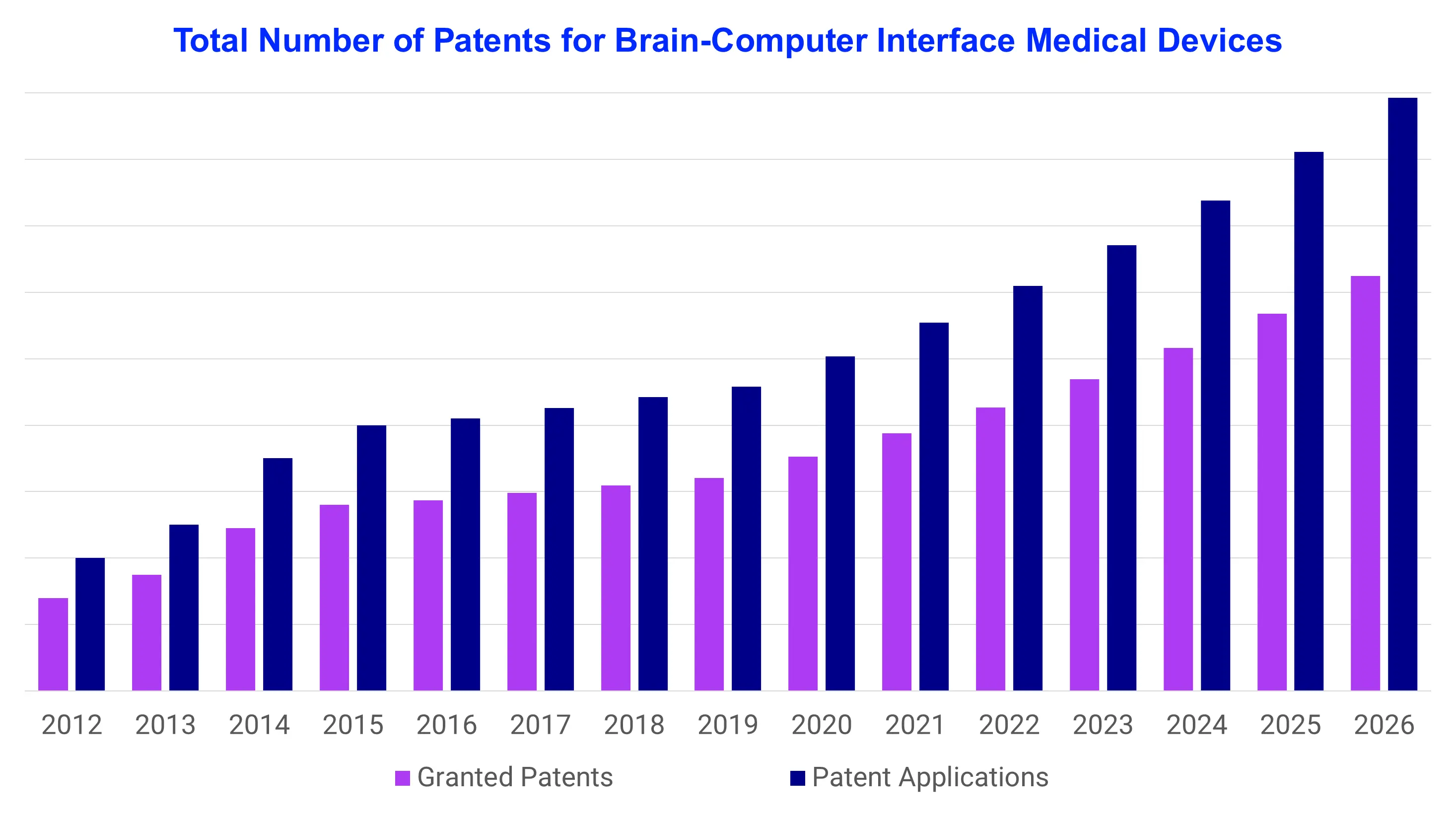
Patent activity is accelerating, with 1,650+ brain-computer interface medical devices patents granted in 2025, reflecting strong innovation momentum in high-channel-count neural interfaces, neural signal decoding algorithms, minimally invasive endovascular electrodes, and closed-loop neuromodulation with brain sensing.
Top assignees in the brain-computer interface medical devices patent landscape include Medtronic, Neuralink, Blackrock Neurotech, Synchron, and Precision Neuroscience, with the United States, China, and Europe as the dominant patent jurisdictions.
The market value is driven by rising cases of ALS, spinal cord injury and stroke across the globe. Roughly 12 million people live with ALS, spinal cord injury or severe stroke related paralysis globally, and stroke alone affects over 12 million new patients each year. Limited options for restoring movement and speech keep demand for neural interfaces high.
North America is the largest regional market, supported by early feasibility study pathways at the US FDA, Breakthrough Device designations and funding for academic programmes such as BrainGate. China is the fastest growing region, with national policy support for BCI industrialisation announced in 2025 and implant trials by NeuCyber and StairMed. Europe contributes through Onward, Clinatec and CE-marked neurorehabilitation systems.
Commercial evidence is building. Synchron completed its COMMAND early feasibility study with six implanted participants and raised USD 200 million in 2025 to prepare a registration trial. Neuralink reported more than ten implanted participants by late 2025, and Blackrock Neurotech arrays have supported most published speech and arm control demonstrations.
Read more about this report - REQUEST FREE SAMPLE COPY IN PDF
Patent filings in brain-computer interface medical devices follow clinical proof points. Landmark publications in 2023 and 2024 showing speech decoding at near conversational rates by Stanford and UCSF teams triggered new filings on decoding models and speech prostheses.
The dataset covers more than 11,500 patent families, with filing peaks in 2021, 2022 and 2024. Electrode design, wireless implant electronics and machine learning decoders account for most of the growth.
Demand from paralysed and speech impaired patients converts directly into filings on higher channel counts, longer implant life and reliable daily home use.
The report covers invasive, partially invasive and non-invasive brain-computer interfaces used for medical purposes, including motor restoration, communication, neurorehabilitation, stroke recovery and spinal cord injury repair. Closed-loop neuromodulation systems that sense brain activity are included.
The scope is limited to systems that carry a medical claim, which excludes consumer gaming headsets and wellness neurofeedback products. Granted patents and pending applications are analysed by technology, application, component and jurisdiction.
Assignees range from neuromodulation incumbents and venture-backed implant developers to universities, hospital systems and Chinese research institutes, all analysed at the parent level after name harmonisation.
The report will cover the following sections in detail:
Analysis by Technology
Analysis by Application
Analysis by Component
Brain-Computer Interface Medical Devices Patent Filing Trend Analysis
Patent family filings grew at an estimated 14% annually over 2020-2024, with the strongest increases in decoding algorithms and wireless implant electronics. Venture funding for implant developers, which exceeded USD 1 billion across the sector in 2024 and 2025, funded larger filing programmes.
Granted patents in 2025 reached an estimated 1,650+, a share of which relates to thin-film electrodes and endovascular delivery. Chinese filings are rising faster than any other jurisdiction, driven by university and hospital applicants.
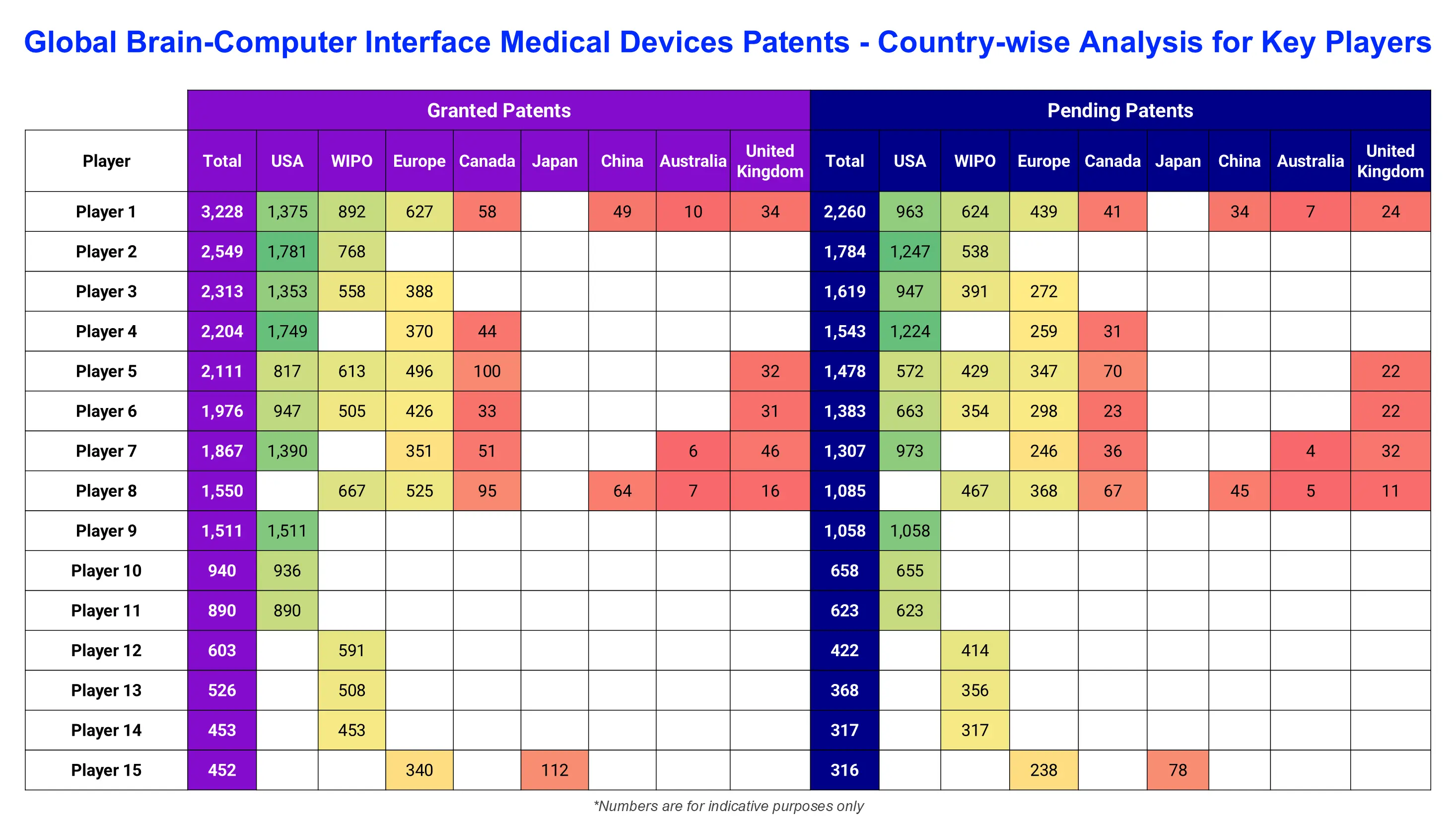
Among the players with brain-computer interface medical devices patent families, new entrants have been identified, which can be either established companies or startups developing novel technology in the field. Some of the major companies mentioned in this report (a non-exhaustive list) are as follows:
Medtronic holds the broadest neuromodulation portfolio among BCI-relevant assignees, covering implantable pulse generators, leads, sensing electronics and closed-loop control. Its BrainSense adaptive deep brain stimulation, approved by the US FDA in 2025 on the Percept platform, records local field potentials and adjusts stimulation automatically. Spinal cord stimulation and sacral neuromodulation families add sensing and telemetry claims that transfer to cortical interfaces. The company protects hardware architecture and control algorithms in parallel, with continuation filings that extend platform claims. Its commercial position rests on a large implanted base, established neurosurgical channels and reimbursement experience.
Neuralink has built a dense young portfolio around its N1 implant, the R1 robotic implantation system and flexible polymer thread electrodes with high channel counts. Claims span thread insertion, wireless data transmission, chip packaging and decoding of motor intent. The first human implant took place in January 2024, and the PRIME and CONVOY studies have since enrolled participants controlling computers and robotic arms. The company holds FDA Breakthrough Device designations for speech restoration and vision restoration programmes. It files mostly in the United States with selective PCT coverage, which supports a vertically integrated device, robot and software strategy.
Other companies include Synchron, Blackrock Neurotech, and Precision Neuroscience.
The top five assignees hold an estimated 18% of families, so the field remains fragmented. Medtronic leads on volume through its neuromodulation base, while Neuralink and Blackrock Neurotech lead in intracortical interface claims. University applicants contribute close to a third of filings.
*Please note that this is only a partial list; the complete list of key players is available in the full report. Additionally, the list of key players can be customized to better suit your needs.*
The report assesses patent activity across major jurisdictions, including:
The United States leads filing volume at an estimated 40% of families, supported by the FDA Breakthrough Device programme and venture funding. China ranks second with a rapidly growing share of university and hospital filings. Europe ranks third, with strong activity from Onward, Clinatec and German and Swiss research groups.
Read more about this report - REQUEST FREE SAMPLE COPY IN PDF
The report segments patent activity across the following technology clusters:
Among these, neural decoding and machine learning holds the largest share of recent filings, ahead of intracortical microelectrode arrays.
Competition combines established neuromodulation companies with venture-backed implant developers. Medtronic holds the largest portfolio, while Neuralink, Blackrock Neurotech, Synchron and Precision Neuroscience hold focused positions in cortical interfaces. Paradromics, Onward and Cognixion add differentiated claims in high-bandwidth implants, spinal stimulation paired with brain sensing, and wearable assistive interfaces.
Companies are focusing on:
Emerging innovation themes include fully implanted wireless systems with thousands of channels, speech neuroprostheses, brain-spine interfaces for walking recovery, augmented reality control for ALS patients (such as Cognixion's Axon-R study with a headset display), and foundation models for neural decoding.
Strategic activity centres on platform control, with developers pairing electrode hardware, surgical delivery and decoder software under one portfolio. Licensing from universities remains important, since BrainGate and Stanford programmes generated much of the early intracortical art.
Technology segments, application areas and assignee profiles are mapped in this report. The report provides actionable intelligence supporting:
The analysis draws on the USPTO, EPO, WIPO PATENTSCOPE, CNIPA, JPO and KIPO databases, covering publications through 2025. Patent counts are rounded estimates built from family-level consolidation.
Search queries combine CPC classes A61B 5/369, A61B 5/24, G06F 3/015, A61N 1/36 and A61F 2/72 with keyword sets covering brain-computer interface, neural decoding, cortical electrode and neuroprosthesis. Results are screened manually, and applications are merged into families by priority number.
The market side uses regulatory filings from the US FDA and EU authorities, company disclosures, clinical trial registries such as ClinicalTrials.gov, and peer-reviewed journals including Nature, NEJM and Nature Medicine.
Brain Computer Interface Market


Upto 15% Off
USD
$2699 $2429
$4299 $3869
$5799 $4949
$6999 $5949


*While we strive to always give you current and accurate information, the numbers depicted on the website are indicative and may differ from the actual numbers in the main report. At Expert Market Research, we aim to bring you the latest insights and trends in the market. Using our analyses and forecasts, stakeholders can understand the market dynamics, navigate challenges, and capitalize on opportunities to make data-driven strategic decisions.*
EMR’s Brain-Computer Interface Medical Devices Patent Landscape Analysis provides a comprehensive assessment of patent filings, innovation clusters, assignee portfolios, and geographic filing patterns across the brain-computer interface medical devices landscape. The report identifies 11,500+ patent families, evaluates leading jurisdictions including the United States, China, and Europe, and profiles the top assignees by portfolio size.
The global brain-computer interface medical devices market was valued at USD 2.59 Billion in 2025. The market is projected to reach USD 11.43 Billion by 2035, expanding at a CAGR of 16.00% during 2026-2035.
The report analyses approximately 11,500+ patent families related to brain-computer interface medical devices. These include filings from the United States, China, Europe, and international WIPO filings.
Key companies operating within the landscape include Medtronic, Neuralink, Blackrock Neurotech, Synchron, and Precision Neuroscience, among others. These organisations collectively account for a significant portion of patent activity analysed in this report.
The report evaluates patent activity across the United States, Europe, China, Japan, South Korea, India, and international WIPO filings. The United States leads with an estimated 40% of patent families, followed by China and Europe.
Yes. The report scope can be customised based on geography, technology segment, assignee selection, time period, or specific innovation cluster focus. Please connect with the EMR team to define the customisation scope.
Patent landscape analysis helps organisations understand innovation trends, competitive activity, technology whitespace, and IP risk across a defined domain. For brain-computer interface medical devices, this report supports strategic decisions in R&D prioritisation, licensing evaluation, competitive benchmarking, and market entry planning.
Explore our key highlights of the report and gain a concise overview of key findings, trends, and actionable insights that will empower your strategic decisions.
|
Scope of the Report |
Details |
|
Analysis by Technology |
|
|
Analysis by Application |
|
|
Analysis by Component |
|
|
Analysis by End User |
|
|
Key Players Mentioned |
|
|
Geographies Covered |
|
Mini Report
One User
USD 2,699
USD 2,429
tax inclusive*
Single User License
One User
USD 4,299
USD 3,869
tax inclusive*
Five User License
Five User
USD 5,799
USD 4,949
tax inclusive*
Corporate License
Unlimited Users
USD 6,999
USD 5,949
tax inclusive*
*Please note that the prices mentioned below are starting prices for each bundle type. Kindly contact our team for further details.*
Flash Bundle
Small Business Bundle
Growth Bundle
Enterprise Bundle
*Please note that the prices mentioned below are starting prices for each bundle type. Kindly contact our team for further details.*
Flash Bundle
Number of Reports: 3
20%
tax inclusive*
Small Business Bundle
Number of Reports: 5
25%
tax inclusive*
Growth Bundle
Number of Reports: 8
30%
tax inclusive*
Enterprise Bundle
Number of Reports: 10
35%
tax inclusive*
How To Order

Select License Type
Choose the right license for your needs and access rights.

Click on ‘Buy Now’
Add the report to your cart with one click and proceed to register.

Select Mode of Payment
Choose a payment option for a secure checkout. You will be redirected accordingly.
Strategic Solutions for Informed Decision-Making
Gain insights to stay ahead and seize opportunities.

Get insights & trends for a competitive edge.

Track prices with detailed trend reports.

Analyse trade data for supply chain insights.

Leverage cost reports for smart savings

Enhance supply chain with partnerships.

Connect For More Information
Our expert team of analysts will offer full support and resolve any queries regarding the report, before and after the purchase.
Our expert team of analysts will offer full support and resolve any queries regarding the report, before and after the purchase.
We employ meticulous research methods, blending advanced analytics and expert insights to deliver accurate, actionable industry intelligence, staying ahead of competitors.
Our skilled analysts offer unparalleled competitive advantage with detailed insights on current and emerging markets, ensuring your strategic edge.
We offer an in-depth yet simplified presentation of industry insights and analysis to meet your specific requirements effectively.




