

Consumer Insights
Uncover trends and behaviors shaping consumer choices today
Procurement Insights
Optimize your sourcing strategy with key market data
Industry Stats
Stay ahead with the latest trends and market analysis.
The global fracture fixation devices market stood at USD 9.80 Billion in 2025 and is projected to reach USD 17.22 Billion by 2035, advancing at a CAGR of 5.80%. Demand rests on four drivers: an ageing population with a growing burden of osteoporotic fractures, a steady caseload from road trauma and sports injuries, wider use of titanium and bioabsorbable materials, and the adoption of patient-specific implants for complex fractures. Procurement pressure in large public systems keeps unit prices firm, so value growth depends on volume and on higher-specification products.
Patent activity is concentrated in locking plate and screw design, intramedullary nail systems, external fixation frames, bioabsorbable and biodegradable fixation, patient-specific and 3D-printed implants, and instrumentation, navigation and imaging for fracture repair. Filings from the established trauma franchises show continuous refinement of mature platforms, while newer entrants file mainly on additive manufacturing and resorbable materials. Commercial validation is visible in the broad portfolios of DePuy Synthes, Stryker, Zimmer Biomet, Smith & Nephew and Arthrex, and in the steady flow of regulatory clearances for plates, nails and bioabsorbable implants in the United States, Europe and China.
This Fracture Fixation Devices Patent Landscape Analysis Report provides a structured view of filing trends, leading assignees, jurisdictions, technology clusters and company profiles across plates, nails, external fixators, pins and bioabsorbable fixation.
The fracture fixation devices market is experiencing strong growth, driven by ageing populations with osteoporotic fractures, road trauma and sports injuries, and the shift toward titanium, bioabsorbable and patient-specific implants. Hip fractures are usually treated surgically, and early surgery is linked to better outcomes, which keeps nailing and plating systems in constant use in hospital trauma pathways.
Patent activity is accelerating, with 1,400+ fracture fixation devices patents granted in 2025, reflecting strong innovation momentum in locking plate and screw design, intramedullary nail systems, bioabsorbable and biodegradable fixation, and patient-specific and 3D-printed implants.
Top assignees in the fracture fixation devices patent landscape include DePuy Synthes, Stryker, Zimmer Biomet, Smith & Nephew, and Arthrex, with the United States, Europe, and China as the dominant patent jurisdictions.
Fracture fixation sits at the centre of orthopaedic trauma care, where surgeons use plates, screws, nails, pins, wires and external frames to hold broken bones in alignment while they heal. Demand follows injury incidence rather than elective choice, with falls among older adults, road traffic collisions, sports injuries and workplace accidents generating a steady flow of operative cases. Hospitals and trauma centres buy these devices as complete sets with dedicated instruments, so purchasing favours suppliers that offer every implant size, reliable surgeon training and prompt availability. The category is mature in established markets, which keeps price negotiation firm, while newer materials and patient-specific designs give manufacturers room to differentiate.
The market growth is driven by the rising number of low-energy fractures in an ageing population, which keeps operative volumes growing even where unit prices are under pressure. The International Osteoporosis Foundation estimates that more than 8.9 million osteoporotic fractures occur worldwide each year, and every hip or wrist fracture among them carries a risk of surgical fixation, so a baseline of procedures persists regardless of elective demand. Hip fractures are usually treated surgically, and early surgery is linked to better outcomes, which has led hospitals to build fast-track pathways that depend on ready stocks of nails and plates.
Road traffic crashes cause about 1.2 million deaths a year according to the World Health Organization, with tens of millions of non-fatal injuries, and a large share of those involve limb fractures needing fixation. This explains why trauma implant demand stays high in middle-income countries, where motorisation is growing faster than road safety measures. Locking plate technology, which became mainstream in the 2000s, widened the range of fractures that can be stabilised in weak bone and so raised surgeon confidence in operating on elderly patients. China introduced national volume-based procurement for orthopaedic trauma implants from 2021, which lowered prices sharply but widened patient access, and suppliers in tender-driven systems are therefore moving to titanium alloys, bioabsorbable polymers and patient-specific designs, where clinical benefit supports higher selling prices.
Read more about this report - REQUEST FREE SAMPLE COPY IN PDF
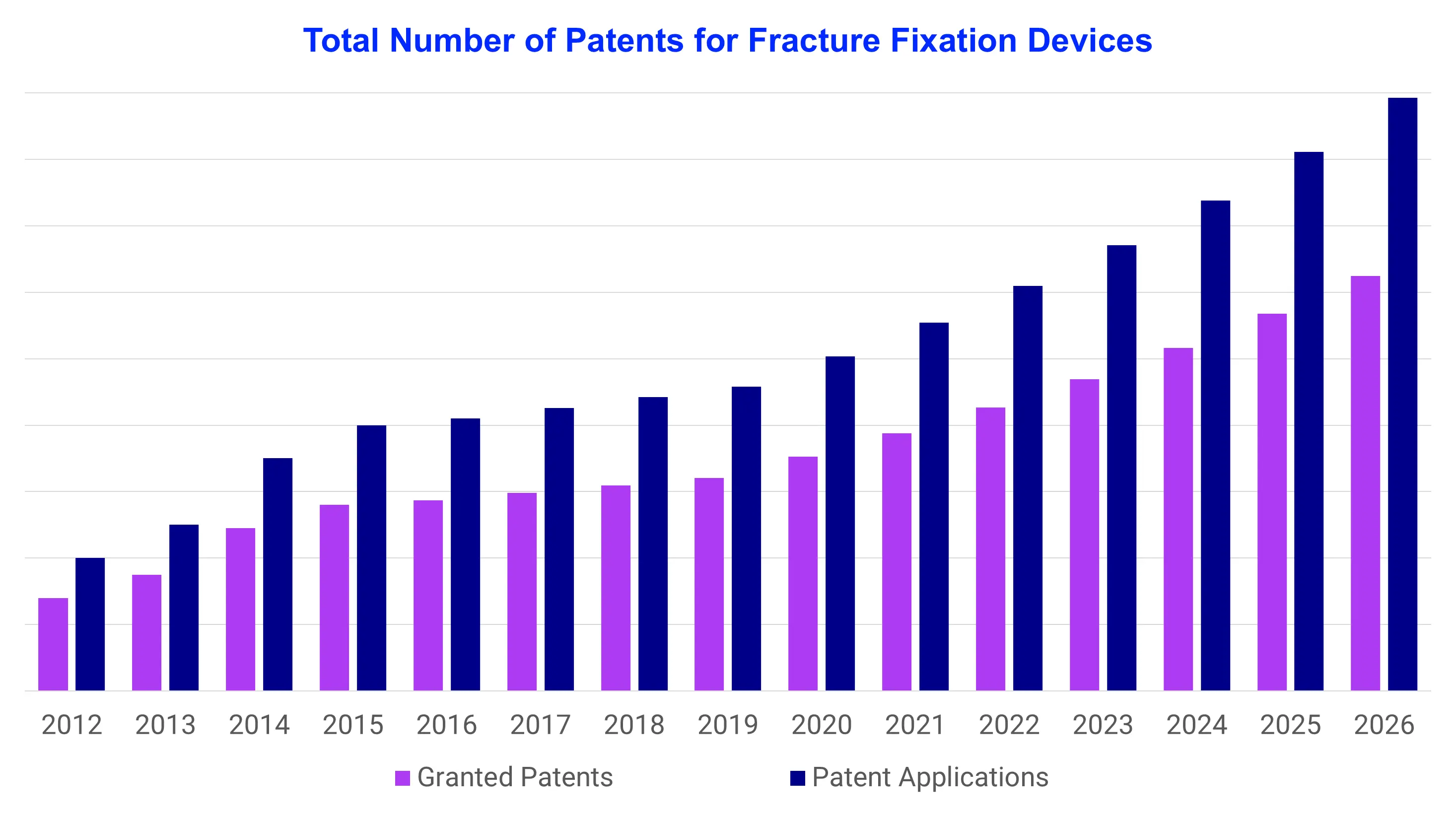
Filing intensity in fracture fixation devices is steady rather than explosive, which matches the maturity of the category. Large trauma franchises renew their portfolios continuously, filing on refinements to plate contours, screw threads, nail geometries and instrument sets, so annual volumes mirror the research budgets of a small group of orthopaedic companies. Commercial investment appears as continuation filings that extend families when a product moves from first launch to wider size ranges and new anatomical sites. Newer activity in additive manufacturing and bioabsorbable materials reflects companies building fresh positions in these areas, rather than defending established ones.
The landscape comprises 11,200+ patent families, with filing activity peaking between roughly 2018 and 2023 as additive manufacturing, resorbable polymers and targeting aids entered mainstream development programmes. Locking plate and screw design and intramedullary nail systems account for the largest clusters, followed by external fixation frames and instrumentation, navigation and imaging for fracture repair. Bioabsorbable and biodegradable fixation, together with patient-specific and 3D-printed implants, form the fastest-growing clusters, though from a smaller base. Each family typically covers several jurisdictions, which is why the family count is smaller than the total number of individual patents.
Rising fracture volumes in ageing and motorising populations, together with price pressure that rewards differentiated products, explain why patent expansion continues in locking constructs, nail systems and resorbable fixation.
Coverage extends across the United States, Europe, China, Japan, South Korea, India and filings made through the World Intellectual Property Organization, with the three largest jurisdictions analysed individually. Market coverage spans hospitals, trauma centres, outpatient surgical centres, orthopaedic clinics and military and emergency care facilities, which together account for operative fracture care. Patent records are included from the major patent offices and are grouped into patent families so that one invention filed in several countries is counted once. Regional demand, regulatory pathways and procurement rules are reviewed alongside the filings to show where protection and commercial activity coincide.
Technology and product scope covers plates and screws, intramedullary nails, pins, wires and staples, external fixators and bioabsorbable fixation devices, with materials including stainless steel, titanium and titanium alloys, bioabsorbable polymers, and composite and PEEK materials. Fracture sites range from hip and femur fractures through lower leg and ankle, upper extremity, pelvic and spinal, and craniomaxillofacial fractures. Supporting technologies such as locking mechanisms, targeting guides, navigation, intraoperative imaging, additive manufacturing and patient-specific planning are included wherever they are claimed together with a fixation implant or its instruments.
Entities in the landscape include global orthopaedic manufacturers with full trauma franchises, mid-sized specialist firms focused on extremity or craniomaxillofacial fixation, and regional producers that have grown under national procurement programmes, notably in China. Start-ups are active in bioabsorbable implants, porous additively manufactured structures and software for fracture planning. Universities, teaching hospitals and research institutes contribute filings on new alloys, resorbable polymers and fixation concepts, often with co-inventors from device companies. Military research groups and trauma societies appear as applicants for damage-control fixation and field-use devices.
The report will cover the following sections in detail:
Analysis by Product Type
Analysis by Material
Analysis by Fracture Site
Fracture Fixation Devices Patent Filing Trend Analysis
Fracture fixation devices patent filing shows a pattern of continuous renewal with periodic step changes. The step changes include the introduction of variable-angle locking technology, improved nail targeting systems and, more recently, additively manufactured implants with porous surfaces. Established assignees file steadily each year to protect incremental improvements, and newer applicants appear whenever a material or manufacturing method matures enough to reach clinical use. Granted patents lag filings by several years, so recent grants reflect development programmes begun before 2020.
Annual filing growth between 2020 and 2024 is estimated at approximately 6 to 7 percent, a pace that exceeds the underlying growth of fracture fixation volumes. Three factors lie behind this: heavier filing by Chinese manufacturers after national procurement reform made differentiation a commercial necessity, growing interest in bioabsorbable and patient-specific fixation, and added protection of navigation and imaging aids used during fracture repair. Resumed elective activity after pandemic-era disruption also helped development timelines and filing schedules recover during this period.
Among the players with fracture fixation devices patent families, new entrants have been identified, which can be either established companies or startups developing novel technology in the field. Some of the major companies mentioned in this report (a non-exhaustive list) are as follows:
DePuy Synthes holds one of the broadest trauma portfolios in the landscape, covering plates, screws, intramedullary nails, external fixation and craniomaxillofacial fixation. Its named platforms include the Locking Compression Plate system, variable-angle locking plates, the TFN-ADVANCED proximal femoral nailing system and the TRUMATCH patient-specific solutions for craniomaxillofacial reconstruction. Most plates, screws and nails in this category are generally cleared through the FDA 510(k) pathway and carry the CE mark, and the company keeps its filings aligned with those product lines. Its IP strategy relies on large patent families that are extended through continuation and design filings as screw geometries, nail targeting and instrument sets are refined. A long working relationship with surgeon education networks and its global sales reach give the portfolio a leading commercial position among hospital trauma buyers.
Stryker maintains a large fracture fixation portfolio built around the T2 intramedullary nailing platform, the Gamma3 hip fracture nailing system, AxSOS locking plates and Hoffmann external fixation frames. Its trauma and extremities business sells implants together with dedicated instrument sets, which supports repeat use in hospital and trauma centre operating rooms. Products in these categories are generally marketed under FDA 510(k) clearance and the CE mark, with continued attention to the European medical device regulation transition. Its patent strategy centres on incremental protection of nail geometry, locking mechanisms, plate contours and targeting instruments, reinforced by filings in the United States, Europe and China. Stryker is positioned as a primary competitor to DePuy Synthes in nailing and plating, with a particular strength in hip fracture care.
Other companies include Zimmer Biomet, Smith & Nephew, and Arthrex.
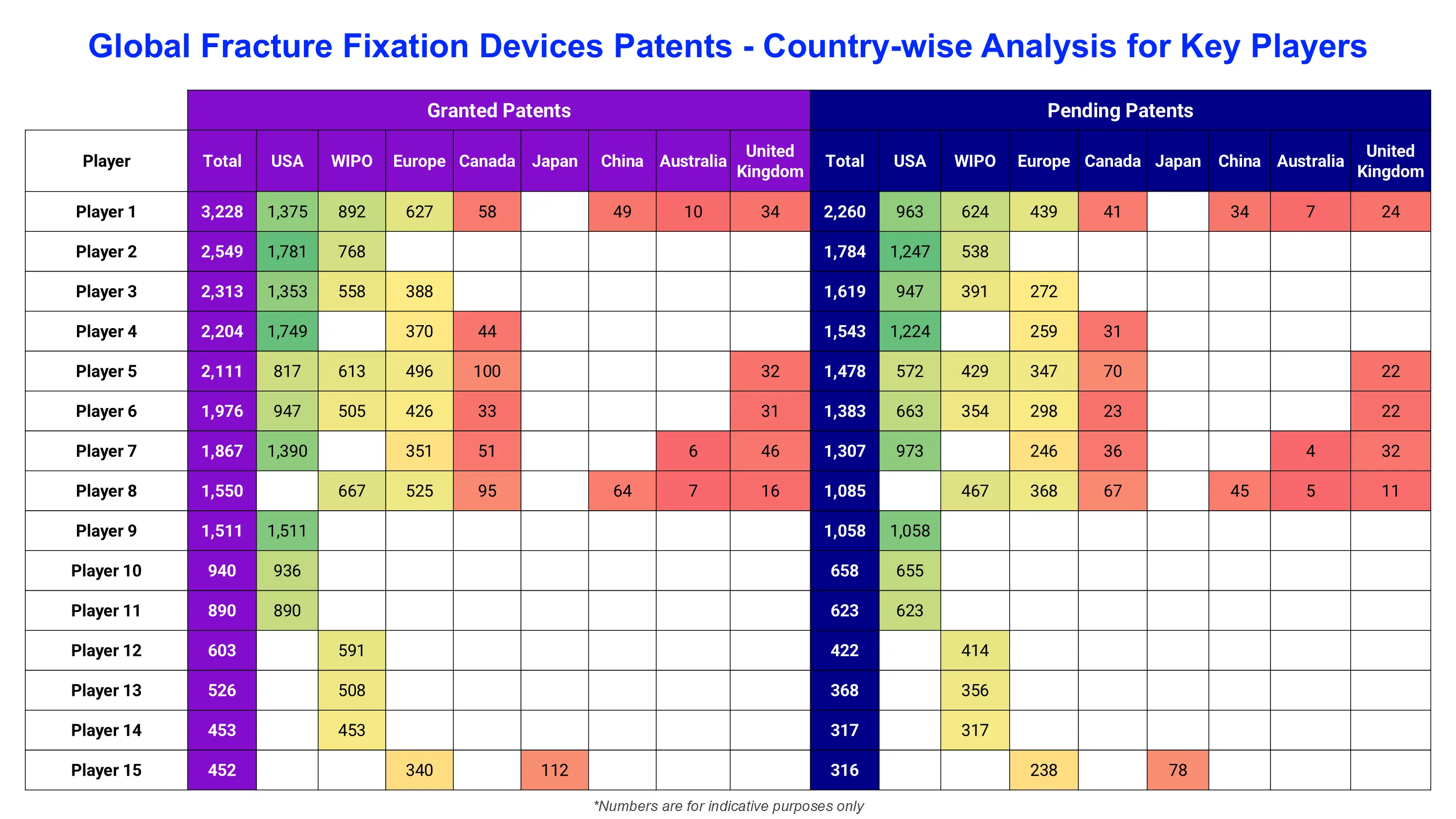
Patent ownership is concentrated among a small group of orthopaedic companies. DePuy Synthes and Stryker hold the deepest trauma portfolios, built on locking plate systems and intramedullary nail platforms and protected through large continuation-rich families. Zimmer Biomet combines trauma filings with its wider joint reconstruction and biologics activity, and Smith & Nephew pairs fracture fixation with sports medicine and advanced wound care. Arthrex concentrates on foot, ankle, hand and upper extremity fixation, often tied to minimally invasive instruments. Together these five groups account for a large share of leading family counts, while a long tail of regional and specialist applicants fills the remainder.
*Please note that this is only a partial list; the complete list of key players is available in the full report. Additionally, the list of key players can be customized to better suit your needs.*
The report assesses patent activity across major jurisdictions, including:
The United States leads in patent volume, supported by the presence of the largest trauma franchises and a clear regulatory pathway for plates, screws and nails. Europe follows, with protection filed mainly through the European Patent Office and national offices in Germany, Switzerland, France and the United Kingdom, where several established fixation companies originated. China has risen quickly, as domestic manufacturers file extensively in response to volume-based procurement and a large trauma caseload. South Korea and India show smaller but growing activity, driven by local implant producers and expanding surgical capacity, while filings through the World Intellectual Property Organization indicate where applicants plan international protection.
Read more about this report - REQUEST FREE SAMPLE COPY IN PDF
Technology segmentation in the fracture fixation devices patent landscape is organised around five areas:
Locking plate and variable-angle screw systems lead patent activity, because the same plate platform can be adapted to many anatomical sites and weak bone is the dominant clinical problem in older patients. Intramedullary nail design and targeting follows closely, supported by continuing work on distal locking, fracture-site compression and nails for the femur and tibia. Patient-specific and 3D-printed implants are the fastest-growing segment by filings, though from a smaller base.
Competition is led by four or five global orthopaedic groups that sell complete trauma systems, supported by specialist firms in extremity, craniomaxillofacial and external fixation segments. Established players protect their lead through large families on locking mechanisms, nail geometries and instrument sets, and compete through surgeon training and hospital supply agreements. Chinese domestic manufacturers have gained share in tender-driven markets and now file more often outside China as well. Specialist and emerging firms differentiate through bioabsorbable materials, porous implant structures and software-planned fixation.
Companies are focusing on:
Emerging themes include fixation designed for osteoporotic bone, such as augmented screws and cement-assisted constructs, and implants that combine metal and resorbable parts to avoid second surgery for removal. Additively manufactured titanium plates and cages with patient-matched geometry are moving from planning studies toward routine use in complex pelvic and craniomaxillofacial cases. Digital planning tools that select implant size and screw trajectory from computed tomography images are also appearing in claims. Antibacterial coatings and drug-eluting surfaces are attracting filings as infection after open fractures remains a major source of revision surgery.
The fracture fixation devices patent landscape maps who protects what, where and in which technology areas across plates, nails, external fixators, pins and bioabsorbable fixation. Patent families are grouped by technology cluster, assignee and jurisdiction so that readers can see where protection is dense and where it is thin. Portfolio profiles of the leading assignees show how each company balances platform defence against new product entry. Trends in filing and grant activity give context for decisions on research direction, partnerships and market positioning across hospital, trauma centre and outpatient settings.
The landscape provides actionable intelligence for the following uses:
Patent research was carried out across major patent databases and national and regional patent office records, using keyword and classification searches built around fracture fixation devices, including plates, screws, intramedullary nails, pins, wires, staples, external fixators and bioabsorbable fixation. Cooperative Patent Classification codes for bone fixation and orthopaedic implants were combined with terms for materials, anatomical sites and instruments. Search strings were refined iteratively until additional queries returned no new relevant families.
Retrieved records were screened to remove duplicate families and filings with no relevance to fracture fixation. Each remaining family was assigned to a technology cluster, a jurisdiction and an assignee, with subsidiaries and name variants consolidated under their parent organisations. Filing dates, grant dates and legal status were used to establish activity by year, and family size was used to indicate where applicants sought international protection.
Market analysis supports the patent findings by relating filing activity to fracture incidence, procedure volumes, regulatory pathways and procurement practices in the main regions. Company information, product literature, regulatory databases and published clinical sources were reviewed to confirm named platforms and approval status. Estimates for annual filing growth and relative shares are analyst approximations, and market forecasts are modelled from procedure volumes, device usage and pricing trends.
Fracture Fixation Products Market


Upto 15% Off
USD
$2699 $2429
$4299 $3869
$5799 $4949
$6999 $5949


*While we strive to always give you current and accurate information, the numbers depicted on the website are indicative and may differ from the actual numbers in the main report. At Expert Market Research, we aim to bring you the latest insights and trends in the market. Using our analyses and forecasts, stakeholders can understand the market dynamics, navigate challenges, and capitalize on opportunities to make data-driven strategic decisions.*
EMR's Fracture Fixation Devices Patent Landscape Analysis provides a comprehensive assessment of patent filings, innovation clusters, assignee portfolios, and geographic filing patterns across the fracture fixation devices landscape. The report identifies 11,200+ patent families, evaluates leading jurisdictions including the United States, Europe, and China, and profiles the top assignees by portfolio size.
The global fracture fixation devices market was valued at USD 9.80 Billion in 2025. The market is projected to reach USD 17.22 Billion by 2035, expanding at a CAGR of 5.80% during 2026 - 2035.
The report analyses approximately 11,200+ patent families related to fracture fixation devices. These include filings from the United States, Europe, China, and international WIPO filings.
Key companies operating within the landscape include DePuy Synthes, Stryker, Zimmer Biomet, Smith & Nephew, and Arthrex, among others. These organisations collectively account for a significant portion of patent activity analysed in this report.
The report evaluates patent activity across the United States, Europe, China, Japan, South Korea, India, and international WIPO filings. The United States is the largest single jurisdiction in the landscape, with more than 4,100 fracture fixation devices patents associated with it.
Yes. The report scope can be customised based on geography, technology segment, assignee selection, time period, or specific innovation cluster focus. Readers who need a scoped view of a specific device type, assignee set or jurisdiction can contact the EMR team to discuss a customised study built around their requirements.
Patent landscape analysis helps organisations understand innovation trends, competitive activity, technology whitespace, and IP risk across a defined domain. For fracture fixation devices, this report supports strategic decisions in R&D prioritisation, licensing evaluation, competitive benchmarking, and market entry planning.
Explore our key highlights of the report and gain a concise overview of key findings, trends, and actionable insights that will empower your strategic decisions.
|
Scope of the Report |
Details |
|
Analysis by Product Type |
|
|
Analysis by MaterialAnalysis by Material |
|
|
Analysis by Fracture Site |
|
|
Analysis by End User |
|
|
Key Players Mentioned |
|
|
Geographies Covered |
|
Mini Report
One User
USD 2,699
USD 2,429
tax inclusive*
Single User License
One User
USD 4,299
USD 3,869
tax inclusive*
Five User License
Five User
USD 5,799
USD 4,949
tax inclusive*
Corporate License
Unlimited Users
USD 6,999
USD 5,949
tax inclusive*
*Please note that the prices mentioned below are starting prices for each bundle type. Kindly contact our team for further details.*
Flash Bundle
Small Business Bundle
Growth Bundle
Enterprise Bundle
*Please note that the prices mentioned below are starting prices for each bundle type. Kindly contact our team for further details.*
Flash Bundle
Number of Reports: 3
20%
tax inclusive*
Small Business Bundle
Number of Reports: 5
25%
tax inclusive*
Growth Bundle
Number of Reports: 8
30%
tax inclusive*
Enterprise Bundle
Number of Reports: 10
35%
tax inclusive*
How To Order

Select License Type
Choose the right license for your needs and access rights.

Click on ‘Buy Now’
Add the report to your cart with one click and proceed to register.

Select Mode of Payment
Choose a payment option for a secure checkout. You will be redirected accordingly.
Strategic Solutions for Informed Decision-Making
Gain insights to stay ahead and seize opportunities.

Get insights & trends for a competitive edge.

Track prices with detailed trend reports.

Analyse trade data for supply chain insights.

Leverage cost reports for smart savings

Enhance supply chain with partnerships.

Connect For More Information
Our expert team of analysts will offer full support and resolve any queries regarding the report, before and after the purchase.
Our expert team of analysts will offer full support and resolve any queries regarding the report, before and after the purchase.
We employ meticulous research methods, blending advanced analytics and expert insights to deliver accurate, actionable industry intelligence, staying ahead of competitors.
Our skilled analysts offer unparalleled competitive advantage with detailed insights on current and emerging markets, ensuring your strategic edge.
We offer an in-depth yet simplified presentation of industry insights and analysis to meet your specific requirements effectively.




