

Consumer Insights
Uncover trends and behaviors shaping consumer choices today
Procurement Insights
Optimize your sourcing strategy with key market data
Industry Stats
Stay ahead with the latest trends and market analysis.
The ingestible sensor technologies market was valued at USD 0.78 Billion in 2025 and is projected to reach USD 3.69 Billion by 2035, expanding at a CAGR of 16.80% during the forecast period. Demand is shaped by four forces: the growing burden of gastrointestinal disease and colorectal cancer screening, the need to verify whether patients take prescribed medicines, the miniaturisation of cameras, batteries and radio components, and a clinical preference for diagnostics that avoid sedation and invasive scopes.
Patent activity reflects a field that has moved from single-purpose capsule cameras to multi-sensor swallowable platforms. Filings concentrate in capsule endoscopy imaging, ingestible event markers for medication adherence, gas and pH sensing capsules, pressure, motility and transit sensing, wireless power and data transmission from the gut, and biosensing for biomarkers and targeted drug release. Regulatory milestones such as the 2001 FDA clearance of a small bowel capsule endoscope and the 2017 FDA approval of the first drug with a digital ingestion tracking system give these filings a clear commercial reference point.
This Ingestible Sensor Technologies Patent Landscape Analysis Report provides a structured view of patent filing trends, assignee positions, jurisdiction activity, technology segmentation and competitive strategy across swallowable sensing devices.
The ingestible sensor technologies market is experiencing strong growth, driven by wider use of capsule endoscopy, demand for objective medication adherence data, and new gas and motility sensing tools for functional gut disorders. Capsule endoscopy alone has moved from a niche small bowel test, first cleared by the FDA in 2001, to a routine option in many gastroenterology units.
Patent activity is accelerating, with 3,300+ ingestible sensor technologies patents granted in 2025, reflecting strong innovation momentum in capsule endoscopy imaging, ingestible event markers for medication adherence, gas and pH sensing capsules, and pressure, motility, and transit sensing.
Top assignees in the ingestible sensor technologies patent landscape include Medtronic, Olympus, CapsoVision, Otsuka Pharmaceutical, and Atmo Biosciences, with the United States, China, and Europe as the dominant patent jurisdictions.
Ingestible sensor technologies sit at the point where gastroenterology, medication management and wearable electronics meet. A swallowable device can look at the lining of the gut, measure acidity, temperature, gas, pressure or contractions, and confirm that a tablet reached the stomach, all without a tube or a sedated procedure. Clinicians value this because many gut disorders produce symptoms that are hard to measure from outside the body, and because long stretches of the small bowel are out of reach of standard scopes. Pharmaceutical sponsors see a second source of demand, since objective dosing records help in trials of chronic therapies. Hospitals, gastroenterology clinics and home care settings are all adopting these tools at different speeds.
The market growth is driven by the shift from sedated endoscopy towards swallowable devices that collect data from inside the gut, which widens the group of patients who can be examined outside a procedure suite. Colorectal cancer accounts for roughly 1.9 million new cases worldwide each year, and every screening pathway that avoids a full colonoscopy adds potential demand for colon capsules. Roughly one in ten people lives with irritable bowel symptoms, which sustains interest in transit and gas testing.
Adoption is closely tied to clinical evidence and regulatory precedent. In 2001 the FDA cleared the first capsule endoscope for small bowel imaging, and that clearance created a reimbursed procedure that later entrants could build on, which explains why imaging capsules remain the largest revenue base. The 2017 approval of aripiprazole tablets with an ingestion sensor showed that regulators would accept a digital tracking system inside a drug product, and it opened a path for adherence monitoring in psychiatric and chronic care. Non-adherence affects about half of patients on long-term therapy according to World Health Organization estimates, so any tool that records actual dosing has a clear buyer in pharmaceutical development and payer programmes.
Read more about this report - REQUEST FREE SAMPLE COPY IN PDF
Patent filing intensity in ingestible sensor technologies tracks commercial investment in capsule platforms closely. Large endoscopy and medical device groups file continuously around imaging, power and data transmission, because each product generation needs new optics, lower power electronics and better localisation. Smaller specialist firms file around a single sensing concept, such as gas detection or ingestion confirmation, and use those claims to attract partners and venture funding. Clinical trial activity and regulatory submissions usually precede a rise in continuation filings, which shows that applicants treat patents as part of commercial planning and not only as an invention record.
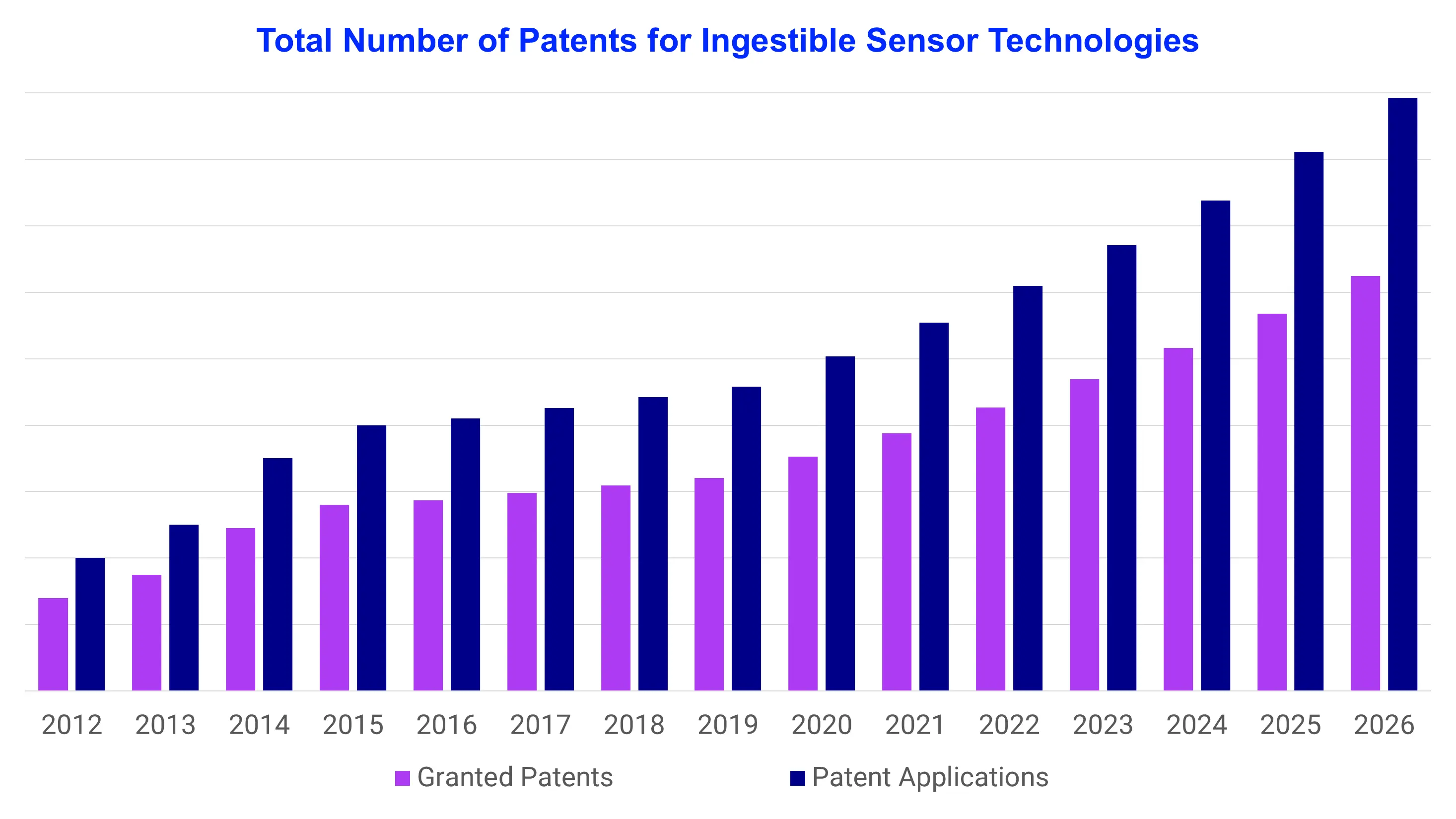
More than 1,700 patent families related to ingestible sensor technologies were identified across the landscape. Filing activity built steadily after 2015 and reached its peak between 2021 and 2024, when wireless power, miniaturised gas sensors and event marker electronics matured at the same time. The main technology clusters are capsule endoscopy imaging, ingestible event markers for medication adherence, gas and pH sensing capsules, pressure, motility and transit sensing, wireless power and data transmission from the gut, and biosensing for biomarkers and targeted drug release. Imaging and transmission claims account for the largest share of families, while gas and biosensing claims form the fastest growing group.
Rising clinical demand for non-invasive gut diagnostics and verified dosing has pushed companies to widen their patent coverage from capsule imaging into gas, motility and drug release sensing.
The report covers patent filings, granted patents and published applications related to ingestible sensor technologies across the United States, Europe, China, Japan, South Korea, India and international filings under the Patent Cooperation Treaty administered by WIPO. Market coverage extends to hospitals, gastroenterology clinics, pharmaceutical companies, clinical research organizations and home care settings, which are the main places where swallowable sensing devices are bought or used. The time frame includes historical filing activity and recent publications, so that early capsule endoscopy families and current gas sensing and adherence filings can be read together.
Technology scope spans sensors and sensor-bearing capsules, tablets and markers that are swallowed to measure conditions inside the body or to confirm medication ingestion. Sensor types covered are imaging sensors, pH and temperature sensors, gas sensors, pressure and motility sensors, and chemical and biochemical sensors. Applications include gastrointestinal diagnostics, medication adherence monitoring, core body temperature monitoring, drug delivery monitoring, and microbiome and biomarker sensing. Form factors range across swallowable capsule devices, pill-embedded sensor markers, tethered capsule devices, and smart pills with drug release, together with the wireless transmission and power systems that support them.
Entities in the landscape include large endoscopy and medical technology manufacturers, specialist capsule developers, pharmaceutical companies with digital medicine programmes, and electronics suppliers that provide sensors, batteries and radio chips. Start-ups working on gas sensing, ingestible biosensors and smart drug release capsules add a steady flow of new families. Academic and clinical institutions, including engineering schools and gastroenterology research centres, contribute early claims on novel sensing materials, localisation methods and clinical use. Contract research organizations and device testing groups appear less often as applicants but shape how these technologies are validated.
The report will cover the following sections in detail:
Analysis by Sensor Type
Analysis by Application
Analysis by Form Factor
Ingestible Sensor Technologies Patent Filing Trend Analysis
Annual patent filings in ingestible sensor technologies have grown in each year since 2015, with a clear step up after 2019. Early volume came mostly from capsule endoscopy imaging, which gave the field a stable base of families. Newer filings add layers around communication, power and sensing modalities, so the same device now carries claims from several clusters.
Annual filing growth between 2020 and 2024 is estimated at roughly 11 percent, a pace that is above the long-run rate for the field. Growth came from three sources: wider interest in gas and pH sensing after early human studies, renewed work on ingestion tracking following regulatory acceptance of digital pills, and a rise in wireless power and low-energy radio claims that serve every capsule type. Filings from China rose faster than the global average over the period, and European and United States applicants kept steady volumes.
Among the players with ingestible sensor technologies patent families, new entrants have been identified, which can be either established companies or startups developing novel technology in the field. Some of the major companies mentioned in this report (a non-exhaustive list) are as follows:
Medtronic holds one of the broadest portfolios in swallowable diagnostics, built largely around the PillCam capsule endoscopy family and the SmartPill wireless motility capsule that it inherited through its Covidien and Given Imaging lineage. The PillCam range covers small bowel, colon and oesophageal imaging, and the company's capsules have been used in millions of procedures worldwide. Its patents address image capture, low-power radio links, capsule localisation, and software that helps clinicians review long video sequences. Regulatory standing rests on FDA clearances and CE marking for several capsule systems, which supports hospital and gastroenterology clinic adoption. The company relies on a layered IP strategy that combines hardware claims with software and data handling claims, and it holds a strong commercial position in gastrointestinal imaging.
Olympus brings its long record in flexible endoscopy to ingestible sensing, with a portfolio centred on the EndoCapsule small bowel imaging system and its reading software. Patents cover capsule optics, illumination, image processing, and capsule position tracking, and the company has also published work on magnetically guided capsule movement. EndoCapsule is marketed in Japan, Europe and other regions, and the company works within the regulatory pathways of each market. Olympus tends to file broadly around imaging components that are shared across its endoscope and capsule lines, which gives its IP a platform character. Commercially, the company positions capsule devices as a complement to its conventional endoscopy base in hospitals and gastroenterology clinics.
Other companies include CapsoVision, Otsuka Pharmaceutical, and Atmo Biosciences.
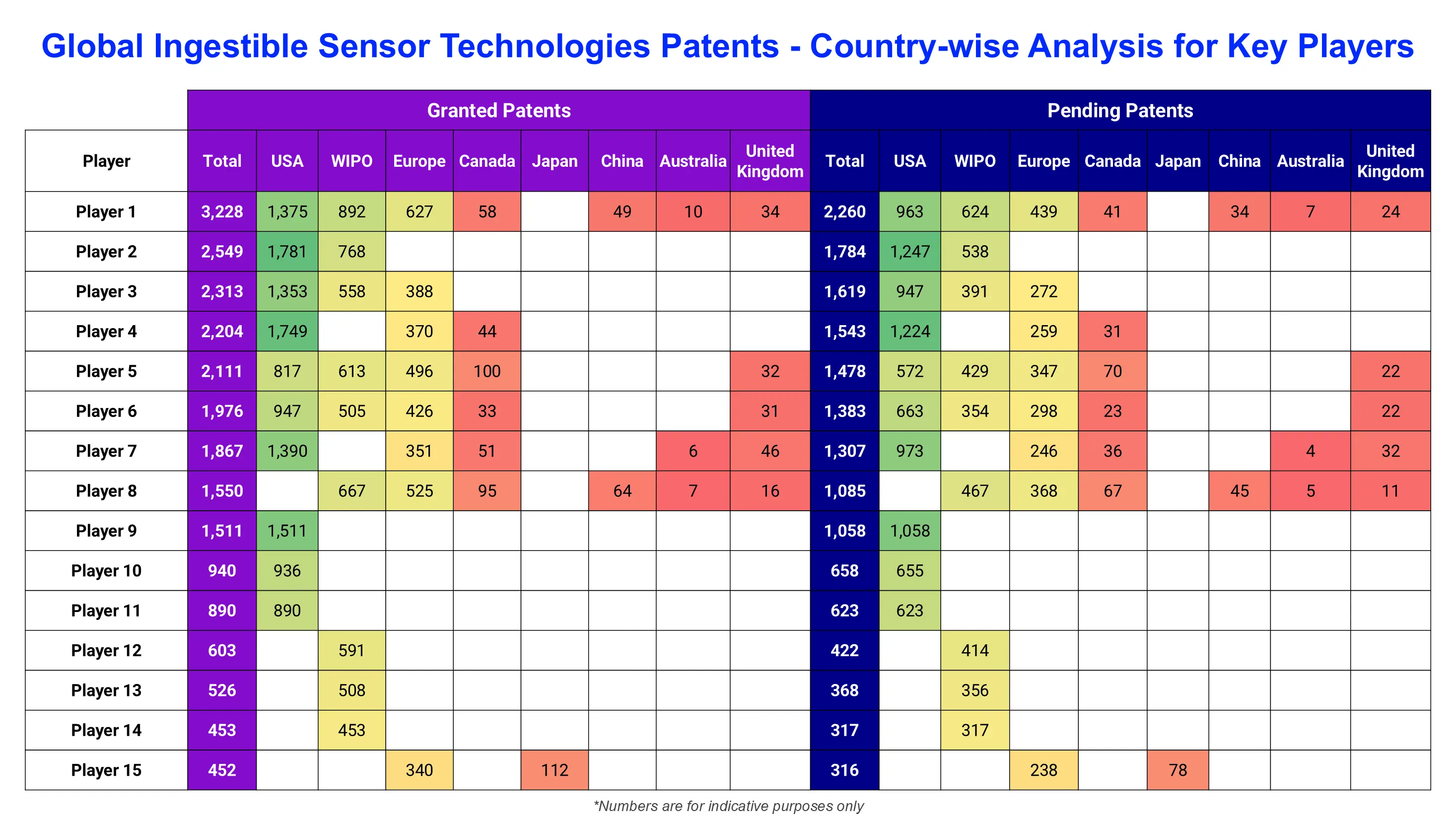
Assignee ownership in ingestible sensor technologies is concentrated among a small group of established device makers, with specialist and pharmaceutical applicants holding narrower but strategically important positions. Medtronic and Olympus hold large imaging and transmission portfolios that cover several product generations and rely on continuation filings to extend coverage. CapsoVision files around panoramic imaging and onboard image storage, which sets its capsule apart from wireless recorder systems. Otsuka Pharmaceutical holds claims tied to ingestion tracking within drug products. Atmo Biosciences concentrates on gas sensing capsules and related measurement methods. Together these five groups shape the main claim territories, while a long tail of start-ups and universities holds individual sensing concepts.
*Please note that this is only a partial list; the complete list of key players is available in the full report. Additionally, the list of key players can be customized to better suit your needs.*
The report assesses patent activity across major jurisdictions, including:
The United States leads in patent volume, supported by a large digital health sector, active venture investment and the commercial importance of FDA clearance. China ranks second and has grown quickly, helped by domestic capsule endoscopy manufacturers and strong electronics supply chains. Europe follows with a diverse group of applicants from Germany, the United Kingdom, the Netherlands and the Nordic countries, many linked to hospital research. South Korea contributes filings from electronics groups and university teams, India shows a smaller but growing base around low-cost capsule devices, and WIPO filings indicate the families that applicants intend to protect in several markets at once.
Read more about this report - REQUEST FREE SAMPLE COPY IN PDF
Patent activity in ingestible sensor technologies is concentrated in five technology segments:
Capsule endoscopy imaging systems lead patent activity because they have the longest commercial history, the broadest clinical use and the most active group of established applicants. Imaging claims also overlap with transmission, power and localisation claims, so each imaging family tends to be counted across several clusters. Gas sensing and biosensing are smaller, but their filing growth is faster as early clinical studies move towards wider use.
Competition in ingestible sensor technologies is structured around three groups. Established endoscopy and medical technology manufacturers defend large imaging portfolios and extend them with software and artificial intelligence image reading. Pharmaceutical and digital medicine companies protect ingestion tracking and drug release concepts tied to specific products. Specialist capsule developers compete through narrower claims on gas sensing, panoramic imaging or motility measurement. Cross-licensing and partnerships are common, because a complete capsule product needs optics, electronics, power, wireless links and clinical software that no single applicant fully owns.
Companies are focusing on:
Emerging themes include capsules that measure several variables at once, such as gas, pH, temperature and pressure, and use the combined signal to separate normal transit from disease patterns. Battery-free approaches that draw power from gastric fluid or from external fields are drawing attention, since battery size limits capsule design. Microbiome sampling, where a capsule collects fluid from a defined segment of the gut, is attracting claims from academic groups and start-ups. Tethered capsules for oesophageal screening, and sensor markers that report core body temperature, widen the field beyond conventional diagnostics.
The ingestible sensor technologies patent landscape maps how imaging, adherence, gas, motility and drug release claims overlap and where white space remains. Concentrated clusters such as capsule endoscopy imaging contrast with open areas in biochemical sensing and in power supply from the gut. Readers can compare the position of each assignee, the age of its families and the jurisdictions where it files, which makes it easier to judge freedom to operate and the direction of competitor investment.
The landscape provides actionable intelligence for the following uses:
Patent research was carried out across international patent databases, including those covering the United States, Europe, China, Japan, South Korea, India and WIPO. Search strategies combined keywords for ingestible, swallowable and capsule devices with sensor types and Cooperative Patent Classification codes for endoscopy, diagnostic sensing, drug delivery and wireless communication. Patent families were grouped so that each invention was counted once across jurisdictions.
Retrieved records were screened for relevance, and duplicate families and filings with no connection to ingestible sensor technologies were removed. Each remaining family was classified by sensor type, application, form factor, assignee, jurisdiction and technology cluster. Filing years, legal status and grant dates were used to separate pending applications from granted patents and to identify the most recent grant year.
Patent findings were read alongside market information on capsule endoscopy, adherence monitoring and gut function testing, including regulatory approvals, clinical programmes and company announcements. This allowed patent growth to be set against commercial and clinical activity in each segment. Assignee positions and jurisdiction patterns were then compared with end user adoption across hospitals, gastroenterology clinics, pharmaceutical companies, clinical research organizations and home care settings.


Upto 15% Off
USD
$2699 $2429
$4299 $3869
$5799 $4949
$6999 $5949


*While we strive to always give you current and accurate information, the numbers depicted on the website are indicative and may differ from the actual numbers in the main report. At Expert Market Research, we aim to bring you the latest insights and trends in the market. Using our analyses and forecasts, stakeholders can understand the market dynamics, navigate challenges, and capitalize on opportunities to make data-driven strategic decisions.*
EMR's Ingestible Sensor Technologies Patent Landscape Analysis provides a comprehensive assessment of patent filings, innovation clusters, assignee portfolios, and geographic filing patterns across the ingestible sensor technologies landscape. The report identifies 1,700+ patent families, evaluates leading jurisdictions including the United States, China, and Europe, and profiles the top assignees by portfolio size.
The global ingestible sensor technologies market was valued at USD 0.78 Billion in 2025. The market is projected to reach USD 3.69 Billion by 2035, expanding at a CAGR of 16.80% during 2026 - 2035.
The report analyses approximately 1,700+ patent families related to ingestible sensor technologies. These include filings from the United States, China, Europe, and international WIPO filings.
Key companies operating within the landscape include Medtronic, Olympus, CapsoVision, Otsuka Pharmaceutical, and Atmo Biosciences, among others. These organisations collectively account for a significant portion of patent activity analysed in this report.
The report evaluates patent activity across the United States, Europe, China, Japan, South Korea, India, and international WIPO filings. The United States is the leading jurisdiction in the ingestible sensor technologies patent landscape, with 650+ patents associated with it, which makes it the largest single jurisdiction ahead of China and Europe.
Yes. The report scope can be customised based on geography, technology segment, assignee selection, time period, or specific innovation cluster focus. Readers who want a customised study, such as a narrower technology cluster, a specific assignee set or an additional jurisdiction, can contact the Expert Market Research team to scope the work and agree the deliverables.
Patent landscape analysis helps organisations understand innovation trends, competitive activity, technology whitespace, and IP risk across a defined domain. For ingestible sensor technologies, this report supports strategic decisions in R&D prioritisation, licensing evaluation, competitive benchmarking, and market entry planning.
Explore our key highlights of the report and gain a concise overview of key findings, trends, and actionable insights that will empower your strategic decisions.
|
Scope of the Report |
Details |
|
Analysis by Sensor Type |
|
|
Analysis by ApplicationAnalysis by Application |
|
|
Analysis by Form Factor |
|
|
Analysis by End User |
|
|
Key Players Mentioned |
|
|
Geographies Covered |
|
Mini Report
One User
USD 2,699
USD 2,429
tax inclusive*
Single User License
One User
USD 4,299
USD 3,869
tax inclusive*
Five User License
Five User
USD 5,799
USD 4,949
tax inclusive*
Corporate License
Unlimited Users
USD 6,999
USD 5,949
tax inclusive*
*Please note that the prices mentioned below are starting prices for each bundle type. Kindly contact our team for further details.*
Flash Bundle
Small Business Bundle
Growth Bundle
Enterprise Bundle
*Please note that the prices mentioned below are starting prices for each bundle type. Kindly contact our team for further details.*
Flash Bundle
Number of Reports: 3
20%
tax inclusive*
Small Business Bundle
Number of Reports: 5
25%
tax inclusive*
Growth Bundle
Number of Reports: 8
30%
tax inclusive*
Enterprise Bundle
Number of Reports: 10
35%
tax inclusive*
How To Order

Select License Type
Choose the right license for your needs and access rights.

Click on ‘Buy Now’
Add the report to your cart with one click and proceed to register.

Select Mode of Payment
Choose a payment option for a secure checkout. You will be redirected accordingly.
Strategic Solutions for Informed Decision-Making
Gain insights to stay ahead and seize opportunities.

Get insights & trends for a competitive edge.

Track prices with detailed trend reports.

Analyse trade data for supply chain insights.

Leverage cost reports for smart savings

Enhance supply chain with partnerships.

Connect For More Information
Our expert team of analysts will offer full support and resolve any queries regarding the report, before and after the purchase.
Our expert team of analysts will offer full support and resolve any queries regarding the report, before and after the purchase.
We employ meticulous research methods, blending advanced analytics and expert insights to deliver accurate, actionable industry intelligence, staying ahead of competitors.
Our skilled analysts offer unparalleled competitive advantage with detailed insights on current and emerging markets, ensuring your strategic edge.
We offer an in-depth yet simplified presentation of industry insights and analysis to meet your specific requirements effectively.




