

Consumer Insights
Uncover trends and behaviors shaping consumer choices today
Procurement Insights
Optimize your sourcing strategy with key market data
Industry Stats
Stay ahead with the latest trends and market analysis.
The global airport information system market attained a value of USD 4.05 Billion in 2025 and is projected to expand at a CAGR of 3.50% through 2035. The market is further expected to achieve USD 5.71 Billion by 2035. The increased usage of biometric border controls is boosting the demand growth for integrated airport information systems that can seamlessly connect passenger identity verification with gate allocation and real-time flight status management.
Governments are instituting measures that require passenger data sharing between airlines and border agencies to be at a higher level. Moreover, airport operators are aiming to reduce aircraft turnaround times to enhance slot utilization. To meet these demands, tightly integrated information systems that can minimize manual coordination across terminals are necessary.
The airport information system market is evolving rapidly as operators digitize passenger flow management and airside coordination. In November 2024, SITA introduced its Smart Airport Operations Control Center platform integrating AI-driven decision support with real-time turnaround management. The system connects flight information display systems, baggage reconciliation, and resource allocation into one operational dashboard. According to the airport information system market analysis, over 75% of airlines are investing in advanced analytics for operational efficiency. This confirms that airport authorities are under pressure to modernize legacy information platforms.
Airports are no longer investing in standalone display or gate management software. They are demanding interoperable systems that sync with airline departure control systems and border control databases. For example, EU’s new digital Entry/Exit System (EES) launched in October 2025, replaced passport stamps with biometric entry/exit records for visitors. Vendors are responding with cloud-native architectures that support remote updates and predictive maintenance. Integration capability is now more important than hardware footprint. Moreover, parallel upgrades are underway at mid-sized regional airports, accelerating the airport information system market value. Several airports have been signing multi-year digital transformation contracts with system integrators aimed at reducing congestion and enhancing on-time performance. Vendors are focusing on securing long-term managed service agreements instead of one-time installations. This change is leading to recurrence revenue models; however, procurement cycles are becoming more complex than before.
Compound Annual Growth Rate
3.5%
Value in USD Billion
2026-2035
NATS launched its Intelligent Stand Manager digital tool, leveraging predictive analytics to optimize stand allocation and minimize aircraft turnaround delays. Vendors can develop AI-driven stand allocation modules, digital twin platforms, and integrated apron management systems, leveraging such developments in the airport information system market.
Chhatrapati Shivaji Maharaj International Airport introduced a digitally integrated Airport Operations Control Centre to enable real-time monitoring and faster operational response. Solution providers can, therefore, offer unified data platforms, advanced A-CDM dashboards, and cross-functional data orchestration tools.
Indira Gandhi International Airport deployed an AI-enabled airside management system to enhance ground movement efficiency, safety monitoring, and turnaround coordination. Companies can capitalize on this trend in the airport information system market by delivering AI-based surveillance analytics, predictive runway occupancy systems, and IoT-enabled airside monitoring solutions.
Adani Airports rolled out AVIIO, a real-time operations and passenger experience platform enhancing stakeholder collaboration and seamless airport journeys. Therefore, technology firms can also expand into passenger-centric information ecosystems, offering biometric integration, real-time passenger flow analytics, and omnichannel engagement platforms.
Airports are investing in centralized digital command platforms that merge multiple subsystems into one interface. In October 2024, Adani Airport Holdings partnered with Thales deploying Fly to Gate biometrics and planning APOC digital control centers to boost operations and passenger experience to include predictive stand allocation using machine learning. This airport information system market trend reduces ground delays during peak traffic windows. The Federal Aviation Administration continues to emphasize data modernization under its NextGen program, which encourages real-time data sharing between air traffic control and airports. Vendors are embedding API based architectures that allow seamless integration with airline systems. These developments are helping airports minimize disruption during irregular operations.
Passenger identity verification is moving beyond border checkpoints. In September 2025, Perth Airport partnered with Amadeus to launch Australia’s first end-to-end biometric check-in and boarding process for a seamless, contactless passenger journey. The Transportation Security Administration in the United States has expanded biometric pilot programs across major hubs. This expansion requires airport information systems to process identity credentials securely while syncing flight updates instantly, thereby opening up new airport information system market opportunities. Vendors are developing encrypted data pipelines and identity token management layers. These systems reduce queue times and enhance compliance reporting, which appeals strongly to airport operators managing growing international traffic volumes.
Cloud migration is reshaping airport IT architecture. Companies like Honeywell International Inc. are introducing scalable cloud platforms for passenger flow analytics. Airports are using sensor-driven dashboards to monitor security lane output and gate congestion. The United States Department of Transportation has supported infrastructure grants that include digital system upgrades within terminal renovation projects. In February 2026, AirportLabs exhibited its cloud-native aviation operations platforms at Passenger Terminal EXPO 2026, simplifying data and enhancing real-time efficiency. Cloud-native solutions reduce dependency on on-premise servers and allow faster deployment of new modules, redefining the airport information system market dynamics. Vendors are targeting subscription-based software licensing to ensure predictable income streams.
Baggage management systems are increasingly interconnected with flight information displays and mobile notifications. In March 2024, Siemens Logistics expanded its aviation data hub, AI baggage forecasting, and smart services to boost digitalization and sustainable airport operations. Airports face pressure to minimize the number of mishandled baggage cases. Global airline operational data reveals that baggage mishandling continues to be a significant cost factor for carriers. Therefore, vendors are concentrating on real-time tracking and exception alerts. The integration between baggage reconciliation systems and passenger apps is becoming a norm in new terminal projects, broadening the airport information system market scope.
Cybersecurity issues are being prioritized as airport information systems become extensively integrated. In June 2025, Indra partnered with Finavia to implement its cloud-based A-CDM/AOP platform, improving safety, flight predictability, and operational efficiency. The Cybersecurity and Infrastructure Security Agency in the United States has provided guidelines to critical infrastructure operators, airports included, accelerating the airport information system market value. Vendors are integrating continuous monitoring tools, as well as encrypted communication layers, into information systems.
Read more about this report - REQUEST FREE SAMPLE COPY IN PDF
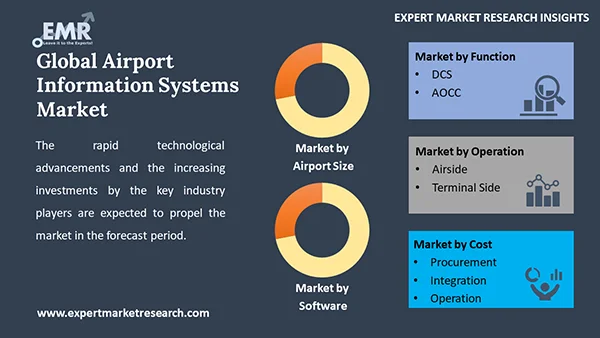
The EMR’s report titled “Global Airport Information System Market Report and Forecast 2026-2035” offers a detailed analysis of the market based on the following segments:
Market Breakup by Type
Key Insight: Terminal side systems dominate the airport information system market dynamics because passenger movement, retail optimization, and compliance drive immediate returns. Airside platforms are gaining momentum with operational efficiency mandates and safety upgrades. In October 2025, ADB SAFEGATE introduced new AI-driven airside digitalization tools, strengthening apron operations, safety automation, and predictive performance analytics for airports.
Market Breakup by System
Key Insight: AOCC systems account for the leading position in the airport information system market through centralized operational visibility. Passenger check-in and boarding is growing with automation. Cargo handling, flight dispatch, maintenance management, and crew management systems support specialized coordination. DCS and FIDS remain core communication tools, while weather monitoring strengthens safety planning. Each system category contributes differently but relies on deep integration. The competitive edge lies in interoperability and predictive analytics rather than isolated modules.
Market Breakup by Airport
Key Insight: Class A airports capture a substantial share of the airport information system market due to their operational scale and complexity, requiring highly integrated and data-intensive systems. Class B airports are steadily expanding through phased modernization initiatives and digital upgrades. In September 2023, Airports Authority of India inducted two advanced B-360 aircraft into its flight inspection fleet to enhance navigational aid calibration and safety. Meanwhile, Class C and D airports focus on selective adoption of digital tools aimed at improving efficiency and cost control. Investment intensity typically aligns with passenger traffic volumes and regulatory requirements. Larger hubs prioritize fully integrated technology ecosystems, whereas smaller airports prefer modular, scalable platforms.
Market Breakup by Investment
Key Insight: As per the airport information system market report, brownfield projects keep on being the majority of projects because most airports are replacing the equipment of their control rooms, such as display systems and databases, without closing their operations. These projects require releasing the phases one by one and close coordination with the vendors. Greenfield projects are growing since at times new regional airports and secondary hubs with digital-first concepts are being constructed.
Market Breakup by Cost
Key Insight: Operating costs largely determine decision-making as airports are more focused on sustainable performance rather than on short-term savings. The costs of integration go up as the systems become more complex and as the need to communicate between different platforms increases, accelerating the airport information system market penetration. Authorities are focusing on total cost of ownership models when they are considering granting approvals. Vendors who can reduce the complexity of integration and at the same time lower exposure to maintenance have a chance of winning stronger credibility.
Market Breakup by Application
Key Insight: Passenger information sustains its dominance within the airport information system market dynamics because communication efficiency directly shapes experience and revenue flow. Security is expanding rapidly under regulatory scrutiny and risk management priorities. In January 2026, Macau International Airport introduced the MIA One ID smart security and boarding service using facial recognition for seamless, paperless passenger processing. Finance, maintenance, and ground handling systems support internal coordination and operational continuity. Each application serves a distinct function, yet all depend on reliable data exchange. Airports are aligning these modules into cohesive ecosystems rather than isolated tools. The segmentation highlights how visible passenger-facing platforms coexist with critical backend systems.
Market Breakup by End Use
Key Insight: Passenger systems anchor majority of the demand in the airport information system market because they directly impact revenue and brand perception. Non-passenger systems expand with automation and performance optimization goals. Both segments are interdependent. Passenger experience cannot improve without strong backend coordination. Airports are gradually merging these layers into unified dashboards that provide holistic oversight. End-use segmentation shows how commercial and operational objectives intersect within airport information strategies. Long-term competitiveness depends on balancing front-end innovation with robust internal process management.
Market Breakup by Region
Key Insight: North America is at the forefront with structured modernization and regulatory stability. Asia Pacific is the fastest growing region through infrastructure expansion and transit hub ambitions. Europe gives priority to compliance-driven upgrades and sustainability alignment. Latin America and the Middle East and Africa are focusing on targeted investments in line with tourism growth and national aviation strategies. Regional segmentation as considered in the airport information system market report, mirrors the variations in funding models, regulatory maturity, and passenger growth trajectories. Vendors should tailor their products to local procurement procedures and infrastructure priorities.
By type, terminal side dominates the market due to passenger digitalization investments
Terminal side systems represent the largest share as airports put passenger experience and output optimization at the forefront. To prevent overcrowding during peak hours, operators are updating check-in, boarding, and real-time display platforms. Terminal information systems are thus combining biometric validation, self-bag drop, and dynamic gate allocation facilities. Airports reckon these investments as their lock-in mechanism of revenues because delays and inefficiencies in passenger flow impact retail and concession revenues significantly. Vendors are incorporating predictive analytics into terminal dashboards so that airport managers can see the formation of queues beforehand. In January 2026, Kempegowda International Airport announced plans to introduce an automated people mover for seamless inter-terminal transfers, becoming India’s first.
Airside systems constitute the fastest-growing area of the type segment in the airport information system market. This is mainly because the former emphasizes aircraft turnaround time and apron safety. Instantaneous stand allocation systems and electronic apron management are two of the solutions that are being leveraged to decrease the aircraft's idle time. Vendors are thus working on a set of integrated airside dashboards interfacing with both air traffic data feeds and ground handling systems. Airports have the responsibility of significantly improving on-time performance, especially in cases where slot penalties are strict.
By system, Airport Operation Control Centre accounts for the largest market share through centralized oversight
AOCC platforms lead the system segment because they unify operational data into a single command interface. Airports use AOCC solutions to coordinate flights, gates, resources, and emergency responses in real time. Vendors are offering modular architectures that connect flight data, baggage tracking, and security alerts. Decision support engines now simulate delay scenarios and recommend corrective actions. Airport authorities prefer centralized visibility to minimize disruption during irregular operations. Integration with national aviation authorities’ data systems is often required.
Passenger check-in and boarding systems are expanding their shares in the airport information system market due to automation and self-service adoption. Airports are deploying biometric kiosks and touchless boarding gates that connect directly with departure control databases. Vendors are enhancing mobile integration so boarding passes sync with digital identity verification. These systems reduce staffing pressure and accelerate output. Airlines favor digital boarding analytics to monitor load factors and late arrivals in real time. In April 2025, Collins Aerospace launched its integrated self-service check-in and baggage drop solution, enhancing passenger autonomy and streamlining airport output.
By airport, Class A airports secure the leading position in the market due to international traffic volume
Class A airports hold dominance in the airport information system market share because they manage high passenger volumes and international operations. These hubs require advanced integrated information platforms to coordinate multiple terminals and long-haul carriers. Investments focus on scalable digital dashboards and redundancy systems. Vendors target these airports with enterprise-grade cybersecurity layers and predictive analytics modules. Class A facilities often pilot new technologies before broader deployment. Complex slot management and regulatory oversight make advanced systems essential. In February 2026, SITA unveiled its API to alert airlines and airports earlier about potential delays, boosting proactive disruption management and efficiency.
Class B airports are also contributing to the airport information system market revenue due to better regional connectivity. Majority of these airports are refurbishing their old facilities to meet the increasing demand for domestic trips. Sellers recognize a chance for modular systems which are scalable without significant changes to the building structure. The emphasis of digitization is on enhancing operational efficiency without heavy investment. Class B airports are attempting to attract new entrants in the airline market by offering reduced turnaround times and efficient passenger flow management.
By investment, the brownfield category dominates the global industry due to legacy system upgrades
Brownfield projects register the dominant share of the airport information system market as many airports modernize existing terminals. Operators seek to replace fragmented legacy systems without halting operations. Vendors design phased migration strategies that minimize disruption. Integration complexity is high because older databases and hardware must remain functional during transition. Brownfield upgrades often prioritize interoperability and cybersecurity enhancements. The Indian government announced plans to undertake 50 airport development projects, including new builds and major upgrades, to bolster aviation and connectivity in April 2025.
Greenfield investments are also gaining momentum with new airport construction projects. These facilities can implement fully digital architectures from inception. Vendors integrate AOCC, biometric, and passenger flow systems into master planning stages. Greenfield projects allow airports to avoid legacy integration challenges. This segment drives demand for advanced design consulting and system customization.
By cost, the operating cost category accounts for the dominant share due to lifecycle management priorities
Operating cost remains the dominant consideration because airport authorities think beyond installation. They are looking to secure business with long-term maintenance contracts, software updates, cybersecurity monitoring, and staffing efficiency. Vendors come up with managed service agreements and predictive maintenance dashboards that effectively reduce unplanned downtime. Remote diagnostics and centralized monitoring tools allow a reduction in the number of field service visits. Airports also assess energy consumption tied to server rooms and display systems. In October 2025, SITA and Maureva introduced AeroCost Manager, an automated cost-control platform centralizing airline operating cost validation and fraud detection.
Integration cost is increasing its share in the airport information system market as airports connect legacy baggage, security, airline, and border databases into unified dashboards. Interoperability requires API development, middleware configuration, and strong cybersecurity validation. Many older systems were not designed for open architecture. Vendors must now deliver customized connectors and data translation layers. This complexity pushes consulting and system integration revenues higher. Airports are also demanding real-time synchronization between mobile apps and internal control centers.
By application, passenger information registers the largest share of the market through digital passenger engagement strategy
Passengers' information systems continue to be one of the most important aspects as they have a direct influence on traveler satisfaction and finally the airport revenue performance. Real-time flight updates, gate changes, and multilingual announcements tremendously help in reducing passenger confusion and thus improving terminal circulation flows. Additionally, vendors are upgrading the display system staff to synchronize their mobile so that the passengers receive the same updates on the apps and kiosks. Integration with airline databases guarantees consistency of data across channels. Airports consider accurate passenger communication as a key factor for times of delays or bad weather. In October 2025, Indira Gandhi International Airport launched digital e-arrival cards for foreign travelers, reducing paperwork and speeding immigration processing.
Security applications are largely driving the airport information system market growth as compliance requirements tighten across international aviation markets. Airports are integrating surveillance analytics, access control logs, and incident management dashboards into central information systems. Vendors are embedding AI-based anomaly detection tools to support faster response times. Regulatory agencies increasingly expect real-time reporting and audit trails. Digital security platforms now connect with passenger identity systems and boarding validation tools.
By end use, passenger systems account for the bigger market share through revenue-driven service optimization focus
Passenger systems emerge to be the largest segment of the airport information system market as airport commercial success is heavily driven by passenger volume and overall traveler satisfaction. These systems manage check-in, boarding, flight display, and digital notifications. Vendors are embedding biometric authentication and mobile identity tools in passenger-facing platforms. Airports use these systems to keep flows predictable and minimize congestion in peak hours. Retail and concession sales depend on how easily passengers go through terminals. In November 2024, SITA integrated IPS Intelligent Passenger Solutions, creating a unified, end-to-end digital passenger processing platform to boost airport efficiency.
Non-passenger systems are becoming a significant segment of the airport information system market as more airports focus on automating the backend of the operations. Data is being increasingly used for resource allocation, maintenance scheduling, and airside logistics. Vendors give equipment servicing forecasting predictive analytics for better crew deployment. Integration with finance and procurement modules enhances management. These systems which are invisible to travelers have a strong impact on operational reliability. Airports which are geared towards improving turnaround times and wastage mitigation are rapidly backend digitalization.




North America clocks in the largest market share through structured modernization and compliance upgrades
North America remains the leading regional airport information system market as a result of continued upgrades of the main hubs and strict regulatory oversight. The region's airports are upgrading to integrated operational platforms as they are slowly leaving behind the old, fragmented legacy systems. There is a great emphasis on the procurement processes regarding cybersecurity certification and long-term vendor accountability. Digital transformation initiatives are being supported by stable funding mechanisms and public-private partnerships.
Asia Pacific is the region that exhibits the fastest growth in the airport information system market. This is mainly because new airports as well as expansion of terminals are increasing the capacity of local airports in developing economies. Governments are incorporating digital infrastructure in the master airport plans starting from the earliest design stage. Vendors are coming up with scalable cloud-based platforms that are capable of handling high passenger growth environments. Competition among the players in the aviation markets in the region is one of the reasons for rapid technology adoption. The Indian Prime Minister opened the new Hirasar Greenfield Airport in July 2025, boosting regional connectivity and economic growth.
The global market is moderately concentrated, however, competition is getting fierce as airports prefer unified digital ecosystems to separate software modules. Most of the airport information system market players are essentially developing integrated Airport Operations Control Centers to collectively manage flight data, resource allocation, passenger flow analytics, and security alerts into single dashboards. Cloud-native deployment models are taking the center stage, especially for mid-sized airports that want to scale up without heavy on-site infrastructure requirements. Moreover, cybersecurity certification and data governance compliance are major factors behind the brand choice, particularly in North America and Europe.
Airport information system companies are integrating AI engines that can predict gate conflicts, baggage congestion, and crew shortages such that the disruptions do not escalate. Instead of one-time system installations, long-term managed service contracts are being introduced. Players that can prove capabilities of interoperability with airline DCS platforms and border control systems are securing multi-year tender agreements.
ADB SAFEGATE was founded in 1920, and its main office is located in Belgium. The company delivers integrated airside and tower information solutions. ADB SAFEGATE focuses on providing advanced surface movement guidance and digital apron management platforms. The company helps airports that want tighter coordination between runway lighting, surveillance data, and operations control systems.
Amadeus IT Group SA was established in 1987 with its headquarters in Madrid, Spain. The company is a vendor of passenger processing and airport IT platforms. Amadeus packaged biometric boarding, departure control, and cloud-based check-in systems, boosting the airport information system market growth. Airports and airlines that want smooth passenger journeys and centralized data management are supported by this company.
Raytheon Technologies Corporation was founded in 1922, and it is based in the United States. The company is a vendor of air traffic management and surveillance systems. It bundles radar data and airport operational dashboards. Solutions from this company lead to improved situational awareness and better coordination between airport authorities and national aviation regulators.
Damarel Systems International Ltd. was established in 1998 with its offices in England, United Kingdom. The company is a specialist in the provision of flight information display and airport resource management systems. Damarel provides modular software that can be integrated with airline departure platforms. Its customers are regional and international airports that are looking for affordable ways to modernize their facilities.
*Please note that this is only a partial list; the complete list of key players is available in the full report. Additionally, the list of key players can be customized to better suit your needs.*
Other key players in the report include INFORM GmbH, among others.
Unlock the latest insights with our airport information system market trends 2026 report. Discover regional growth patterns, consumer preferences, and key industry players. Stay ahead of competition with trusted data and expert analysis. Download your free sample report today and drive informed decisions in the market.


Upto 15% Off
USD
$2499 $2249
$3999 $3599
$4999 $4249
$5999 $5099


*While we strive to always give you current and accurate information, the numbers depicted on the website are indicative and may differ from the actual numbers in the main report. At Expert Market Research, we aim to bring you the latest insights and trends in the market. Using our analyses and forecasts, stakeholders can understand the market dynamics, navigate challenges, and capitalize on opportunities to make data-driven strategic decisions.*
In 2025, the market reached an approximate value of USD 4.05 Billion.
The market is projected to grow at a CAGR of 3.50% between 2026 and 2035.
The market is estimated to witness healthy growth in the forecast period of 2026-2035, reaching a value of around USD 5.71 Billion by 2035.
Investing in interoperable platforms, expanding cybersecurity capabilities, forming airline technology partnerships, adopting subscription service models, and developing scalable cloud architectures are strengthening competitive positioning in airport information markets.
The key market trends include the increasing penetration of information technology and growing passenger traffic.
The market is broken down into North America, Europe, Asia Pacific, Latin America, the Middle East, and Africa.
The various types of systems in the market include knowledge-based CDSS and non-knowledge CDSS.
By system, the market is divided into airport operation control centre (AOCC) and departure control system (DCS).
The various airport classifications in the market include Class A, Class B, Class C, and Class D.
The various investments in the market include greenfield and brownfield.
Costs in the market include operating cost, procurement cost and integration cost.
Based on application, the market is broken down into finance and operation, maintenance, ground handling, security, and passenger information.
The primary end-uses in the market include passenger system, and non-passenger system.
The key players in the market include ADB SAFEGATE, Amadeus IT Group SA, Raytheon Technologies Corporation, Damarel Systems International Ltd., and INFORM GmbH, among others.
System interoperability with legacy infrastructure, rising cybersecurity risks, long procurement cycles, regulatory compliance complexity, and integration delays are challenging vendors seeking scalable, profitable airport information system deployments globally.
Explore our key highlights of the report and gain a concise overview of key findings, trends, and actionable insights that will empower your strategic decisions.
| REPORT FEATURES | DETAILS |
| Base Year | 2025 |
| Historical Period | 2019-2025 |
| Forecast Period | 2026-2035 |
| Scope of the Report |
Historical and Forecast Trends, Industry Drivers and Constraints, Historical and Forecast Market Analysis by Segment:
|
| Breakup by Type |
|
| Breakup by System |
|
| Breakup by Airport |
|
| Breakup by Investment |
|
| Breakup by Cost |
|
| Breakup by Application |
|
| Breakup by End Use |
|
| Breakup by Region |
|
| Market Dynamics |
|
| Competitive Landscape |
|
| Companies Covered |
|
Datasheet
One User
USD 2,499
USD 2,249
tax inclusive*
Single User License
One User
USD 3,999
USD 3,599
tax inclusive*
Five User License
Five User
USD 4,999
USD 4,249
tax inclusive*
Corporate License
Unlimited Users
USD 5,999
USD 5,099
tax inclusive*
*Please note that the prices mentioned below are starting prices for each bundle type. Kindly contact our team for further details.*
Flash Bundle
Small Business Bundle
Growth Bundle
Enterprise Bundle
*Please note that the prices mentioned below are starting prices for each bundle type. Kindly contact our team for further details.*
Flash Bundle
Number of Reports: 3
20%
tax inclusive*
Small Business Bundle
Number of Reports: 5
25%
tax inclusive*
Growth Bundle
Number of Reports: 8
30%
tax inclusive*
Enterprise Bundle
Number of Reports: 10
35%
tax inclusive*
How To Order

Select License Type
Choose the right license for your needs and access rights.

Click on ‘Buy Now’
Add the report to your cart with one click and proceed to register.

Select Mode of Payment
Choose a payment option for a secure checkout. You will be redirected accordingly.
Strategic Solutions for Informed Decision-Making
Gain insights to stay ahead and seize opportunities.

Get insights & trends for a competitive edge.

Track prices with detailed trend reports.

Analyse trade data for supply chain insights.

Leverage cost reports for smart savings

Enhance supply chain with partnerships.

Connect For More Information
Our expert team of analysts will offer full support and resolve any queries regarding the report, before and after the purchase.
Our expert team of analysts will offer full support and resolve any queries regarding the report, before and after the purchase.
We employ meticulous research methods, blending advanced analytics and expert insights to deliver accurate, actionable industry intelligence, staying ahead of competitors.
Our skilled analysts offer unparalleled competitive advantage with detailed insights on current and emerging markets, ensuring your strategic edge.
We offer an in-depth yet simplified presentation of industry insights and analysis to meet your specific requirements effectively.




