

Consumer Insights
Uncover trends and behaviors shaping consumer choices today
Procurement Insights
Optimize your sourcing strategy with key market data
Industry Stats
Stay ahead with the latest trends and market analysis.
The Asia Pacific industrial gases market, valued at USD 34.22 Billion in 2025, is projected to grow at a CAGR of 5.46% during 2026-2035, reaching USD 58.23 Billion by 2035.
Compound Annual Growth Rate
5.46%
Value in USD Billion
2026-2035
With increasing investments by governments and FII in electronics, packaging, and beverage manufacturing there is a rapid rise in the production of industrial gases across these sectors. Many industrial gases like oxygen act as a lifeline for industries which involve combustion. Recent advancements in technology and new industry openings across different sectors are boosting the Asia Pacific industrial gases market.
India and China ranked in the top 3 in terms of land area in the Asia-Pacific, with about 50-60% of this land being used for agricultural practices. Fertiliser is one such key element that plays an important role in this agricultural sector. Hydrogen gas acts as an active ingredient in the manufacturing of fertilisers, thus generating demand for industrial gases in the Asia Pacific.
Companies can now benefit from schemes like Make in India and the 2030 hydrogen mission in the Asia Pacific, allowing companies to use incentives for better production capability and price positioning in the market.
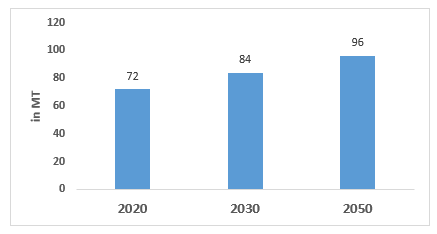
DEMAND OF NITROGEN IN ASIA PACIFIC FORECAST (STATED POLICIES SCENARIO) 2020-2050
Messer completed the acquisition of WKS Group in Singapore and Malaysia and announced agreements to acquire Wipco and Kobewel in Malaysia. WKS operates packaged-gas filling stations, dissolved-acetylene plants, cylinder depots and distribution networks serving industrial customers, including the marine and offshore sectors. The transactions significantly expand Messer’s Southeast Asian footprint and strengthen its local production and distribution capabilities across industrial, specialty and packaged gases. The expansion strengthens regional supply infrastructure and increases Messer’s capacity to serve industrial-gas customers across Southeast Asia.
Air Liquide signed a long-term agreement with SK hynix to supply gases for its new advanced packaging and testing facility in Cheongju, South Korea. Air Liquide will invest nearly €200 million to build and operate a state-of-the-art nitrogen production unit for SK hynix’s P&T7 facility. The project is designed to support production of high-bandwidth memory used in artificial-intelligence applications, with operations planned for late 2027. The project is increasing demand for ultra-high-purity nitrogen and strengthening the industrial-gas sector’s role in Asia’s expanding semiconductor manufacturing ecosystem.
Air Liquide announced a €200 million investment to build and operate two new industrial-gas production units in Hiroshima, Japan, under a long-term agreement with a global semiconductor manufacturer. The facilities will supply large volumes of ultra-high-purity nitrogen, oxygen and argon for advanced semiconductor production, particularly next-generation chips supporting artificial intelligence applications. Operations are scheduled to begin by the end of 2028, expanding Air Liquide’s dedicated semiconductor gas infrastructure in Japan. The investment is expanding high-purity gas production capacity and creating additional demand from Japan’s advanced semiconductor manufacturing sector, thus shaping new trends in the Asia Pacific industrial gases market.
INOX Air Products began construction of a ₹500-crore electronic specialty gas hub at Dholera, Gujarat, designed to support India’s growing semiconductor and electronics manufacturing ecosystem. The facility is intended to strengthen domestic availability of specialty gases required by high-tech manufacturing operations. The project forms part of India’s broader semiconductor-development push and represents an expansion beyond conventional bulk industrial gases into higher-value electronic and specialty gas applications. The investment is strengthening India’s domestic specialty-gas supply chain and opening new growth opportunities for high-purity gases used in semiconductor and electronics production.
A major Asia Pacific trend is the localisation of ultra-high-purity industrial gas production alongside semiconductor manufacturing facilities. Modern chip fabrication facilities need highly reliable sources of nitrogen, oxygen, argon, hydrogen, and specialty gases, leading to increased demands for proximity and purity. In July 2026, Air Products San Fu inked a deal for expansion of its gas supply infrastructure at new semiconductor fabrication plants and advanced package manufacturing sites in Taiwan, thanks to increased demands from AI and high-performance computing facilities. Air Liquide too is building carrier-gas plants in Singapore for semiconductor firms. These developments are shifting industrial-gas suppliers from conventional bulk delivery towards dedicated, long-term, fab-linked infrastructure.
Industrial-gas companies are increasingly building, owning and operating production units directly at customer sites rather than relying primarily on transported cylinders or bulk deliveries. This model provides semiconductor manufacturers with continuous supply while reducing logistics risks and maintaining stringent purity requirements. Linde’s April 2025 agreement with Samsung provides a clear example. Linde is adding an eighth on-site air separation unit at Samsung’s Pyeongtaek complex to supply nitrogen, oxygen and argon, alongside hydrogen from existing facilities, with supply scheduled from mid-2026. Such arrangements create long-duration customer relationships and make industrial gases an integral part of semiconductor plant infrastructure rather than simply an input material.
India’s semiconductor manufacturing push is creating a new demand centre for electronic-grade industrial and specialty gases. Rather than depending entirely on imported materials, suppliers are beginning to establish domestic purification, packaging and logistics capabilities. A major investment initiative worth ₹500 crore was announced by INOX Air Products in October 2025 for Dholera, Gujarat, which comprises an Electronic Specialty Gas Hub along with increased capacity for gas purification and import-oriented logistics. It is expected that the plant will provide ultra-pure nitrogen, oxygen, argon and hydrogen for use in the production of semiconductors and OSATs. This signals a broader transition in India from conventional industrial-gas consumption towards locally produced, semiconductor-grade gases supporting a developing electronics manufacturing ecosystem, thereby augmenting the growth of the Asia Pacific industrial gases market.
AI processors and advanced-node chips are creating demand not only for traditional bulk gases but also for highly specialised gas molecules used during semiconductor fabrication. According to Air Liquide, it has expanded its capabilities in Asia through the establishment of plants and contract agreements aimed at improving the production of advanced semiconductors. For instance, Air Liquide has established plants that supply critical molecules such as diborane in South Korea. These molecules are responsible for modifying the electrical properties of silicon used in semiconductor devices. In China, Air Liquide has signed 2025 agreement to supply nitrogen along with hydrogen. The trend is therefore broadening the Asia Pacific industrial-gas opportunity from volume-based atmospheric gases toward higher-value electronic specialty gases.
Industrial-gas suppliers are increasingly responding to supply-chain resilience requirements by expanding production within major Asian manufacturing clusters. This is particularly evident where semiconductor, electronics and advanced manufacturing supply chains are being diversified. Air Liquide’s 2025 investments in Singapore and China demonstrate this approach: the company is establishing additional local production for semiconductor customers, while its Singapore facilities incorporate automation and predictive-maintenance capabilities. Linde has similarly expanded its Asian electronics footprint, including South Korea and Taiwan. The emphasis is shifting from simply supplying gases at competitive prices to guaranteeing continuity, purity and operational reliability through geographically closer production assets and long-term contracts.
As Asia Pacific contains the 3 major fastest economies of the world, there is rapid growth in the number of industries in the manufacturing sector. With an increasing demand for superior processes across these manufacturing companies, there is a significant increase in the use of industrial gases.
Incentive schemes by Governments act as fillers for companies to increase their production capacity and reach net zero emission levels. In Asia Pacific, the industrial gas market is driven by advancements in manufacturing processes and sustainability.
Asia Pacific Industrial Gases Market Report and Forecast 2026-2035 offers a detailed analysis of the market based on the following segments:
Market Breakup by Type
Market Breakup by Application
Market Breakup by Supply Mode
Market Breakup by Country
With recent advancements in manufacturing space, there is a need for specialized gases like argon, carbon dioxide, and nitrogen in industries like semiconductors, food beverages and others boosting the Asia Pacific industrial gases market growth.
Argon and carbon dioxide play an important role in welding applications, as they act as shielding agents due to their inert nature.
Oxygen plays a crucial role in steel manufacturing as it provides better combustion, increasing the efficiency of the overall process.
Nitrogen, due to its inert nature, is best suited for the deposition process for producing high-quality semiconductors. With the increase in demand for carbonated beverages, carbon dioxide finds its application in wine, beer, and soda beverages.
The Asia Pacific industrial gases market growth is propelled by the manufacturing sector, where these gases are crucial for maintaining precise conditions, improving safety, and optimizing production processes across diverse industries.
Industrial gases find their application in cryogenic cooling, purging, and welding applications across various industries.
Governments across countries are looking to further reduce emissions by introducing new regulations. With strict norms, companies have started to look for alternatives, and hydrogen, due to its abundance, is the best alternative available on the market. The rising demand for a sustainable future is attributable to the growth of the industrial gas market in Asia and the Pacific.
The Asia Pacific industrial gases market share is boosted by the advancements in technology and modernising of the traditional distribution channel.
Certain industries require on-time delivery of gases, so they prefer to have onsite production as any delay in delivery of gases can hamper the whole manufacturing process.
Manufacturing industries across different sectors don't have specialised gas production, and they require huge volumes of gases to perform certain production processes. All these factors are promoting the growth of the industrial gas market in Asia and the Pacific.
With rapid economic growth in this region, fuelled by the economic growth of companies like India, China, Japan, and ASEAN nations, there is rapid industrialization in this region, with many companies opening their manufacturing plants across the region. The industrial gas market is expanding at a rapid pace due to its application in these industries.
According to the IEA, Asia Pacific produces 1649.71 MT of carbon dioxide emissions through natural gas. As of 2021, high levels of carbon emissions contribute significantly to rising temperatures in this region. Hydrogen can reduce this emission by reducing the carbon footprint in this region.
Asia Pacific industrial gases market development is supported by strong government policies and investments with a vision to become net zero are creating a strong push for green hydrogen production in this region.
Market players are driving Asia Pacific industrial gases market growth by offering air-conditioning devices at competitive pricing and offering additional health benefits to their consumers.
Linde plc., founded in 1879, has its headquarters in the United Kingdom and serves customers with its industrial gases across healthcare, petroleum refining, manufacturing, food, beverage carbonation and water treatment industries.
Messer Asia Pacific, Inc., established in 1898, and headquartered in Bad Soden, Germany, supplies various industrial gases including oxygen, nitrogen, argon, carbon dioxide, hydrogen, helium, and shielding gases for industrial applications.
Matheson Tri-Gas was established in 1927 having its headquarters in the United States supplies industrial gases for various industries including medical, chemical, and electronic manufacturers.
Air Products and Chemicals, Inc., established in 1940, is headquartered in the United States. Offering a variety of industrial gas options from generalized gases to on-demand specialized gases
*Please note that this is only a partial list; the complete list of key players is available in the full report. Additionally, the list of key players can be customized to better suit your needs.*
Other Asia Pacific industrial gases market key players are L’AIR LIQUIDE S.A, Iwatani Corporation, and Nippon Sanso Holding Corporation among others.


Upto 15% Off
USD
$2499 $2249
$3999 $3599
$4999 $4249
$5999 $5099


*While we strive to always give you current and accurate information, the numbers depicted on the website are indicative and may differ from the actual numbers in the main report. At Expert Market Research, we aim to bring you the latest insights and trends in the market. Using our analyses and forecasts, stakeholders can understand the market dynamics, navigate challenges, and capitalize on opportunities to make data-driven strategic decisions.*
The market was valued at USD 34.22 Billion in 2025.
The market is projected to grow at a CAGR of 5.46% between 2026 and 2035.
The revenue generated from the industrial market in Asia Pacific is expected to reach USD 58.23 Billion in 2035.
Technological innovations and advancements, hydrogen as a green fuel, disinfecting agents, and medical applications are key factors driving the industrial market growth.
The industrial gas market is categorized based on the supply mode into packaged, bulk, and on-site supply modes.
The key players in the Asia Pacific market are Linde plc., Messer Asia Pacific, Inc., Matheson Tri-Gas, Air Products and Chemicals, Inc., L’AIR LIQUIDE S.A, Iwatani Corporation, and Nippon Sanso Holding Corporation among others.
The market is broken down into China, Japan, India, ASEAN, and Australia, among others.
Based on the application in the industry the industrial gases found their application in manufacturing, metallurgy, energy, healthcare, chemicals, and others.
Based on the type, industrial gases are divided into nitrogen, oxygen, carbon dioxide, argon, hydrogen and others.
Explore our key highlights of the report and gain a concise overview of key findings, trends, and actionable insights that will empower your strategic decisions.
| REPORT FEATURES | DETAILS |
| Base Year | 2025 |
| Historical Period | 2019-2025 |
| Forecast Period | 2026-2035 |
| Scope of the Report |
Historical and Forecast Trends, Industry Drivers and Constraints, Historical and Forecast Market Analysis by Segment:
|
|
Breakup by Type |
|
| Breakup by Application |
|
| Breakup by Supply Mode |
|
| Breakup by Region |
|
| Market Dynamics |
|
| Competitive Landscape |
|
| Companies Covered |
|
Datasheet
One User
USD 2,499
USD 2,249
tax inclusive*
Single User License
One User
USD 3,999
USD 3,599
tax inclusive*
Five User License
Five User
USD 4,999
USD 4,249
tax inclusive*
Corporate License
Unlimited Users
USD 5,999
USD 5,099
tax inclusive*
*Please note that the prices mentioned below are starting prices for each bundle type. Kindly contact our team for further details.*
Flash Bundle
Small Business Bundle
Growth Bundle
Enterprise Bundle
*Please note that the prices mentioned below are starting prices for each bundle type. Kindly contact our team for further details.*
Flash Bundle
Number of Reports: 3
20%
tax inclusive*
Small Business Bundle
Number of Reports: 5
25%
tax inclusive*
Growth Bundle
Number of Reports: 8
30%
tax inclusive*
Enterprise Bundle
Number of Reports: 10
35%
tax inclusive*
How To Order

Select License Type
Choose the right license for your needs and access rights.

Click on ‘Buy Now’
Add the report to your cart with one click and proceed to register.

Select Mode of Payment
Choose a payment option for a secure checkout. You will be redirected accordingly.
Strategic Solutions for Informed Decision-Making
Gain insights to stay ahead and seize opportunities.

Get insights & trends for a competitive edge.

Track prices with detailed trend reports.

Analyse trade data for supply chain insights.

Leverage cost reports for smart savings

Enhance supply chain with partnerships.

Connect For More Information
Our expert team of analysts will offer full support and resolve any queries regarding the report, before and after the purchase.
Our expert team of analysts will offer full support and resolve any queries regarding the report, before and after the purchase.
We employ meticulous research methods, blending advanced analytics and expert insights to deliver accurate, actionable industry intelligence, staying ahead of competitors.
Our skilled analysts offer unparalleled competitive advantage with detailed insights on current and emerging markets, ensuring your strategic edge.
We offer an in-depth yet simplified presentation of industry insights and analysis to meet your specific requirements effectively.




