

Consumer Insights
Uncover trends and behaviors shaping consumer choices today
Procurement Insights
Optimize your sourcing strategy with key market data
Industry Stats
Stay ahead with the latest trends and market analysis.
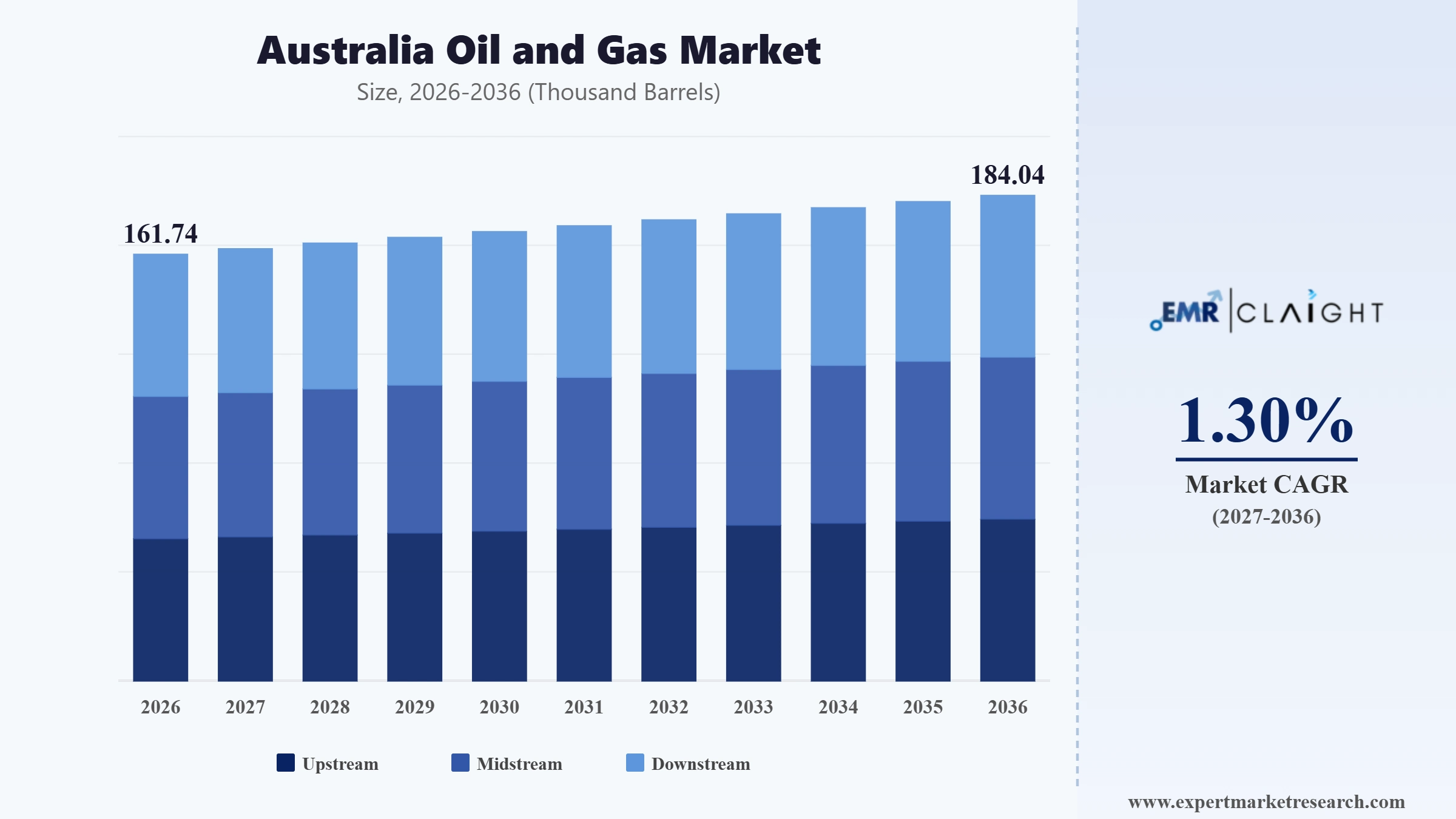
The Australia oil and gas market attained a volume of 159.66 Thousand Barrels in 2025 and is projected to expand at a CAGR of 1.30% through 2035. The market is further expected to achieve 181.67 Thousand Barrels by 2035. Expanding LNG export infrastructure is creating specialised demand across Australia’s oil and gas value chain. The Scarborough Energy Project is designed to supply approximately 8 million tonnes of LNG annually, while Pluto Train 2 has planned capacity of around 5 million tonnes per year. These projects are increasing requirements for offshore production systems, subsea equipment, gas processing, LNG storage, marine transportation and specialised maintenance services. The concentration of large-scale LNG developments around established Western Australian hubs is also enabling suppliers to leverage existing infrastructure, technical capabilities and service networks, supporting greater operational scalability.
Growing focus on the security of gas supply from domestic sources is facilitating investments in the production, processing, and transportation network. For instance, in Western Australia, the Gorgon and Wheatstone plants can produce up to 530 TJ/day of domestic gas, and Chevron claims that both facilities meet the needs of over 40% of domestic gas requirements in Western Australia. Long-term supply agreements with electricity generators and industrial customers are encouraging producers to maintain dependable production and strengthen transmission capabilities. This is creating opportunities for gas processing, pipeline infrastructure, supply management and flexible contracting across Australia's domestic energy market, thereby boosting the Australia oil and gas market value.
Connectivity through digital technology is being developed as an important innovation in Australian offshore oil and gas production. As far back as April 2026, Woodside made a direct link from its Scarborough floating production unit, situated 375 km off shore from Karratha, via fiber optics to its Perth control center. It allows the company to facilitate large amounts of data communication for remote operations, equipment and process monitoring, applications and cyber security. By August 2026, the fibre network had reached approximately 1,500 km of connectivity between the FPU and Woodside's Integrated Remote Operations Centre. This infrastructure enables more data-intensive remote monitoring and operational support for offshore assets.
Stringent emissions requirements remain a restraint for Australia's oil and gas industry because operators must progressively reduce emissions while maintaining production and competitiveness. The Safeguard Mechanism covers facilities emitting more than 100,000 tonnes of CO₂-e annually, including oil and gas facilities. Under the current framework, covered facility baselines generally decline by 4.9% annually through 2030. In 2023–24, 219 facilities across covered sectors were subject to the mechanism, collectively accounting for around 31% of Australia's greenhouse gas emissions. Meeting these declining baselines can require investment in emissions-reduction technologies, monitoring and compliance systems, thereby restricting the Australia oil and gas market developments.
Read more about this report - Request a Free Sample
Woodside delivered the final and heaviest module for the Pluto LNG Train 1 modifications project at Karratha, Western Australia. The module weighs approximately 4,500 tonnes and forms part of the upgrades required to process gas from the Scarborough field. Woodside stated that the Scarborough Energy Project was 98% complete at the end of Q2 2026, with first LNG cargo targeted for Q4 2026. The milestone supports demand for LNG commissioning, engineering, maintenance and operational services.
Chevron signed a new five-year agreement with Alinta Energy to supply 46 petajoules of natural gas, beginning in July 2027. The gas will be sourced from Chevron's Western Australian portfolio, including its interests in Gorgon, Wheatstone and the North West Shelf Project. Chevron stated that Gorgon and Wheatstone together provide approximately 40% of Western Australia's domestic gas supply. The agreement strengthens long-term domestic gas supply and supports continued demand for production, processing and transmission infrastructure.
Viva Energy's proposed Geelong Gas Terminal received federal environmental approval under the EPBC Act. The project includes a floating LNG storage and regasification facility, a treatment plant and approximately 7 km of new pipeline. The terminal is designed to provide additional natural gas supply to Victoria and southeastern Australia. The approval advances development of LNG import and regasification infrastructure and creates potential requirements for terminal construction, gas treatment, pipeline development, marine logistics and associated energy infrastructure.
Beach Energy announced that its Waitsia Gas Plant had reached its 250 TJ/day nameplate capacity. The Perth Basin facility is the largest gas plant commissioned in Western Australia since 2016 and can supply nearly one-quarter of the state's domestic natural gas demand. Waitsia Stage 2 includes additional development wells and supports both domestic gas commitments and LNG exports. The milestone strengthens Perth Basin production and supports demand for gas processing, field operations, transportation and related infrastructure services, thus boosting the trends of the Australia oil and gas market.
The National Advertising Division (NAD) reviewed advertising claims made by Nanit following a challenge from Owlet and recommended that Nanit discontinue its “#1 smart baby monitor” and “#1 baby monitor” claims. The February 2026 decision highlights the increasingly competitive positioning of smart-monitor brands in North America, where product differentiation increasingly depends on measurable technology capabilities and substantiated performance claims.
Natural gas remains a significant component of Australia's energy system, accounting for 32% of primary energy production in 2023–24, equivalent to around 6,122 PJ. Australia exported approximately 4,509 PJ of natural gas during the same period, demonstrating the scale of its production and export infrastructure. Gas also represented 53.5% of primary energy use in Western Australia and 69.6% in the Northern Territory in 2023–24. These conditions are creating opportunities for gas suppliers and infrastructure operators to optimise pipeline capacity, processing, compression and contracted supply. The role of gas in supporting regional electricity systems alongside variable renewable generation is also increasing the value of flexible supply arrangements and dispatchable generation assets.
Digital connectivity is becoming increasingly integrated into Australia's offshore LNG operations. In April 2026, Woodside confirmed that fibre connectivity had been established between the Scarborough floating production unit, located 375 km offshore from Karratha, and its Perth headquarters. The link facilitates high-speed data transmission to provide remote control capabilities, machine monitoring, process automation, and security. The innovation has opened up new avenues for suppliers of solutions relating to communications, cybersecurity, remote monitoring, predictive maintenance, and data management in industries. Enhanced connectivity allows offshore facilities spread out over a wide area to constantly send operational data. As LNG operators increasingly adopt connected operating models, technology providers capable of managing large volumes of real-time asset data can become increasingly relevant to offshore production and maintenance activities.
Carbon capture and storage is developing alongside Australia's established oil and gas infrastructure. Santos' Moomba CCS project commenced operations in September 2024 and is designed to store up to 1.7 million tonnes of CO2e annually. By 2026, Santos reported that approximately 2.3 million tonnes of CO2e had been stored since the facility began operations. This project shows the potential of using the depleted reservoirs and the current capacity of the energy industry to help manage carbon. This is leading to new business opportunities for companies that offer CO2 compression, transport, injection, and reservoir monitoring services. Oil and gas companies could also make use of their existing expertise in drilling, geology, pipelines, and processing to manage carbon storage.
Production and consumption of LNG in Western Australia are providing business prospects for all aspects of production, processing, and management of supply. In March 2026, Chevron made an announcement regarding a five-year contract signed between the company and Horizon Power starting from January 2027. According to the contract, Chevron will provide around 14 PJ of natural gas per year out of its production in Western Australia. Furthermore, Chevron mentioned that its Gorgon and Wheatstone domestic gas plants have a joint capacity of up to 530 TJ/day. These figures highlight the scale of infrastructure serving domestic customers alongside LNG operations. Opportunities are emerging in pipeline access, processing, contract management, scheduling and supply optimisation as producers balance export-linked operations with requirements from electricity generators and industrial users.
Australia's fuel-security policies are increasing the strategic importance of domestic refining, storage and distribution infrastructure. In 2026, the Australian Government announced A$10 million during 2026–27 for feasibility studies examining expanded domestic refining capacity. The government is also maintaining measures supporting Australia's remaining refineries and strengthening national fuel reserves. The broader fuel-security framework includes a A$3.2 billion Australian Fuel Security Reserve, while minimum stockholding requirements are being increased toward 50 days for diesel and jet fuel. These measures are creating opportunities for refinery engineering, storage infrastructure, fuel-handling equipment, inventory-management systems and logistics providers. Companies involved in refinery upgrades and associated storage and transportation projects can therefore participate in Australia's efforts to strengthen domestic fuel resilience.
The Expert Market Research’s report titled "Australia Oil And Gas Market Report and Forecast 2026-2035” offers a detailed analysis of the market based on the following segments:
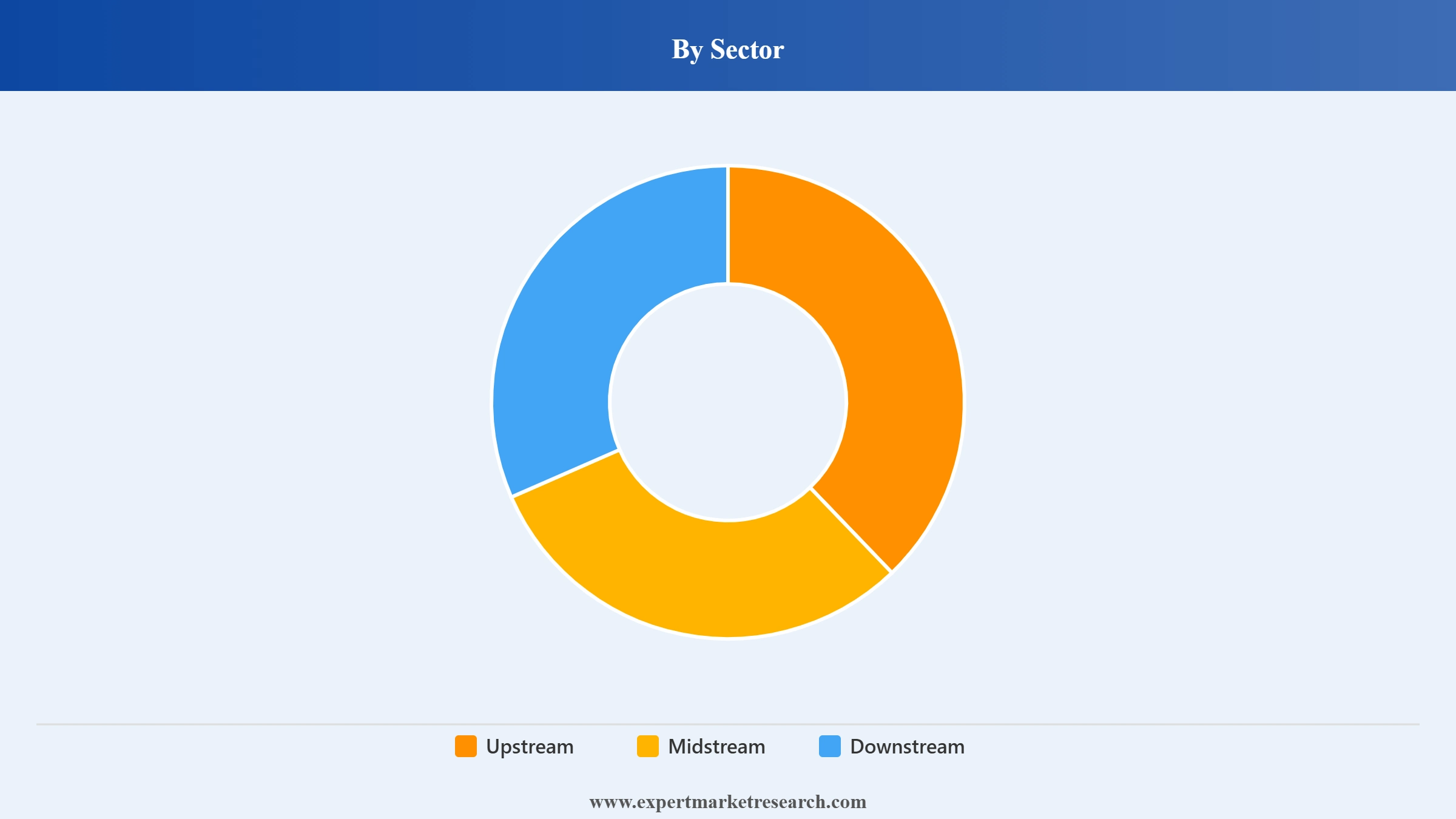
Market Breakup by Sector
Key Insight: The upstream sector is gaining traction through continued development of offshore gas resources and LNG-linked projects, including Australia's major developments in Western Australia and the Northern Territory. Midstream activity is being supported by investment in gas processing, pipelines, storage and LNG infrastructure, enabling producers to connect new resources with domestic and export markets. In the downstream oil segment, transportation remains an important demand centre, while industrial and agricultural applications continue to require refined fuels and lubricants for equipment and operations. Downstream gas is gaining momentum from its role in electricity generation and industrial processing, with natural gas also supporting fertilizer manufacturing through its use as a feedstock. Growing requirements for reliable gas supply and integrated infrastructure are strengthening linkages across upstream, midstream and downstream activities.
Market Breakup by Region
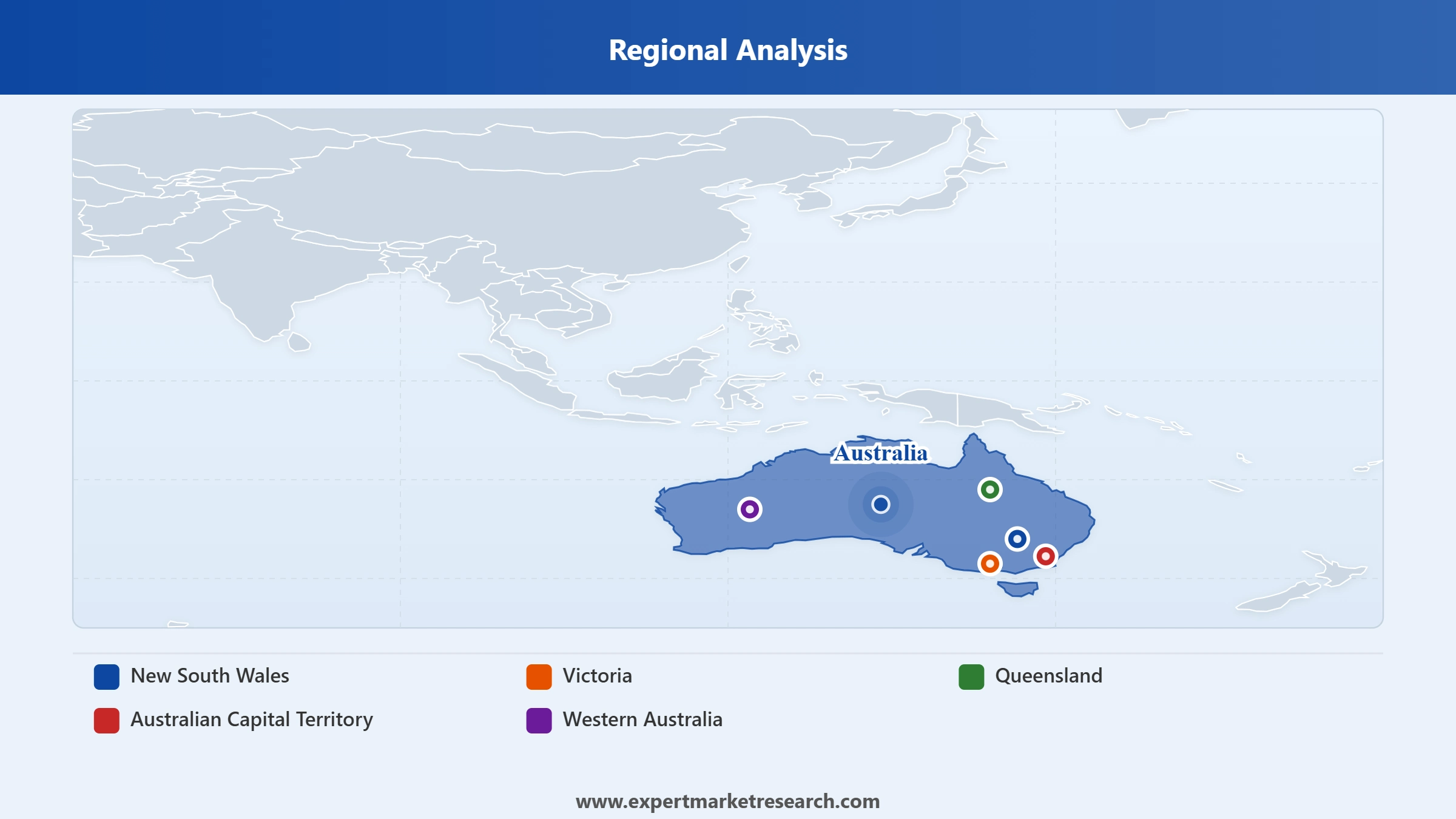
Key Insight: New South Wales is gaining traction through the proposed Narrabri Gas Project, with Santos signing a September 2025 MOU to potentially supply up to 3.2 PJ of gas annually to the Northern NSW Inland Port, supporting new industrial activity. Victoria is strengthening its upstream position through renewed production from the offshore Otway Basin, where gas output reached 23.9 PJ in FY2024-25, compared with 8.92 PJ in FY2023-24. Queensland remains centred on its established LNG and gas-producing basins, supporting east-coast supply chains. Western Australia is gaining further momentum from Woodside’s Scarborough Energy Project, with Pluto Train 2 targeting first LNG cargo in Q4 2026. The Australian Capital Territory has limited upstream activity but remains connected to gas-market development through east-coast infrastructure and demand. Other regions are supported by emerging exploration and infrastructure opportunities linked to Australia’s broader oil and gas supply network.
Read more about this report - Request a Free Sample
By sector, video is anticipated to dominate through comprehensive visual and connected monitoring capabilities
The upstream segment holds the dominant position in Australia’s oil and gas market, underpinned by the country’s extensive resource base and concentration of large-scale producing assets. Offshore developments in Western Australia remain central to production, supported by established LNG-oriented fields, subsea infrastructure and processing facilities. Queensland’s coal seam gas industry also contributes significantly to Australia’s gas supply. Activity across drilling, reservoir management, field expansion and production optimisation continues to reinforce upstream’s market position. The segment’s established asset base and integration with LNG projects provide producers with opportunities to maintain output while extending the productive life of existing resources. Such developments will thus boost Australia oil and gas market trends in the long run.
Read more about this report - Request a Free Sample
Faster growth is seen in the downstream gas industry since natural gas is meeting the particular power generation and industrial needs in various regions. Western Australia and Northern Territory in particular depend on gas-fired power generation, which means that there is a need for a reliable supply of gas, gas processing, and distribution infrastructure. The gas is also increasingly being used as part of power systems that use dispatchable generation with renewable energy sources. Industrial users further support demand through applications requiring dependable thermal energy and gas feedstock, strengthening downstream gas activity across Australia's regional energy markets.
By region, Western Australia dominates due to its gas production, LNG infrastructure and export-oriented energy ecosystem
Western Australia remains the principal center of Australia's oil and gas production ecosystem. In 2023-24, the state generated 3,535 PJ of natural gas, accounting for 58% of national production, while natural gas represented 53.5% of the state's primary energy mix. The region's importance is reinforced by its concentration of offshore resources, LNG processing facilities and domestic gas infrastructure. Queensland forms the other major production hub, with 1,583 PJ of gas production in 2023-24, nearly five times its production a decade earlier, largely reflecting the expansion of coal seam gas, thereby directly boosting the Australia oil and gas market regional growth.
Read more about this report - Request a Free Sample
Southeastern Australia presents a different commercial profile, with stronger emphasis on consumption, fuel distribution and gas-supply infrastructure. New South Wales accounted for 24.2% of Australia's total energy consumption in 2023-24, while Victoria accounted for 20.7%. Victoria is particularly significant for residential gas and downstream infrastructure, while NSW represents a large industrial and transport energy market. The Australian Capital Territory remains primarily a demand center. Collectively, these regions create a two-speed market: resource-rich western and northeastern jurisdictions drive production and export infrastructure, while southeastern jurisdictions generate opportunities in refining, storage, gas imports, distribution and energy-security services.
Australia oil and gas market players are aiming to boost growth and scalability through expansion of LNG capacity, development of new gas resources, optimisation of existing assets, and investment in advanced exploration and production technologies. Companies are focusing on improving operational efficiency, increasing recovery from mature fields, and strengthening gas processing, transportation, and export infrastructure. Strategic partnerships, joint ventures, long-term supply agreements, and portfolio diversification are also being used to spread capital requirements and access new markets. These strategies enable companies to scale production while improving asset utilisation and strengthening their position across domestic and international energy markets.
Australia oil and gas companies are increasingly targeting lower-emission operations and carbon-management capabilities to align future investments with Australia's energy-transition objectives. Investments in emissions reduction, methane management, carbon capture and storage, electrification, and renewable-energy integration are being pursued alongside conventional oil and gas projects. Companies are also prioritising digitalisation and automation to improve asset monitoring, reduce downtime, and support scalable operations.
Woodside Energy was established in 1954 and is headquartered in Perth, Western Australia. The company offers integrated oil and gas solutions covering exploration, development, production, LNG processing, domestic gas supply, marketing and energy trading. Its Australian portfolio includes Pluto LNG, North West Shelf interests and the Scarborough Energy Project. Woodside supplies LNG, pipeline gas, condensate and crude oil to domestic and international customers. Its offerings also increasingly include lower-carbon energy solutions, carbon management and new-energy projects supporting the transition of its energy portfolio.
Santos was founded in 1954 and has its registered and head office in Adelaide, South Australia. The company offers upstream exploration, natural gas and oil production, gas processing, LNG development, pipeline transportation and domestic energy supply. Its Australian portfolio includes the Cooper Basin, Gladstone LNG and Darwin LNG, supported by associated processing and infrastructure assets. Santos supplies natural gas and LNG to domestic and international customers while developing carbon-management capabilities. Its broader offerings include integrated gas projects, infrastructure services and solutions aimed at supporting lower-emission energy production.
Chevron traces its corporate history to 1879 and is headquartered in Houston, Texas. In Australia, the company offers integrated energy operations spanning natural gas exploration and production, offshore development, gas processing, LNG production and energy supply. Its major Australian interests include Gorgon, Wheatstone and the North West Shelf Project. Chevron supplies LNG and domestic natural gas while operating associated offshore platforms, subsea infrastructure and processing facilities. The company also develops carbon-management and emissions-reduction initiatives alongside its conventional oil and gas activities to support more efficient energy production.
Beach Energy was founded in 1961 and is headquartered in Adelaide, South Australia. The company offers exploration, development and production of oil, natural gas and natural gas liquids across multiple Australian basins. Its portfolio includes assets in the Cooper, Perth, Otway and Bass basins, supporting domestic gas supply and oil production. Beach Energy's offerings encompass upstream field operations, gas processing, transportation arrangements, exploration services and resource development. The company focuses on supplying natural gas to Australian markets while maintaining an oil production and exploration portfolio across its operating regions.
Other key players in the market include ExxonMobil Australia Pty Ltd., BP Australia Pty Ltd., Shell Energy Operations Pty Ltd., Origin Energy Limited, and Cooper Energy Limited, among others.
*Please note that this is only a partial list; the complete list of key players is available in the full report. Additionally, the list of key players can be customized to better suit your needs.*
Explore the Australia Oil and Gas Market trends 2026 with Expert Market Research's comprehensive industry assessment. The report provides detailed analysis of market structure, sector performance, regional opportunities, competitive developments and the Australia Oil and Gas Market forecast 2026-2035. Download the sample report to understand emerging investment opportunities, changing supply dynamics and strategic developments shaping the Australia Oil and Gas Markets Market Size and outlook.


Upto 15% Off
USD
$2499 $2249
$3999 $3599
$4999 $4249
$5999 $5099


*While we strive to always give you current and accurate information, the numbers depicted on the website are indicative and may differ from the actual numbers in the main report. At Expert Market Research, we aim to bring you the latest insights and trends in the market. Using our analyses and forecasts, stakeholders can understand the market dynamics, navigate challenges, and capitalize on opportunities to make data-driven strategic decisions.*
In 2025, the market reached an approximate volume of 159.66 Thousand Barrels.
The market is projected to grow at a CAGR of 1.30% between 2026 and 2035.
The market is estimated to witness a healthy growth in the forecast period of 2026-2035 to reach 181.67 Thousand Barrels by 2035.
Key strategies driving the Australia oil and gas market include investment in exploration and production, expansion of LNG export capacity, adoption of advanced drilling technologies, development of lower-emission operations, strategic partnerships, infrastructure modernisation, portfolio diversification, and long-term supply agreements.
Key trends aiding the market expansion encompass technological advancements like digitalisation and automation improving operational efficiency, focus on renewable energy sources impacting investment decisions, and increasing emphasis on sustainability driving innovation in extraction methods.
Regions considered in the market are New South Wales, Victoria, Queensland, Western Australia, and Australian Capital Territory, among others.
Key players in the market are ExxonMobil Australia Pty Ltd., BP Australia Pty Ltd., Woodside Energy Group Limited, Shell Energy Operations Pty Ltd., Santos Ltd., Origin Energy Limited, Beach Energy Limited, Cooper Energy Limited, and Chevron Australia Pty Ltd, among others.
Key challenges in the Australia oil and gas market include commodity price volatility, stringent environmental regulations, emissions reduction targets, high operating and project costs, ageing infrastructure, skilled labour shortages, supply chain disruptions, and the transition towards renewable energy sources.
Explore our key highlights of the report and gain a concise overview of key findings, trends, and actionable insights that will empower your strategic decisions.
| REPORT FEATURES | DETAILS |
| Base Year | 2025 |
| Historical Period | 2019-2025 |
| Forecast Period | 2026-2035 |
| Scope of the Report |
Historical and Forecast Trends, Industry Drivers and Constraints, Historical and Forecast Market Analysis by Segment:
|
| Breakup by Sector |
|
| Breakup by Region |
|
| Market Dynamics |
|
| Competitive Landscape |
|
| Companies Covered |
|
Datasheet
One User
USD 2,499
USD 2,249
tax inclusive*
Single User License
One User
USD 3,999
USD 3,599
tax inclusive*
Five User License
Five User
USD 4,999
USD 4,249
tax inclusive*
Corporate License
Unlimited Users
USD 5,999
USD 5,099
tax inclusive*
*Please note that the prices mentioned below are starting prices for each bundle type. Kindly contact our team for further details.*
Flash Bundle
Small Business Bundle
Growth Bundle
Enterprise Bundle
*Please note that the prices mentioned below are starting prices for each bundle type. Kindly contact our team for further details.*
Flash Bundle
Number of Reports: 3
20%
tax inclusive*
Small Business Bundle
Number of Reports: 5
25%
tax inclusive*
Growth Bundle
Number of Reports: 8
30%
tax inclusive*
Enterprise Bundle
Number of Reports: 10
35%
tax inclusive*
How To Order

Select License Type
Choose the right license for your needs and access rights.

Click on ‘Buy Now’
Add the report to your cart with one click and proceed to register.

Select Mode of Payment
Choose a payment option for a secure checkout. You will be redirected accordingly.
Strategic Solutions for Informed Decision-Making
Gain insights to stay ahead and seize opportunities.

Get insights & trends for a competitive edge.

Track prices with detailed trend reports.

Analyse trade data for supply chain insights.

Leverage cost reports for smart savings

Enhance supply chain with partnerships.

Connect For More Information
Our expert team of analysts will offer full support and resolve any queries regarding the report, before and after the purchase.
Our expert team of analysts will offer full support and resolve any queries regarding the report, before and after the purchase.
We employ meticulous research methods, blending advanced analytics and expert insights to deliver accurate, actionable industry intelligence, staying ahead of competitors.
Our skilled analysts offer unparalleled competitive advantage with detailed insights on current and emerging markets, ensuring your strategic edge.
We offer an in-depth yet simplified presentation of industry insights and analysis to meet your specific requirements effectively.




