

Consumer Insights
Uncover trends and behaviors shaping consumer choices today
Procurement Insights
Optimize your sourcing strategy with key market data
Industry Stats
Stay ahead with the latest trends and market analysis.
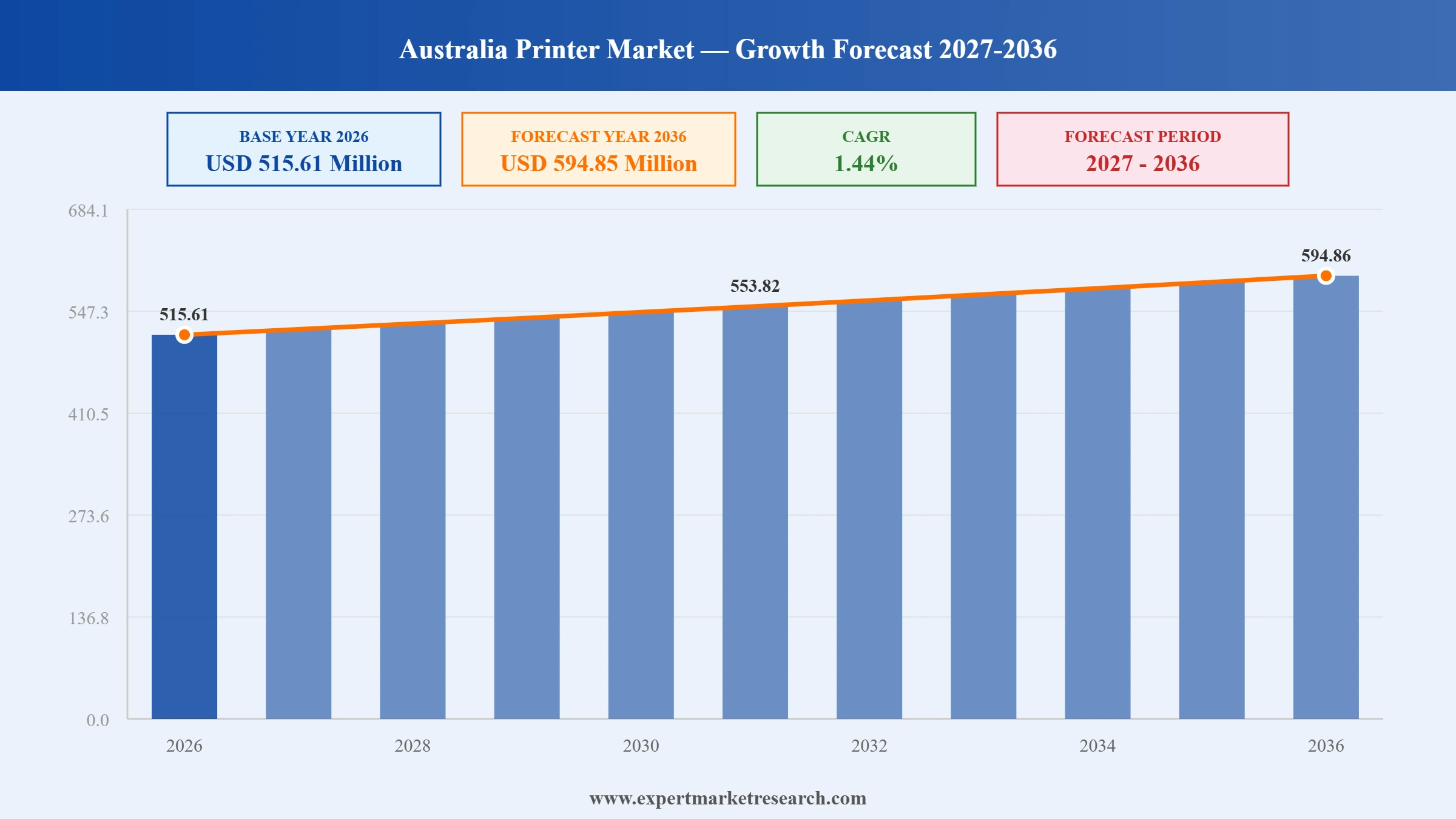
The Australia printer market attained a value of USD 508.29 Million in 2025 and is projected to expand at a CAGR of 1.44% through 2035. The market is further expected to achieve USD 586.41 Million by 2035, supported by continued document compliance requirements across healthcare, legal, education, and government sectors alongside hybrid work-driven demand for compact home and small office printers. Growth spans laser, inkjet, LED, and thermal printing technologies across standalone and multi-functional formats, with manufacturers across New South Wales, Victoria, Queensland, and Western Australia competing on print speed, security features, and enterprise workflow integration.
Document compliance requirements across regulated industries continue to anchor steady demand across the Australia printer market, as healthcare, legal, and government sectors maintain hard-copy record obligations even amid broader digital workflow adoption. Manufacturers are also investing in compact, space-efficient designs, reflecting the industry's recalibration around smarter, more efficient printing needs rather than raw output volume alone.
The Australia printer market is witnessing further developments as established manufacturers launch new compact printing solutions engineered for high-demand, space-efficient environments. OKI Data Australia launched two new A4 mono single function LED printers, the B433dn and B513dn, in October 2025, engineered for high-volume print environments across healthcare, construction, retail, logistics, financial services, and education. This shift toward compact, high-speed LED printing is concentrated among manufacturers with established LED print head technology, while smaller specialists instead compete on price within standard laser categories.
In addition, established manufacturers are increasingly embedding advanced security features into enterprise printer lines, reflecting the industry's recognition that document security increasingly determines procurement decisions for regulated and financial services customers. HP introduced its LaserJet Pro 4000/4100 Series and LaserJet Enterprise 5000/6000 Series in March 2026 at its Imagine 2026 event, featuring the world's first SMB printer with quantum-resistant security alongside AI-powered workflow tools. Such security-hardened enterprise launches are reshaping competitive positioning across the wider australia printer market as manufacturers with advanced encryption capability increasingly differentiate themselves from competitors offering standard security features alone.
Read more about this report - REQUEST FREE SAMPLE COPY IN PDF
Enterprise printer manufacturers are increasingly building next-generation encryption directly into hardware rather than relying on network-level security alone. HP introduced its LaserJet Pro 4000/4100 Series and LaserJet Enterprise 5000/6000 Series at its Imagine 2026 event, featuring the world's first SMB printer with quantum-resistant security alongside AI-powered workflow tools and faster document digitisation. Companies can leverage hardware-embedded encryption to differentiate enterprise printer lines ahead of tightening data security regulations.
Industrial label and auto-ID printer manufacturers are increasingly embedding predictive maintenance capability directly into hardware to reduce customer downtime. SATO began the global rollout of its CL4-SXR and CL6-SXR flagship industrial printers from January 2026, delivering improved print speed, advanced sensor technology, and AI-powered predictive maintenance. Companies can leverage predictive maintenance features to reduce unplanned downtime for customers running high-volume, business-critical labelling operations.
LED printer manufacturers are increasingly targeting the high-speed segment of the mono single-function category as demand intensifies across document-heavy industries. OKI Data Australia launched the B433dn and B513dn A4 mono LED printers, reporting over 25 percent growth in the higher-speed 35 to 45 pages-per-minute segment driven by healthcare, construction, retail, logistics, financial services, and education customers. Companies can leverage high-speed LED print engines to capture share in the fastest-growing portion of the mono printer category.
Government agencies are increasingly directing digital transformation funding toward modernising office equipment alongside core IT infrastructure. Australian government programmes supporting technology adoption continue to indirectly benefit printer manufacturers, as financing and grant programmes encourage agencies to replace legacy printing equipment with more efficient, network-integrated alternatives. Companies can leverage government procurement frameworks to secure multi-year equipment refresh contracts across public sector customers.
Precision manufacturing specialists are continuing to invest in advanced machining equipment to support increasingly complex 3D printed part finishing. Amiga Engineering commissioned, in April 2026, a new FANUC Robocut Model Alpha-C800iC electrical-discharge machine for precision cutting of thick, stepped, and tapered parts, complementing its position as one of the few companies globally certified to metal 3D print in tungsten and the only Australian company certified to print in Scalmalloy. Companies can leverage specialised post-processing equipment investment to differentiate metal 3D printing capability beyond the print process itself.
Enterprise IT buyers are increasingly evaluating printer security credentials alongside traditional criteria such as print speed and running costs. Following HP's quantum-resistant security launch at its March 2026 Imagine event, competing manufacturers accelerated their own encryption roadmaps to avoid losing security-conscious enterprise and financial services customers across the wider australia printer market. Companies can leverage advanced encryption capability to protect against a shifting compliance landscape, particularly as government and financial services procurement policies increasingly mandate quantum-resistant security credentials for new equipment purchases.
A feature once confined to specialist industrial hardware is steadily working its way into mainstream product catalogues. Following SATO's January 2026 CL4-SXR and CL6-SXR rollout, manufacturers across the standard office printer segment began exploring similar sensor-driven maintenance alerts to reduce service call volumes and improve customer uptime guarantees, recognising that proactive fault detection increasingly differentiates premium device tiers from budget alternatives in procurement evaluations. Companies can leverage predictive maintenance capability to reduce unplanned downtime costs for enterprise customers running high-volume print fleets across multiple office locations.
Digital manufacturing specialists are packaging printing materials into simplified, pre-measured formats to reduce handling complexity for clinical and laboratory customers. Asiga introduced its PrintPods material capsule line in March 2025 at the International Dental Show in Cologne, offering dentistry and audiology customers a more convenient material handling format for its precision 3D printing platforms. Companies can leverage simplified material packaging formats to reduce handling errors and improve workflow consistency for clinical 3D printing customers, particularly in time-pressed dental and audiology practices where consistent material handling directly affects patient appointment scheduling.
This Expert Market Research Report titled "Australia Printer Market Report and Forecast 2026-2035" offers a detailed analysis of the market based on the following segments:
Market Breakup by Type
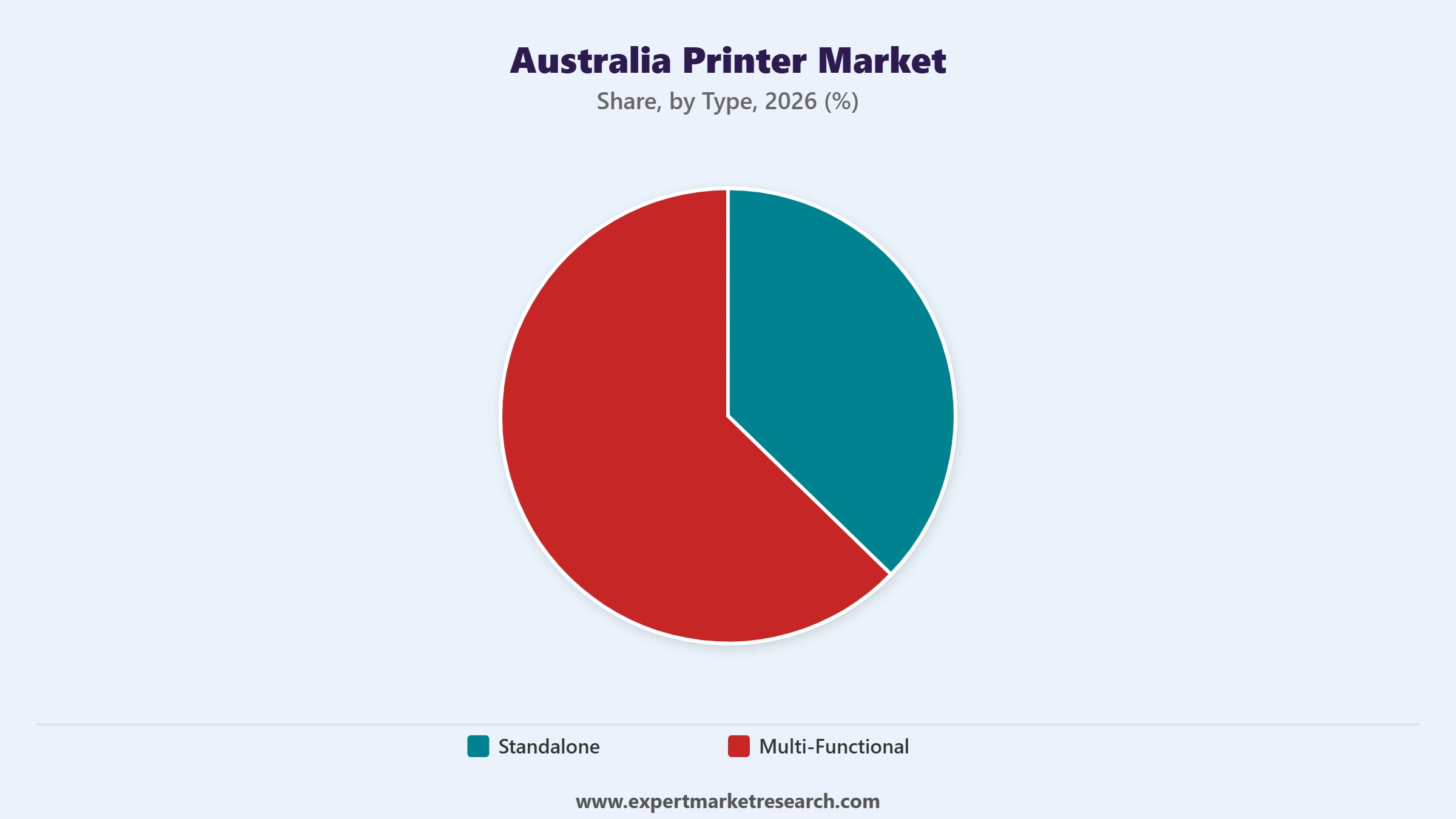
Key Insight: Standalone accounts for the largest share of the market, reflecting established demand for dedicated single-purpose devices in cost-sensitive residential and small office settings. Multi-Functional is growing at a fast pace at a projected CAGR of 2.10%, as businesses increasingly consolidate printing, scanning, and copying functions into single devices to reduce office footprint and equipment costs, particularly among small and mid-sized offices seeking to minimise both capital outlay and ongoing maintenance overhead.
Market Breakup by Technology
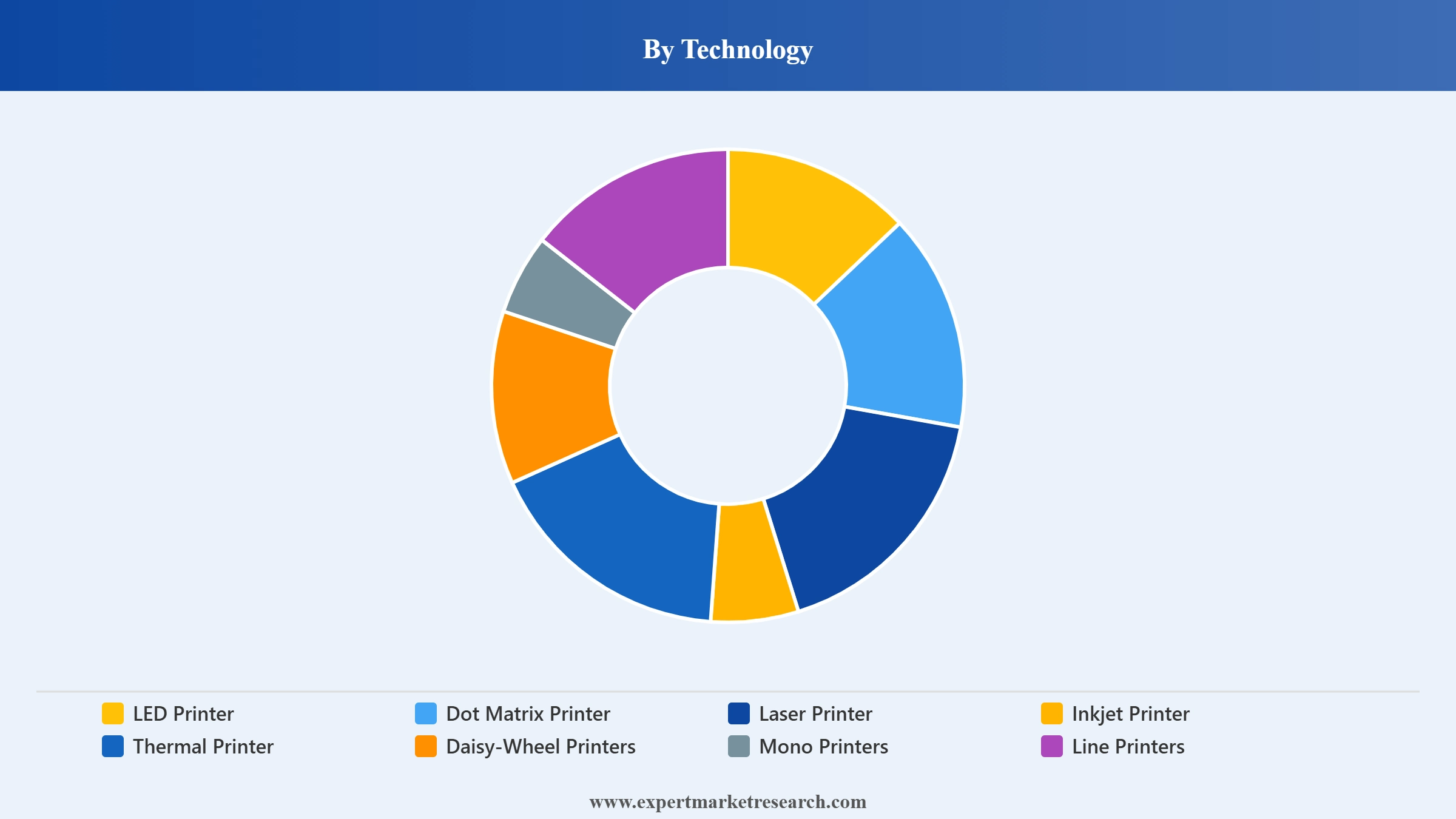
Key Insight: Laser Printer accounts for the largest share of the market, growing at a projected CAGR of 1.90%, illustrated by HP's March 2026 launch of its LaserJet Pro 4000/4100 and LaserJet Enterprise 5000/6000 series featuring quantum-resistant security. LED Printer is expanding steadily, illustrated by OKI Data Australia's October 2025 launch of the B433dn and B513dn A4 mono LED printers targeting high-speed, space-efficient environments. Thermal Printer serves industrial labelling and auto-ID applications, reinforced by SATO's January 2026 global rollout of its CL4-SXR and CL6-SXR industrial printers. Inkjet Printer supports home and small office photo and document printing requiring lower upfront cost. Dot Matrix Printer maintains a niche presence in multi-part form and receipt printing applications. Mono Printers serves budget-conscious buyers prioritising running cost over colour output. Daisy-Wheel Printers and Line Printers each retain small, specialised presences in legacy document and high-volume batch printing applications respectively. Others encompasses emerging and hybrid printing technologies not captured elsewhere, a category expected to gradually absorb newer print engine innovations as they mature from pilot deployments into mainstream commercial adoption.
Market Breakup by Printer Interface
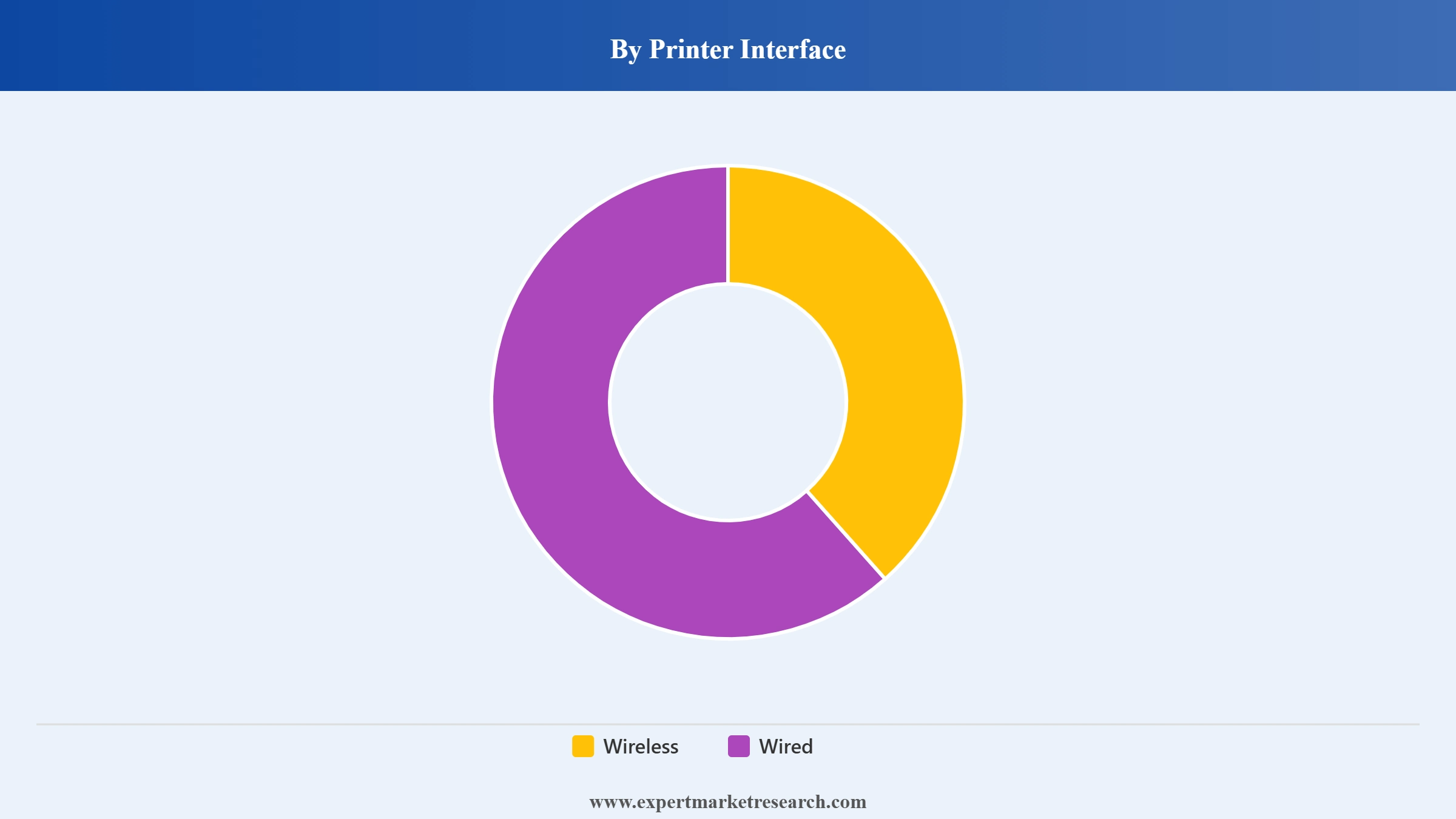
Key Insight: Wireless accounts for the largest share of the market, reflecting growing preference for flexible device placement and mobile printing compatibility across home and office environments. Wired continues to serve enterprise and industrial settings requiring stable, high-volume network connections, particularly in secure environments where wireless connectivity introduces additional security considerations that many enterprise IT departments prefer to avoid entirely for their most sensitive document workflows.
Market Breakup by Output Type
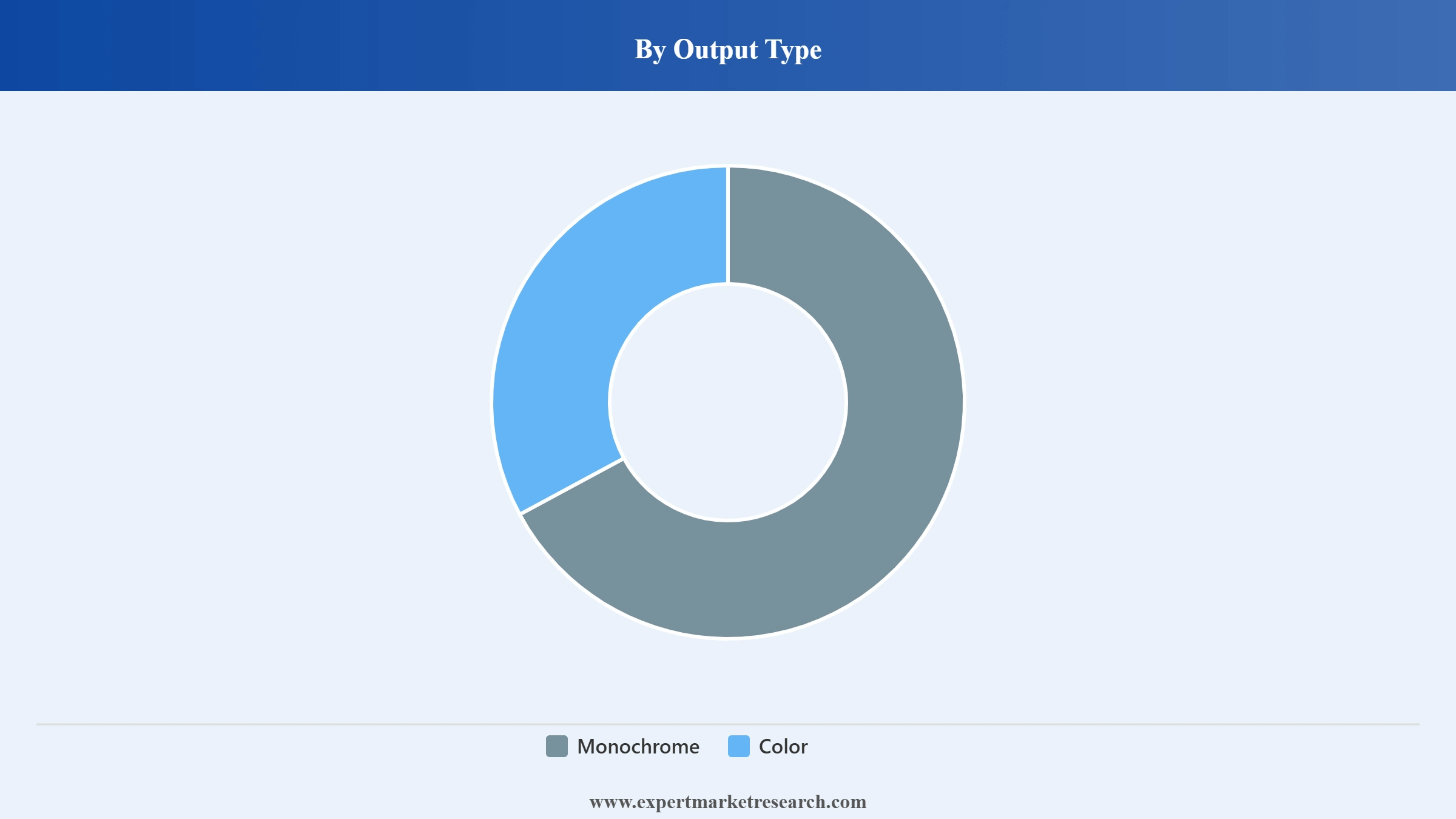
Key Insight: Monochrome accounts for the largest share of the market, reinforced by OKI Data Australia's October 2025 launch of its B433dn and B513dn A4 mono LED printers targeting high-volume document environments. Color continues to represent substantial demand across marketing, design, and customer-facing document applications requiring visual presentation quality, with demand concentrated among design agencies, marketing teams, and retail environments needing accurate colour reproduction for external-facing materials.
Market Breakup by End Use
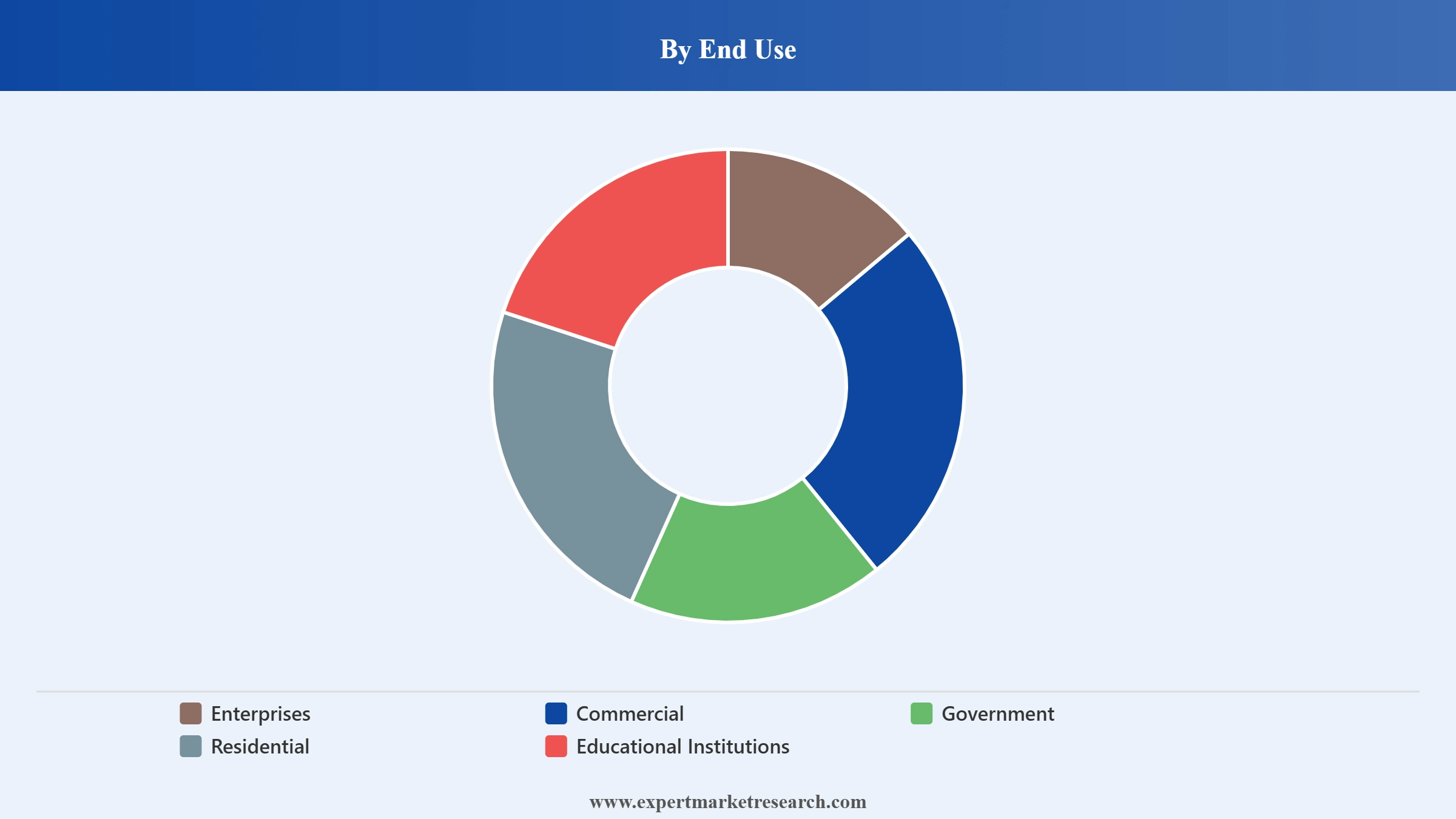
Key Insight: Enterprises accounts for the largest share of the market, reinforced by HP's March 2026 launch of its quantum-resistant LaserJet Enterprise series targeting security-conscious corporate customers. Commercial demand is reinforced by SATO's January 2026 industrial label printer rollout serving manufacturing and logistics customers. Government continues to represent steady demand tied to digital transformation funding programmes supporting equipment modernisation. Residential demand is sustained by hybrid work models redistributing printing from centralised offices to home setups. Educational Institutions remain a reliable volume driver for multifunctional devices across primary schools through universities. Others encompasses smaller-volume end-use categories including healthcare and legal sector document printing, sectors where strict record-keeping and compliance requirements continue to sustain hard-copy printing demand despite broader digital workflow adoption elsewhere.
Market Breakup by Region
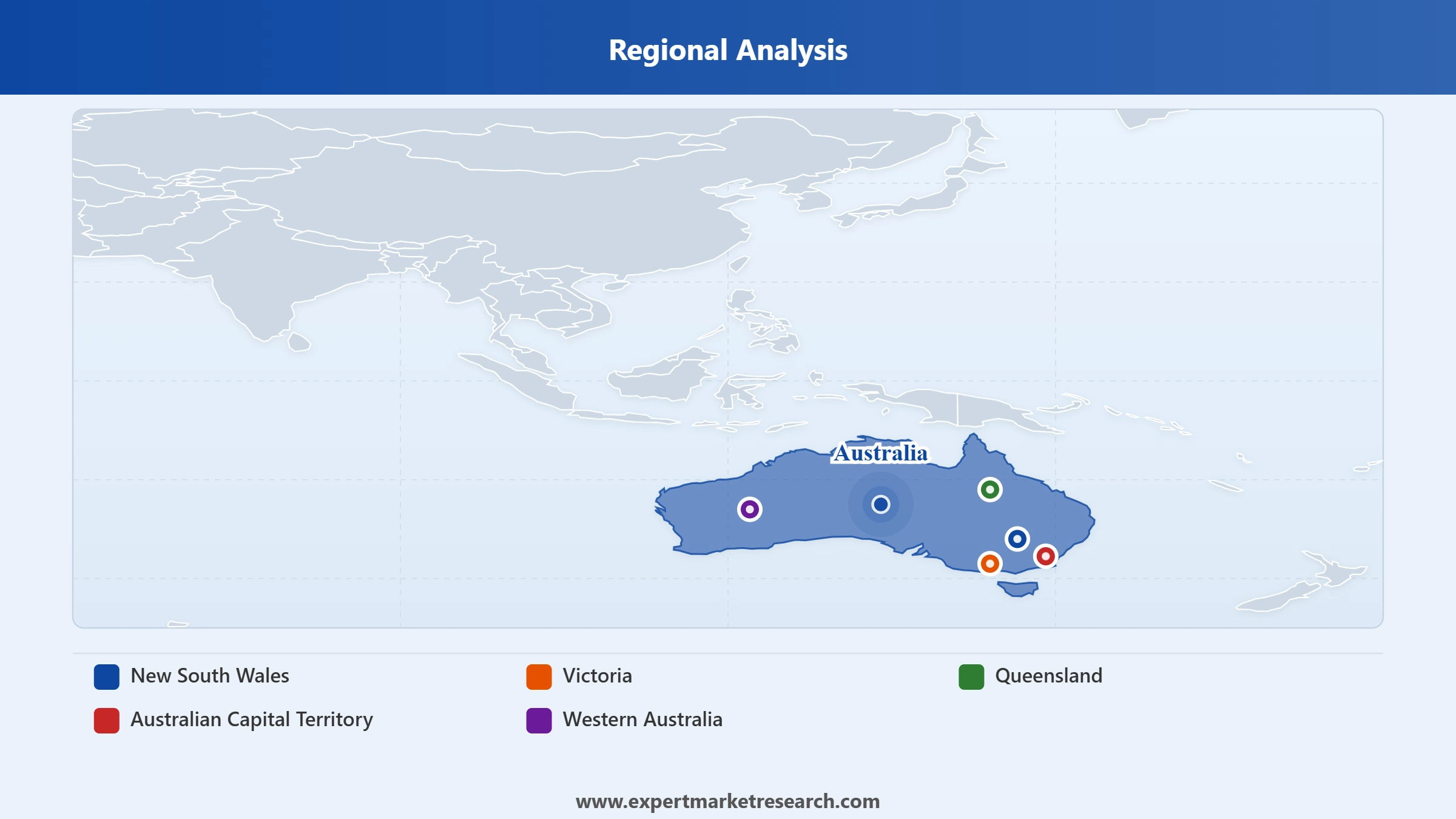
Key Insight: New South Wales accounts for the largest share of the market, anchored by its dense enterprise, government, and educational institution base concentrated around Sydney. Victoria continues to represent substantial demand tied to its established commercial printing infrastructure. Queensland supports steady demand tied to its growing education sector volume driver across primary schools through universities. Western Australia is emerging as a key growth market at an estimated CAGR of 2.20%, supported by expanding mining and resources sector back-office administrative demand. Australian Capital Territory maintains steady government-driven demand tied to federal agency operations. Others captures smaller state and territory markets including South Australia and Tasmania, where printer demand remains closely tied to smaller government, educational, and commercial installed bases relative to the larger eastern states.
Read more about this report - REQUEST FREE SAMPLE COPY IN PDF
By type, standalone leads the market while multi-functional grows fastest given office consolidation demand
Standalone continues to account for the largest share of the market, reflecting established demand for dedicated single-purpose devices in cost-sensitive residential and small office settings, a category Asiga's March 2025 PrintPods material line illustrates from the specialist end, where dedicated single-purpose 3D printing platforms serve precision dental and jewellery workflows, applications that continue to favour specialised, single-function equipment over multi-purpose alternatives given the exacting accuracy these workflows demand.
Read more about this report - REQUEST FREE SAMPLE COPY IN PDF
Multi-Functional is growing at the fastest pace across the australia printer market at a projected CAGR of 2.10%, as businesses increasingly consolidate printing, scanning, and copying functions into single devices, a trend HP's March 2026 AI-powered workflow tools directly support by unifying document capture, processing, and output within a single enterprise-grade platform, reducing the number of separate systems IT departments must manage across large, distributed office networks.
By technology, laser printer leads the market while LED printer grows steadily given high-speed compact demand
Laser Printer continues to account for the largest technology share, reinforced by HP's March 2026 launch of its quantum-resistant LaserJet Pro and Enterprise series targeting security-conscious enterprise customers, with AI-powered workflow tools embedded alongside the new encryption capability to further differentiate the segment's premium offerings, a combination competitors are now racing to match as enterprise buyers increasingly treat integrated security and automation as baseline procurement requirements.
Read more about this report - REQUEST FREE SAMPLE COPY IN PDF
LED Printer continues to gain share, illustrated by OKI Data Australia's October 2025 launch of the B433dn and B513dn A4 mono LED printers, which reported over 25 percent growth in the higher-speed 35 to 45 pages-per-minute segment. Thermal Printer serves industrial labelling applications, reinforced by SATO's January 2026 global rollout of its next-generation CL4-SXR and CL6-SXR printers. Inkjet Printer holds a smaller but steady position among home users and small offices prioritising lower upfront device cost over running expense. Dot Matrix Printer persists in niche multi-part form and receipt applications where impact printing remains a functional requirement. Mono Printers appeals to buyers for whom running cost outweighs colour capability. Daisy-Wheel Printers and Line Printers occupy narrow legacy niches in document typing and high-volume batch output respectively, while Others rounds out the mix with emerging hybrid print technologies still working their way from pilot deployments into broader commercial availability across the Australian market.
By printer interface, wireless leads the market while wired continues to serve enterprise environments
Wireless continues to account for the largest share of the market, reflecting growing preference for flexible device placement and mobile printing compatibility, a preference reinforced as manufacturers increasingly bundle app-based mobile printing and cloud connectivity as standard features rather than premium add-ons, lowering the effective cost of wireless capability for budget-conscious residential and small office buyers.
Read more about this report - REQUEST FREE SAMPLE COPY IN PDF
Wired continues to serve enterprise and industrial settings requiring stable, high-volume network connections, particularly in secure environments prioritising controlled connectivity, a positioning reinforced by HP's March 2026 quantum-resistant LaserJet Enterprise launch aimed squarely at security-conscious, network-controlled corporate deployments that prefer wired infrastructure over wireless, particularly within regulated industries such as finance and government where network isolation remains a core information security requirement.
By output type, monochrome leads the market while color continues to serve presentation-focused demand
Monochrome continues to account for the largest share of the market, reinforced by OKI Data Australia's October 2025 launch of its high-speed A4 mono LED printer range, which the company reported delivered over 25 percent growth in its higher-speed 35 to 45 pages-per-minute segment, reflecting sustained document-heavy operational demand across healthcare, logistics, and financial services customers even as overall office printing volumes plateau.
Read more about this report - REQUEST FREE SAMPLE COPY IN PDF
Color retains a solid, steady share across marketing collateral, design proofing, and other customer-facing documents where visual presentation quality remains essential, with demand concentrated among design agencies, marketing departments, and retail environments requiring accurate colour reproduction for their customer-facing printed materials, a niche that continues to command premium per-page running costs relative to monochrome output across comparable print volumes.
By end use, enterprises leads the market while residential grows fastest given hybrid work adoption
Enterprises continues to account for the largest share of the market, reinforced by HP's March 2026 launch of its quantum-resistant LaserJet Enterprise series aimed squarely at security-conscious corporate procurement teams managing large, distributed office fleets. Commercial and Government customers round out the largest volume drivers, both increasingly favouring vendors that can demonstrate compliance-ready security credentials alongside standard print performance.
Read more about this report - REQUEST FREE SAMPLE COPY IN PDF
Residential is the fastest-growing end use, propelled by hybrid work models that continue redistributing a meaningful share of printing volume from centralised offices to home setups, with Educational Institutions also sustaining reliable multifunctional device demand from primary schools through universities and Others capturing smaller-volume healthcare and legal sector printing needs.
New South Wales commands the largest share of the market through its concentrated enterprise and government base
New South Wales holds the largest share of the Australia printer market, anchored by its dense enterprise, government, and educational institution base concentrated around Sydney, home to several profiled manufacturers' own headquarters.
Read more about this report - REQUEST FREE SAMPLE COPY IN PDF
Western Australia posts the fastest regional growth rate at an estimated 2.20% CAGR, propelled by expanding mining and resources sector back-office administrative demand. Victoria maintains substantial demand tied to its established commercial printing infrastructure and manufacturing base. Queensland benefits from a growing education sector volume driver spanning primary schools through universities across the state. Australian Capital Territory sustains steady government-driven demand tied to federal agency equipment refresh cycles. Others, including South Australia and Tasmania, continues to serve smaller but consistent regional demand patterns.
The industry is fragmented, with australia printer market companies ranging from global enterprise printing conglomerates to specialist local manufacturers competing across type, technology, and end use segments. Established players operate across the full printer value chain, from device design and manufacturing through enterprise workflow software and regional distribution support.
Competitive dynamics among australia printer players are increasingly shaped by the pace of security feature innovation, the depth of predictive maintenance capability, and the strength of high-speed print engine technology. Manufacturers are investing in quantum-resistant encryption, AI-powered maintenance alerts, and compact, space-efficient designs to secure long-term relationships with enterprise, government, and educational customers.
Founded in 1940 and headquartered in Tokyo, Japan, with an established Australian and New Zealand operating presence, SATO manufactures barcode and RFID label printers, labels and tags, mobility devices, and label design software for auto-ID and data-capture applications. In January 2026, the company began the global rollout of its CL4-SXR and CL6-SXR flagship industrial printers, delivering AI-powered predictive maintenance and improved print speed. SATO's specialisation in industrial auto-ID and RFID labelling differentiates its offering from general office printer manufacturers.
Founded in 1881 as Oki Electric Industry Co., Ltd. of Japan and headquartered in Sydney, Australia as its local subsidiary, OKI Data Australia pioneered LED print head technology over 30 years ago, offering digital colour and mono printers, multifunction products, and dot matrix printers. In October 2025, the company launched the B433dn and B513dn A4 mono LED printers targeting high-speed, space-efficient printing environments. OKI's pioneering LED print engine heritage differentiates its offering from laser-based competitors.
Founded in 1939 and headquartered in Palo Alto, United States, with an established Australian operating presence, HP manufactures a broad range of laser and inkjet printers spanning consumer, small business, and enterprise categories. In March 2026, the company unveiled its LaserJet Pro 4000/4100 Series and LaserJet Enterprise 5000/6000 Series at its Imagine 2026 event, featuring the world's first SMB printer with quantum-resistant security. HP's advanced security and AI workflow integration differentiate its offering from competitors focused primarily on print speed and cost.
Founded in 2009 and headquartered in Sydney, Australia, Asiga designs and manufactures 3D printers specialising in digital manufacturing solutions for dentistry, audiology, jewellery, and microfluidics applications. The company launched the world's first LED-based DLP 3D printer in 2011 and continues developing its Pico, MAX, and PRO 4K platforms with an in-house mechanical, electronics, software, and materials team. Asiga's specialised focus on precision digital manufacturing for healthcare and jewellery applications differentiates its offering from general-purpose document printer manufacturers.
Other key players in the Australia printer market include Objective3D, Inc., Aurarum Pty Ltd., and Amiga Engineering Pty Ltd., among others.
*Please note that this is only a partial list; the complete list of key players is available in the full report. Additionally, the list of key players can be customized to better suit your needs.*
Unlock the latest insights with our Australia printer market trends 2026 report. Discover regional growth patterns, type and technology trends, and key industry players. Stay ahead of competition with trusted data and expert analysis. Download your free sample report today and drive informed decisions in the market.


Upto 15% Off
USD
$2499 $2249
$3999 $3599
$4999 $4249
$5999 $5099


*While we strive to always give you current and accurate information, the numbers depicted on the website are indicative and may differ from the actual numbers in the main report. At Expert Market Research, we aim to bring you the latest insights and trends in the market. Using our analyses and forecasts, stakeholders can understand the market dynamics, navigate challenges, and capitalize on opportunities to make data-driven strategic decisions.*
In 2025, the market reached an approximate value of USD 508.29 Million.
The market is projected to grow at a CAGR of 1.44% between 2026 and 2035.
The revenue generated from the market is expected to reach USD 586.41 Million in 2035.
The printer market is categorised according to the type, which includes standalone and multi-functional.
The key players in the market include SATO Australia Pty. Ltd., Asiga, Objective3D, Inc., Aurarum Pty Ltd., OKI Data Australia Pty Ltd., Amiga Engineering Pty Ltd., and HP Development Company L.P., among others.
Based on the printer interface, the market is divided into wireless and wired.
The market is broken down into New South Wales, Victoria, Queensland, Australian Capital Territory, Western Australia, and others.
Manufacturers face declining office print volumes amid continued digital workflow adoption, intense price competition from a fragmented supplier base, and the ongoing need to embed advanced security features without significantly raising device costs.
Embedding quantum-resistant encryption and AI-powered workflow tools into enterprise printer lines, developing predictive maintenance capability to reduce customer downtime, and launching compact, high-speed LED printers for space-efficient environments.
Explore our key highlights of the report and gain a concise overview of key findings, trends, and actionable insights that will empower your strategic decisions.
| REPORT FEATURES | DETAILS |
| Base Year | 2025 |
| Historical Period | 2019-2025 |
| Forecast Period | 2026-2035 |
| Scope of the Report |
Historical and Forecast Trends, Industry Drivers and Constraints, Historical and Forecast Market Analysis by Segment:
|
| Breakup by Type |
|
| Breakup by Technology |
|
| Breakup by Printer Interface |
|
| Breakup by Output Type |
|
| Breakup by End Use |
|
| Breakup by Region |
|
| Market Dynamics |
|
| Competitive Landscape |
|
| Companies Covered |
|
Datasheet
One User
USD 2,499
USD 2,249
tax inclusive*
Single User License
One User
USD 3,999
USD 3,599
tax inclusive*
Five User License
Five User
USD 4,999
USD 4,249
tax inclusive*
Corporate License
Unlimited Users
USD 5,999
USD 5,099
tax inclusive*
*Please note that the prices mentioned below are starting prices for each bundle type. Kindly contact our team for further details.*
Flash Bundle
Small Business Bundle
Growth Bundle
Enterprise Bundle
*Please note that the prices mentioned below are starting prices for each bundle type. Kindly contact our team for further details.*
Flash Bundle
Number of Reports: 3
20%
tax inclusive*
Small Business Bundle
Number of Reports: 5
25%
tax inclusive*
Growth Bundle
Number of Reports: 8
30%
tax inclusive*
Enterprise Bundle
Number of Reports: 10
35%
tax inclusive*
How To Order

Select License Type
Choose the right license for your needs and access rights.

Click on ‘Buy Now’
Add the report to your cart with one click and proceed to register.

Select Mode of Payment
Choose a payment option for a secure checkout. You will be redirected accordingly.
Strategic Solutions for Informed Decision-Making
Gain insights to stay ahead and seize opportunities.

Get insights & trends for a competitive edge.

Track prices with detailed trend reports.

Analyse trade data for supply chain insights.

Leverage cost reports for smart savings

Enhance supply chain with partnerships.

Connect For More Information
Our expert team of analysts will offer full support and resolve any queries regarding the report, before and after the purchase.
Our expert team of analysts will offer full support and resolve any queries regarding the report, before and after the purchase.
We employ meticulous research methods, blending advanced analytics and expert insights to deliver accurate, actionable industry intelligence, staying ahead of competitors.
Our skilled analysts offer unparalleled competitive advantage with detailed insights on current and emerging markets, ensuring your strategic edge.
We offer an in-depth yet simplified presentation of industry insights and analysis to meet your specific requirements effectively.




