

Consumer Insights
Uncover trends and behaviors shaping consumer choices today
Procurement Insights
Optimize your sourcing strategy with key market data
Industry Stats
Stay ahead with the latest trends and market analysis.
The automated machine tending systems market was valued at USD 3.40 Billion in 2025. The market is expected to grow at a CAGR of 9.00% during the forecast period of 2026-2035 to reach a value of USD 8.05 Billion by 2035. Rising labor shortages, growing demand for unattended machining, and wider adoption of collaborative robots are collectively driving the market growth.
The current automated machine tending systems market dynamics reflect uneven regional demand alongside a steady push toward unattended machining. In June 2025, the VDMA Robotics and Automation association forecast that German robotics and automation revenue would fall 10% to EUR 14.5 billion in 2025, with industrial robotics down 5% to EUR 3.7 billion, showing how weaker European capital spending is tempering growth in mature markets. At the same time, labor shortages, quality demands, and the need to run spindles longer are encouraging manufacturers in Asia and North America to expand tending cells, and suppliers are responding with simpler programming, standardized carts, and flexible financing for smaller shops, while trade policy uncertainty keeps buyers watching equipment costs closely.
The overall industry dynamics through 2025 and 2026 are also being shaped by strong customer interest in automation at production events. In September 2025, EMO Hannover marked its 50th anniversary with more than 1,600 exhibitors from 44 countries and almost 80,000 visitors, with about 140 robotics firms exhibiting and half of visitors citing automation productivity as a key interest. Such momentum signals sustained investment intent among shops and is steering machine builders and robot suppliers toward integrated, easy to deploy cells that reduce operator dependence and support shorter production runs, higher spindle utilization, and consistent part quality.
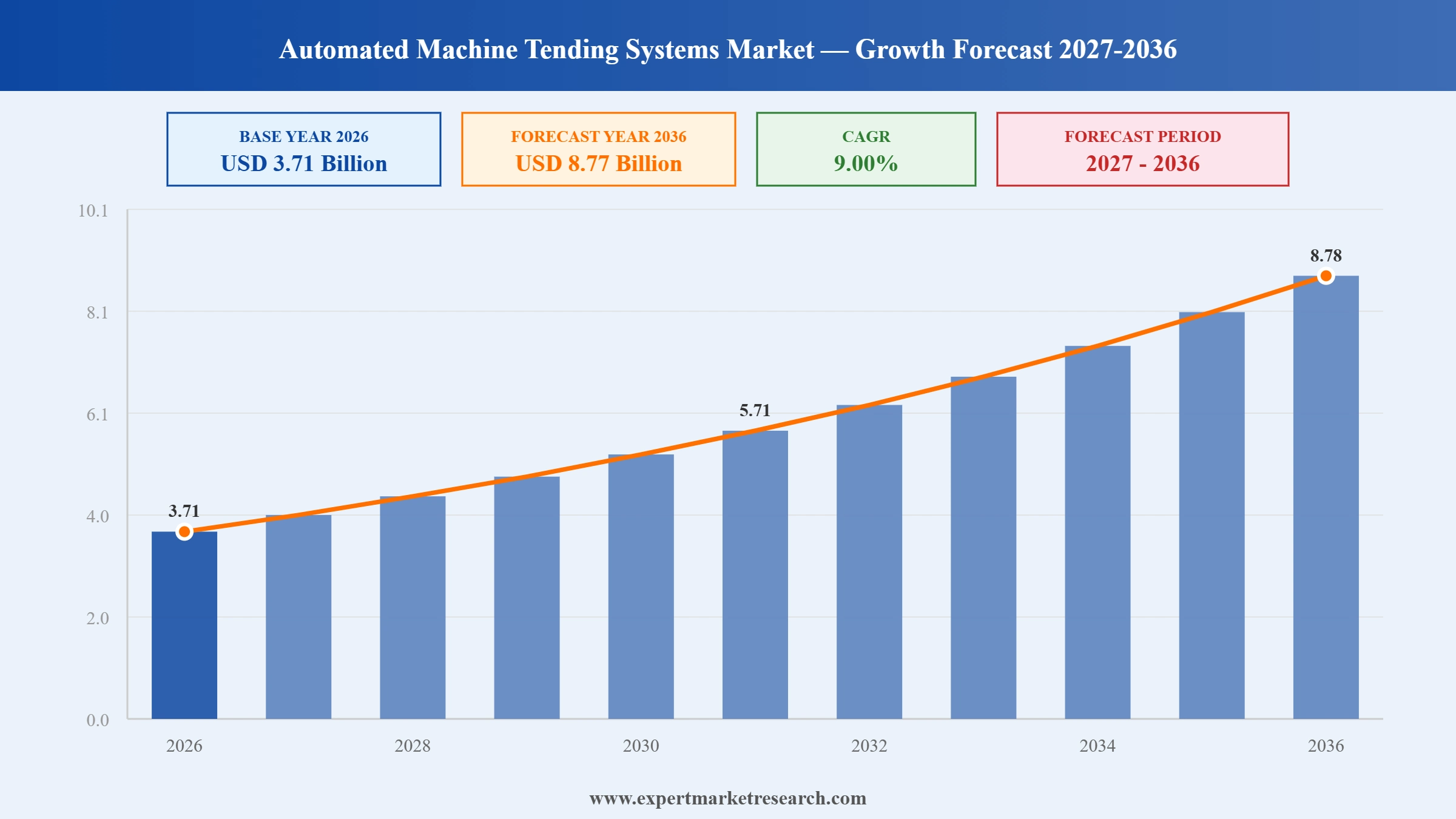
Read more about this report - REQUEST FREE SAMPLE COPY IN PDF
|
Automated Machine Tending Systems Market Report Summary |
Description |
Value |
|
Base Year |
USD Billion |
2025 |
|
Historical Period |
USD Billion |
2019-2025 |
|
Forecast Period |
USD Billion |
2026-2035 |
|
Market Size 2025 |
USD Billion |
3.40 |
|
Market Size 2035 |
USD Billion |
8.05 |
|
CAGR 2019-2025 |
Percentage |
XX% |
|
CAGR 2026-2035 |
Percentage |
9.00% |
|
CAGR 2026-2035 - Market by Region |
Asia Pacific |
10.2% |
|
CAGR 2026-2035 - Market by Robot Type |
Collaborative Robots |
13.5% |
|
CAGR 2026-2035 - Market by End Use |
Medical Devices |
11.2% |
|
2025 Market Share by Region |
Asia Pacific |
40.0% |
The automated machine tending systems market is being reshaped by regional production expansion, rising adoption of collaborative robots and turnkey cells, and deal making that adds integration expertise. Rising manufacturing investment across Asia Pacific and North America and the shift toward artificial intelligence enabled handling are further reshaping the competitive landscape.
Yaskawa inaugurated its expanded robot distribution and systems production center in Kocevje, Slovenia, investing about EUR 32 million across over 30,000 square meters. The site was planned to process at least 80% of robot orders from Europe, the Middle East, and Africa. Competitors across the automated machine tending systems market can benefit by pooling regional assembly and logistics in one hub, improving delivery reliability and service response.
FANUC America announced a USD 90 million investment to build a new 840,000 square foot robot manufacturing building in Michigan, creating 225 new jobs. The company noted nearly USD 300 million already invested in its United States facilities. Robot makers elsewhere can capitalize by building production and training capacity close to customers, which shortens delivery times for automated loading systems across the automated machine tending systems market.
Staubli Robotics launched the MTC-900, a plug and play machine tending cart working with TX2-60 and TX2-60L robots. It connected to injection molding machines through Euromap 67, supported EtherCAT, PROFINET, and Ethernet/IP communication, and included built-in laser scanning for safety. Rivals can follow by bundling robots, safety, and interfaces into ready cells, letting small shops automate easily without specialist help.
Doosan Robotics acquired 89.59% of ONExia, a robotics system integrator in Exton, Pennsylvania, for about USD 25.9 million. The deal reflected a shift from collaborative robot hardware toward artificial intelligence and software solutions, and it gave Doosan engineering capacity near North American customers. Peers across the automated machine tending systems market can draw on this approach by acquiring integrators, gaining application expertise, installation capability, and project pipelines.
Manufacturers across the automated machine tending systems market are struggling to fill machine operator roles, and unattended loading and unloading is becoming a practical answer for keeping spindles running through shifts and weekends. Automated cells let skilled workers move to programming and inspection while robots handle repetitive part handling. For example, in August 2026, United States labor data showed 481,000 manufacturing job openings in June, up about 23% from a year earlier, while hiring remained weak, which is reinforcing demand for automation among shops of every size.
Developers across the automated machine tending systems market are combining vision, language models, and simulation training so robots can handle varied parts without rigid programming, which widens tending use to high mix, low volume workshops and smaller manufacturers. Investors are backing this shift with large rounds aimed at scaling production, expanding globally, and building training datasets for industrial deployment. For example, in June 2026, Neura Robotics raised up to USD 1.4 billion, the largest financing round in Germany, with Qualcomm, Nvidia, Amazon, and Bosch among its investors.
Machine tool makers across the automated machine tending systems market are selling robots, pallet systems, and automation cells together with machining centers, so buyers receive one supplier responsible for performance and service. This bundling shortens commissioning, simplifies service responsibility, and increases automation attach rates on new equipment orders across metalworking customers worldwide. For example, in September 2026, Okuma exhibited 11 machines at IMTS in Chicago, with 9 paired with automation, including three new factory automation designs and robot loader additions for pallet and drawer-based part handling.
Capital spending on machining equipment is recovering in many markets, and shops are pairing new machines with tending automation to raise utilization and protect margins. Higher order volumes also pull through demand for grippers, fixtures, sensors, and controllers sold alongside robots and cells. For example, in September 2026, the Association for Manufacturing Technology reported first half orders of USD 3.44 billion in the United States, up 36% year on year and the strongest half year since records began in 1998.
Metalworking exhibitions across the automated machine tending systems market are increasingly showcasing machining paired with robots, tool management, and digital monitoring, and visitors are arriving with specific automation investment plans. Suppliers are using these events to launch standardized cells, secure integrator partnerships, and gather early orders, while visitors compare approaches to unattended machining and part handling. For example, in September 2026, AMB in Stuttgart drew about 65,000 visitors from 76 countries and 1,195 exhibitors, with 68% of visitors being manufacturing decision makers evaluating machining together with automation.
The Expert Market Research's report titled "Automated Machine Tending Systems Market Report and Forecast 2026-2035" offers a detailed analysis of the market based on the following segments:
Market Breakup by Component
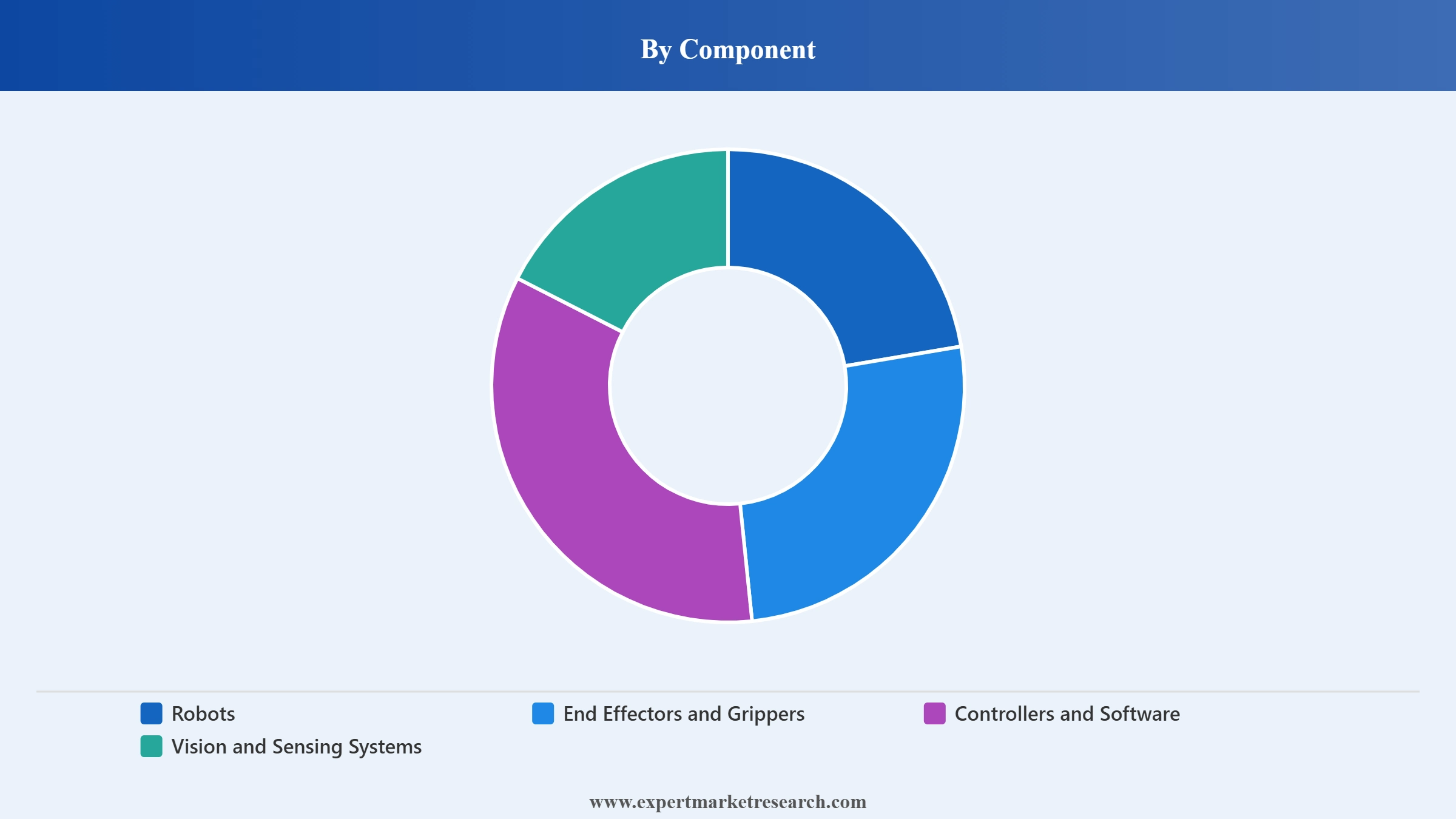
Key Insight: Robots account for the largest share of the automated machine tending systems market by component, while end effectors and grippers, controllers and software, and vision and sensing systems complete each cell. Vision and sensing systems are the fastest-growing component, and other items such as safety scanners, fixtures, and tool changers add to system value. Reflecting the shift toward smarter software, in July 2026, Mitsubishi Electric updated its MELFA robot platform, making preventive maintenance, wear simulation, and automatic calibration with thermal compensation standard features.
Market Breakup by Robot Type
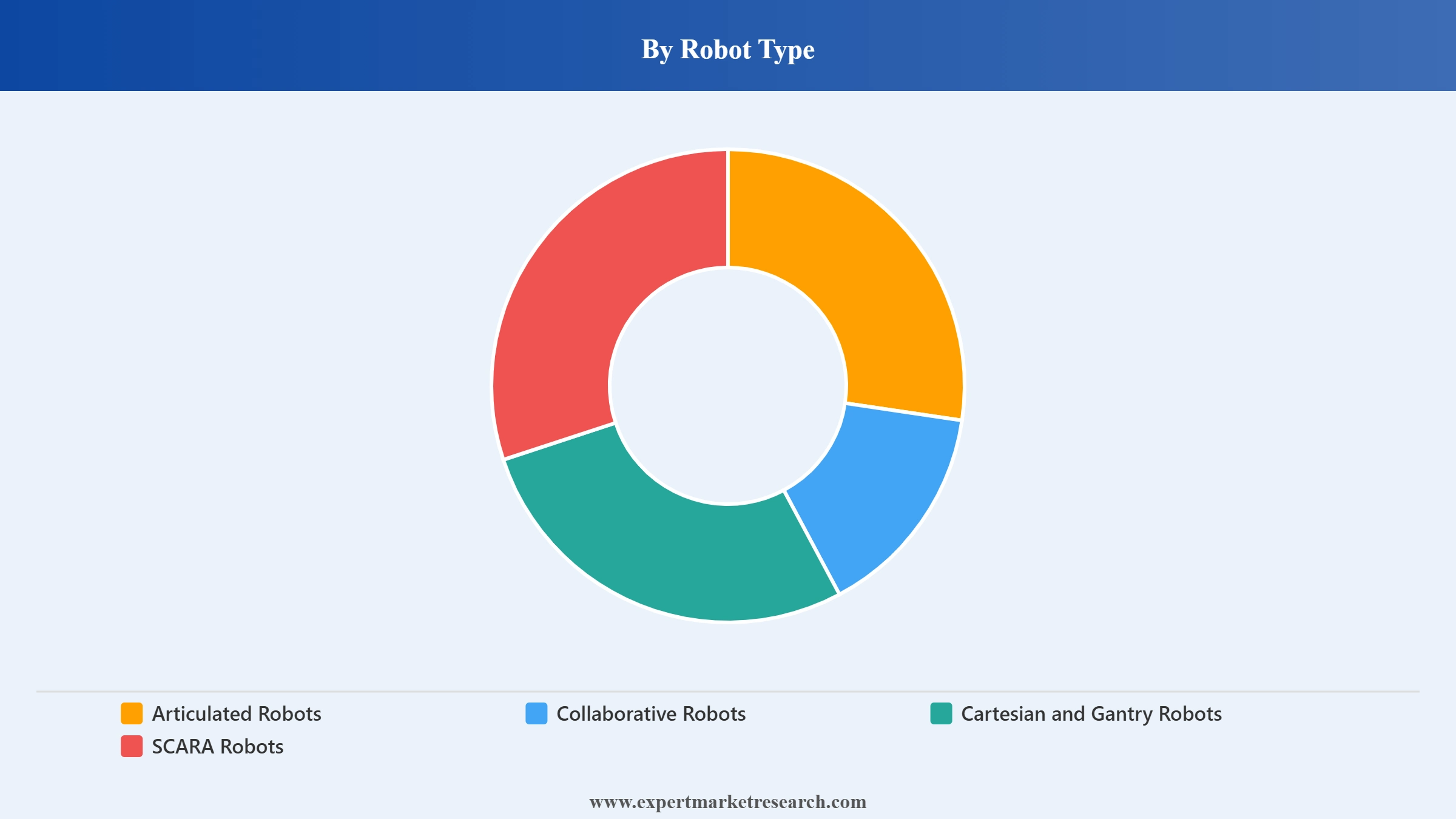
Key Insight: Articulated robots dominate the automated machine tending systems market by robot type, thanks to their reach and payload, while collaborative robots are the fastest-growing type as shops seek fence free automation. Cartesian and gantry robots serve dedicated high-speed loading, SCARA robots handle compact precision tasks, and other designs fill niche needs. Showing the push for faster cobots, in May 2025, Universal Robots launched the UR15 with a 15 kg payload and a top tool speed of 5 meters per second.
Market Breakup by Machine Type
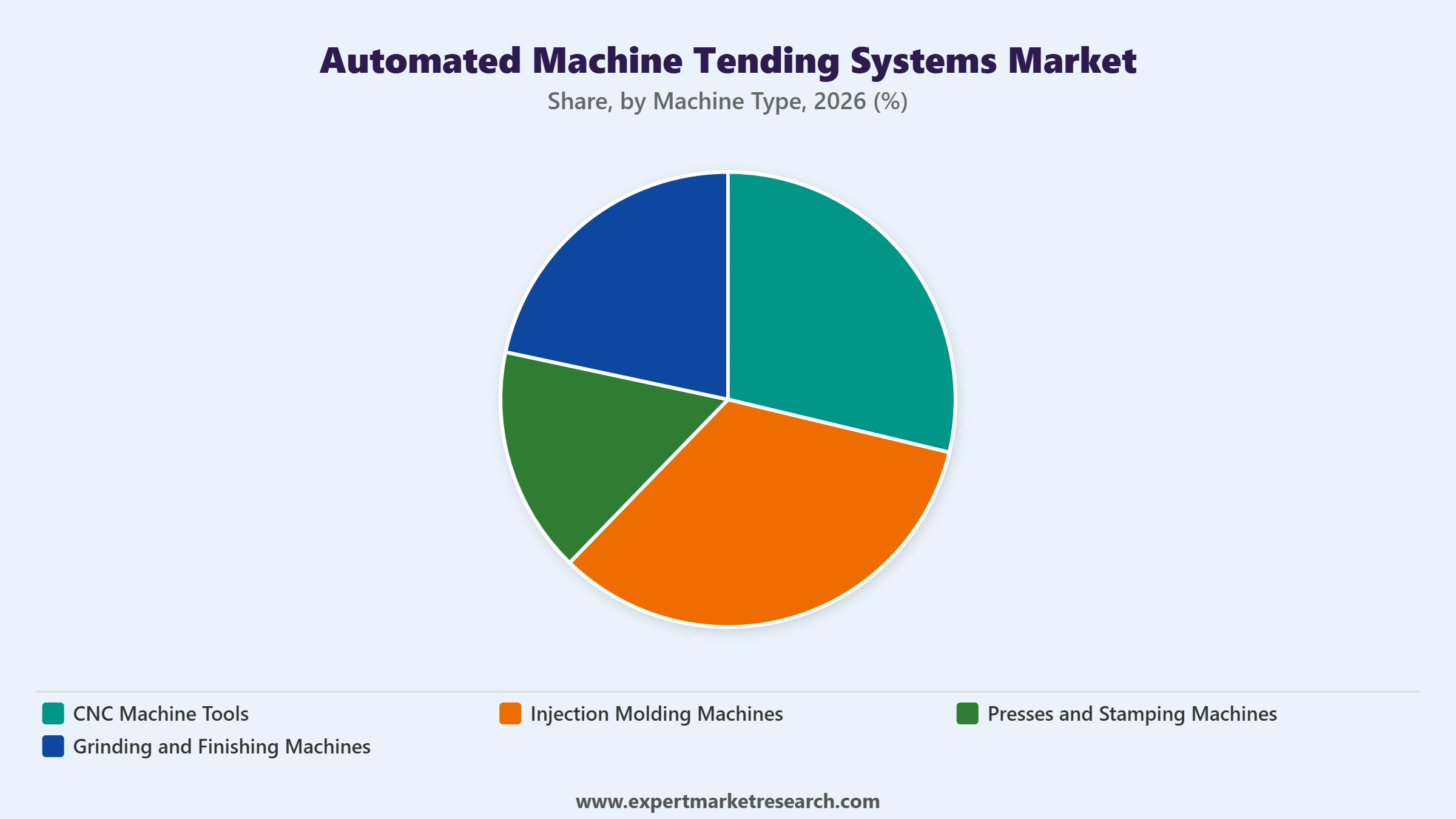
Key Insight: CNC machine tools lead the automated machine tending systems market by machine type, as lathes, mills, and machining centers are the most common candidates for unattended loading. Injection molding machines and presses and stamping machines add steady demand through part removal and feeding tasks. Grinding and finishing machines are the fastest-growing machine type because precision parts reward repeatable handling, and other equipment such as laser cutting systems provides additional opportunities for automation suppliers.
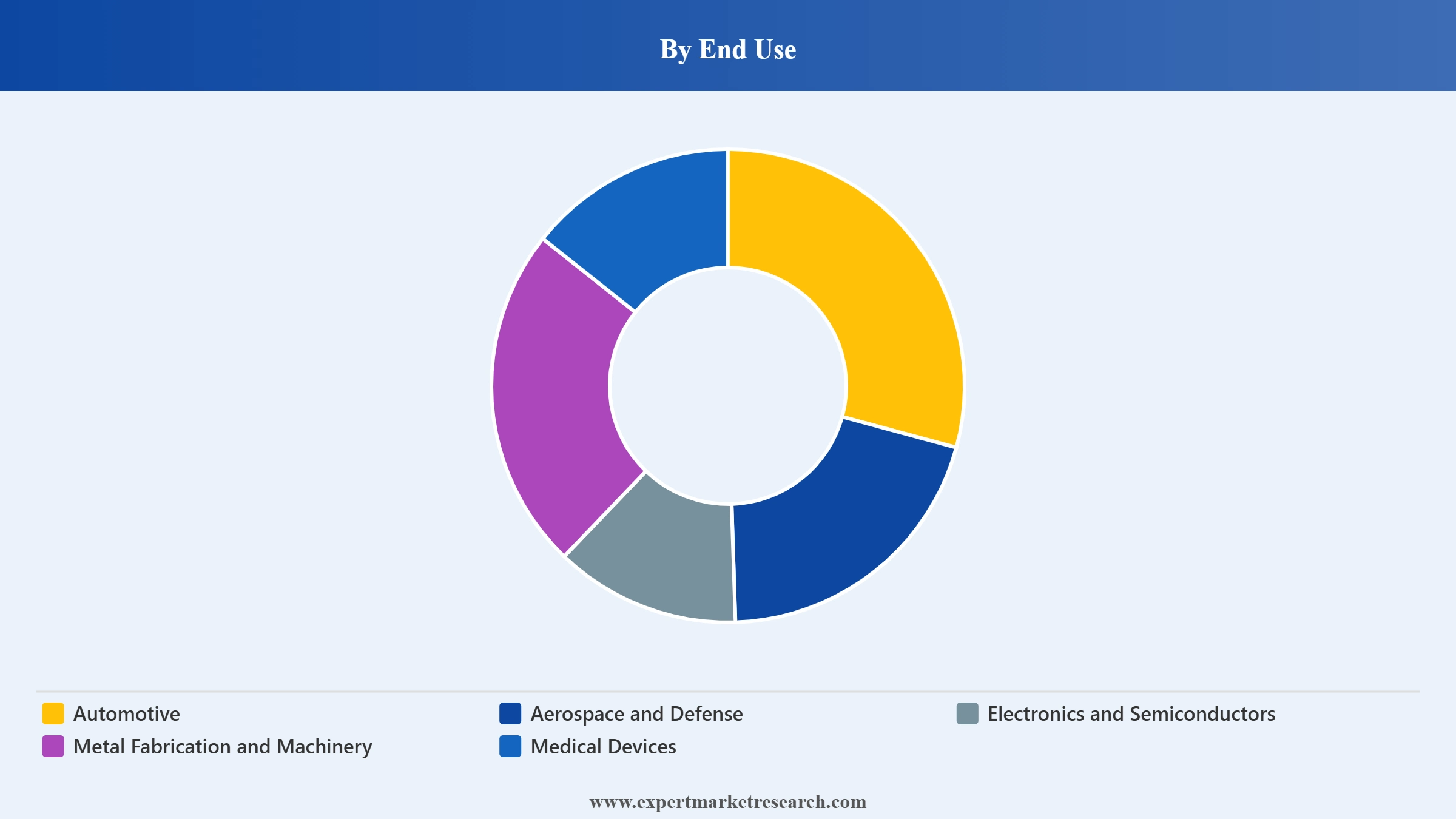
Market Breakup by End Use
Key Insight: Automotive dominates the automated machine tending systems market by end use, driven by large machining volumes and supplier automation programs, while medical devices is the fastest-growing end use. Aerospace and defense, electronics and semiconductors, metal fabrication and machinery, and other industries contribute steady demand for flexible tending cells across production environments. Illustrating pull from electronics and automotive plants, in March 2026, Techman unveiled a wheeled humanoid robot with a vision language action model, aimed at semiconductor, electronics, and automotive production, with commercialization planned for 2026.
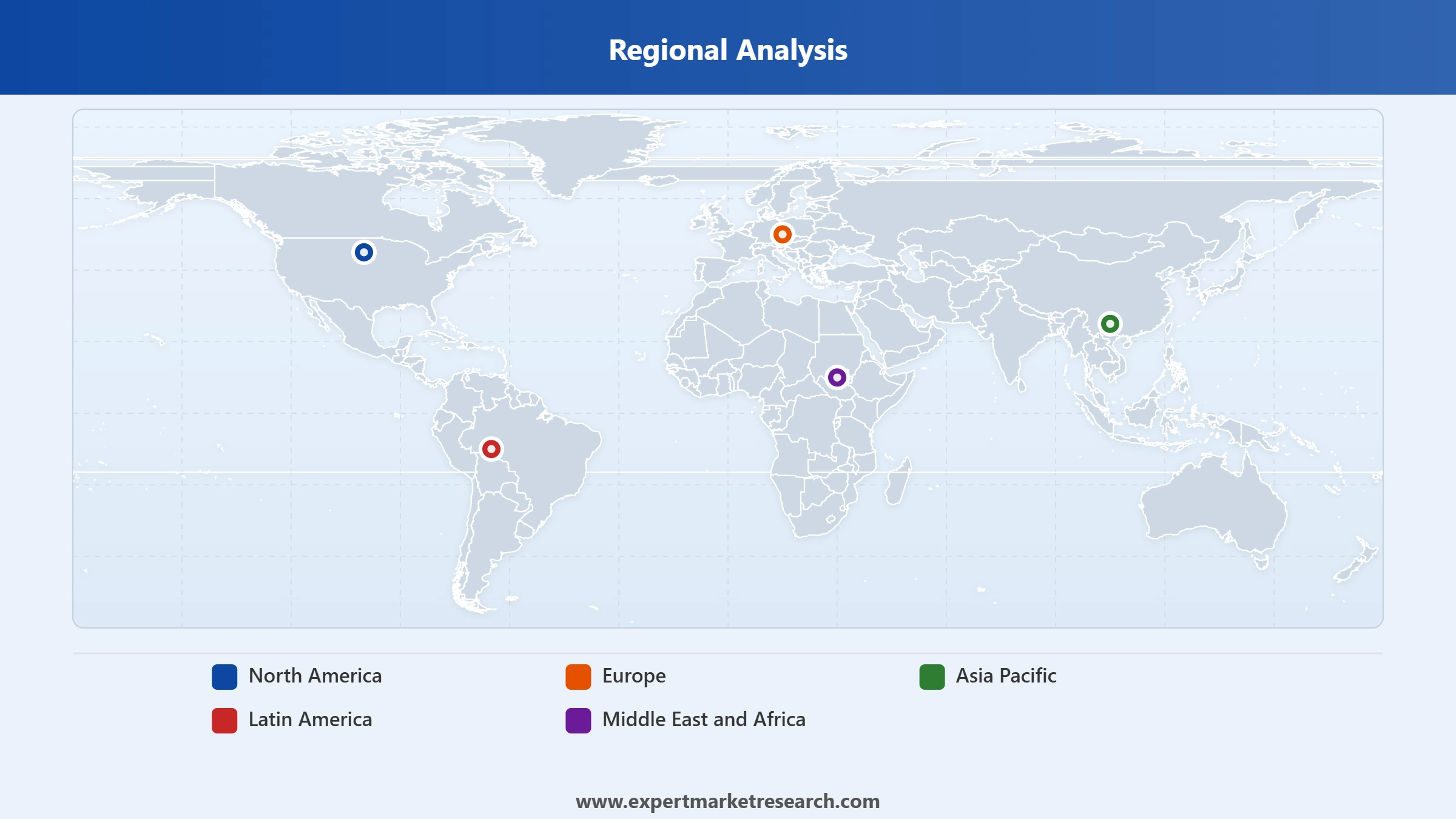
Market Breakup by Region
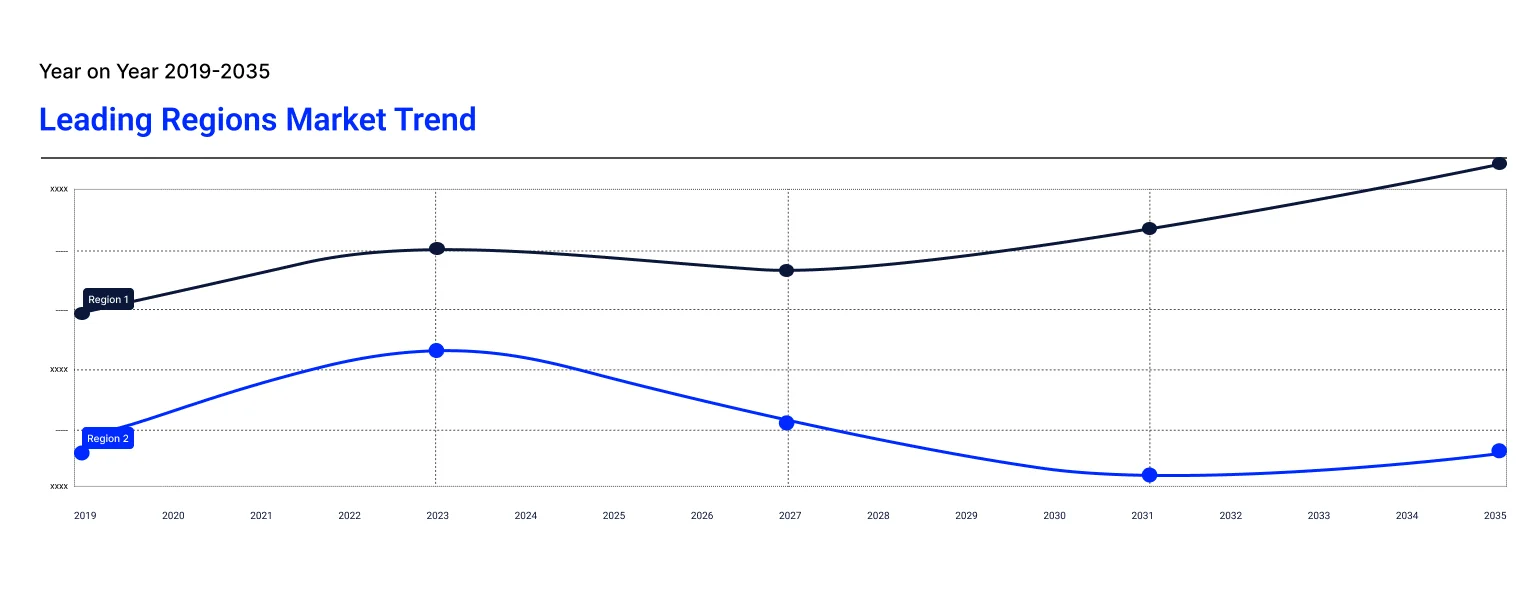
Key Insight: Asia Pacific dominates the automated machine tending systems market, supported by China's vast machining base and rising production across India, South Korea, and Southeast Asia, and it is also the fastest-growing region. North America is supported by reshoring, labor shortages, and recovering machine tool investment, while Europe is a mature, technology leading market with strong machine builders. Latin America benefits from automotive and metalworking expansion, and the Middle East and Africa from growing local manufacturing.
Read more about this report - REQUEST FREE SAMPLE COPY IN PDF
By component, robots dominate the market due to their central role in every tending cell
Robots account for the largest share of the automated machine tending systems market by component, since the robot arm is the core asset in every loading and unloading cell worldwide and carries the highest share of system cost. For example, in April 2026, ABB Robotics announced its MACH 2026 lineup, including the OmniVance collaborative machine tending cell and the FlexLoader FP800, which uses three-dimensional vision to pick randomly oriented parts, showing how robots and sensing technologies are packaged together.
Read more about this report - REQUEST FREE SAMPLE COPY IN PDF
Vision and sensing systems are the fastest-growing component as shops need robots that can locate loose parts, verify clamping, and inspect finished workpieces without expensive fixtures. Controllers and software are also expanding quickly because easier programming, simulation, and machine connectivity cut deployment time for small manufacturers. End effectors and grippers remain essential, with tool changers and custom fingers sold alongside nearly every cell, while remaining hardware categories grow steadily as installed bases expand across metalworking plants and contract manufacturers worldwide.
By robot type, articulated robots dominate the market due to reach, payload, and flexibility
Articulated robots account for the largest share of the market by robot type, because six axis arms offer the reach, payload, and motion range needed to serve CNC machines, presses, and molding equipment of different sizes. For example, in December 2025, OMRON Robotics expanded its TM S series with the TM20S and TM30S, aimed at machine tending and palletizing with higher payloads and IP65 protection, showing how arm makers are widening capacity options for heavier workpieces and more demanding cells.
Read more about this report - REQUEST FREE SAMPLE COPY IN PDF
Collaborative robots are the fastest-growing robot type as small and mid-sized shops want automation that can be installed without safety fencing and redeployed between machines in hours. Gradually falling prices, simple teaching interfaces, and standardized cart-based cells are encouraging first-time buyers, particularly in job shops running high mix, low volume batches. Cartesian and gantry robots remain popular for dedicated, high-speed loading, while SCARA robots serve compact electronics applications where precision and speed are important for high volume output.
By machine type, CNC machine tools dominate the market due to widespread lathe and mill automation
CNC machine tools account for the largest share of the market by machine type, since lathes, mills, and machining centers are the most common candidates for unattended loading and unloading. Shops use robots to extend spindle uptime across shifts and weekends. For example, in September 2026, KUKA showed a KR CYBERTECH robot tending an EMAG cylindrical grinding machine with integration partner Formic, holding cylindricity deviations below a single micrometer, illustrating the precision that robotic tending cells now achieve in grinding.
Read more about this report - REQUEST FREE SAMPLE COPY IN PDF
Grinding and finishing machines are the fastest-growing machine type because tight tolerances, repeatable handling, and in-process measurement make automation especially valuable for precision parts across demanding industries. Injection molding machines remain a large application, using robots for part removal, insertion, and packing, while presses and stamping lines adopt tending to improve safety and consistency. Other equipment such as laser cutting systems and additive manufacturing post processing is also adding demand as manufacturers look to automate surrounding steps in the workflow.
By end use, automotive dominates the market due to high volume machining and strong supplier automation
Automotive accounts for the largest share of the market by end use, as vehicle and component suppliers run large machining volumes where automated tending improves throughput and quality. For example, in April 2026, Hexagon and Schaeffler announced plans to deploy at least 1,000 AEON humanoid robots across Schaeffler's global plants by 2032, following a pilot where a station loaded and unloaded parts across multiple machines, signaling the long-term direction of tending automation in automotive supply chains and component plants.
Read more about this report - REQUEST FREE SAMPLE COPY IN PDF
Medical devices is the fastest-growing end use as makers of implants, surgical instruments, and diagnostic components need clean, traceable, and precise handling across small batch production runs. Aerospace and defense are also expanding steadily, supported by strong demand for titanium and high value machined parts that justify unattended operation. Electronics and semiconductors continue to adopt compact robots for repetitive handling, while metal fabrication and machinery builders use tending to offset skilled labor shortages and improve spindle utilization and delivery reliability.
Asia Pacific dominates the market due to large manufacturing bases and rapid robot adoption
Asia Pacific dominates the automated machine tending systems market, anchored by China's enormous and sophisticated machining base and the density of robot suppliers, integrators, and machine tool builders serving it. For example, in September 2026, the International Federation of Robotics reported that China installed about 354,000 industrial robots in 2025, up 20% and accounting for 59% of global installations, a scale that supports strong and sustained regional demand for machine tending systems, grippers, controllers, and related components across many factories.
Read more about this report - REQUEST FREE SAMPLE COPY IN PDF
India, South Korea, and Southeast Asian economies are accelerating growth as automotive, electronics, and engineering investments expand, and wage costs rise. Local robot makers and integrators are increasingly scaling lower cost cells for domestic shops, while global suppliers add regional assembly and service centers. As a result, the region is expected to post the fastest growth through the forecast period, supported by government manufacturing incentives, rising skilled labor shortages, and wider adoption of collaborative robots among small and medium enterprises.
|
CAGR 2026-2035 - Market by |
Region |
|
North America |
8.4% |
|
Europe |
7.4% |
|
Asia Pacific |
10.2% |
|
Latin America |
8.8% |
|
Middle East and Africa |
9.6% |
The global automated machine tending systems companies are moderately consolidated, with large robot manufacturers and specialist collaborative robot suppliers competing on payload range, ease of programming, safety, and integrator networks. Companies like FANUC Corporation, ABB Ltd., Yaskawa Electric Corporation, and KUKA AG lead through broad robot portfolios and global service reach, while Universal Robots, Doosan Robotics, Omron, Staubli, and Mitsubishi Electric strengthen positions through collaborative robots and factory automation platforms.
Leading automated machine tending systems market players are focusing on collaborative tending cells, artificial intelligence enabled vision, easier programming, and regional assembly and service centers to strengthen their competitive position. Alliances with machine tool builders, standardized turnkey packages, and bolt on deals for engineering talent are also helping suppliers shorten deployment time, build recurring software and service revenue, and support sustained long term market growth.
FANUC Corporation, headquartered in Oshino, Yamanashi, Japan, was founded in 1972 and is listed on the Tokyo Stock Exchange. The company supplies industrial robots, computer numerical controls, and machines, including CRX collaborative robots and cells for loading and unloading machine tools, supported by a worldwide service and training network.
ABB Ltd., headquartered in Zurich, Switzerland, was formed in 1988 through the merger of ASEA and Brown Boveri. Its robotics business offers industrial and collaborative robots, controllers, and software, serving automotive, electronics, logistics, and general manufacturing customers through a worldwide network of sales, engineering, and service centers.
Yaskawa Electric Corporation, headquartered in Kitakyushu, Fukuoka, Japan, was founded in 1915 and is listed on the Tokyo Stock Exchange. The company manufactures servo drives, inverters, and Motoman industrial robots used for welding, handling, and machine and press tending, supported by manufacturing and service bases across the world.
KUKA AG, headquartered in Augsburg, Germany, was founded in 1898 and is owned by Midea Group. The company supplies industrial robots, mobile platforms, and software, working with system partners and end users in automotive, metalworking, electronics, and healthcare sectors across global markets.
Other key players in the market report include Universal Robots A/S, Doosan Robotics Inc., Omron Corporation, Staubli International AG, and Mitsubishi Electric Corporation, among others.
*Please note that this is only a partial list; the complete list of key players is available in the full report. Additionally, the list of key players can be customized to better suit your needs.*
Explore the latest trends shaping the automated machine tending systems market 2026-2035 with our in-depth report. Gain strategic insights to support your business decisions. Get in touch with our analysts today. Download a free sample report or contact our team for a customized consultation on the market trends 2026.


Upto 15% Off
USD
$2499 $2249
$3999 $3599
$4999 $4249
$5999 $5099


*While we strive to always give you current and accurate information, the numbers depicted on the website are indicative and may differ from the actual numbers in the main report. At Expert Market Research, we aim to bring you the latest insights and trends in the market. Using our analyses and forecasts, stakeholders can understand the market dynamics, navigate challenges, and capitalize on opportunities to make data-driven strategic decisions.*
In 2025, the automated machine tending systems market reached an approximate value of USD 3.40 Billion.
The market is projected to grow at a CAGR of 9.00% between 2026 and 2035.
The key players in the market include FANUC Corporation, ABB Ltd., Yaskawa Electric Corporation, KUKA AG, Universal Robots A/S, Doosan Robotics Inc., Omron Corporation, Staubli International AG, and Mitsubishi Electric Corporation, among others.
Leading manufacturers are pursuing collaborative tending cells, vision guided handling, turnkey cell packages, and regional production and service expansion close to key customers.
Key challenges include high upfront system costs, integration complexity, shortages of automation programming skills, and trade and tariff uncertainty affecting equipment supply chains.
Explore our key highlights of the report and gain a concise overview of key findings, trends, and actionable insights that will empower your strategic decisions.
|
Report Features |
Details |
|
Base Year |
2025 |
|
Historical Period |
2019-2025 |
|
Forecast Period |
2026-2035 |
|
Scope of the Report |
Historical and Forecast Trends, Industry Drivers and Constraints, Historical and Forecast Market Analysis by Segment:
|
|
Breakup by Component |
|
|
Breakup by Robot Type |
|
|
Breakup by Machine Type |
|
|
Breakup by End Use |
|
|
Breakup by Region |
|
|
Market Dynamics |
|
|
Competitive Landscape |
|
|
Companies Covered |
|
Datasheet
One User
USD 2,499
USD 2,249
tax inclusive*
Single User License
One User
USD 3,999
USD 3,599
tax inclusive*
Five User License
Five User
USD 4,999
USD 4,249
tax inclusive*
Corporate License
Unlimited Users
USD 5,999
USD 5,099
tax inclusive*
*Please note that the prices mentioned below are starting prices for each bundle type. Kindly contact our team for further details.*
Flash Bundle
Small Business Bundle
Growth Bundle
Enterprise Bundle
*Please note that the prices mentioned below are starting prices for each bundle type. Kindly contact our team for further details.*
Flash Bundle
Number of Reports: 3
20%
tax inclusive*
Small Business Bundle
Number of Reports: 5
25%
tax inclusive*
Growth Bundle
Number of Reports: 8
30%
tax inclusive*
Enterprise Bundle
Number of Reports: 10
35%
tax inclusive*
How To Order

Select License Type
Choose the right license for your needs and access rights.

Click on ‘Buy Now’
Add the report to your cart with one click and proceed to register.

Select Mode of Payment
Choose a payment option for a secure checkout. You will be redirected accordingly.
Strategic Solutions for Informed Decision-Making
Gain insights to stay ahead and seize opportunities.

Get insights & trends for a competitive edge.

Track prices with detailed trend reports.

Analyse trade data for supply chain insights.

Leverage cost reports for smart savings

Enhance supply chain with partnerships.

Connect For More Information
Our expert team of analysts will offer full support and resolve any queries regarding the report, before and after the purchase.
Our expert team of analysts will offer full support and resolve any queries regarding the report, before and after the purchase.
We employ meticulous research methods, blending advanced analytics and expert insights to deliver accurate, actionable industry intelligence, staying ahead of competitors.
Our skilled analysts offer unparalleled competitive advantage with detailed insights on current and emerging markets, ensuring your strategic edge.
We offer an in-depth yet simplified presentation of industry insights and analysis to meet your specific requirements effectively.




