

Consumer Insights
Uncover trends and behaviors shaping consumer choices today
Procurement Insights
Optimize your sourcing strategy with key market data
Industry Stats
Stay ahead with the latest trends and market analysis.
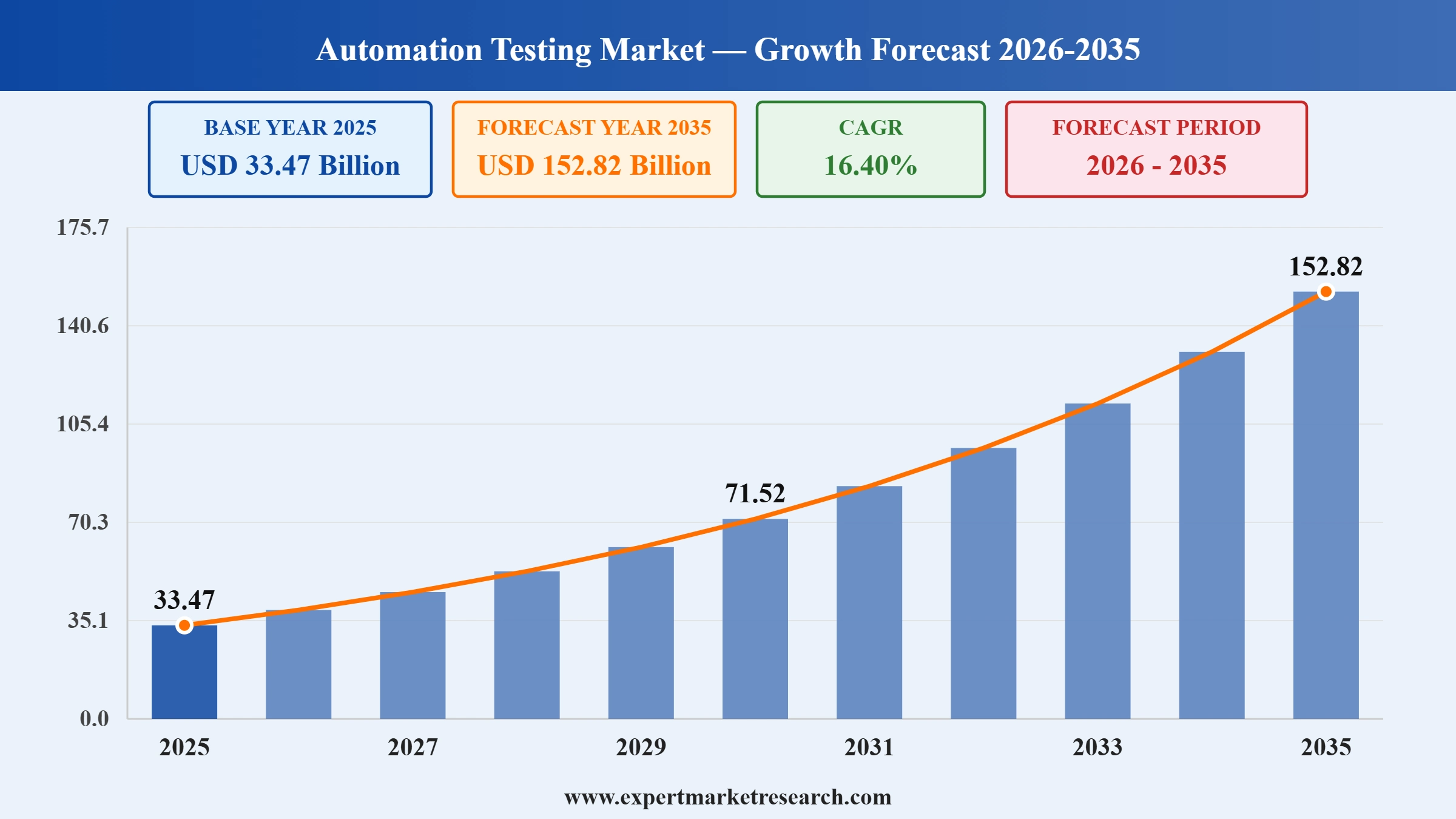
The global automation testing market attained a value of USD 33.47 Billion in 2025 and is projected to expand at a CAGR of 16.40% through 2035. The market is further expected to achieve a value of USD 152.82 Billion by 2035. Generative artificial intelligence multiplying code output, agentic platforms generating and maintaining tests autonomously, and a widening gap between development velocity and quality assurance capacity are strengthening the automation testing industry while reshaping what buyers expect a testing platform to do.
The automation testing market covers the software tools, platforms and services used to verify that applications behave as designed without requiring a person to execute each check manually. A testing tool drives the application the way a user would, entering data, navigating screens and calling interfaces, then compares the result against an expected outcome and reports any deviation. Coverage spans functional testing that confirms features work, regression testing that confirms new changes have broken nothing, performance testing that measures behaviour under load, and application programming interface testing that validates the third-party services on which most modern software depends.
Deployment runs across web, mobile, desktop and embedded environments, and the market divides between testing solutions supplying the platform itself and services covering framework design, migration from legacy suites and integration with continuous delivery pipelines. Demand originates with software engineering and quality assurance teams in banking, automotive, aerospace, healthcare and retail, where release frequency and defect consequence are both high. The technical basis of the market is shifting, as platforms built on artificial intelligence agents now generate test cases from written requirements and adapt them when applications change, which moves the value from executing scripts faster towards removing the need to write and maintain them at all.
Read more about this report - REQUEST FREE SAMPLE COPY IN PDF
| Automation Testing Market Report Summary | Description | Value |
| Base Year | USD Billion | 2025 |
| Historical Period | USD Billion | 2019-2025 |
| Forecast Period | USD Billion | 2026-2035 |
| Market Size 2025 | USD Billion | 33.47 |
| Market Size 2035 | USD Billion | 152.82 |
| CAGR 2019-2025 | Percentage | XX% |
| CAGR 2026-2035 | Percentage | 16.40% |
| CAGR 2026-2035 - Market by Region | Asia Pacific | 18.9% |
| CAGR 2026-2035 - Market by Country | India | 21.7% |
| CAGR 2026-2035 - Market by Country | China | 18.1% |
| CAGR 2026-2035 - Market by Component | Testing Solutions | 18.0% |
| CAGR 2026-2035 - Market by Industry Vertical | BFSI | 18.7% |
| Market Share by Country 2025 | France | 3.3% |
Growth in the automation testing market is being driven by a mismatch between how fast code is now written and how fast it can be verified. Generative artificial intelligence has multiplied the volume of code reaching testing pipelines, and a Tricentis survey of 2,501 senior technology decision-makers fielded in April 2026 found 60 percent of organisations deploying untested code to production, with 30 percent citing overwhelming volumes of AI-generated code. Enterprises already allocate roughly 22 to 25 percent of information technology budgets to quality assurance, yet automated coverage for complex workflows remains below 35 percent, leaving a substantial gap for automation tools to close.
The manual testing overhang represents the largest conversion opportunity. Research covering 273 software professionals found that while 87 percent of organisations had automated at least 20 percent of their testing, 92 percent still relied on manual methods and nearly 60 percent conducted over 40 percent of testing by hand. Agentic platforms launched during 2026 by Tricentis and Sauce Labs target exactly this constraint, generating and maintaining tests from natural language requirements rather than requiring engineers to script them, which removes the maintenance burden that historically limited how far automation programmes could extend.
There are two important reasons behind the growth of the global automation testing market. First, generative artificial intelligence has multiplied the volume of code entering testing pipelines without a corresponding increase in quality assurance capacity, which forces organisations to automate verification simply to keep pace with what developers now produce. Second, the cost of defects reaching production has risen as software has become the primary customer interface across banking, retail, healthcare and mobility, making automated regression coverage a commercial requirement rather than an engineering preference.
The global automation testing market is undergoing a structural change, in which artificial intelligence agents generate and maintain tests rather than executing scripts written by humans. This trend became more evident in March 2026, when Tricentis launched an agentic quality engineering platform combining AI Workspace with agentic modules covering quality intelligence, test automation, performance testing and test creation. Sauce Labs followed in April 2026 with general availability of Sauce AI for Test Authoring, which converts business requirements expressed in natural language into framework-agnostic test suites for web and mobile environments, claiming up to 90 percent faster test creation.
The global automation testing market is also undergoing transformation due to the quality gap that artificial intelligence has opened between code production and verification. A Tricentis survey of 2,501 senior technology decision-makers across six countries, fielded in April 2026, found 60 percent of organisations still deploying untested code to production, with leadership pressure to prioritise speed cited by 32 percent and overwhelming volumes of AI-generated code by 30 percent. Separate research covering 273 software professionals reported that 93 percent had adopted artificial intelligence coding tools while 68 percent expected faster development to create testing bottlenecks.
The Expert Market Research's report titled “Automation Testing Market Report and Forecast 2026-2035 offers a detailed analysis of the market based on the following segments:
Market Breakup by Component
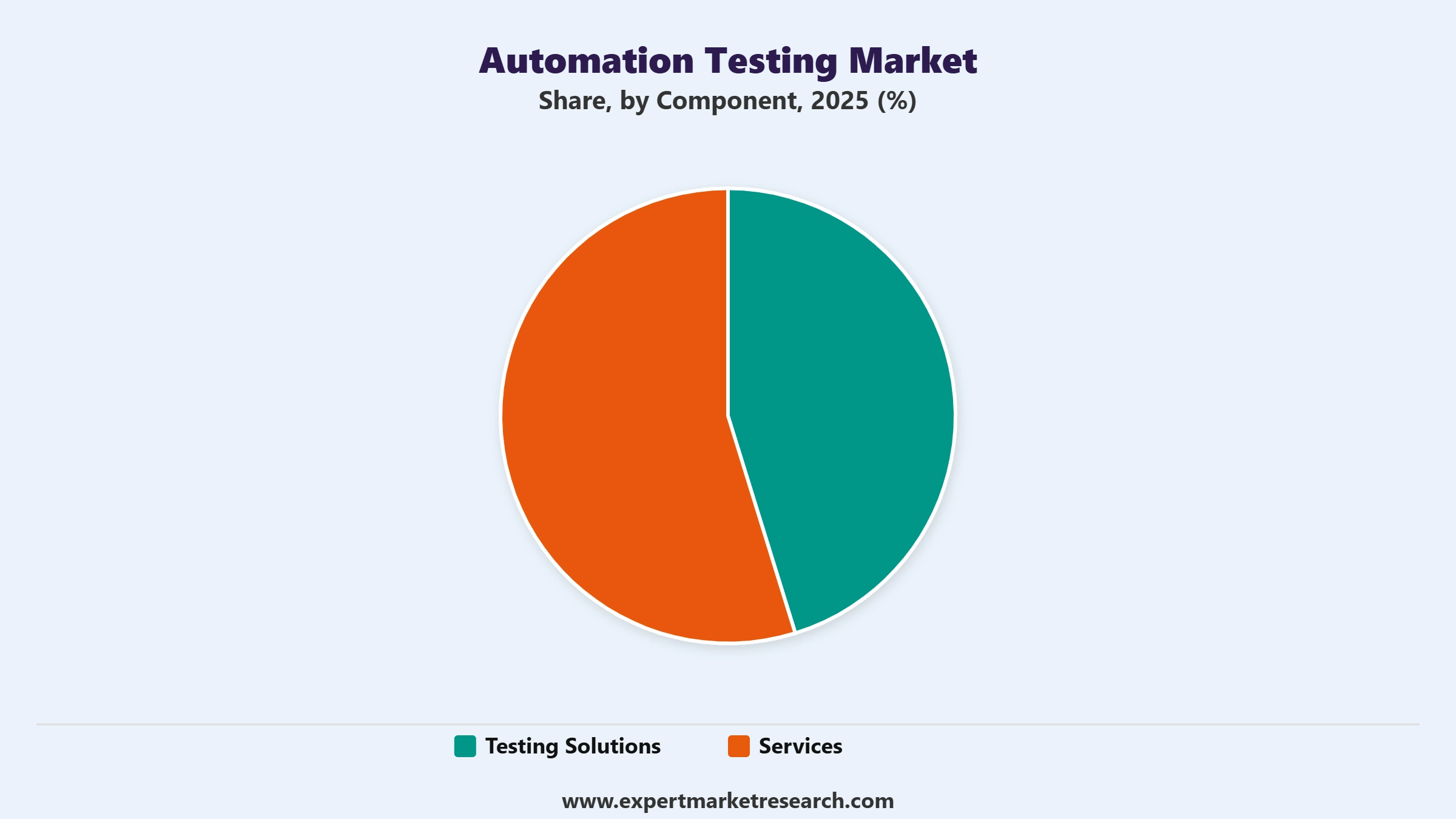
Key Insight: Testing solutions lead the component segment of the global automation testing market and are forecast to grow at an 18.0% CAGR between 2026 and 2035, reflecting the shift from human-written scripts towards platforms that generate and maintain tests autonomously. Agentic products launched during 2026 by Tricentis and Sauce Labs illustrate where product value is concentrating, since capability now resides in the model and orchestration layer rather than in the execution engine. Services remain essential for framework design, migration from legacy suites, test data management and continuous integration pipeline work, particularly in regulated industries where validation evidence must be documented.
Market Breakup by Endpoint Interface
Key Insight: Web holds the largest share of the endpoint interface segment in the global automation testing market, since browser-based applications carry most customer-facing functionality and change frequently enough to require continuous regression coverage. Mobile is expanding rapidly because device, operating system and screen size fragmentation multiply the test matrix beyond what manual verification can cover, and agent-generated suites now target web and mobile together. Desktop testing persists in enterprise environments running established line-of-business applications, while embedded software testing carries the strictest requirements in automotive, aerospace and medical devices where certification demands documented verification.
Market Breakup by Industry Vertical
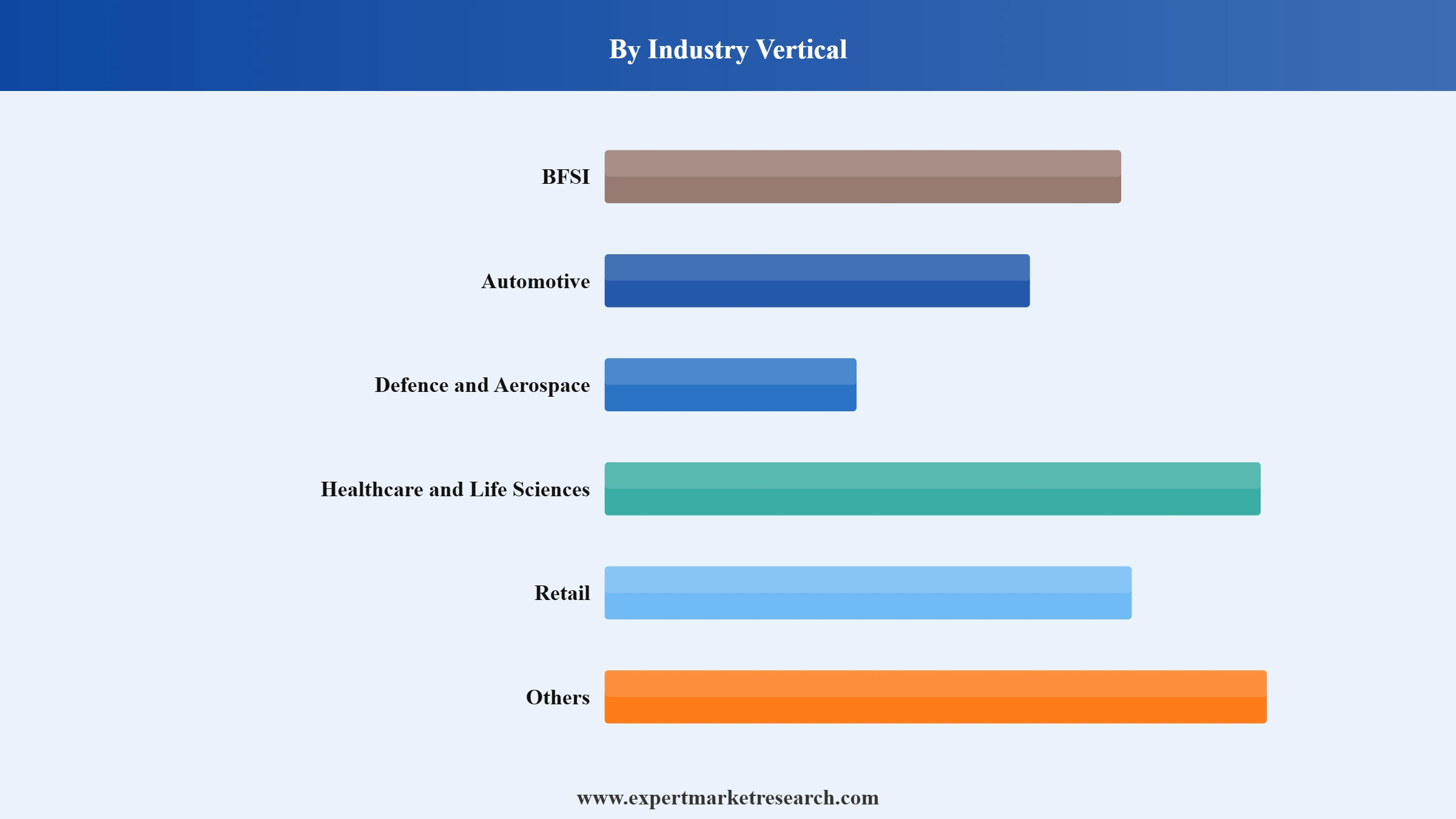
Key Insight: BFSI is anticipated to witness significant growth in the global automation testing market at an 18.7% CAGR through 2035, driven by rapid digital service expansion, the need to protect customer data security and competitive pressure to deliver new capability quickly. Financial institutions run large legacy estates alongside new digital channels, which produces regression testing requirements at a scale that manual approaches cannot serve. Regulatory examination adds a documentation dimension, since institutions must evidence that changes were tested before release. Automotive, defence and aerospace, and healthcare and life sciences follow similar logic, where embedded and safety-critical software demands verification that certification bodies will accept.
Market Breakup by Region




By component, testing solutions dominate the market as intelligence shifts into the platform layer
Testing solutions take the largest share of the global automation testing market and are forecast to grow at an 18.0% CAGR through 2035, because the capability that determines programme success now resides in software rather than in the scripts an organisation writes around it. Platforms that generate test cases from requirements, adapt them when applications change and interpret failures without human triage reduce the labour that previously dominated automation cost. Aligning with this trend, in April 2026, Sauce Labs released an authoring agent claiming up to 90 percent faster test creation, while Tricentis launched a coordinated agentic platform in March 2026 reporting performance insight acceleration of 90 to 95 percent.
Services retain a substantial position in the global automation testing market, covering framework architecture, migration from legacy test suites, test data provisioning and integration with continuous delivery pipelines. Demand is strengthening rather than eroding as artificial intelligence enters the toolchain, since organisations require help selecting among rapidly changing options and establishing governance over agent-generated tests. Survey evidence from 2026 indicating that over half of organisations experience regular change in their artificial intelligence tools and processes underlines the advisory requirement attached to this transition.
Read more about this report - REQUEST FREE SAMPLE COPY IN PDF
By industry vertical, BFSI leads the market owing to regulatory obligation and large legacy estates
BFSI accounts for a leading share of the global automation testing market and is forecast to expand at an 18.7% CAGR through 2035, since banks and insurers operate extensive legacy systems alongside continuously updated digital channels, producing regression coverage requirements at a scale manual testing cannot meet. Security of customer information is a governing consideration, and institutions must demonstrate to supervisors that changes were verified before deployment. Competitive pressure to release new services quickly compounds the requirement, making automated coverage the mechanism through which speed and control are reconciled.
Automotive, defence and aerospace, and healthcare and life sciences occupy the most demanding technical positions in the global automation testing market, where embedded and safety-critical software must satisfy certification requirements and where verification evidence forms part of the regulatory submission. Retail depends on automation for peak trading readiness, since e-commerce platforms must absorb seasonal load without failure and change frequently in response to merchandising decisions. Across all these verticals, the volume of AI-generated code entering pipelines has raised the coverage threshold organisations must reach before release.
Read more about this report - REQUEST FREE SAMPLE COPY IN PDF
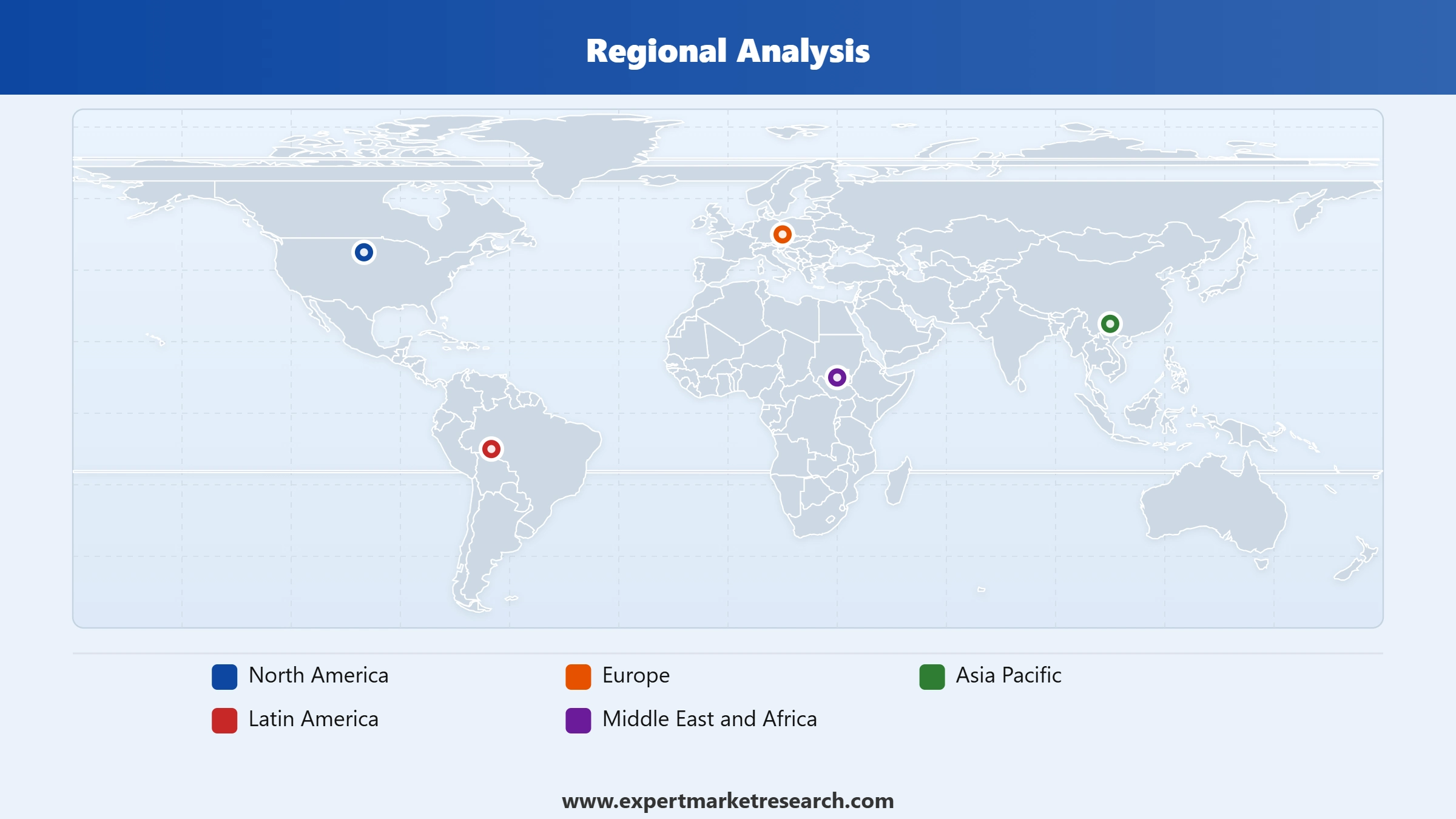
North America accounts for the largest market share through early enterprise adoption and vendor concentration
The global automation testing market continues to be led by North America due to widespread technology adoption, intense competition among technology providers, rising deployment of advanced technologies including the Internet of Things, and increasing use of automation testing across industries. The region hosts the major platform vendors and the enterprise buyers implementing artificial intelligence in development pipelines earliest, which is why agentic product launches during 2026 were timed to North American enterprise buying cycles. Survey evidence from the region shows the quality gap most clearly, with organisations acknowledging that code is reaching production without adequate verification.
The Asia Pacific automation testing market is witnessing the fastest growth at an 18.9% CAGR through 2035, with India leading country forecasts at a 21.7% CAGR and China at 18.1%. India combines a large domestic technology sector with the global delivery capacity that supports quality assurance functions for enterprises worldwide, which places it at the centre of both demand and supply for testing services. Europe grows more moderately, with the United Kingdom at 15.0% and France at 12.9%, shaped by regulatory requirements around software governance and by an established financial services and automotive engineering base.
Read more about this report - REQUEST FREE SAMPLE COPY IN PDF
Competition is shifting towards autonomous test generation, maintenance reduction and framework-agnostic output as opposed to execution speed alone. Automation testing companies are building agent architectures that interpret requirements, author test suites, adapt to application change and diagnose failures without human triage, since test maintenance rather than execution has become the dominant cost in enterprise programmes.
Leading global automation testing market players are also positioning around the credibility gap that artificial intelligence has created in software delivery. As Tricentis chief executive Kevin Thompson observed, artificial intelligence is transformative in its ability to create code at unprecedented speed, yet the friction caused by lack of confidence in output quality is causing chief information officers real pain. One more important issue that players are addressing is tooling volatility, with vendors emphasising framework-agnostic output and stable integration layers so that accumulated test assets survive changes elsewhere in the toolchain.
IBM Corporation is an IT services and IT consulting company that was founded in 1911 and is headquartered in New York, United States. Their specialities include technology support, consulting, analytics, and resiliency services, among others.
Microsoft Corporation is a software development company that was established in 1975 and is headquartered in Washington, United States. The company specialises in operating systems, virtual reality, and cloud computing, among others.
Accenture Plc, founded in 1989 and headquartered in Dublin, Ireland, is an IT services and IT consulting company. Their specialities include business process outsourcing, management consulting, and application and infrastructure outsourcing, among others.
Other market players include Open Text Corporation, Capgemini SE, Parasoft, Tricentis, Cygnet Infotech, Mobisoft Infotech LLC, Apexon, QASource, Inc., and Ranorex GmbH, among others.
*Please note that this is only a partial list; the complete list of key players is available in the full report. Additionally, the list of key players can be customized to better suit your needs.*
Test maintenance remains the persistent challenge in automation testing. Scripts break whenever an interface changes, and the effort required to repair them has historically consumed the savings automation was meant to deliver. Tooling volatility compounds this, with over half of organisations that have implemented artificial intelligence internally reporting that their tools and processes change regularly, which erodes the accumulated test assets programmes depend on. A confidence gap has also emerged between leadership and practitioners, with 81 percent of chief executives expressing high confidence in artificial intelligence driven systems against 56 percent of quality assurance and DevOps professionals.
Organisational pressure restrains adoption more than technology does. Leadership prioritisation of release speed was cited by 32 percent of surveyed organisations as a reason for deploying untested code, indicating that testing investment competes directly with delivery targets. Skills shortages in quality engineering limit how quickly teams can operate new platforms, and around 65 percent of software professionals surveyed expressed concern that decision-makers underestimate the risk of accelerated development without corresponding testing capability.
The manual testing burden defines the opportunity. With 92 percent of organisations still testing manually and nearly 60 percent conducting over 40 percent of testing by hand, agentic platforms that generate tests from written requirements address work that scripting could never economically reach.


Upto 15% Off
USD
$3999 $3599
$2499 $2249
$4999 $4249
$5999 $5099


*While we strive to always give you current and accurate information, the numbers depicted on the website are indicative and may differ from the actual numbers in the main report. At Expert Market Research, we aim to bring you the latest insights and trends in the market. Using our analyses and forecasts, stakeholders can understand the market dynamics, navigate challenges, and capitalize on opportunities to make data-driven strategic decisions.*
The market size reached a value of approximately USD 33.47 Billion in 2025.
The market is expected to grow at a CAGR of 16.40% between 2026 and 2035.
The market is estimated to witness a healthy growth in the forecast period of 2026-2035 to reach USD 152.82 Billion by 2035.
The major market drivers include increased cost savings facilitated by automation testing, reduced regression testing time, and increased usage of mobile applications.
The key trends fuelling the growth of the market include rising utilisation of automation testing by various companies and rapid advancements in modern technologies.
The major regions in the market are North America, Europe, the Asia Pacific, Latin America, and the Middle East and Africa.
The primary components of automation testing are testing solutions and services, with testing solutions sub-divided by type into functional testing, API testing, security testing, compliance testing, and usability testing, among others.
The key players in global automation testing market are IBM Corporation, Microsoft Corporation, Accenture Plc, Open Text Corporation, Capgemini SE, Parasoft, Tricentis, Cygnet Infotech, Mobisoft Infotech LLC, Apexon, QASource, Inc., and Ranorex GmbH, among others.
Explore our key highlights of the report and gain a concise overview of key findings, trends, and actionable insights that will empower your strategic decisions.
| REPORT FEATURES | DETAILS |
| Base Year | 2025 |
| Historical Period | 2019-2025 |
| Forecast Period | 2026-2035 |
| Scope of the Report |
Historical and Forecast Trends, Industry Drivers and Constraints, Historical and Forecast Market Analysis by Segment:
|
| Breakup by Component |
|
| Breakup by Endpoint Interface |
|
| Breakup by Industry Vertical |
|
| Breakup by Region |
|
| Market Dynamics |
|
| Competitive Landscape |
|
| Companies Covered |
|
Single User License
One User
USD 3,999
USD 3,599
tax inclusive*
Datasheet
One User
USD 2,499
USD 2,249
tax inclusive*
Five User License
Five User
USD 4,999
USD 4,249
tax inclusive*
Corporate License
Unlimited Users
USD 5,999
USD 5,099
tax inclusive*
*Please note that the prices mentioned below are starting prices for each bundle type. Kindly contact our team for further details.*
Flash Bundle
Small Business Bundle
Growth Bundle
Enterprise Bundle
*Please note that the prices mentioned below are starting prices for each bundle type. Kindly contact our team for further details.*
Flash Bundle
Number of Reports: 3
20%
tax inclusive*
Small Business Bundle
Number of Reports: 5
25%
tax inclusive*
Growth Bundle
Number of Reports: 8
30%
tax inclusive*
Enterprise Bundle
Number of Reports: 10
35%
tax inclusive*
How To Order

Select License Type
Choose the right license for your needs and access rights.

Click on ‘Buy Now’
Add the report to your cart with one click and proceed to register.

Select Mode of Payment
Choose a payment option for a secure checkout. You will be redirected accordingly.
Strategic Solutions for Informed Decision-Making
Gain insights to stay ahead and seize opportunities.

Get insights & trends for a competitive edge.

Track prices with detailed trend reports.

Analyse trade data for supply chain insights.

Leverage cost reports for smart savings

Enhance supply chain with partnerships.

Connect For More Information
Our expert team of analysts will offer full support and resolve any queries regarding the report, before and after the purchase.
Our expert team of analysts will offer full support and resolve any queries regarding the report, before and after the purchase.
We employ meticulous research methods, blending advanced analytics and expert insights to deliver accurate, actionable industry intelligence, staying ahead of competitors.
Our skilled analysts offer unparalleled competitive advantage with detailed insights on current and emerging markets, ensuring your strategic edge.
We offer an in-depth yet simplified presentation of industry insights and analysis to meet your specific requirements effectively.




