

Consumer Insights
Uncover trends and behaviors shaping consumer choices today
Procurement Insights
Optimize your sourcing strategy with key market data
Industry Stats
Stay ahead with the latest trends and market analysis.
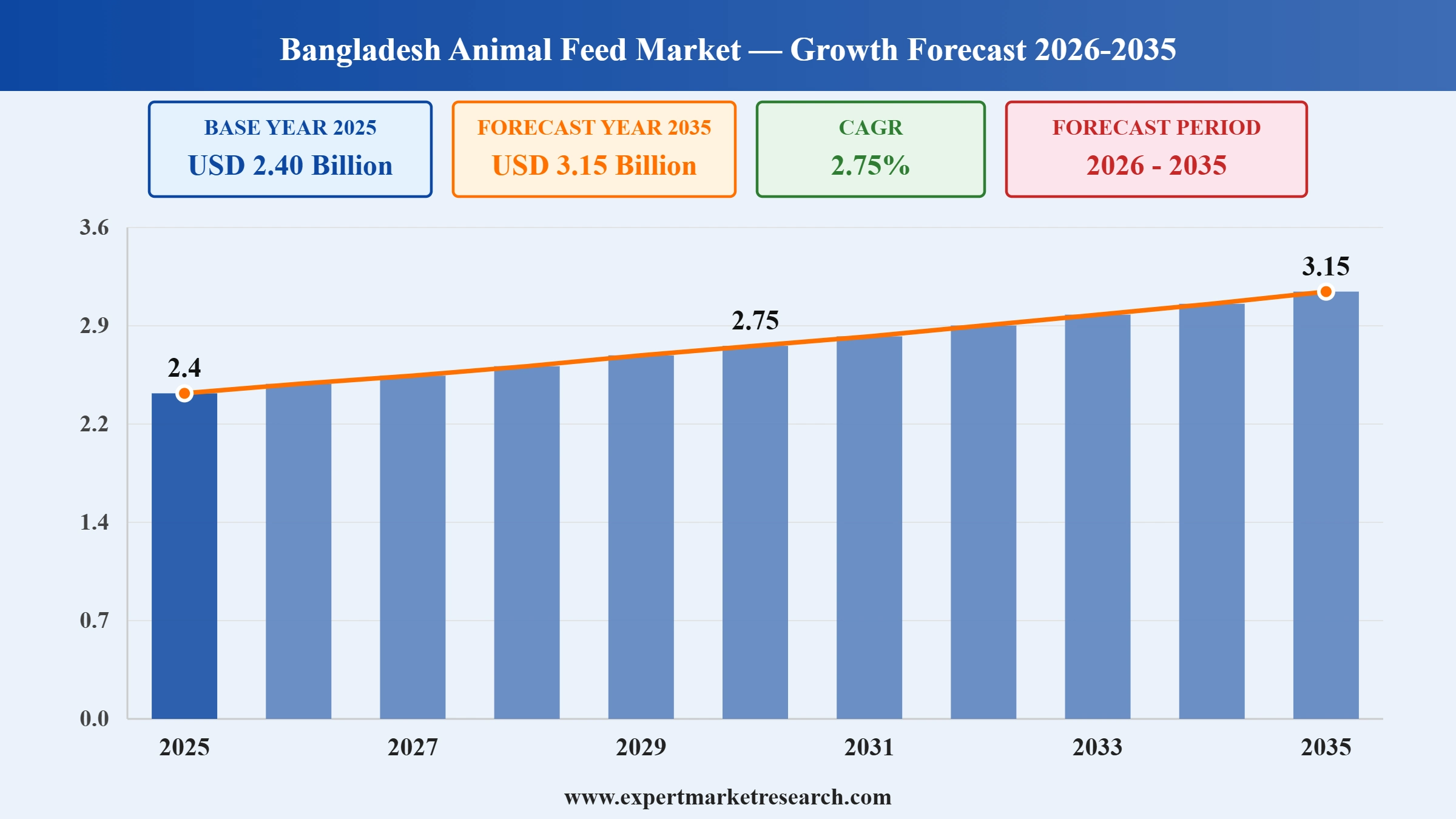
The Bangladesh animal feed market attained a value of USD 2.40 Billion in 2025 and is projected to expand at a CAGR of 2.75% through 2035. The market is further expected to achieve USD 3.15 Billion by 2035. The growing trend of contract farming in poultry and aquaculture is pushing feed companies to develop and deliver performance-linked formulations to ensure a stable sourcing relationship with large-scale farming operations across the country.
Cold chain infrastructure requirement is increasing rapidly and that is why animal producers are inclined to produce standardized and predictable output. This change is leading to a demand growth for high-quality, nutritionally balanced feed formulations, impacting the overall Bangladesh animal feed market trends. On the other hand, due to the higher frequency of livestock diseases, farmers are gradually abandoning traditional feeds and thus switching to fortified ones that are enriched with immunity boosters, probiotics, and functional additives to help lower mortality risks.
According to the Bangladesh animal feed market analysis, the nation produced 4.9 million MT of fish in 2024, with aquaculture accounting for 58.03% of total production. Firms are no longer focused on volume expansion but are also aiming for feed efficiency ratios as a benchmark of competition, especially in poultry and pangasius farming hubs. ACI Godrej Agrovet Bangladesh launched a new broiler feed brand called Pustidana, formulated to deliver consistent growth, better FCR, and improved profitability for farmers in October 2023. This trend reflects the increasing focus of major feed manufacturers on process automation and nutrient precision to protect their margins and keep up with the growing demand for protein.
The market is further undergoing a process of structural repositioning as a result of the integrators' increased control over sourcing and formulation. In January 2026, leading soy value chain companies from Bangladesh signed letters of intent to increase their purchases of United States soy over the next 12 months. However, major players are reformulating their animal feeds to decrease dependence on imported soybean meal by using rice bran oilcake, mustard cake, and locally processed maize. This Bangladesh animal feed market trend is changing procurement patterns and promoting long-term supply contracts with local crushers.
In MY 2023/2024, Bangladesh produced 145 tons of soybean in a cultivated area of 80 Ha.
In Bangladesh, approximately 20% of the population earns their livelihood through work associated with raising cattle and poultry.
The significant livestock population in Bangladesh, is contributing to a growing demand for animal feed for improved meat quality.
Read more about this report - REQUEST FREE SAMPLE COPY IN PDF
Aboitiz acquired a Singapore-based animal feed supplement manufacturer to expand the company’s nutrition portfolio and to reinforce the presence of functional additives in the Asian markets. Using this Bangladesh animal feed market trend, domestic feed manufacturers can collaborate with global nutrition companies to locally promote premium supplements and science-led formulations.
Bangladesh’s poultry sector implemented new practices in chicken welfare and early nutrition to facilitate uniform growth and better productivity at farm level. These developments encourage companies to produce starter feeds that emphasize gut health, uniformity, and early-stage performance optimization.
Ajooni Biotech was able to secure export orders for animal feed supplements from different countries, thus indicating the increasing demand for nutrition products across the borders. Local suppliers in the Bangladesh animal feed market can develop their capacity to produce for export high-quality feed additives that are in line with international standards of quality and traceability.
Bangladesh intensified its livestock health and feed safety controls as a strategy to prevent disease outbreaks and maintain protein supply chains stable across the country. Businesses can thus create a market for fortified feeds that help in immunity and meet the mounting health and biosecurity legislation requirements.
Precision nutrition approaches are being increasingly adopted by Bangladesh-based feed manufacturers. The Bangladesh animal feed market is witnessing the introduction of enzyme-based products and amino acid balancing. This is aimed at minimizing wastage and optimizing growth rates in animals. Feed performance guarantees are being increasingly included in poultry integrator contracts. Government livestock extension services are also promoting the use of nutrient-dense feeds. In April 2025, Wittaya and Maverick Innovation joined forces to provide comprehensive support for the evaluation and commercialization of innovative feed ingredients.
Feed manufacturers are working to decrease dependence on imported soybean meal. Investments in local oilseed crushing and maize aggregation are rising. Large-scale manufacturers are establishing supply contracts with local farmers to source raw materials, creating new Bangladesh animal feed market opportunities. In December 2024, AKIJ Agro Feed Ltd (AAFL) officially launched a wide range of high-quality feed products to empower livestock farmers and agro-entrepreneurs in Bangladesh. By reducing foreign exchange risk, manufacturers are ensuring stable input costs. The approach enhances pricing stability and local supply chains.
Vertical integration is gathering pace as poultry and fish companies begin to vertically integrate their feed procurement. This is because vertically integrated companies are increasing the number of in-house feed mills to control quality and prices. This makes them less vulnerable to market fluctuations and biosecurity risks, accelerating the Bangladesh animal feed market growth. In January 2026, PRAN-RFL Group announced plans to launch Bangladesh’s first commercial indoor hilsa farming project through a Tk430 crore joint venture with Denmark-based Assentoft Aqua Limited, using advanced recirculating aquaculture system technology. Feed business units are being managed as strategic businesses rather than cost-reduction centers. This is being made possible by the government’s initiatives for commercial farming clusters.
The feed industry is using technology to monitor farmer performance and feed consumption. Mobile advisory platforms are being connected to feed sales, and this is creating a loyalty program based on data. This technology enables the company to monitor consumption patterns and make changes to the formulation, redefining the Bangladesh animal feed market dynamics. Bangladesh launched SmartStart system for early chick feeding, boosting welfare, uniformity, and early performance in poultry production in January 2026.
The demand for aquafeed is increasing at a faster rate than livestock feed. The industry is seeing the development of species-specific feeds to meet the sensitivity of shrimp to diseases. Export-oriented farming is increasing the demand for traceable and residue-managed aquafeed. Export compliance regulations by the government are fueling this demand in the Bangladesh animal feed market. Feed manufacturers are also developing water-stable pellets for protein management. In April 2024, Skretting introduced Armis, a breakthrough functional feed to boost shrimp resilience and nutrition under challenging aquaculture conditions.
The EMR’s report titled “Bangladesh Animal Feed Market Report and Forecast 2026-2035” offers a detailed analysis of the market based on the following segments:
Market Breakup by Type
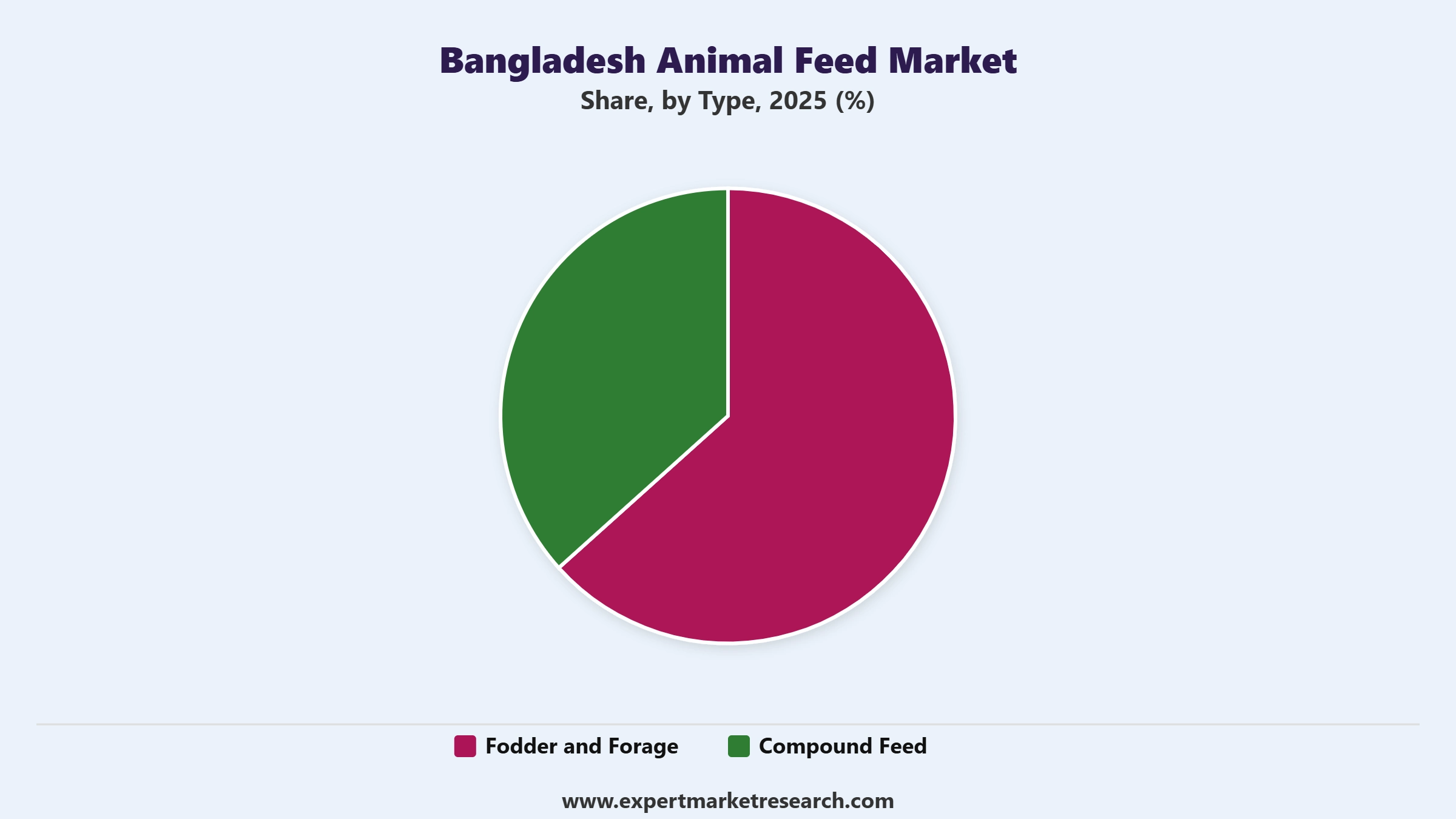
Key Insight: As per the Bangladesh animal feed market report, compound feed leads the market due to performance reliability and integration with commercial farming systems. Fodder and forage are gaining rapid momentum as cattle nutrition practices improve. In September 2025, Everest Agronics ltd officially launched XPM, an innovative product containing postbiotics Metabolites for the development of livestock in Bangladesh. Segment growth reflects increasing specialization, efficiency targets, and cost optimization priorities across livestock categories.
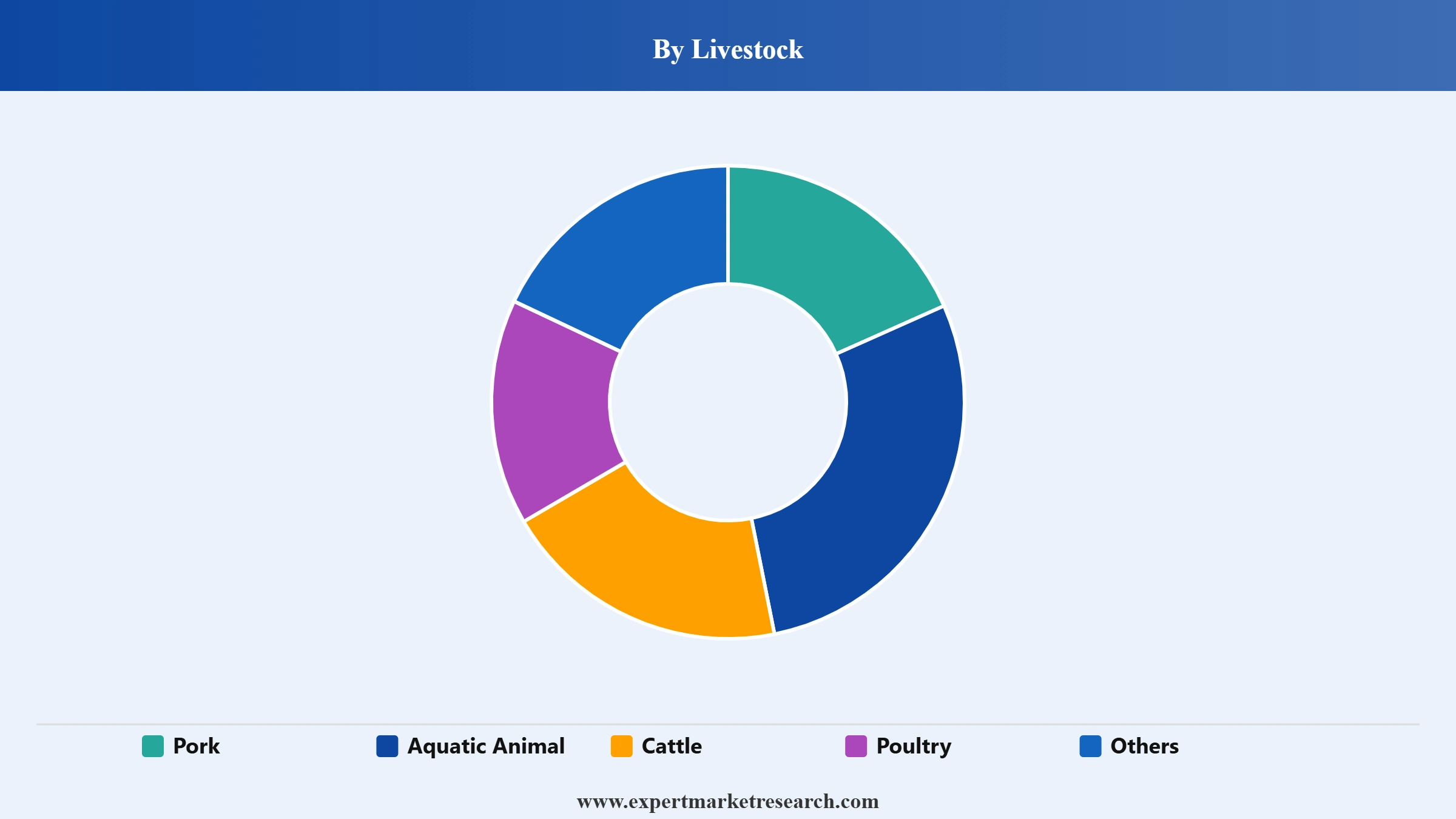
Market Breakup by Livestock
Key Insight: Demand in the Bangladesh animal feed industry is driven by production intensity and market orientation. Poultry leads market growth due to large-scale integration and a short production cycle. Aquatic animal feed is growing at a rapid rate, driven by export-oriented aquaculture. Cattle feed is gradually growing popular in the market due to the increasing adoption of commercial dairy farming.
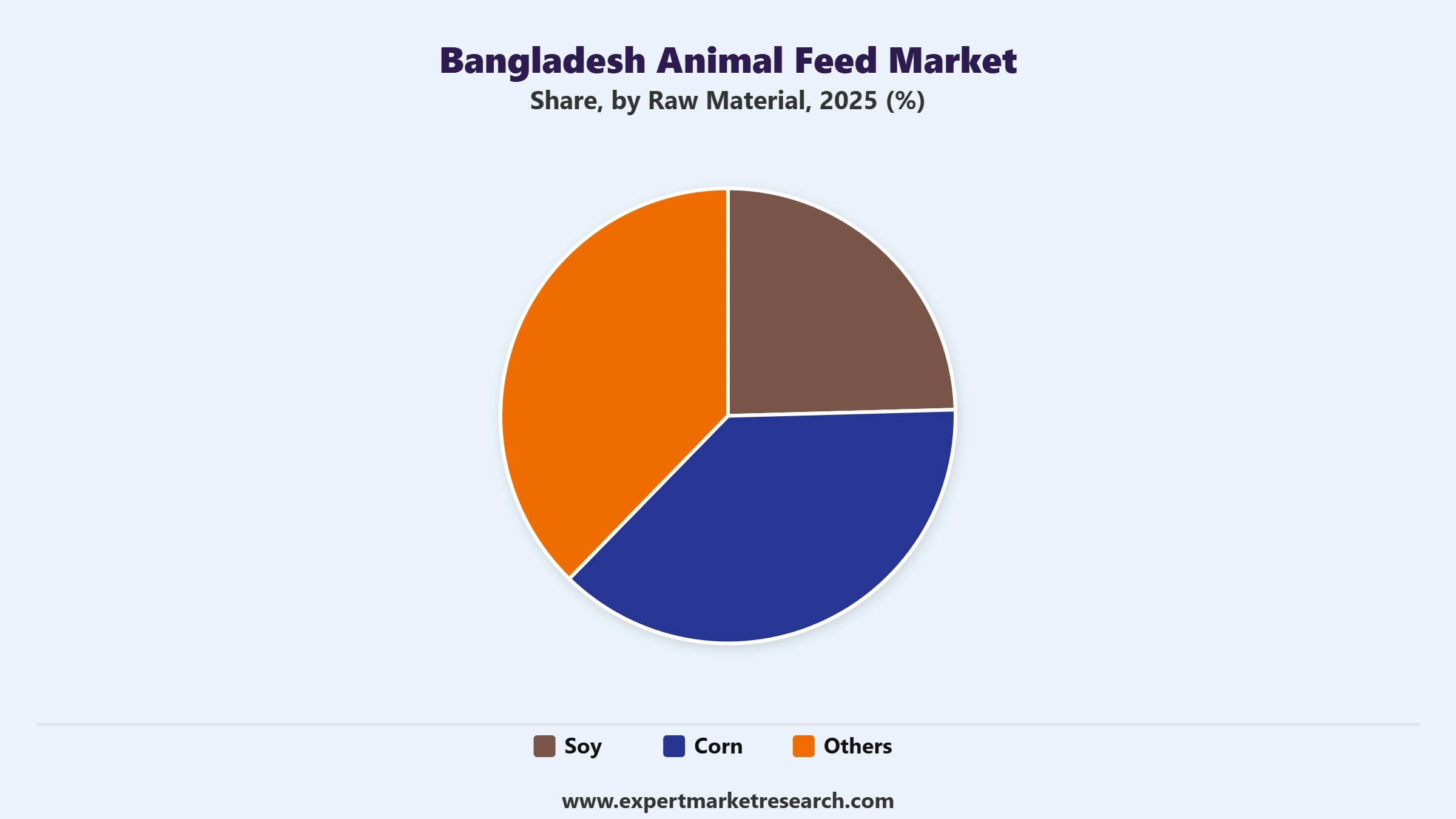
Market Breakup by Raw Material
Key Insight: Raw material approaches in the Bangladesh animal feed market dynamics focus on nutritional complementarity and price stability. Soybeans retain their market dominance because of their nutritional efficiency and formulation consistency. Corn is emerging as the preferred energy component, which helps in digestibility and price management. Other components help in formulation flexibility and substitution. Feed companies are trying to optimize raw material proportions to deal with price fluctuations while meeting performance requirements.
Read more about this report - REQUEST FREE SAMPLE COPY IN PDF
Compound feed dominates the market due to rising contract farming and nutrition standardization
Compound feed leads the Bangladesh animal feed market due to the growing number of commercial livestock farms. Poultry and fish farm integrators use compound feed to ensure constant growth rates, stable feed conversion ratios, and disease management. The feed industry is working to improve the accuracy of compound feed formulation using automated mixing and nutrition balancing equipment. Compound feed also helps build brands, enabling firms to market phase-specific feeds associated with performance results. For example, Addarome Cattle HS Plus stimulates the feeding response in compound, concentrate, and mineral feed applications. Contract farming systems are highly dependent on compound feed to ensure consistency among large numbers of farmers.
Read more about this report - REQUEST FREE SAMPLE COPY IN PDF
The fodder and forage category is also contributing to the Bangladesh animal feed market revenue. Commercial farming systems are increasingly adopting silage and treated forage to boost milk production and cattle health. The feed industry is promoting packaged fodder solutions along with expert advice to promote adoption. The rising cost of concentrates is driving farmers to mix feeds with forage inputs. Government initiatives to boost livestock productivity are indirectly contributing to this trend.
By livestock, poultry feed accounts for the biggest share of the market due to integrator expansion and faster production cycles
Poultry feed leads the animal feed demand in Bangladesh due to rapid turn-around times in broiler farms and growing layer farms. Integrators demand accurate formulations to address growth rate, mortality rate, and feed conversion ratios. Feed manufacturers cater to standardized feeds based on contract farming needs. Poultry feed leads to high turnover of volumes and stable demand trends. This category acts as the major demand driving factor influencing production planning and utilization of capacities.
Read more about this report - REQUEST FREE SAMPLE COPY IN PDF
Aquatic animal feed is rapidly expanding its share in the Bangladesh animal feed market with the development of export-oriented aquaculture in the country. Shrimp and fish farmers are adopting species-specific feeds to improve feed conversion efficiency, disease protection, and survival rates. Feed manufacturers are developing water-stable pellets, slow-sinking feeds, and functional feeds for gut health and immunity. Export regulations on the control of residues and traceability are driving the demand for stable feed quality in hatcheries. In December 2025, Chenyuan Biotech hosted Bangladesh partners for a one-week factory inspection and technical cooperation summit, advancing feed additive collaboration and tailored livestock solutions.
Soy-based raw materials dominated due to protein efficiency and formulation flexibility
Soy remains the dominant raw material used in the animal feed market in Bangladesh due to its high protein content. The soymeal produced is used by feed manufacturers to ensure a consistent amino acid supply, which is required for poultry and aquafeed. Despite the high importation rate, soy is still able to support high-quality feed formulations with predictable nutritional performance. The inclusion rate is carefully controlled by manufacturers to ensure that price volatility is reduced while maintaining feed efficiency targets. Soy can also be blended with other raw materials in the country, allowing for the formulation of customized feeds depending on the type of livestock.
Read more about this report - REQUEST FREE SAMPLE COPY IN PDF
The use of corn is on the increase as feed manufacturers seek to improve the energy balance and digestibility of livestock feed formulations. The Bangladesh animal feed market witnesses an increased focus on local maize consolidation, which is reducing reliance on imported energy sources. Feed manufacturers are revamping feed formulations to incorporate higher levels of corn, particularly in poultry and cattle feeds. This trend helps with cost management while keeping energy density intact. Corn also enhances pellet quality and feed intake performance. As producers strike a balance between protein-rich formulations and energy optimization, corn is becoming more valuable. According to the market reports, in 2024, Bangladesh imported over 3.2 million metric tons of soybeans and soybean meal from the United States, Brazil, and Argentina.
Prominent Bangladesh animal feed companies are concentrating on specialty animal nutrition, enzymes, premixes, and technical consulting. Local companies compete on scale, reach, and existing farmer networks. The key to competitiveness revolves around formulation know-how, supply chain stability, and contract farming integration. The most promising areas of growth are aquafeed, functional additives, and precision animal nutrition.
Bangladesh animal feed market players that have invested in regional warehousing and rapid delivery networks are boosting farmer retention and are reducing spoilage. Collaborations with integrators and suppliers are now shaping the market alignment. Discipline in delivery, expertise, and supply chain performance are becoming more important than the scale of capacity. Those companies that can apply animal nutrition expertise with logistics optimization are well positioned to sustain market share in the growing performance-driven feed market.
Founded in 1980 and based in Kentucky, United States, Alltech provides specialty feed additives and nutrition technology in Bangladesh. The company concentrates on enzymes, probiotics, and mycotoxin control. Alltech partners with feed producers to enhance feed conversion and animal health.
Founded in 1994 and based in Netherlands, Nutreco operates in Bangladesh with cutting-edge poultry and aquafeed technology. The company concentrates on precise nutrition, sustainability, and productivity. Nutreco assists commercial farmers with technical consulting and formulation expertise.
Founded in 1982 and headquartered in China, New Hope Liuhe provides large-scale feed technology in Bangladesh. The company concentrates on poultry and fish feed manufacturing. Its strategy focuses on cost-effective formulation, scale production, and supply chain optimization.
Founded in 1995 and headquartered in Dhaka, Bangladesh, Quality Feeds operates in the poultry, cattle, and fish sectors. The company concentrates on local distribution, farmer networks, and tailored feed products. Quality Feeds focuses on reliability, competitiveness, and local market knowledge to effectively compete with global brands.
*Please note that this is only a partial list; the complete list of key players is available in the full report. Additionally, the list of key players can be customized to better suit your needs.*
Other key players in the market include AGATA Feed Mills Ltd., Astha Feed, Aftab Feed Products Ltd., and Paragon Feed Limited, among others.
Unlock the latest insights with our Bangladesh animal feed market trends 2026 report. Discover regional growth patterns, consumer preferences, and key industry players. Stay ahead of competition with trusted data and expert analysis. Download your free sample report today and drive informed decisions in the market.


Upto 15% Off
USD
$2499 $2249
$3999 $3599
$4999 $4249
$5999 $5099


*While we strive to always give you current and accurate information, the numbers depicted on the website are indicative and may differ from the actual numbers in the main report. At Expert Market Research, we aim to bring you the latest insights and trends in the market. Using our analyses and forecasts, stakeholders can understand the market dynamics, navigate challenges, and capitalize on opportunities to make data-driven strategic decisions.*
The market is projected to grow at a CAGR of 2.75% between 2026 and 2035.
The key raw materials include soy, and corn, among others.
The major classifications based on type include fodder and forage, and compound feed.
The livestock include pork, aquatic animals, cattle, poultry, and others.
The total population of Bangladesh is about 150 million.
The livestock population in Bangladesh during FY 21-22 was more than 43 crores.
Animal feed refers to the raw or processed foods given to domesticated animals.
The key players in the market include Alltech Inc., Nutreco N.V., New Hope Liuhe Co., Ltd., Quality Feeds Ltd., AGATA Feed Mills Ltd., Astha Feed, Aftab Feed Products Ltd., and Paragon Feed Limited, among others.
In 2025, the market reached an approximate value of USD 2.40 Billion.
Raw material price volatility, import dependence, disease outbreaks, logistics gaps, and limited farmer awareness continue challenging feed manufacturers on margins, quality consistency, and long-term demand predictability.
Stakeholders are investing in formulation science, securing raw material contracts, expanding aquafeed portfolios, digitizing farmer engagement, and strengthening distribution networks to improving resilience and profitability.
Explore our key highlights of the report and gain a concise overview of key findings, trends, and actionable insights that will empower your strategic decisions.
| REPORT FEATURES | DETAILS |
| Base Year | 2025 |
| Historical Period | 2019-2025 |
| Forecast Period | 2026-2035 |
| Scope of the Report |
Historical and Forecast Trends, Industry Drivers and Constraints, Historical and Forecast Market Analysis by Segment:
|
| Breakup by Type |
|
| Breakup by Livestock |
|
| Breakup by Raw Material |
|
| Market Dynamics |
|
| Competitive Landscape |
|
| Companies Covered |
|
Datasheet
One User
USD 2,499
USD 2,249
tax inclusive*
Single User License
One User
USD 3,999
USD 3,599
tax inclusive*
Five User License
Five User
USD 4,999
USD 4,249
tax inclusive*
Corporate License
Unlimited Users
USD 5,999
USD 5,099
tax inclusive*
*Please note that the prices mentioned below are starting prices for each bundle type. Kindly contact our team for further details.*
Flash Bundle
Small Business Bundle
Growth Bundle
Enterprise Bundle
*Please note that the prices mentioned below are starting prices for each bundle type. Kindly contact our team for further details.*
Flash Bundle
Number of Reports: 3
20%
tax inclusive*
Small Business Bundle
Number of Reports: 5
25%
tax inclusive*
Growth Bundle
Number of Reports: 8
30%
tax inclusive*
Enterprise Bundle
Number of Reports: 10
35%
tax inclusive*
How To Order

Select License Type
Choose the right license for your needs and access rights.

Click on ‘Buy Now’
Add the report to your cart with one click and proceed to register.

Select Mode of Payment
Choose a payment option for a secure checkout. You will be redirected accordingly.
Strategic Solutions for Informed Decision-Making
Gain insights to stay ahead and seize opportunities.

Get insights & trends for a competitive edge.

Track prices with detailed trend reports.

Analyse trade data for supply chain insights.

Leverage cost reports for smart savings

Enhance supply chain with partnerships.

Connect For More Information
Our expert team of analysts will offer full support and resolve any queries regarding the report, before and after the purchase.
Our expert team of analysts will offer full support and resolve any queries regarding the report, before and after the purchase.
We employ meticulous research methods, blending advanced analytics and expert insights to deliver accurate, actionable industry intelligence, staying ahead of competitors.
Our skilled analysts offer unparalleled competitive advantage with detailed insights on current and emerging markets, ensuring your strategic edge.
We offer an in-depth yet simplified presentation of industry insights and analysis to meet your specific requirements effectively.




