

Consumer Insights
Uncover trends and behaviors shaping consumer choices today
Procurement Insights
Optimize your sourcing strategy with key market data
Industry Stats
Stay ahead with the latest trends and market analysis.
The Japan LNG bunkering market was valued at USD 208.22 Million in 2025. The market is expected to grow at a CAGR of 6.10% during the forecast period of 2026-2035 to reach a value of USD 376.42 Million by 2035. The market is witnessing accelerated growth driven by rapid expansion of ship-to-ship (STS) infrastructure, integrated supply networks, and utility-led decarbonization strategies across maritime logistics.
The demand in the Japan LNG bunkering market is expected to mainly be driven by the rising need to reduce carbon emissions in the shipping industry and the growth of the fleet of ships that use LNG as fuel. The increase in environmental standards set by IMO is compelling shipping companies to move away from more environmentally hazardous sources of energy to alternatives like LNG as an intermediate source of fuel. In addition, there have been improvements in bunkering facilities such as ship-to-ship and port-based fueling services, which improve fuel security and lower emissions per ton of cargo transported.
In addition, the Japan LNG bunkering market observes a rising trend towards flexible LNG systems in terms of delivery, which would help minimize the reliance on port-based facilities as well as optimize operations for LNG-powered ships. Additionally, massive investments are being made in multimodal fuel supply systems by market players owing to increasing marine demand for LNG.
Reflecting such trends in the market, in April 2026, Osaka Gas performed ship-to-ship LNG bunkering using the recently developed SETO AZURE ship. As a result, the company became another member of STS operators besides other truck-to-ship and port-to-ship systems. In relation to the growing tendency of more flexible supply chains of LNG through joint collaboration of power plants and shipping companies, the Japan LNG bunkering market is becoming a part of a wider mission of supplying reliable LNG for LNG-powered ships.
Compound Annual Growth Rate
6.1%
Value in USD Million
2026-2035
|
Japan LNG Bunkering Market Report Summary |
Description |
Value |
|
Base Year |
USD Million |
2025 |
|
Historical Period |
USD Million |
2019-2025 |
|
Forecast Period |
USD Million |
2026-2035 |
|
Market Size 2025 |
USD Million |
208.22 |
|
Market Size 2035 |
USD Million |
376.42 |
|
CAGR 2019-2025 |
Percentage |
XX% |
|
CAGR 2026-2035 |
Percentage |
6.10% |
|
CAGR 2026-2035 - Market by Region |
Kanto |
6.7% |
|
CAGR 2026-2035 - Market by Application |
Container |
5.8% |
|
CAGR 2026-2035 - Market by End User |
Commercial |
6.0% |
|
2025 Market Share by Region |
Kansai |
21.7% |
Osaka Gas Company Limited developed the SETO AZURE; an LNG bunker barge specifically designed for providing the service of LNG bunkering between ships on the coasts of Japan. This move plays a vital role in improving infrastructure for flexible fueling.
The NYK line made their LNG bunkering operations more effective through improved integration of LNG-fueled ships within the fuel logistics operations. This ensures not only efficient use but also sustainable supply of LNG, hence accelerating the adoption of green maritime fuels.
Kawasaki Kisen Kaisha Ltd. (K-line), a ship operator company, raised its number of LNG dual-fuel ships. Such developments strengthen structural fuel requirements and support infrastructure scaling in the Japan LNG bunkering market.
Mitsui O.S.K. Lines expanded LNG-fueled vessel operations as part of its decarbonization strategy to increase demand for liquefied natural gas fuel on several vital shipping routes. Such developments are expected to aid in the continued growth of the Japan LNG bunkering market.
The initial development of adaptive LNG fuel delivery systems is transforming the state of preparedness in ports, which are deploying ship-to-ship, truck-to-ship, and port-based fuel delivery methods concurrently. Such innovation enhances the operational security of LNG-powered ships and lowers their reliance on a single delivery infrastructure point. The advantage of greater assurance in the refueling process aids decision-making for quicker conversion to alternative fuels, thereby redefining the Japan LNG bunkering market dynamics. It also enhances cooperation between energy providers and logistics companies.
Purpose-built LNG bunker ships are steadily emerging as a vital facilitator for effective ship-to-ship LNG refueling, with no dependency on stationary bunkering facilities. This innovation brings higher safety standards and improved accessibility to LNG bunkering for coastal shipping companies in Japan. With the growth of LNG-powered shipping, visibility of demand becomes more apparent along regional sea routes, thus incentivizing investments in bunkering infrastructure. Purpose-built LNG bunker ships play a critical role in scaling up low-carbon emission shipping within the Japan LNG bunkering market. An important breakthrough occurred when Mitsubishi Shipbuilding Company unveiled the first LNG bunkering ship in Western Japan during July 2023.
The use of long-term LNG supply programs is helping secure fuel supplies for the shipping industry and facilitate steady growth in the number of LNG-fueled ships. With respect to the Japan LNG bunkering market, the signing of such agreements are expected to help minimize risks of volatile prices and make decisions regarding investments in LNG-compliant vessels and bunkering facilities. It facilitates the linkage between the upstream and downstream sides, making it easier to provide adequate supplies of fuels in international shipping lanes. For instance, in June 2024, TotalEnergies' announced the delivery of LNG into Asia under long- and mid-term contracts.
Expansion of offshore LNG facilities in Asia-Pacific maritime regions increases the efficiency of fuel delivery and improves the efficiency of the region’s bunkering systems. The improvement in capacity leads to less congestion in ports and an efficient LNG transport system for both coastal and deep-water ships. In the case of the Japan LNG bunkering market trends and dynamics, it leads to more reliability in the logistics process and helps in adopting LNG-fueled ships because of the reliable delivery system. These developments also help in harmonizing the bunkering practices across international shipping channels. The development in the Singapore offshore LNG bunkering facility in March 2026 plays an indirect role.
Fuel systems integration and alternative energy solutions are becoming important driving factors for decarbonization policies in marine applications, especially in terms of auxiliary operations and vessels. Such approaches facilitate increased operational adaptability and efficiency while minimizing carbon emissions at ports, thereby propelling the Japan LNG bunkering market growth trajectory. Adoption of multiple fuel systems promotes greater use of LNG as a transitional fuel solution amid evolving maritime logistics. Fuel integration also fosters the development of technologies in fuel management and energy management on board vessels. These technological advances include the deployment of a tugboat fitted with onboard biofuel blending technology by the subsidiary of K Line in April 2026.
The EMR’s report titled “Japan LNG Bunkering Market Report and Forecast 2026-2035” offers a detailed analysis of the market based on the following segments:
Market Breakup by Application
Key Insight: The development of the Japan LNG bunkering market can be linked to strong adoption of LNG in the tanker ships, ferries, ro-ro ships, and container segments because of the need to meet environmental and energy consumption needs. LNG is being increasingly adopted by tanker ships with the objective of reducing emissions along the way, while ferries and ro-ro ships adopt the use of LNG due to its low cost of usage along the coastlines. Shipping companies operating in the container ships segment, such as NYK Line and MOL Lines, are increasing the number of ships powered by LNG based on the IMO’s regulations.
Market Breakup by End User
Key Insight: The commercial vessel category is set to emerge as the dominant end-user type in the Japan LNG bunkering market scope due to the rising trend among international shipping companies to adopt LNG-fueled vessels due to emission compliance. Another significant aspect of increasing demand is the rise of regional shipping operations, which is expected to drive demand in the ferry category and the freight transport category. Shipping companies such as K LINE and MOL are investing in LNG fuel-powered vessels, making sure that their use will be sustainable. Meanwhile, the military category is looking into the possibility of using LNG as auxiliary fuel for their sustainability goals.
Market Breakup by Product Type
Key Insight: Ships to ships, ports to ships, trucks to ships, and portable tanks, among others, are some of the modes of transport considered in the Japan LNG bunkering market report. The ship-to-ship category can be characterized as the fastest-growing mode in regard to the flexibility and scalability that it brings forth. One of the notable developments in this segment is the commissioning of an LNG bunker ship in March 2026 by Enagás and Axpo, marking progress in alternative marine fuel infrastructure.
Market Breakup by Region
Key Insight: The Japan LNG bunkering market landscape is driven by the development level of the ports' infrastructure and the demand for transportation of industrial goods in the regions of Kanto, Kansai, Chubu, and others, located along the coastlines of Japan. The Kanto region leads the market as it consists of large-sized ports that can serve cargo vessels. The Kansai region is also emerging as one of the major bunkering hubs due to Osaka Gas’ initiatives and ship-to-ship activities. Meanwhile, the Chubu region also exhibits benefits from the exports of automobiles and industrial transportation of goods, thus the utilization of LNG.
By applications, tankers show high product uptake driven by dual-fuel bunker capacity expansion
The Japan LNG bunkering market observes an increase in the number of tankers due to the introduction of LNG dual-fuel bunker tankers, which facilitate more efficient transportation of the fuel and minimize emissions in long-distance maritime shipping operations. This also helps in increasing the flexibility in LNG delivery to multiple types of vessels and increases dependability in marine fuel supply logistics. There has been a greater focus on using bunker tankers for scaling LNG deliveries, and this has also been reflected by the development plans made at IMO levels. The introduction of the new LNG dual-fuel bunker tanker by Minerva Bunkering in October 2024 is a notable example.
The ferries and ro-ro category accounts for a significant share of the Japan LNG bunkering market and it is continuously increasing its share with the change in technology in marine propulsion systems. As ships are being powered by electric engines that operate on LNG fuel in order to comply with coastal emissions, there is frequent bunkering activity and consistent LNG demand due to predictable operation along predictable routes. There is also an increasing effort by ferry companies in adopting technologies that can make their service sustainable for their passengers. To cite an instance, Brittany Ferries announced its LNG-powered ferry trial in September 2024.
By end user, the commercial category leads the market growth attributed to the large-scale fleet decarbonization
The commercial sector retains its dominance in the Japan LNG bunkering industry because shipping firms and ports are increasingly adopting a decarbonization policy by diversifying fuel types. LNG is becoming more prevalent in cargo ship transportation and logistics due to regulations and economic efficiency reasons. Major firms are favoring LNG as a bridge fuel to aid fleet renewal. The success of FuelNG in conducting its first-ever commercial bunkering using LNG in March 2026 shows that commercial fuel development is making it easier for firms in Japan to adopt LNG bunkering.
On the contrary, the defense end user category contributes substantially to the Japan LNG bunkering market revenue as it steadily considers using cleaner fuel options for their vessels as part of the wider naval modernization plans. While the use of cleaner fuel is still in the nascent stages, authorities like the Japan Maritime Self-Defense Force are seeking ways to make their vessels compatible with low emission fuels. This is expected to ensure that the vessels used by the self-defense force do not only remain efficient but also environmentally friendly. In addition, ship builders such as Mitsubishi Heavy Industries have started making ships capable of running on LNG fuel and even dual fuel engines.
By product type, ship-to-ship witnesses high demand owing to ongoing offshore refueling flexibility
The ship-to-ship LNG bunkering has become the most rapidly growing LNG bunkering product type in the market due to its flexibility, scalability, and capability to offer service to ships without having to rely on ports. This system is important for making improvements in the turnaround procedure while offering continuous fuel services to the massive fleet that works on international routes. With respect to this aspect, it is becoming increasingly important for expanding LNG logistics globally. The initiation of LNG bunkering procedures in Hong Kong in February 2025 underscores this trend.
Meanwhile, the port-to-ship category is accelerating the Japan LNG bunkering market expansion as ports increasingly invest in dedicated LNG storage tanks, transfer pipelines, and refueling terminals to support large-scale marine fuel supply. This method enables efficient, high-volume bunkering directly at berth, making it suitable for container ships, tankers, and bulk carriers operating on fixed port schedules. As LNG-powered fleets expand, port authorities are prioritizing integrated LNG infrastructure to ensure consistent fuel availability. These developments are strengthening supply reliability and encouraging wider adoption of LNG across commercial shipping routes in the market.
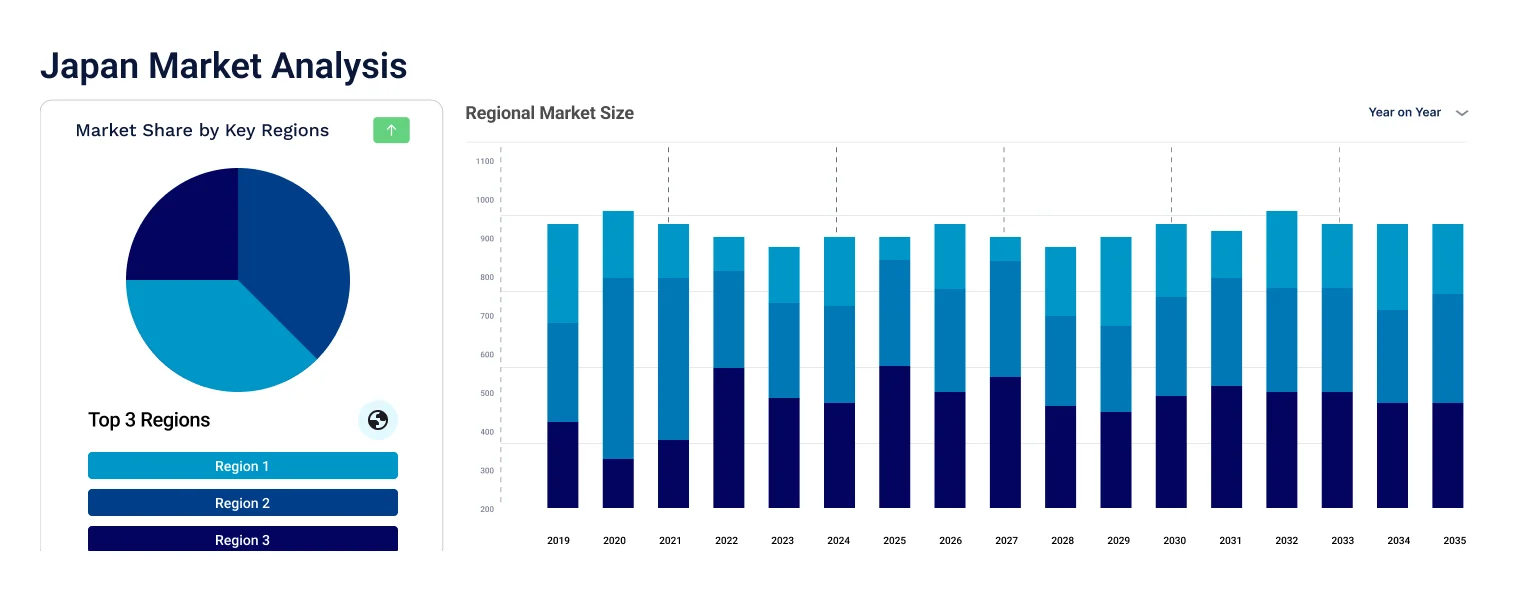
|
CAGR 2026-2035 - Market by |
Region |
|
Kanto |
6.7% |
|
Kansai |
XX% |
|
Chubu |
XX% |
|
Others |
XX% |
By region, Kanto dominates the market growth driven by high-throughput container logistics expansion
The Kanto region leads the Japan LNG bunkering market growth owing to the flow of containers through the ports, which have been developed and integrated in the Tokyo Bay system. There are regular movements of container ships as well as tankers through ports such as Yokohama and Tokyo, and due to this reason, there is a constant supply of LNG for fueling purposes. The improvements taking place in the ports’ infrastructure have made the process of bunkering easier and enabled faster turnaround of ships. A notable example is the introduction of LNG-powered trucks by Container Corporation of India in April 2026.
On the other hand, Kansai is emerging into an important growth center within the Japan LNG bunkering market scope through increased use of industrial shipping services along with the active involvement of energy utility firms located at Osaka and Kobe harbors. The development of LNG facilities as well as the use of ship-to-ship bunkering systems is making fuel readily available to ships operating in the coastal areas. This is facilitating increased adoption of LNG fuel by shipping companies based in the region as well as promoting energy-mobility integration.
Major Japan LNG bunkering market players are focused on developing LNG bunkering infrastructure as a means of ensuring better fuel availability and logistical efficiency along important shipping routes. Investments are being made towards creating ship-to-ship and port-refueling systems that will allow for greater flexibility and scalability of fuel provision for LNG-powered ships. At the same time, logistics networks are being optimized in order to minimize turnaround time. These steps contribute to the growing use of LNG as a marine fuel and increase confidence in infrastructure development within changing maritime shipping routes.
Collaboration among energy providers, ports, and shipping companies is becoming increasingly vital in the development of LNG bunkering infrastructure. The key priority for LNG bunkering companies in Japan is the fleet renewal using dual-fuel ships, as well as employing environmental-friendly propulsion solutions in accordance with emission norms. Moreover, it is essential to develop integrated systems of fuel, including their production, storage, and transportation.
Arkas Holding SA is a conglomerate of logistics and shipping companies founded in 1902. It is headquartered in Izmir, Turkey. The corporation works in maritime shipping and port management and provides logistics services to international freight routes with significant activity in the Mediterranean region.
Barents NaturGass AS is a shipping and energy service provider that has been in operation since 2007. It is based in Hammerfest, Norway. This company has emerged as a prominent Japan LNG bunkering market player as it provides shipping services and LNG bunker stations with particular emphasis on small LNG stations.
Crowley Maritime Corp., a logistics, marine, and energy solutions firm founded in the United States in 1892, has its head office in Jacksonville, Florida. The firm offers maritime and logistic solutions as well as liquefied natural gas distribution.
Eagle LNG Partners is a company which provides LNG infrastructure and supply services that was founded in 2013. It has its headquarters in Jacksonville, Florida, United States. Eagle LNG Partners mainly deals with small-scale liquefied natural gas services including production, storage, and transport.
*Please note that this is only a partial list; the complete list of key players is available in the full report. Additionally, the list of key players can be customized to better suit your needs.*
Other key players in the market include Equinor ASA, EVOL LNG, Fluxys SA, Gasum Oy, Harvey Gulf International Marine LLC, Naturgy Energy Group SA, and PETRONAS Chemicals Group Berhad, among others.
Explore the latest trends shaping the Japan LNG bunkering market 2026-2035 with our in-depth report. Gain strategic insights, future forecasts, and key market developments that can help you stay competitive. Download a free sample report or contact our team for customized consultation on Japan LNG bunkering market trends 2026.


Upto 15% Off
USD
$2499 $2249
$3999 $3599
$4999 $4249
$5999 $5099


*While we strive to always give you current and accurate information, the numbers depicted on the website are indicative and may differ from the actual numbers in the main report. At Expert Market Research, we aim to bring you the latest insights and trends in the market. Using our analyses and forecasts, stakeholders can understand the market dynamics, navigate challenges, and capitalize on opportunities to make data-driven strategic decisions.*
In 2025, the Japan LNG bunkering market reached an approximate value of USD 208.22 Million.
The market is projected to grow at a CAGR of 6.10% between 2026 and 2035.
The key players in the market include Arkas Holding SA, Barents NaturGass AS, Crowley Maritime Corp., Eagle LNG Partners, Equinor ASA, EVOL LNG, Fluxys SA, Gasum Oy, Harvey Gulf International Marine LLC, Naturgy Energy Group SA, and PETRONAS Chemicals Group Berhad, among others.
Key strategies driving the market include expansion of LNG bunkering infrastructure, development of ship-to-ship and port-based refueling systems, adoption of dual-fuel LNG vessels, strategic partnerships between energy companies and shipping operators, and investment in dedicated LNG bunkering vessels to improve supply reliability and scalability.
Major challenges that the Japan LNG bunkering market players face includes high capital investment requirements, limited bunkering infrastructure coverage, LNG price volatility, regulatory and safety compliance complexities, and slow adoption in certain vessel segments such as defense and smaller coastal operators.
Explore our key highlights of the report and gain a concise overview of key findings, trends, and actionable insights that will empower your strategic decisions.
| REPORT FEATURES | DETAILS |
| Base Year | 2025 |
| Historical Period | 2019-2025 |
| Forecast Period | 2026-2035 |
| Scope of the Report |
Historical and Forecast Trends, Industry Drivers and Constraints, Historical and Forecast Market Analysis by Segment:
|
| Breakup by Application |
|
| Breakup by End User |
|
| Breakup by Product Type |
|
| Breakup by Region |
|
| Market Dynamics |
|
| Competitive Landscape |
|
| Companies Covered |
|
Datasheet
One User
USD 2,499
USD 2,249
tax inclusive*
Single User License
One User
USD 3,999
USD 3,599
tax inclusive*
Five User License
Five User
USD 4,999
USD 4,249
tax inclusive*
Corporate License
Unlimited Users
USD 5,999
USD 5,099
tax inclusive*
*Please note that the prices mentioned below are starting prices for each bundle type. Kindly contact our team for further details.*
Flash Bundle
Small Business Bundle
Growth Bundle
Enterprise Bundle
*Please note that the prices mentioned below are starting prices for each bundle type. Kindly contact our team for further details.*
Flash Bundle
Number of Reports: 3
20%
tax inclusive*
Small Business Bundle
Number of Reports: 5
25%
tax inclusive*
Growth Bundle
Number of Reports: 8
30%
tax inclusive*
Enterprise Bundle
Number of Reports: 10
35%
tax inclusive*
How To Order

Select License Type
Choose the right license for your needs and access rights.

Click on ‘Buy Now’
Add the report to your cart with one click and proceed to register.

Select Mode of Payment
Choose a payment option for a secure checkout. You will be redirected accordingly.
Strategic Solutions for Informed Decision-Making
Gain insights to stay ahead and seize opportunities.

Get insights & trends for a competitive edge.

Track prices with detailed trend reports.

Analyse trade data for supply chain insights.

Leverage cost reports for smart savings

Enhance supply chain with partnerships.

Connect For More Information
Our expert team of analysts will offer full support and resolve any queries regarding the report, before and after the purchase.
Our expert team of analysts will offer full support and resolve any queries regarding the report, before and after the purchase.
We employ meticulous research methods, blending advanced analytics and expert insights to deliver accurate, actionable industry intelligence, staying ahead of competitors.
Our skilled analysts offer unparalleled competitive advantage with detailed insights on current and emerging markets, ensuring your strategic edge.
We offer an in-depth yet simplified presentation of industry insights and analysis to meet your specific requirements effectively.




