

Consumer Insights
Uncover trends and behaviors shaping consumer choices today
Procurement Insights
Optimize your sourcing strategy with key market data
Industry Stats
Stay ahead with the latest trends and market analysis.
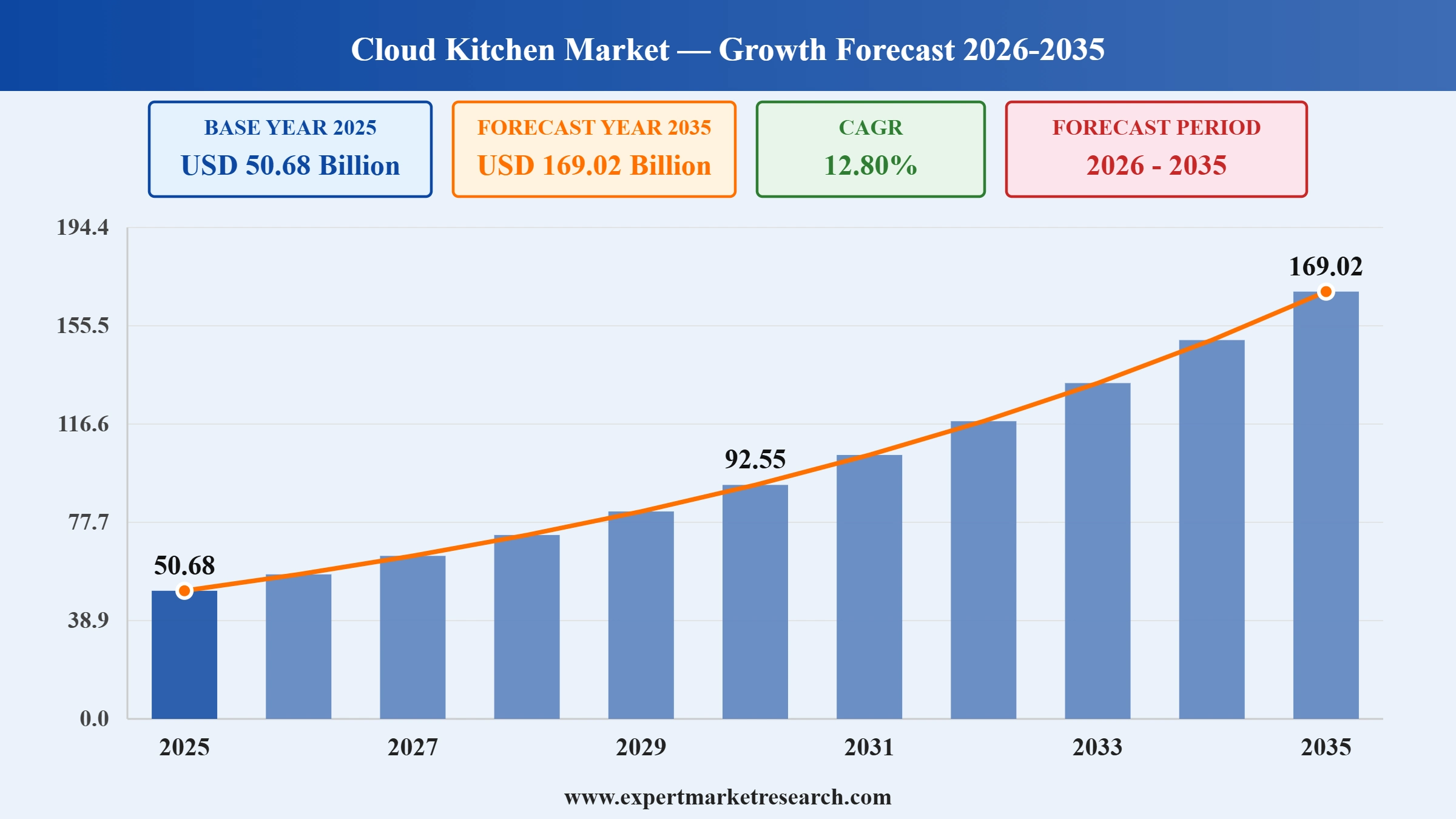
The global cloud kitchen market size was valued at USD 50.68 Billion in 2025. The industry is expected to grow at a CAGR of 12.80% during the forecast period of 2026-2035 to reach a value of USD 169.02 Billion by 2035. The global cloud kitchen market is increasingly driven by product innovation that transcends traditional delivery-only food preparation.
The cloud kitchen market is being driven primarily by the emergence of digital, first dining which means consumers are more inclined than ever to order their food online and opt for delivery without contact. Besides, operators can scale their businesses without making heavy investments in real estate. At the same time, to meet the needs of consumers for diversified, gourmet, and customizable menus, brands are being pushed to come up with creative niche cuisines and offer premium products resulting in increased customer engagement and more repeat orders.
Cloud kitchens are turning into micro, manufacturing hubs that enable operators and consumer brands to rapidly develop, test, and launch convenience, oriented food products. Utilizing shared kitchen facilities and data, driven insights, businesses are able to fine, tune limited batch productions, keep the products fresh, and shorten the time needed to reach the market. Besides, such a strategy not only increases the number of available dishes but also supports the booming demand of quick, commerce and consequently results in new streams of incomes beyond the typical delivery. This kind of strategic product diversification perfectly fits consumer engagement and continuous orders and, therefore, supports market growth, particularly in urban areas. Cloud kitchens are thus being transformed into flexible, hybrid models combining food service with cutting, edge product development. For instance, on January 2026, ITC made public its fresh packaged food product launch plan, including the likes of cookies, cakes, chutneys, and namkeens, made through its cloud kitchen ecosystem and offered via ecommerce and quick, commerce platforms such as Blinkit and Swiggy.
Read more about this report - REQUEST FREE SAMPLE COPY IN PDF
Mandya Zilla Panchayat has initiated a publicity campaign around Akkana Butti, a cloud kitchen run by a self, help group that provides nutritious packed meals for offices and institutions. This government-supported initiative is a sign of the growing acceptance of cloud kitchens by institutions. It encourages local food production and inclusive entrepreneurship while also contributing to the strengthening of the overall cloud kitchen ecosystem in India.
Athens-based FoodTech startup StiQ secured EUR 20 million from the European Investment Bank in July 2025 to extend its AI-powered virtual kitchen platform throughout Europe. The money will be used for research and development and further opening of hubs, thus enhancing cloud kitchen infrastructures through smart demand forecasting and eco, friendly operations, thereby consolidating the trust of investors and speeding up technology, driven growth in the worldwide cloud kitchen market.
BIGGUYS, a leading domestic chicken QSR chain in India, is actively increasing its cloud kitchen presence and has plans for 150 outlets by 2030. This asset, light, digital, first model enables rapid scaling up while significantly reducing real estate expenses. By catering to Tier 13 cities, BIGGUYS plans to provide premium yet affordable chicken QSR options. Their approach is in line with the general pattern of delivery, oriented growth, omnichannel presence, and operational efficiency in the cloud kitchen sector.
Rebel Foods set up its first two cloud kitchens in Riyadh as the first step into the Saudi market. It has set the target of 60 internet restaurants for the city within a year, followed by Jeddah, Dammam, and Khobar. Rebel Foods, with its diverse brands of Faasos, Behrouz Biryani, and Oven Story Pizza, along with partners KitchenPark and Kitch, is leveraging its partnership for efficient scaling, optimized delivery, and a stack of Middle East presence.
It is expected that cloud kitchens will be the main contributors of rapid growth by focusing on ultra, fast delivery to be able to satisfy the rising consumer demand for instant meals. To fulfill sub 30 minute orders, operators utilize AI forecasting combined with optimized logistics, which also leads to an increase in order frequency and customer loyalty. Thanks to this speed, centric approach, cloud kitchens are being integrated into quick commerce ecosystems. For instance, in February 2025, Rebel Foods introduced QuickiES, a delivery service where they promise 15 minutes or free delivery for customers in Mumbai through their EatSure platform.
One of the strategies of cloud kitchen companies to attract more customers is by acquiring established food brands to expand their menu offerings. These takeovers bring together delivery scalability with well, known products while at the same time extending the geographic footprint. Besides that, this approach also results in higher average order values and portfolio diversification. To mirror this development, Curefoods signed a deal in May 2025 to obtain the pan India rights for Krispy Kreme, thus bringing together the world, famous doughnut brand with its cloud kitchens as well as the retail formats, thereby making an even more attractive product range.
Delivery platforms are helping cloud kitchens to create virtual brands by launching such brands and thus allowing operators to test new food concepts without setting up physical outlets. The model accelerates product trials, cuts down on setting up costs, and broadly caters to the demand for menu variety. It also leads to better usage of kitchen space and satisfies niche consumer preferences. Uber Eats is a good example in this respect as in March 2023, it started its Certified Virtual Restaurant Program in the US whereby merchants can use delivery, only brands in their existing kitchens.
Cloud kitchen ecosystems are burgeoning rapidly as delivery platforms incorporate AI powered infrastructures to enhance proximity, speed, and partner economics. Asset light models enable restaurant brands to spread their wings in new communities while keeping their capital risk low, thus, strengthening the overall network density and order volumes. This method is speeding up the penetration of cloud kitchens in the emerging regions. Indeed, in line with this trend, in February 2026, talabat announced that talabat Kitchens had become more than 30 hubs across MENA, which was only possible with the support of its AI engine Pepper that enabled predictive expansion and quicker deliveries.
The Asia Pacific cloud kitchen market landscape is being reshaped by chef, driven brands that are embracing delivery, first formats to scale artisanal food concepts while minimizing real estate costs. High-end dessert and bakery operators are deploying cloud kitchens to target urban consumers who want curated, made-to-order offerings. To make this point Apero by Malvika in August 2025, launched its first cloud kitchen in Mumbai, offering exclusive desserts like Crackling Cheesecake and Dream Cake, thus, giving an example of how experiential menus are driving cloud, based F&B adoption.
The EMR’s report titled “Global Cloud Kitchen Market Report and Forecast 2026-2035” offers a detailed analysis of the market based on the following segments:
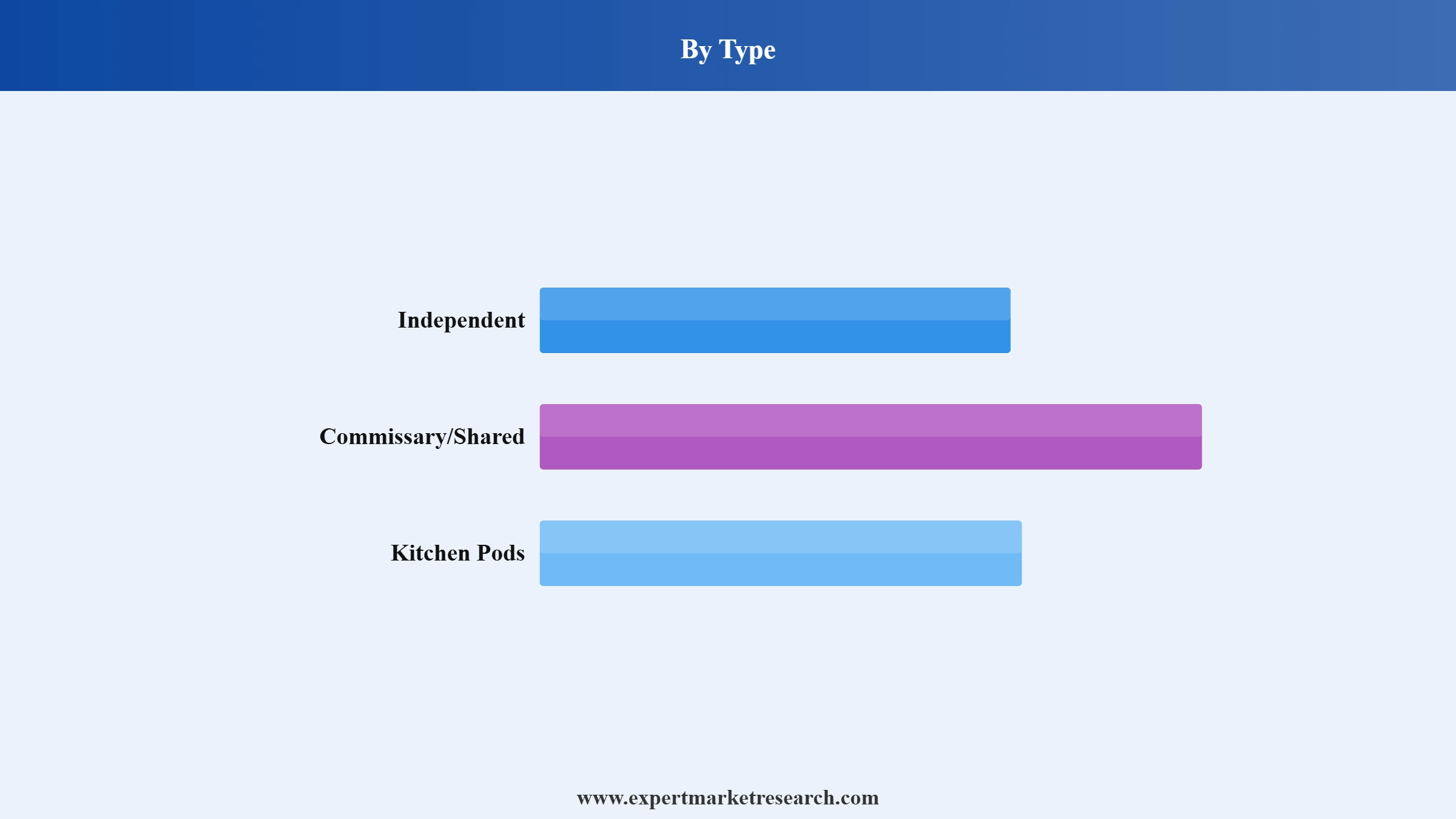
Market Breakup by Type
Key Insights: The market encompasses various segments such as Independent, Commissary/Shared, and Kitchen Pods. Independents like Shake Shack and Sweetgreen place great emphasis on high, end menus and local rollouts. At the same time, commissary/shared kitchens such as CloudKitchens and Kitchen United make smart use of space, bring about multi, brand options, and help in lowering expenditures. While kitchen Pods by Kitopi and Olo offer disassemblable setups for fast location. The factors driving growth are delivery integration, flexible scaling, and online ordering trends.
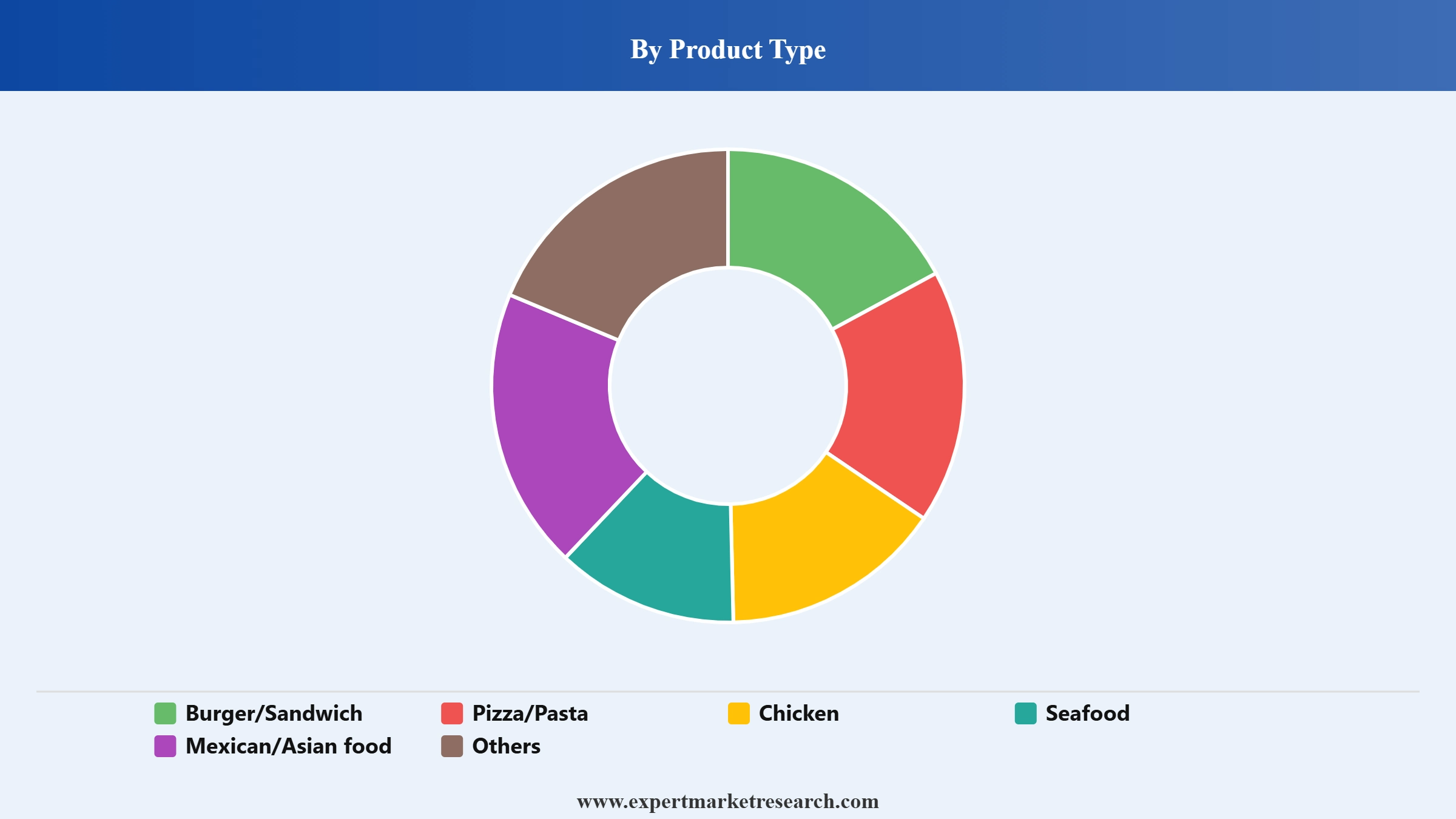
Market Breakup by Product Type
Key Insights: Burger/Sandwich, Pizza/Pasta, Chicken, Seafood, Mexican/Asian Food, and Others categories are expanding, fueled by consumers' desire for convenience and premium experiences. FAT Brands and Subway are scaling burgers through delivery, focused kitchens. Domino's and London Yard Pizza are redefining artisanal pizzas. KFC and Popeyes are broadening chicken menu offerings, while Chipotle and Panda Express are widening Mexican/Asian options. Plant-based and niche 'Others' foods are inspiring experimentation and healthier choices.
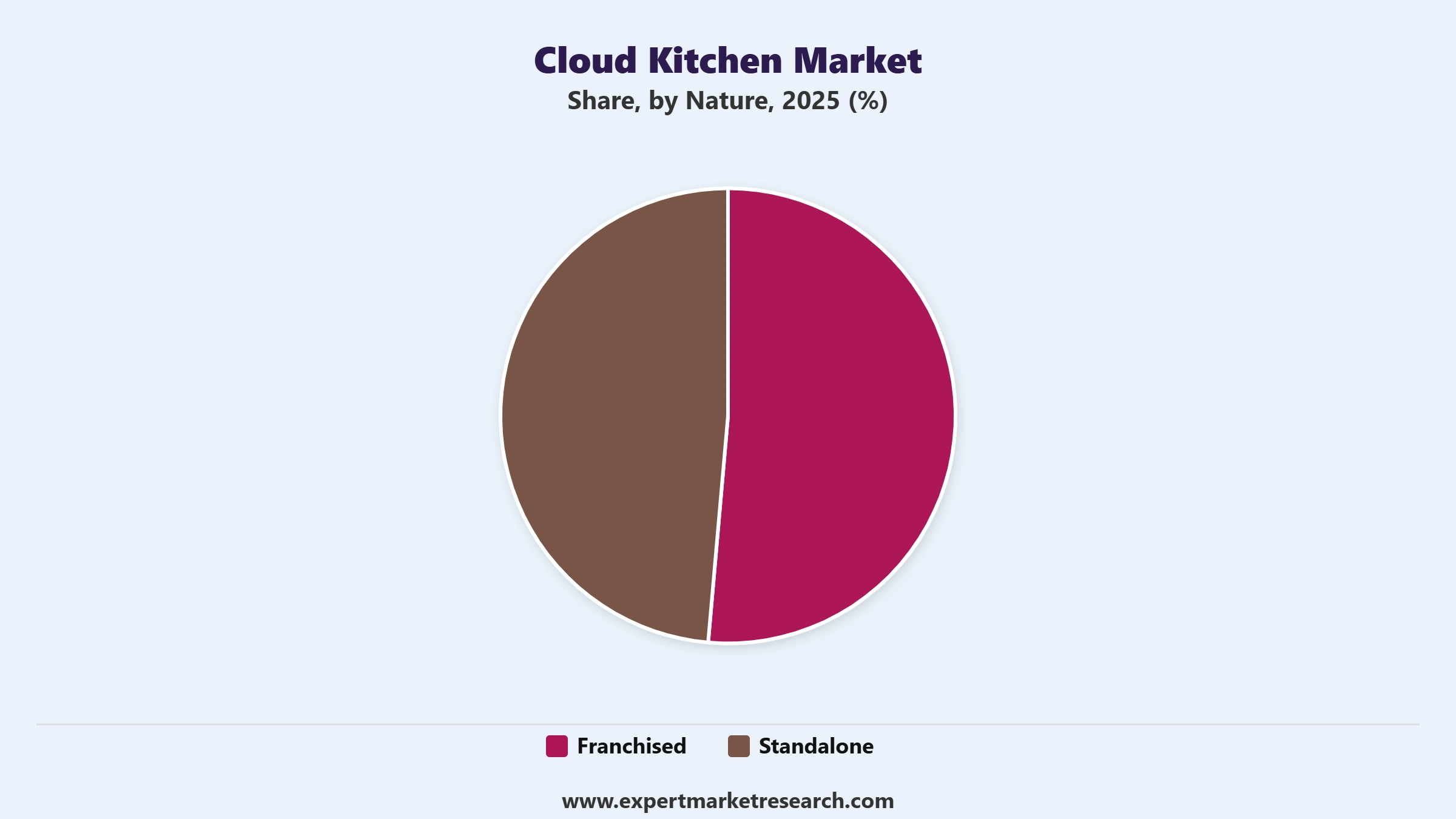
Market Breakup by Nature
Key Insights: Franchised and standalone kitchens are increasing their presence working from divergent approaches. Franchises such as Dominos and Subway rely on their brand equity, standardization, and multi-location consistency to leverage the market. On the other hand, standalone kitchens, including Momofuku and niche ghost kitchens, put the spotlight on local flavors, menu experimentation, and flexibility. Both types of businesses are going digital by incorporating online ordering, inventory automation, and delivery optimization. New hybrid forms exhibit standalone kitchens borrowing franchise thinking, and franchise brands embracing delivery-focused strategies to cater to evolving consumer expectations.
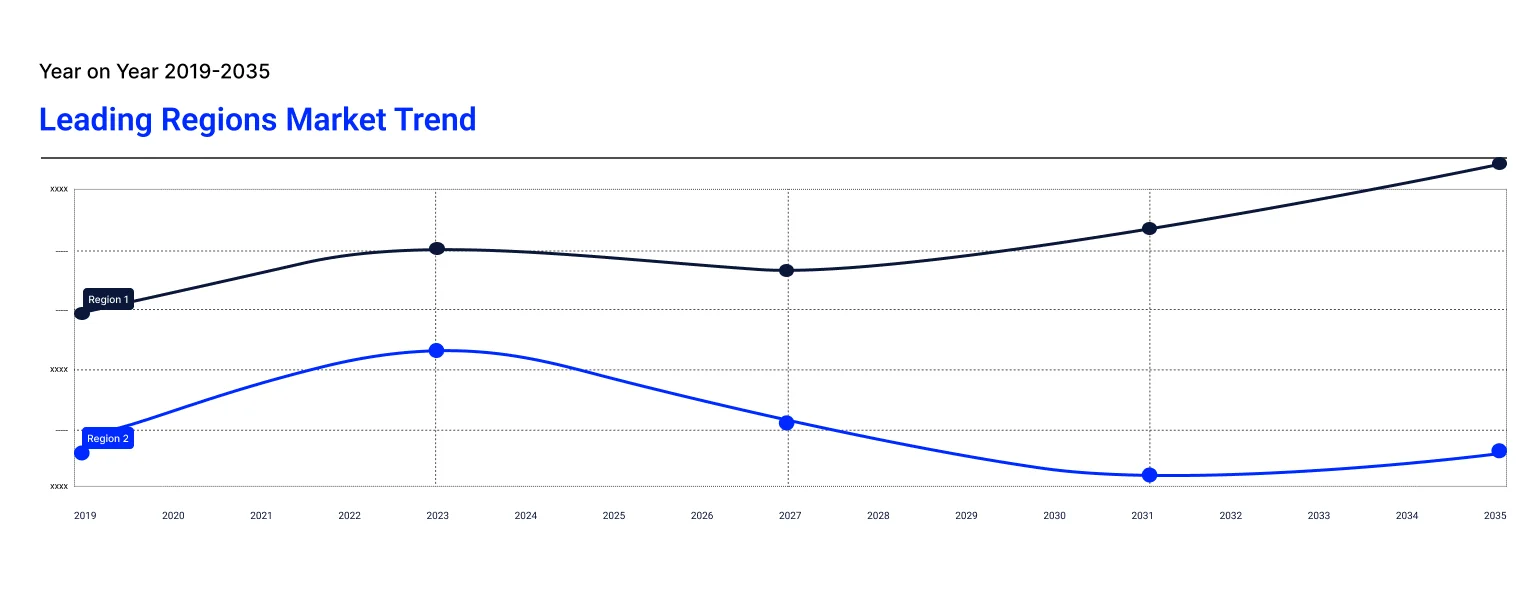
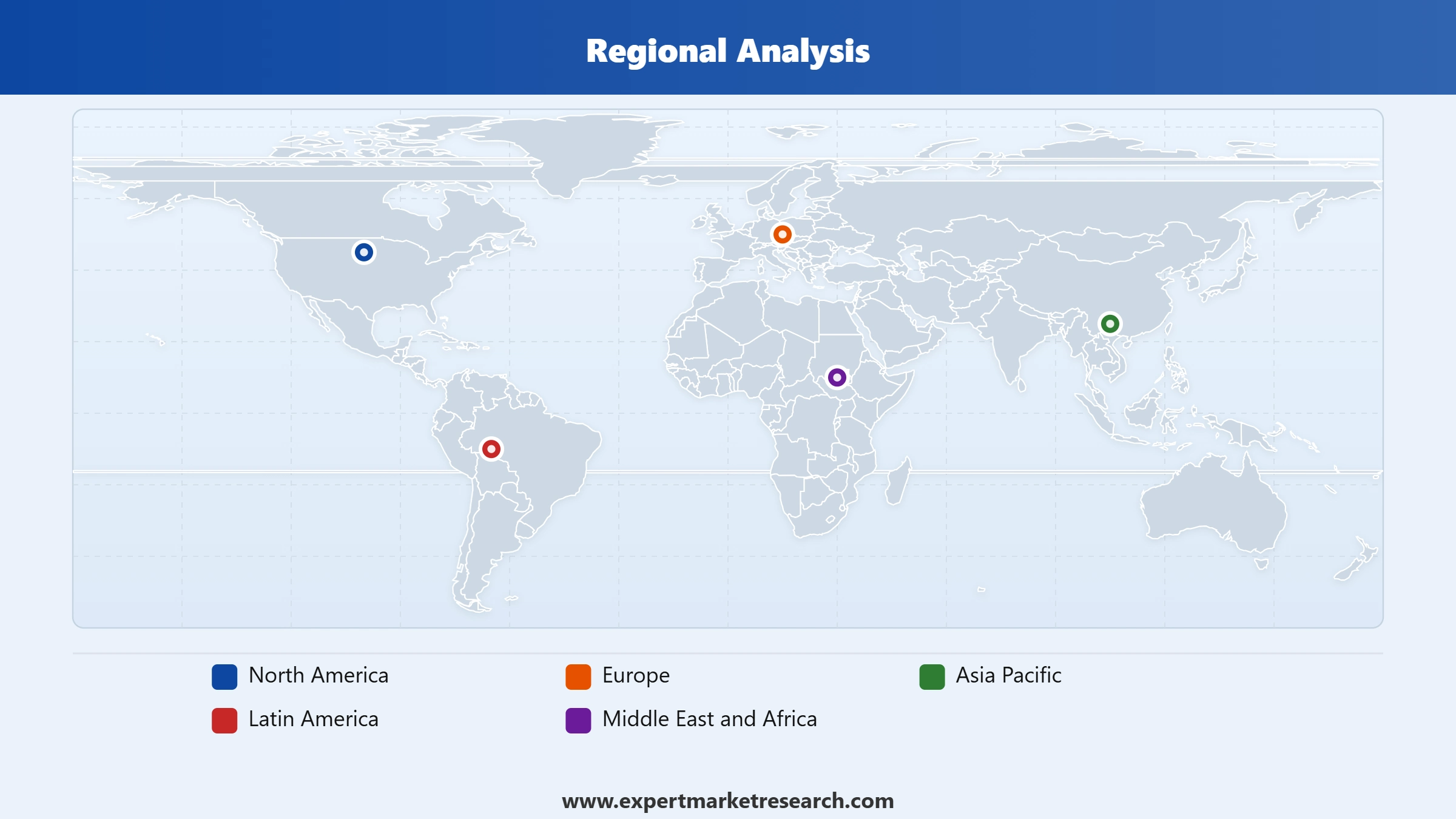
Market Breakup by Region
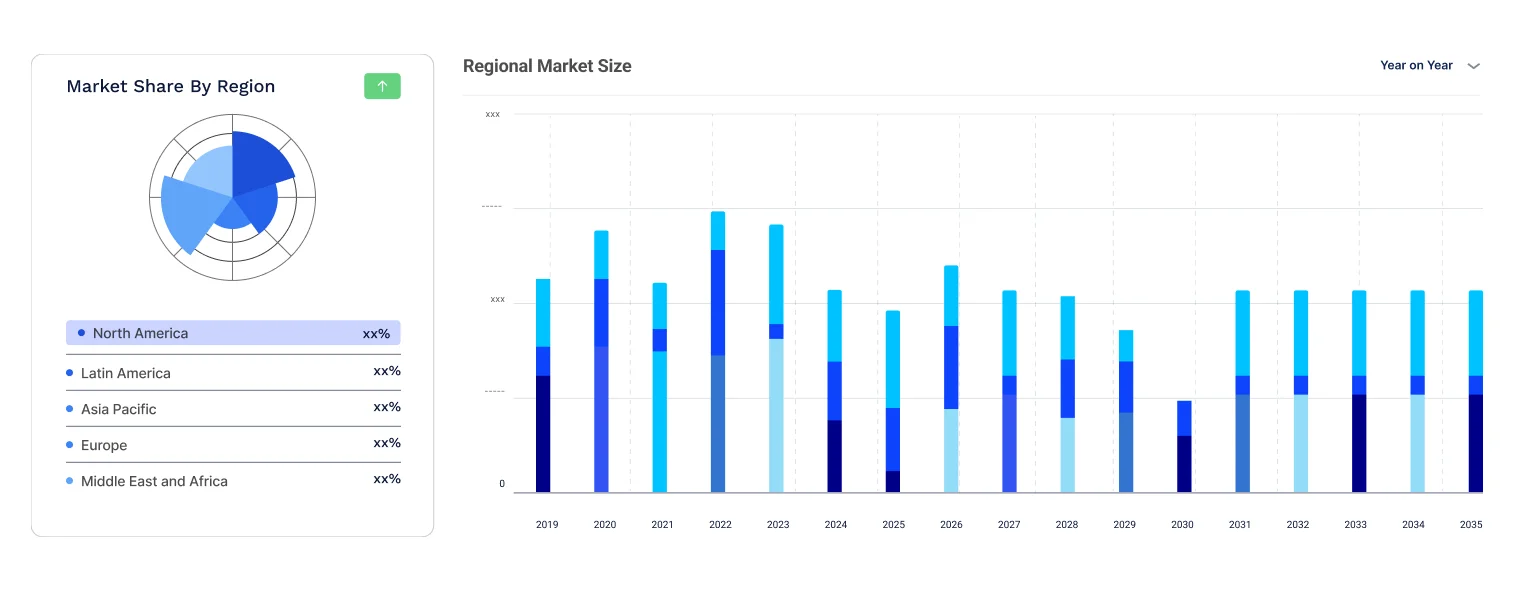
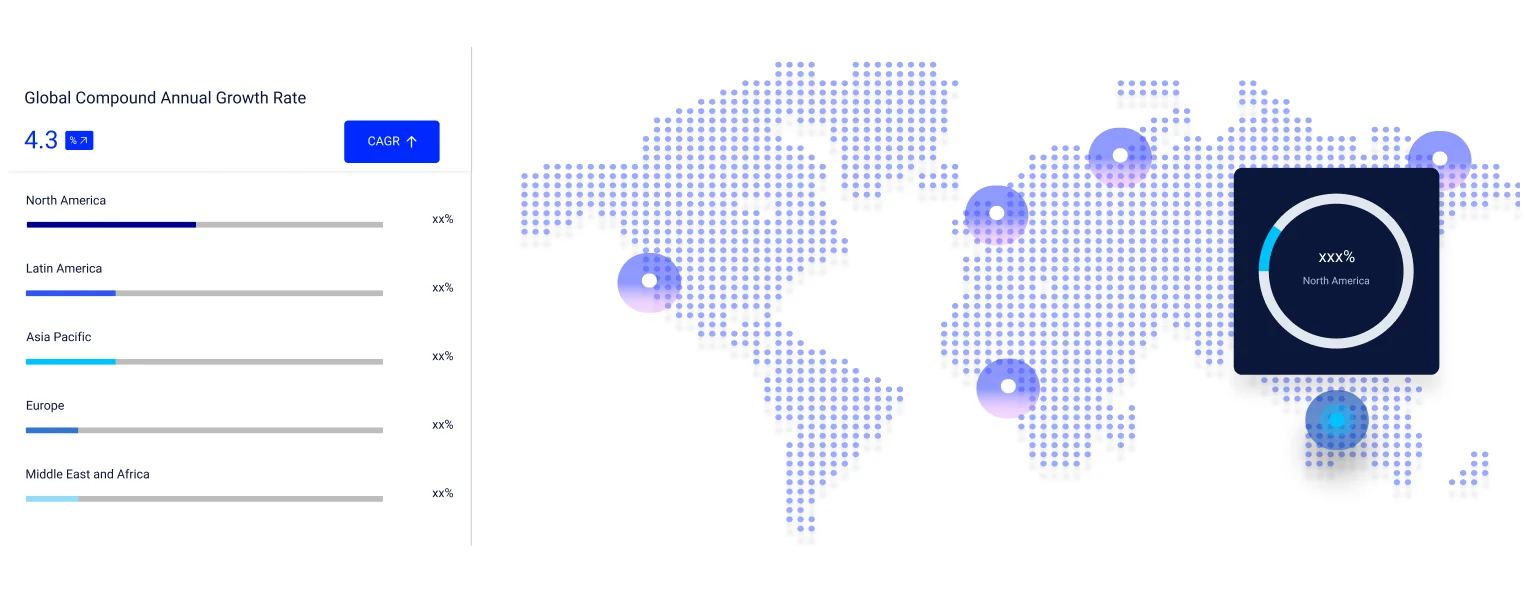
Key Insights: North America, Europe, Asia Pacific, Latin America, and the Middle East & Africa all show different growth patterns. North America's CloudKitchens and Kitchen United are scaling delivery operations. Europe is putting more focus on premium offerings through Deliveroo Editions. Asia Pacific, with Rebel Foods and Swiggy at the forefront, is turning to cloud kitchens for rapid expansion. Latin America and the MEA are concentrating on franchised and shared kitchens. Across these regions, digital ordering, delivery efficiency, and menu innovation are the main factors propelling the market growth.
Read more about this report - REQUEST FREE SAMPLE COPY IN PDF
By type, independent kitchens are picking up pace owing to low entry barriers and rising demand for niche, delivery-focused cuisines
The segment of independent kitchens is expanding fast as individual operators use cloud and ghost kitchen models to offer niche cuisines with less overheads. These kitchens put a first emphasis on menu innovation, delivery efficiency, and operational flexibility. Tandoor Morni, for example, has been helping Indian cuisine entrepreneurs to establish scalable ghost kitchens throughout North America with the help of specialized tandoor equipment. This is one of the ways in which the demand for independent, delivery, focused food businesses is increasing.
Read more about this report - REQUEST FREE SAMPLE COPY IN PDF
The commissary/shared kitchen segment is experiencing strong growth as a result of the rising adoption of digital platforms and technology integrations that facilitate operations across multiple brands. Toast, for example, partnered with Instacart in February 2026 to offer restaurants just-in-time procurement solutions and provide retailers with easy inventory management. Such solutions drive efficiency, minimize operational disruptions, and make it possible for shared kitchens to grow rapidly while delivering the same level of service to all tenants.
By product type, pizza/pasta show robust growth driven by growing demand for artisanal and experiential offerings
Urban consumption and expansion of cloud kitchen models, as well as people's preference for premium and experiential dining formats, are the main reasons for the pizza and pasta segment's steady growth. Meanwhile, brands are encouraged to innovate their menus and scale regionally as consumers are more attracted to artisanal dough, global flavor profiles, and oversized sharing portions. This trend was confirmed when London Yard Pizza was planning to open a new location in Maharashtra in early 2026 and presented their 30-inch Monster Pizza as well as their plan to open up to 75 outlets across the state.
Read more about this report - REQUEST FREE SAMPLE COPY IN PDF
The burger and sandwich segment is rapidly growing as brands use ghost kitchens to increase their delivery coverage without the need to build physical stores. Furthermore, operators are able to concentrate on menu innovation, operational efficiency, and customer experience. Case in point, FAT Brands collaborated with Epic Kitchens in Chicago to bring Fatburger, Buffalo's Express, and Hurricane Grill & Wings to customers through delivery, only kitchens, thus, providing a vivid example of virtual setups' potential in driving market expansion.
By nature, franchise-led brand expansion is accelerating cloud kitchen adoption
Expansion strategies to franchise, backed cloud kitchen growth is now the main point of the food brands managing to scale their brands quickly across different cities without investing a lot of money. Through the use of standardized menus, centralized supply chains, and hybrid dine-in plus delivery formats, operators are maximizing the unit economics and widening the consumer base. This strategy allows for quick market penetration and multi-brand portfolio development. To exemplify this movement, Thyme & Whisk revealed in February 2025 that they were going to increase their outlets to 50+ over the next 57 years while also launching four new cloud kitchen brands and growing both through the company-owned and franchises scheme.
Read more about this report - REQUEST FREE SAMPLE COPY IN PDF
The isolated cloud kitchen category is becoming popular as food brands are choosing asset, light expansion, lower operational costs, and faster market entry. Among others, London Yard Pizza, Rebel Foods, EatSure, Oven Story, and Mojo Pizza utilize facilities in the central kitchen, digital first ordering models, and delivery platform integrations to scale up effectively. This method allows menu experimentation at a fast pace, hyperlocal targeting, and demand forecasting through data, but it also removes the high rental cost. The continued switch of consumers to online food delivery and the rising trend of pizza and pasta dishes are boosting the standalone cloud kitchens to be an even more scalable and profitable growth channel.
By Region, Asia Pacific leads the market growth driven by rapid cloud kitchen expansion and asset light scaling models
The Asia Pacific cloud kitchen market is experiencing a rapid pace of growth as brands leverage asset light models to meet the increasing demand for cheaper-on-demand meals not only in metro cities but also in emerging ones. Hence, businesses are focusing on achieving regional menu localization and establishing a dense delivery network to boost their unit economics. To this end, Big Bowl opened its 200th cloud kitchen in Hyderabad in February 2025 and revealed its expansion plans to include 300 more outlets by 2027, thus, stressing on aggressive regional expansion strategies.
Read more about this report - REQUEST FREE SAMPLE COPY IN PDF
The North American cloud kitchen market is experiencing a growth phase due to accelerator-led entrepreneurship and early, stage investment programs that reduce the entry barriers for food founders. LAUNCH Incubator, in November 2024, took the step to include cloud kitchen in its space expansion and offered a 14-week program consisting of mentorship, operational guidance, and seed funding to help entrepreneurs create scalable virtual food brands. Such programs help to build innovation pipelines, increase unit economics, and stimulate concept launches that are new, thereby supporting the sustained market growth.
Top cloud kitchen market players are focused on growing their networks quickly, gather multiple brands under one roof, and use tech-based operations in order to deepen their market exposure. Leading players such as Rebel Foods, Kitopi, and Kitchen United are allocating funds for AI-driven demand forecasting, uniform kitchen setup, and menu adaptation to the local tastes for the purpose of deepening the improvements in unit economics. They are also enhancing the capabilities for quick market entry through strategic acquisitions and regional partnerships while improving the efficiency of delivery and customer reach.
Market players, along with their core businesses, are also looking into diverse revenue streams. For this, they are using hybrid formats, branded franchise tie, ups, and capacity scaling supported by ventures. Organizations like DoorDash and REEF help restaurant partners with shared kitchens and logistics platforms. At the same time, new brands are targeting secondary and tertiary cities. Together, these initiatives are not only speeding up the market penetration but also leading to the rise in order volumes as well as to the reinforcement of the cloud kitchen model as a growth engine that is scalable.
Kitchen United is a ghost kitchen business in the U.S. that was set up in 2017 and has its main office in Pasadena, California. The firm offers completely equipped kitchen facilities and tech, enabled order fulfillment solutions to restaurant brands that want to expand quickly and efficiently in densely populated urban areas.
Rebel Foods Pvt. Ltd. is a cloud kitchen company based in India. It was founded in 2011 in Mumbai. The company runs a portfolio of food brands that are digital, first and uses data, driven operations to roll out delivery, focused restaurant concepts in various international markets.
DoorDash, Inc. is a U.S. on, demand logistics and food delivery platform that was set up in 2013 and has its main office in San Francisco, California. With DoorDash Kitchens, the company provides its restaurant partners with shared kitchen spaces and demand generation tools to help them enter the market faster.
Kitopi Catering Services LLC is a managed cloud kitchen platform based in Dubai that was set up in 2018. The company collaborates with global as well as regional restaurant brands, offering them a full range of kitchen operations and technology integration to facilitate quick geographic expansion.
*Please note that this is only a partial list; the complete list of key players is available in the full report. Additionally, the list of key players can be customized to better suit your needs.*
Explore the latest trends shaping the Global Cloud Kitchen Market 2026-2035 with our in-depth report. Gain strategic insights, future forecasts, and key market developments that can help you stay competitive. Download a free sample report or contact our team for customized consultation on global cloud kitchen market trends 2026.


Upto 15% Off
USD
$2499 $2249
$3999 $3599
$4999 $4249
$5999 $5099


*While we strive to always give you current and accurate information, the numbers depicted on the website are indicative and may differ from the actual numbers in the main report. At Expert Market Research, we aim to bring you the latest insights and trends in the market. Using our analyses and forecasts, stakeholders can understand the market dynamics, navigate challenges, and capitalize on opportunities to make data-driven strategic decisions.*
In 2025, the global cloud kitchen market reached an approximate value of USD 50.68 Billion.
The market is projected to grow at a CAGR of 12.80% between 2026 and 2035.
Key strategies driving the market include rapid market expansion, asset light kitchen models, multi brand operations, AI driven demand planning, localized menus, and partnerships with delivery platforms to improve reach and operational efficiency.
The key trends guiding the market growth are the robust growth of the food delivery businesses and rapid technological advancements.
The major regions in the cloud kitchen market are North America, the Asia Pacific, Latin America, Europe, and the Middle East and Africa.
The major types of cloud kitchen considered in the market report are independent, commissary/shared, and kitchen pods.
The various product types in the market are burger/sandwich, pizza/pasta, chicken, seafood, and Mexican/Asian food, among others.
The significant segments based on the nature of cloud kitchen are franchised and standalone.
The key players in the market include Kitchen United, Rebel Foods Pvt. Ltd., DoorDash, Inc. (Doordash Kitchen), and Kitopi Catering Services LLC, among others.
The major challenges that the global cloud kitchen market players face includes high competition, rising operating costs, reliance on delivery aggregators, maintaining food quality at scale, regulatory complexities, and pressure on margins.
Explore our key highlights of the report and gain a concise overview of key findings, trends, and actionable insights that will empower your strategic decisions.
| REPORT FEATURES | DETAILS |
| Base Year | 2025 |
| Historical Period | 2019-2025 |
| Forecast Period | 2026-2035 |
| Scope of the Report |
Historical and Forecast Trends, Industry Drivers and Constraints, Historical and Forecast Market Analysis by Segment:
|
| Breakup by Type |
|
| Breakup by Product Type |
|
| Breakup by Nature |
|
| Breakup by Region |
|
| Market Dynamics |
|
| Competitive Landscape |
|
| Companies Covered |
|
| Report Price and Purchase Option | Explore our purchase options that are best suited to your resources and industry needs. |
| Delivery Format | Delivered as an attached PDF and Excel through email, with an option of receiving an editable PPT, according to the purchase option. |
Datasheet
One User
USD 2,499
USD 2,249
tax inclusive*
Single User License
One User
USD 3,999
USD 3,599
tax inclusive*
Five User License
Five User
USD 4,999
USD 4,249
tax inclusive*
Corporate License
Unlimited Users
USD 5,999
USD 5,099
tax inclusive*
*Please note that the prices mentioned below are starting prices for each bundle type. Kindly contact our team for further details.*
Flash Bundle
Small Business Bundle
Growth Bundle
Enterprise Bundle
*Please note that the prices mentioned below are starting prices for each bundle type. Kindly contact our team for further details.*
Flash Bundle
Number of Reports: 3
20%
tax inclusive*
Small Business Bundle
Number of Reports: 5
25%
tax inclusive*
Growth Bundle
Number of Reports: 8
30%
tax inclusive*
Enterprise Bundle
Number of Reports: 10
35%
tax inclusive*
How To Order

Select License Type
Choose the right license for your needs and access rights.

Click on ‘Buy Now’
Add the report to your cart with one click and proceed to register.

Select Mode of Payment
Choose a payment option for a secure checkout. You will be redirected accordingly.
Strategic Solutions for Informed Decision-Making
Gain insights to stay ahead and seize opportunities.

Get insights & trends for a competitive edge.

Track prices with detailed trend reports.

Analyse trade data for supply chain insights.

Leverage cost reports for smart savings

Enhance supply chain with partnerships.

Connect For More Information
Our expert team of analysts will offer full support and resolve any queries regarding the report, before and after the purchase.
Our expert team of analysts will offer full support and resolve any queries regarding the report, before and after the purchase.
We employ meticulous research methods, blending advanced analytics and expert insights to deliver accurate, actionable industry intelligence, staying ahead of competitors.
Our skilled analysts offer unparalleled competitive advantage with detailed insights on current and emerging markets, ensuring your strategic edge.
We offer an in-depth yet simplified presentation of industry insights and analysis to meet your specific requirements effectively.




