

Consumer Insights
Uncover trends and behaviors shaping consumer choices today
Procurement Insights
Optimize your sourcing strategy with key market data
Industry Stats
Stay ahead with the latest trends and market analysis.

The global enterprise content management market is projected to grow at a CAGR of 14.00% in the forecast period of 2026-2035. The expansion of the market is driven by the increasing demand from companies for solutions to organise and streamline content management.
Base Year
Historical Period
Forecast Period
Rising demand for organised content and personalised delivery fuels the enterprise content management market growth.
Transition from paper-based storage to electronic management systems boosts efficiency and security of content management.
Integration of AI and ML into ECM systems enhances business intelligence and efficiency, propelling the market growth.
Compound Annual Growth Rate
14%
2026-2035
*this image is indicative*
| Global Enterprise Content Management Market Report Summary | Description | Value |
| Base Year | USD Billion | 2025 |
| Historical Period | USD Billion | 2019-2025 |
| Forecast Period | USD Billion | 2026-2035 |
| Market Size 2025 | USD Billion | XX |
| Market Size 2035 | USD Billion | XX |
| CAGR 2019-2025 | Percentage | XX% |
| CAGR 2026-2035 | Percentage | 2025% |
| CAGR 2026-2035 - Market by Region | Asia Pacific | 16.1% |
| CAGR 2026-2035 - Market by Country | India | 18.5% |
| CAGR 2026-2035 - Market by Country | China | 15.5% |
| CAGR 2026-2035 - Market by Deployment Mode | Cloud | 19.6% |
| CAGR 2026-2035 - Market by Industry | Banking, Financial Services, and Insurance | 16.0% |
| Market Share by Country 2025 | France | 3.0% |
Enterprise content management (ECM) refers to a system solution, which is designed to help an organisation manage its documents. This system stores unstructured information, such as Word documents, PDFs, Excel spreadsheets, and scanned images, and makes it accessible to the appropriate people at the right time. The system ensures content management by inserting a timeline for each content item for its creation, approval, and distribution.
Several key enterprise content management market trends are the rising demand from companies to organise, categorise, and structure the entire available content in a meaningful and easily accessible manner and the growing demand of companies to provide personalised content to audiences via suitable channels.
Increasing shift towards cloud-based solutions; integration of AI and ML in enterprise content management; evolving regulatory requirements; and the rising emphasis on security are positively impacting the market growth
The market is experiencing a significant shift towards cloud-based ECM solutions as it offers scalability, flexibility, and remote access.
AI and machine learning are being increasingly integrated into ECM system to enable enhanced data analytics and content categorisation and streamline workflow.
ECM systems are evolving to help organisations comply with a growing range of regulations (like GDPR, HIPAA, etc.) by improving how they manage and protect sensitive information.
Amidst growing data breaches, ECM systems emphasise enhanced security, integrating advanced encryption, stringent access controls, and regular audits as standard features for robust data protection.
Advanced analytics are being used for content analysis to derive actionable business insights, enabling data-driven decision-making.
The enterprise content management market demand is primarily driven by the challenges associated with paper document storage. Paper-based records not only occupy physical space but also demand extensive time for management and are susceptible to damage and loss. In contrast, electronic data management offers a more efficient and secure approach. Advancements in technology have facilitated the development of robust systems that ensure secure storage and easy retrieval of documents.
The integration of AI and ML into ECM systems is transforming how businesses manage and utilise their content. It brings a new level of intelligence, efficiency, and scalability to ECM solutions, making them more adaptive, predictive, and valuable in today's data-driven business environment. This evolution is driving the growth and expansion of the enterprise content management market.
Read more about this report - REQUEST FREE SAMPLE COPY IN PDF
“Global Enterprise Content Management Market Report and Forecast 2026-2035” offers a detailed analysis of the market based on the following segments:
Market Breakup by Type
Market Bifurcation by Service
Market Breakup by Deployment Mode
Market Breakup by Organisation Size
Enterprise Content Management Market Breakup by Industry
Market Breakup by Region
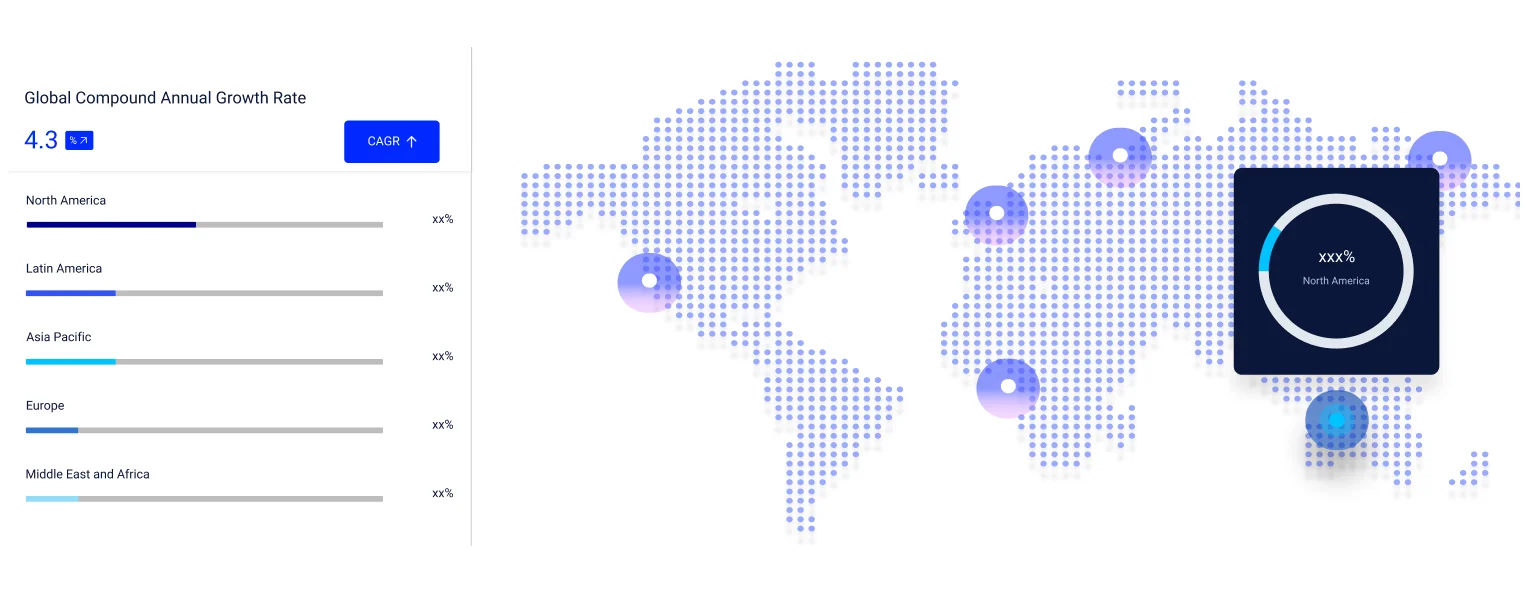
| CAGR 2026-2035 - Market by | Country |
| India | 18.5% |
| China | 15.5% |
| USA | 14.2% |
| UK | 12.8% |
| Australia | 11.0% |
| Canada | XX% |
| Germany | XX% |
| France | 11.0% |
| Italy | XX% |
| Japan | XX% |
| Saudi Arabia | XX% |
| Brazil | XX% |
| Mexico | XX% |
Cloud-based enterprise content management systems are increasingly being adopted due to operational benefits
According to the global enterprise content management market analysis, cloud-based systems are expected rapidly rise in demand due to several advantages over on-premise systems. Cloud-based ECM solutions offer greater scalability and flexibility, allowing businesses to easily adjust their storage needs and manage resources more efficiently, which is particularly beneficial for organisations with fluctuating demands. It is cost effective, enhances accessibility to content, and provides enhanced security.
However, on-premises solutions can be highly customised to fit specific business needs and processes. They also allow for better integration with existing in-house systems and infrastructure, providing a seamless operational flow.
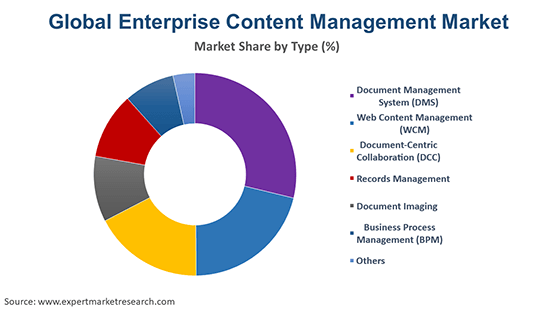
Document management systems are likely to be the most prevalent owing to their versatility
Within the field of enterprise content management (ECM), document management systems (DMS) are notably the most prevalent choice. These systems cater to a wide array of sectors and businesses of all sizes. They primarily focus on the essential task of managing, storing, and tracking documents.
DMS not only efficiently handles the foundational aspects of document management but also often serves as the cornerstone in developing a broader ECM strategy. Many enterprises begin the development of ECM systems with a robust DMS and progressively incorporate other specialised functionalities. These may include web content management (WCM), which is crucial for handling online content, document-centric collaboration (DCC) for enhancing cooperative work on documents, and records management for ensuring compliance and legal adherence in record-keeping.
Some major enterprise content management market players are heavily investing in advanced technologies to enhance their ECM solutions:
Founded in 1911, IBM Corporation is a global technology leader in hardware, software, and IT services, known for its innovations in cloud computing, artificial intelligence, and corporate research.
Xerox Corporation, established in 1906, revolutionised office printing and copying. It is now a key player in digital transformation and document management.
Microsoft Corporation, founded in 1975, is a pivotal force in the personal computing industry, renowned for its software products, including the Windows operating system and Office suite, as well as cloud services and gaming.
SAP SE, a German multinational software corporation, specialises in enterprise software. Renowned for its enterprise resource planning software, SAP helps organisations streamline processes and use live data to predict customer trends and business opportunities.
*Please note that this is only a partial list; the complete list of key players is available in the full report. Additionally, the list of key players can be customized to better suit your needs.*
Other key players in the enterprise content management market are M-Files Inc. and Epicor Software Corporation, among others.
Companies are heavily investing in advanced technologies like artificial intelligence (AI), machine learning (ML), and blockchain to enhance their ECM solutions. AI and ML are being used for intelligent content classification, enhanced search capabilities, and automation of routine tasks, while blockchain offers enhanced security and data integrity.
Region-wise, North America accounts for a significant portion of the enterprise content management market share, with the United States holding a significant market share, followed by Canada. Both countries have strongly invested in research and development activities to innovate new and advanced technologies.
Europe follows closely, with its market maturity also defined by a stringent regulatory framework emphasising compliance and privacy. In contrast, the Asia Pacific enterprise content management market, though currently behind in technology adoption, is rapidly evolving. It is marked by a significant growth potential, fuelled by a strong emphasis on modernisation and digital transformation. The regulatory impact in Asia Pacific varies, influenced by diverse local norms. Thus, while North America and Europe present established, mature markets, the Asia Pacific stands out as a dynamic, rapidly developing region.


Upto 15% Off
USD
$2499 $2249
$3999 $3599
$4999 $4249
$5999 $5099


*While we strive to always give you current and accurate information, the numbers depicted on the website are indicative and may differ from the actual numbers in the main report. At Expert Market Research, we aim to bring you the latest insights and trends in the market. Using our analyses and forecasts, stakeholders can understand the market dynamics, navigate challenges, and capitalize on opportunities to make data-driven strategic decisions.*
Get in touch with us for a customized solution tailored to your unique requirements and save upto 35%!
The global market is projected to grow at a CAGR of 14.00% in the forecast period of 2026-2035.
Rising need for companies to provide personalised content to the suitable audience via suitable channels is the key industry trend propelling the growth of the market.
The major drivers of the market include rising demand from companies to organise, categorise, and structure the entire available content in a meaningful and easily accessible manner, and the rising internet usage, technological advancements and growing mobile users.
Rising need for companies to provide personalised content to the suitable audience via suitable channels is the key industry trend propelling the growth of the market.
The major regional markets are the Asia Pacific, North America, Latin America, Europe, and the Middle East and Africa.
The types include document management system (DMS), web content management (WCM), document-centric collaboration (DCC), records management, document imaging, and business process management (BPM), among others.
The organisation sizes include small and medium enterprises and large enterprises.
The service segments are professional and managed.
On-premises and cloud are the different deployment modes of enterprise content management.
The diverse industry segments for market are banking, financial services, and insurance, government, manufacturing, healthcare and life sciences, telecom and IT, media and entertainment, retail and e-commerce, and transportation and logistics, among others.
The major players in the market are IBM Corporation, Xerox Corporation, Microsoft Corporation, SAP SE, M-Files Inc., and Epicor Software Corporation, among others.
Explore our key highlights of the report and gain a concise overview of key findings, trends, and actionable insights that will empower your strategic decisions.
| REPORT FEATURES | DETAILS |
| Base Year | 2025 |
| Historical Period | 2019-2025 |
| Forecast Period | 2026-2035 |
| Scope of the Report |
Historical and Forecast Trends, Industry Drivers and Constraints, Historical and Forecast Market Analysis by Segment:
|
| Breakup by Type |
|
| Breakup by Service |
|
| Breakup by Deployment Mode |
|
| Breakup by Organisation Size |
|
| Breakup by Industry |
|
| Breakup by Region |
|
| Market Dynamics |
|
| Competitive Landscape |
|
| Companies Covered |
|
Datasheet
One User
USD 2,499
USD 2,249
tax inclusive*
Single User License
One User
USD 3,999
USD 3,599
tax inclusive*
Five User License
Five User
USD 4,999
USD 4,249
tax inclusive*
Corporate License
Unlimited Users
USD 5,999
USD 5,099
tax inclusive*
*Please note that the prices mentioned below are starting prices for each bundle type. Kindly contact our team for further details.*
Flash Bundle
Small Business Bundle
Growth Bundle
Enterprise Bundle
*Please note that the prices mentioned below are starting prices for each bundle type. Kindly contact our team for further details.*
Flash Bundle
Number of Reports: 3
20%
tax inclusive*
Small Business Bundle
Number of Reports: 5
25%
tax inclusive*
Growth Bundle
Number of Reports: 8
30%
tax inclusive*
Enterprise Bundle
Number of Reports: 10
35%
tax inclusive*
How To Order

Select License Type
Choose the right license for your needs and access rights.

Click on ‘Buy Now’
Add the report to your cart with one click and proceed to register.

Select Mode of Payment
Choose a payment option for a secure checkout. You will be redirected accordingly.
Gain insights to stay ahead and seize opportunities.

Get insights & trends for a competitive edge.

Track prices with detailed trend reports.

Analyse trade data for supply chain insights.

Leverage cost reports for smart savings

Enhance supply chain with partnerships.

Connect For More Information
Our expert team of analysts will offer full support and resolve any queries regarding the report, before and after the purchase.
Our expert team of analysts will offer full support and resolve any queries regarding the report, before and after the purchase.
We employ meticulous research methods, blending advanced analytics and expert insights to deliver accurate, actionable industry intelligence, staying ahead of competitors.
Our skilled analysts offer unparalleled competitive advantage with detailed insights on current and emerging markets, ensuring your strategic edge.
We offer an in-depth yet simplified presentation of industry insights and analysis to meet your specific requirements effectively.





Share