

Consumer Insights
Uncover trends and behaviors shaping consumer choices today
Procurement Insights
Optimize your sourcing strategy with key market data
Industry Stats
Stay ahead with the latest trends and market analysis.
The Europe enterprise WLAN market size was valued at USD 4.76 Billion in 2025. The industry is expected to grow at a CAGR of 9.75% during the forecast period of 2026-2035 to reach a value of USD 12.07 Billion by 2035. The market growth is mainly fueled by increasing demands for ultra-high-capacity and super-low-latency wireless networks to support highly device-dense environments and cloud-centric workflows in enterprises.
Besides that, the move toward advanced Wi-Fi standards that provide better use of spectrum and higher network reliability also plays a key role in the development of Europe enterprise WLAN market. Furthermore, prioritizing secure, centrally managed WLAN architectures is one of the factors that is compelling enterprises to upgrade their old networks to modern ones that facilitate scalable connectivity, performance monitoring, and integration with digital transformation activities smoothly across industries.
Enterprise businesses are upgrading their wireless networks more to be able to support high-density device environments, IoT deployments, and applications that require minimal latency, like unified communications and immersive collaboration. These innovations open opportunities in the Europe enterprise WLAN market for organizations to build a high-performance, intelligent, and secure WLAN infrastructure, which is indispensable for hybrid work models, digital transformation, and data-intensive operations. The combination of Wi-Fi 7 access points equipped with AI-driven network management and identity-based security at the same time guarantees that enterprises can scale up efficiently while they have strong control and visibility over the whole network across geographically distributed sites. Leading market players are already upgrading their WLAN portfolios to fulfill these requirements. For example, Cisco introduced its intelligent, secure, and assured Wi-Fi 7 access points back in November 2024, and then, in November 2025, it released its Secure Enterprise Network Architecture, combining Wi-Fi 7 hardware, AI-powered cloud management, and AI-driven security.
Compound Annual Growth Rate
9.75%
Value in USD Billion
2026-2035
Nokia and Telefónica Germany extended their partnership for another five years through a contract that focuses on modernizing and upgrading the operator's entire radio access network with cutting-edge technologies such as Cloud RAN solutions, AI-powered management, and energy-efficient massive MIMO radios. The upgraded network will offer superior indoor and outdoor connectivity, greater 5G coverage, and increased operational efficiency. Additionally, it will help develop strong enterprise WLAN ecosystems by enhancing the overall wireless performance and network intelligence in Germany, further boosting the Europe enterprise WLAN market growth.
Vodafone Three granted a significant network expansion contract worth several billion pounds to Ericsson, whereby the latter will be supplying new radio access and core network equipment to the leading cities in the United Kingdom to offer ultra-fast 5G services. Upgrading connectivity infrastructure of the future generation will help businesses to keep up with their rising demands for WLAN and mobile data usage by providing not only the necessary bandwidth but also making wireless access totally seamless and of very high capacity across cities and the United Kingdom business environments.
The Wi-Fi Alliance chose RUCKUS Networks' Wi-Fi 7 access point platform as the reference hardware in its Wi-Fi CERTIFIED 7 interoperability test bed, thereby setting standards for next-gen wireless performance. This choice further builds trust in the market for enterprise Wi-Fi 7 solutions and speeds up the adoption by proving that the performance and interoperability are in line with different vendor ecosystems.
Huawei's entire Air Engine Wi-Fi 7 family was awarded the prestigious Wi-Fi CERTIFIED 7 by the Wi-Fi Alliance, with 22 class enterprise devices getting certification for interoperability and performance. The adoption of high-quality wireless solutions that have been tested, support dense device environments, and satisfy sophisticated network requirements is accelerated by this accomplishment, which boosts the confidence of businesses implementing Wi-Fi 7 infrastructure and supports the Europe enterprise WLAN market.
Continuous product releases of high-capacity, globally sourced equipment are propelling the Europe enterprise WLAN market development. These new features help enterprises handle an increasing number of devices, IoT, and AI workloads more efficiently. Product releases enlarge the WLAN ecosystem, thus prompting enterprises to upgrade their infrastructures for the achievement of the latest developmental and competitive advantages. A major instance was the launch of HPE Aruba Networking's high-capacity Wi-Fi 7 access points for secure, AI-optimized, enterprise-grade wireless connectivity in April 2024.
OEMs of wireless local area network (WLAN) equipment are increasingly creating solutions addressed to different enterprise verticals, like the hotel industry, education, and retail, which, on the one hand, allow the connectivity to be tailored and, on the other hand, ensure better operational efficiency. Vertical-driven inventions in the Europe enterprise WLAN market are the key to fast adoption as enterprises look for purpose-built WLAN systems that satisfy both their performance and operational needs. For instance, in November 2025, Huawei, along with its partner Cerium, unveiled the Xinghe Intelligent High-Quality Hotel Network Solution in Madrid, a hotel network solution delivering Wi-Fi 7-based high-speed and energy-efficient connectivity that is the perfect fit for European hotels.
The growing adoption in the Europe enterprise WLAN market is deeply intertwined with the strong partner ecosystems that have allowed vendors to scale their solutions regionally and offer highly customized services. The expansion of partner networks translates into more localized support, quicker rollouts, and greater trust of the enterprises, thus facilitating wider growth of the WLAN infrastructure in Europe. For instance, in April 2025, Huawei ramped up collaboration with European partners during the Huawei European Partner Conference in Como, Italy, where they jointly laid out the deployment plans for enterprise ICT and WLAN solutions.
The delivery of advanced and interoperable WLAN solutions is accelerated by standardization and vendor collaborations in the Europe enterprise WLAN market, which increases enterprise adoption and confidence. By influencing technological standards and raising the bar, businesses can make strategic decisions about their WLAN enhancements while also benefiting from vendor-aligned, high-performance networks. In September 2025, Huawei partnered with IEEE and other industry leaders to publish the WiFi 7 Advanced Technology White Paper, which delved into features such as multi-AP coordination and integrated sensing for next-gen WLAN networks.
Read more about this report - REQUEST FREE SAMPLE COPY IN PDF
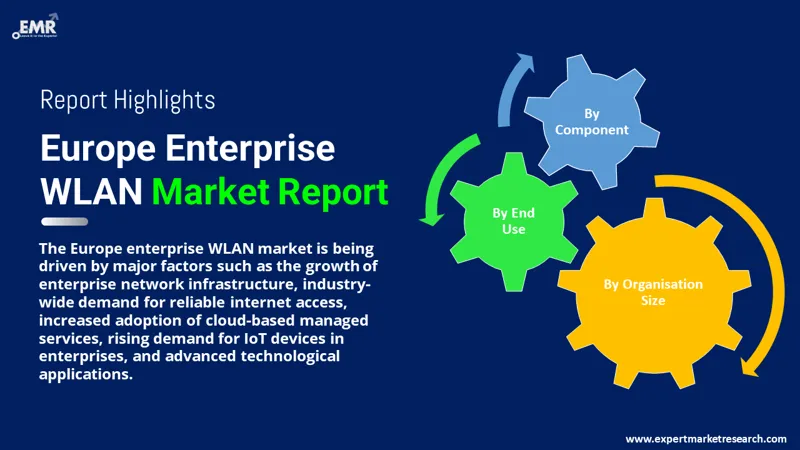
The EMR’s report titled “Europe Enterprise WLAN Market Report and Forecast 2026-2035” offers a detailed analysis of the market based on the following segments:
Market Breakup by Component
Key Insights: The Europe enterprise WLAN market scope comprises components such as hardware, software, and services, with each one playing a different role in the support of growth. The hardware segment is the greatest beneficiary of the activities of leading firms such as Cisco, HPE Aruba, and Huawei that launch high-capacity Wi-Fi 6E and Wi-Fi 7 access points. The software segment is benefited by AI-driven WLAN management platforms from leading manufacturers such as Cisco Meraki and Juniper Mist. On the service side, vendors and system integrators in the IT solutions domain are supporting enterprises in the deployment and operation of complex wireless networks efficiently, thereby expanding services like managed WLAN and network optimization.
Market Breakup by Organisation Size
Key Insights: Large enterprises have taken over a major share of the Europe enterprise WLAN market through their extensive campus networks, security needs, and multi-site WLAN deployments. Therefore, the major vendors like Cisco and Juniper have been putting their efforts into scalable, AI-managed solutions. On the other hand, small and medium enterprises are becoming a powerful growth segment because of the support provided to them in the form of simplified, cloud-managed WLAN offerings from Cisco Meraki and HPE Aruba that help in cost and operational complexity reduction. This dual, segmented focus allows vendors to widen their customer base and speed up WLAN adoption across Europe.
Market Breakup by End Use
Key Insights: The Europe enterprise WLAN market serves several industries, including retail, IT, telecommunications, banking, financial services, insurance, and healthcare. BFSI and IT and telecommunications sectors are dependent on secure, high-availability WLAN solutions from Cisco and Juniper. Healthcare is expected to have a higher WLAN adoption rate as connected medical devices supported by trusted wireless networks from HPE Aruba become the norm. Retail businesses are using WLAN to carry out customer analytics and digital engagement, while the education and manufacturing sectors have wireless infrastructure to facilitate automation and smart operations, resulting in consistent growth across all sectors.
Market Breakup by Region
Key Insights: The Europe enterprise WLAN market landscape includes the United Kingdom, Germany, France, Italy, and other European nations. Germany remains at the forefront due to highly advanced enterprise IT modernization and industrial WLAN deployment initiatives. The United Kingdom and France have been witnessing considerable demand coming from BFSI, the public sector, and healthcare facility upgrades. Italy's commercial and campus networks have been steadily progressing, whereas other parts of Europe have been enjoying the advantages of hybrid work. Manufacturers like Cisco, HPE Aruba, Huawei, and Juniper are continuously broadening their regional collaboration to boost market penetration.
By component, hardware shows significant uptake driven by improvements in solutions enabling wireless coverage
Hardware continues to remain the major contributor to the Europe enterprise WLAN market share as vendors come up with chipsets and access technologies that can extend the range of wireless coverage and, at the same time, lower power consumption. Large-scale IoT environments, smart buildings, and industrial campuses that are connected to enterprise WLAN backbones will all be made possible by these advancements. Reflecting this trend, in March 2025, Morse Micro unveiled its MM8102 Wi-Fi HaLow SoC, enabling ultra-low power, long-range, and EU-compliant connectivity for mass IoT and enterprise deployments across Europe.
On the other hand, software innovations are picking up pace and are shaping the evolution of the Europe enterprise WLAN market, with enterprises increasingly preferring platforms that offer them proactive monitoring, analytics, and automated optimization even in complex wireless setups. Such offerings help to raise the level of service reliability, cut down the need for manual interventions, and improve the user experience in high-density enterprise networks. For instance, in September 2024, AVSystem introduced its Customer Experience Management (CEM) Platform, featuring AI-powered diagnostics, smart Wi-Fi optimization, and end-to-end service assurance that aim to enhance WLAN performance and operational effectiveness.
By organization size, large enterprises contribute substantially to the market, driven by Industry 4.0 adoption and large-scale automation needs
Major corporations are speeding up their WLAN investments to help Industry 4.0 initiatives, automation, and high-density device environments across large industrial sites. These types of installations demand a wireless infrastructure that is rugged, scalable, and centrally managed to guarantee reliability and low latency. As a matter of fact, Zyxel Networks unveiled its IAP500BE industrial Wi-Fi 7 access point in November 2025, which can provide resilient, cloud-managed connectivity to large factories and warehouse environments, thus supporting this trend in the Europe enterprise WLAN market.
Small and medium enterprises have started to upgrade their WLAN to advanced ones for several reasons, such as supporting remote working, IoT devices, and customer-facing operations, while keeping the costs low. Vendors have been delivering the compact, high-capacity access points that are geared towards ease of deployment and management. In December 2025, Ubiquiti rolled out its UniFi E7 series Wi-Fi 7 access points, which helped SMEs connect to 1,000 devices per AP with low latency and scalable cloud management, hence increasing operational efficiency and network reliability.
By end-use, the healthcare sector shows significant product uptake driven by ongoing connectivity upgradation efforts by hospitals
The healthcare end-use category is the major contributor to the surging demand in the Europe enterprise WLAN market as hospitals are upgrading connectivity to support clinical workflows, telemedicine, and IoMT devices. A dependable high-capacity WLAN cuts down on latency, facilitates communication among staff, and opens the use of data-heavy applications in the different locations of a hospital. In line with this shift, HM Hospitales in Spain teamed up with Huawei in 2025 to roll out a Wi-Fi 7 and cloud-managed smart network throughout 22 hospitals and numerous clinics, thus boosting the performance, reliability, and future innovation capacity.
The IT and telecommunications industry is facilitating the rapid adoption of solutions from the Europe enterprise WLAN market by introducing AI-based network management tools that improve customer experience, make better use of available bandwidth, and lower the costs of operations. Many businesses are installing managed Wi-Fi systems to guarantee uninterrupted connectivity in homes, offices, and multi-dwelling units. For instance, in November 2025, Airties' deployment for Deutsche Telekom helped introduce Germany's first managed Wi-Fi, leading to enhanced internet performance and lower churn.
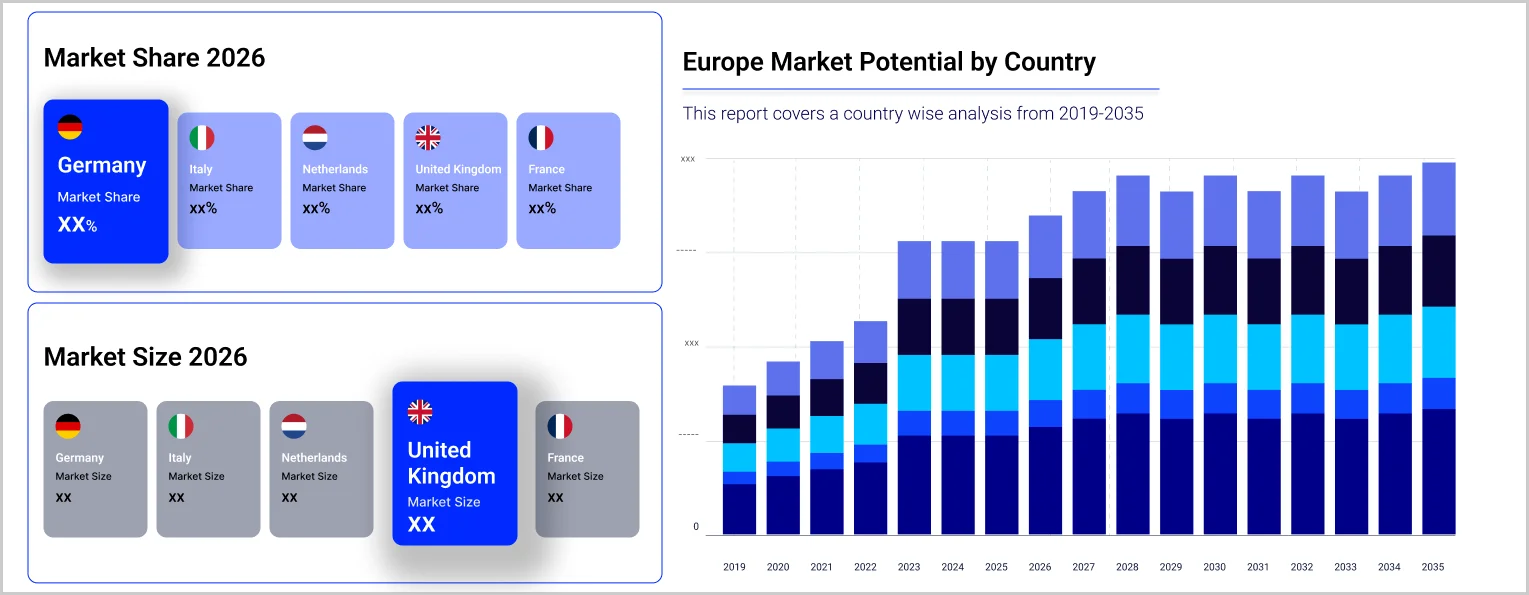
By region, the United Kingdom leads the market growth attributed to the growing demand to support hybrid work lifestyles
The United Kingdom WLAN market continues to grow rapidly, mainly due to the widespread use of next-generation Wi-Fi solutions for supporting hybrid work, streaming, and smart home integration in homes and small businesses. Companies invest in high-performance, AI-managed routers capable of increasing speeds, lowering latency, and optimizing throughput across multiple devices being connected. For instance, in September 2025, D-Link introduced its Wi-Fi 7 M36 and R36 routers to the United Kingdom market, thus providing features such as advanced mesh networking, Multi-Link Operation, and 2.5G connectivity, which are aimed at upgrading both residential and SMB networks.
Germany contributes significantly to the Europe enterprise WLAN market revenue, resulting from the increasing convergence of 5G and private network solutions. WLAN significantly boosts the performance of automation, monitoring, and remote control over a very distributed industrial infrastructure. Additionally, an increasing number of companies are working together to deliver secure, high-performance networks for critical operations. For instance, there is a partnership between Siemens and Telefonica Germany, which allowed the launch of a 5G network slicing solution for water utilities in April 2025, thus providing access to reliable, secure, and efficient connectivity, enabling automated processes.
Major Europe enterprise WLAN market players are investing significant amounts of capital in next-generation Wi-Fi technologies, such as Wi-Fi 6 and Wi-Fi 7, to address the increasing necessity for fast, low-latency connectivity. They focus on incorporating AI-powered network management, mesh systems, and upgraded security protocols, which, altogether, will enhance user experience, operational efficiency, and network reliability not only in homes but also in SMBs and enterprise networks, thereby facilitating the gradual expansion of WLAN infrastructure in several sectors.
Through strategic partnerships, product innovation, and market penetration via infrastructural upgrades, enterprise WLAN companies in Europe are working to increase WLAN adoption as well as to fortify their range of services. The deployment of industrial-grade access points, dual-band routers, and private networks is aimed at ensuring that connectivity is secure, scalable, and high-performing. As a result, these initiatives help enterprises realize the full potential of automation, IoT applications, and remote operations, which in turn contributes to the overall development of the Europe enterprise WLAN market and the creation of competitive differentiation both geographically and across the end-user segments.
Established in 1984 and based in San Jose, California, Cisco Systems is a global leader in networking and cybersecurity solutions. The company invents cutting-edge hardware, software, and services that allow secure, scalable enterprise connectivity globally.
Hewlett Packard Enterprise is a company that was established in 2015 and is in Houston, Texas. It is mainly engaged in enterprise IT solutions and cloud computing. The firm provides products such as servers, storage, networking, and software services that help businesses in upgrading their infrastructure and enhancing their operations.
Arista Networks, a company established in 2004 and based in Santa Clara, California, is a cloud networking and data center switch specialist. Arista Networks offers high-performance network solutions that are specifically designed for scalable, programmable, and software-driven infrastructures.
Ubiquiti is a company established in 2005 and has its main office in New York. It is recognized for its wireless networking and enterprise connectivity products that are very innovative. The company is geared towards bringing high-performance Wi-Fi access points, routers, and management platforms to more businesses and service providers.
*Please note that this is only a partial list; the complete list of key players is available in the full report. Additionally, the list of key players can be customized to better suit your needs.*
Other players in the Europe enterprise WLAN market include CommScope, Inc., Huawei Technologies Co., Ltd., Dell Inc., and Juniper Networks, Inc., among others.
Explore the latest trends shaping the Europe Enterprise WLAN Market 2026-2035 with our in-depth report. Gain strategic insights, future forecasts, and key market developments that can help you stay competitive. Download a free sample report or contact our team for customized consultation on Europe enterprise WLAN market trends 2026.


Upto 15% Off
USD
$3499 $3149
$5599 $5039
$6999 $5949
$8459 $7190


*While we strive to always give you current and accurate information, the numbers depicted on the website are indicative and may differ from the actual numbers in the main report. At Expert Market Research, we aim to bring you the latest insights and trends in the market. Using our analyses and forecasts, stakeholders can understand the market dynamics, navigate challenges, and capitalize on opportunities to make data-driven strategic decisions.*
The market is projected to grow at a CAGR of 9.75% between 2026 and 2035.
Key strategies driving the market include adoption of advanced Wi-Fi technologies (Wi-Fi 6/7), product innovations, partnerships and collaborations, infrastructure expansions, and strategic mergers and acquisitions.
The increasing volume of data utilised by enterprise applications and heightened dependency on Wi-Fi-enabled devices are the key industry trends propelling the growth of the market.
The key players in the market include Cisco Systems Inc., Hewlett Packard Enterprise Development LP, Arista Networks, Inc., Ubiquiti Inc., CommScope, Inc., Huawei Technologies Co., Ltd., Dell Inc., and Juniper Networks, Inc., among others.
A wireless local area network (WLAN) is a wireless distribution technology for two or more devices. High-frequency radio waves are used by WLANs, which usually have an integrated Internet access point. Enterprise WLAN refers to WLAN networks that support connectivity across the premises of the organisation.
To link devices, enterprise WLAN employs routers and access points, connecting devices wirelessly to the internet within the constrained area.
Enterprise WLANs transmits data using radio, microwave, and infrared waves without the use of cables, offering a way to build a Local Area Network without cables. The WLAN can be linked to an established, larger network, such as the internet.
In 2025, the Europe enterprise WLAN market reached an approximate value of USD 4.76 Billion.
The major challenges that the Europe enterprise WLAN market faces include high deployment costs, complex network integration, cybersecurity threats, intense competition, and evolving regulatory compliance requirements.
Explore our key highlights of the report and gain a concise overview of key findings, trends, and actionable insights that will empower your strategic decisions.
| REPORT FEATURES | DETAILS |
| Base Year | 2025 |
| Historical Period | 2019-2025 |
| Forecast Period | 2026-2035 |
| Scope of the Report |
Historical and Forecast Trends, Industry Drivers and Constraints, Historical and Forecast Market Analysis by Segment:
|
| Breakup by Component |
|
| Breakup by Organisation Size |
|
| Breakup by End Use |
|
| Breakup by Region |
|
| Market Dynamics |
|
| Competitive Landscape |
|
| Companies Covered |
|
Datasheet
One User
USD 3,499
USD 3,149
tax inclusive*
Single User License
One User
USD 5,599
USD 5,039
tax inclusive*
Five User License
Five User
USD 6,999
USD 5,949
tax inclusive*
Corporate License
Unlimited Users
USD 8,459
USD 7,190
tax inclusive*
*Please note that the prices mentioned below are starting prices for each bundle type. Kindly contact our team for further details.*
Flash Bundle
Small Business Bundle
Growth Bundle
Enterprise Bundle
*Please note that the prices mentioned below are starting prices for each bundle type. Kindly contact our team for further details.*
Flash Bundle
Number of Reports: 3
20%
tax inclusive*
Small Business Bundle
Number of Reports: 5
25%
tax inclusive*
Growth Bundle
Number of Reports: 8
30%
tax inclusive*
Enterprise Bundle
Number of Reports: 10
35%
tax inclusive*
How To Order

Select License Type
Choose the right license for your needs and access rights.

Click on ‘Buy Now’
Add the report to your cart with one click and proceed to register.

Select Mode of Payment
Choose a payment option for a secure checkout. You will be redirected accordingly.
Strategic Solutions for Informed Decision-Making
Gain insights to stay ahead and seize opportunities.

Get insights & trends for a competitive edge.

Track prices with detailed trend reports.

Analyse trade data for supply chain insights.

Leverage cost reports for smart savings

Enhance supply chain with partnerships.

Connect For More Information
Our expert team of analysts will offer full support and resolve any queries regarding the report, before and after the purchase.
Our expert team of analysts will offer full support and resolve any queries regarding the report, before and after the purchase.
We employ meticulous research methods, blending advanced analytics and expert insights to deliver accurate, actionable industry intelligence, staying ahead of competitors.
Our skilled analysts offer unparalleled competitive advantage with detailed insights on current and emerging markets, ensuring your strategic edge.
We offer an in-depth yet simplified presentation of industry insights and analysis to meet your specific requirements effectively.




