

Consumer Insights
Uncover trends and behaviors shaping consumer choices today
Procurement Insights
Optimize your sourcing strategy with key market data
Industry Stats
Stay ahead with the latest trends and market analysis.
The Europe excavator market size was valued at USD 22.59 Billion in 2025. The industry is expected to grow at a CAGR of 6.70% during the forecast period of 2026-2035 to reach a value of USD 43.21 Billion by 2035. The market is witnessing a strong push toward electrification, driven by stringent EU emissions regulations, sustainability mandates, and the rising need for environmentally friendly construction equipment.
Original equipment manufacturers (OEMs) are widening their electric product range in the Europe excavator market to cover various machine classes, i.e., from small and medium-sized excavators that can be used at urban sites to large, heavy-duty models that can be used for full-day operations on infrastructure projects. Citing an instance, SANY introduced its SY215E electric excavator in June 2024, which is specifically designed to comply with European operational requirements through the use of ultra batteries and long run times.
This growth indicates a tactical move by producers to supply carbon-free emission alternatives without any performance or efficiency losses. Consequently, the demand for electric excavators is anticipated to increase gradually, thus affecting contractor decisions on purchasing, lowering operating costs, and supporting the overall sustainability progress in the Europe excavator market landscape.
Another strong driver is the expansion of zero-emission lineups through strategic collaborations, as OEMs increasingly rely on shared technologies to accelerate electrification. Reflecting this trend, Hitachi Construction Machinery Europe, in partnership with KTEG, is set to showcase nine zero-emission excavator models at Bauma 2025, including swappable-battery minis, mid-sized electric units, and the hydrogen-powered ZE300. This collaboration strengthens the rollout of advanced, low-emission solutions across machine classes and enhances customer access to diversified powertrain options.
Compound Annual Growth Rate
6.7%
Value in USD Billion
2026-2035
In the EMEA region, Bobcat unveiled a limited Premiere Launch Edition of its R2-Series 1–2 tonne mini excavators. Besides the premium finishes and numbered plates, the new models feature four high-value kits equipped with the SmartFlow hydraulic system, a technology designed to enhance energy efficiency, precision, and reduce diesel consumption by up to 18% in urban and compact construction tasks. This upgrade aligns with Europe’s push for fuel-efficient, low-emission machinery, supporting greater demand for advanced mini excavators.
At EIMA 2024, New Holland introduced new midi excavators spanning the 6–12 tonne segment. The five models incorporate versatile booms, customizable hydraulics, and 60–75 HP engines, improving efficiency, agility, and operator comfort for European construction and landscaping projects. These innovations cater directly to Europe’s expanding mid-size machinery needs, contributing to market growth driven by infrastructure and landscaping demand.
CASE launched the CX210E-S 20-tonne crawler excavator, a mid-size addition to its E-Series lineup in Europe. The “Essential” model combines robust construction, versatile hydraulics, and operator comfort at an affordable price point. By broadening its 20-tonne offerings, CASE strengthens its position in the mid-sized crawler segment and provides dependable, high-performance solutions for construction and infrastructure projects. This strategic expansion supports market growth by offering cost-efficient options amid rising equipment demand across Europe.
In Europe, Kobelco introduced the SK230SRLC-7 and SK270SR(N)LC-7 short-radius excavators. These compact models address the growing need for highly maneuverable equipment in urban and residential construction environments, reinforcing Kobelco’s commitment to the short-radius category. Their launch supports Europe’s increasing shift toward compact, space-efficient machinery, further driving market expansion in dense construction zones.
With the contracted led demand for silent and zero-emission machines in the middle of the cities, the Europe excavator market trends are moving towards electrified small-sized machines at a fast speed. To meet the regulatory standards and rental requests, the makers of heavy machinery are widening their electric vehicle (EV) range. In line with this development, Komatsu unveiled its three electric mini-excavator models, PC20E, PC26E, and PC33E, at Bauma 2025. Those units facilitate on-board charging and longer running time and can also be used indoors. In a way, such developments deepen fleet electrification, which is the main reason why compact EV excavators are being indifferently picked up by most European users.
The demand in the Europe excavator market is escalating as the continent carries out its promised infrastructural upgrades; thus, the need for OEMs to strengthen their local manufacturing of heavy equipment rises. By improving the local supply, the company diminishes delivery problems and, at the same time, supports the sustainability goals. To that effect, Volvo CE has, in June 2025, declared an investment of 2,500 MSEK to a project that aims at increasing not only local but also worldwide production of the crawler excavator, with the initial site to be at Sweden. This project enhances the factory's capability to withstand crises and at the same time ensures readiness for the European market as the construction business picks up.
Consolidation across the construction-equipment sector is redefining the competitive landscape of the Europe excavator market, as they aim at having larger product selections for dense urban markets in Europe. Acquiring other companies helps the OEMs to strengthen product diversity and innovation capacity. For instance, Fayat Group acquired Mecalac in June 2025, and integrated Mecalac's compact-excavator technologies. This merger enabled stronger research and development capabilities and better coverage of urban-focused excavation needs throughout Europe due to the consolidation of these two companies. Further lead to improved research and development capabilities as well as expanded city-focused excavation coverage throughout the European market.
The introduction of foreign players in the Europe excavator market facilitates the process of industry-wide transition to electrification of tech, as they can provide battery-electric vehicle (BEV) models that are both cost-effective and competitive. Furthermore, by the emergence of such players, the technology diversity will be enlarged, and contractors will have more cost-efficient choices. One of the most prominent cases is LiuGong, which at INTERMAT 2024, presented the 9027FE for compact and 922FE for medium battery-electric excavators. To strengthen market competition through such products and to expedite the EV development of the existing brands is what unfolding a quick charge and LFP batteries for these machines means.
The technology-driven transformation in the Europe excavator market is going far beyond the electrification as lesser things OEMs are willing to explore AI-based interfaces, automation, and modularity in their product offerings. Concept machines represent the future direction of the excavator platform, significantly influencing long-term investment decisions across the industry. Citing an instance, at Bauma 2025, Hitachi Construction Machinery Europe unveiled its concept LANDCROS One featuring multi-power compatibility, futuristic operator-assist, and remote capabilities. Highlights of such breakthroughs are future systems for flexible design as well as the support of Europe’s changing construction requirements made by OEMs.

Read more about this report - REQUEST FREE SAMPLE COPY IN PDF
The EMR’s report titled “Europe Excavator Market Report and Forecast 2026-2035” offers a detailed analysis of the market based on the following segments:
Market Breakup by Product
Key Insights: The Europe excavator market is extensively diversifying in different segments, such as mini/compact, crawler, and demolition, the main factors being the same: sustainability, infrastructure expansion, and circular-economy ambitions. Minis are turned electric to meet the energy needs of urban and renovation sites. Crawler machines are increased in power through local production to meet the needs of large-scale infrastructure. Demolition is the field where OEMs push the most for zero-emission teardown solutions. For example, the company XCMG showed 13 E-series electric excavators among which were the XE10E and XE45E mini models at Bauma 2025 to be used in Europe.
Market Breakup by Mechanism Type
Key Insights: Fully electric excavators are slowly but surely becoming the choice of the majority of OEMs who want to eliminate emissions from the models they offer and create compliance with green job-site mandates. Machines with a traditional hydraulic system are still the main ones in heavy-duty and infrastructure works because of their power density being the one that has been tested numerous times already. Hybrid excavators gain the largest volume of positive feedback as they provide fuel savings and reduce CO₂ emissions without performance decrease. To cite an instance, Volvo Construction Equipment announced recently the introduction of five new hydraulic-hybrid models, which includes EC260, EC300, EC370, EC400, and EC500, with fuel efficiency improved by up to 20% and CO₂ emissions lowered by 15% compared to the previous generations.
Market Breakup by Power Range
Key Insights: The Europe excavator market demonstrates a wide spectrum of demand across different power ranges as diversified project requirements emerge. Machines with power of up to 300 HP are at the forefront of urban constructions and municipal works because of their agility and fuel efficiency. Models with 301–500 HP are used for tunneling and large civil projects, with OEMs elevating engines and hydraulics to higher performance levels. Doosan (Develon) in Europe launched the DX380LC-7K 344-HP excavator in October 2024, which not only enhances swing performance but also serviceability. The segment of more than 501 HP is expanding in mining and major earthmoving sectors.
Market Breakup by Application
Key Insights: The Europe excavator market scope evolves through mining, construction, and other industrial uses, each with its own distinctive requirements. The mining applications are powered by high-capacity crawler excavators that can keep up with the growth of quarry and aggregate production. Construction is the main driver of demand through urban redevelopment and transport upgrades, which in turn are changing the demand for low-emission machines. Komatsu in April 2024 introduced its PC210LCE electric excavator for urban construction in Europe. The “Others” category is steadily increasing with demand for utilities, forestry, and waste-handling applications.
Market Breakup by Region
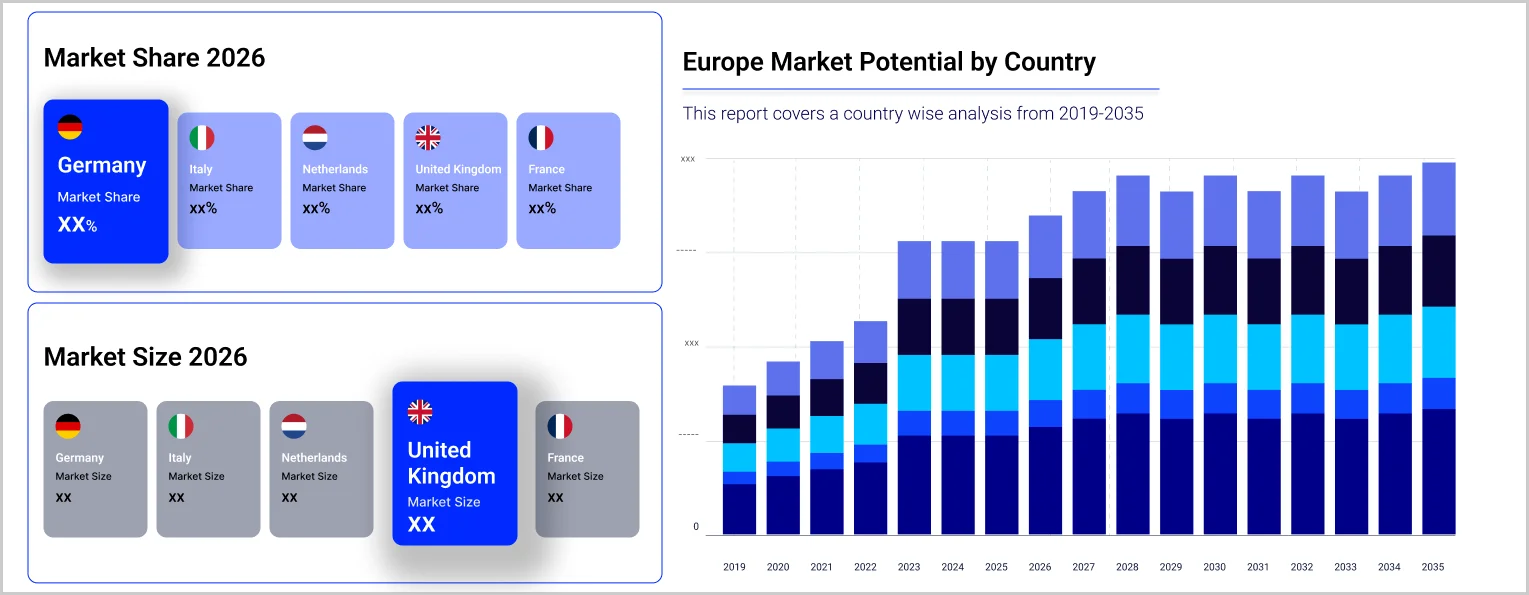
Key Insights: The Europe excavator market growth exhibits different regional levels of activity driven by expanded infrastructure and sustainability objectives. Among them, Germany shines bright, being the location where Volvo CE powered the world's first fully electric deconstruction site at Siemens' Erlangen Technology Campus with the use of EC230 Electric along with other battery-powered machines. Compact and electric models remain the main choices for urban redevelopment in the United Kingdom and France, while Italy's expansion is being assisted by transport upgrades and renovation programs across major cities.
By product, mini/compact excavators show significant uptake
In Europe, urban and utility-based construction are changing the type of machinery they use, in a way that the machines are smaller and more environmentally friendly. As a consequence, original equipment manufacturers (OEMs) are converting their mini-excavator lines to electric. For example, Hyundai Construction Equipment Europe introduced its first battery-powered mini excavator, the HX19e, at Bauma 2025. The device can be equipped with a 32 kWh or 40 kWh battery, enabling it to run for up to 6.7 hours. Low-emission vans are becoming the standard of the future for cities, landscaping, and other confined sites, as local authorities and contractors release such mandates.
Crawlers witness high demand in the Europe excavator market, fuelled by the region's infrastructural development and large-scale construction projects, which have become an incentive for the original equipment manufacturers (OEM) to ramp up their production locally. In June 2025, Volvo CE made public its decision to invest 2,500 MSEK in the expansion of the manufacturing capacity of the company's crawler-excavator unit in Sweden as well as other different plants. The company aims to reduce transportation-related risks and waiting times by manufacturing closer to primary markets, enabling better alignment of supply with the rising demand for heavy, high-performance excavators and improving overall operational efficiency.
By mechanism, electric excavators are picking up pace
Electric excavators are becoming more popular in Europe as the demand for zero-emission construction zones is increasing in cities and contractors are looking for quieter, low-maintenance equipment. OEMs are broadening their electric offerings and initiating technology-driven collaborations to speed up the transition. In September 2024, Hitachi Construction Machinery collaborated with Dimaag to create a 1.7-ton class zero-emission electric excavator that uses Dimaag’s ENCORE swappable-battery system, enabling battery replacement without operation interruption. With this move, the company is acknowledging the trend of increasing investments for compact EV machinery specifically designed for dense European urban worksites.
Hybrid category is gaining notable traction in the Europe excavator market, as viable and efficient remote solution to the problem of diesel and full electrification, as they use hydraulic energy-recovery systems to reduce fuel consumption in a demanding application. OEMs are also turning hybrid models into specially-equipped machines for certain niche operations. In May 2024, the Volvo CE’s EC380E Hybrid was chosen for underwater excavation in a gravel pit in Germany, where the long-reach boom and hybrid hydraulics were used to achieve fuel savings of 10–15%. This is a perfect illustration of how hybrid systems are being refined to very specialized, high-value European projects.
By power range, 301–500 HP category gains traction
Excavators with a power range of 301–500 HP are increasingly being used in heavy civil works, quarrying, and infrastructure projects, which has led OEMs to concentrate on making the engines more efficient and reliable. Manufacturers are enhancing hydraulics and the design of the undercarriage to not only deliver more power but also to keep the operating costs at a lower level. As a matter of example, Hyundai is marketing the HX520A L crawler excavator equipped with a 395-HP engine to European companies that are looking for a powerful medium-sized machine but want to avoid the high fuel consumption. This market segment is still very important to contractors who are asking for performance combined with sustainable economics.
The 501 HP+ category growth in the Europe excavator market is mainly influenced by large-scale mining, bulk earthmoving, and infrastructure megaprojects, where a high horsepower and the durability of the machine are of utmost importance. OEMs are going bigger and more advanced to cater for these requirements by new-generation shovels and heavy excavators. As a matter of fact, at Bauma 2025, Caterpillar introduced the Cat 395 Front Shovel with a power of 542 HP (405 kW), a machine that is aimed at mining customers who want high-power performance but at the same time fuel efficient. In other words, this is a clear indication of the commitment of the OEMs to the long-haul, high-capacity operations.
By applications, the mining sector registers robust growth
To keep up with the demand for aggregates and minerals, Europe's mining and quarrying sector is progressively going for bigger, more durable excavators. Original Equipment Manufacturers (OEMs) are upgrading powertrains, hydraulics, and telematics to deliver more output in a less accessible part of the pit. Liebherr presented its revamped R 9300 mining excavator in March 2024, a machine made lighter in fuel consumption and more robust in durability for big quarries. It points to how manufacturers are focusing on capacity solutions as the first choice for European mining operators.
The rise in construction activity throughout Europe is boosting the Europe excavator market revenue owing to the increasing use of low-emission and high-efficiency excavators as cities become stricter on sustainability regulations. New-generation models, which are fuel-saving and less noisy, are being adopted by contractors. JCB updated its Hydradig 110W Wastemaster in January 2024, adding features like better visibility and improved hydraulic control for urban and municipal construction tasks. This change is a clear indication of OEMs' commitment to adapting their products to the requirements of dense European job sites.
By region, the United Kingdom shows robust growth
OEMs in the United Kingdom are utilizing sustainability targets and the increasing demand for urban infrastructure to extend their electric excavator fleets. As a matter of fact, LiuGong exhibited six BEV machines, among them excavators, at INTERMAT 2024, to emphasize its European BEV leadership and intentions to broaden its United Kingdom dealer network. By committing strongly to the product, manufacturers are making it possible for green fleet transitions to be carried out in those countries which are giving priority to low-emission construction.
The construction players in Germany are increasingly investing in the Europe excavator market, to deploy more and more ambitious measures for circularity and low emissions by forming strategic partnerships. Volvo CE, Siemens, and Metzner Recycling collaborated to carry out the world's first fully electric deconstruction project at Siemens' Erlangen Technology Campus with the use of electric excavators and trucks. This groundbreaking collaboration demonstrates that demolition can be executed with absolutely no tailpipe emissions, thus aiding the promotion of circular building practices and cleaner job sites.
Top Europe excavator market players are refining their products by introducing electrification, automation, and digital integration to comply with sustainability requirements and enhance productivity. The top-tier players are widening their electric excavator offerings, committing to energy-efficient drivetrains, and modernizing their telematics platforms. These initiatives lead to lowered emissions, increased precision in operations, and the provision of data-driven fleet management solutions to contractors who are making the transition to the green sector in urban and infrastructure projects.
The major Europe excavator companies are also using various strategies such as acquisitions, localized production expansion, and strategic partnership to solidify their competitive positions. Original equipment manufacturers (OEMs) are upgrading their European factory capacity, improving their supply-chain resilience, and working with technology companies for next-generation control systems and battery solutions. These changes result in the faster delivery of products, the extension of the company's product line, and the coexistence with the customer's ever-changing demands in the region's construction and mining sectors, further boosting the scope of the Europe excavator market.
CNH Global NV is a powerful player in the market of construction and agricultural machinery, which is applauded for its broad equipment portfolio and strong distribution network. The company was established in 1999 and is located in Amsterdam. It is using high-tech engineering to meet the varied needs of excavation and infrastructure.
Caterpillar Inc. is the first among the global manufacturers of heavy machinery and still the most valuable supplier of high-performance excavators throughout Europe. Founded in 1925 and located in Illinois, USA, the company puts its focus on durability, productivity, and the continuous investment in the next-generation construction technologies.
Volvo Construction Equipment AB is honored with an excellent record for delivering environmentally friendly construction equipment, such as leading edge battery-powered and hybrid excavators. The company was founded in 1832 and is based in Gothenburg, Sweden. It commits to innovation, operator safety, and energy-efficient solutions throughout the global construction markets.
Hyundai Construction Equipment Co., Ltd. provides a diverse range of excavator products that are well-known for their reliability, fuel efficiency, and the use of modern technology. The company was established in 1985, and its main office is in Seoul, South Korea. It keeps on solidifying its European market by upgrading its models and increasing dealer partnerships.
*Please note that this is only a partial list; the complete list of key players is available in the full report. Additionally, the list of key players can be customized to better suit your needs.*
Other players in the market include Kobelco Construction Machinery Co. Ltd., Liebherr Group, among others.
Explore the latest trends shaping the Europe Excavator Market 2026-2035 with our in-depth report. Gain strategic insights, future forecasts, and key market developments that can help you stay competitive. Download a free sample report or contact our team for customized consultation on Europe excavator market trends 2026.


Upto 15% Off
USD
$3999 $3599
$2499 $2249
$4999 $4249
$5999 $5099


*While we strive to always give you current and accurate information, the numbers depicted on the website are indicative and may differ from the actual numbers in the main report. At Expert Market Research, we aim to bring you the latest insights and trends in the market. Using our analyses and forecasts, stakeholders can understand the market dynamics, navigate challenges, and capitalize on opportunities to make data-driven strategic decisions.*
The market is projected to grow at a CAGR of 6.70% between 2026 and 2035.
Key strategies driving the market include expanding electric and hybrid excavator portfolios, investing in localized production and supply chains, pursuing strategic acquisitions and partnerships, developing next-generation technology like automation and AI interfaces, and targeting niche applications with specialized machines.
Technological advancements and increased spending on construction are the key industry trends propelling the growth of the market.
The major regions in the industry are the United Kingdom, Germany, Italy, and France, among others.
The different products in the market are mini/compact, crawler, and demolition, among others.
Based on mechanism type, the industry can be broadly categorised into electric, hydraulic, and hybrid.
By power range, the market includes upto 300 HP, 301-500 HP, and 501 HP and above.
The major applications of the product are mining and construction, among others.
The key players in the market include CNH Global NV, Caterpillar Inc., Volvo Construction Equipment AB, Hyundai Construction Equipment Co., Ltd., Kobelco Construction Machinery Co. Ltd., Liebherr Group, and other regional and global manufacturers.
In 2025, the Europe excavator market reached an approximate value of USD 22.59 Billion.
The Europe excavator market faces challenges such as high upfront costs of electric and hybrid machines, complex regulatory compliance, supply chain disruptions, and the need for skilled operators to manage advanced equipment.
Explore our key highlights of the report and gain a concise overview of key findings, trends, and actionable insights that will empower your strategic decisions.
| REPORT FEATURES | DETAILS |
| Base Year | 2025 |
| Historical Period | 2019-2025 |
| Forecast Period | 2026-2035 |
| Scope of the Report |
Historical and Forecast Trends, Industry Drivers and Constraints, Historical and Forecast Market Analysis by Segment:
|
| Breakup by Product |
|
| Breakup by Mechanism Type |
|
| Breakup by Power Range |
|
| Breakup by Application |
|
| Breakup by Region |
|
| Market Dynamics |
|
| Competitive Landscape |
|
| Companies Covered |
|
| Report Price and Purchase Option | Explore our purchase options that are best suited to your resources and industry needs. |
| Delivery Format | Delivered as an attached PDF and Excel through email, with an option of receiving an editable PPT, according to the purchase option. |
Single User License
One User
USD 3,999
USD 3,599
tax inclusive*
Datasheet
One User
USD 2,499
USD 2,249
tax inclusive*
Five User License
Five User
USD 4,999
USD 4,249
tax inclusive*
Corporate License
Unlimited Users
USD 5,999
USD 5,099
tax inclusive*
*Please note that the prices mentioned below are starting prices for each bundle type. Kindly contact our team for further details.*
Flash Bundle
Small Business Bundle
Growth Bundle
Enterprise Bundle
*Please note that the prices mentioned below are starting prices for each bundle type. Kindly contact our team for further details.*
Flash Bundle
Number of Reports: 3
20%
tax inclusive*
Small Business Bundle
Number of Reports: 5
25%
tax inclusive*
Growth Bundle
Number of Reports: 8
30%
tax inclusive*
Enterprise Bundle
Number of Reports: 10
35%
tax inclusive*
How To Order

Select License Type
Choose the right license for your needs and access rights.

Click on ‘Buy Now’
Add the report to your cart with one click and proceed to register.

Select Mode of Payment
Choose a payment option for a secure checkout. You will be redirected accordingly.
Strategic Solutions for Informed Decision-Making
Gain insights to stay ahead and seize opportunities.

Get insights & trends for a competitive edge.

Track prices with detailed trend reports.

Analyse trade data for supply chain insights.

Leverage cost reports for smart savings

Enhance supply chain with partnerships.

Connect For More Information
Our expert team of analysts will offer full support and resolve any queries regarding the report, before and after the purchase.
Our expert team of analysts will offer full support and resolve any queries regarding the report, before and after the purchase.
We employ meticulous research methods, blending advanced analytics and expert insights to deliver accurate, actionable industry intelligence, staying ahead of competitors.
Our skilled analysts offer unparalleled competitive advantage with detailed insights on current and emerging markets, ensuring your strategic edge.
We offer an in-depth yet simplified presentation of industry insights and analysis to meet your specific requirements effectively.




