

Consumer Insights
Uncover trends and behaviors shaping consumer choices today
Procurement Insights
Optimize your sourcing strategy with key market data
Industry Stats
Stay ahead with the latest trends and market analysis.
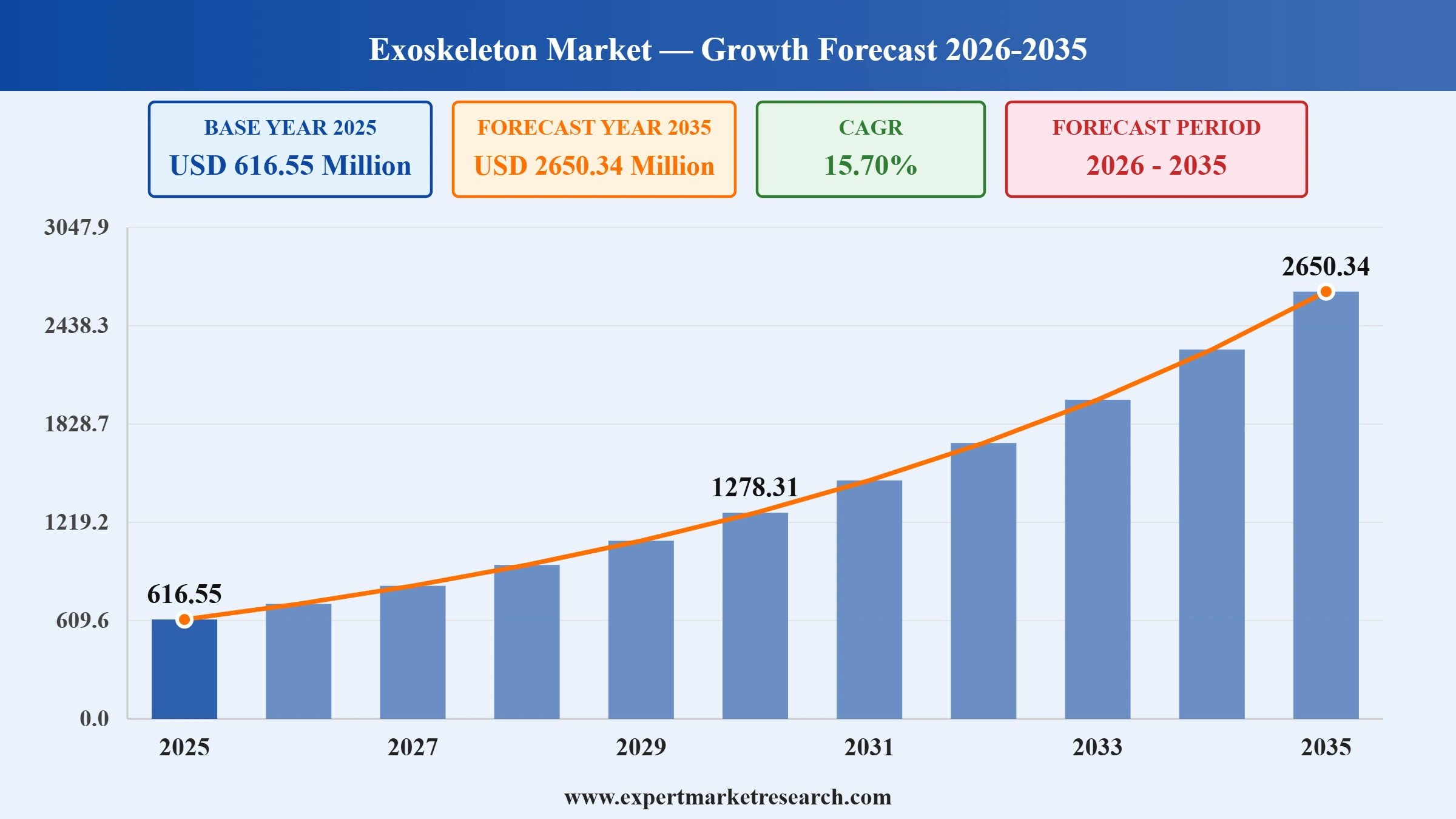
The exoskeleton market was valued at USD 616.55 Million in 2025. The market is expected to grow at a CAGR of 15.70% during the forecast period of 2026-2035 to reach a value of USD 2650.34 Million by 2035. Growing adoption of wearable robotics in healthcare and industrial sectors is one significant factor that is stimulating growth in the market.
The exoskeleton market covers wearable devices that support or augment human movement through powered or passive mechanisms, worn on the body and mechanically coupled to the user's musculoskeletal structure. The market divides into two applications with little technical overlap in purchasing logic. Clinical rehabilitation devices restore mobility following spinal cord injury, stroke or neurological impairment, and are sold into a healthcare system where regulatory clearance and insurance coverage determine access. Occupational devices reduce fatigue and musculoskeletal injury during lifting, overhead work and repetitive tasks, and are bought by employers evaluating injury cost against equipment expenditure.
What has held this market below its technical potential for a decade is not capability but payment. Clinical devices demonstrated function long before insurers would fund them, leaving individuals unable to afford equipment their physicians recommended. The commercial inflection now underway follows from reimbursement pathways consolidating across major payers rather than from any single engineering breakthrough, though self-balancing control has simultaneously widened the population that qualifies for a device at all.
Read more about this report - REQUEST FREE SAMPLE COPY IN PDF
| Exoskeleton Market Report Summary | Description | Value |
| Base Year | USD Million | 2025 |
| Historical Period | USD Million | 2019-2025 |
| Forecast Period | USD Million | 2026-2035 |
| Market Size 2025 | USD Million | 616.55 |
| Market Size 2035 | USD Million | 2650.34 |
| CAGR 2019-2025 | Percentage | XX% |
| CAGR 2026-2035 | Percentage | 15.70% |
| CAGR 2026-2035 - Market by Region | Asia Pacific | 19.8% |
| CAGR 2026-2035 - Market by Country | China | 19.0% |
| CAGR 2026-2035 - Market by Country | India | 18.1% |
| CAGR 2026-2035 - Market by Treatment Type | Rehabilitation | 21.3% |
| CAGR 2026-2035 - Market by Body Part Type | Lower Body | 20.4% |
| Market Share by Country 2025 | UK | 3.5% |
Exoskeleton robotics has steered in a new age of modern neuromuscular rehabilitation engineering and assistive technology research. The technology has shown significant promise to enhance upper-limb functionalities needed to carry out daily activities. Upper limb exoskeletons refer to electromechanical systems devised to interact with the user to amplify power, assist or substitute motor function. Generally, these devices are anthropomorphic in nature, and interact mechanically with the human upper-limb musculoskeletal structure. Applications include power amplification in industrial settings, compensation of neuromuscular impairment, post-stroke rehabilitation, and supporting disabled people in daily activities.
Over the last twenty years, upper-limb exoskeletons employed for services and rehabilitation have garnered much attention from biomedical and engineering sectors; the technology has gained continual prominence as a possible solution for physically weak or disabled individuals. Solutions have been developed to enhance strength and performance of the wearer. Leading companies are engaged in developing solutions to amplify human ability, protect workers, boost productivity, treat patients and rehabilitate mobility deficits. For example, Ekso Bionics is helping people live, work, and recover with bionic technology. The company developed EksoNR, a lower-body clinical bionic rehabilitation device - the first exoskeleton to receive FDA clearance cleared for stroke and spinal cord injury (SCI); it was also the only exoskeleton cleared by FDA for acquired brain injury. Such solutions are expected to drive the global exoskeleton market. The EksoNR neurorehabilitation suit was devised to help patients with a neurological diagnosis regain natural leg movement after suffering lower limb disabilities.
Building upon its clinical expertise, the company developed a solution for upper-body rehabilitation - EksoUE. The exoskeleton helped patients in rebuilding their upper extremity strength and maintaining upright posture while providing upper extremity support. The solution enabled 180 degrees of motion at the shoulder, and could be used by the patient while sitting, standing, and walking. Patients with SCI, strokes, brain injuries, and neurological disorders could greatly benefit from assistive technology in a rehabilitation setting.
Exoskeletons have several applications that are expected to boost the global exoskeleton market, these include solar installation, utilities and telecommunications, logistics and fulfilment, surgery, arborists, automotive mechanics, drywall installation, film equipment operation, food processing, manufacturing, shipbuilding, ceramics, natural gas and oil, HVAC installation and repair, hair dressing, plastering, firefighting, etc.
Exoskeletons also have important military applications. For example, the U.S. Navy and DARPA have use bionic robotics products (such as HULC) to enable soldiers carry heavier cargos over long distances.
To enhance Indian soldiers’ performance in military scenarios, several DRDO labs are involved in developing configurations including lower/upper extremity, and full-body exoskeletons.
The construction sector has witnessed increased use of smaller, more specialized exoskeleton projects targeting a particular body part. Full body suits are also in use. For example, Mounted Arm Exosuit (such as EksoZeoG, from Ekso Bionics) is not worn on the body, rather, workers control the arm by placing their hand at its end. The solution helps workers use heavy hand-tools quickly and complete tasks faster, with less fatigue, and better workmanship.
Overhead Exosuits include exoskeletons that offer arm, neck, and shoulder support to help workers carry out overhead installation work such as fitting ductwork or sprinklers. The solutions decrease load on the arm and neck muscles while cutting down on repetitive-stress injuries.
Arm Support Limbs are simple arms that help workers lift heavier tools while fuller exoskeletons offer shoulder or arm support. For example, Fraco Exoskeleton by Mawashi is a hybrid system that combines passive and quasi-passive actuation to aid and assist masons in lifting and placing masonry blocks as well as manipulating masonry tools.
The Expert Market Research's report titled “Exoskeleton Market Report and Forecast 2026-2035 offers a detailed analysis of the market based on the following segments:
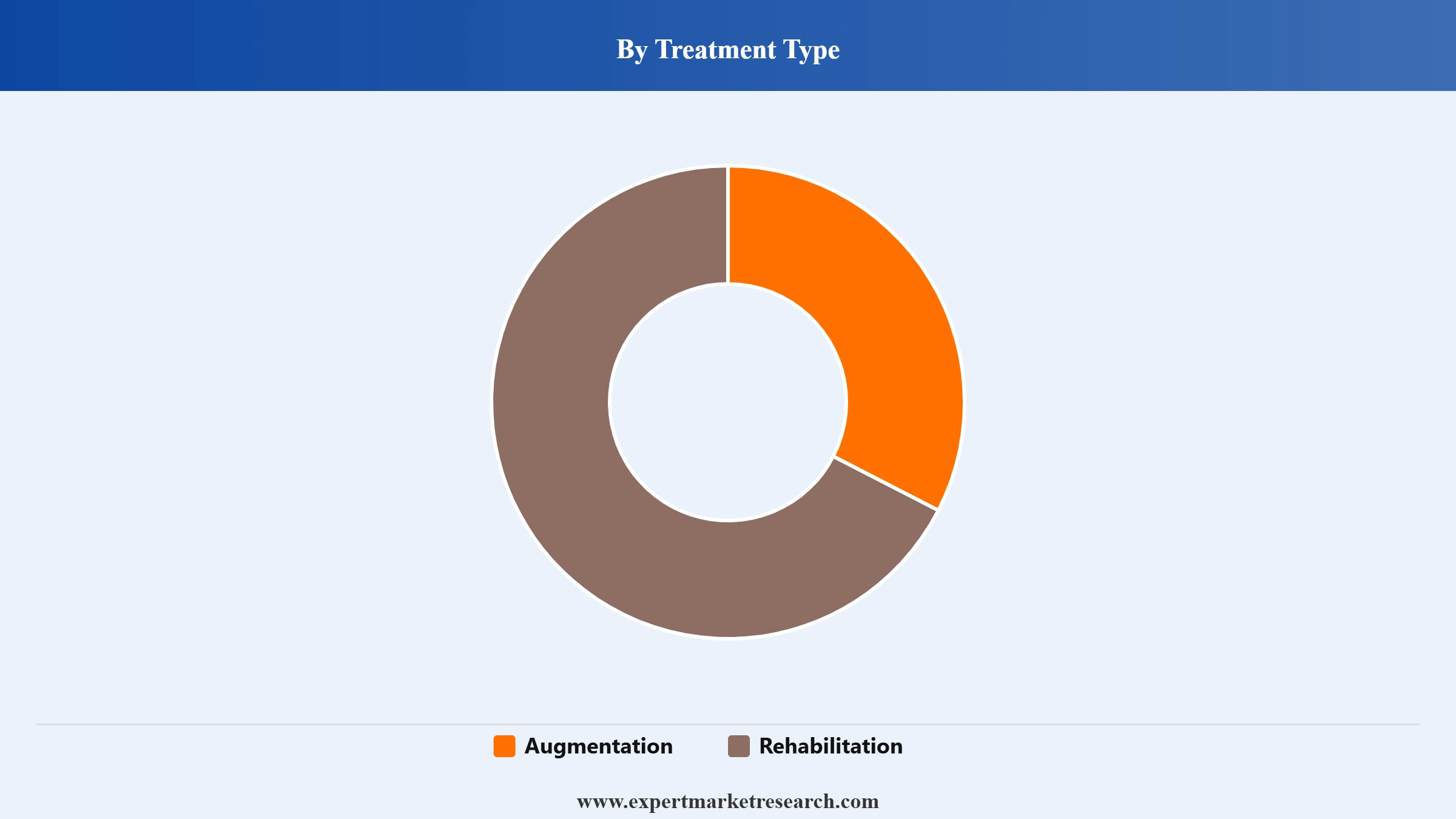
Market Breakup by Treatment Type
Key Insight: Rehabilitation is the faster-growing type in the global exoskeleton market at a forecast 21.3% CAGR through 2035, driven by reimbursement pathways that now cover personal devices across major payers and by regulatory clearances extending eligibility to spinal cord injuries at any level. Clinical evidence supporting improvements in endurance, spasticity, balance and autonomic function strengthens the case for coverage, and expansion into upper extremity stroke rehabilitation broadens the patient population considerably beyond spinal cord injury. Augmentation serves industrial, logistics, construction and military applications where the objective is reducing fatigue and injury rather than restoring lost function, and this category is being transformed by adaptive artificial intelligence systems that learn individual movement patterns and deliver dynamic lift support of up to 38 kilograms.
Market Breakup by Product Type
Key Insight: Mobile exoskeletons hold the leading position in the global exoskeleton market and are extending it, since the value of the technology is realised where the user needs to move through real environments rather than remain at a fixed station. The August 2026 clearance of a self-balancing personal device for home and everyday use illustrates the direction, as does industrial adoption in warehouses and construction sites where workers cover distance between tasks. Stationary systems retain an important clinical position in gait training and controlled rehabilitation, where fixed frames permit body weight support, precise movement control and instrumented measurement that mobile devices cannot replicate, making them complementary to rather than displaced by portable systems.
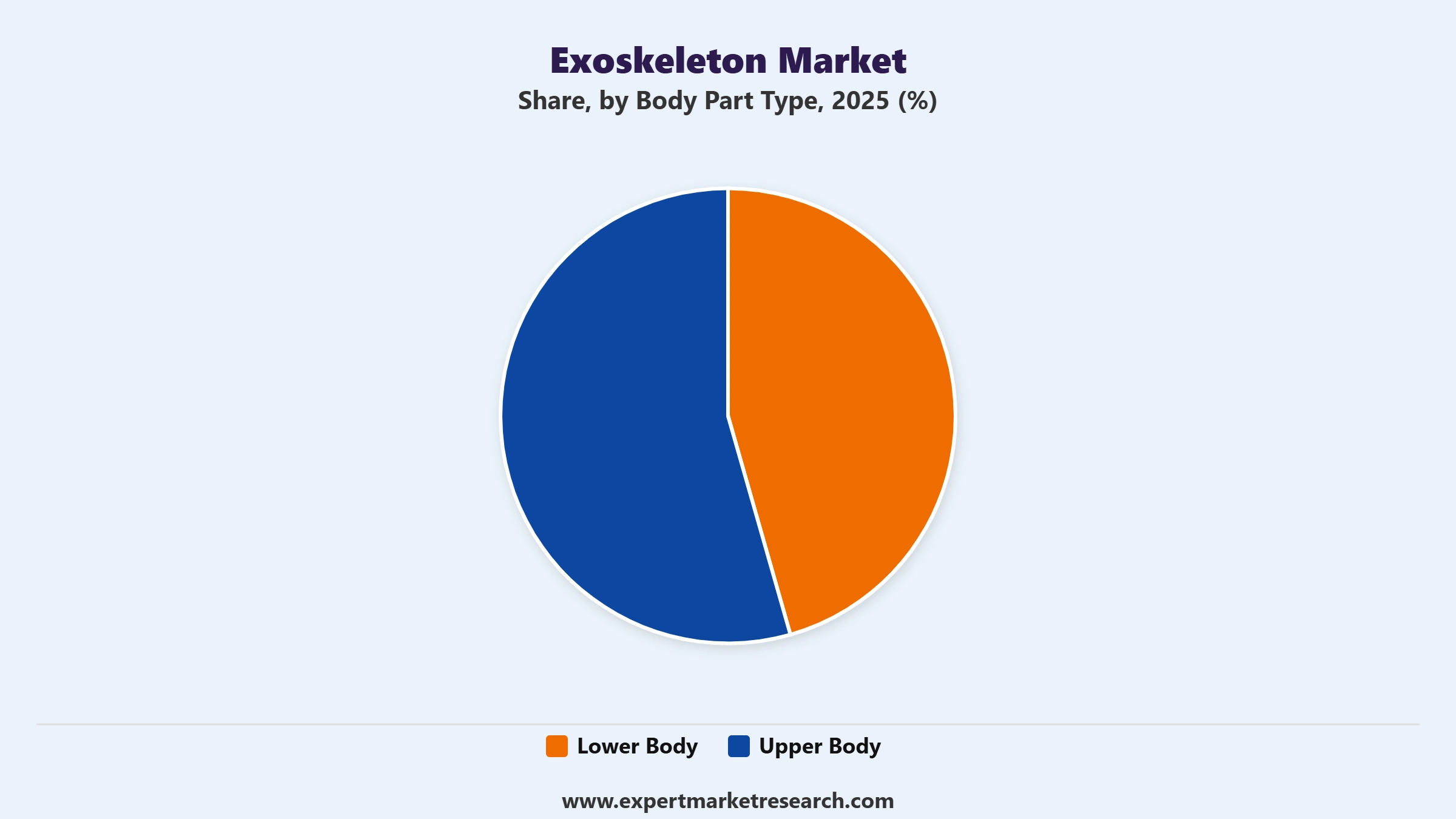
Market Breakup by Body Part Type
Key Insight: Lower body devices dominate the body part segment of the global exoskeleton market at a forecast 20.4% CAGR through 2035, reflecting the concentration of both clinical and commercial development on restoring walking following spinal cord injury and stroke, and on reducing lower back loading in industrial lifting. Self-balancing control represents the most significant recent advance in this category. Upper body devices are gaining attention as acquisition activity during 2026 directed upper extremity technology towards stroke rehabilitation, and as occupational applications address overhead work in construction, assembly and installation where shoulder and neck support reduces repetitive strain injury that accounts for a substantial share of workplace claims.
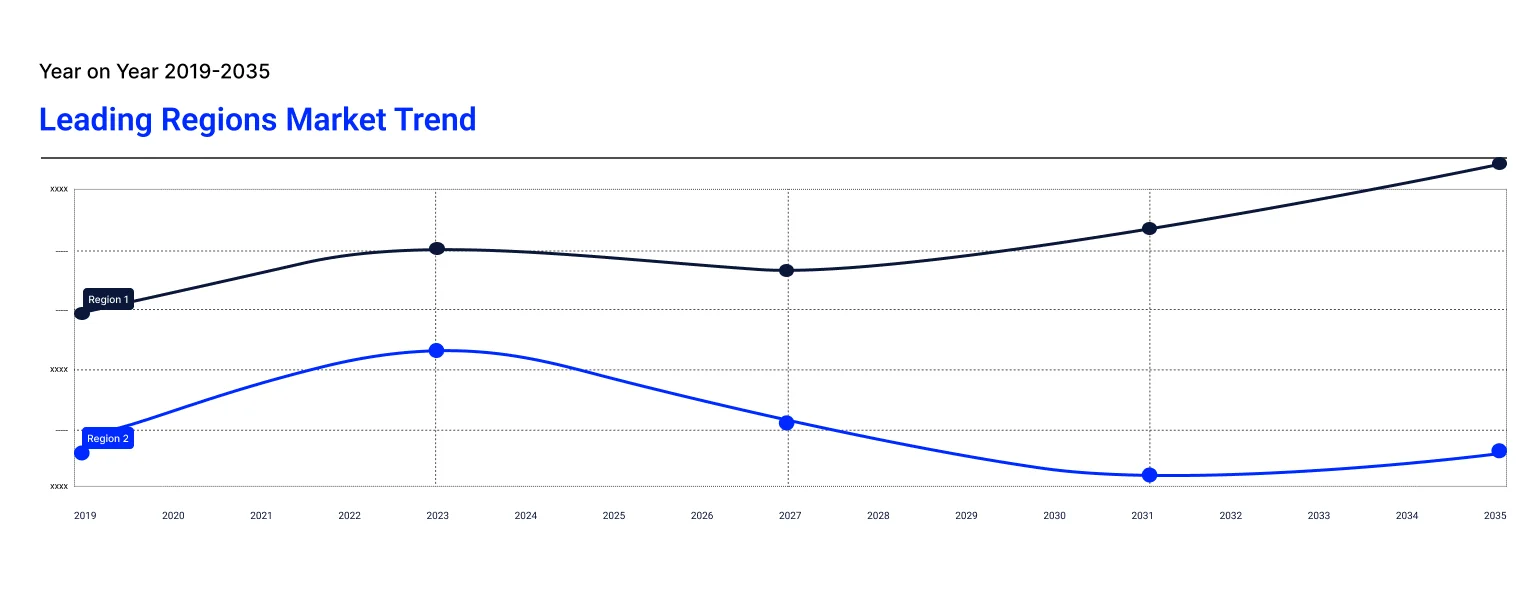
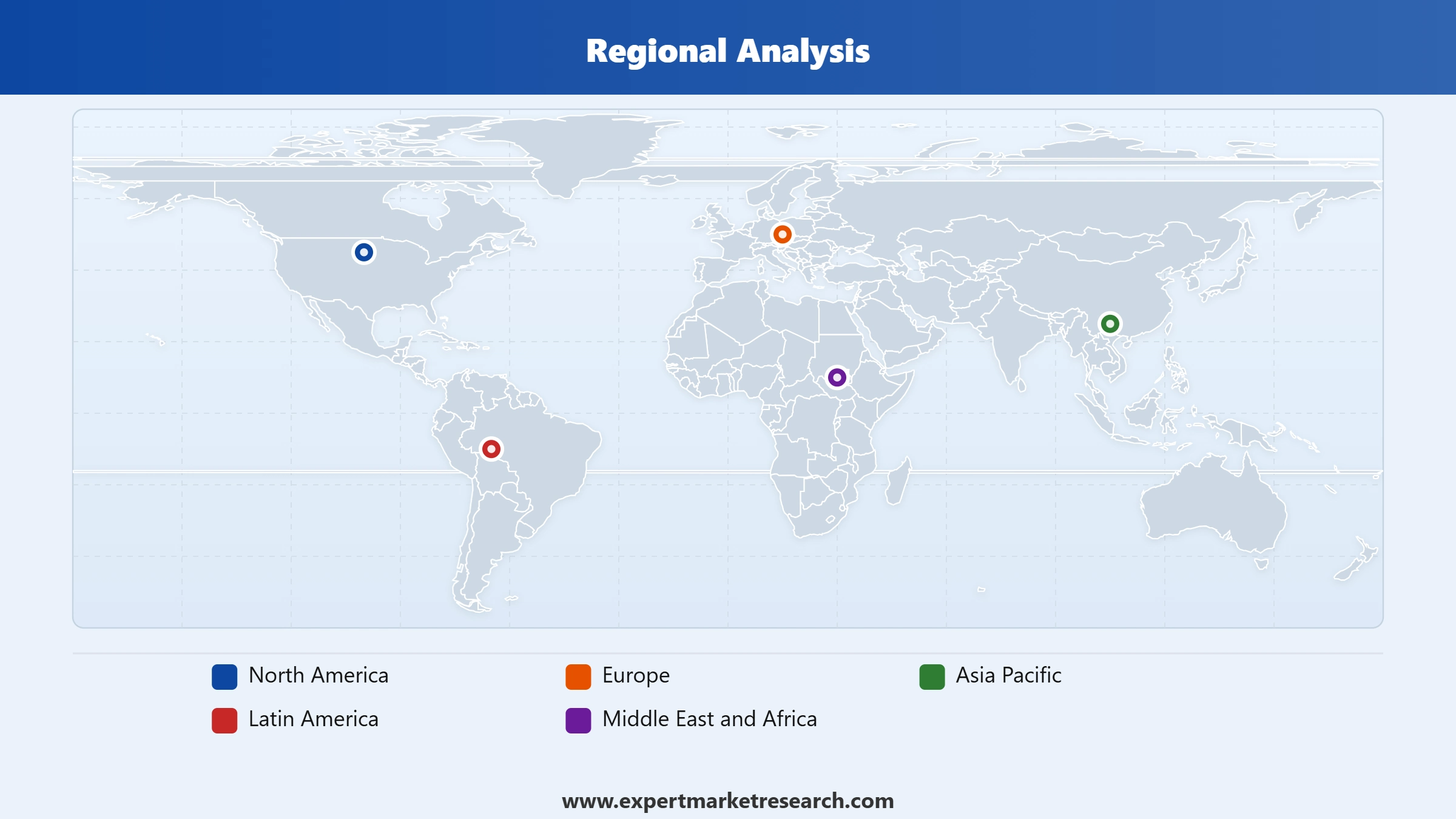
Market Breakup by Region
Read more about this report - REQUEST FREE SAMPLE COPY IN PDF
By type, rehabilitation leads growth as reimbursement removes the funding barrier
Rehabilitation applications are forecast to grow fastest in the global exoskeleton market at a 21.3% CAGR through 2035, because the constraint on this segment was never clinical efficacy but payment. With a formal reimbursement pathway established and coverage extending across Aetna, Humana and UnitedHealthcare, individuals who could not fund a device privately can now obtain authorisation, and the effect appears directly in reported results where personal exoskeleton revenue rose 11 percent year on year during the first quarter of 2026 while other lines contracted. Regulatory clearance extending eligibility to spinal cord injuries at any level widens the qualifying population further.
Augmentation applications hold a substantial position in the global exoskeleton market across industrial, logistics, construction and defence settings, where the purchasing rationale rests on injury reduction and sustained productivity rather than clinical outcome. The segment is being reshaped by adaptive systems trained on billions of motion data points that adjust assistance to the individual and the task, supported by digital twin monitoring and cloud analytics. Subscription commercial models suit this buyer, since employers can evaluate cost against measured injury and productivity outcomes rather than committing capital in advance.
Read more about this report - REQUEST FREE SAMPLE COPY IN PDF
By body part, lower body devices dominate the market on clinical and industrial demand alike
Lower body exoskeletons account for the largest share of the global exoskeleton market at a forecast 20.4% CAGR through 2035, serving two distinct demands that both concentrate on the same anatomy. Clinically, restoring walking after spinal cord injury or stroke has been the central objective of the field, and self-balancing control cleared in August 2026 represents the most significant advance in a decade because it removes the upper body function requirement that previously determined eligibility. Industrially, lower back and hip loading during lifting drives the largest category of workplace musculoskeletal injury, which directs product development towards the same region.
Upper body devices constitute a smaller but expanding portion of the global exoskeleton market with growth arriving from both directions. In rehabilitation, acquisition activity during 2026 directed upper extremity technology towards stroke recovery, where arm and hand function loss affects a patient population substantially larger than spinal cord injury. In occupational settings, overhead work in construction, installation and assembly produces shoulder and neck strain that arm support systems address directly, and these devices are typically passive, lighter and less costly than powered lower limb systems, which lowers the adoption threshold for employers.
Read more about this report - REQUEST FREE SAMPLE COPY IN PDF
North America accounts for the largest market share through regulatory pathways and insurance coverage
The global exoskeleton market is led in value by North America, where the regulatory clearances that establish market entry are granted and where the insurance mechanisms that fund personal devices have matured fastest. Coverage extending across Aetna, Humana and UnitedHealthcare, with the Medicare Advantage plans alone representing 47 percent of national enrollees, converts clinical capability into purchasable product. The United States is forecast at a 15.3% CAGR through 2035, supported additionally by industrial adoption across logistics and manufacturing where workplace injury cost provides a measurable return on deployment.
The Asia Pacific exoskeleton market is witnessing the fastest growth at a 19.8% CAGR through 2035, led by China at 19.0% and India at 18.1%, driven by the scale of manufacturing and logistics employment, ageing populations that expand rehabilitation requirements, and government programmes supporting domestic robotics capability. Europe combines established clinical rehabilitation infrastructure with occupational health regulation that encourages industrial adoption, with the United Kingdom forecast at 15.7% and holding 3.5% of the global market in 2025, Germany at 14.2% and Japan at 11.8%. Latin America and the Middle East and Africa expand from smaller bases as healthcare infrastructure and industrial safety frameworks develop.
Read more about this report - REQUEST FREE SAMPLE COPY IN PDF
The report presents a detailed analysis of the following key players in the global exoskeleton market, looking into their capacity, and latest developments like capacity expansions, plant turnarounds, and mergers and acquisitions:
The Expert Market Research report gives an in-depth insight into the industry by providing a SWOT analysis as well as an analysis of Porter’s Five Forces model.
The exoskeleton industry faces an evidence challenge that lengthens every commercial cycle. Payer coverage decisions require clinical trial data demonstrating functional benefit, and assembling that evidence takes years during which a manufacturer funds development without corresponding revenue. Manufacturers must also navigate reimbursement processes that remain inconsistent across individual payers and jurisdictions despite recent consolidation, so a device approved by one insurer may still require appeal with another covering the same indication.
Several restraints temper expansion. Device cost remains high relative to the populations that most need them, and where insurance does not reach, private purchase is rarely feasible. Battery endurance and device weight limit continuous daily use, particularly for powered lower limb systems worn across a full day rather than a therapy session. Training requirements for clinicians and workplace supervisors also slow deployment, since devices delivered without adequate instruction are frequently abandoned.
Opportunities remain substantial. Upper extremity rehabilitation addresses a stroke population considerably larger than spinal cord injury, and acquisition activity during 2026 shows established manufacturers moving into it. Service-based commercial models lower the adoption threshold on both clinical and industrial sides. Asia Pacific offers the fastest regional growth, at a 19.8% CAGR through 2035, on manufacturing employment scale and ageing demographics.


Upto 15% Off
USD
$2499 $2249
$3999 $3599
$4999 $4249
$5999 $5099


*While we strive to always give you current and accurate information, the numbers depicted on the website are indicative and may differ from the actual numbers in the main report. At Expert Market Research, we aim to bring you the latest insights and trends in the market. Using our analyses and forecasts, stakeholders can understand the market dynamics, navigate challenges, and capitalize on opportunities to make data-driven strategic decisions.*
The market is projected to grow at a CAGR of 15.70% between 2026 and 2035.
The major drivers of the market include the growing global geriatric population, rising adoption rates of medical devices in different industries, growing prevalence of disabled individuals, rising expenditure on research activities, and growing public and private support.
Important applications in medical rehabilitation and multiple other sectors and rising incidence of stroke are the key industry trends propelling the market's growth.
The major regions in the industry are North America, Latin America, the Middle East and Africa, Europe, and the Asia Pacific.
The various types of treatments in the market are augmentation and rehabilitation.
The different types of products in the market are stationary and mobile.
Based on body part type, the market is classified into lower body and upper body.
The major players in the industry are Ekso Bionics Holdings, Inc., ReWalk Robotics Ltd., BIONIK Laboratories Corp., Ottobock SE & Co. KGaA, and Lockheed Martin Corporation, among others.
In 2025, the global exoskeleton market reached an approximate value of USD 616.55 Million.
The market is anticipated to experience robust growth and reach approximately USD 2650.34 Million by 2035.
Explore our key highlights of the report and gain a concise overview of key findings, trends, and actionable insights that will empower your strategic decisions.
| REPORT FEATURES | DETAILS |
| Base Year | 2025 |
| Historical Period | 2019-2025 |
| Forecast Period | 2026-2035 |
| Scope of the Report |
Historical and Forecast Trends, Industry Drivers and Constraints, Historical and Forecast Market Analysis by Segment:
|
| Breakup by Treatment Type |
|
| Breakup by Product Type |
|
| Breakup by Body Part Type |
|
| Breakup by Region |
|
| Market Dynamics |
|
| Competitive Landscape |
|
| Companies Covered |
|
| Report Price and Purchase Option | Explore our purchase options that are best suited to your resources and industry needs. |
| Delivery Format | Delivered as an attached PDF and Excel through email, with an option of receiving an editable PPT, according to the purchase option. |
Datasheet
One User
USD 2,499
USD 2,249
tax inclusive*
Single User License
One User
USD 3,999
USD 3,599
tax inclusive*
Five User License
Five User
USD 4,999
USD 4,249
tax inclusive*
Corporate License
Unlimited Users
USD 5,999
USD 5,099
tax inclusive*
*Please note that the prices mentioned below are starting prices for each bundle type. Kindly contact our team for further details.*
Flash Bundle
Small Business Bundle
Growth Bundle
Enterprise Bundle
*Please note that the prices mentioned below are starting prices for each bundle type. Kindly contact our team for further details.*
Flash Bundle
Number of Reports: 3
20%
tax inclusive*
Small Business Bundle
Number of Reports: 5
25%
tax inclusive*
Growth Bundle
Number of Reports: 8
30%
tax inclusive*
Enterprise Bundle
Number of Reports: 10
35%
tax inclusive*
How To Order

Select License Type
Choose the right license for your needs and access rights.

Click on ‘Buy Now’
Add the report to your cart with one click and proceed to register.

Select Mode of Payment
Choose a payment option for a secure checkout. You will be redirected accordingly.
Strategic Solutions for Informed Decision-Making
Gain insights to stay ahead and seize opportunities.

Get insights & trends for a competitive edge.

Track prices with detailed trend reports.

Analyse trade data for supply chain insights.

Leverage cost reports for smart savings

Enhance supply chain with partnerships.

Connect For More Information
Our expert team of analysts will offer full support and resolve any queries regarding the report, before and after the purchase.
Our expert team of analysts will offer full support and resolve any queries regarding the report, before and after the purchase.
We employ meticulous research methods, blending advanced analytics and expert insights to deliver accurate, actionable industry intelligence, staying ahead of competitors.
Our skilled analysts offer unparalleled competitive advantage with detailed insights on current and emerging markets, ensuring your strategic edge.
We offer an in-depth yet simplified presentation of industry insights and analysis to meet your specific requirements effectively.




