

Consumer Insights
Uncover trends and behaviors shaping consumer choices today
Procurement Insights
Optimize your sourcing strategy with key market data
Industry Stats
Stay ahead with the latest trends and market analysis.
The global flexible plastic packaging market size was valued at USD 182.35 Billion in 2025. The industry is expected to grow at a CAGR of 4.20% during the forecast period of 2026-2035 to reach a value of USD 275.16 Billion by 2035. Another factor driving growth in the global flexible plastic packaging market is that companies are expanding their capabilities and product portfolios through acquisitions and strategic investments. These moves help organizations enter new markets, strengthen technical expertise, and meet a wider range of customer requirements.
The global flexible plastic packaging market expansion is significantly influenced by the escalating interest in convenience target packs and distinctly made resealable and portion control packs, which dominate in urban retail and internet-based shops. Moreover, the increasing acceptance in pharmaceutical and health care packaging due to high moisture retention and contamination protection is broadening the range of applications beyond the conventional food industry.
Furthermore, many businesses are moving towards expanding the scope of their technical skills and diversification of their product lines to satisfy the increasing demand in the flexible plastic packaging industry from the food, pharmaceutical and personal care markets. These tactical actions enable companies to gain a competitive advantage, enter new markets quicker, and provide differentiated and high-performance solutions that are customer aligned. As production capabilities and product features improve, organizations must adapt to shifting consumer tastes and environmental concerns to benefit from the growing flexible plastic packaging market opportunities. For instance, in February 2025, Flexible Packaging Partners acquired New Tech Plastics to enhance its blown film operations and expand its reach to the region. Moreover, in August 2025, Constantia Flexibles expanded its offering by purchasing Aluflexpack and upgrading production. This enabled the company to offer pouch and lidding solutions with advanced technology.
Compound Annual Growth Rate
4.2%
Value in USD Billion
2026-2035
| Global Flexible Plastic Packaging Market Report Summary | Description | Value |
| Base Year | USD Billion | 2025 |
| Historical Period | USD Billion | 2019-2025 |
| Forecast Period | USD Billion | 2026-2035 |
| Market Size 2025 | USD Billion | 182.35 |
| Market Size 2035 | USD Billion | 275.16 |
| CAGR 2019-2025 | Percentage | XX% |
| CAGR 2026-2035 | Percentage | 4.20% |
| CAGR 2026-2035 - Market by Region | Asia Pacific | 5.4% |
| CAGR 2026-2035 - Market by Country | India | 6.2% |
| CAGR 2026-2035 - Market by Country | China | 5.2% |
| CAGR 2026-2035 - Market by Type | Stand-up Pouches | 4.6% |
| CAGR 2026-2035 - Market by Application | Food and Beverage | 4.7% |
| Market Share by Country 2025 | Australia | 1.7% |
UFlex introduced innovative flexible packaging equipment, films, PET resin, and sustainable solutions at PLASTINDIA 2026. With solventless laminators and high-precision printing cylinders, as well as the innovations of solventless laminators, the showcase highlighted the company's commitment to sustainability and efficiency in food and beverage packaging. It also promoted circularity and increased production capacity.
Tipa Compostable Packaging introduced four more high-barrier laminates that can be used in flexible packaging, which promotes sustainable substitutes without affecting performance. These films have been developed to be used in single-serve snacks, powders, and nutraceuticals, with powders and single-serve snacks having a shelf life of up to 12 months and compostable solutions. The expansion is expected to meet the increasing demands of environmentally friendly packaging and will support the development of circularity and sustainability of the European and global market of Tipa.
Nobelus introduced StrataFlex Thermal Pre-Lams, designed to be used in digital flexible packaging using METPET barrier cores with PE and EVA layers to provide efficient thermal lamination. These pre-lams are more efficient in workflow, minimize downtimes, and facilitate higher-quality output by allowing reverse printing on thinner films, which converters are using to increase demand and boost the digital flexible plastic packaging market.
Ahlstrom added LamiBak Flex to its LamiBak portfolio, and it is a flexible food packaging base paper and of high performance. It is available in pouches, sachets, and flow packs and offers better barrier properties, lowers the amount of primer, and aids in recyclability. The introduction supports market expansion in flexible packaging made of paper with sustainability because it provides brands with a substitute for the plastic and metallic substrates, both of which are not environmentally friendly.
The global flexible plastic packaging market is witnessing a growing demand to find sustainable solutions that will not harm the environment but will ensure performance. The brands and manufacturers are also looking into finding recyclable and circular materials that satisfy customers as well as regulatory demands. This stimulus promotes the development of plastic that is flexible, especially for use in food and beverages and personal care, among other applications. For instance, in May 2025 Oroflexible Packaging unveiled Oroflex, a sustainable packaging system that integrates innovative flexible plastics with recycling assistance.
The packaging manufacturers and technology providers are collaborating to accelerate product innovation in the flexible plastic packaging market, thus facilitating new and high-performance flexible films and solutions. These alliances enable quicker creation of recyclable, barrier, and functional packaging to meet customer demands, enhancing competitiveness. For instance, in December 2024, Berry Global collaborated with VOID Technologies to create recyclable polyethylene films to package pet food, combining the state-of-the-art VO+™ technology with the expertise of Berry in producing it.
The increasing world consumption rate of packaged products is compelling producers to invest in the increase of production capacity. Such investments guarantee quality and timely delivery of flexible packaging of high quality and add value to the efficiency of operations. Increased capacity also facilitates large-scale implementation of new materials and products in food, pharma, and personal care segments. For instance, in May 2025, Jindal Poly Films declared a INR 700 crore investment to set up new BOPP, PET, and CPP production in its Nashik plant. Such developments enable to fuel revenue in the flexible plastic packaging market.
Recyclable flexible plastics and chemically compatible flexible plastics are being innovated by the demand for solutions to the circular economy. Recycled content is increased with new processes and resins that do not compromise product quality and new applications in food, pharma, and retail. Businesses are looking at technologies to enable end-of-life recycling in order to enhance sustainability. For instance, in July 2025, Dow introduced its INNATE TF 220 recyclable resin to allow flexible packaging with recyclable BOPE films.
The latest printing and finishing processes are becoming essential in flexible plastic packaging market to facilitate the high-quality graphics, superior branding, and high-quality positioning of the products. The investments in the latest flexographic and finishing lines enhance the efficiency of production and reachability to the needs of clients. Indicatively, Walki Westpak invested in new flexographic printing and finishing capacity in September 2025, which will allow it to produce high-quality and sustainable flexible packaging of food and consumer goods.
Read more about this report - REQUEST FREE SAMPLE COPY IN PDF
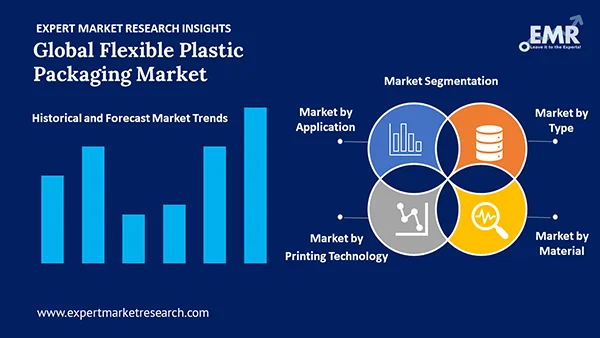
The EMR’s report titled “Global Flexible Plastic Packaging Market Report and Forecast 2026-2035” offers a detailed analysis of the market based on the following segments:
Market Breakup by Type
Key Insights: Based on types, the flexible plastic packaging market scope comprises stand-up pouches, flat pouches, and roll stocks, among others that are marketed as needed under different categories. Stand-up pouches are the most popular because of their resealability and retail appearance. For instance, Spectalpack digital printed pouches are high-end branding. Roll stocks and flat pouches allow the automation of food and pharma at low costs. Personal care and household applications are supported by other formats like spouted pouches, due to the growing adoption of e-commerce.
Market Breakup by Material
Key Insights: In terms of materials, the flexible plastic packaging market features polyethylene, polypropylene, polyamide, PVC, and polystyrene, among others, which are used based on performance and barrier requirements. Most of the moisture-resistant materials used are polyethylene and polypropylene that aid in packaging sterile items in medical practice. Polyamide guarantees high oxygen barriers. Companies such as Amcor and Berry Global invest in recyclable PE films and high-tech polymers and build sustainable portfolios and promote harsher environmental regulations.
Market Breakup by Printing Technology
Key Insights: The flexible plastic packaging industry uses various printing technologies, such as flexography, rotogravure, digital printing, and others, to fulfil different brand, quality, and production requirements. Flexography keeps the production line running for high-volume output with cost-efficient, water-based, and UV ink systems. Rotogravure makes it possible for snacks and confectionery to have top, high-fidelity graphics. Digital printing allows short runs, personalization, and quick turnaround. Other methods (offset, screen, and hybrid) are used for specialized applications. Innovations in the industry, such as Nobelus' StrataFlex Thermal Pre, Lams for digital flex pack workflows in May 2025, are continuing to raise the bar of efficiency and adoption.
Market Breakup by Application
Key Insights: The flexible plastic packaging market caters to the needs across sectors, including food and beverage, healthcare, and personal care, among others. The most demanding industries are food and beverage, in regard to convenience and shelf-life improvement. Similarly, healthcare necessitates sterile and high-barrier packaging. Personal care product manufacturers in the form of visually appealing resealable formats and industrial/household products are taken in flexible and lightweight designs. Businesses constantly develop new models and merchandise to ensure variety in needs, with respect to operational and regulatory efficiency, and further support market growth.
Market Breakup by Region
Key Insights: Regionally, the global flexible plastic packaging market landscape includes North America, Europe, Asia Pacific, Latin America, and the Middle East and Africa, which are driven by different forces. Asia Pacific is ahead in terms of fast urbanization, expanding retail and commerce, and investments in high-tech materials like Dow's recyclable INNATE TF 220 resin. North America and Europe prioritize sustainability and recycling infrastructure, developing recyclable shapes and mono materials. Latin America, the Middle East, and Africa are all expanding, with increased manufacturing expenditures and a need for cost-effective, flexible package solutions, favoring regional production networks.
Read more about this report - REQUEST FREE SAMPLE COPY IN PDF
By type, flat pouches witness significant uptake driven by improved shelf appeal and sustainability goals
Flat pouches are gaining popularity as firms seek efficient, sustainable, and visually appealing packaging options. Many product-based businesses are focusing on improving operational efficiency, shelf stability, and recyclability while also promoting large-scale production. Polipaks flat-bottom pouches are a good example, as they improve brand exposure and operational efficiency, allowing the producer to increase quality, reduce material waste, and satisfy sustainability goals.
Stand-up pouches contribute substantially to the flexible plastic packaging market revenue owing to the growing demands from brands to have durable, large-format, and recyclable packaging of home care products. In response to this, companies are coming up with innovative materials and machinery to increase the size of the pouches without compromising performance. For instance, in November 2024, Mespack and amcor introduced a 2-liter drop-resistant, recycle-ready stand-up pouch that uses AmPrima, with sustainable properties, of Amcor, and the high-speed H570 machine of Mespack to guarantee compatibility, along with cleaner and laundry seals and compliance.
By material, polyethylene is highly preferred owing to its recyclability, mechanical strength, and versatility across flexible packaging applications
The polyethylene flexible plastic packaging market is showing an upward trend as companies prioritize sustainable and high-performance materials for flex packaging. Innovation attempts to combine recyclability with mechanical strength to meet performance and regulatory criteria. For instance, in March 2025, Borealis released a post-consumer recyclate-rich (85% post-consumer) recycled linear low-density polyethylene (rLLDPE) grade by the name Borcycle™ M CWT120CL. It is formulated as stretch film, hoods, and industrial protection wrappings, and it has better stretchability, toughness, and stiffness, which enable brands to meet the sustainability targets without attacking product quality.
On the other hand, polystyrene continues to gain preference in the flexible plastic packaging market as brands and manufacturers turn to circular materials such as polystyrene as food packaging materials. In September 2025, INEOS Styrolution published sour cream cups manufactured with 30 percent recycled polystyrene, which are currently sold in stores of ALDI SÜD in Germany. The cups, created in collaboration with ALDI SÜD and Unternehmensgruppe Theo Muller, are food safety compliant and have a lower environmental impact, further supporting the transition towards scalable and circular packaging in the dairy and the food industry.
By printing technology, digital printing continues to gain traction owing to rising demand for short-run customization
Digital printing witnesses high demand in the flexible plastic packaging market due to the popularity of short-run, bespoke, and quality packaging in the food and beverage industry. Digital technologies enable faster turnaround, adaptable designs, and small batch production for seasonal campaigns and temporary releases. For instance, in October 2023, All4Labels opened its All4Flexibles division, incorporating futuristic digital presses with sustainable materials, showing how digital innovation is broadening the market opportunities and making the sector more efficient and sustainable.
Flexography is gaining significant traction in the flexible plastic packaging market, driven by the growing demand for higher-quality, more cost-effective, and environmentally friendly flexible packages in the food, beverage, and personal care industries. Short production runs, many SKUs, and faster turnaround times all have an impact on flexo requirements. Hence, brands prefer to deploy diverse flexo solutions for precision, less waste, and increased efficiency. For instance, at Labelexpo Europe 2025 in July, Comexi introduced its small-format flexo press, the F4 Origin, which has a higher level of operation and sustainability in the production of small-format flexible packaging and labels.
By application, the food and beverage sector shows robust growth driven by eco-friendly packaging adoption
The food and beverage sector has spurred a booming trend in the flexible plastic packaging market, where manufacturers switch to sustainable, high-performance, flexible packaging that satisfies regulated standards and rising customer demand for eco-friendly packaging. The emphasis on innovating and advancing confectionery, snacks, and beverages is influenced by a focus on recyclability, mechanical strength, and compatibility with heat sealing. For instance, in June 2024, Saica and Mondelez introduced a recyclable paper-based bag for multipack confectionery, biscuits, and chocolates, noting the ongoing movement towards circular, sustainable packaging options.
In the personal care category, the flexible plastic packaging market is focusing on sustainable and high-performance solutions that preserve product quality and enhance brand appeal. Business organizations are targeting lightweight and recyclable materials to satisfy consumer and regulatory sustainability requirements. For instance, in January 2026, INEOS introduced Recycl-IN rPP1025C, a 70% recycled content polypropylene hybrid grade used as cosmetics packaging, which has caps, jars, and dispenser parts with virgin-like strength, heat defiance, and aesthetics.




By Region, Asia Pacific leads the market growth driven by increased investments in advanced manufacturing infrastructure
The Asia Pacific flexible plastic packaging market is developing at a notable growth rate, attributed to the rising regional demands for high-quality and sustainable solutions. For instance, Amcor consolidated its market base by opening its biggest flexible packaging facility in Huizhou, China, with an automated production line, high-speed printing, and smart operation systems, which will increase efficiency, quality, and low-carbon production, serving the food and personal care sectors. This has strengthened Amcor’s leadership in the region.
Meanwhile, Europe holds a significant share of the global flexible plastic packaging market due to the increased demand for food, beverage, and personal care products, which seek more expedient, more personalized, and environmentally friendly packaging products. The implementation of new digital printing technologies is facilitating a reduction in production cycles, increased quality of the products, and efficiency in the workflow. Nobelus introduced StrataFlex Thermal Pre-Lams in May 2025, which contributes to these tendencies and enhances the expansion of the market in the region even more.
| CAGR 2026-2035 - Market by | Country |
| India | 6.2% |
| China | 5.2% |
| Saudi Arabia | 4.8% |
| UK | 3.8% |
| Australia | 3.7% |
| USA | XX% |
| Canada | XX% |
| Japan | 3.3% |
| Brazil | XX% |
| Mexico | XX% |
| Germany | 3.1% |
| France | 2.9% |
| Italy | 2.6% |
The flexible plastic packaging market players are aggressively investing in sustainable materials, sophisticated barrier films, and lightweight packaging structures to support the changing regulatory and consumer demands. Businesses are also enhancing regional manufacturing agreements and modernizing production technologies so that efficiency can be enhanced, as well as the provision of reliability. These activities allow more prompt customization of their products in the principal end-use markets of food, pharmaceutical, and personal care.
Simultaneously, flexible plastic packaging companies are seeking strategic alliances, takeovers, and capacity increases to expand product lines and increase geographic coverage. More emphasis on digital printing, mono-material structures that are made recyclable, and the implementation of the circular economy also facilitate innovation on the value chain. A combination of these strategies can assist companies in differentiating and speeding up the commercialization of new solutions and capturing new growth opportunities in the flexible plastic packaging market.
Amcor plc is a global leader in responsible packaging options for food and beverage, pharmaceutical, and personal care markets. The company was established in 1864, and it is based in Zurich, Switzerland, and its main work is to design innovative flexible or rigid packaging with a great focus on sustainability.
Sealed Air Corporation offers protective and food packaging solutions that are aimed at enhancing supply chain efficiency and minimizing waste. The company is based in Charlotte, North Carolina, and was established in 1960. It is well known in the flexible plastic packaging market because of its performance-based packaging technologies.
ProAmpac Intermediate, Inc. specializes in flexible packaging solutions across the food, healthcare, and consumer goods industries. Established in 2016 and headquartered in Cincinnati, Ohio, the company emphasizes material innovation and customized packaging formats to support evolving customer needs.
Sigma Plastics Group is a major manufacturer of flexible packaging and film products serving diverse industrial and consumer applications. Established in 1978 and headquartered in Atlanta, Georgia, the company operates an extensive North American manufacturing network focused on operational efficiency and product reliability.
*Please note that this is only a partial list; the complete list of key players is available in the full report. Additionally, the list of key players can be customized to better suit your needs.*
Other players in the market include Coveris Management GmbH, among others.
Explore the latest trends shaping the Global Flexible Plastic Packaging Market 2026-2035 with our in-depth report. Gain strategic insights, future forecasts, and key market developments that can help you stay competitive. Download a free sample report or contact our team for customized consultation on global flexible plastic packaging market trends 2026.


Upto 15% Off
USD
$2499 $2249
$3999 $3599
$4999 $4249
$5999 $5099


*While we strive to always give you current and accurate information, the numbers depicted on the website are indicative and may differ from the actual numbers in the main report. At Expert Market Research, we aim to bring you the latest insights and trends in the market. Using our analyses and forecasts, stakeholders can understand the market dynamics, navigate challenges, and capitalize on opportunities to make data-driven strategic decisions.*
In 2025, the global flexible plastic packaging market reached an approximate value of USD 182.35 Billion.
The market is projected to grow at a CAGR of 4.20% between 2026 and 2035.
Key strategies driving the market include expanding recyclable packaging portfolios, investing in advanced materials for better barrier performance, strengthening regional manufacturing, and pursuing partnerships and acquisitions. Companies are also focusing on lightweight formats, customized solutions for food and pharma, and digital printing to improve branding efficiency.
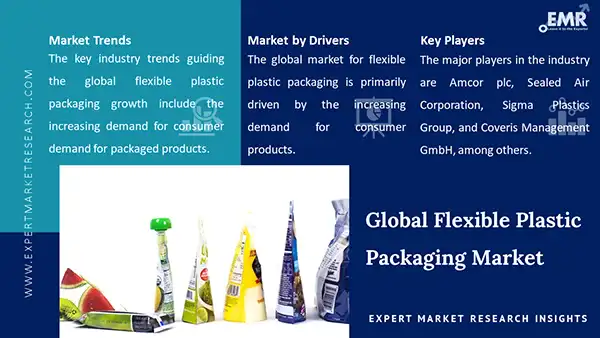
The key trends propelling the market growth include the surging demand for packaged products and the sustainability benefits offered by flexible plastic packaging.
The major regions in the market are North America, Latin America, the Middle East and Africa, Europe, and the Asia Pacific.
The major types of the product include stand-up pouches, flat pouches, and rollstocks, among others.
The different materials considered in the market report are polyethylene, polypropylene, polyamide, poly vinyl chloride, and polystyrene, among others.
Flexography, rotogravure, and digital printing, among others, are the various printing technologies included in the market report.
The significant applications of the product include food and beverage, healthcare, and personal care, among others.
The key players in the market include Amcor plc, Sealed Air Corporation, ProAmpac Intermediate, Inc., Sigma Plastics Group, and Coveris Management GmbH, among others.
The market is assessed to witness a healthy growth in the forecast period to reach around USD 275.16 Billion in 2035.
Major challenges include regulatory pressure on plastics, raw material price volatility, competition from alternative packaging, sustainability demands, recyclability limits of multilayer structures, supply chain disruptions, and high investment requirements.
Explore our key highlights of the report and gain a concise overview of key findings, trends, and actionable insights that will empower your strategic decisions.
| REPORT FEATURES | DETAILS |
| Base Year | 2025 |
| Historical Period | 2019-2025 |
| Forecast Period | 2026-2035 |
| Scope of the Report |
Historical and Forecast Trends, Industry Drivers and Constraints, Historical and Forecast Market Analysis by Segment:
|
| Breakup by Type |
|
| Breakup by Material |
|
| Breakup by Printing Technology |
|
| Breakup by Application |
|
| Breakup by Region |
|
| Market Dynamics |
|
| Competitive Landscape |
|
| Companies Covered |
|
| Report Price and Purchase Option | Explore our purchase options that are best suited to your resources and industry needs. |
| Delivery Format | Delivered as an attached PDF and Excel through email, with an option of receiving an editable PPT, according to the purchase option. |
Datasheet
One User
USD 2,499
USD 2,249
tax inclusive*
Single User License
One User
USD 3,999
USD 3,599
tax inclusive*
Five User License
Five User
USD 4,999
USD 4,249
tax inclusive*
Corporate License
Unlimited Users
USD 5,999
USD 5,099
tax inclusive*
*Please note that the prices mentioned below are starting prices for each bundle type. Kindly contact our team for further details.*
Flash Bundle
Small Business Bundle
Growth Bundle
Enterprise Bundle
*Please note that the prices mentioned below are starting prices for each bundle type. Kindly contact our team for further details.*
Flash Bundle
Number of Reports: 3
20%
tax inclusive*
Small Business Bundle
Number of Reports: 5
25%
tax inclusive*
Growth Bundle
Number of Reports: 8
30%
tax inclusive*
Enterprise Bundle
Number of Reports: 10
35%
tax inclusive*
How To Order

Select License Type
Choose the right license for your needs and access rights.

Click on ‘Buy Now’
Add the report to your cart with one click and proceed to register.

Select Mode of Payment
Choose a payment option for a secure checkout. You will be redirected accordingly.
Strategic Solutions for Informed Decision-Making
Gain insights to stay ahead and seize opportunities.

Get insights & trends for a competitive edge.

Track prices with detailed trend reports.

Analyse trade data for supply chain insights.

Leverage cost reports for smart savings

Enhance supply chain with partnerships.

Connect For More Information
Our expert team of analysts will offer full support and resolve any queries regarding the report, before and after the purchase.
Our expert team of analysts will offer full support and resolve any queries regarding the report, before and after the purchase.
We employ meticulous research methods, blending advanced analytics and expert insights to deliver accurate, actionable industry intelligence, staying ahead of competitors.
Our skilled analysts offer unparalleled competitive advantage with detailed insights on current and emerging markets, ensuring your strategic edge.
We offer an in-depth yet simplified presentation of industry insights and analysis to meet your specific requirements effectively.




