

Consumer Insights
Uncover trends and behaviors shaping consumer choices today
Procurement Insights
Optimize your sourcing strategy with key market data
Industry Stats
Stay ahead with the latest trends and market analysis.
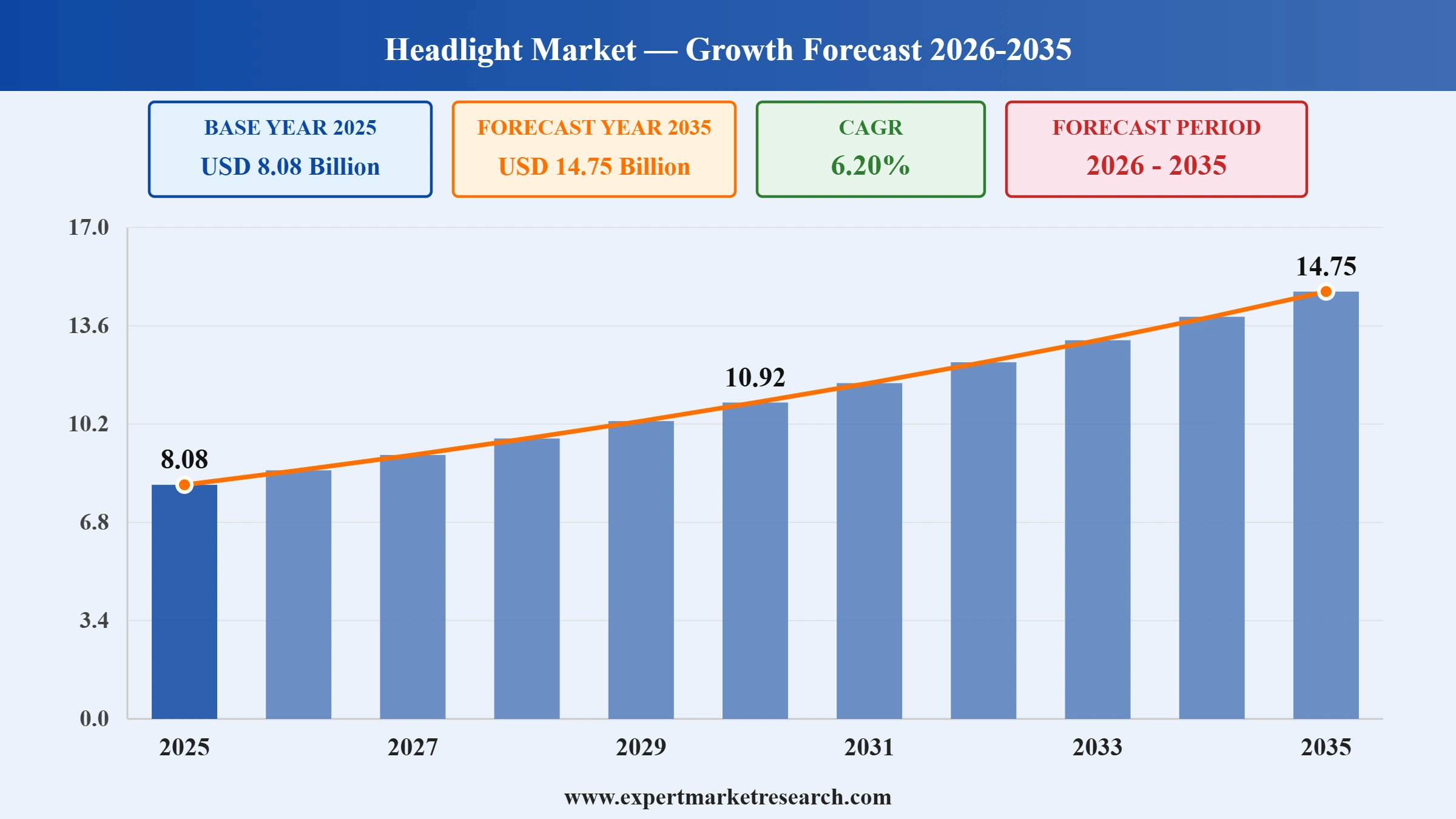
The global headlight market attained a value of USD 8.08 Billion in 2025 and is projected to expand at a CAGR of 6.20% through 2035. The market is further expected to achieve USD 14.75 Billion by 2035. Rising vehicle production volumes, tightening road safety regulations, and the continued transition from halogen to LED lighting technology are encouraging suppliers to expand adaptive and digital lighting capabilities.
Rising global vehicle production, combined with tightening road safety regulations mandating improved illumination and glare control, continues to anchor steady demand across the headlight market. Suppliers are also investing in adaptive driving beam and digital matrix lighting technology to differentiate their offering as LED adoption approaches saturation among premium vehicle segments.
The headlight market is witnessing further developments as suppliers localise digital lighting production closer to major vehicle assembly hubs to reduce lead times and shipping costs. In June 2026, FORVIA HELLA fully localised production of its SSL|HD digital, high-resolution headlamp system in China for the first time, with the system integrated into Geely's new Zeekr 8X electric vehicle. Established suppliers continue to prioritise regional manufacturing localisation as automakers demand shorter supply chains for increasingly complex digital lighting components.
In addition, headlight suppliers are increasingly forming technology-sharing partnerships between lighting specialists and sensor or electronics companies rather than developing adaptive driving beam capability entirely in-house, reflecting the growing software and sensor-fusion complexity of modern lighting systems. In April 2026, Marelli showcased its production-ready Thin Corner-to-Corner Headlamp at Auto China 2026 in Beijing, an ultra-slim MicroLED module measuring just 15 by 120 millimetres that integrates touch and voice interaction directly into the lighting system. Such cross-industry partnerships and software-defined feature integration are reshaping competitive positioning across the wider headlight market as suppliers without in-house electronics expertise seek external partners to remain competitive on advanced lighting features.
Read more about this report - REQUEST FREE SAMPLE COPY IN PDF
ZKW Lighting Systems USA opened a new stand-alone office facility in Troy, Michigan, moving from shared office space to increase capacity and improve service to North American customers. Companies can establish dedicated regional facilities to strengthen customer proximity and support responsiveness as North American order volumes justify standalone local operations.
Valeo launched a next-generation adaptive driving beam LED matrix headlamp system designed for midsize SUVs, promising improved glare-free high-beam performance and energy efficiency compared with previous-generation matrix systems. Companies can target specific vehicle segments with tailored adaptive lighting variants to match feature sets against realistic price points for that class.
VBG Group, a Swedish industrial engineering company, acquired auxiliary vehicle lighting specialist Ledson Lights for approximately 4 million US dollars, broadening its product portfolio into the auxiliary and aftermarket lighting segment. Companies can pursue smaller bolt-on acquisitions to enter adjacent lighting segments without the engineering investment required to develop comparable capability organically.
Stanley Electric and Mitsubishi Electric Mobility formed a joint venture to develop next-generation vehicle lamp systems, combining Stanley's automotive lighting manufacturing expertise with Mitsubishi Electric's broader mobility electronics capabilities. Companies can form joint ventures with complementary electronics specialists to accelerate next-generation lamp system development beyond what either partner could achieve independently.
Automotive lighting suppliers are increasingly localising digital and high-resolution headlamp production closer to major vehicle assembly regions rather than exporting from established European or Japanese manufacturing bases, reducing lead times for automakers pursuing rapid model launches. In June 2026, FORVIA HELLA fully localised production of its SSL|HD digital, high-resolution headlamp system in China for the first time, with both series development and manufacturing now based at FORVIA HELLA's Chinese sites, supporting integration into Geely's new Zeekr 8X electric vehicle across the headlight market. Such localisation reduces the upstream supply chain complexity that increasingly sophisticated digital lighting systems would otherwise require.
Automotive lighting manufacturers are increasingly partnering with electronics and sensor companies to develop adaptive driving beam technology, rather than building the underlying sensor-fusion software entirely in-house. In February 2025, Denso announced a strategic partnership with Koito Manufacturing to co-develop next-generation adaptive driving beam headlamps for global markets, combining Denso's advanced driver assistance system electronics with Koito's lighting manufacturing capabilities. Such partnerships allow lighting specialists to access electronics expertise without the multi-year investment required to build comparable capability internally.
Automotive lighting specialists increasingly use major international auto shows to unveil next-generation projection and signature lighting technology ready for near-term mass production, rather than announcing new capabilities exclusively through direct automaker channels. At Auto Shanghai 2025, Marelli unveiled its Near-Field Ground Projection module and Thin Lit Line Headlamp, both confirmed ready for mass production, showcasing advanced lighting innovations to a global automaker and media audience in a single venue. Such show-based unveilings help lighting specialists generate broader industry visibility for new technology than direct automaker briefings alone would typically achieve.
Diversified automotive component suppliers continue to apply electronics and sensor expertise developed for other vehicle systems to increasingly complex headlight applications. Osram GmbH, headquartered in Munich, Germany, continues to develop multipixel LED technology enabling fully adaptive headlight operation and high-resolution road surface projection for hazard warnings, drawing on the company's broader semiconductor and optoelectronics research base beyond automotive lighting alone. Such cross-application research investment gives diversified suppliers a technical foundation that lighting-only specialists must build separately.
Regional automotive lighting manufacturers continue to compete alongside the largest global suppliers by offering more competitive manufacturing costs and faster delivery to regional automaker customers. SL America Corporation, headquartered in West Point, Georgia, United States, continues to expand its North American manufacturing footprint to serve Hyundai-Kia Group vehicle programmes assembled domestically, reducing shipping lead times compared with lighting systems imported from Asian manufacturing bases. Such regional manufacturing proximity increasingly matters as automakers pursue shorter, more resilient supply chains.
This Expert Market Report titled "Global Headlight Market Report and Forecast 2026-2035" offers a detailed analysis of the market based on the following segments:
Market Breakup by Technology
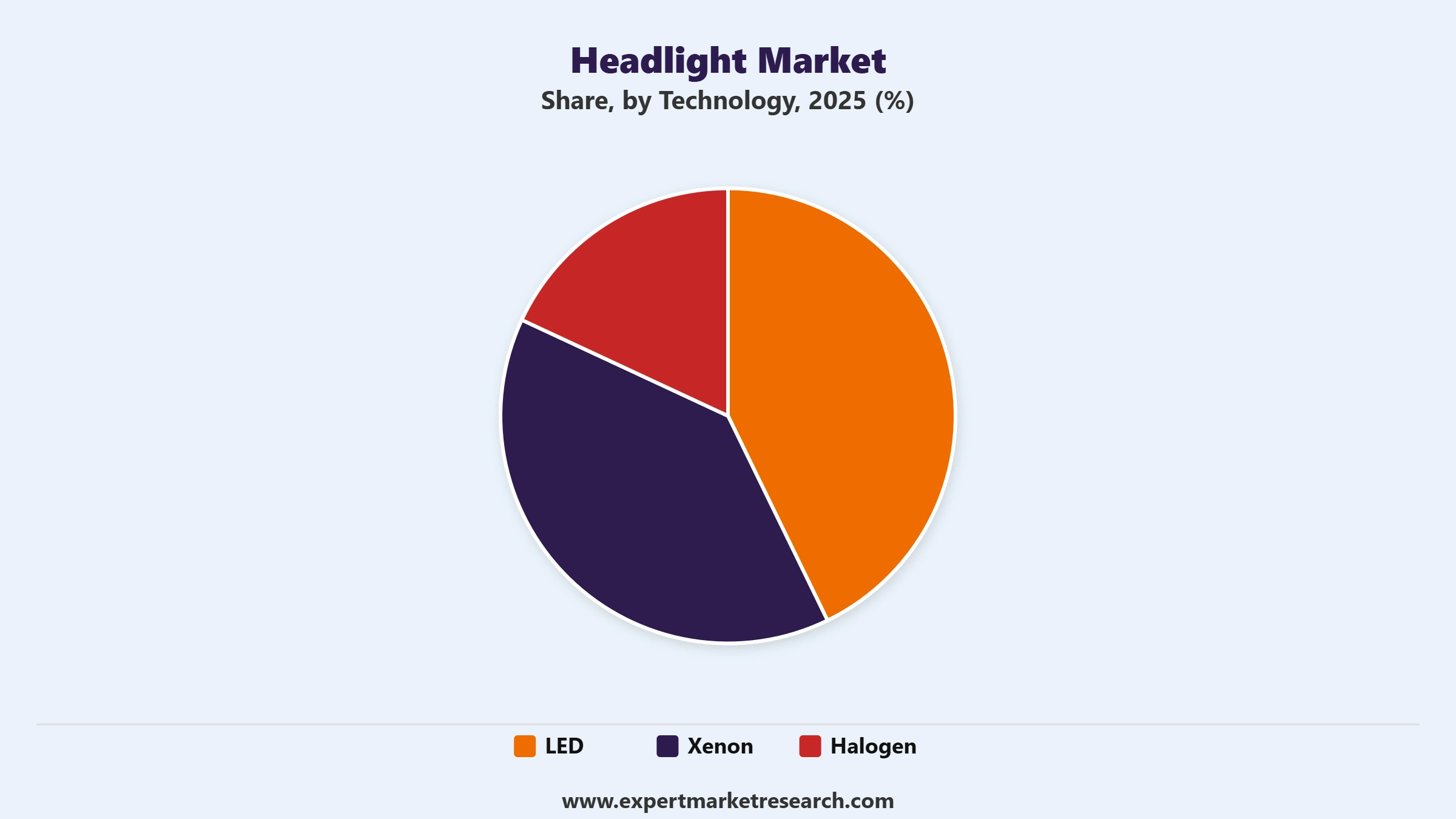
Key Insight: LED technology accounts for the largest share of the headlight market, owing to its superior energy efficiency, longer operational lifespan, and greater design flexibility compared with halogen and xenon alternatives; in May 2025, Valeo launched a next-generation adaptive driving beam LED matrix headlamp system designed specifically for midsize SUVs. Xenon technology continues to serve premium vehicle segments requiring high-intensity illumination, while halogen technology remains concentrated in cost-sensitive vehicle segments and aftermarket replacement applications where lower upfront cost outweighs efficiency considerations.
Market Breakup by Vehicle Type
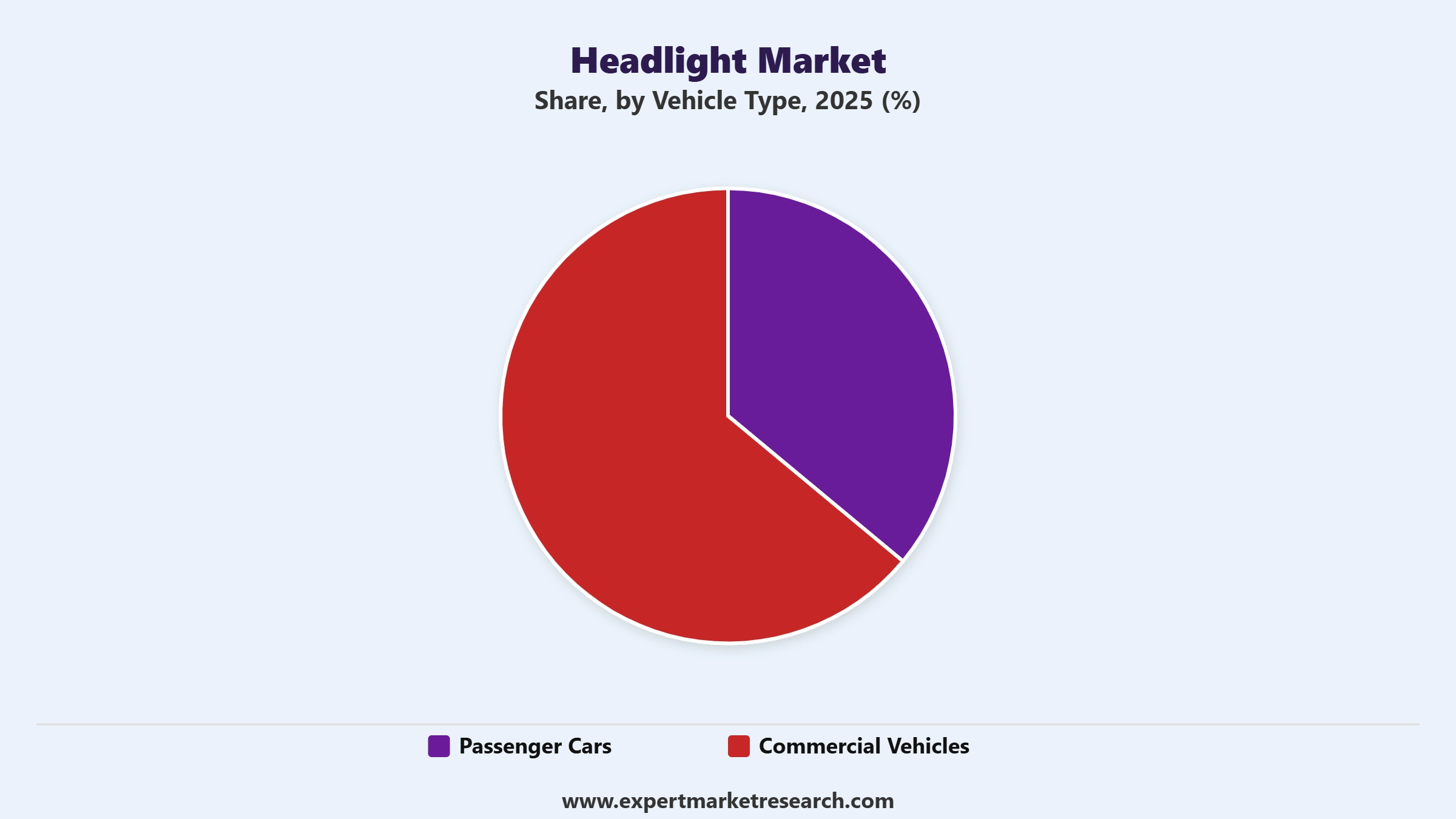
Key Insight: Passenger cars account for the largest share of the headlight market, reflecting the scale of global passenger vehicle production across mass-market and premium segments alike. Commercial vehicles continue to see steady demand as fleet operators prioritise durable, high-visibility lighting for extended operating hours and challenging road conditions typical of freight and logistics applications.
Market Breakup by Vehicle Propulsion
Key Insight: ICE vehicles continue to account for the largest share of the headlight market, reflecting the still-substantial global internal combustion engine vehicle production base despite accelerating electrification. Electric vehicles are growing at the fastest pace as automakers increasingly position advanced adaptive and digital lighting as a key differentiator for electric model lines; in 2026, Mercedes-Benz introduced a facelifted GLE in Europe offering an optional next-generation digital headlamp system combining Micro LED technology with high-performance chips, part of nearly 3,000 newly developed or enhanced components across the refreshed model.
Market Breakup by Distribution Channel
Key Insight: The OEM channel accounts for the largest share of the headlight market, reflecting the scale of original equipment fitment across new vehicle production worldwide. The aftermarket channel continues to see steady demand as vehicle owners upgrade ageing halogen systems to LED alternatives and replace damaged headlight assemblies, supported by a growing base of specialist aftermarket lighting brands entering the auxiliary and replacement lighting segment.
Market Breakup by Region
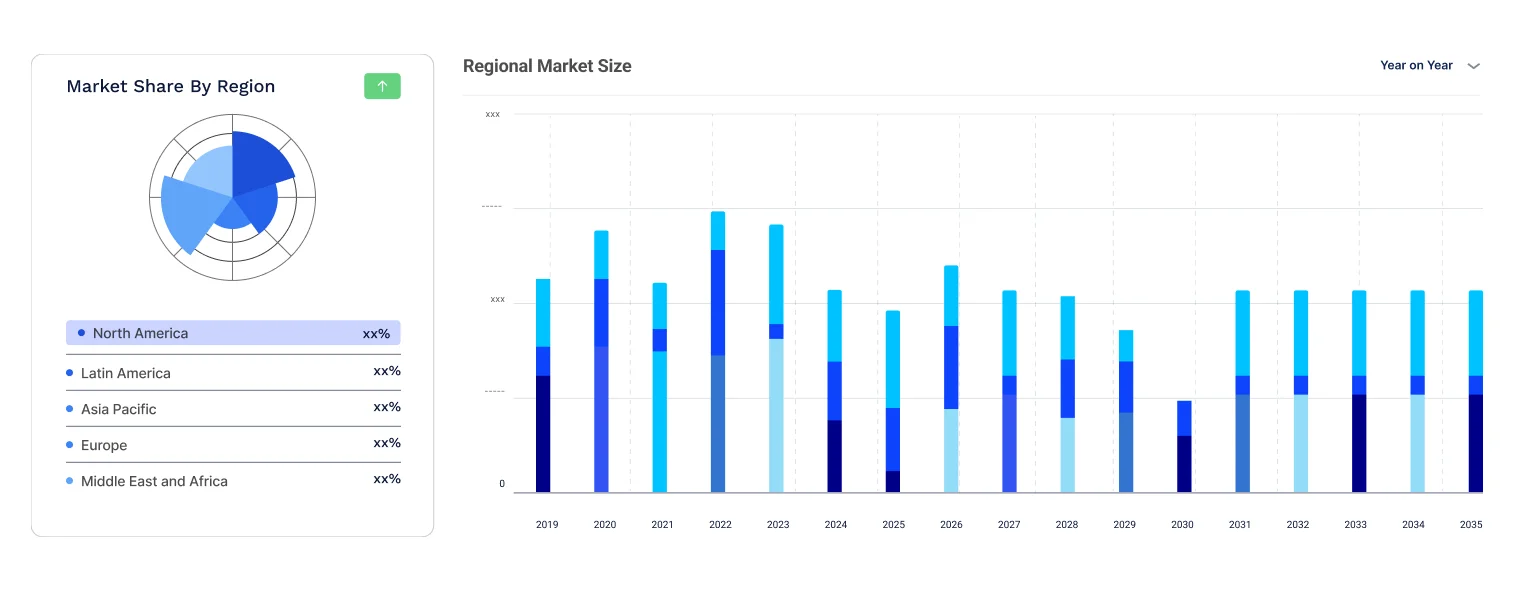
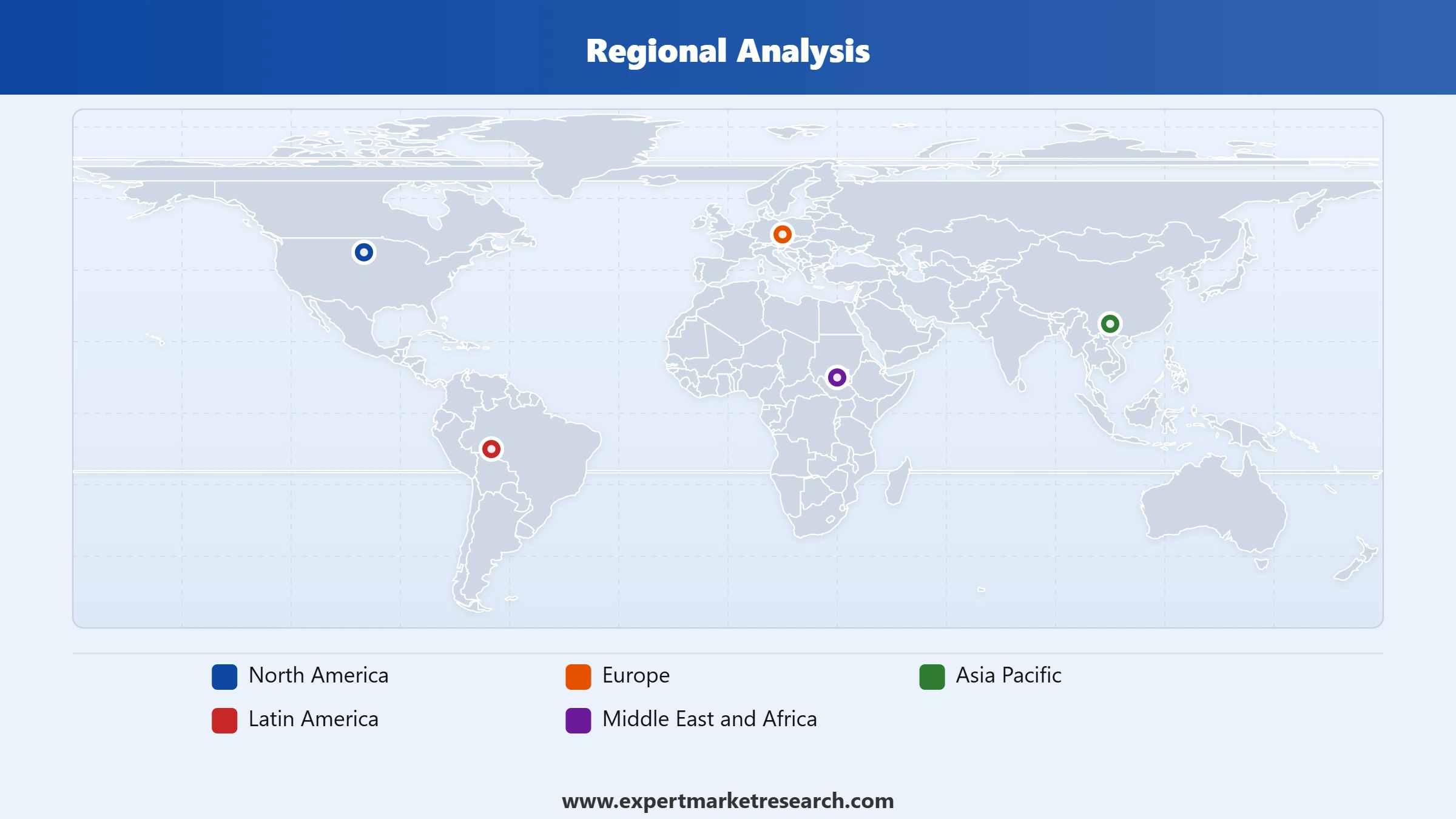
Key Insight: Asia Pacific accounts for the largest share of the headlight market, driven by China's vehicle production scale and Japan's established automotive lighting technology base anchored by long-standing domestic manufacturers. Asia Pacific is also expected to grow at the fastest pace as rising vehicle production volumes and increasing LED adoption across the region's expanding middle-class vehicle market drive sustained demand. In April 2026, Chinese automaker NIO launched pre-sales of its ES9 flagship SUV equipped with HDPL micro-LED headlamps, illustrating the pace at which Chinese domestic automakers are adopting advanced digital lighting to differentiate premium electric vehicle offerings. North America and Europe continue to see steady demand from stringent vehicle safety regulations, while Latin America and the Middle East and Africa are gradually scaling adoption alongside expanding regional vehicle production.
By technology, LED leads the market given its superior efficiency and design flexibility over halogen and xenon alternatives
LED technology continues to account for the largest share of the market, owing to its superior energy efficiency, longer operational lifespan, and greater design flexibility compared with halogen and xenon alternatives. Established LED product lines continue to anchor steady replacement demand as automakers transition successive vehicle platform generations away from halogen lighting entirely. Micro LED variants are increasingly displacing standard LED modules in premium segments, with more than ten vehicle models, including offerings from Mercedes-Benz and NIO, having adopted micro-LED headlamp technology by 2026 as pixel density and component costs continue to improve.
Read more about this report - REQUEST FREE SAMPLE COPY IN PDF
Xenon technology continues to serve premium vehicle segments requiring high-intensity illumination across the headlight market, though its share is gradually narrowing as LED matrix systems increasingly match or exceed xenon light output while offering superior adaptive beam control and lower power consumption. Xenon's remaining stronghold lies in older platform generations still mid-cycle, where automakers have not yet found it commercially justified to re-engineer headlamp housings around newer LED matrix architectures before the next scheduled model refresh.
By vehicle propulsion, ICE vehicle leads the market given the still-substantial global combustion vehicle production base
ICE vehicles continue to account for the largest share of the market, reflecting the still-substantial global internal combustion engine vehicle production base despite accelerating electrification across major automotive markets. Established ICE vehicle platforms continue to anchor steady headlight replacement and aftermarket demand as the existing global vehicle fleet remains predominantly combustion-powered, with millions of ageing halogen and early-generation LED units still requiring periodic replacement across markets where vehicle ownership periods extend well beyond a decade.
Read more about this report - REQUEST FREE SAMPLE COPY IN PDF
Electric vehicles are growing at the fastest pace across the headlight market as automakers increasingly position advanced adaptive and digital lighting as a key differentiator for electric model lines; in May 2024, Varroc Engineering added three new electric vehicle customers and secured lifetime orders worth approximately 8,700 crore Indian rupees, reflecting the scale of EV-specific lighting demand now flowing to component suppliers. Suppliers report EV programmes increasingly specify digital matrix and adaptive lighting as standard rather than optional equipment, reflecting automakers' strategy of using lighting to differentiate electric lines from combustion counterparts.
By distribution channel, OEM leads the market given the scale of original equipment fitment across new vehicle production
The OEM channel continues to account for the largest share of the market, reflecting the scale of original equipment fitment across new vehicle production worldwide and the multi-year platform contracts that anchor supplier revenue for the duration of a vehicle's production run. Suppliers that secure early-stage design-in positions on a new vehicle platform typically retain that business for the platform's entire multi-year lifecycle, giving incumbent OEM suppliers a durable advantage over newer entrants seeking to displace them mid-programme.
The aftermarket channel continues to see steady growth as vehicle owners upgrade ageing halogen systems to LED alternatives and replace damaged headlight assemblies, supported by a growing base of specialist aftermarket lighting brands entering the auxiliary and replacement lighting segment through targeted acquisitions and organic product line expansion. Insurance-driven replacement demand following collision damage continues to provide a stable secondary revenue stream for aftermarket suppliers largely uncorrelated with new vehicle production cycles.
Read more about this report - REQUEST FREE SAMPLE COPY IN PDF
Asia Pacific commands the largest share of the market through China's production scale and Japan's established lighting technology base
Asia Pacific holds the largest share of the headlight market, driven by China's vehicle production scale and Japan's established automotive lighting technology base anchored by long-standing domestic manufacturers including Koito Manufacturing and Stanley Electric. In March 2026, at the 21st ALE Auto Lighting Exhibition, Chinese LED suppliers including Sanan Optoelectronics and BOE HC Semitek showcased new micro-LED headlamp modules exceeding 40,000 individually controllable pixels. The region's concentration of vehicle assembly and upstream lighting component manufacturing gives regional suppliers a cost and lead-time advantage over imported lighting.
Asia Pacific is also expected to grow at the fastest pace as rising vehicle production volumes and increasing LED adoption across the region's expanding middle-class vehicle market drive sustained demand, with China's growing electric vehicle sector providing an additional layer of demand for advanced digital lighting systems beyond conventional LED adoption. India and ASEAN markets are also emerging as significant growth contributors as rising middle-class vehicle ownership and gradually tightening local safety regulations push first-time buyers toward LED-equipped models over older halogen-based platforms still common across the region's used vehicle market.
Read more about this report - REQUEST FREE SAMPLE COPY IN PDF
The global industry is moderately consolidated, with headlight companies ranging from diversified automotive suppliers spanning multiple vehicle systems to specialist lighting manufacturers competing across technology, vehicle propulsion, and distribution channel segments. Established players operate across the full headlight value chain, from LED and sensor component design through complete headlamp assembly and aftermarket replacement supply for global automaker and independent customers.
Competitive dynamics among headlight market players are increasingly shaped by the pace of digital and adaptive lighting technology development, the scale of cross-industry partnerships combining lighting and electronics expertise, and the race to localise production closer to major vehicle assembly hubs. Manufacturers are investing in adaptive driving beam systems, digital matrix lighting, and regional manufacturing capacity to differentiate their offering and secure long-term automaker platform contracts.
Founded in 1899 and headquartered in Lippstadt, Germany, Hella, operating under the FORVIA HELLA brand following its 2022 merger with Faurecia, supplies automotive lighting and electronics systems to nearly all major global vehicle brands. The company's combined technological leadership in digital and matrix LED lighting spans both premium and volume vehicle segments, supported by a broad global manufacturing footprint. Hella's integration into the larger Forvia group provides additional scale and cross-divisional electronics expertise beyond what a standalone lighting specialist would typically possess.
Founded in 1923 and headquartered in Paris, France, Valeo supplies automotive lighting systems alongside a broader portfolio spanning electrification, driver assistance, and thermal management technology through its Power, Brain, and Light divisions. The company positions its lighting business around integration with advanced driver assistance systems, differentiating through smart lighting that adjusts beam patterns based on real-time sensor data. Valeo's scale as one of the world's largest automotive suppliers gives it negotiating leverage with global automakers that smaller specialist lighting manufacturers typically cannot match.
Founded in 1919 and headquartered in Munich, Germany, Osram, operating as ams OSRAM following its 2020 merger, supplies automotive lighting components including LED chips, modules, and complete headlamp systems for automakers and tier-one suppliers worldwide. The company's broader semiconductor and optoelectronics research base extends beyond automotive applications into industrial and consumer lighting technology. Osram's component-level supply model positions it as a key upstream partner for lighting assembly manufacturers rather than a direct headlamp system competitor to companies like Hella or Valeo.
Founded in 1915 and headquartered in Tokyo, Japan, Koito Manufacturing designs and manufactures complete automotive lighting systems, including LED headlamps and adaptive driving beam systems, for vehicle manufacturers across Japan, the Americas, Europe, and China. The company holds the largest global market share among automotive lighting manufacturers, with strength in pedestrian detection technology achieved through its proprietary BladeScan beam-scanning system. Koito's North American subsidiary operations position it as a leading domestic lighting supplier for US-assembled vehicle programmes.
Other key players in the headlight market include ZKW Group, Marelli Holdings Co., Ltd., SL America Corporation, Varroc Group, Stanley Electric Co., Ltd., and Magna International Inc., among others.
*Please note that this is only a partial list; the complete list of key players is available in the full report. Additionally, the list of key players can be customized to better suit your needs.*
Unlock the latest insights with our headlight market trends 2026 report. Discover regional growth patterns, technology and application trends, and key industry players. Stay ahead of competition with trusted data and expert analysis. Download your free sample report today and drive informed decisions in the market.


Upto 15% Off
USD
$2499 $2249
$3999 $3599
$4999 $4249
$5999 $5099


*While we strive to always give you current and accurate information, the numbers depicted on the website are indicative and may differ from the actual numbers in the main report. At Expert Market Research, we aim to bring you the latest insights and trends in the market. Using our analyses and forecasts, stakeholders can understand the market dynamics, navigate challenges, and capitalize on opportunities to make data-driven strategic decisions.*
In 2025, the market reached an approximate value of USD 8.08 Billion.
The market is projected to grow at a CAGR of 6.20% between 2026 and 2035.
The market is estimated to witness a healthy growth in the forecast period of 2026-2035 to USD 14.75 Billion by 2035.
Localising digital lighting production closer to major vehicle assembly hubs, forming cross-industry partnerships between lighting specialists and electronics companies, and pursuing targeted acquisitions to enter adjacent auxiliary and aftermarket lighting segments.
The rising demand for energy-efficient lighting solutions, use of aesthetically appealing headlights, increasing demand for luxury vehicles, and rising customer demand for premium features in luxury cars are the key trends propelling the growth of the market.
Regions considered in the market are North America, Europe, the Asia Pacific, Latin America, and the Middle East and Africa.
As per headlight market report, high beam headlights are commonly used at night as these headlights provide strong visibility to support safe driving at night.
The brightest street bulbs available for a car include xenon and LED headlights.
White light is preferable as it enhances the visibility at night, and it prevents risk of visual distortions that may result from coloured headlights.
The key players in the market include Hella KGaA Hueck & Co., Valeo SA, Osram GmbH, Koito Manufacturing Co., Ltd, ZKW Group, Marelli Holdings Co., Ltd., SL America Corporation, Varroc Group, Stanley Electric Co., Ltd., and Magna International Inc., among others.
Suppliers face rising engineering complexity and cost associated with adaptive digital lighting systems, the technical challenge of integrating sensor-fusion electronics developed by external partners, and pricing pressure from automakers seeking to offset broader vehicle electrification costs.
Explore our key highlights of the report and gain a concise overview of key findings, trends, and actionable insights that will empower your strategic decisions.
| REPORT FEATURES | DETAILS |
| Base Year | 2025 |
| Historical Period | 2019-2025 |
| Forecast Period | 2026-2035 |
| Scope of the Report |
Historical and Forecast Trends, Industry Drivers and Constraints, Historical and Forecast Market Analysis by Segment:
|
| Breakup by Technology |
|
| Breakup by Vehicle Type |
|
| Breakup by Vehicle Propulsion |
|
| Breakup by Distribution Channel |
|
| Breakup by Region |
|
| Market Dynamics |
|
| Competitive Landscape |
|
| Companies Covered |
|
Datasheet
One User
USD 2,499
USD 2,249
tax inclusive*
Single User License
One User
USD 3,999
USD 3,599
tax inclusive*
Five User License
Five User
USD 4,999
USD 4,249
tax inclusive*
Corporate License
Unlimited Users
USD 5,999
USD 5,099
tax inclusive*
*Please note that the prices mentioned below are starting prices for each bundle type. Kindly contact our team for further details.*
Flash Bundle
Small Business Bundle
Growth Bundle
Enterprise Bundle
*Please note that the prices mentioned below are starting prices for each bundle type. Kindly contact our team for further details.*
Flash Bundle
Number of Reports: 3
20%
tax inclusive*
Small Business Bundle
Number of Reports: 5
25%
tax inclusive*
Growth Bundle
Number of Reports: 8
30%
tax inclusive*
Enterprise Bundle
Number of Reports: 10
35%
tax inclusive*
How To Order

Select License Type
Choose the right license for your needs and access rights.

Click on ‘Buy Now’
Add the report to your cart with one click and proceed to register.

Select Mode of Payment
Choose a payment option for a secure checkout. You will be redirected accordingly.
Strategic Solutions for Informed Decision-Making
Gain insights to stay ahead and seize opportunities.

Get insights & trends for a competitive edge.

Track prices with detailed trend reports.

Analyse trade data for supply chain insights.

Leverage cost reports for smart savings

Enhance supply chain with partnerships.

Connect For More Information
Our expert team of analysts will offer full support and resolve any queries regarding the report, before and after the purchase.
Our expert team of analysts will offer full support and resolve any queries regarding the report, before and after the purchase.
We employ meticulous research methods, blending advanced analytics and expert insights to deliver accurate, actionable industry intelligence, staying ahead of competitors.
Our skilled analysts offer unparalleled competitive advantage with detailed insights on current and emerging markets, ensuring your strategic edge.
We offer an in-depth yet simplified presentation of industry insights and analysis to meet your specific requirements effectively.




