

Consumer Insights
Uncover trends and behaviors shaping consumer choices today
Procurement Insights
Optimize your sourcing strategy with key market data
Industry Stats
Stay ahead with the latest trends and market analysis.
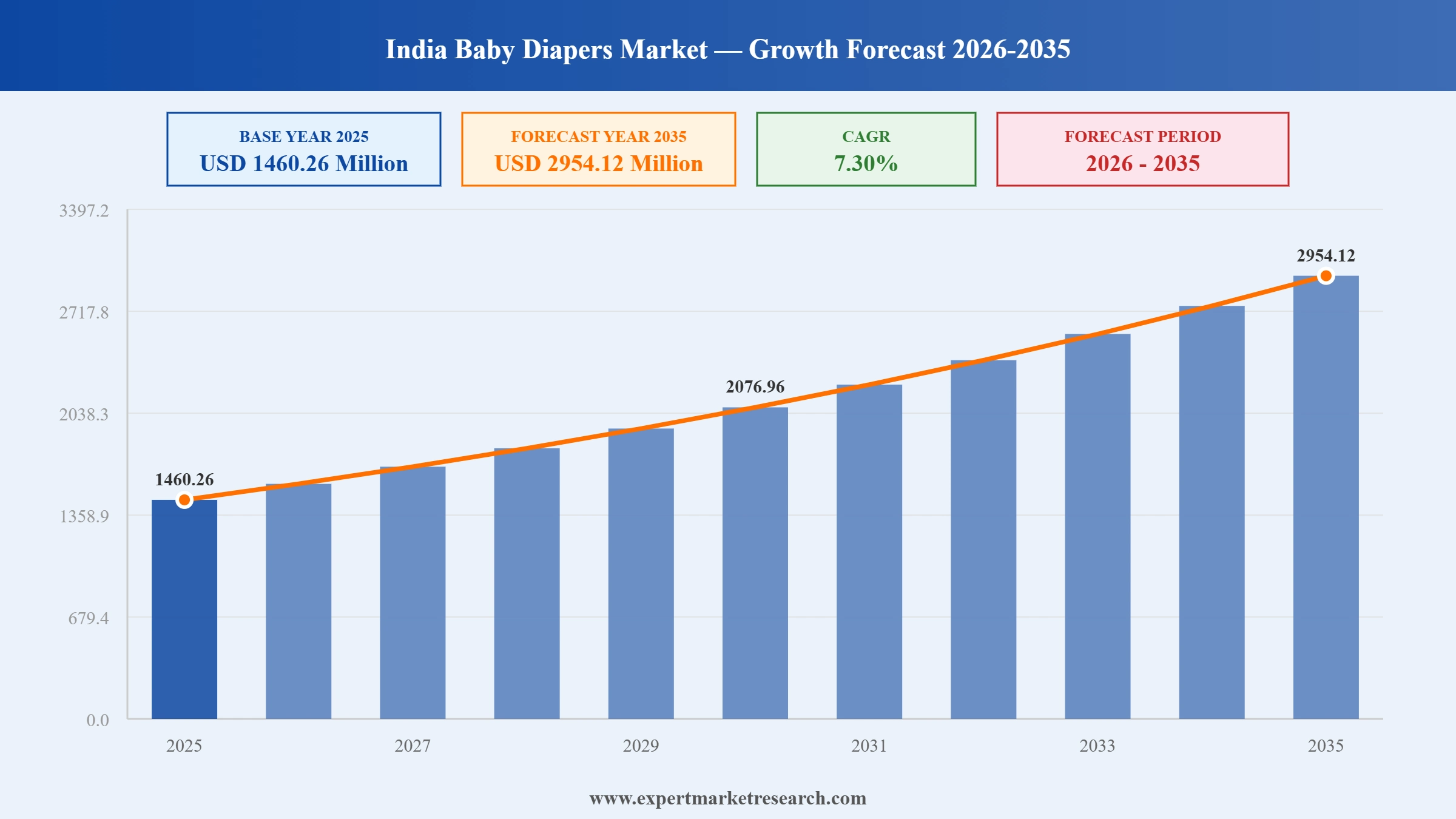
India Baby Diapers Market was valued at USD 1460.26 Million in 2025 and is set to grow at a CAGR of around 7.30% through 2026-2035. Rising female workforce participation, increasing infant hygiene awareness, and the rapid shift from cloth to disposable formats are reinforcing growth momentum. The market is on track to reach USD 2954.12 Million by 2035. Premium and pant-style adoption, expanding e-commerce access across Tier-2 and Tier-3 cities, rising demand for organic variants, and new domestic entrants are fuelling the India baby diapers market.
Read more about this report - REQUEST FREE SAMPLE COPY IN PDF
The India baby diapers market is advancing through domestic manufacturer expansion and sustainability-led innovation. Leading brands are launching biodegradable, pant-style, and premium formats while scaling Tier-2 and Tier-3 distribution, investing in capacity, e-commerce, and value-tier portfolios to capture rising hygiene demand.
Nobel Hygiene introduced Teddyy Bio-Earth in February 2026, India’s first baby diaper using biodegradable nonwovens developed with Avgol Industries and Polymateria biotransformation technology. Around 75% of components by weight degrade within two years, strengthening Nobel’s sustainability positioning in the domestic baby diaper segment.
Swara Baby Products launched a first-of-its-kind diaper technology in India in April 2025 that significantly reduces conventional wood-pulp usage. As a leading domestic contract manufacturer for major brands, the innovation supports tree conservation while improving cost efficiency across high-volume baby diaper production.
Dabur announced its entry into the Indian baby diaper market in March 2025, expanding its hygiene portfolio. The FMCG major aims to leverage its established brand strength and distribution network to compete in the fast-growing baby diaper category across urban and semi-urban India.
Unicharm announced plans in February 2025 to establish a third manufacturing facility in India, lifting diaper output by roughly 30%. The expansion supports MamyPoko’s pant-segment leadership and strengthens supply across high-growth North and South India markets amid rising hygiene demand.
Disposable diapers dominate the India baby diapers market, with pant-style formats progressively replacing tape variants in urban homes. MamyPoko, Pampers, and Huggies anchor this shift, and P&G’s November 2025 World’s Smallest Diaper for preemie care signals continued disposable innovation driving market growth.
Online stores are the fastest-growing distribution channel in the India baby diapers market. FirstCry serves over 7.5 million monthly users via predictive subscription models, while Amazon, Flipkart, and quick-commerce platforms broaden diaper access across Tier-2 and Tier-3 cities.
Organic and biodegradable diapers are an emerging growth pocket within the India baby diapers industry. Nobel Hygiene’s Teddyy Bio-Earth launch in February 2026 and Himalaya’s Ayurveda-infused range reflect rising parental demand for chemical-free, sustainable infant hygiene products across premium urban segments.
Domestic manufacturers are scaling aggressively in the India baby diapers market. Nobel Hygiene raised about USD 20 million from Neo Asset Management in May 2025 to expand brands and distribution, while Unicharm’s third India plant lifts diaper capacity by nearly 30%.
Product innovation is reshaping the India baby diapers market growth trajectory. Kimberly-Clark invested USD 15 million in its Pune technology centre to develop smart diapers with AI-enabled wetness and temperature alerts, advancing real-time monitoring and dermatologically safe infant hygiene solutions.
The report of Expert Market Research titled “India Baby Diapers Market Report and Forecast 2026-2035” offers a detailed analysis of the market based on the following segments:
Market Breakup by Age Group
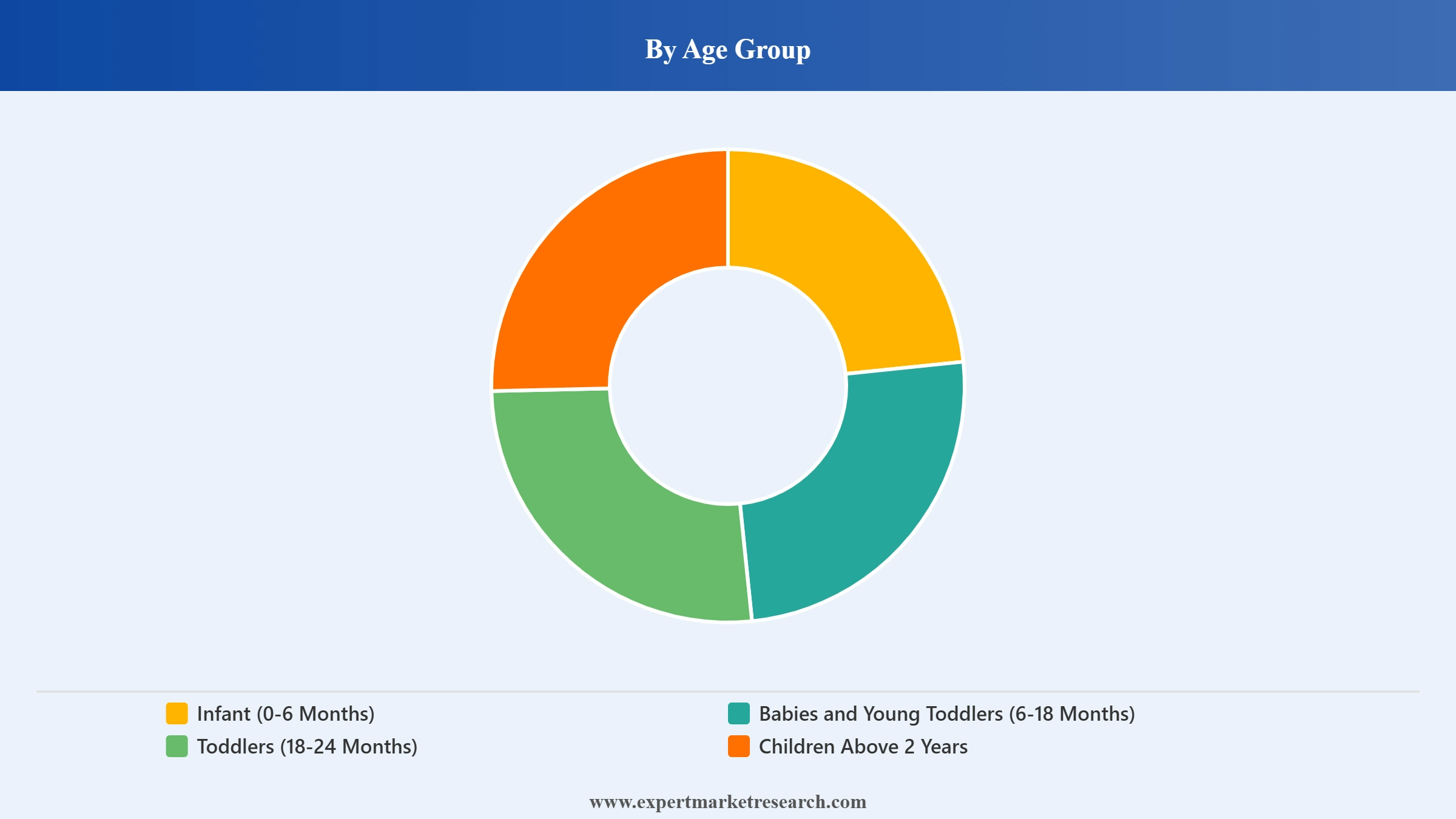
Key Insight: Babies and Young Toddlers (6-18 Months) hold the largest consumption share, as higher mobility and longer wear cycles raise diaper frequency. Infant (0-6 Months) demand stays steady via newborn tape diapers, while Children Above 2 Years sustain volume through training pants.
Market Breakup by Type
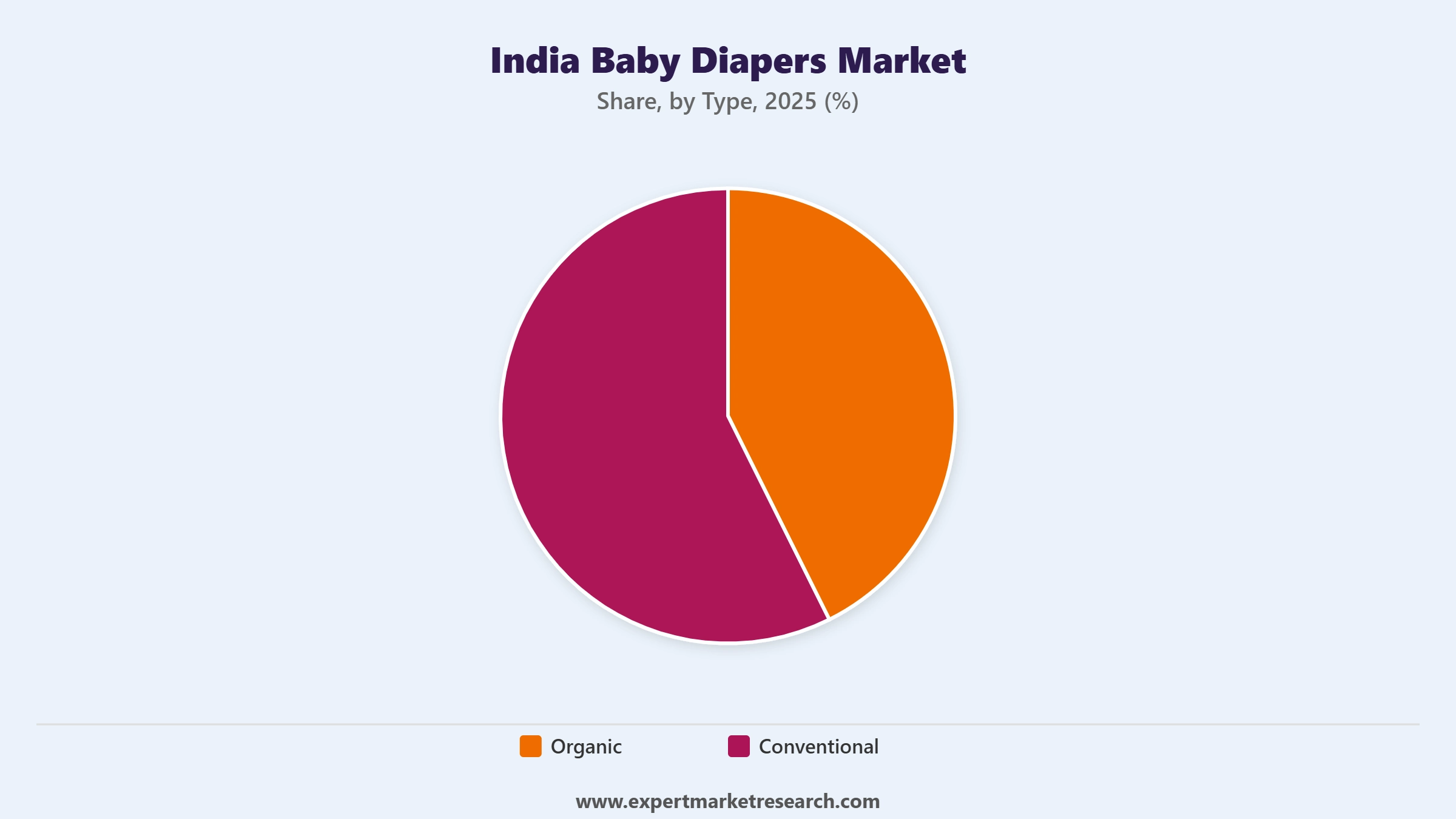
Key Insight: Conventional diapers hold the dominant share, underpinned by affordability and mass-market availability from Pampers, MamyPoko, and Huggies. Organic diapers grow faster on skin-safety and sustainability concerns, with Himalaya and Nobel’s Teddyy Bio-Earth expanding options.
Market Breakup by Product Type
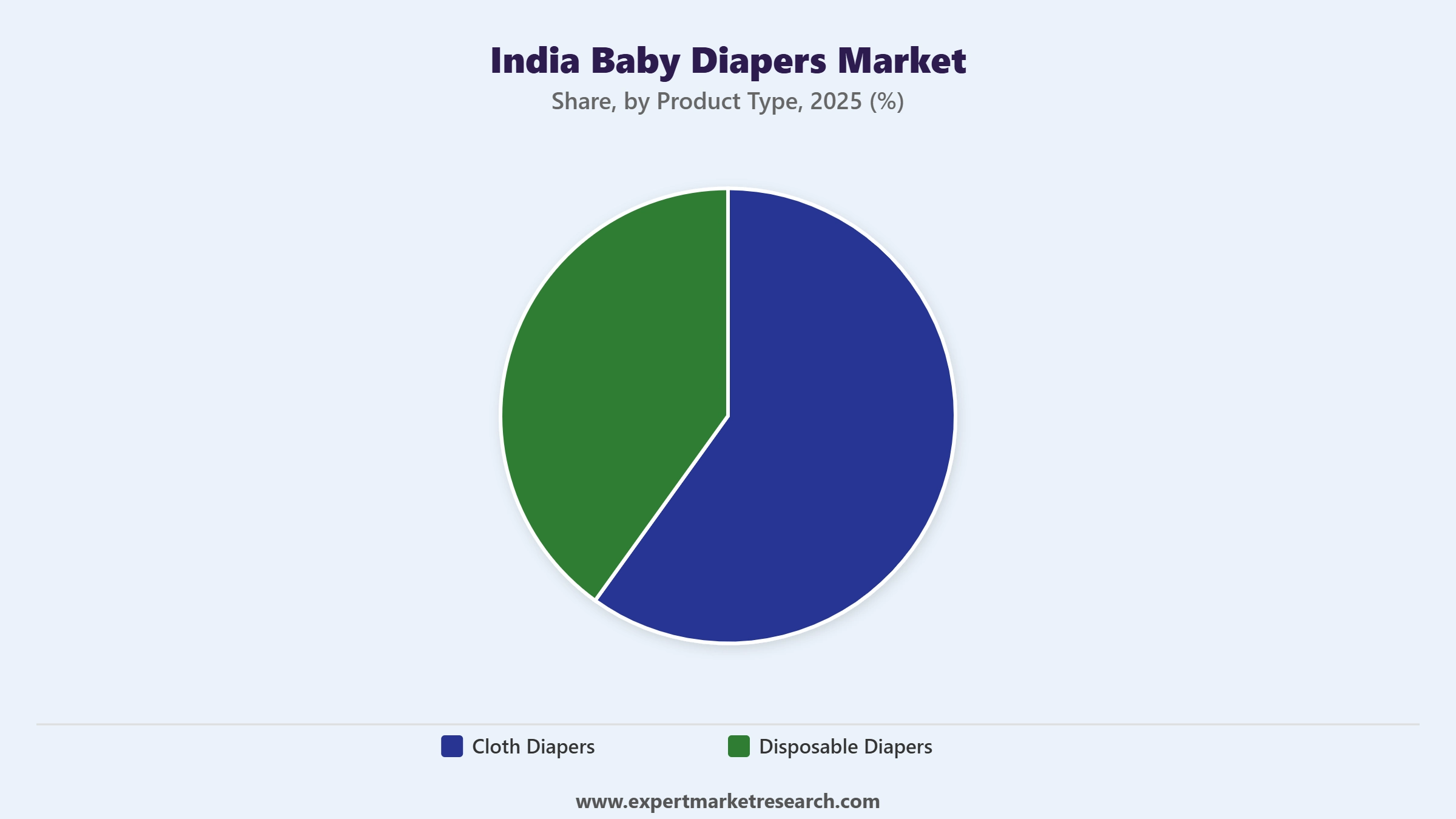
Key Insight: Disposable diapers dominate on convenience, absorbency, and wide e-commerce availability across Amazon, Flipkart, and FirstCry. Cloth diapers retain a niche among cost-conscious, eco-aware parents in semi-urban and rural India, supported by reusable brands like SuperBottoms.
Market Breakup by Distribution Channel
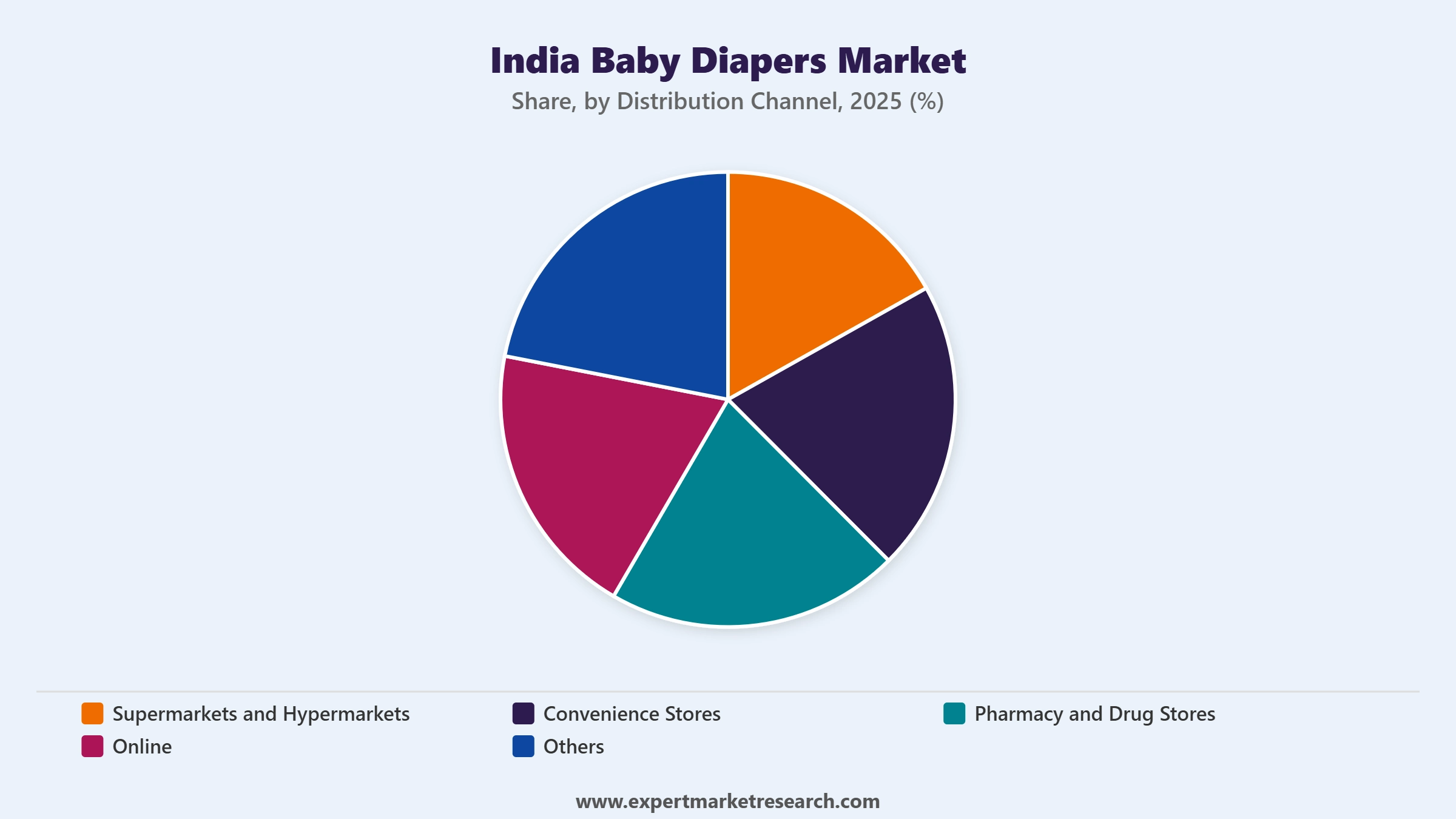
Key Insight: Supermarkets and hypermarkets lead distribution through wide assortments and promotional pricing across chains like DMart and Reliance Smart. Online is the fastest-growing channel, with quick-commerce and subscription models from FirstCry, Amazon, and Flipkart expanding access.
Market Breakup by Region
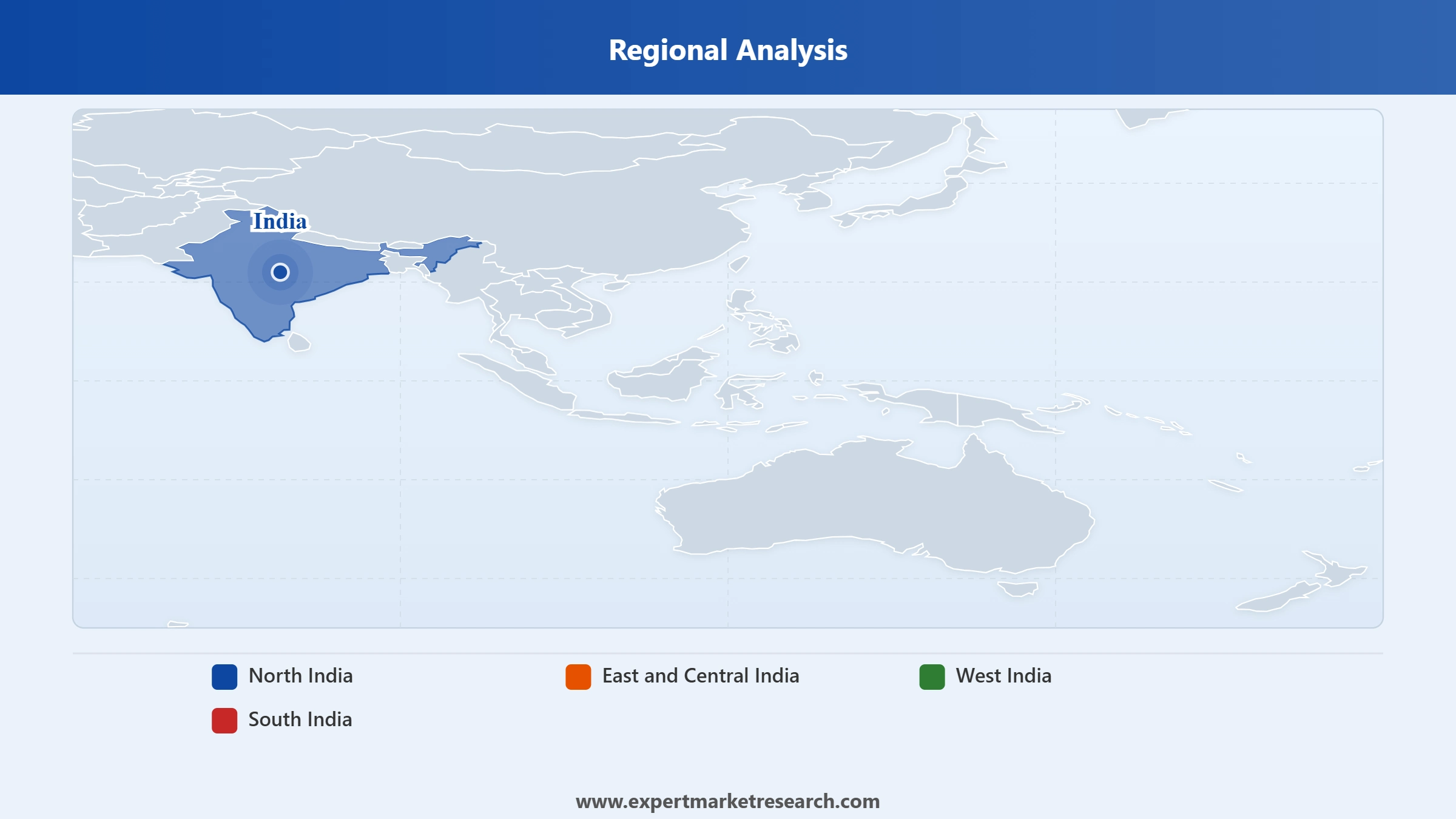
Key Insight: North India dominates on population density, NCR retail infrastructure, and premium penetration. South India follows on higher literacy, hygiene awareness, and pharmacy networks, while West India records the fastest growth on urban demand and Tier-2 expansion.
Read more about this report - REQUEST FREE SAMPLE COPY IN PDF
By Age Group, Babies and Young Toddlers (6-18 Months) dominate the market due to higher diaper frequency and longer daily wear cycles
Babies and Young Toddlers aged 6-18 months form the highest-consumption cohort of the India baby diapers market. Increased crawling and walking activity raises change frequency, while parents prioritise leak protection and absorbency, favouring pant-style diapers from MamyPoko and Pampers.
Read more about this report - REQUEST FREE SAMPLE COPY IN PDF
The Children Above 2 Years cohort expands as potty-training pants gain acceptance, while Infant (0-6 Months) demand stays resilient through newborn tape diapers. Rising first-time urban parents and premiumisation lift per-child diaper spend across the India baby diapers market.
By Type, Conventional diapers account for the dominant share of the market due to affordability and mass-market distribution scale
Conventional diapers command the leading share of the India baby diapers market, built on competitive pricing and deep retail penetration. Pampers, MamyPoko, and Huggies lead this tier with superabsorbent-polymer formats trusted by price-sensitive households nationwide.
Read more about this report - REQUEST FREE SAMPLE COPY IN PDF
Organic diapers grow fastest as parents prioritise skin safety and sustainability. Nobel Hygiene’s Teddyy Bio-Earth launch in February 2026 and Himalaya’s Ayurvedic range reflect rising demand for chemical-free, biodegradable infant care in the premium India baby diapers segment.
By Product Type, Disposable Diapers account for the dominant share of the market due to convenience and superior absorbency
Disposable diapers overwhelmingly dominate the India baby diapers market on convenience, reliable absorbency, and ubiquitous retail and e-commerce availability. Dual-income, time-pressed urban families increasingly favour disposables over cloth, accelerating penetration in metropolitan and Tier-1 cities.
Read more about this report - REQUEST FREE SAMPLE COPY IN PDF
Cloth diapers retain a defensible niche among budget-conscious, eco-aware parents in semi-urban and rural India. Reusable brands such as SuperBottoms are scaling through D2C and e-commerce in 2025, appealing to sustainability-focused households.
By Distribution Channel, Supermarkets and Hypermarkets account for the dominant share of the market due to wide assortments and promotional pricing
Supermarkets and hypermarkets lead India baby diapers distribution through broad assortments, impulse shelf placement, and frequent promotions. Expanding organised retail formats like DMart and Reliance Smart across Tier-1 and Tier-2 cities reinforce this channel’s primacy.
Read more about this report - REQUEST FREE SAMPLE COPY IN PDF
Online is the fastest-growing channel as quick-commerce and subscription models reshape buying. FirstCry’s subscription platform serves over 7.5 million monthly users, while Amazon and Flipkart broaden bulk-pack access. Pharmacies and convenience stores remain key for trusted top-up purchases.
North India dominates the market due to high population density, NCR retail infrastructure, and strong premium product penetration
North India leads the India baby diapers market, anchored by the densely populated National Capital Region and well-developed modern retail networks across Delhi, Punjab, Haryana, and Uttar Pradesh. High urbanisation, rising disposable incomes, and broad availability of premium pant-style diapers from Pampers, MamyPoko, and Huggies sustain above-average per-child diaper consumption.
West India is the fastest-growing region, propelled by strong urban demand across Mumbai, Pune, and Ahmedabad and rapid Tier-2 retail penetration. Unicharm’s February 2025 plan for a third India factory widens diaper access, while South India advances on high literacy and dense pharmacy networks in Bengaluru, Chennai, and Hyderabad.
Read more about this report - REQUEST FREE SAMPLE COPY IN PDF
The India baby diapers market is moderately concentrated, led by multinational majors in premium urban positions alongside fast-scaling domestic manufacturers competing on price and reach. Unicharm (MamyPoko), Procter & Gamble (Pampers), and Kimberly-Clark (Huggies) command the dominant revenue share, with no single player exceeding roughly a quarter of market value.
Domestic firms including Nobel Hygiene, Millennium BabyCares, and Swara Baby Products challenge multinationals in value-tier and contract-manufacturing segments. Product innovation, sustainability, pant-style leadership, and Tier-2 and Tier-3 expansion are the key priorities, while e-commerce lets smaller brands reach national audiences.
Founded in 1837 and headquartered in Cincinnati, Ohio, Procter & Gamble markets the Pampers brand in India across newborn tape, Active Baby, and Premium Care pant ranges. The company focuses on premium urban leadership through continuous product innovation, influencer-led digital marketing, and expanding e-commerce and D2C diaper distribution.
Founded in 1961 and headquartered in Tokyo, Japan, Unicharm leads India’s diaper segment through its MamyPoko brand, credited with mainstreaming pant-style diapers. Its Crisscross Absorbent Sheet technology delivers up to 12-hour absorption, and the company is adding a third India factory to lift capacity by around 30%.
Founded in 1872 and headquartered in Irving, Texas, Kimberly-Clark markets Huggies in India, known for DryTouch absorbency and breathable, ultra-slim designs. The company invested USD 15 million in its Pune technology centre to develop AI-enabled smart diapers with wetness and temperature alerts for real-time infant monitoring.
Founded in 2000 and headquartered in Maharashtra, India, Nobel Hygiene is the country’s largest home-grown hygiene manufacturer, operating its Teddyy baby diaper brand. In February 2026 it launched Teddyy Bio-Earth, India’s first biodegradable nonwovens diaper, reinforcing its value-pricing and sustainability-led growth strategy across Tier-2 and Tier-3 markets.
Other key players in the market include Essity AB, Johnson & Johnson, Uniclan Healthcare Pvt. Ltd., Awibi, Millennium BabyCares Pvt. Ltd., and Swara Baby Products Pvt. Ltd., and others.
*Please note that this is only a partial list; the complete list of key players is available in the full report. Additionally, the list of key players can be customized to better suit your needs.*
Our full report for 2026-2035 delivers the demand analysis, segmentation detail, distribution channel intelligence, and competitive benchmarking needed to navigate the India baby diapers market with confidence. Reach out to our team to access the complete report or request a customised version.


Upto 15% Off
USD
$2499 $2249
$3999 $3599
$4999 $4249
$5999 $5099


*While we strive to always give you current and accurate information, the numbers depicted on the website are indicative and may differ from the actual numbers in the main report. At Expert Market Research, we aim to bring you the latest insights and trends in the market. Using our analyses and forecasts, stakeholders can understand the market dynamics, navigate challenges, and capitalize on opportunities to make data-driven strategic decisions.*
The baby diapers market in India reached approximately USD 1460.26 Million in 2025.
The market is projected to grow at a CAGR of 7.30% between 2026 and 2035.
The market is estimated to witness healthy growth in the forecast period of 2026-2035 to reach a value of USD 2954.12 Million by 2035.
The major classifications based on distribution channel are supermarkets and hypermarkets, convenience stores, pharmacy and drug stores, and online, among others.
The age groups considered are infant (0-6 months), babies and young toddlers (6-18 months), toddlers (18-24 months), and children above 2 years.
The different types of diapers available in India are cloth diapers and disposable diapers.
The major countries as per the market report are North India, East and Central India, West India, and South India.
The major players in the market are Procter & Gamble Co, Essity AB, Unicharm Corp., Johnson & Johnson, Kimberly-Clark Corporation, Nobel Hygiene Pvt. Ltd, Uniclan Healthcare Pvt. Ltd, Awibi, Millennium BabyCares Pvt. Ltd., and Swara Baby Products Pvt. Ltd, among others.
Explore our key highlights of the report and gain a concise overview of key findings, trends, and actionable insights that will empower your strategic decisions.
| REPORT FEATURES | DETAILS |
| Base Year | 2025 |
| Historical Period | 2019-2025 |
| Forecast Period | 2026-2035 |
| Scope of the Report |
Historical and Forecast Trends, Industry Drivers and Constraints, Historical and Forecast Market Analysis by Segment:
|
| Breakup by Age Group |
|
| Breakup by Type |
|
| Breakup by Product Type |
|
| Breakup by Distribution Channel |
|
| Breakup by Region |
|
| Market Dynamics |
|
| Competitive Landscape |
|
| Companies Covered |
|
Datasheet
One User
USD 2,499
USD 2,249
tax inclusive*
Single User License
One User
USD 3,999
USD 3,599
tax inclusive*
Five User License
Five User
USD 4,999
USD 4,249
tax inclusive*
Corporate License
Unlimited Users
USD 5,999
USD 5,099
tax inclusive*
*Please note that the prices mentioned below are starting prices for each bundle type. Kindly contact our team for further details.*
Flash Bundle
Small Business Bundle
Growth Bundle
Enterprise Bundle
*Please note that the prices mentioned below are starting prices for each bundle type. Kindly contact our team for further details.*
Flash Bundle
Number of Reports: 3
20%
tax inclusive*
Small Business Bundle
Number of Reports: 5
25%
tax inclusive*
Growth Bundle
Number of Reports: 8
30%
tax inclusive*
Enterprise Bundle
Number of Reports: 10
35%
tax inclusive*
How To Order

Select License Type
Choose the right license for your needs and access rights.

Click on ‘Buy Now’
Add the report to your cart with one click and proceed to register.

Select Mode of Payment
Choose a payment option for a secure checkout. You will be redirected accordingly.
Strategic Solutions for Informed Decision-Making
Gain insights to stay ahead and seize opportunities.

Get insights & trends for a competitive edge.

Track prices with detailed trend reports.

Analyse trade data for supply chain insights.

Leverage cost reports for smart savings

Enhance supply chain with partnerships.

Connect For More Information
Our expert team of analysts will offer full support and resolve any queries regarding the report, before and after the purchase.
Our expert team of analysts will offer full support and resolve any queries regarding the report, before and after the purchase.
We employ meticulous research methods, blending advanced analytics and expert insights to deliver accurate, actionable industry intelligence, staying ahead of competitors.
Our skilled analysts offer unparalleled competitive advantage with detailed insights on current and emerging markets, ensuring your strategic edge.
We offer an in-depth yet simplified presentation of industry insights and analysis to meet your specific requirements effectively.




