

Consumer Insights
Uncover trends and behaviors shaping consumer choices today
Procurement Insights
Optimize your sourcing strategy with key market data
Industry Stats
Stay ahead with the latest trends and market analysis.
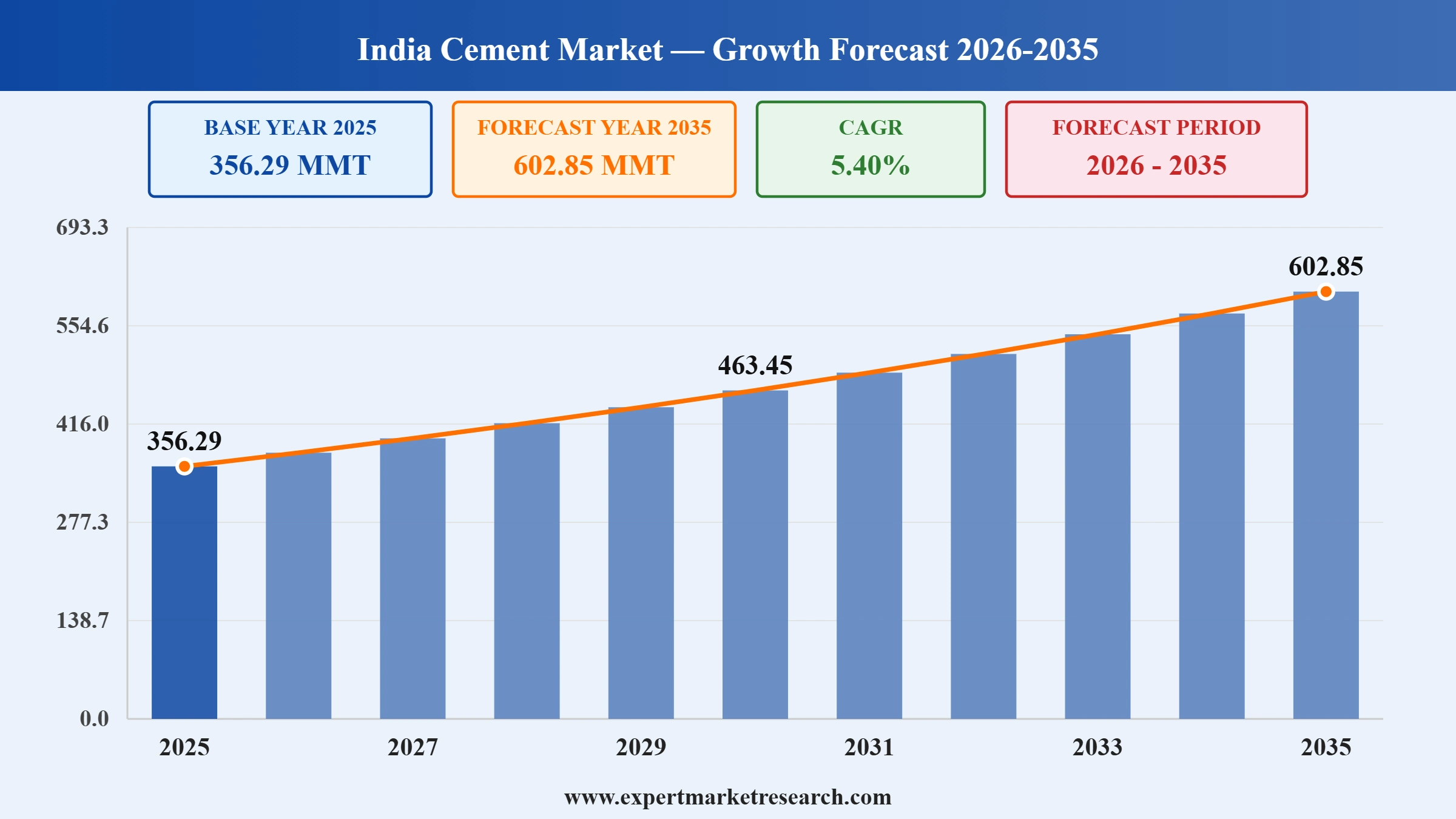
The India cement market attained a volume of 356.29 MMT in 2025 and is projected to expand at a CAGR of 5.40% through 2035. The market is further expected to achieve 602.85 MMT by 2035, supported by sustained infrastructure and housing construction, expanding blended-cement adoption, and continued capacity additions across major producers. Growth spans blended and portland cement types across residential, commercial, and infrastructural end uses, with manufacturers across South India, West and Central India, and North India competing on capacity scale, consolidation strategy, and premium-product mix.
Sustained capacity expansion continues to anchor supply growth across the India cement market, as leading producers commission new integrated units to serve rising demand. UltraTech Cement Ltd. disclosed in September 2026 that it commissioned 4.6 million tonnes per annum of new capacity, including a 3.6 mtpa greenfield unit at Petnikota, Andhra Pradesh, lifting its global manufacturing capability to 210.1 mtpa, with domestic capacity accounting for approximately 97% of the total. This pattern of capacity commissioning reflects a broader industry preference for greenfield expansion in high-growth regions, helping producers reduce transportation costs while positioning supply closer to demand.
The market is witnessing further developments as major conglomerates pursue consolidation to strengthen market presence. Ambuja Cements Ltd. reported in May 2026 that its FY26 revenue reached INR 25,062 crore, with capacity expanding to 109 MTPA following the merger of Sanghi Industries and Penna Cement into a unified operating platform, and disclosed a target of 119 MTPA capacity by FY27. Such platform consolidation reflects the sector's shift toward larger, more efficient operating footprints, as conglomerates seek economies of scale and streamline logistics networks against smaller regional producers.
In addition, established producers are reporting sharp profitability gains on the back of strong volume growth. ACC Limited reported revenue of INR 5,932 crore in its fiscal second quarter, in results disclosed in October 2025, up 28% year-over-year, with net profit surging 460% to INR 1,119 crore and cement volumes reaching an all-time quarterly record of 10.0 million tonnes, underscoring robust underlying demand across the sector. This profitability trend underscores how disciplined cost management and premium product mix continue to support margin resilience, even as producers navigate input-cost volatility and competition from regional suppliers.
Read more about this report - REQUEST FREE SAMPLE COPY IN PDF
| India Cement Market Report Summary | Description | Value |
| Base Year | MMT | 2025 |
| Historical Period | MMT | 2019-2025 |
| Forecast Period | MMT | 2026-2035 |
| Market Size 2025 | MMT | 356.29 |
| Market Size 2035 | MMT | 602.85 |
| CAGR 2019-2025 | Percentage | XX% |
| CAGR 2026-2035 | Percentage | 5.40% |
| CAGR 2026-2035 - Market by Region | West India and Central India | 5.8% |
| CAGR 2026-2035 - Market by Region | North India | 4.7% |
| CAGR 2026-2035 - Market by Type | Blended | 6.1% |
| CAGR 2026-2035 - Market by End Use | Infrastructural | 5.9% |
| 2025 Market Share by Region | South India | 21.3% |
UltraTech commissioned a 3.6 mtpa greenfield integrated unit at Petnikota, Andhra Pradesh, alongside 1.0 mtpa of debottlenecking capacity across facilities in Visakhapatnam, Patratu, and Nathdwara, lifting its global manufacturing capability to 210.1 mtpa. Domestic capacity now accounts for approximately 97% of the company's total output. Companies can leverage greenfield capacity additions strategically located near demand centers to strengthen regional market presence across southern, eastern, and northern India. This debottlenecking and greenfield strategy reflects the broader industry shift toward decentralized manufacturing footprints, allowing producers to reduce freight costs and respond more flexibly to regional demand.
Ambuja Cements reported FY26 standalone revenue of INR 25,062 crore with operating EBITDA of INR 2,930 crore, while merging Sanghi Industries and Penna Cement into a unified operating platform that lifted total capacity to 109 MTPA, with a target of 119 MTPA by FY27. Cement sales volumes totaled 48.8 million tonnes for the year. Companies can leverage platform consolidation mergers to accelerate capacity scale-up while capturing operational synergies across regional plant networks. This consolidation-driven scale-up illustrates how diversified conglomerates continue to prioritize platform integration to defend margins and strengthen distribution reach against smaller regional competitors operating with narrower capacity bases nationwide.
Shree Cement signed a letter of intent to invest INR 20 billion in a new 2 mtpa cement plant in Chandrapur district, Maharashtra, funded through internal cash reserves, as the country's third-largest cement maker pursues expansion toward an estimated 72-75 mtpa capacity by FY27. The company also has additional projects underway in Rajasthan and Karnataka. Companies can leverage internally funded greenfield investment to expand capacity without raising external debt. This internally funded expansion approach reflects a broader preference among established producers for conservative capital structures, preserving balance-sheet flexibility while still pursuing aggressive regional capacity growth across multiple states.
ACC reported fiscal second-quarter revenue of INR 5,932 crore, up 28% year-over-year, with operating EBITDA of INR 846 crore, up 94%, and net profit surging 460% to INR 1,119 crore, supported by record quarterly cement volumes of 10.0 million tonnes and ready-mix concrete volume growth of 49%. Companies can leverage premium product mix, which comprised 47% of ACC's trade sales, to sustain margin expansion even amid input-cost volatility. This margin performance highlights the growing importance of premiumization strategies across the sector, as producers increasingly prioritize higher-value product mixes to offset input-cost pressures and sustain profitability through demand cycles.
UltraTech's September 2026 capacity disclosure highlighted debottlenecking investments across Visakhapatnam in Andhra Pradesh, Patratu in Jharkhand, and Nathdwara in Rajasthan, optimising production locations relative to regional demand centers while maintaining domestic capacity at approximately 204.7 mtpa against 5.4 mtpa of overseas operations. Companies can leverage debottlenecking investments at existing facilities to add capacity faster and at lower capital cost than greenfield construction alone. This approach to optimising existing facilities before new greenfield sites reflects a broader capital-efficiency discipline, as producers balance growth ambitions with prudent cost management.
Following its May 2026 merger of Sanghi Industries and Penna Cement, Ambuja Cements outlined a roadmap to reach 119 MTPA of total capacity by FY27, building on FY26 profit after tax of INR 3,558 crore and production volume of 37.37 million tonnes, as the company streamlines operations under a unified cement platform. Companies can leverage unified operating platforms following acquisitions to standardise cost efficiencies across newly integrated plant networks. This unified platform approach mirrors a wider industry trend toward post-merger integration discipline, as conglomerates harmonise procurement, logistics, and production processes across combined plant networks.
Shree Cement's December 2025 Maharashtra investment announcement came alongside ongoing capacity projects in Rajasthan and Karnataka, with the company holding INR 65.41 billion in cash reserves at the end of FY25 to fund continued expansion, as analysts project capacity could reach 80 mtpa by FY28-29 depending on market demand conditions. Companies can leverage strong balance-sheet cash reserves to pursue multi-state expansion without diluting shareholder equity. This reliance on internal cash reserves rather than external financing reflects a conservative capital-allocation approach among established producers, prioritising balance-sheet strength while pursuing multi-state expansion.
ACC's fiscal first-half 2026 results, disclosed in October 2025, showed cumulative revenue of INR 12,019 crore and net profit of INR 1,495 crore, while the company maintained a debt-free balance sheet with net worth of INR 19,937 crore and the highest available CRISIL credit ratings, positioning it to fund continued capacity expansion from internal resources. Companies can leverage debt-free balance sheets to pursue capacity expansion while preserving financial flexibility through demand cycles. This financial discipline reflects a broader trend among established producers to preserve investment-grade credit profiles, ensuring access to low-cost capital for future capacity expansion in a cyclical industry.
This Expert Market Research's Report titled "India Cement Market Report and Forecast 2026-2035" offers a detailed analysis of the market based on the following segments:
Market Breakup by Type
Key Insight: Portland accounts for a substantial share of the India cement market, reflecting its established use across general construction applications nationwide. Blended is the fastest-growing type segment at an estimated CAGR of 6.10%, as producers scale lower-clinker formulations, reinforced by UltraTech Cement Ltd.'s September 2026 commissioning of 4.6 mtpa of new capacity that lifted its global manufacturing capability to 210.1 mtpa. Others captures specialty cement variants serving niche industrial and construction applications. This segmentation reflects the industry's gradual shift toward more sustainable formulations, as regulatory pressure and cost considerations continue to influence how producers allocate capacity across traditional and blended product lines.
Market Breakup by End Use
Key Insight: Residential accounts for a substantial share of the market, supported by sustained housing construction demand across urban and semi-urban India. Infrastructural is the fastest-growing end use segment at an estimated CAGR of 5.90%, driven by sustained government infrastructure spending, illustrated by Ambuja Cements Ltd.'s May 2026 disclosure of capacity reaching 109 MTPA following its Sanghi Industries and Penna Cement merger. Commercial/Institutional/Industrial continues to represent steady demand tied to non-residential construction activity nationwide. This distribution reflects the interplay between steady household-driven demand and cyclical public-investment cycles, with producers increasingly tailoring product specifications to meet the distinct performance requirements of each end-use category.
Market Breakup by Region
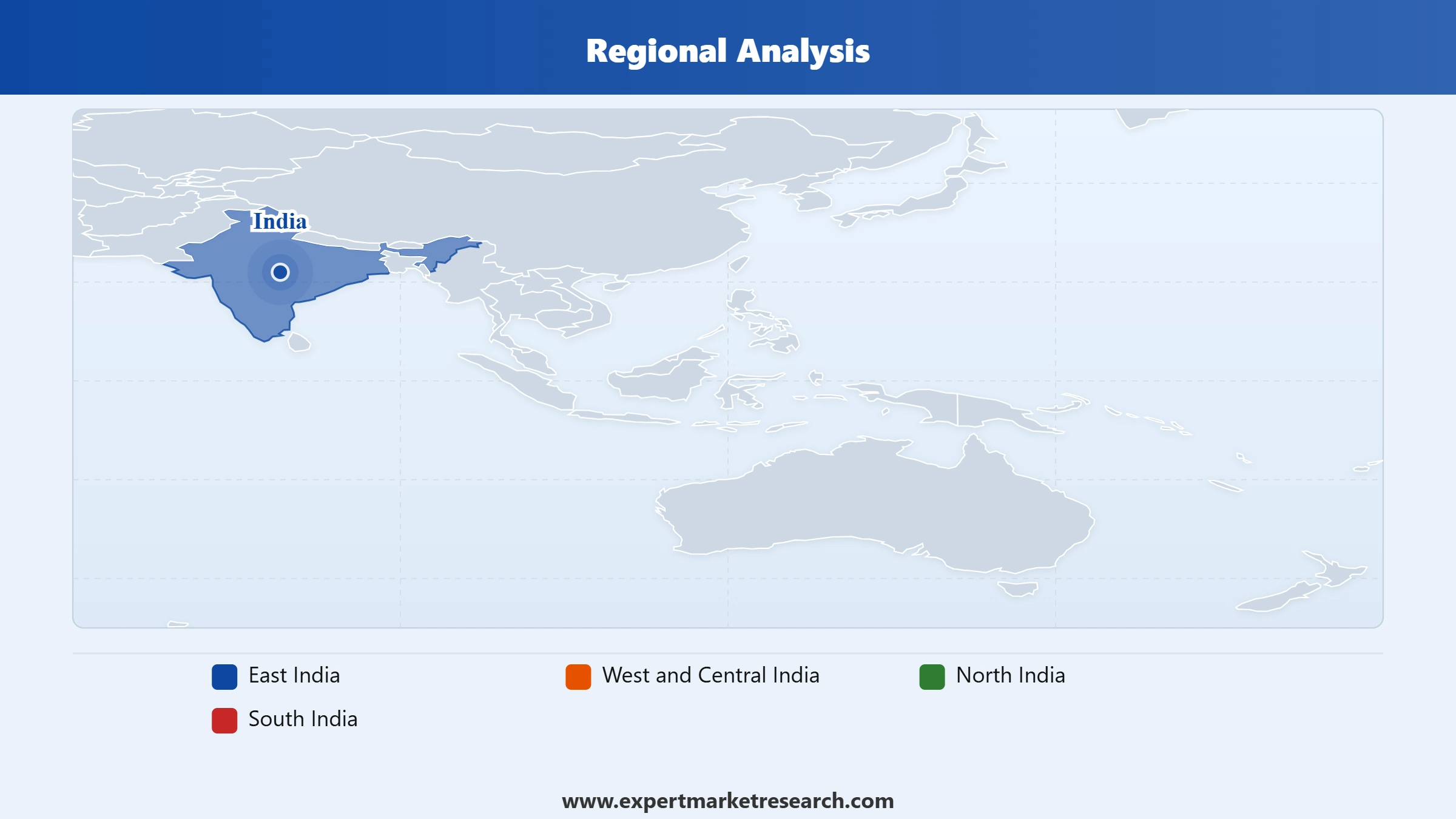
Key Insight: South India accounts for the largest share of the India cement market at approximately 21.3%, supported by concentrated limestone reserves and established manufacturing infrastructure. West and Central India is the fastest-growing region at an estimated CAGR of 5.80%, reinforced by Shree Cement Ltd.'s December 2025 announcement of an INR 20 billion investment in a new Maharashtra plant. North India continues to represent substantial demand tied to its infrastructure and housing construction activity, while East India serves steady demand linked to industrial and mining-sector cement consumption. This regional distribution reflects how proximity to raw-material reserves and transportation infrastructure shapes competitive positioning, with producers concentrating capacity investment in areas offering the strongest logistics advantages.
Read more about this report - REQUEST FREE SAMPLE COPY IN PDF
Portland continues to account for a substantial share of the market, reflecting its established use across general construction applications nationwide. ACC Limited's fiscal second-quarter results, reported in October 2025, showed premium products comprising 47% of trade sales, reflecting continued product-mix upgrading across established cement categories. Its dominance is reinforced by extensive dealer networks and long-standing brand recognition among institutional buyers, who continue to favour established grey-cement formulations for large-scale infrastructure and housing projects over emerging alternatives. This continued dominance also reflects producers' emphasis on consistent quality standards and reliable supply chains, which remain critical purchasing criteria for large-scale institutional and government-backed infrastructure projects across the country.
Blended is growing at a fast pace across the market at a projected CAGR of 6.10%, as producers scale lower-clinker formulations to meet sustainability and cost-efficiency goals. Ambuja Cements Ltd.'s May 2026 disclosure of its Sanghi Industries and Penna Cement merger reflects continued consolidation supporting broader blended-cement product-mix expansion across the combined platform. Regional producers are also scaling clinker-substitution technology to meet tightening emissions standards, positioning blended formulations as the preferred choice for cost-conscious commercial and residential developers alike. This shift also aligns with tightening environmental regulations, which continue to push producers toward lower-carbon production processes and encourage broader adoption of supplementary cementitious materials.
Residential continues to account for a substantial share of the market, supported by sustained housing construction demand across urban and semi-urban India. Shree Cement Ltd.'s December 2025 announcement of its INR 20 billion Maharashtra plant investment reflects continued capacity investment supporting residential and broader construction demand across the region. Rising urbanisation and government-backed affordable housing schemes continue to reinforce this demand base, with developers increasingly specifying cement grades that balance cost efficiency with long-term structural durability. This steady demand base is further reinforced by rising disposable incomes and expanding urban infrastructure, which continue to support new residential construction activity across both metropolitan and emerging semi-urban markets.
Infrastructural is growing at a fast pace across the market, driven by sustained government infrastructure spending on highways, rail, and urban development. UltraTech Cement Ltd.'s September 2026 capacity expansion across southern, eastern, and northern India positions the company to serve this accelerating infrastructure-linked demand. State-level road and metro-rail programmes across multiple regions are further accelerating cement offtake, prompting producers to prioritise infrastructural-grade capacity allocation as public works budgets continue to expand nationwide. This accelerating momentum also reflects growing private-sector participation in infrastructure financing, broadening the base of demand beyond government-funded projects and supporting sustained capacity utilisation industry-wide.
Read more about this report - REQUEST FREE SAMPLE COPY IN PDF
South India commands the largest share of the market at approximately 21.3%. This is supported by concentrated limestone reserves and established manufacturing infrastructure across Andhra Pradesh, Telangana, and Tamil Nadu, with major producers maintaining dense plant networks to serve this dominant demand base.
West and Central India is emerging as the fastest-growing region at an estimated CAGR of 5.80%, illustrated by Shree Cement Ltd.'s December 2025 announcement of an INR 20 billion investment in a new 2 mtpa plant in Chandrapur district, Maharashtra. North India continues to represent substantial demand tied to its infrastructure and housing construction activity, while East India serves steady demand linked to industrial and mining-sector cement consumption across the region.
The industry is fragmented, with India cement market companies ranging from large diversified conglomerates to regional producers competing across type, end use, and region segments. Established players operate across the full cement value chain, from limestone mining and clinker production through grinding, distribution, and premium product development for residential, commercial, and infrastructure customers.
Competitive dynamics among India cement players are increasingly shaped by the scale of capacity consolidation, the depth of premium and blended-product mix, and the strength of regional distribution networks. Manufacturers are investing in greenfield and debottlenecking capacity, platform mergers, and balance-sheet discipline to secure long-term relationships with infrastructure and construction customers.
Founded in 1983 and headquartered in Mumbai, Maharashtra, UltraTech Cement is India's largest cement manufacturer, producing grey cement, ready-mix concrete, and building products. The company commissioned 4.6 mtpa of new capacity in September 2026, including a 3.6 mtpa greenfield unit in Andhra Pradesh, lifting its global manufacturing capability to 210.1 mtpa, with domestic capacity representing approximately 97% of the total.
Founded in 1983 and headquartered in Mumbai, Maharashtra, Ambuja Cements is part of the Adani Group's cement platform, manufacturing cement and ready-mix concrete across India. The company reported FY26 revenue of INR 25,062 crore in May 2026, with capacity reaching 109 MTPA following the merger of Sanghi Industries and Penna Cement, and set a target of 119 MTPA capacity by FY27.
Founded in 1936 and headquartered in Mumbai, Maharashtra, ACC is part of the Adani Group's cement platform, manufacturing cement and ready-mix concrete. The company reported fiscal second-quarter revenue, disclosed in October 2025, of INR 5,932 crore, up 28% year-over-year, with net profit surging 460% to INR 1,119 crore and record quarterly cement volumes of 10.0 million tonnes, while maintaining a debt-free balance sheet.
Founded in 1979 and headquartered in Kolkata, West Bengal, Shree Cement is India's third-largest cement producer by capacity, operating plants across Rajasthan, Karnataka, and other states. The company announced an INR 20 billion investment in a new 2 mtpa Maharashtra plant in December 2025, funded through internal cash reserves, as part of a broader expansion program targeting 72-75 mtpa capacity by FY27.
Other key players in the India cement market include Dalmia Bharat Ltd., J.K.Cement Limited, Ramco Group, Birla Corporation., India Cements Ltd., and Orient Cement Ltd., among others.
*Please note that this is only a partial list; the complete list of key players is available in the full report. Additionally, the list of key players can be customized to better suit your needs.*
Unlock the latest insights with our India cement market trends 2026 report. Discover regional growth patterns, type and end use trends, and key industry players. Stay ahead of competition with trusted data and expert analysis. Download your free sample report today and drive informed decisions in the market.


Upto 15% Off
USD
$2499 $2249
$3999 $3599
$4999 $4249
$5999 $5099


*While we strive to always give you current and accurate information, the numbers depicted on the website are indicative and may differ from the actual numbers in the main report. At Expert Market Research, we aim to bring you the latest insights and trends in the market. Using our analyses and forecasts, stakeholders can understand the market dynamics, navigate challenges, and capitalize on opportunities to make data-driven strategic decisions.*
In 2025, the market reached an approximate volume of 356.29 MMT.
The market is projected to grow at a CAGR of 5.40% between 2026 and 2035.
The market is assessed to witness healthy growth in the forecast period to reach around 602.85 MMT in 2035.
The different types of cement in the market include Portland, and blended, among others.
The different end uses of cement include residential, commercial/institutional/industrial, and infrastructural.
The different regions covered in the market report are East India, West and Central India, North India, and South India.
The key players in the market include UltraTech Cement Ltd., Ambuja Cements Ltd., ACC Limited, Shree Cement Ltd., Dalmia Bharat Ltd., J.K.Cement Limited, Ramco Group, Birla Corporation., India Cements Ltd., and Orient Cement Ltd., among others.
Manufacturers face intense price competition from a fragmented regional supplier base, volatile limestone and energy input costs, and the capital-intensive complexity of scaling greenfield and blended-cement production capacity.
Pursuing platform consolidation and capacity mergers, expanding blended-cement and premium product mix, and funding multi-state greenfield expansion through internal cash reserves and debt-free balance sheets.
Explore our key highlights of the report and gain a concise overview of key findings, trends, and actionable insights that will empower your strategic decisions.
| REPORT FEATURES | DETAILS |
| Base Year | 2025 |
| Historical Period | 2019-2025 |
| Forecast Period | 2026-2035 |
| Scope of the Report |
Historical and Forecast Trends, Industry Drivers and Constraints, Historical and Forecast Market Analysis by Segment:
|
| Breakup by Type |
|
| Breakup by End Use |
|
| Breakup by Region |
|
| Market Dynamics |
|
| Competitive Landscape |
|
| Companies Covered |
|
Datasheet
One User
USD 2,499
USD 2,249
tax inclusive*
Single User License
One User
USD 3,999
USD 3,599
tax inclusive*
Five User License
Five User
USD 4,999
USD 4,249
tax inclusive*
Corporate License
Unlimited Users
USD 5,999
USD 5,099
tax inclusive*
*Please note that the prices mentioned below are starting prices for each bundle type. Kindly contact our team for further details.*
Flash Bundle
Small Business Bundle
Growth Bundle
Enterprise Bundle
*Please note that the prices mentioned below are starting prices for each bundle type. Kindly contact our team for further details.*
Flash Bundle
Number of Reports: 3
20%
tax inclusive*
Small Business Bundle
Number of Reports: 5
25%
tax inclusive*
Growth Bundle
Number of Reports: 8
30%
tax inclusive*
Enterprise Bundle
Number of Reports: 10
35%
tax inclusive*
How To Order

Select License Type
Choose the right license for your needs and access rights.

Click on ‘Buy Now’
Add the report to your cart with one click and proceed to register.

Select Mode of Payment
Choose a payment option for a secure checkout. You will be redirected accordingly.
Strategic Solutions for Informed Decision-Making
Gain insights to stay ahead and seize opportunities.

Get insights & trends for a competitive edge.

Track prices with detailed trend reports.

Analyse trade data for supply chain insights.

Leverage cost reports for smart savings

Enhance supply chain with partnerships.

Connect For More Information
Our expert team of analysts will offer full support and resolve any queries regarding the report, before and after the purchase.
Our expert team of analysts will offer full support and resolve any queries regarding the report, before and after the purchase.
We employ meticulous research methods, blending advanced analytics and expert insights to deliver accurate, actionable industry intelligence, staying ahead of competitors.
Our skilled analysts offer unparalleled competitive advantage with detailed insights on current and emerging markets, ensuring your strategic edge.
We offer an in-depth yet simplified presentation of industry insights and analysis to meet your specific requirements effectively.




