

Consumer Insights
Uncover trends and behaviors shaping consumer choices today
Procurement Insights
Optimize your sourcing strategy with key market data
Industry Stats
Stay ahead with the latest trends and market analysis.
The India facility management market attained a value of USD 3.14 Billion in 2025 and is projected to expand at a CAGR of 10.49% through 2035. The market is further expected to achieve USD 8.51 Billion by 2035. Increased investments in data centers, industrial estates, health infrastructure, and smart buildings are fueling the growth of technology-driven integrated facility management solutions.
The India facility management market is experiencing the growth driven by two powerful demand driving factors. The first one is the growing trend among multinational companies to bundle their facility services into one integrated contract to be able to offer consistent operations within their national footprint, better control of costs, and higher level of accountability for provided services. Another driving factor is the increased pressure on business organizations from their sustainability objectives, which is leading to adoption of energy management, water conservation, and predictive maintenance solutions based on artificial intelligence, helping businesses decrease their carbon footprint and minimize downtime.
The India facility management market is undergoing significant change with IFCs looking to offer AI-based building operations, predictive maintenance, and digital workplace management software solutions. This was highlighted when in September 2024, CBRE bolstered its IFCs in India through technology-based workplace solutions that leverage smart sensors, energy analytics, and central control rooms for enterprises. The change reflects the growing enterprise requirement for intelligent asset management in commercial offices, manufacturing facilities, and data centers. The country observed consistent commercial real estate growth with Grade A office inventory of more than 900 million sq ft in metro cities as per reports published in 2025, offering immense scope for technology-powered facility managers.
International players along with local providers are now moving towards integrated contracts covering services related to engineering, security, workplace experience, cleaning, sustainability and compliance on an integrated platform. Enterprises want partners who can deliver value by lowering costs as well as meet ESG goals through energy-efficient building operations, waste management and digital monitoring systems. Hence, companies in the India facility management market are now looking at robotics for repetitive cleaning, IoT-based equipment monitoring, and AI-powered helpdesk platforms. For example, in October 2025, SILA and Xempla partnered to launch India's first AI-led facilities management model, enabling predictive maintenance.
Compound Annual Growth Rate
10.49%
Value in USD Billion
2026-2035
Read more about this report - REQUEST FREE SAMPLE COPY IN PDF
The NHAI introduced a national initiative aimed at developing state-of-the-art public facilities at toll plazas. Organizations may benefit from maintenance contracts through the application of intelligent sanitation, Internet of Things, and predictive maintenance for highway infrastructure.
SILA acquired SMS Integrated Facility Services and extended its service network to 125 cities. Companies may consider making strategic acquisitions and regional partnerships in order to strengthen their capabilities in integrated facility management, following such trends in the India facility management market.
FM360 by SILA is an AI-based platform for consultation and advice to help developers make their facilities more efficient and sustainable in terms of operation and lifecycle costs. The India facility management market therefore presents potential for companies to offer AI-based consulting services, digital twin, and predictive analytics solutions to help optimize building operations during the design phase.
In Kolkata, Sodexo India created a specific healthcare management facility offering special healthcare management services in hospitals. It can be useful for companies to develop their specialized healthcare facility management services with regard to infection control, compliance, and technology-enabled hospital operations.
AI and IoT are changing the entire India facility management market dynamics, especially in the real estate sector. An increasing number of companies are opting for platforms that can keep tabs on HVAC systems, utilities, occupancy, and the condition of assets via a centralized dashboard to cut down on downtime and increase efficiency in operation. For example, in July 2026, Factech introduced an AI-powered CAFM agent, automating maintenance workflows, asset management, and real-time facility operations with predictive intelligence. The Smart Cities Mission initiative from the Government of India is boosting the rollout of connected infrastructure, making providers adopt smart building management systems. Firms like CBRE, JLL, and Cushman & Wakefield are continuing to grow their AI-driven integrated facility management service offerings to corporate campuses and tech parks.
The growing number of data centers in India is creating unique opportunities for India facility management market players. Hyperscale data centers need round-the-clock power management, environment monitoring, precision cooling, security, and predictive maintenance, making the providers adopt high levels of specialization. The Government of India classifies data centers as infrastructure whereas many state governments are rolling out data center-friendly policies to boost investment flow. On the other hand, in June 2026, Meta partnered with Reliance to develop India's first AI-enabled data center, strengthening hyperscale infrastructure and renewable-powered digital operations.
Commitments toward corporate sustainability are leading to the development of new procurement models in the India facility management market. Firms are looking for partners who can minimize carbon footprints through intelligent energy management practices, waste segregation, water conservation, and environmentally friendly facility management. India's Energy Conservation Building Code and Bureau of Energy Efficiency are consistently promoting the efficient use of energy in commercial structures. Facility management companies are increasingly implementing artificial intelligence-based energy analytics, automated lighting management systems, and predictive equipment maintenance to optimize ESG. Firms like Sodexo, ISS Facility Services India, and Updater Services Limited are also broadening their sustainability portfolio to assist corporate firms meet their environmental objectives by cutting down their operating expenses. On the other hand, in July 2026, Saint-Gobain and CEPT partnered to advance sustainable building solutions, reducing energy consumption through climate-resilient construction research and innovation.
Industrial investments under the Make in India program and Production Linked Incentives are expanding opportunities in the India facility management market. New plants, logistics centers, warehouses, and industrial corridors need maintenance, security, utilities, and compliance management services throughout the lifecycle of the facilities. Developers are increasingly outsourcing non-core operations to facility management service providers with nationwide presence. Companies such as SIS Limited, Quess Corp, and BVG India are strengthening industrial facility management portfolios through technology-enabled workforce deployment and digital inspection systems. Demonstrating this shift, in in July 2026, Healthfab partnered with Andhra Pradesh to establish a sustainable manufacturing facility, expanding period-care production and creating 700 jobs.
The role of facility management companies is evolving into that of workplace experience partners. The trend of hybrid working is resulting in clients having a greater focus on analytics regarding space utilization, employee wellness, indoor air quality monitoring, and flexible workspace services. The India facility management market observes robust tenanting activity by global capabilities centers and technology firms, resulting in a rise in demand for premium integrated workplace management. Leading facility management companies are rolling out occupancy analytics, touchless visitor management, robotic cleaning services, and mobile apps-based service requests. For example, in May 2026, LOGIC launched Workspaces, delivering modular hybrid office infrastructure with rapid deployment, tool-free installation, and flexible collaboration spaces.
The EMR’s report titled “India Facility Management Market Report and Forecast 2026-2035” offers a detailed analysis of the market based on the following segments:
Market Breakup by Services
Key Insight: The service sector represents changing consumer preferences for facility management that is specialized and technology based. The India facility management market is dominated by soft services since they provide the necessary functions on a day-to-day basis in a wide range of business establishments. Technical services are expanding their scope due to the growing usage of smart building infrastructure and facilities. Pest management services are becoming increasingly relevant with improved hygiene standards, and support services make workplaces more efficient with help in administration. In June 2026, India established a Central Integrated Pest Management Centre in Varanasi, strengthening crop surveillance, farmer advisory, and sustainable pest control. Cleaning services are adopting automation for greater efficiency, while security services use digital surveillance and access control.
Market Breakup by Sector
Key Insight: The India facility management market scenario shows a steady movement towards professionalization of services provided. The organized industry sustains its dominance due to procurement systems, a bigger number of facilities, and usage of more technologies. However, the unorganized industry is developing as customers become more aware of the benefits of using standardized facility management. The growing requirements of compliance, increased infrastructural development, and higher attention to quality of services are reducing the gap between two industries.
Market Breakup by Spending Pattern
Key Insight: Differences in spending habits reveal how different priorities in terms of operations are being maintained by organizations. Outsource arrangements remain prominent due to the combination of technical knowledge, operational flexibility, and delivery through technology within a well-known cost structure. On-site management is essential for those businesses that need to have control over critical facilities, people management, and unique compliance processes. The advancement of digital platforms in delivering greater visibility in services provided makes both spending methods accelerate the India facility management market development.
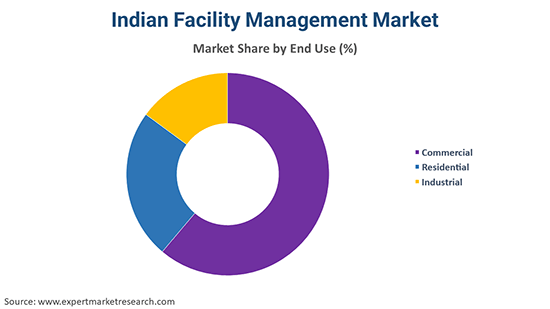
Market Breakup by End Use
Key Insight: Demand from end-use facilities depends on the needs of various types of infrastructure in India. Commercial facilities are significantly boosting demand in the India facility management market owing to the need for proper office management and excellence in service delivery. The use of professional facility management in residential facilities is becoming widespread as a result of the increasing need for improved living standards and efficiency. Industrial facilities are growing at a fast pace due to the modernization of manufacturing techniques.
Market Breakup by Region
Key Insight: The different patterns in demand across regions are a result of different economic strengths and infrastructural considerations. The India facility management market retains its market dominance due to well-established commercial environments, financial services, and industry. The south of India shows rapid growth owing to technology-based investment and technological needs at the workplace. North India enjoys the advantages of government presence, commercial centers, and urban infrastructure growth, whereas the eastern region is making steady progress via industrial growth, logistics, and modernization of facilities. In March 2026, CRC engaged CBRE for integrated facility management, enhancing smart operations, sustainability, and predictive maintenance at Noida's flagship commercial campus.
Read more about this report - REQUEST FREE SAMPLE COPY IN PDF
Soft services dominate the market owing to integrated workplace management and recurring operational requirements
Soft services dominate the India facility management market due to outsourcing of functions such as housekeeping, cleaning, landscaping, waste management, front office, and office services within integrated service packages. The need for greater efficiency while minimizing administrative effort makes corporate offices, hospitals, airports, educational institutions, and retail establishments choose soft services bundles. Technology is being used by service providers to provide better performance through robotics, AI-driven scheduling, and digital quality audits. For example, in July 2026, DTSS transformed soft services into a scalable, governance-led integrated facility management solution, improving efficiency and maintenance outcomes.
Technical services are expected to experience the highest rate of growth in the India facility management market as organizations seek specialist maintenance for HVAC systems, electrical systems, elevators, fire safety systems, and building automation systems. Investments in data centers, manufacturing plants, commercial parks, and healthcare facilities drive the need for predictive maintenance and remote monitoring. Facility management companies use IoT and digital asset management systems to reduce downtime, increase equipment lifespan, and ensure compliance.
The organized sector leads the market through large enterprise outsourcing and compliance-focused operations
The organized sector makes up for the largest share of the India facility management market as multinationals, IT firms, banks, health care organizations, airports, and manufacturing companies are becoming increasingly dependent on outsourcing their facilities management activities to professional service providers. Such companies have a preference for standardized delivery of their services, adherence to rules and regulations, quantifiable performance parameters, and digitization. The use of long-term contracts and service integration encourages the service providers to invest in technology solutions, training the workforce, and sustainability efforts, helping them increase customer retention rates. In July 2026, Krystal Integrated Services secured an INR 27.64 crore sanitation contract, managing 563 Andhra Pradesh welfare hostels across thirteen districts.
The unorganized sector is experiencing the highest rate of growth in the India facility management market as smaller companies, residential societies, educational institutions, and commercial firms in the regions are moving towards organized facility management providers. Customers are increasingly realizing the importance of safety, hygiene, compliance, and efficiency of operations, leading them to change their fragmented local service providers for an integrated service solution. Service booking portals, cost-effective bundling options, and easy availability of the workforce are making it possible for organized facility management to reach more customers.
By spending pattern, the outsourced spending category captures a substantial share of the market through specialized expertise and long-term integrated service contracts
Outsourced facility management holds the largest share in the India facility management market as organizations are increasingly looking forward to specialized vendors who can handle multiple facilities on consolidated contract basis. The process helps in achieving optimization in terms of operation cost, trained labor, compliance with policies, and implementation of advanced technology. This helps the organization in managing performance in terms of service level agreement and reporting system. This process also allows prediction of maintenance of facilities which increases productivity in the organization.
Facility management within the organization is gaining traction as some organizations have to manage sensitive facilities, such as research labs and select manufacturing units and government agencies. Organizations need to be able to have control over the facilities, labor management and immediate response mechanism, accelerating the overall India facility management market penetration. In June 2026, BW Facility Management Summit united India's facility management leaders, advancing smart workplaces, sustainability, digital transformation, and industry collaboration.
By end use, commercial facilities continue to dominate the market due to expanding corporate offices and integrated workplace services
Commercial properties are considered the largest segment in terms of end-use owing to the rising requirement of facility management in office campuses, shopping complexes, hotels, airports, healthcare organizations, and education organizations. Facility management services that include maintenance, security, cleaning, energy management, and workplace experience help in improving efficiency of operations. HyFlex work environments and high-end commercial buildings are encouraging organizations to invest in intelligent building management, digital workplace management, and predictive maintenance through service partnerships.
The industrial sector is witnessing fastest growth in the overall India facility management market revenue due to increasing demand for maintenance, engineering, utility management, and compliance from manufacturing plants, warehouses, logistics centers, pharmaceutical facilities, and industrial parks. The need for automation, smart manufacturing, and operational reliability is encouraging organizations to hire technical facility management. Companies that provide predictive maintenance, asset lifecycle optimization, and safety management are gaining benefits from industrial infrastructure development in several industries. In August 2025, Modine opened a Chennai manufacturing facility producing data center cooling equipment, strengthening APAC supply, and localized thermal solutions.
Read more about this report - REQUEST FREE SAMPLE COPY IN PDF
West India clocks in the largest share of the market through commercial real estate and financial business expansion
The West India facility management market witnesses exponential growth due to the presence of corporate offices, financial services organizations, IT parks, industrial hubs, logistics infrastructures, and commercial properties. Cities like Mumbai, Pune, and Ahmedabad together with nearby industrial areas have constant demand for the integration of facility management solutions. The wide acceptance of smart facilities, sustainable practices, and outsourcing of workspaces drives this dominance of the western region in terms of both commercial and industrial infrastructure.
The Southern India facility management market is considered the fastest growing industry due to the development of technology parks, global delivery centers, electronic manufacturing, healthcare infrastructure, and hyperscale data centers. Cities like Bengaluru, Hyderabad, and Chennai along with other urban agglomerations in the region face increasing demands for digital facility management, predictive maintenance, energy optimization, and integration of workspaces. In July 2026, Marvell invested USD 250 million to expand its Bengaluru facility, accelerating AI semiconductor innovation and engineering talent development.
The market is evolving to become more competitive as India facility management companies are switching from labor-intensive services to technologically enabled and integrated solutions. They are using AI-based asset management, robotics-based cleaning operations, predictive maintenance systems, and digitized workforce management as differentiation points. Another aspect that is gaining importance in the market is sustainability. Providers are offering energy efficiency and waste reduction services, along with ESG reporting services for enterprises.
New developments in data centers, industrial parks, healthcare facilities, airports, and Global Capability Centers are leading to a rise in demand for technical facility management services. Regional presence is being augmented through acquisitions, upskilling of workforce, and smart building alliances. India facility management market players that are able to integrate engineering knowledge with digital insights, facility management with cybersecurity awareness, and quantifiable results in services are expected to gain multi-year contracts from companies.
Dusters Total Solutions Services Pvt. Ltd., founded in 1944 and based in Bengaluru, is an Indian company that offers comprehensive facility management, housekeeping, engineering maintenance, security, and business support services across the country. Digital service monitoring and quality audit services along with custom solutions for office spaces, hospitals, industries, educational institutions, and retail establishments are the primary focus of this organization to help businesses become more efficient through advanced service delivery technologies.
BVG India Limited was founded in 1993 and has its headquarters in Pune, Maharashtra, India. It provides integrated facility management, engineering maintenance, waste management, sanitation, emergency, and smart city services. Increasing mechanization in cleaning equipment and AI-based monitoring systems are among the new directions in which this organization is working.
CLR Facility Services Pvt. Ltd. is based in Pune, India, and was founded in 2002. It provides services such as integrated facility management services, technical maintenance, housekeeping, landscaping, security coordination, and workplace services. Its clientele includes IT parks, commercial offices, residential areas, and factories while its services include customized models, preventive maintenance, digital inspection, among others.
Orion Security Solutions Pvt. Ltd. established in 2005 and is headquartered in New Delhi, India. It is a provider of integrated security and facility management services to enterprises, industrial facilities, commercial establishments, and residential complexes. The company is a key player in the India facility management market that integrates security services by providing trained security professionals with electronic surveillance and access control technology as well as visitor management systems.
Other key players in the market include CSK Facility Management Pvt. Ltd., Checkmate Group, ISS Facility Services India Pvt. Ltd., Handiman Services Limited, A La Concierge Services Pvt. Ltd., UrbanClap Technologies India Pvt. Ltd. (Urban Company), and HouseJoy, among others.
*Please note that this is only a partial list; the complete list of key players is available in the full report. Additionally, the list of key players can be customized to better suit your needs.*
Unlock the latest insights with our India facility management market trends 2026 report. Discover regional growth patterns, consumer preferences, and key industry players. Stay ahead of competition with trusted data and expert analysis. Download your free sample report today and drive informed decisions in the market.
United Kingdom Facility Management Market
North America Facility Management Market
United States Facility Management Market
Europe Facility Management Market
Facility Management Market
India Landscaping Services Market
India Building Automation Market


Upto 15% Off
USD
$2499 $2249
$3999 $3599
$4999 $4249
$5999 $5099


*While we strive to always give you current and accurate information, the numbers depicted on the website are indicative and may differ from the actual numbers in the main report. At Expert Market Research, we aim to bring you the latest insights and trends in the market. Using our analyses and forecasts, stakeholders can understand the market dynamics, navigate challenges, and capitalize on opportunities to make data-driven strategic decisions.*
The market is projected to grow at a CAGR of 10.49% between 2026 and 2035.
Investing in AI platforms, expanding sustainability services, strengthening workforce training, forming smart-building partnerships, developing specialized technical expertise, and adopting outcome-based contracts are improving long-term competitiveness.
Workforce shortages, rising labor costs, technology integration expenses, regulatory compliance, high employee attrition, and maintaining consistent service quality across geographically dispersed facilities remain significant challenges.
The major regional markets are North, South, West and East India.
The major services of facility management in the Indian market are soft services, technical services, pest management services, support service, cleaning, security, and hospitality, among others.
The significant sectors of facility management considered in the market report include organised sector and unorganised sector.
In-house and outsourced are the various spending patterns considered in the market report.
The several end uses of facility management are commercial, residential, and industrial.
The key players in the market include Dusters Total Solutions Services Pvt. Ltd., BVG India Limited, CLR Facility Services Pvt. Ltd., Orion Security Solutions Pvt. Ltd., CSK Facility Management Pvt. Ltd., Checkmate Group, ISS Facility Services India Pvt. Ltd., Handiman Services Limited, A La Concierge Services Pvt. Ltd., UrbanClap Technologies India Pvt. Ltd. (Urban Company), and HouseJoy, among others.
In 2025, the market reached an approximate value of USD 3.14 Billion.
Explore our key highlights of the report and gain a concise overview of key findings, trends, and actionable insights that will empower your strategic decisions.
| REPORT FEATURES | DETAILS |
| Base Year | 2025 |
| Historical Period | 2019-2025 |
| Forecast Period | 2026-2035 |
| Scope of the Report |
Historical and Forecast Trends, Industry Drivers and Constraints, Historical and Forecast Market Analysis by Segment:
|
| Breakup by Services |
|
| Breakup by Sector |
|
| Breakup by Spending Pattern |
|
| Breakup by End Use |
|
| Breakup by Region |
|
| Market Dynamics |
|
| Competitive Landscape |
|
| Companies Covered |
|
| Report Price and Purchase Option | Explore our purchase options that are best suited to your resources and industry needs. |
| Delivery Format | Delivered as an attached PDF and Excel through email, with an option of receiving an editable PPT, according to the purchase option. |
Datasheet
One User
USD 2,499
USD 2,249
tax inclusive*
Single User License
One User
USD 3,999
USD 3,599
tax inclusive*
Five User License
Five User
USD 4,999
USD 4,249
tax inclusive*
Corporate License
Unlimited Users
USD 5,999
USD 5,099
tax inclusive*
*Please note that the prices mentioned below are starting prices for each bundle type. Kindly contact our team for further details.*
Flash Bundle
Small Business Bundle
Growth Bundle
Enterprise Bundle
*Please note that the prices mentioned below are starting prices for each bundle type. Kindly contact our team for further details.*
Flash Bundle
Number of Reports: 3
20%
tax inclusive*
Small Business Bundle
Number of Reports: 5
25%
tax inclusive*
Growth Bundle
Number of Reports: 8
30%
tax inclusive*
Enterprise Bundle
Number of Reports: 10
35%
tax inclusive*
How To Order

Select License Type
Choose the right license for your needs and access rights.

Click on ‘Buy Now’
Add the report to your cart with one click and proceed to register.

Select Mode of Payment
Choose a payment option for a secure checkout. You will be redirected accordingly.
Strategic Solutions for Informed Decision-Making
Gain insights to stay ahead and seize opportunities.

Get insights & trends for a competitive edge.

Track prices with detailed trend reports.

Analyse trade data for supply chain insights.

Leverage cost reports for smart savings

Enhance supply chain with partnerships.

Connect For More Information
Our expert team of analysts will offer full support and resolve any queries regarding the report, before and after the purchase.
Our expert team of analysts will offer full support and resolve any queries regarding the report, before and after the purchase.
We employ meticulous research methods, blending advanced analytics and expert insights to deliver accurate, actionable industry intelligence, staying ahead of competitors.
Our skilled analysts offer unparalleled competitive advantage with detailed insights on current and emerging markets, ensuring your strategic edge.
We offer an in-depth yet simplified presentation of industry insights and analysis to meet your specific requirements effectively.




