

Consumer Insights
Uncover trends and behaviors shaping consumer choices today
Procurement Insights
Optimize your sourcing strategy with key market data
Industry Stats
Stay ahead with the latest trends and market analysis.
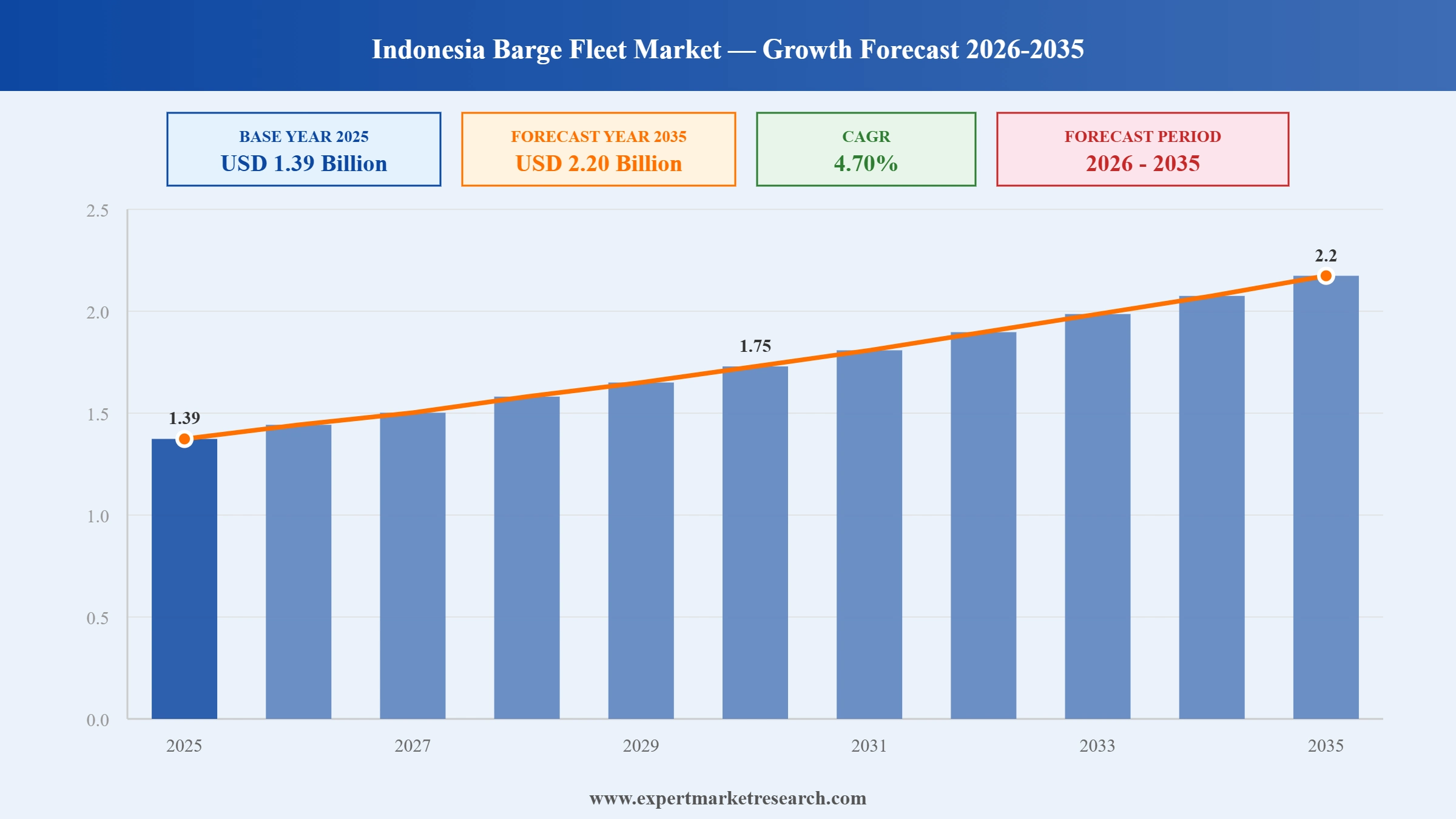
The Indonesia barge fleet market reached a value of USD 1.39 Billion at 2025 and is projected to expand at a CAGR of around 4.70% during the forecast period of 2026-2035. With rising demand for cost-effective bulk commodity transportation across Indonesia's archipelago of over 17,000 islands, the ongoing expansion of port infrastructure under the government's Tol Laut Maritime Highway programme, increasing coal and petroleum product shipment volumes, and accelerating fleet modernisation investment by major operators, the market is expected to reach USD 2.20 Billion by 2035.
Read more about this report - REQUEST FREE SAMPLE COPY IN PDF
| Indonesia Barge Fleet Market Report Summary | Description | Value |
| Base Year | USD Billion | 2025 |
| Historical Period | USD Billion | 2019-2025 |
| Forecast Period | USD Billion | 2026-2035 |
| Market Size 2025 | USD Billion | 1.39 |
| Market Size 2035 | USD Billion | 2.20 |
| CAGR 2019-2025 | Percentage | XX% |
| CAGR 2026-2035 | Percentage | 4.70% |
| CAGR 2026-2035 - Market by Region | Sumatra | 5.0% |
| CAGR 2026-2035 - Market by Region | Sulawesi | 4.2% |
| CAGR 2026-2035 - Market by Type | Covered Barge | 5.6% |
| CAGR 2026-2035 - Market by End Use | Agricultural Products | 5.6% |
| 2025 Market Share by Region | Kalimantan | 54.0% |
The Indonesia barge fleet market is experiencing a period of measured but steady expansion, driven by a wave of new vessel orders and deliveries by major fleet operators, continued investment in fleet modernisation, and the structural demand generated by Indonesia's coal and petroleum trade. Recent fleet additions by Sinarmas LDA Maritime and PT Sillo Maritime Perdana are representative of the broader industry trend toward upgrading aging fleets with modern, fuel-efficient vessels to meet growing logistical demand across the archipelago.
Sinarmas LDA Maritime launched SLM Thetis 1, a 300-foot dry barge, at Palma Progress Shipyard in Indonesia in September 2025, advancing its multi-year fleet investment campaign to meet growing demand for dry bulk cargo transport across Indonesia's archipelago.
Sinarmas LDA Maritime received delivery of SLM Herakles 1, a twin-screw tugboat with 1,790 kW power, from Tuong Aik Shipyard in Malaysia on June 25, 2025, as part of its ongoing fleet expansion to strengthen Indonesian port operations.
PT Sillo Maritime Perdana Tbk allocated USD 150 million in capital expenditure for 2025 fleet expansion in January 2025, targeting 10% revenue growth to USD 203.56 million by adding new vessels and upgrading its barge and offshore fleet.
Sinarmas LDA Maritime welcomed SLM Dionysos, its fifth self-propelled barge, to its maritime logistics fleet after its launch in January 2025, further expanding its capacity to transport liquid and dry bulk cargo across Indonesia's inter-island shipping routes.
Coal is the dominant cargo driving the Indonesia barge fleet market, as Indonesia ranks among the world's largest coal exporters. Barges are the primary transport mode for coal from Kalimantan and Sumatra mining regions to both domestic and export terminals.
Indonesia's unique archipelagic geography of over 17,000 islands makes barge transport essential and cost-effective for inter-island bulk cargo movement. The absence of viable land alternatives and growing domestic trade volumes sustain consistent demand for barge fleet services across the nation.
The Indonesian government's Tol Laut Maritime Highway programme has strengthened inter-island shipping infrastructure, supporting growth in the Indonesia barge fleet market. In 2024, the government accelerated smart port modernisation across 59 ports, improving digital logistics and efficiency for fleet operators.
Fleet modernisation is reshaping the Indonesia barge fleet market, with operators investing in fuel-efficient and eco-friendly technologies. Sinarmas LDA Maritime invested over USD 200 million in new tugboats and barges, demonstrating the industry's commitment to upgrading Indonesia's maritime logistics capabilities.
The Indonesia barge fleet market is positioned to benefit from Indonesia's major construction projects including the new capital city IKN Nusantara and ongoing National Strategic Projects, which require barge-based transport of construction materials to remote regions across the Indonesian archipelago.
The report of Expert Market Research’s titled “Indonesia Barge Fleet Market Report and Forecast 2026-2035” offers a detailed analysis of the market based on the following segments:
Market Breakup by Type
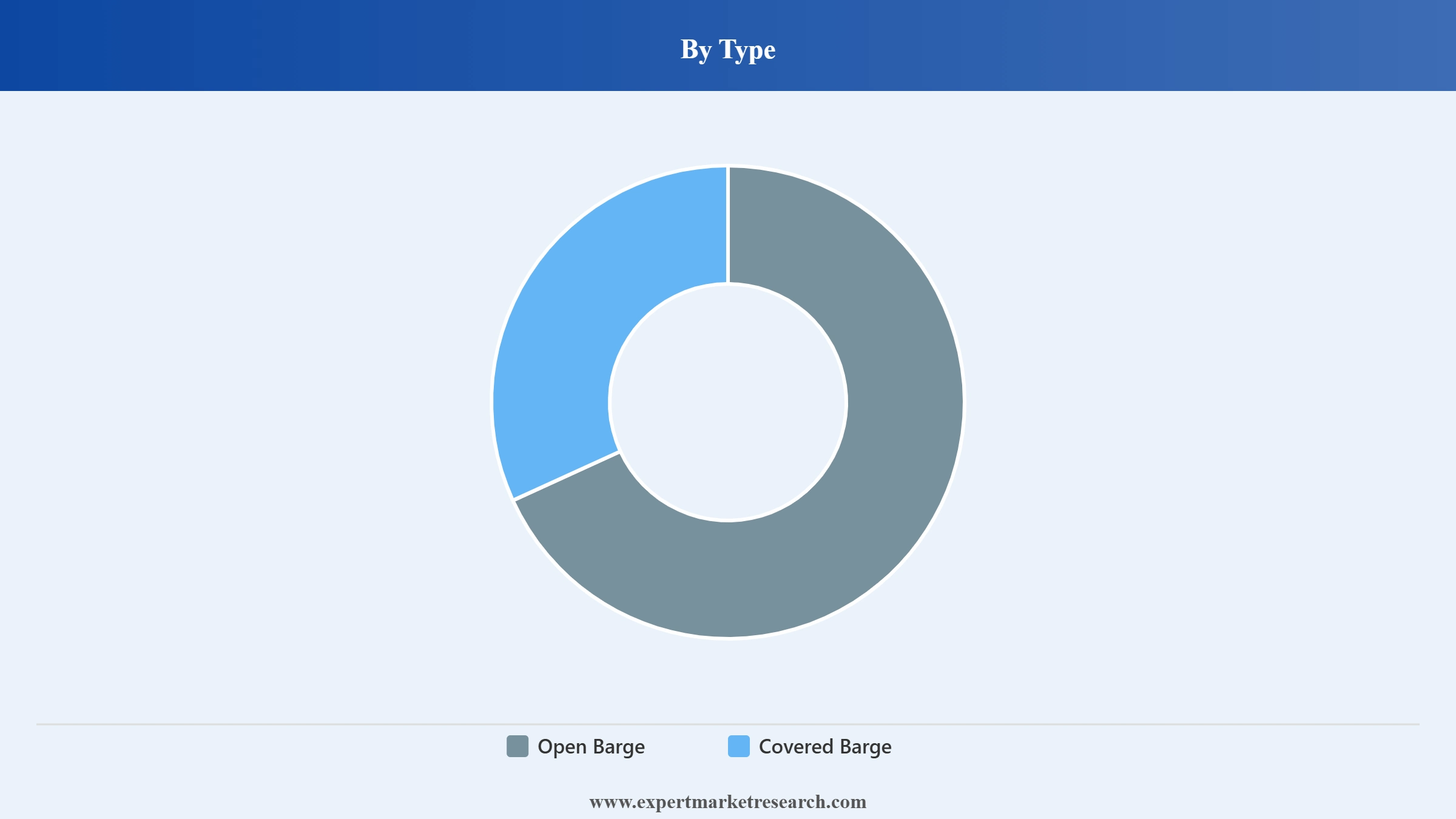
Key Insight: Open barges dominate the Indonesia barge fleet market, serving as the primary vessel type for the transportation of coal, sand, aggregate, and other bulk dry commodities that do not require protection from weather during transit. Their simpler construction and lower operating costs relative to covered barges make them the preferred choice for the high-volume, price-sensitive coal transport sector that drives the majority of barge fleet utilisation in Indonesia. Covered barges serve a growing niche in the transport of agricultural products, bagged cement, fertilisers, and general cargo requiring protection from moisture during inter-island transit.
Market Breakup by Tonnage Capacity
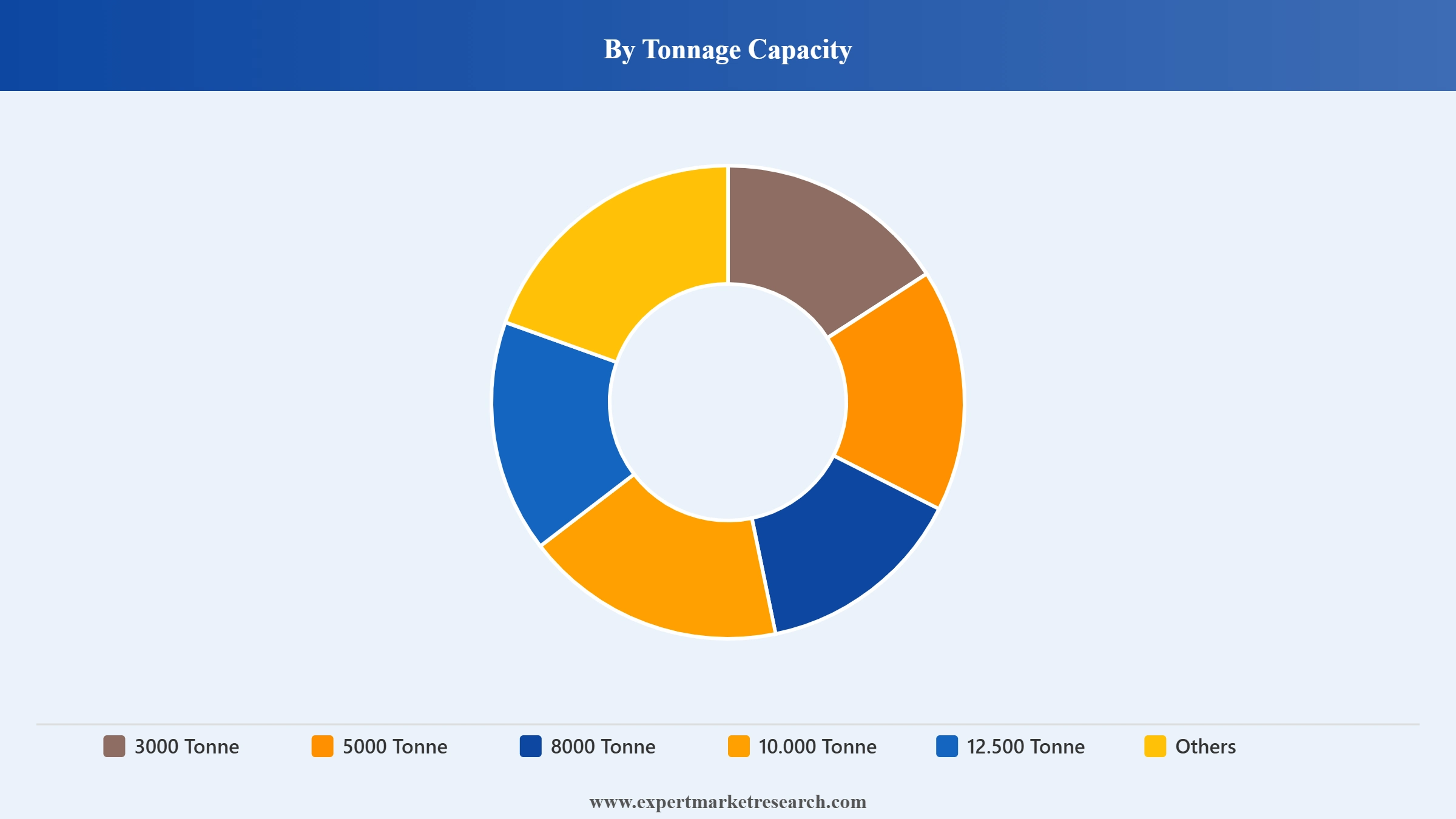
Key Insight: Larger tonnage barges in the 8,000 to 12,500 tonne capacity range are increasingly dominant in the Indonesia barge fleet market, reflecting the industry trend toward greater economies of scale in coal and petroleum product transportation. Operators like Sinarmas LDA Maritime run tug-barge pairs with capacities ranging from 3,400 to 12,800 MT, with the larger-capacity vessels commanding higher utilisation rates in bulk commodity trade. The 3,000 tonne segment serves smaller regional port routes and short-haul applications where larger vessels cannot navigate safely in shallow waterways.
Market Breakup by Application
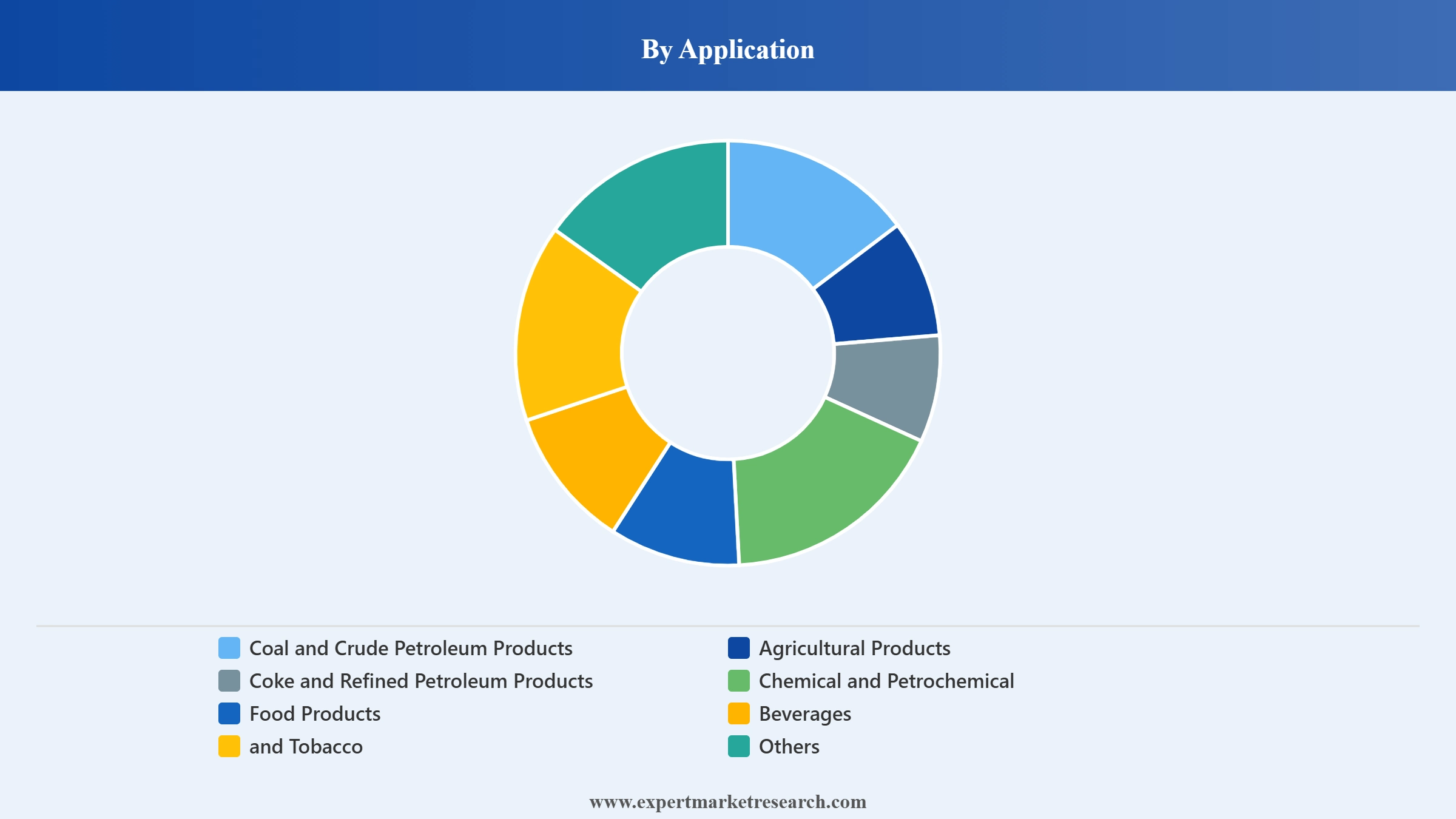
Key Insight: Coal and crude petroleum products represent the dominant application segment in the Indonesia barge fleet market, underpinned by Indonesia's position as one of the world's largest coal producers and exporters. Barges are the primary mode of coal transport from Kalimantan and Sumatra mining sites to domestic power plants and coastal export terminals, generating consistent and high-volume demand for open barge capacity. Agricultural products including palm oil, rice, and fertilisers represent the second-largest application, while chemicals and petrochemicals are a growing segment supported by Indonesia's expanding refining and petrochemical industries.
Market Breakup by Region
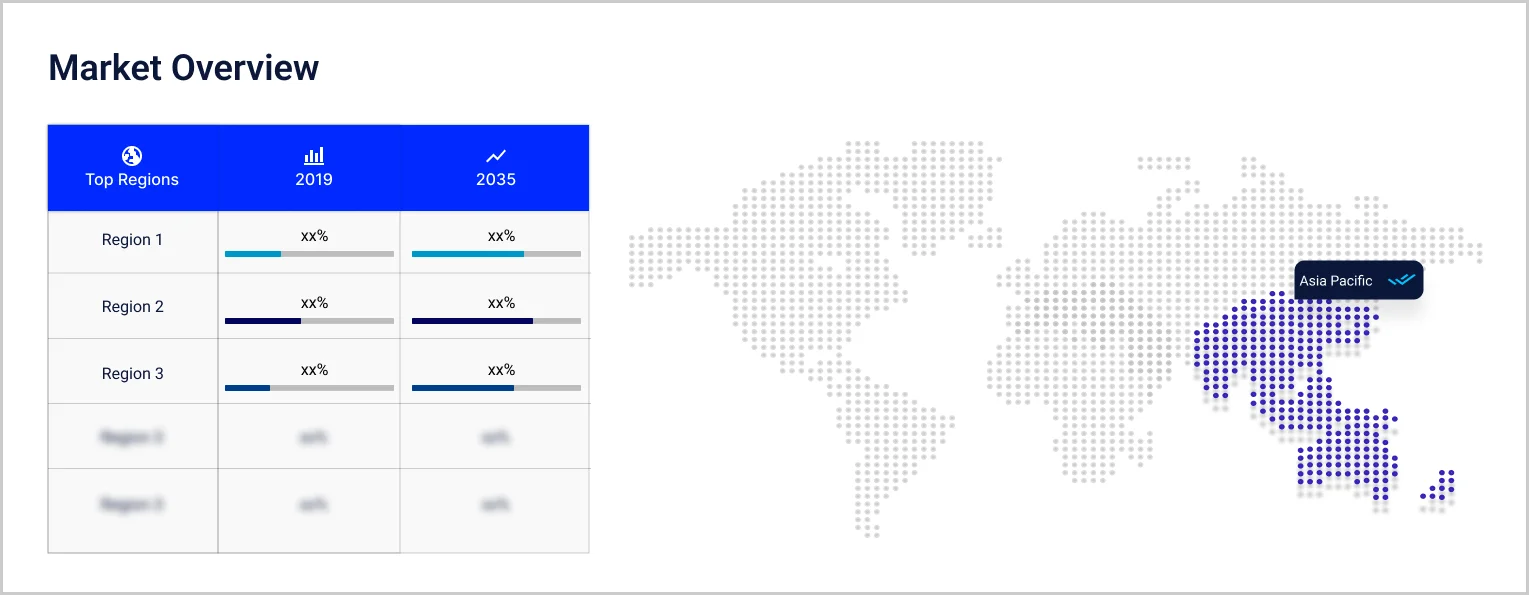
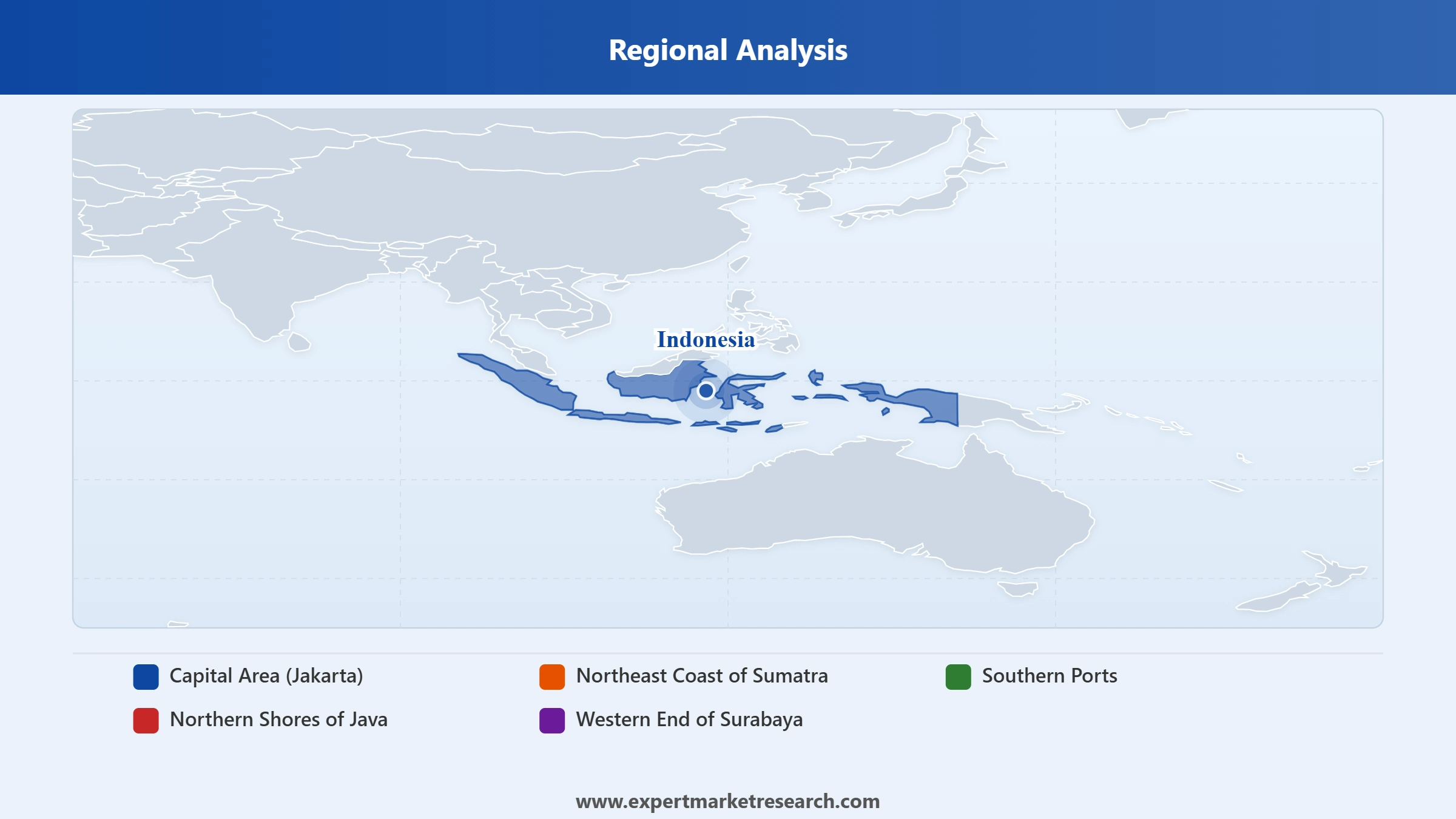
Key Insight: The Capital Area of Jakarta and the Northern Shores of Java collectively account for the dominant share of the Indonesia barge fleet market, reflecting Java's position as Indonesia's economic and industrial heartland. Jakarta's port complex serves as the primary gateway for imported goods and manufactured exports, generating sustained barge activity. The Northeast Coast of Sumatra is the fastest-growing regional sub-market, driven by intensifying coal and palm oil transport from Sumatra's resource-rich hinterland. Western End of Surabaya and Southern Ports are strategically important regional markets supporting eastern Indonesian trade flows.
Read more about this report - REQUEST FREE SAMPLE COPY IN PDF
By Type, open barges dominate the market due to their cost-effectiveness and suitability for coal and bulk dry cargo transport
Open barges account for the dominant share of the Indonesia barge fleet market, driven by the central role they play in transporting coal, sand, aggregates, and other unpackaged bulk commodities across Indonesia's vast inter-island waterway network. The open configuration enables rapid loading and unloading using conveyor systems and grab cranes at mining terminals and power plant jetties, making open barges operationally efficient for the high-throughput bulk transport that characterises Indonesia's coal logistics sector. Their lower build cost and simpler maintenance profile make them the preferred choice for operators focused on high-volume, price-competitive cargo contracts.
Read more about this report - REQUEST FREE SAMPLE COPY IN PDF
Covered barges serve an important and growing application in the Indonesia barge fleet market, addressing cargo categories that require weatherproof protection during transit. Agricultural commodities including bagged rice, fertilisers, and cement, as well as manufactured consumer goods, are increasingly transported in covered barges as operators seek to reduce cargo losses and meet buyer quality requirements. Demand for covered barges is particularly strong in routes serving eastern Indonesian provinces where weather volatility during wet seasons creates risks for uncovered cargo, and where growing agricultural trade is generating new demand for dedicated covered capacity.
By Tonnage Capacity, 8,000 to 12,500 tonne barges account for the growing dominant share due to coal trade economies of scale
Larger-tonnage barge configurations in the 8,000 to 12,500 tonne range are commanding growing market share in the Indonesia barge fleet market, reflecting the steady shift toward higher-capacity vessels that deliver better cost economics for long-haul coal and petroleum product transportation between Kalimantan and Sumatra origins and Java destination ports. PT DAK's launch of a 300-foot barge with 8,500 metric tonne capacity for PT Bukit Prima Bahari illustrates ongoing new vessel commissioning in this key capacity segment. Sinarmas LDA Maritime operates tug-barge pairs with up to 12,800 MT capacity, reflecting the growing preference for large-format vessels among major operators.
Read more about this report - REQUEST FREE SAMPLE COPY IN PDF
Smaller capacity barges in the 3,000 to 5,000 tonne range remain an important segment of the Indonesia barge fleet market, serving regional and coastal routes where water depth constraints, port infrastructure limitations, or short-haul economics make larger vessels impractical. These smaller barges support agricultural commodity distribution, construction material delivery, and inter-island general cargo transport in more remote island communities. The 5,000 tonne category represents a useful middle-ground configuration for medium-distance inter-island routes that account for a significant proportion of Indonesia's domestic trade volumes.
By Application, coal and crude petroleum products account for the dominant share due to Indonesia's position as a leading global coal producer
Coal and crude petroleum product transportation is the foundational and dominant application driving the Indonesia barge fleet market. Indonesia is one of the world's largest coal producers and exporters, with Kalimantan alone generating hundreds of millions of tonnes of coal annually, the vast majority of which is transported by barge either to coastal export terminals or to Java-based power plants via sea. The structural dependency of Indonesia's energy sector on coal, combined with the archipelagic geography that makes barge transport the only viable bulk logistics mode across most routes, ensures that coal transport remains the primary demand engine for barge fleet utilisation.
Read more about this report - REQUEST FREE SAMPLE COPY IN PDF
Agricultural products represent the second-largest application in the Indonesia barge fleet market, driven by the transportation of palm oil, copra, rice, and fertilisers across the archipelago's island network. Indonesia's position as the world's largest palm oil producer generates substantial barge freight demand for crude palm oil (CPO) transport from Sumatra and Kalimantan processing facilities to Java refineries and export ports. Chemical and petrochemical applications are a growing segment, supported by the expansion of Indonesia's downstream petrochemical industry. Food, beverage, and tobacco transportation generates consistent barge demand from consumer goods manufacturers serving island-distributed retail markets.
Capital Area (Jakarta) and Northern Shores of Java dominate the market due to Java's economic centrality and gateway port function
The Capital Area of Jakarta and the Northern Shores of Java collectively hold the largest share of the Indonesia barge fleet market, reflecting Java's unmatched concentration of industrial activity, consumer demand, and port infrastructure. Tanjung Priok, Jakarta's main container and general cargo port, serves as the primary import gateway for Indonesia and a major origin point for manufactured goods moving eastward via coastal shipping. The Northern Shores of Java industrial corridor encompasses major power plants, cement factories, and steel mills that generate consistent demand for barge-delivered coal, clinker, and raw materials. Multiple major barge operators maintain dedicated terminal access points along this corridor to serve industrial clients on long-term charter contracts.
Read more about this report - REQUEST FREE SAMPLE COPY IN PDF
The Northeast Coast of Sumatra is the fastest-growing regional sub-market in the Indonesia barge fleet market, driven by intensifying coal mining and palm oil agro-industrial activity in Sumatra's resource-rich interior. The region's ports serve as critical loading points for Sumatra-origin coal and CPO bound for Java refineries and export terminals, generating growing demand for larger-capacity tug-barge configurations. The Western End of Surabaya is strategically important as Indonesia's second-largest city and a gateway to eastern Indonesian markets, with growing demand for barge services supporting construction materials and consumer goods distribution toward Sulawesi, Maluku, and Papua. Southern Ports are increasingly relevant as Indonesia's IKN new capital city development drives construction logistics demand.
The Indonesia barge fleet market is a moderately fragmented sector with a mix of integrated maritime logistics conglomerates, mid-size regional operators, and specialist vessel-charter companies competing for bulk cargo contracts across the archipelago. Larger operators including Sinarmas LDA Maritime, PT Pelayaran Nasional Bina Buana Raya Tbk, and PT Sillo Maritime Perdana Tbk hold significant fleet advantages through scale, diversified vessel portfolios, and established relationships with major commodity shippers. Fleet modernisation, fuel efficiency, and digital logistics integration are becoming the primary competitive differentiators in an industry historically characterised by legacy vessel fleets.
Competition is intensifying as a wave of new barge construction capacity built during the 2022-2023 coal boom enters service, placing pressure on freight rates and requiring operators to secure long-term cargo contracts to protect revenue visibility. Companies with established mining and energy company client relationships and integrated port operations are best positioned to navigate this environment, while operators relying on spot freight rates face margin compression from excess fleet supply.
Founded in 1991 and based in Indonesia, Habco Indonesia is a marine logistics company providing integrated marine solutions across the Indonesian archipelago through inter-island voyage services. The company operates multiple business units that work together to deliver end-to-end maritime logistics, connecting shippers and clients across Indonesia's extensive island network with a focus on operational reliability and service integration.
GAC Indonesia Shipping was established in 1997 in Indonesia as a member of the international GAC Group, maintaining a strong presence in local shipping and logistics through its partnership with PT Andhika Lines. The company offers a comprehensive fleet of dry cargo, tanker, navy, offshore, and cruise vessels with integrated warehouse capacity and operational support for complex logistics services across Indonesia.
Founded in 1971 and headquartered in West Jakarta, Gurita Lintas Samudera is a deep-sea freight transportation company operating a mixed fleet of bulk carriers and tug-barge pairs across the Indonesian archipelago. The company is recognised for its ISO-approved operations, rigorous cargo handling standards, and customised maritime logistics solutions spanning more than five decades of operational history in Indonesian waters.
PT Pelayaran Nasional Bina Buana Raya Tbk, established in 1998 and listed on the Indonesia Stock Exchange since 2013, is headquartered in Central Jakarta. The company operates a large fleet of barges, tugboats, and offshore support vessels, providing vessel chartering, offshore services, and cargo haulage with a focus on coal, oil, and inter-island logistics across Indonesia.
Other key players in the market are PT Sillo Maritime Perdana TBK, and Others.
*Please note that this is only a partial list; the complete list of key players is available in the full report. Additionally, the list of key players can be customized to better suit your needs.*
Navigate Indonesia's evolving barge fleet market with confidence using Expert Market Research's comprehensive 2026 report. Access in-depth analysis of vessel type performance, tonnage capacity trends, cargo application dynamics, regional port developments, and competitive strategies across Indonesia's leading maritime logistics operators. Whether you are a barge owner, fleet investor, commodity shipper, or port infrastructure developer, this report provides the intelligence you need to make strategic decisions in one of Southeast Asia's most essential maritime markets. Download your free sample today and explore the opportunities within the Indonesia barge fleet sector.


Upto 15% Off
USD
$2999 $2699
$4399 $3959
$5599 $4759
$6659 $5660


*While we strive to always give you current and accurate information, the numbers depicted on the website are indicative and may differ from the actual numbers in the main report. At Expert Market Research, we aim to bring you the latest insights and trends in the market. Using our analyses and forecasts, stakeholders can understand the market dynamics, navigate challenges, and capitalize on opportunities to make data-driven strategic decisions.*
The market is projected to grow at a CAGR of 4.70% between 2026 and 2035.
The key strategies in the market include fleet modernization with fuel-efficient, eco-friendly vessels, and increased digitalization through real-time tracking, predictive maintenance, and route optimization. Infrastructure expansion, such as improved ports, terminals, and inland waterways also plays a critical role.
The key market trends include the growing demand for cost-effective conveyance and an upsurge in the demand for coal to meet the rising energy needs.
The various types of barge fleets include open barge and covered barge.
The several applications of barge fleets include coal and crude petroleum products, agricultural products, coke and refined petroleum products, chemical and petrochemicals, and food products, beverages, and tobacco, among others.
The major regions in the market are the Capital Area (Jakarta), the Northeast Coast of Sumatra, the Southern Ports, the Northern Shores of Java, and the Western End of Surabaya.
The key players in the market include Habco Indonesia, GAC Indonesia Shipping, Gurita Lintas Samudera, PT Pelayaran Nasional Bina Buana Raya Tbk, and PT Sillo Maritime Perdana TBK, among others.
The purpose of a barge is to transport heavy and high-volume cargo across waterways such as rivers and canals.
In 2025, the market reached an approximate value of USD 1.39 Billion.
Key challenges include aging, inefficient vessels needing costly upgrades; inconsistent and burdensome regulations; infrastructure bottlenecks, fuel price volatility and severe weather disruptions.
Explore our key highlights of the report and gain a concise overview of key findings, trends, and actionable insights that will empower your strategic decisions.
| REPORT FEATURES | DETAILS |
| Base Year | 2025 |
| Historical Period | 2019-2025 |
| Forecast Period | 2026-2035 |
| Scope of the Report |
Historical and Forecast Trends, Industry Drivers and Constraints, Historical and Forecast Market Analysis by Segment:
|
| Breakup by Type |
|
| Breakup by Tonnage Capacity |
|
| Breakup by Application |
|
| Breakup by Region |
|
| Market Dynamics |
|
| Competitive Landscape |
|
| Companies Covered |
|
Datasheet
One User
USD 2,999
USD 2,699
tax inclusive*
Single User License
One User
USD 4,399
USD 3,959
tax inclusive*
Five User License
Five User
USD 5,599
USD 4,759
tax inclusive*
Corporate License
Unlimited Users
USD 6,659
USD 5,660
tax inclusive*
*Please note that the prices mentioned below are starting prices for each bundle type. Kindly contact our team for further details.*
Flash Bundle
Small Business Bundle
Growth Bundle
Enterprise Bundle
*Please note that the prices mentioned below are starting prices for each bundle type. Kindly contact our team for further details.*
Flash Bundle
Number of Reports: 3
20%
tax inclusive*
Small Business Bundle
Number of Reports: 5
25%
tax inclusive*
Growth Bundle
Number of Reports: 8
30%
tax inclusive*
Enterprise Bundle
Number of Reports: 10
35%
tax inclusive*
How To Order

Select License Type
Choose the right license for your needs and access rights.

Click on ‘Buy Now’
Add the report to your cart with one click and proceed to register.

Select Mode of Payment
Choose a payment option for a secure checkout. You will be redirected accordingly.
Strategic Solutions for Informed Decision-Making
Gain insights to stay ahead and seize opportunities.

Get insights & trends for a competitive edge.

Track prices with detailed trend reports.

Analyse trade data for supply chain insights.

Leverage cost reports for smart savings

Enhance supply chain with partnerships.

Connect For More Information
Our expert team of analysts will offer full support and resolve any queries regarding the report, before and after the purchase.
Our expert team of analysts will offer full support and resolve any queries regarding the report, before and after the purchase.
We employ meticulous research methods, blending advanced analytics and expert insights to deliver accurate, actionable industry intelligence, staying ahead of competitors.
Our skilled analysts offer unparalleled competitive advantage with detailed insights on current and emerging markets, ensuring your strategic edge.
We offer an in-depth yet simplified presentation of industry insights and analysis to meet your specific requirements effectively.




