

Consumer Insights
Uncover trends and behaviors shaping consumer choices today
Procurement Insights
Optimize your sourcing strategy with key market data
Industry Stats
Stay ahead with the latest trends and market analysis.
The Japan automotive artificial intelligence market was valued at USD 193.85 Million in 2025. The market is expected to grow at a CAGR of 23.90% during the forecast period of 2026-2035 to reach a value of USD 1652.64 Million by 2035. The use of edge AI chips in vehicles is promoting on-the-spot decision-making by minimizing latency, helping to build Japan’s smart mobility system infrastructure on highways and city roads.
There are two significant reasons contributing to growth in the Japan automotive artificial intelligence market. First, the fast adoption of software-defined vehicles is prompting OEMs to include AI in their vehicles’ architecture and gain benefits from updating the software, and even creating business opportunities. Secondly, regulations supporting the piloting initiatives for autonomous mobility systems are speeding up the real-time trials in order to fine-tune algorithms in a variety of driving conditions.
The growing trend towards strategic partnerships between automotive OEMs and semiconductor innovators in terms of AI adoption is becoming prevalent in Japan. For example, in January 2025, Toyota announced plans to integrate NVIDIA chips in autonomous vehicles, enhancing AI-driven driving capabilities and supporting trillion-dollar global self-driving market growth. The processors offer more than 2,000 TFLOPS of computational power to perform sensor fusion and decision-making. Considering such Japan automotive artificial intelligence market developments, it is evident that the country is taking the initiative towards Level 4 autonomous driving, supported by various pilot projects in smart mobility zones.
Furthermore, the Japan automotive artificial intelligence market is being transformed by the shift in mobility intelligence that involves not only autonomous driving stacks but also other aspects such as predictive maintenance, driver behavior monitoring, and in-vehicle personalization. Japanese automotive OEMs and tier-one companies are concentrating on vertical integration of AI-based ecosystem services using proprietary data sources and edge processing capabilities. For example, in June 2025, Mitsubishi Electric developed edge-based AI language model, enabling secure, domain-specific manufacturing automation with optimized performance and reduced computational resource requirements.
Compound Annual Growth Rate
23.9%
Value in USD Million
2026-2035
|
Japan Automotive Artificial Intelligence Market Report Summary |
Description |
Value |
|
Base Year |
USD Million |
2025 |
|
Historical Period |
USD Million |
2019-2025 |
|
Forecast Period |
USD Million |
2026-2035 |
|
Market Size 2025 |
USD Million |
193.85 |
|
Market Size 2035 |
USD Million |
1652.64 |
|
CAGR 2019-2025 |
Percentage |
XX% |
|
CAGR 2026-2035 |
Percentage |
23.90% |
|
CAGR 2026-2035 - Market by Region |
Kansai |
27.2% |
|
CAGR 2026-2035 - Market by Component |
Software |
26.4% |
|
CAGR 2026-2035 - Market by Level of Autonomy |
Level 4 |
26.2% |
|
2025 Market Share by Region |
Kanto |
41.2% |
The Woven City idea was developed by Toyota through the incorporation of AI technology, electric vehicle mobility, and connected infrastructure in order to design an intelligent transportation ecosystem for the future. Corporations may construct mobility platforms that utilize AI technology and smart infrastructure services that fit into the framework of integrated urban transportation and connected vehicle ecosystems.
The Japanese automaker intended to standardize its global automobile range and incorporate more advanced AI drive technologies into the process. Businesses can design AI technologies that support autonomous driving and vehicle intelligence in automobiles, leveraging such trends in the Japan automotive artificial intelligence market.
Companies in the automotive and technology sectors created three-way alliances to deploy autonomous vehicles such as robotaxis. The move might aid the commercialization process of autonomous driving as well as scaling up the AI-based urban mobility solutions deployments.
Nissan Motor Corporation advanced the alliance with Monolith in AI through simulation, automation, and data engineering to cut down the costs and shorten the cycle of car design development. Companies in the Japan automotive artificial intelligence market may invest in AI technologies in simulating and automating their product engineering and innovation processes.
Japanese automakers are moving towards software-defined vehicles where artificial intelligence would be the foundation of their performance. For instance, companies like Honda Motor Co., Ltd. are making huge investments in the development of a centralized computer infrastructure that will make it easier to implement AI-based solutions for all cars. Additionally, the government of Japan has also launched various digital transformation initiatives that promote standardization of vehicle software platforms. These trends in the Japan automotive artificial intelligence market are making it possible to minimize the dependency on hardware infrastructure and develop scalable AI-enabled services based on the existing vehicle ownership model. In March 2026, Tata Elxsi launched DevStudioAI platform accelerating automotive software development, enhancing productivity, compliance, and AI-driven engineering workflows.
The Japanese government has taken many steps towards the promotion of autonomous mobility, including the launch of numerous regulatory sandboxes and pilot programs. The Ministry of Land, Infrastructure, Transport and Tourism allows the implementation of Level 4 autonomous vehicles in certain areas and encourages collaboration between OEMs and tech companies. Currently, Nissan Motor Co., Ltd. runs comprehensive test projects that include the use of ProPILOT, which uses AI algorithms for navigation and hazard detection. Such initiatives help companies collect vital data for further development of AI systems. According to the Japan automotive artificial intelligence market analysis, the country targeted software-defined vehicles and AI integration, aiming 12 million SDV sales globally by 2030 through industry collaboration in July 2025.
AI predictive maintenance technology is gaining momentum in the Japan automotive artificial intelligence market. Companies such as Hitachi Ltd. are working on AI tools capable of analyzing sensor data from vehicle parts to predict future failure and prevent it. Such an approach will be especially helpful for the logistics and public transportation companies, which have their financial success directly connected to how efficiently their fleet operates. Initiatives of the Japanese government that promote smart logistics encourage businesses to adopt such innovative technologies. In January 2026, Vertiv launched AI-powered predictive maintenance service, enabling proactive monitoring, risk detection, and optimized performance across modern data centers and AI factories.
Integration of artificial intelligence with V2X and smart infrastructures is another trend that is gaining popularity in Japan. Telecom and automotive companies are collaborating to create advanced tools that will enable exchange of information between the vehicle and the infrastructure in real time. The telecom company SoftBank Corp., for example, is one of the major contributors in creation of 5G-enabled platforms for V2X that allow managing traffic through intelligent systems powered by AI algorithms. Aligning with this Japan automotive artificial intelligence market trend, in January 2026, Foresight and SoftBank advanced Eye-Net V2X collision prevention technology, enhancing real-time road safety and connected mobility solutions deployment.
The advent of AI-enabled man-machine interfaces is revolutionizing the in-car experience in Japan. Manufacturers are shifting their attention towards personalized technology based on machine learning, including adaptive infotainment and driver behavior monitoring systems, accelerating the overall demand in the Japan automotive artificial intelligence market. For instance, Panasonic Holdings Corporation is working on cockpit systems using AI with capabilities like voice recognition, gestures, and emotional sensing. Similarly, in June 2025, Nuvoton launched fourth-generation Gerda HMI display ICs, enhancing automotive safety, image processing, and enabling advanced in-vehicle display systems. Such developments not only improve the driving experience and enhance safety but also provide new sources of income through subscriptions. User-focused innovations are allowing Japanese firms to stand out in a fiercely competitive international automobile industry.
The EMR’s report titled “Japan Automotive Artificial Intelligence Market Report and Forecast 2026-2035” offers a detailed analysis of the market based on the following segments:
Market Breakup by Component
Key Insight: The component segregation as per the Japan automotive artificial intelligence market report illustrates the evident interaction of progressions in hardware and software segments. The hardware takes precedence since its importance lies in supporting AI computations on the edge devices, especially in safety-critical systems. On the other hand, the software is growing at a much quicker pace because businesses are emphasizing scalability, data exploitation, and service-oriented approaches. The hardware investments are becoming increasingly specialized and efficient, while the software strategies are transitioning towards modularization. In February 2026, STMicroelectronics introduced an automotive microcontroller with integrated AI acceleration, enabling real-time edge intelligence, enhancing vehicle performance, safety, and software-defined architecture capabilities.
Market Breakup by Level of Autonomy
Key Insight: The autonomy segmentation in the Japan automotive artificial intelligence market reflects two distinct paces of development, with certain levels of vehicle autonomy advancing more rapidly than others. Level 2 takes a leading position owing to the practicality and consumer-friendly nature of the technology. Level 1 maintains a stable position because it is helpful in developing initial features, whereas Level 3 encounters certain obstacles which prevent the technology from being implemented broadly. Level 4 benefits from focused implementation and support from the authorities. For example, in March 2026, Tensor unveiled Level 4 autonomous robocar, enabling personal ownership, integrating advanced AI, adaptive safety, and dual-mode driving capabilities.
Market Breakup by Vehicle Type
Key Insight: Different adoption behavior can be noted in the Japan automotive artificial intelligence market depending on the vehicle category based on specific use cases. Passenger vehicles emerge to be the major segment because of high consumer interest in advanced capabilities and improved safety through AI integration. Commercial vehicles, on the other hand, are growing at a fast pace due to their cost-effectiveness and efficiency. In April 2026, Sony and Honda shifted focus toward AI-powered in-car assistants and infotainment systems, repurposing Afeela technologies to enhance digital driving experiences.
Market Breakup by Technology
Key Insight: Technological segmentation is indicative of the varied use cases of AI within the car’s different systems. The most prominent category in the Japan automotive artificial intelligence market is the computer vision since it is crucial for the provision of perception and safety functions. There is rapid growth in the machine learning category because of increased access to data, which can provide adaptable AI solutions. Natural language processing and context computing are growing in prominence as well, as a result of their potential for improving user experience.
Market Breakup by Region
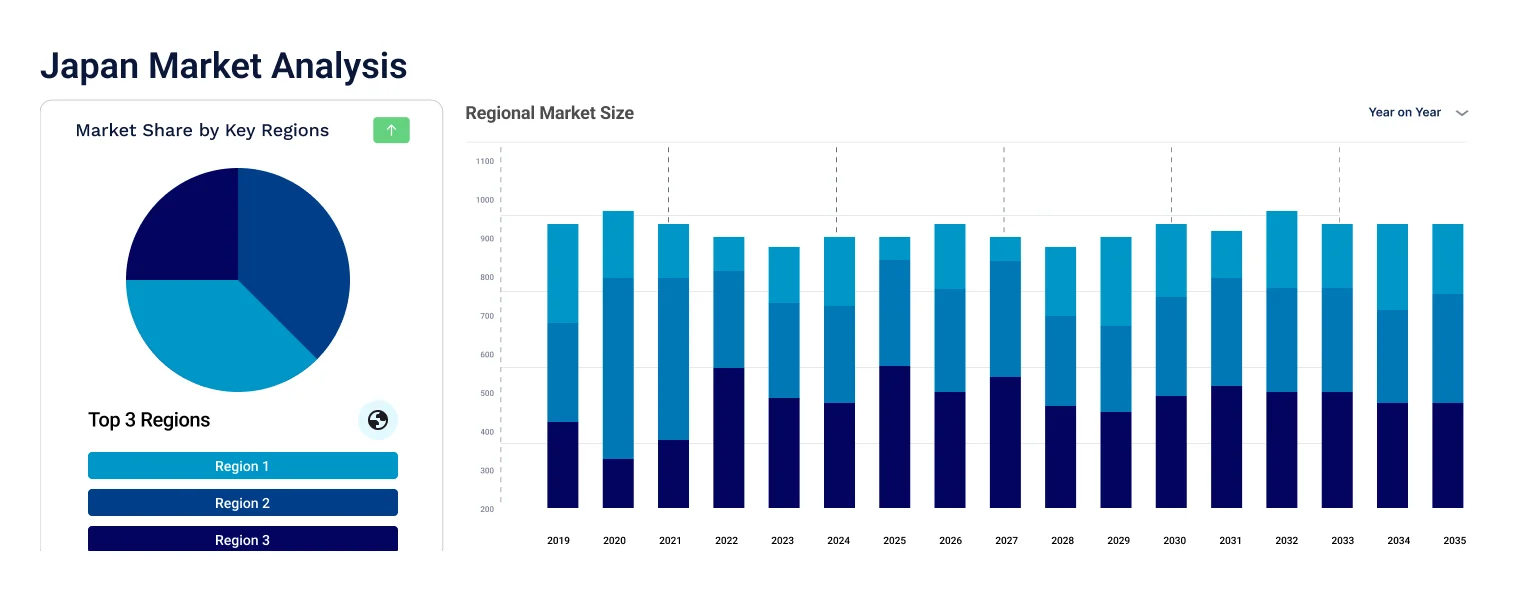
Key Insight: Regional segmentation brings attention to differences in maturity and growth between various Japanese regions. The leading regional automotive artificial intelligence market in Japan is Kanto. This is because of its innovative environment and density of technological companies, which results in the region’s prominence in AI developments. Other regions, such as Kansai, provide input with their ability to diversify industries and engage in research. The Chubu region shows significant potential and rapid growth, strengthened by its powerful manufacturing industry to implement AI applications in production and transportation.
By component, the hardware category accounts for the dominant share of the market due to advanced chip integration demand
Hardware continues to play a vital role within the Japan automotive artificial intelligence market dynamics, with most of the efforts in the sector concentrated on improving computing capabilities and enhancing sensors’ functionality. One company involved in this field is Renesas Electronics Corporation, which aims to create highly effective AI hardware through the development of specialized chips that work efficiently and require minimal energy. The trend towards centralized electronic systems also fuels the demand for new types of processors and graphic processors. In November 2025, Nissan introduced cost-efficient AI-powered self-driving technology using camera-based systems, aiming to democratize autonomous mobility and expand accessibility across mass-market vehicles.
The software sector is observing fast growth in the Japan automotive artificial intelligence market, as car manufacturers move towards creating software-defined cars. For instance, companies such as NTT Data Corporation are developing platforms based on AI technologies, which allow for predicting outcomes and making decisions on their own and updating car systems remotely. This change in the industry makes it possible for OEMs to generate revenue from the sale of software upgrades post-purchase.
By level of autonomy, the level 2 segment accounts for the largest market share due to widespread ADAS feature adoption
Autonomy level 2 currently dominates the Japan automotive artificial intelligence market, fueled by the widespread use of advanced driver assistance systems. Car manufacturers such as Subaru Corporation are embedding artificial intelligence-driven technologies including adaptive cruise control and lane-keeping assistance in their EyeSight systems. Such technologies depend significantly on data analysis and computer vision applications, rendering them financially feasible. Customer preference for improved safety and convenience, coupled with supportive regulatory policies, propels the market growth.
Autonomous vehicles operating at level 4 are experiencing significant progression as Japan advances its smart mobility projects. Firms like Tier IV Inc. are engineering open-source autonomous driving software solutions that can enable self-driving in designated conditions. Test drives of level 4 vehicles under government supervision in both urban and rural environments are facilitating the deployment of such autonomous cars for public transport and logistics services. In February 2026, Helm.ai launched vision-only autonomous driving stack, enabling scalable Level 2+ to Level 4 urban autonomy with reduced data, cost, and hardware dependency.
Passenger vehicles occupy a significant share of the market due to high consumer AI feature demand
Passenger cars represent the dominant category in the Japan automotive artificial intelligence market due to consumers’ preference for safety, comfort, and convenience-related technologies. The leading car manufacturers in Japan such as Mazda Motor Corporation are investing significantly in AI-based systems to be used for assisting drivers in performing different tasks. There is growing pressure on car companies to differentiate themselves via innovative technologies and advanced functionalities offered by intelligent vehicles. For instance, many car manufacturers in Japan are focusing on offering driving modes that cater to particular preferences of customers and voice control technologies. For example, in January 2026, Nvidia unveiled AI-powered self-driving platform enabling reasoning-based autonomy, improving safety, scalability, and decision-making in complex real-world driving scenarios.
Commercial vehicles are one of the fastest-growing segments within the Japan automotive artificial intelligence market scope due to their high potential in terms of efficiency. Leading commercial vehicle producers such as Isuzu Motors Limited are implementing AI-driven technologies in order to improve performance of their fleets. Logistics companies in Japan have also started using AI for optimizing fuel consumption and routes of their vehicles.
By technology, computer vision captures a substantial share of the market due to critical role in perception systems
Computer vision remains the primary technology within the Japan automotive artificial intelligence market, as it provides the basis for such functions as object detection, lane recognition, and driver monitoring. The development of image sensors by firms like Sony Semiconductor Solutions Corporation has led to improved sensor technologies designed specifically for automobile use. Such sensors provide high-resolution images that are necessary for effective operation of AI-based solutions. Multi-camera systems and sensors are being integrated with other techniques, resulting in enhanced efficiency. Given its important role in the provision of critical safety functions, computer vision is expected to continue to dominate the Japanese automobile industry.
Machine learning is rapidly gaining ground in the Japan automotive artificial intelligence market scope, as firms start using their databases to improve AI in vehicles. Companies like Preferred Networks, Inc. work together with automobile manufacturers to develop deep learning models used to support autonomous driving and other processes. Data obtained during the process of driving is becoming a basis for constant optimization of machine learning models. In addition, machine learning is used to reduce power usage in electric vehicles. In August 2025, FPT and Smart Holdings formed Japan joint venture accelerating automotive digital transformation using AI, engineering, and mobility-focused solutions.
|
CAGR 2026-2035 - Market by |
Region |
|
Kansai |
27.2% |
|
Kanto |
XX% |
|
Chubu |
XX% |
|
Others |
XX% |
Kanto dominates the market due to a high concentration of OEMs and tech firms
The Kanto region holds the leading position in the Japan automotive artificial intelligence market owing to the high density of automobile companies, tech companies, and institutions conducting research on artificial intelligence. Tokyo is an important center for innovations since there are many startups dealing in AI and corporate R&D offices in the city. AI mobility applications are currently being developed by companies like Hitachi Astemo Ltd. in this region. In March 2026, Nissan, Wayve, and Uber partnered launching Tokyo robotaxi trials, integrating AI-driven autonomous vehicles with ride-hailing platforms for scalable mobility services.
The Chubu region is showing promising growth potential due to the existence of a powerful automotive industry. As it is home to production plants of Toyota Motor Corporation, there is an increasing amount of investment made in the development of AI-based manufacturing applications and mobility solutions. Companies are employing AI in manufacturing operations to improve their quality and productivity.
There is an increased collaborative effort in the market among car manufacturers, semiconductor companies, and software companies to jointly develop AI software stacks, rather than adopting a silo approach. Japan automotive artificial intelligence companies are working towards deploying edge AI, making use of decision-making systems, and developing software stacks that have a potential for continuous improvement. Partnering strategically creates various opportunities such as autonomous mobility test drives, smart logistics systems, and AI-driven cockpits.
Export-oriented AI products are emerging as a key focus area for the Japan automotive artificial intelligence market players, as they seek to leverage the country’s strong legacy in precision engineering to compete effectively in global markets. Simulation environments and digital twins are increasingly being adopted by players for faster testing cycles.
Aptiv, founded in 1995, and based in Switzerland, is expanding its footprint in Japan with the help of sophisticated ADAS platforms and vehicle architectures. The company specializes in AI software that can be scaled and operated on high-speed hardware to enable adaptive safety features within vehicles. The company’s engagement with OEMs is aimed at simplifying systems and developing software-defined cars.
Founded in 2013, and based in California, United States, Cruise LLC is working on autonomous mobility technology with an emphasis on robotaxis for urban environments. In Japan, the company is considering potential partners for limited deployment experiments. Its AI software relies heavily on deep learning for perception and decision-making in densely populated urban areas.
Mobileye, which was founded in 1999 and has headquarters in Jerusalem, Israel, is extending its reach into Japan using vision-based Advanced Driver Assistance Systems (ADAS) and mapping technologies. Mobileye uses its REM mapping system to collect crowdsourced driving data, improving the accuracy of AI. The EyeQ chips used by the firm are popular among the Japanese automakers, allowing the firm to offer ADAS functionalities affordably.
Founded in 1993 and having its headquarters in Santa Clara, United States of America, NVIDIA Corporation plays an important role in powering the Japan automotive artificial intelligence market. The DRIVE platforms from the firm enable high-performance computing required for self-driving vehicles and AI systems onboard. The current focus of the firm is on building a software-defined car ecosystem.
*Please note that this is only a partial list; the complete list of key players is available in the full report. Additionally, the list of key players can be customized to better suit your needs.*
Other key players in the market include Qualcomm Technologies, Inc., Robert Bosch GmbH, Tesla, Ford Motor Company, TOYOTA RESEARCH INSTITUTE, and Waymo LLC, among others.
Explore the latest trends shaping the Japan automotive artificial intelligence Market 2026-2035 with our in-depth report. Gain strategic insights, future forecasts, and key market developments that can help you stay competitive. Download a free sample report or contact our team for customized consultation on Japan automotive artificial intelligence market trends 2026.


Upto 15% Off
USD
$2499 $2249
$3999 $3599
$4999 $4249
$5999 $5099


*While we strive to always give you current and accurate information, the numbers depicted on the website are indicative and may differ from the actual numbers in the main report. At Expert Market Research, we aim to bring you the latest insights and trends in the market. Using our analyses and forecasts, stakeholders can understand the market dynamics, navigate challenges, and capitalize on opportunities to make data-driven strategic decisions.*
In 2025, the Japan automotive artificial intelligence market reached an approximate value of USD 193.85 Million.
The market is projected to grow at a CAGR of 23.90% between 2026 and 2035.
The key players in the market include Aptiv, Cruise LLC, Mobileye, NVIDIA Corporation, Qualcomm Technologies, Inc., Robert Bosch GmbH, Tesla, Ford Motor Company, TOYOTA RESEARCH INSTITUTE, and Waymo LLC, among others.
Forming strategic partnerships, investing in edge AI chips, expanding pilot testing programs, developing scalable software platforms, and focusing on data-driven services are enabling companies to strengthen competitive positioning.
High development costs, fragmented regulations, limited real-world testing environments, data privacy concerns, and integration complexity between hardware and software systems are slowing large-scale commercialization of automotive AI solutions.
Explore our key highlights of the report and gain a concise overview of key findings, trends, and actionable insights that will empower your strategic decisions.
| REPORT FEATURES | DETAILS |
| Base Year | 2025 |
| Historical Period | 2019-2025 |
| Forecast Period | 2026-2035 |
| Scope of the Report |
Historical and Forecast Trends, Industry Drivers and Constraints, Historical and Forecast Market Analysis by Segment:
|
| Breakup by Component |
|
| Breakup by Level of Autonomy |
|
| Breakup by Vehicle Type |
|
| Breakup by Technology |
|
| Breakup by Region |
|
| Market Dynamics |
|
| Competitive Landscape |
|
| Companies Covered |
|
Datasheet
One User
USD 2,499
USD 2,249
tax inclusive*
Single User License
One User
USD 3,999
USD 3,599
tax inclusive*
Five User License
Five User
USD 4,999
USD 4,249
tax inclusive*
Corporate License
Unlimited Users
USD 5,999
USD 5,099
tax inclusive*
*Please note that the prices mentioned below are starting prices for each bundle type. Kindly contact our team for further details.*
Flash Bundle
Small Business Bundle
Growth Bundle
Enterprise Bundle
*Please note that the prices mentioned below are starting prices for each bundle type. Kindly contact our team for further details.*
Flash Bundle
Number of Reports: 3
20%
tax inclusive*
Small Business Bundle
Number of Reports: 5
25%
tax inclusive*
Growth Bundle
Number of Reports: 8
30%
tax inclusive*
Enterprise Bundle
Number of Reports: 10
35%
tax inclusive*
How To Order

Select License Type
Choose the right license for your needs and access rights.

Click on ‘Buy Now’
Add the report to your cart with one click and proceed to register.

Select Mode of Payment
Choose a payment option for a secure checkout. You will be redirected accordingly.
Strategic Solutions for Informed Decision-Making
Gain insights to stay ahead and seize opportunities.

Get insights & trends for a competitive edge.

Track prices with detailed trend reports.

Analyse trade data for supply chain insights.

Leverage cost reports for smart savings

Enhance supply chain with partnerships.

Connect For More Information
Our expert team of analysts will offer full support and resolve any queries regarding the report, before and after the purchase.
Our expert team of analysts will offer full support and resolve any queries regarding the report, before and after the purchase.
We employ meticulous research methods, blending advanced analytics and expert insights to deliver accurate, actionable industry intelligence, staying ahead of competitors.
Our skilled analysts offer unparalleled competitive advantage with detailed insights on current and emerging markets, ensuring your strategic edge.
We offer an in-depth yet simplified presentation of industry insights and analysis to meet your specific requirements effectively.




