

Consumer Insights
Uncover trends and behaviors shaping consumer choices today
Procurement Insights
Optimize your sourcing strategy with key market data
Industry Stats
Stay ahead with the latest trends and market analysis.
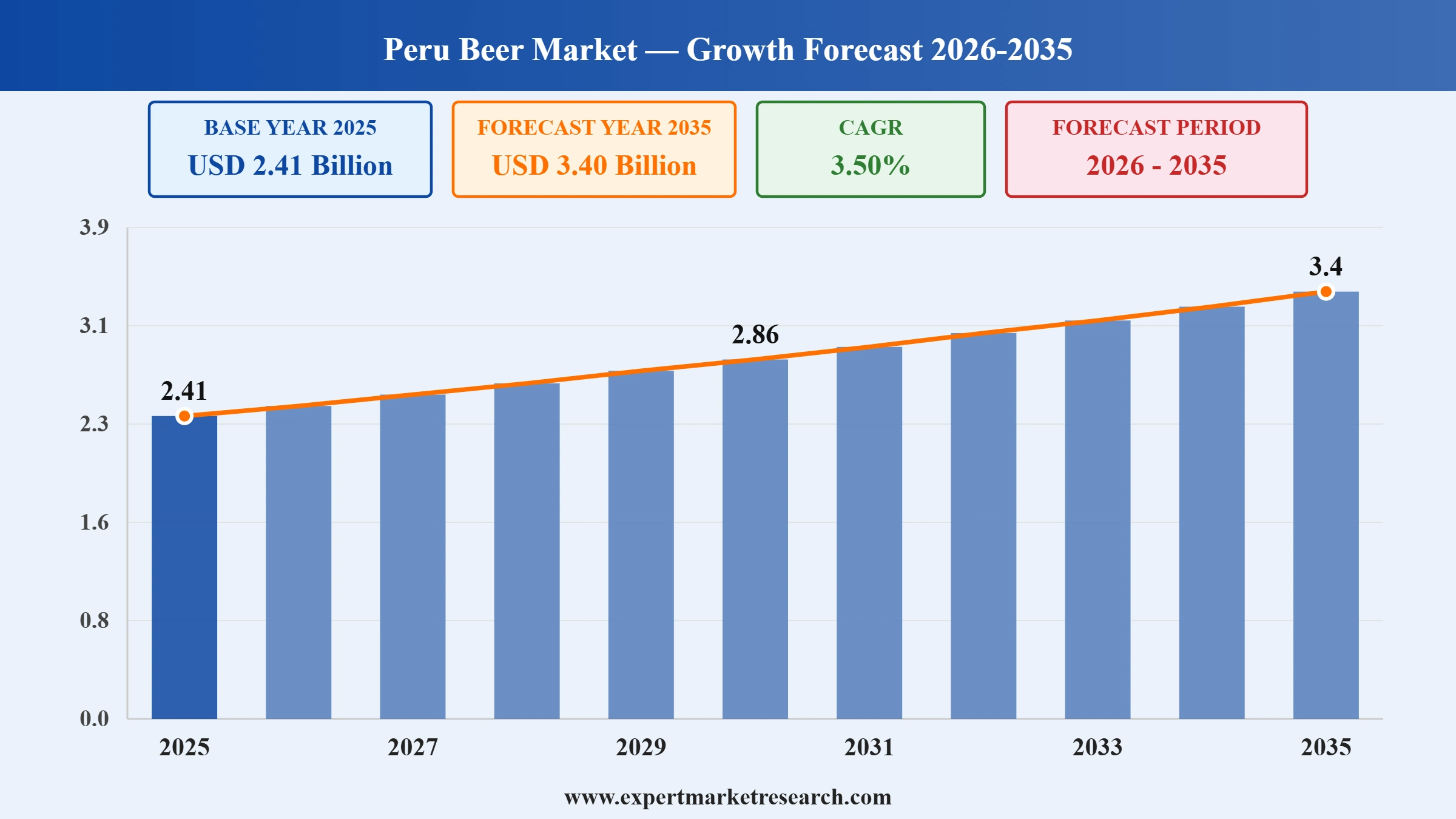
The Peru beer market attained a value of USD 2.41 Billion in 2025 and is projected to expand at a CAGR of 3.50% through 2035. The market is further expected to achieve USD 3.40 Billion by 2035. The use of native Andean grains such as quinoa and purple corn is creating a differentiated demand for Peru’s craft beer segment. Researchers are demonstrating craft beer production using malted purple corn and quinoa, while at the same time research continues examining quinoa’s impact on beer aroma. Such ingredients can give brewers distinctive local flavor, color and provenance, helping premium beers differentiate from mass-market lagers.
The widening of beer consumption occasions is a significant factor augmenting the growth of the Peru beer market. Peruvians consume approximately 43 litres of beer per capita annually, highlighting the category’s established position within the country’s alcoholic beverage landscape. Breweries are no longer relying exclusively on conventional full-strength beer, instead developing products suited to social gatherings, food pairing, sports, convenience consumption and moderation. Recent category developments include growing interest in non-alcoholic and flavoured beer innovations, while craft brewers are increasingly targeting the on-trade channel to strengthen consumer engagement and margins. This is broadening the addressable customer base and helping brands defend relevance among consumers seeking lighter or alternative formats.
Another factor is the strengthening of Peru's hospitality and tourism ecosystem. Tourism contributed PEN 31.1 billion to Peru’s economy in 2024, equivalent to 2.8% of GDP, while the country recorded 3.3 million international overnight tourist arrivals and 44.1 million domestic overnight trips. Restaurants, bars, hotels and entertainment venues therefore remain important points of beer consumption, while premium and craft products can benefit from experiential dining and tourism-led consumption occasions. The increasing sophistication of these channels allows suppliers to introduce higher-value products, improve visibility and develop targeted partnerships with hospitality operators, thereby boosting the Peru beer market value.
Innovation is reshaping the Peru beer market as brewers respond to changing preferences around moderation, convenience and flavour variety. In 2026, Backus highlighted continued development of beer options with and without alcohol, while its portfolio includes Cusqueña Trigo Cero and Corona Cero. Other initiatives undertaken by the firm include the launch of easy-to-drink propositions, which show that the demand for smoother and less bitter flavors is on the rise. Product innovations are not only centered around the alcoholic content but rather have moved to other areas such as flavors, seasons, and alternative occasions. In this way, breweries can appeal to younger consumers who will try out and consume more beer on occasions beyond the traditional ones. Innovation is therefore becoming an important means of differentiating portfolios and maintaining category relevance as consumers increasingly seek products aligned with individual lifestyles and changing drinking habits.
A key challenge for the Peru beer market is intensifying competition from alternative alcoholic beverages, particularly ready-to-drink products that appeal to younger consumers seeking greater variety. Beer brands must compete not only on price and established loyalty but also on flavour, convenience and novelty. The expansion of RTDs and other beverage formats is encouraging consumers to experiment across categories, potentially limiting incremental beer consumption. Economic conditions can further influence purchasing behaviour, creating pressure to balance affordable mainstream products with premium offerings. Brewers must therefore continually refresh portfolios while maintaining brand recognition and distribution strength. Regulatory expectations around responsible alcohol consumption also require companies to promote moderation and responsible sales practices, adding another consideration to market development and consumer engagement, thus aiming more towards the Peru beer market developments.
The demand for lager is expected to grow significantly among consumers.
Off trade consumption of beer is expected to record and witness an upward trend over the forecast period.
Premium beer is expected to constitute a major portion of the Peru beer market share.
Read more about this report - REQUEST FREE SAMPLE COPY IN PDF
Backus introduced Mike's Mango Hot, a limited-edition ready-to-drink product combining mango sweetness with a spicy sensation. The national launch reflects the company's emphasis on flavour experimentation and alternative consumption occasions among adult consumers. The initiative broadens the beverage portfolio around beer-adjacent occasions and demonstrates how established beverage companies are using RTD innovation to capture consumers interested in unconventional flavour experiences. Greater flavour diversification can increase cross-category engagement and encourage incremental beverage occasions.
Backus presented findings on beer's role in Peru's HORECA ecosystem, reporting annual beer sales of 236.7 million litres through the channel and an economic contribution exceeding S/4.4 billion. The initiative positioned beer as part of a broader hospitality value chain involving restaurants, hotels, entertainment businesses and MYPE operators. Greater HORECA integration can strengthen outlet coverage and support sustained commercial demand.
Peruvian craft brewery 7 Vidas announced plans to expand its production facility, introduce a 650 ml returnable bottle and prepare a future can format, alongside potential new taproom locations. The strategy combines production scalability with packaging diversification, allowing the brewery to move beyond niche direct consumption while retaining its premium craft positioning. Expanded production and packaging choices can improve craft-beer availability across additional retail and hospitality channels, thus bolstering the trends in the Peru beer market.
Cervecería del Valle Sagrado announced plans for an alcohol-free line as part of its 2026 growth strategy. The company linked its expansion with demand from consumers interested in wellness while retaining the sensory experience associated with craft beverages. The move indicates that moderation is reaching beyond large industrial breweries and entering Peru's craft segment. Alcohol-free craft products can create a new premium niche and widen the customer base for independent breweries.
The Peruvian beer industry is developing beyond conventional alcoholic products as moderation becomes increasingly relevant to product planning. In January 2026, reporting on Backus's portfolio highlighted the expansion of easy-to-drink and zero-alcohol options, including Pilsen Fresh, Corona Cero and Cusqueña Cero. The development indicates that breweries are using alcohol content as a segmentation variable rather than treating beer as a single homogeneous category. For manufacturers, this creates opportunities to utilise existing brewing expertise across additional consumption occasions, while distributors can use separate shelf positioning to reach consumers seeking moderation without abandoning beer's flavour profile.
Locally-sourced production is an increasingly important issue for Peru’s brewing value chain. In June 2026, Backus revealed a partnership between the company and the ministries of MIDAGRI, UNALM, and INIA to breed Peruvian malting barley varieties suitable to the local climate with the first experiments already being conducted in Jauja and Huancayo. More than 1,000 farmers are participating in the emerging agricultural network. If proven commercially scalable, the production of domestic malting barley would allow breweries to gain yet another source of raw materials.
Premium positioning is becoming more closely linked with origin, gastronomy and cultural storytelling. Cusqueña's association with Cusco provides an example of how local heritage can become part of a premium brand proposition rather than simply serving as a product descriptor. In 2026, Backus used the Cusco festivities and Inti Raymi period to reinforce the connection between the brand and the region's cultural identity. Such positioning gives premium beer manufacturers an avenue to differentiate products through provenance, tourism and food-pairing narratives instead of relying exclusively on packaging or price, thereby augmenting the Peru beer market dynamics and trends.
Peru's craft segment is developing through highly differentiated styles, limited releases, taprooms and barrel-aged products. Cervecería del Valle Sagrado operates taprooms in Cusco and Lima and maintains portfolios spanning classic, seasonal and barrel-aged beers. This is reflected in the architecture of its products, which shows how smaller breweries can engage in competition by focusing on brewing intricacies and retail experience rather than by copying the logistics capabilities of larger industrial breweries. This creates possibilities for specialist ingredient suppliers, brewing equipment manufacturers, hospitality firms, and premium distributors. The growing trend toward experimentation helps the Peruvian breweries include unique local flavors and ingredients in their products.
Beer demand in Peru is closely connected with restaurants, hotels, bars and entertainment venues, making HORECA strategically important for suppliers seeking volume as well as brand visibility. Backus's August 2026 study of the HORECA ecosystem quantified the industry's economic role and highlighted the participation of approximately 161,000 MYPE businesses. Implications for the brewery and the distributor go further than just beverage sales, including outlet segmenting, draught systems, positioning on the menu, food matching, promotion and service may all affect beer’s success. A brewery able to provide such assistance to smaller hospitality establishments will be able to foster better distribution ties.
The Expert Market Research’s report titled "Peru Beer Market Report and Forecast 2026-2035” offers a detailed analysis of the market based on the following segments:
Market Breakup by Product Type
Key Insight: Lager is expected to remain the dominant product type in the Peru beer market, supported by strong consumer familiarity, broad availability and an established preference for lighter, refreshing beer styles. Domestic breweries continue to centre their portfolios on lager variants, spanning mainstream, premium and flavoured offerings. Ale is gaining traction as craft brewing expands and consumers become more interested in distinctive flavours, brewing techniques and speciality products. The growth of independent breweries and experiential beer venues is creating greater visibility for ales, wheat beers and other darker styles. Others, including flavoured, mixed and alcohol-free variants, are also gaining attention as manufacturers respond to changing consumption preferences. Recent product development in Peru increasingly includes innovative flavours and alcohol-free alternatives, broadening the category beyond conventional beer styles, thus boosting the Peru beer market growth.
Market Breakup by Category
Key Insight: The standard beer category is projected to retain its top market share status in the Peru beer market because of its low cost and high appeal among consumers. The availability of the beverages in regular retail stores and social occasions coupled with their brewing traditions makes it possible for consumers to easily identify the products. On the other hand, the premium beer category is gaining growth owing to the increased interest in differentiating flavors and more value from their consumption experience. This has been made possible by brewery companies’ development of special editions of the beers and distinct packaging. Consumers who have greater incomes are trying different types of international beers, which is giving premium beers an opportunity to grow.
Market Breakup by Distribution Channel
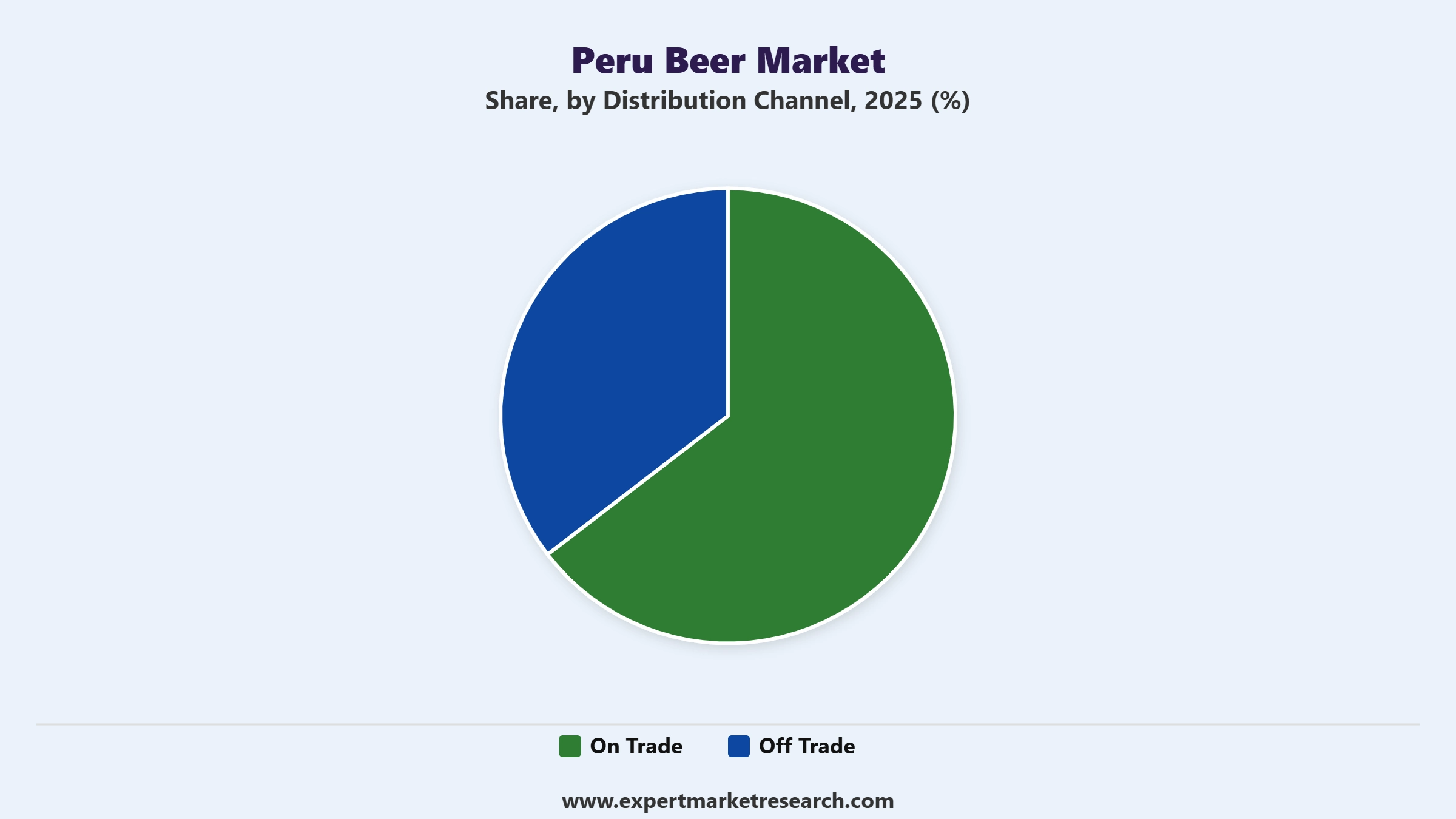
Key Insight: On-trade and off-trade channels are both gaining traction in the Peru beer market as consumption occasions diversify. On-trade benefits from the recovery and expansion of restaurants, bars, hotels and entertainment venues, with beer accounting for 236.7 million litres annually across Peru’s HORECA ecosystem, according to a 2026 Backus-supported study. Off-trade remains crucial through bodegas, supermarkets, convenience stores and other retailers, supported by Backus’ presence across more than 180,000 points of sale nationwide, strengthening accessibility and product visibility.
By type, lager is anticipated to dominate the market due to broad acceptance and extensive distribution
Lager is anticipated to dominate the Peru beer market due to its entrenched consumer acceptance, broad product availability and compatibility with large-scale brewing infrastructure. The category benefits from the extensive distribution networks developed around mainstream beer and remains well positioned across both hospitality and retail channels. Its versatility also allows producers to create multiple sub-positionings, including standard, premium, lighter and alcohol-free variants. This flexibility supports the category's long-term relevance while allowing manufacturers to respond to evolving consumer preferences without abandoning established brewing platforms. An example is Cusqueña Dorada, a Peruvian lager from Backus that is distributed nationally while using Cusco-inspired branding and premium positioning to appeal to consumers seeking a more distinctive alternative to standard mainstream beer. Such developments will thus boost the Peru beer market dynamics and trends in the long run.
Ale is expected to record comparatively strong growth as Peru's craft brewing ecosystem expands and consumers seek more distinctive beer experiences. Independent breweries can differentiate ale through hops, fermentation, ageing and locally inspired ingredients, creating opportunities for higher-value products. Growth is likely to be concentrated in specialist hospitality, taprooms and premium retail rather than mass-market distribution. The category can therefore contribute disproportionately to value creation even where its volume remains below lager, particularly as breweries use limited releases and experimental styles to encourage trial and repeat purchasing.
By category, standard beer is anticipated to dominate the market due to its broad consumer reach
Standard beer is anticipated to account for the dominant share because of its wide consumer base, established pricing structure and strong presence across traditional retail and hospitality channels. In Peru’s HORECA channel, the regular beer segment accounted for 85% of total beer volume, equivalent to 201.2 million litres annually, compared with 15% for premium beer. Its high accessibility makes it the default choice for many everyday social occasions, while established brands benefit from strong recognition and extensive distribution. Standard beer also provides retailers with dependable product rotation. Although premiumization is creating additional value pools, mainstream products remain fundamental to market scale. Their commercial importance ensures that manufacturers will continue to optimize cost structures, packaging, distribution, and promotional activity around the standard segment.
Premium beer is positioned for faster value growth as breweries increasingly differentiate through product quality, provenance, and consumer experience. Peru's culinary reputation and tourism industry provide natural environments for premium beer consumption, particularly in restaurants, hotels and specialist venues. Premium products can also support higher margins through specialized packaging, limited editions and differentiated brewing processes. As consumers become more willing to explore products beyond mainstream lager, breweries can use premium tiers to increase average revenue per consumer. The segment is therefore likely to become increasingly important to portfolio architecture and margin management.
By distribution channel, off trade is anticipated to dominate the market due to extensive retail accessibility
The off-trade category will continue to occupy a dominant role since retail establishments make beer easily accessible to consumers for use within households and the privacy of their own premises. Supermarkets, convenience stores, bodegas, and other retailing points enable breweries to offer various pack sizes and price segments at the same time. Off-trade channels also allow for quick rotation of products and ensure that producers gain significant visibility with regard to new product introductions. For instance, Backus revealed that the company has its products available in more than 180,000 retail outlets all over the country, thus emphasizing the need for a broad retail presence in Peru. Retail development will prove to be especially advantageous in regions beyond major hospitality clusters as a means of reaching secondary cities and residential areas, thereby bolstering the Peru beer demand.
Read more about this report - REQUEST FREE SAMPLE COPY IN PDF
On trade offers strong growth potential as Peru's hospitality ecosystem develops around tourism, dining and entertainment. Restaurants and bars allow breweries to present premium and craft products through draught systems, tasting experiences and food pairings, creating stronger opportunities for value growth than simple packaged sales. Hotels and destination venues can also expose international visitors to Peruvian beer brands, supporting brand-building beyond the domestic market. For suppliers, expanding on-trade penetration requires investment in cold storage, dispensing infrastructure, staff training and outlet relationships. These capabilities can create stronger barriers to competitor substitution and improve customer loyalty.
Read more about this report - REQUEST FREE SAMPLE COPY IN PDF
Lima leads regionally through population, retail, hospitality, premium demand, and product-launch opportunities.
Lima and the surrounding metropolitan market remain the most commercially important regional cluster because of their concentration of population, modern retail, hospitality infrastructure, corporate activity and premium consumption opportunities. The capital also provides breweries with a launchpad for new products before wider national distribution. Lima's extensive network of supermarkets, convenience stores, restaurants, bars and specialist beer venues allows manufacturers to test new formats across different price points and consumption occasions. The city's role as a business and tourism centre further supports premium and craft beer demand. For B2B suppliers, Lima is consequently the priority market for distribution partnerships, new-product trials, specialised packaging and hospitality solutions, thereby directly boosting the Peru beer market regional growth.
Apart from Lima, regional markets present opportunities through tourism, regional identity, and the development of the hospitality industry. Cusco becomes highly important in this context in connection with the market for premium and craft beer due to the tourist influx in the region and the close association between Peruvian beer brands and the city. In Southern Peru, there may be opportunities for the development of regional brands and the expansion of craft brewing industry through the use of locally sourced ingredients and destination-based marketing of products. In Arequipa, it may be shown how regional festivals and gastronomy may be used to develop beer brands, as is the case of Cerveza Arequipeña, which may capitalize on its historical connection with Arequipa in 2026 through the hospitality and anniversary promotions.
Competition in the Peru beer market is increasingly shifting from simple volume expansion towards portfolio architecture, premiumisation, innovation and channel-specific execution. Large international brewers can leverage established brands, production capabilities and sophisticated distribution systems, while independent breweries compete through speciality styles, local ingredients, taprooms and limited releases. This creates a layered competitive structure in which scale and reach remain important, but differentiation increasingly determines value creation.
Peru beer companies are also using product innovation to access emerging consumption occasions. Alcohol-free products, lighter beers, flavoured beverages and alternative formats allow companies to defend beer relevance as consumers diversify their beverage choices. At the same time, craft breweries are increasing production capabilities and developing direct consumer channels. Sustainability, responsible consumption and local sourcing are becoming additional strategic considerations, encouraging companies to build stronger relationships with farmers, hospitality operators and communities. The result is a competitive environment where scalability depends on combining manufacturing efficiency with targeted innovation and market-specific positioning.
Established in 2004 and headquartered in Leuven, Belgium, Anheuser-Busch InBev offers mainstream, premium, alcohol-free and innovative beer products through its extensive global portfolio. In Peru, its presence is represented through Backus and associated brands, supported by established brewing, procurement and distribution capabilities. The company focuses on portfolio diversification, brand investment, channel development and product innovation to strengthen its position across Peru’s evolving beer consumption landscape.
Established in 1997 and headquartered in London, United Kingdom, Diageo offers a diverse beverage alcohol portfolio spanning spirits and beer, including Guinness. The company leverages its international distribution network, premium brand expertise and hospitality relationships to participate in markets such as Peru. Its competitive strategy emphasises premium positioning, brand building, consumer engagement and cross-channel activation, supporting opportunities across premium beer and hospitality-led consumption occasions.
Established in 1952 and headquartered in Amsterdam, Netherlands, Heineken offers a broad international beer portfolio, including Heineken, Amstel and Tres Cruces in Peru. Through HEINEKEN Perú, established in 2020, the company combines international brewing expertise with local market development. Its strategy focuses on premiumisation, product innovation, brand building and responsible consumption, while strengthening distribution and consumer engagement across retail, hospitality and other beer consumption channels.
Established in 2014 and headquartered in Ollantaytambo, Cusco, Peru, Cervecería del Valle Sagrado offers classic, seasonal and barrel-aged craft beers. The brewery operates taprooms in Cusco and Lima, providing direct consumer experiences alongside its specialised product portfolio. Its competitive positioning centres on craft brewing, experimentation, local identity and experiential consumption. The company differentiates itself from large industrial breweries through distinctive beers, small-scale production and hospitality-focused consumer engagement.
Other key players in the market include Huntsman International LLC, H.B. Fuller Australia Pty Ltd., and Sika Australia Pty Ltd., among others.
*Please note that this is only a partial list; the complete list of key players is available in the full report. Additionally, the list of key players can be customized to better suit your needs.*
Understand the changing competitive structure of the Peru Beer market with Expert Market Research's detailed industry analysis. The report evaluates the Peru Beer market size, segmentation, competitive landscape, emerging trends 2026, and long-term opportunities across product types and distribution channels. Download the sample to assess the latest Peru Beer market forecast 2026-2035 and identify actionable opportunities for market entry, product development, distribution expansion and investment.


Upto 15% Off
USD
$2499 $2249
$3999 $3599
$4999 $4249
$5999 $5099


*While we strive to always give you current and accurate information, the numbers depicted on the website are indicative and may differ from the actual numbers in the main report. At Expert Market Research, we aim to bring you the latest insights and trends in the market. Using our analyses and forecasts, stakeholders can understand the market dynamics, navigate challenges, and capitalize on opportunities to make data-driven strategic decisions.*
The market was valued at nearly USD 2.41 Billion in 2025.
The market is projected to grow at a CAGR of 3.50% between 2026 and 2035.
The market is assessed to witness a healthy growth in the forecast period to reach around USD 3.40 Billion in 2035.
The different distribution channels in the market include on trade and off trade.
The major categories of beer in the market are standard beer and premium beer.
The different product types in the market are lager, and ale, among others.
The key market players are Anheuser-Busch Inbev SA/NV, Diageo Plc, Heineken Holding NV, Cervecería del Valle, 7 VIDAS, Jack Vled & Co., and Real Craft Beer Company Sac, among others.
Key challenges include high excise taxation, regulatory burdens, intense market concentration, limited growth in beer volumes, competition from alternative alcoholic beverages, and persistent informality affecting fair competition.
Key strategies include portfolio diversification, premiumisation, low- and no-alcohol innovation, flavour-led product launches, strong distribution, digital engagement, and partnerships with HORECA channels to reach new consumption occasions and consumer segments.
Explore our key highlights of the report and gain a concise overview of key findings, trends, and actionable insights that will empower your strategic decisions.
| REPORT FEATURES | DETAILS |
| Base Year | 2025 |
| Historical Period | 2019-2025 |
| Forecast Period | 2026-2035 |
| Scope of the Report |
Historical and Forecast Trends, Industry Drivers and Constraints, Historical and Forecast Market Analysis by Segment:
|
| Breakup by Product Type |
|
| Breakup by Category |
|
| Breakup by Distribution Channel |
|
| Market Dynamics |
|
| Competitive Landscape |
|
| Companies Covered |
|
Datasheet
One User
USD 2,499
USD 2,249
tax inclusive*
Single User License
One User
USD 3,999
USD 3,599
tax inclusive*
Five User License
Five User
USD 4,999
USD 4,249
tax inclusive*
Corporate License
Unlimited Users
USD 5,999
USD 5,099
tax inclusive*
*Please note that the prices mentioned below are starting prices for each bundle type. Kindly contact our team for further details.*
Flash Bundle
Small Business Bundle
Growth Bundle
Enterprise Bundle
*Please note that the prices mentioned below are starting prices for each bundle type. Kindly contact our team for further details.*
Flash Bundle
Number of Reports: 3
20%
tax inclusive*
Small Business Bundle
Number of Reports: 5
25%
tax inclusive*
Growth Bundle
Number of Reports: 8
30%
tax inclusive*
Enterprise Bundle
Number of Reports: 10
35%
tax inclusive*
How To Order

Select License Type
Choose the right license for your needs and access rights.

Click on ‘Buy Now’
Add the report to your cart with one click and proceed to register.

Select Mode of Payment
Choose a payment option for a secure checkout. You will be redirected accordingly.
Strategic Solutions for Informed Decision-Making
Gain insights to stay ahead and seize opportunities.

Get insights & trends for a competitive edge.

Track prices with detailed trend reports.

Analyse trade data for supply chain insights.

Leverage cost reports for smart savings

Enhance supply chain with partnerships.

Connect For More Information
Our expert team of analysts will offer full support and resolve any queries regarding the report, before and after the purchase.
Our expert team of analysts will offer full support and resolve any queries regarding the report, before and after the purchase.
We employ meticulous research methods, blending advanced analytics and expert insights to deliver accurate, actionable industry intelligence, staying ahead of competitors.
Our skilled analysts offer unparalleled competitive advantage with detailed insights on current and emerging markets, ensuring your strategic edge.
We offer an in-depth yet simplified presentation of industry insights and analysis to meet your specific requirements effectively.




