

Consumer Insights
Uncover trends and behaviors shaping consumer choices today
Procurement Insights
Optimize your sourcing strategy with key market data
Industry Stats
Stay ahead with the latest trends and market analysis.
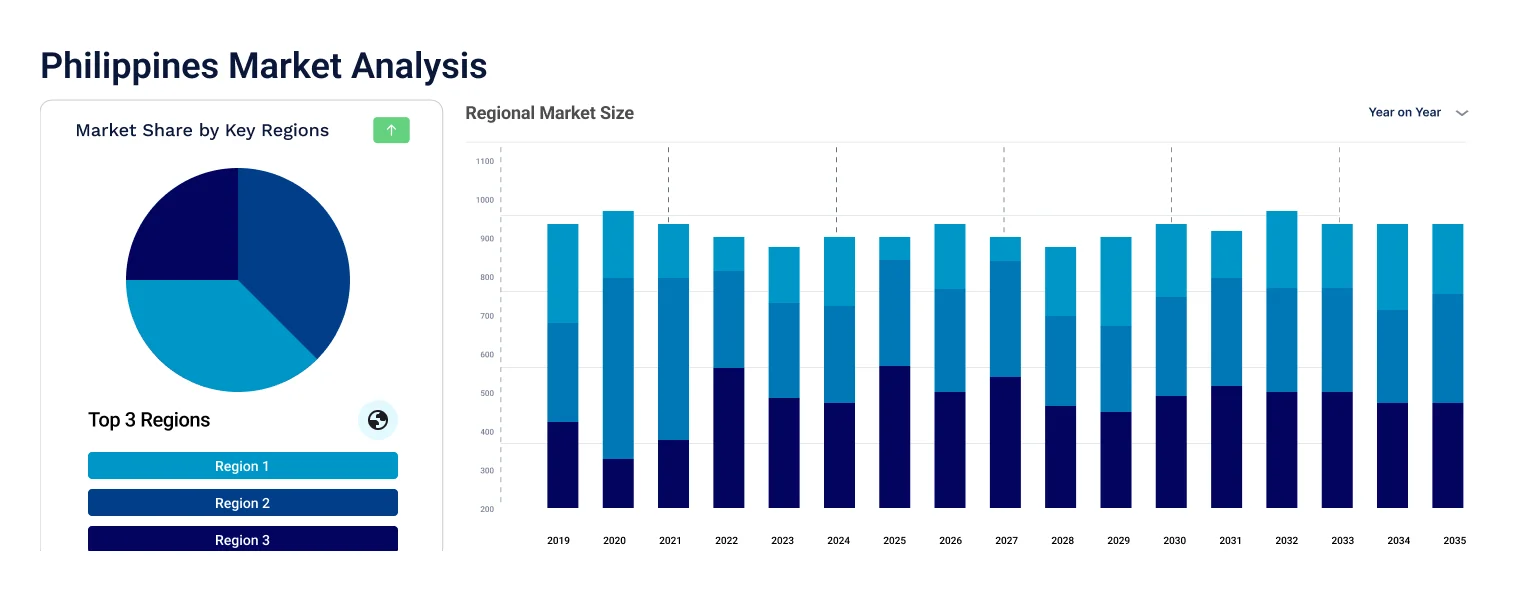
The Philippines medical devices market was valued at USD 729.56 Million in 2025, driven by the presence of an aging population and increased awareness are driving demand for devices such as prosthetics, hearing aids, and implants across the region. The market is anticipated to grow at a CAGR of 9.00% during the forecast period of 2026-2035, with the values likely to reach USD 1727.13 Million by 2035. In addition, policies like the Universal Health Care Act and the ASEAN Medical Device Directive are enhancing regulatory standards and expanding healthcare access, fostering a more favorable environment for medical device adoption.
Compound Annual Growth Rate
9%
Value in USD Million
2026-2035
According to the International Trade Administration, the Philippine medical devices market is heavily import-reliant, with imported products accounting for approximately 99.2% of the market. The United States remains a key supplier, commanding around 12% of the market share. Other major contributors include China, Singapore, Japan, and Germany. Looking ahead, the Philippine medical devices sector presents considerable growth potential, driven by an expanding healthcare infrastructure, particularly in underserved regions like Visayas and Mindanao, and government reforms such as the Universal Health Care (UHC) Act, which aims to enhance healthcare accessibility. In addition, the growth in private healthcare investments and medical tourism, especially in urban centers are also expected to boost market value in the coming years.
Government Incentives to Boost Local Medical Device Manufacturing
The Philippine government is actively promoting local medical device production through strategic initiatives. In August 2024, the Philippine Food and Drug Administration (FDA) and the Philippine Economic Zone Authority (PEZA) signed a Memorandum of Agreement (MOA) to launch the country’s first Pharma-Med Development Hub. This specialized hub is set to attract both domestic and international companies involved in medical device manufacturing, R&D, clinical testing, and trials. Firms operating within the zone will benefit from incentives such as tax breaks and faster regulatory approvals, making the Philippines a more competitive and attractive location for investment. This move is expected to accelerate local production, reduce import dependency, and drive long-term growth in the country’s medical device industry.
Medical-technology companies gathered at Medical Philippines Expo 2026, held from 19–21 August at SMX Convention Center Manila, to showcase medical equipment, healthcare technologies, laboratory solutions, and related innovations. The event provided manufacturers and distributors with a platform to introduce technologies to Philippine healthcare buyers and establish commercial relationships. Greater exposure to advanced equipment can accelerate hospital procurement, broaden product availability, and strengthen competition among domestic distributors and international medical-device suppliers.
Remington Medical announced developments around in-country medical-device prototyping and tooling, highlighting how local engineering capabilities can reduce the time required to transfer device designs into manufacturing. The company’s Philippine operations support medical-device development with quality systems including ISO 13485 certification. Greater local prototyping and manufacturing capability can reduce reliance on overseas development resources, shorten product-development cycles, and strengthen the Philippines’ role within the regional medical-device supply chain, thereby bolstering the Philippines medical devices demand.
The Philippine Department of Health formally implemented its medical-device adverse-event reporting framework through Administrative Order No. 2025-0030. The framework establishes requirements for reporting safety incidents associated with medical devices and adopts relevant provisions of the ASEAN Medical Device Directive. Mandatory post-market surveillance increases compliance responsibilities for manufacturers, importers, and distributors while strengthening device safety monitoring, risk management, corrective-action procedures, and overall confidence in products sold across the Philippine healthcare market.
The Philippine FDA continued implementation of its eServices Portal for medical-device regulatory applications. The system enables regulated establishments to submit and monitor applications electronically, including applications associated with Certificates of Medical Device Notification. The FDA had already mandated electronic submission for initial Class A CMDN applications from March 2025, with the digital system continuing to support regulatory processing in 2026. Increasing regulatory digitalisation can reduce paperwork, improve application tracking, and make market-entry and compliance processes more efficient for medical-device manufacturers and distributors.
A major emerging trend in the Philippines is the push to reduce heavy dependence on imported medical devices by developing local assembly and manufacturing capabilities. Industry stakeholders are exploring partnerships with economic zones and government agencies to establish local operations, particularly for products where importing components and assembling them domestically may be more economical than importing finished devices. This could gradually strengthen domestic supply chains, reduce import dependence, create manufacturing opportunities, and attract international companies seeking regional production bases.
AI-based healthcare services have been attracting increasing interest in the Philippines, with stakeholders in government and the healthcare industry analyzing various applications of artificial intelligence and digital technology to the provision of healthcare services. An analysis carried out in June 2026 through the initiative of the National Academy of Science and Technology focused on AI applications and identified infrastructure, workforce capability, governance, and urban-rural divide as key barriers. The rising trend of adoption of AI is expected to drive demand for intelligent diagnostic, monitoring, and clinical decision support systems, hence boosting the Philippines medical devices market growth.
Healthcare professionals are turning towards the development of connected devices that will be able to collect and transmit patient information not only from traditional hospital settings but also from other locations. The need for such technologies is justified through chronic disease treatment, digital healthcare solutions, and the desire to have monitoring functions extended to patients who do not live close to large hospitals. The healthcare industry of the Philippines demonstrates its needs in data analytics, clinical decision support tools, AI, and machine learning technologies. Greater adoption of connected devices can expand opportunities for remote patient monitoring, wearable medical technologies, home-care equipment, and digitally enabled diagnostic systems.
There has been an increased need for medical diagnostic equipment as healthcare professionals in the Philippines deal with chronic diseases and improve their diagnostic capabilities. The hospitals and healthcare facilities will need equipment that can diagnose cardiovascular diseases, kidney diseases, respiratory problems, cancer, and other ailments with greater accuracy at an earlier stage. The country's healthcare system is also experiencing continued hospital-development activity, creating opportunities for equipment upgrades and replacement. Demand for advanced imaging, laboratory equipment, patient-monitoring systems, and other diagnostic technologies is creating opportunities for suppliers offering higher-performance equipment supported by training, maintenance, and lifecycle services.
The Philippines is increasingly discussing how to build a more resilient domestic medical-device ecosystem rather than remaining primarily dependent on finished-product imports. Industry representatives highlighted fragmented supply chains, limited manufacturing capacity, and gaps in research and development during a January 2026 industry discussion. The Philippines remains highly import-dependent, making supply-chain resilience an important strategic issue. Greater emphasis on local capabilities could stimulate investment in prototyping, component sourcing, contract manufacturing, biomedical engineering, testing, repair, and technical-support services.
The market report offers a detailed analysis of the market based on the following segments:
Market Breakup by Product
Market Breakup by Application
Market Breakup by End User
Cardiology to Lead the Market Share by Application
According to the Philippine Statistics Authority, the top three causes of death from January to April 2024 were ischemic heart diseases, neoplasms (cancers), and cerebrovascular diseases. This data provides a clear basis for segmenting the medical devices market in alignment with the country’s most critical healthcare needs. Ischemic heart disease accounted for 30,848 deaths (20.2% of total deaths), making it the leading cause of mortality. This highlights a strong demand for cardiovascular medical devices such as pacemakers, stents, defibrillators, and diagnostic imaging tools. Innovations targeting early diagnosis, treatment, and management of heart disease will be critical to meet this demand.
The key features of the market report comprise funding and investment analysis, and strategic initiatives by the leading players. The major companies in the market are as follows:
Medtronic is a global leader in medical technology, offering a broad portfolio of products across multiple therapeutic areas including cardiology, neurology, diabetes care, and spinal and orthopedic devices. In the Philippines, Medtronic is a key player especially in cardiovascular devices such as pacemakers, stents, and cardiac monitors. The company’s strong focus on innovation and patient-centric solutions positions it as a trusted partner in addressing the country’s growing burden of cardiovascular and neurological diseases.
Johnson & Johnson MedTech, a division of the multinational Johnson & Johnson group, provides a wide range of medical devices spanning orthopedics, surgery, cardiovascular care, and diabetes management. In the Philippine market, J&J MedTech is known for its advanced surgical instruments, joint reconstruction implants, and diabetes care products. Their extensive healthcare network and commitment to R&D allow them to offer cutting-edge solutions tailored to local healthcare needs.
Fresenius Medical Care specializes in products and services for dialysis and renal care. It is a dominant player in the Philippines for dialysis machines, consumables, and related patient care services, addressing the high prevalence of chronic kidney disease in the country. Fresenius’ integrated approach combining equipment and clinical support services makes it a vital contributor to improving renal care infrastructure and patient outcomes locally.
Abbott is a global healthcare company with a significant presence in the Philippines, offering a wide range of diagnostic, cardiovascular, diabetes care, and nutrition products. In the medical devices market, Abbott is especially recognized for its diabetes care devices such as glucose monitoring systems, as well as diagnostic tools used in hospitals and laboratories. Their innovations in remote monitoring and patient-friendly technologies help improve chronic disease management and early diagnosis.
*Please note that this is only a partial list; the complete list of key players is available in the full report. Additionally, the list of key players can be customized to better suit your needs.*
Other players in the market include GE Healthcare, Koninklijke Philips N.V., Siemens Healthcare GmbH and 3M Company, among others.


Upto 15% Off
USD
$1999 $1799
$3099 $2789
$4599 $3909
$5999 $5099


*While we strive to always give you current and accurate information, the numbers depicted on the website are indicative and may differ from the actual numbers in the main report. At Expert Market Research, we aim to bring you the latest insights and trends in the market. Using our analyses and forecasts, stakeholders can understand the market dynamics, navigate challenges, and capitalize on opportunities to make data-driven strategic decisions.*
Explore our key highlights of the report and gain a concise overview of key findings, trends, and actionable insights that will empower your strategic decisions.
| REPORT FEATURES | DETAILS |
| Base Year | 2025 |
| Historical Period | 2019-2025 |
| Forecast Period | 2026-2035 |
| Scope of the Report |
Historical and Forecast Trends, Industry Drivers and Constraints, Historical and Forecast Market Analysis by Segment:
|
| Breakup by Product |
|
| Breakup by Application |
|
| Breakup by End User |
|
| Market Dynamics |
|
| Supplier Landscape |
|
| Companies Covered |
|
Datasheet
One User
USD 1,999
USD 1,799
tax inclusive*
Single User License
One User
USD 3,099
USD 2,789
tax inclusive*
Five User License
Five User
USD 4,599
USD 3,909
tax inclusive*
Corporate License
Unlimited Users
USD 5,999
USD 5,099
tax inclusive*
*Please note that the prices mentioned below are starting prices for each bundle type. Kindly contact our team for further details.*
Flash Bundle
Small Business Bundle
Growth Bundle
Enterprise Bundle
*Please note that the prices mentioned below are starting prices for each bundle type. Kindly contact our team for further details.*
Flash Bundle
Number of Reports: 3
20%
tax inclusive*
Small Business Bundle
Number of Reports: 5
25%
tax inclusive*
Growth Bundle
Number of Reports: 8
30%
tax inclusive*
Enterprise Bundle
Number of Reports: 10
35%
tax inclusive*
How To Order

Select License Type
Choose the right license for your needs and access rights.

Click on ‘Buy Now’
Add the report to your cart with one click and proceed to register.

Select Mode of Payment
Choose a payment option for a secure checkout. You will be redirected accordingly.
Strategic Solutions for Informed Decision-Making
Gain insights to stay ahead and seize opportunities.

Get insights & trends for a competitive edge.

Track prices with detailed trend reports.

Analyse trade data for supply chain insights.

Leverage cost reports for smart savings

Enhance supply chain with partnerships.

Connect For More Information
Our expert team of analysts will offer full support and resolve any queries regarding the report, before and after the purchase.
Our expert team of analysts will offer full support and resolve any queries regarding the report, before and after the purchase.
We employ meticulous research methods, blending advanced analytics and expert insights to deliver accurate, actionable industry intelligence, staying ahead of competitors.
Our skilled analysts offer unparalleled competitive advantage with detailed insights on current and emerging markets, ensuring your strategic edge.
We offer an in-depth yet simplified presentation of industry insights and analysis to meet your specific requirements effectively.




