

Consumer Insights
Uncover trends and behaviors shaping consumer choices today
Procurement Insights
Optimize your sourcing strategy with key market data
Industry Stats
Stay ahead with the latest trends and market analysis.
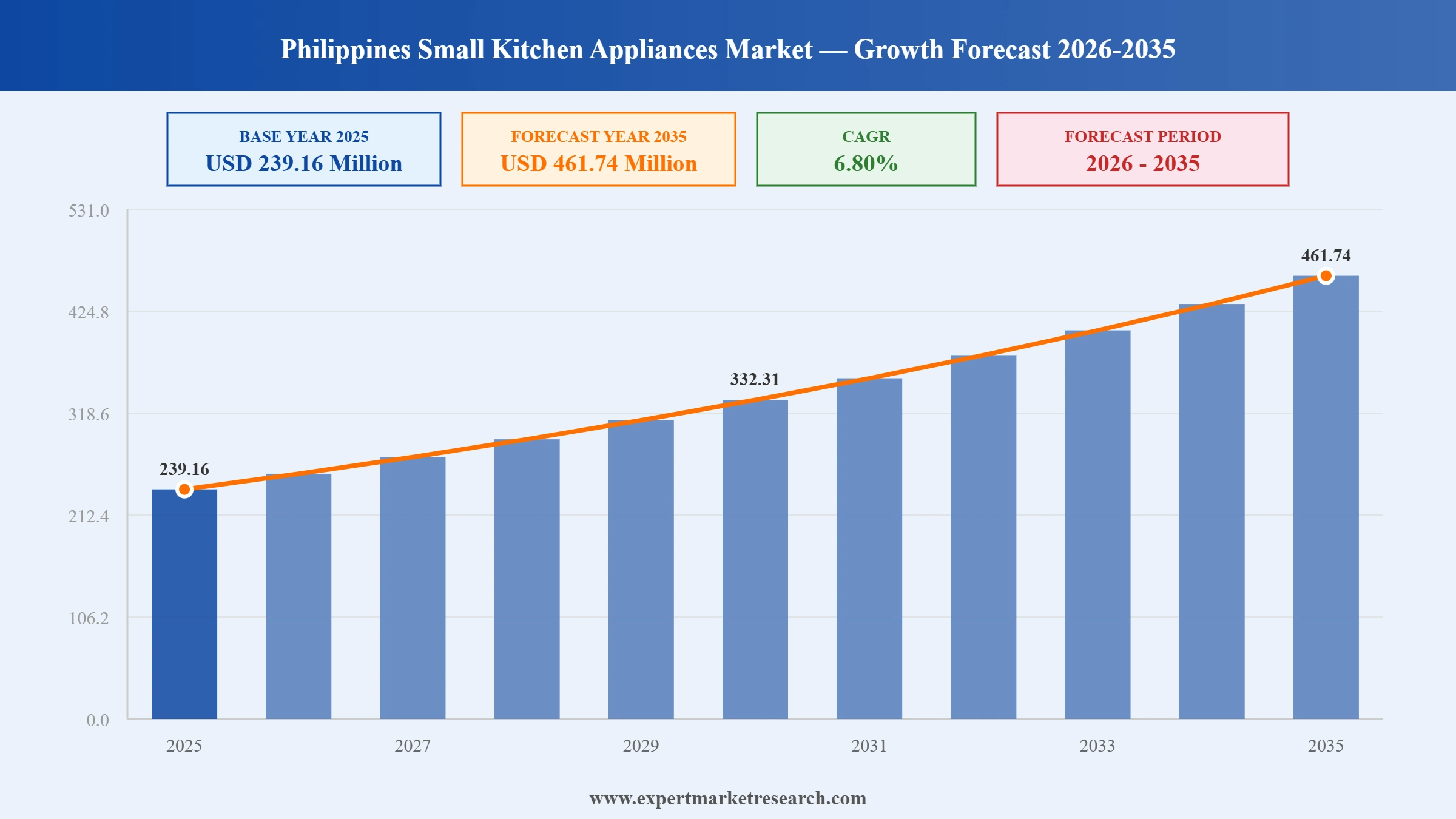
The Philippines Small Kitchen Appliances Market reached a value of USD 239.16 Million at 2025 and is projected to expand at a CAGR of around 6.80% during the forecast period of 2026-2035. With rising health consciousness among Filipino consumers spurring air fryer adoption, rapid e-commerce growth making diverse product ranges accessible across all income levels, the boom in home-based food businesses driving appliance upgrades, and the urban condominium lifestyle demanding compact multifunctional kitchen solutions, the market is expected to reach USD 461.74 Million by 2035.
The rise of condominium living across urban centres in the Philippines is uniquely driving growth in the small kitchen appliances market. With limited kitchen space in high-rise units, consumers increasingly seek compact, multifunctional appliances. For instance, slim air fryers, mini rice cookers, and under-cabinet toasters are gaining popularity among condo residents in Metro Manila. This lifestyle shift encourages manufacturers to innovate space-efficient designs, aligning with the evolving preferences of a growing urban population prioritizing convenience, minimalism, and practical home solutions, thereby driving the growth of Philippines small kitchen appliances market.
The Philippines market for small kitchen appliances is also being reshaped by rising urban migration. According to the Philippine Statistics Authority, the urban population rose by 7.2 million, leading to higher appliance demand in compact city homes. This shift is encouraging purchases of multifunctional and space-saving kitchen tools that suit tight urban living spaces, particularly in cities like Metro Manila and Cebu.
Consumer preference is shifting toward energy-efficient appliances owing to the Department of Energy’s Minimum Energy Performance Standard (MEPS) programme. For example, in 2023, the DOE mandated MEPS compliance for refrigerators and air conditioners, prompting brands like Panasonic and Sharp to launch inverter refrigerators with energy-saving certifications. This led to a noticeable uptake in compliant models, particularly in Metro Manila, as households sought to lower electricity bills while meeting government efficiency standards. The policy is expanding to other appliances, reinforcing this consumer trend.
Start-ups and regional manufacturers are tailoring products to local cooking habits, boosting the Philippines small kitchen appliances market development. For instance, mini rice cookers with built-in steamer trays are gaining popularity in small condos and apartments. In 2023, the DTI (Department of Trade and Industry) reported an 8.82% increase in SME brands integrating local design innovation into product offerings, often combining two or more cooking functions in one device.
As e-commerce penetration expands, even traditional kitchen brands are digitising their product line-ups. Local companies in the Philippines small kitchen appliances market are embedding AI into air fryers and food processors to attract younger, tech-driven consumers. There is also a growing push for “smart budget” appliances, cost-efficient models that offer IoT compatibility and mobile app controls. This hybrid trend is being actively promoted by the DICT (Department of Information and Communications Technology), which is subsidising IoT R&D for local appliance manufacturers.
Read more about this report - REQUEST FREE SAMPLE COPY IN PDF
|
Philippines Small kitchen appliances Market Report Summary |
Description |
Value |
|
Base Year |
USD Million |
2025 |
|
Historical Period |
USD Million |
2019-2025 |
|
Forecast Period |
USD Million |
2026-2035 |
|
Market Size 2025 |
USD Million |
239.16 |
|
Market Size 2035 |
USD Million |
461.74 |
|
CAGR 2019-2025 |
Percentage |
XX% |
|
CAGR 2026-2035 |
Percentage |
6.80% |
|
CAGR 2026-2035 - Market by Distribution Channel |
Online Channel |
7.7% |
|
CAGR 2026-2035 - Market by Product |
Air Fryers |
7.6% |
|
2025 Market Share by Distribution Channel |
Online Channel |
24.6% |
The key trends of the Philippines small kitchen appliances market include the adoption of smart appliances, rising demand for air fryers, energy-efficient models, and booming e-commerce channels.
Samsung unveiled its 2025 Bespoke AI home appliances lineup for the Philippines at the 2025 Southeast Asia Tech Seminar held in Bangkok in June 2025. The Philippines-targeted range includes the Bespoke AI Family Hub refrigerator equipped with a 32-inch touchscreen, the Bespoke AI double-door refrigerator with a 9-inch touchscreen, and the Bespoke AI Combo Washer/Dryer with a 7-inch touchscreen. The all-in-one smart oven, a compact kitchen appliance, was also part of the lineup, representing Samsung's commitment to delivering AI-powered cooking convenience tailored to the space-efficient living demands of urban Filipino households in condominiums and apartments.
In 2025, Evergood Unlimited Corp emerged as the leading player in the Philippines small cooking appliances market, reinforced by strong demand for air fryers driven by health-consciousness trends and social media influence. Hanabishi Philippines Inc followed closely, leveraging its broad distribution network and competitive pricing to maintain its position against digital-first brands. The market saw accelerated air fryer adoption across income tiers, with platforms such as Shopee, Lazada, and TikTok Shop serving as primary purchase channels. Emerging brands including Simplus gained share in the budget segment through aggressive pricing, while established players responded with expanded smart appliance portfolios targeting Filipino urban households.
Samsung presented its advanced Bespoke AI series at an exclusive showcase at Abenson's Greenhills Madison flagship store in the Philippines in September 2024. The featured product highlights included an all-in-one smart oven specifically designed for modern Filipino kitchens, alongside connected refrigeration and laundry solutions. The event underscored Samsung's strategy of embedding AI-powered features into everyday kitchen appliances to cater to the evolving lifestyle preferences of Filipino households, particularly younger consumers in Metro Manila seeking smart, multifunctional cooking solutions that save counter space and preparation time.
Toshiba Lifestyle Philippines participated in the Robinsons Appliances Kitchen Revolution event in Cebu in August 2024, presenting its Lava Series kitchen appliance range to retailers and consumers across the Visayas region. The event highlighted the growing push by international appliance brands to strengthen their presence beyond Metro Manila and reach consumers in provincial cities. Toshiba's participation signals continued investment in the Philippine market and the expanding opportunity in secondary cities where rising disposable incomes and improving retail infrastructure are creating new demand for branded kitchen appliances.
Hitachi Home Appliances marked its formal entry into the Philippine consumer appliance market in May 2024 with a soft launch event highlighting the company's commitment to innovation, product quality, and elevated performance standards for Filipino homes. The entry of Hitachi, a well-regarded Japanese brand with a global reputation for durable and technologically sophisticated appliances, adds a new competitive tier to the Philippines small kitchen appliances segment. Hitachi's market entry reflects growing international confidence in the Philippines consumer appliances market and creates additional choice for consumers seeking premium, energy-efficient kitchen products from established global manufacturers.
Air fryers have emerged as the single fastest-growing product in the Philippines small kitchen appliances market, projected to expand at a CAGR of 7.6% through the forecast period. Filipino consumers are increasingly drawn to oil-free cooking as health consciousness rises and nutritional awareness deepens across urban and semi-urban households. Social media platforms, particularly TikTok and Facebook, have played a significant role in normalizing air fryer cooking through recipe demonstrations, product reviews, and influencer endorsements, effectively driving first-time purchases among younger demographics. Philippines Small Kitchen Appliances Market growth in this category is also being fueled by competitive pricing as both international brands and value-oriented local challengers expand air fryer availability. In June 2023, Gaabor launched its air fryer series in the Philippines with an aggressive digital-first go-to-market strategy, specifically targeting Shopee and Lazada consumers through promotional pricing and high-visibility online campaigns.
The integration of IoT and AI capabilities into small kitchen appliances is gaining momentum in the Philippines, with leading brands embedding app-controlled features, voice activation, and adaptive cooking programs into devices ranging from coffee makers to multi-cookers and smart ovens. Midea's AI-enabled Barista Brew coffee machine, which uses machine learning to suggest personalized brew profiles, exemplifies how brands are using technology to justify premium pricing and build consumer loyalty beyond single-purchase transactions. Samsung's September 2024 showcase of the Bespoke AI smart oven in the Philippines demonstrated a deliberate effort to introduce AI-powered cooking convenience to Filipino households, particularly in Metro Manila's growing condominium residential segment where compact, multifunctional smart appliances deliver clear value in limited kitchen spaces.
Online channels are the fastest-growing distribution route for small kitchen appliances in the Philippines, projected to expand at a CAGR of 7.7% through 2035. The Philippines' e-commerce market reached USD 17 billion in sales in 2021 and has continued to climb, with appliance categories benefiting from platform-level promotional events such as Shopee 11.11 and Lazada sale days that significantly lower the effective purchase barrier for mid-range kitchen products. Newer appliance categories such as air fryers and egg cookers, which are well-suited to content-driven marketing, have seen particularly strong online-driven growth. The expansion of digital payment infrastructure and improved logistics to provincial cities is extending e-commerce appliance access beyond Metro Manila, opening new consumer bases in Luzon, Visayas, and Mindanao for online-first brands.
The rise of home-based food businesses and online food selling platforms in the Philippines has created a new and growing demand segment for small kitchen appliances at the prosumer level. Entrepreneurs operating via social media stores, food delivery platforms, and online marketplaces increasingly invest in stand mixers, food processors, blenders, and induction cookers to support higher-volume, more consistent food production from residential kitchens. This trend is supporting appliance upgrades even in lower-to-middle income households, expanding the effective consumer base beyond lifestyle-driven purchasers to include functional business users. In October 2023, Fruitas Holdings, a food cart business group, announced the acquisition of foodpanda Philippines' cooking facilities to accelerate its own cloud kitchen startup, reflecting the growing formalization of home-adjacent food production businesses in the country.
The EMR’s report titled “Philippines Small Kitchen Appliances Market Report and Forecast 2026-2035” offers a detailed analysis of the market based on the following segments:
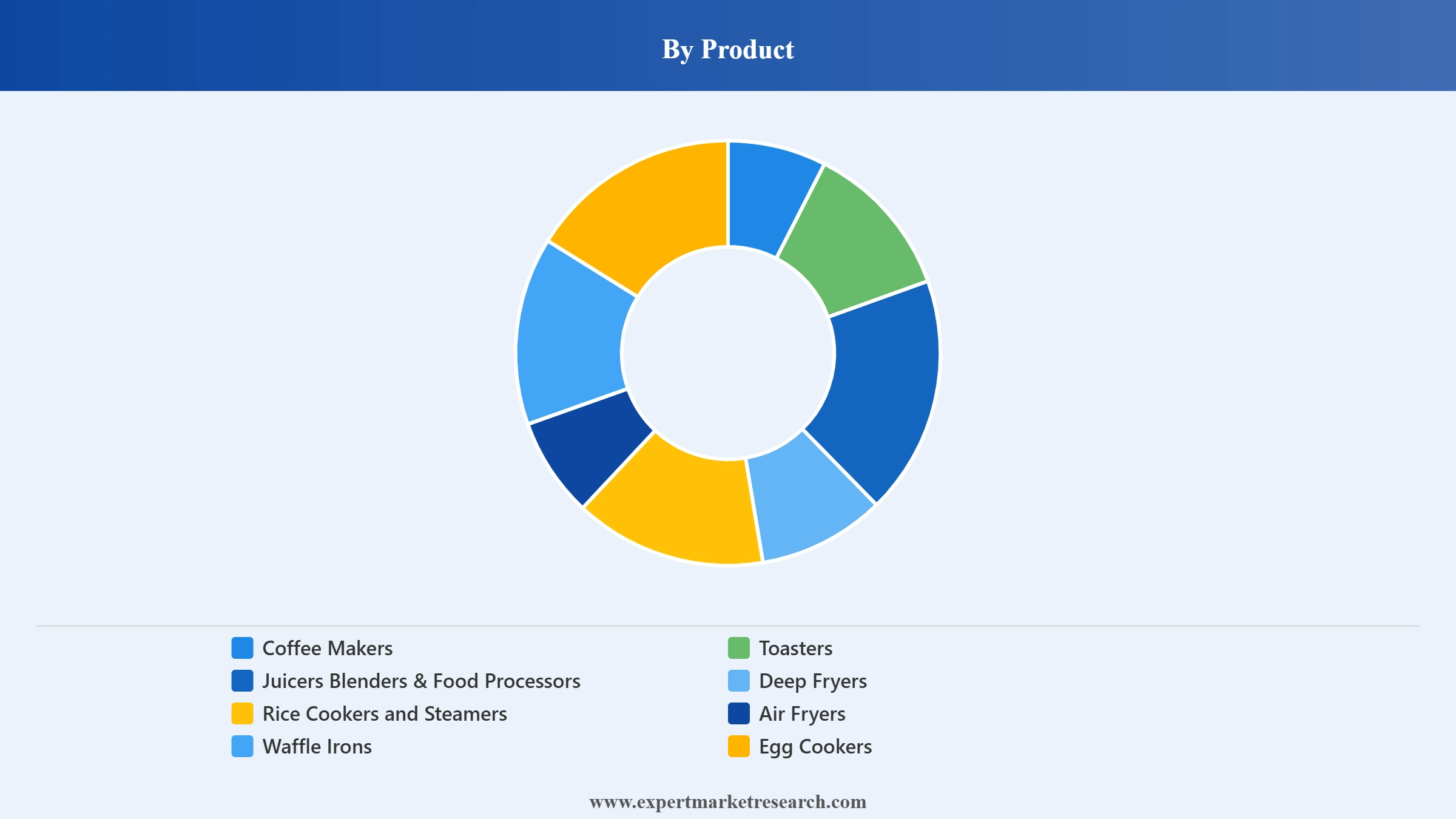
Market Breakup by Product
Key Insight: Rice cookers and steamers form the largest product base in the Philippines small kitchen appliances market, reflecting the centrality of rice in the Filipino diet and the near-universal household ownership of this category. Air fryers are the fastest-growing product, projecting a CAGR of 7.6% through the forecast period, fueled by health-conscious consumers seeking oil-free cooking and by aggressive marketing on social media platforms. Coffee makers are growing in technological sophistication, with app-connected and bean-to-cup models attracting premium buyers in urban centers as the cafe culture extends into home settings. Juicers, blenders, and food processors remain everyday staples aligned with both traditional Filipino cooking needs and the rising interest in smoothies and plant-based meal preparation. Niche categories including waffle irons and egg cookers are gaining ground among high-income urban households seeking breakfast-time convenience and variety.
Market Breakup by Distribution Channel
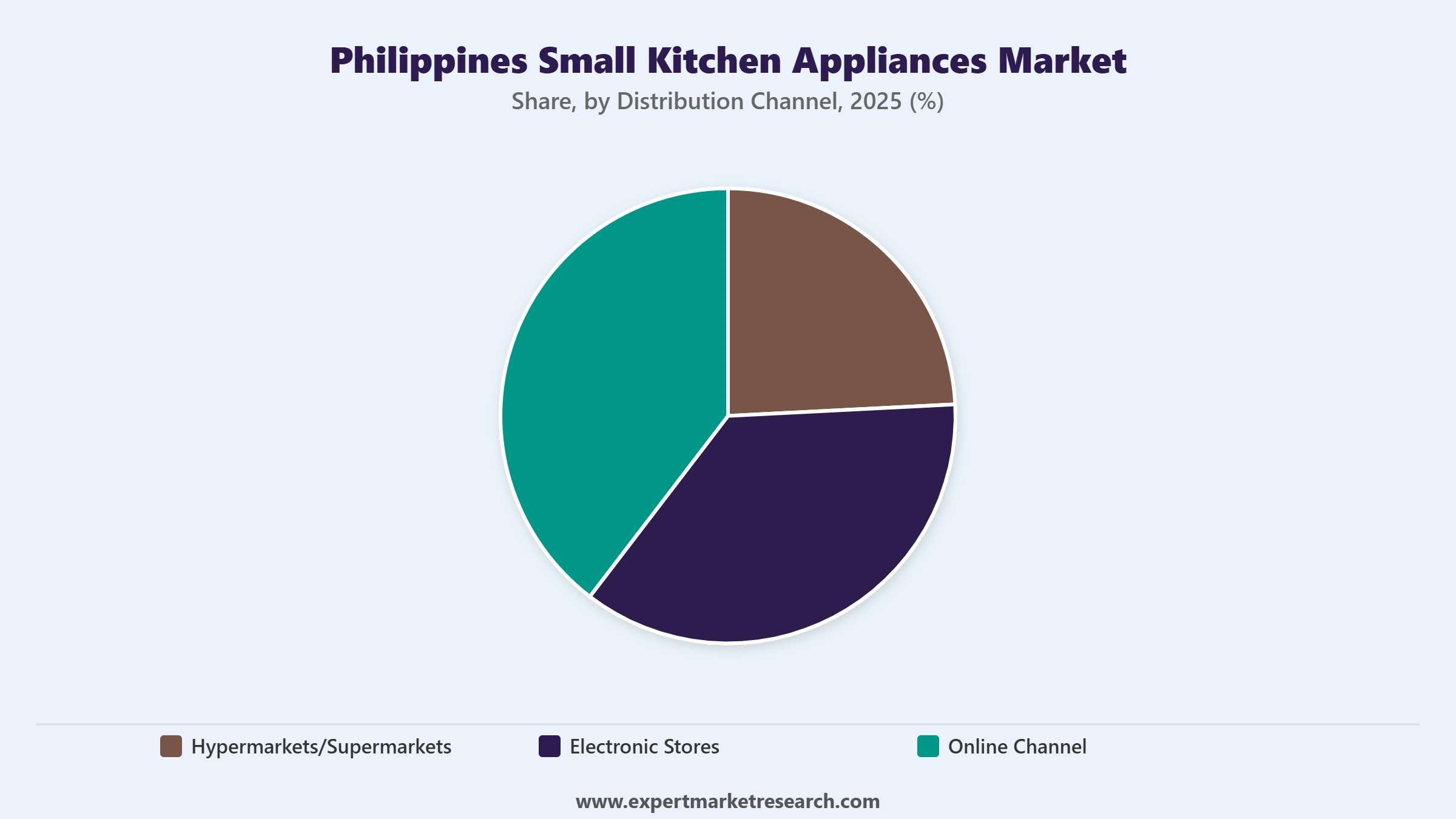
Key Insight: Electronic stores held the largest revenue share of the Philippines small kitchen appliances market in 2024, capturing approximately 47.3% of market revenue, as Filipino consumers continue to prefer in-person product evaluation, particularly for higher-ticket appliance purchases. Chains such as Abenson's and Ansons remain the primary destination for branded appliance purchases offering installment options and post-sale service support. Hypermarkets and supermarkets serve mid-tier and budget appliance purchases, providing accessible distribution for everyday kitchen items. The Online Channel, while currently holding approximately 24.6% market share, is the fastest-growing segment at a projected CAGR of 7.7%, driven by promotional events on Shopee and Lazada and the increasing comfort of Filipino consumers in purchasing higher-value items digitally. The growth in online channel penetration is also enabling brands to reach consumers in provincial cities and rural areas beyond the reach of traditional retail networks.
Read more about this report - REQUEST FREE SAMPLE COPY IN PDF
By Product, Rice Cookers and Steamers Account for the Leading Position in the Market
Rice cookers represent the dominant segment in the Philippines small kitchen appliances market, not just for rice but also for steaming fish, dumplings, and vegetables and other culturally significant meals. Brands likeHanabishi and Kyowa now integrate smart steaming timers and detachable trays. Companies like Imarflex have introduced a dual-cooking rice cooker that simultaneously cooks soup or adobo underneath a steaming basket. With 95.3% of Filipino households consuming rice daily, rice cookers have evolved from single-use devices to all-in-one culinary stations. The wide utility, local meal compatibility, and compact form factor make them a staple.
Read more about this report - REQUEST FREE SAMPLE COPY IN PDF
Air fryers are observing fast growth in the Philippines small kitchen appliances industry, driven by the health-conscious wave and smart technology integration. Millennials in Metro Manila are adopting air fryers as low-oil alternatives to traditional deep frying. Recently, XTREME Appliances launched the first locally produced app-controlled air fryer. These devices now offer custom presets for Filipino snacks like lumpia and chicharon. Moreover, community health programmes supported by DOH endorse low-fat cooking, boosting demand toward air frying. Adaptability, low power consumption, and multi-dish use make air fryers the most preferred choice among newer households and urban renters.
By Distribution Channel, Hypermarkets/Supermarkets Significantly Contribute to the Market Revenue
Hypermarkets and supermarkets like SM Hypermarket, Robinsons, and Puregold continue to dominate the Philippines small kitchen appliances market. Their ability to offer bundled deals and physical demonstrations makes them popular among first-time buyers. DTI’s “Go Lokal” campaign has encouraged major retail chains to stock locally manufactured compact appliances. The trust factor remains high for the consumers, with in-person service, warranty confidence, and the touch-and-feel factor driving bulk purchases. Seasonal promotions, in-store financing, and appliance bundles tied to other household goods give this channel a strong edge in mid-to-lower-income segments.
Read more about this report - REQUEST FREE SAMPLE COPY IN PDF
Online retail is the fastest-rising distribution channel, driven by platforms like Shopee, Lazada, and brand-exclusive webstores. In the last few years, the consumers shopping habits shifted had shifted towards online and e-commerce channels, boosting the Philippines small kitchen appliances market value Online platforms offer lower prices, bundled add-ons, hassle-free replace and returns, and faster delivery, which are particularly attractive to working-class consumers and tech-savvy young families. Some platforms now offer AR previews of appliances in real home settings. Furthermore, DTI’s eCommerce Philippines 2022 Roadmap has accelerated digital infrastructure and seller onboarding. Flash sales and influencer-led product launches further fuel this segment’s rapid growth.
The Philippines small kitchen appliances market players like Hanabishi, Imarflex, and XTREME are blending cultural relevance with digital upgrades. Global players like Panasonic and Philips are responding by localising their offerings and investing in regional R&D hubs. A key area of focus for these companies is energy efficiency, with government policies like MEPS incentivising brands to develop inverter-based and solar-compatible appliances. Players are also exploring alternative materials like bioplastics, modular repairs, and recyclable components to align with the growing environmental awareness among Filipino consumers. Furthermore, retail partnerships are becoming strategic. Philippines small kitchen appliances companies are signing exclusive deals with e-commerce platforms or launching flagship digital stores for direct engagement. Influencer marketing, gamified shopping apps, and live product demonstrations have become mainstream in driving appliance sales. Moreover, local players have the advantage of cultural insight and cost efficiency, while international brands bring precision technology.
Founded in 1968 and headquartered in Guangdong, China, Midea is one of the world's largest home appliance manufacturers with a significant and expanding presence in the Philippine market. Midea's Philippine small kitchen appliances portfolio includes rice cookers, air fryers, blenders, and AI-enabled coffee machines, all designed to align with contemporary consumer demands for convenience and smart functionality. The company's Barista Brew coffee machine, which uses AI to personalize brewing profiles, exemplifies its technology-forward strategy in the premium kitchen appliance segment. Midea's extensive distribution reach and competitive pricing make it one of the most widely accessible international brands across all retail formats in the Philippines.
Founded in 1939 and headquartered in Tokyo, Japan, Toshiba operates in the Philippine appliance market with a range of small kitchen products including rice cookers and microwave ovens, all built around the company's longstanding commitment to energy efficiency and reliable performance. Toshiba Lifestyle Philippines maintains an active retail presence across the archipelago, including participation in provincial retail events such as the August 2024 Robinsons Appliances Kitchen Revolution showcase in Cebu, reflecting the brand's deliberate strategy to build visibility beyond Metro Manila. Toshiba's reputation for durability and Japanese quality standards resonates strongly with Filipino consumers who prioritize long-term appliance value over short-term affordability.
LG Corporation, established in 1947 and headquartered in Seoul, South Korea, is one of the Philippines' most recognized consumer electronics and appliance brands. Within the small kitchen appliances category, LG has built a distinctive position by emphasizing smart technology integration and energy efficiency in products such as air fryers, coffee machines, and multi-cookers. LG's innovation strategy is underpinned by its broader Smart Home ecosystem, which enables its kitchen appliances to connect and operate within a wider network of IoT-enabled home devices. This ecosystem approach appeals strongly to tech-savvy Filipino consumers in Metro Manila's condominium market and positions LG favorably against competitors in the growing premium kitchen segment.
Panasonic Corporation, founded in 1918 and headquartered in Osaka, Japan, holds a well-entrenched position in the Philippines consumer appliance market built on decades of brand trust and a broad product range spanning kitchen appliances, personal care, and home electronics. Panasonic's Philippine small kitchen appliances portfolio includes rice cookers, bread makers, blenders, and microwave ovens, supported by a widespread distribution network across hypermarkets, electronics stores, and online platforms. In August 2025, Panasonic R&D Center Singapore opened a new Innovation Hub at the Punggol Digital District dedicated to developing AI-powered smart building and home appliance solutions for Southeast Asia, signaling continued R&D investment that will benefit its Philippine appliance lineup in the coming years.
Other key players in the market are Beko APAC IBC Co., Ltd., and Others.
*Please note that this is only a partial list; the complete list of key players is available in the full report. Additionally, the list of key players can be customized to better suit your needs.*
Explore the full depth of the Philippines Small Kitchen Appliances Market with our 2026 research report. From understanding which product categories are growing fastest to mapping the competitive moves of Midea, Panasonic, LG, and Toshiba across Philippines retail and digital channels, our report puts the intelligence you need directly in your hands. Whether you are a brand planning your next product launch, a distributor reviewing your portfolio, or an investor sizing the opportunity, download your free sample today and start making decisions backed by data.


Upto 15% Off
USD
$3999 $3599
$2499 $2249
$4999 $4249
$5999 $5099


*While we strive to always give you current and accurate information, the numbers depicted on the website are indicative and may differ from the actual numbers in the main report. At Expert Market Research, we aim to bring you the latest insights and trends in the market. Using our analyses and forecasts, stakeholders can understand the market dynamics, navigate challenges, and capitalize on opportunities to make data-driven strategic decisions.*
In 2025, the Philippines small kitchen appliances market reached an approximate value of USD 239.16 Million.
The market is projected to grow at a CAGR of 6.80% between 2026 and 2035.
The market is estimated to witness healthy growth in the forecast period of 2026-2035 to reach a value of around USD 461.74 Million by 2035.
Key strategies driving the market include embedding app-controlled features, collaborating with local chefs, leveraging government tech incentives, expanding into regional eCommerce, and launching multifunctional compact appliances tailored to evolving Filipino cooking habits and lifestyle needs.
The key challenges are supply chain delays, limited R&D funding for local players, and inconsistent enforcement of energy standards.
The various products considered in the market report are coffee makers, toasters, juicers, blenders & food processors, deep fryers, rice cookers and steamers, air fryers, waffle irons, and egg cookers.
The various distribution channels considered in the market report are hypermarkets/ supermarkets, electronic stores, online channels, and others.
The major players in the market are Midea Inc., Toshiba Corporation, LG Corporation, Panasonic Corporation, and Beko APAC IBC Co., Ltd., among others.
Explore our key highlights of the report and gain a concise overview of key findings, trends, and actionable insights that will empower your strategic decisions.
| REPORT FEATURES | DETAILS |
| Base Year | 2025 |
| Historical Period | 2019-2025 |
| Forecast Period | 2026-2035 |
| Scope of the Report |
Historical and Forecast Trends, Industry Drivers and Constraints, Historical and Forecast Market Analysis by Segment:
|
| Breakup by Product |
|
| Breakup by Distribution Channel |
|
| Market Dynamics |
|
| Competitive Landscape |
|
| Companies Covered |
|
Single User License
One User
USD 3,999
USD 3,599
tax inclusive*
Datasheet
One User
USD 2,499
USD 2,249
tax inclusive*
Five User License
Five User
USD 4,999
USD 4,249
tax inclusive*
Corporate License
Unlimited Users
USD 5,999
USD 5,099
tax inclusive*
*Please note that the prices mentioned below are starting prices for each bundle type. Kindly contact our team for further details.*
Flash Bundle
Small Business Bundle
Growth Bundle
Enterprise Bundle
*Please note that the prices mentioned below are starting prices for each bundle type. Kindly contact our team for further details.*
Flash Bundle
Number of Reports: 3
20%
tax inclusive*
Small Business Bundle
Number of Reports: 5
25%
tax inclusive*
Growth Bundle
Number of Reports: 8
30%
tax inclusive*
Enterprise Bundle
Number of Reports: 10
35%
tax inclusive*
How To Order

Select License Type
Choose the right license for your needs and access rights.

Click on ‘Buy Now’
Add the report to your cart with one click and proceed to register.

Select Mode of Payment
Choose a payment option for a secure checkout. You will be redirected accordingly.
Strategic Solutions for Informed Decision-Making
Gain insights to stay ahead and seize opportunities.

Get insights & trends for a competitive edge.

Track prices with detailed trend reports.

Analyse trade data for supply chain insights.

Leverage cost reports for smart savings

Enhance supply chain with partnerships.

Connect For More Information
Our expert team of analysts will offer full support and resolve any queries regarding the report, before and after the purchase.
Our expert team of analysts will offer full support and resolve any queries regarding the report, before and after the purchase.
We employ meticulous research methods, blending advanced analytics and expert insights to deliver accurate, actionable industry intelligence, staying ahead of competitors.
Our skilled analysts offer unparalleled competitive advantage with detailed insights on current and emerging markets, ensuring your strategic edge.
We offer an in-depth yet simplified presentation of industry insights and analysis to meet your specific requirements effectively.




