

Consumer Insights
Uncover trends and behaviors shaping consumer choices today
Procurement Insights
Optimize your sourcing strategy with key market data
Industry Stats
Stay ahead with the latest trends and market analysis.
The global robotic process automation market size was valued at USD 7.71 Billion in 2025. The market is expected to grow at a CAGR of 36.30% during the forecast period of 2026-2035 to reach a value of USD 170.61 Billion by 2035. Expanding use of automation systems in healthcare for patient data management, medical claims processing, and compliance tracking is accelerating demand in life sciences and clinical workflows.
The market is gaining significant traction, largely driven by the surge in enterprise-scale adoption of AI-integrated automation. A major trend reshaping the industry is hyper-automation, which extends beyond repetitive task automation toward end-to-end business orchestration. According to the robotic process automation market analysis, 74% of organizations have already embarked on RPA journeys as of June 2022. Notably, the United States federal government’s “Technology Modernization Fund” has injected over USD 1.2 billion since its inception in 2017, allocating a substantial portion toward automation-driven modernization, underscoring how policy initiatives are accelerating market adoption.
Another compelling factor is workforce transformation across industries. In India, the government’s Digital India program has also pushed automation adoption across banking and citizen services, enabling public agencies to save manual hours while reducing error rates. Moreover, the European Commission’s Horizon Europe program, with EUR 95.5 billion in funding, has earmarked automation and AI projects as central pillars for industrial competitiveness. These government-backed initiatives illustrate how policy alignment and fiscal support are becoming catalysts for large-scale RPA implementation globally.
The robotic process automation market’s potential is further highlighted by efficiency-driven results. Industry reports note that RPA can reduce operational costs by 20% in industries like telecom and healthcare. This blend of cost efficiency, supportive government policies, and AI-driven innovation places the market on an accelerated growth trajectory, making it an essential area of investment for enterprises navigating digital transformation.
Compound Annual Growth Rate
36.3%
Value in USD Billion
2026-2035
Read more about this report - REQUEST FREE SAMPLE COPY IN PDF
In an effort to speed up and improve the deployment of its delivery service, Serve Robotics, a leader in autonomous sidewalk robots, purchased Vayu Robotics. This acquisition highlights how robotics firms are integrating automation intelligence, indirectly boosting demand for RPA solutions in logistics and delivery management workflows.
Elevate Robotics was introduced as a new, fully owned subsidiary of Apptronik, a United States-based AI humanoid robotics business dedicated to developing industrial automation that goes beyond human capabilities. This robotic process automation market development reflects the rising convergence of robotics and RPA, expanding opportunities in manufacturing and industrial use cases.
Leading enterprise automation and AI software provider UiPath revealed its new strategic direction and vision, which is focused on agentic automation, the next development in enterprise automation. UiPath’s new vision accelerates the evolution of RPA into agentic, decision-making systems, signaling a pivotal leap toward intelligent enterprise automation.
Saudia Private unveils a full-fledged digital strategy that includes B2B solutions, AI chatbots, robotic process automation, and new mobile apps. By embedding RPA into its digital transformation roadmap, Saudia Private underscores the growing role of automation in B2B service delivery and customer engagement.
The shift from standalone task automation to hyper automation is redefining how enterprises achieve scale. Unlike traditional RPA, hyper automation integrates AI, process mining, and advanced analytics to automate complex workflows. For example, in January 2025, the United Kingdom government partnered with UiPath to enhance automation across its National Health Service (NHS), improving efficiency in appointment scheduling and claims verification, reshaping the robotic process automation market trends. This progression signals that RPA is no longer confined to rule-based processes but is evolving into a transformative ecosystem of intelligent automation that delivers long-term value.
Government bodies are increasingly leveraging RPA to modernize legacy systems, reduce costs, and improve citizen services. In the United States, the Department of Veterans Affairs now automates more than 1,000 DIC claims payments or adjustments per day and is in the process of ongoing enhancements, significantly reducing backlogs. Similarly, across Europe, the European Social Fund has actively financed automation-driven e-governance projects, transforming the robotic process automation market dynamics. This institutional adoption validates RPA’s critical role in advancing operational resilience and public service accessibility on a global scale.
The healthcare sector is embracing RPA for administrative efficiency and compliance. In November 2024, Mayo Clinic piloted RPA solutions for patient record reconciliation, lowering manual errors significantly. Life sciences companies are integrating automation for clinical trial management and pharmacovigilance reporting, with the United States FDA supporting digital innovations under its Technology Modernization Action Plan. Additionally, Japan’s Ministry of Health has encouraged the adoption of RPA across hospital networks to handle demographic challenges from an aging population, accelerating the robotic process automation market opportunities.
BFSI remains the largest adopter of RPA, primarily due to compliance-heavy operations. Banks like JPMorgan Chase are leveraging bots to process loan applications and detect fraud at scale, reducing turnaround time drastically. In February 2024, the Reserve Bank of India highlighted automation’s role in improving compliance monitoring across regional banks. Meanwhile, European insurers are using RPA for claims automation, supported by EU regulations encouraging digital innovation in financial services. By reducing manual workloads in areas like Know Your Customer (KYC) verification, BFSI players are achieving both regulatory alignment and faster service delivery, sustaining their dominance in robotic process automation adoption.
Cloud deployment of RPA has emerged as a strategic growth lever, enabling enterprises to scale automation faster and more cost-effectively. Microsoft, through its Power Automate cloud offering, launched in July 2023, has expanded access to AI-enhanced automation for SMEs and large corporations alike. Governments are also encouraging this robotic process automation market trend. For example, Singapore’s Smart Nation initiative actively funds cloud-first digital projects that integrate RPA into public services. This transition to cloud-native automation is a strong signal of how enterprises will unlock scalability and accelerate time-to-value.
Read more about this report - REQUEST FREE SAMPLE COPY IN PDF
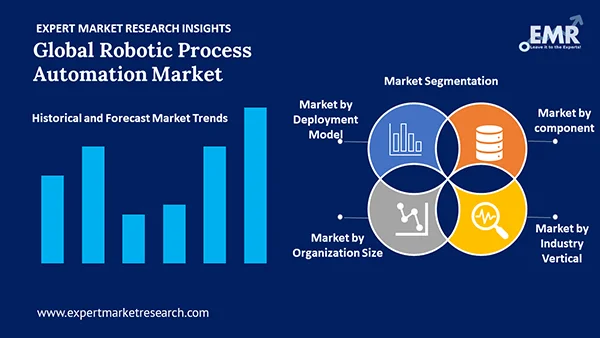
The EMR’s report titled “Global Robotic Process Automation Market Report and Forecast 2026-2035” offers a detailed analysis of the market based on the following segments:
Market Breakup by Component
Key Insight: Across the component spectrum, software remains dominant in the market due to its scalability and advanced features, while services are growing at an accelerated pace as organizations require advisory and integration support. Hardware, though a minor contributor, serves niche areas such as RPA-enabled kiosks and ATMs. Both of these components form a balanced ecosystem, with software offering the core framework, services ensuring seamless execution, and hardware addressing specialized deployment needs.
Market Breakup by Deployment Mode
Key Insight: Deployment models as considered in the robotic process automation market report, are defined by security and scalability trade-offs. On-premise retains dominance among compliance-heavy industries, while cloud solutions are witnessing rapid expansion due to cost efficiency and accessibility. Hybrid deployment models are also becoming popular, bridging security concerns with scalability benefits, giving enterprises flexibility to choose solutions tailored to operational and regulatory needs.
Market Breakup by Organization Size
Key Insight: Organization size categorization in the robotic process automation market shows how RPA adoption is scaling differently across enterprise profiles. Large enterprises remain the largest contributors, leveraging automation for complex processes and compliance-heavy industries, while SMEs are growing rapidly due to flexible pricing and cloud accessibility. These enterprise sizes illustrate how automation has become a universal strategy across both ends of the corporate spectrum.
Market Breakup by Industry Vertical
Key Insight: Industry vertical analysis reveals that BFSI largely contributes to the robotic process automation market value due to compliance-heavy processes, while healthcare is accelerating adoption to meet clinical efficiency and patient-care demands. Other verticals such as manufacturing, IT & telecom, retail, and government agencies are also expanding automation adoption, driven by sector-specific needs like supply chain optimization, customer engagement, and digital service delivery. Collectively, RPA’s relevance is expanding across diverse industries with distinct growth triggers.
Market Breakup by Region
Key Insight: Regional trends in the robotic process automation market indicates North America’s dominance, owing to mature ecosystems and vendor leadership, while Asia Pacific is emerging as the fastest-growing hub. Europe remains vital for regulatory-driven adoption, Latin America is exploring automation for financial services, and the Middle East & Africa are gradually investing in RPA for government-led modernization. Each region demonstrates unique motivators, highlighting how local dynamics shape the pace and scale of automation deployment.
By component, software secures the largest share of the market due to enterprise-wide adoption
Software dominates the market as enterprises increasingly invest in automation platforms to streamline large-scale operations. Leading vendors like UiPath, Blue Prism, and Automation Anywhere are expanding AI capabilities within software suites, making them the core growth lever of adoption. The rising popularity of SaaS-based RPA tools, coupled with integration with ERP and CRM systems, has solidified software as the backbone of enterprise transformation.
Services experience accelerated growth in the robotic process automation market, driven by enterprises seeking tailored automation strategies and support. Consulting, deployment, and managed services help organizations achieve faster return on investment with less operational disruption. For instance, Accenture is a leading managed automation initiatives for global banks and insurers, providing end-to-end support from strategy design to scaling. The complexity of integrating RPA with AI, process mining, and legacy IT infrastructure has pushed organizations to rely on external expertise.
On-premise deploymen retains the largest share of the market due to security needs
On-premise deployment dominates the robotic process automation market revenue, particularly among industries handling sensitive data such as banking, defense, and healthcare. Enterprises with stringent compliance requirements prefer on-premise setups to ensure full control over automation workflows and data security. For instance, several European banks continue to prioritize on-premise automation solutions to align with General Data Protection Regulation (GDPR) mandates. Moreover, industries with legacy IT infrastructures continue to favor on-premise integration for seamless coexistence with their existing technology stacks.
Cloud-based RPA is gaining traction rapidly, owing to its cost-effectiveness, rapid deployment capabilities, and flexible scaling. Enterprises are inclining toward cloud-native platforms that integrate easily with ERP and CRM systems, allowing automation to expand across business units. For example, SAP’s cloud RPA offering has gained traction across SMEs, while Microsoft’s Power Automate has made automation more accessible to smaller firms, stimulating the robotic process automation demand. Cloud adoption is also being encouraged by national initiatives like Singapore’s Smart Nation program, which promotes cloud-first digital services.
Large enterprises secure the largest share of the market due to scale-driven automation need
Large enterprises largely impact the total market revenue as they operate complex, high-volume processes that demand automation at scale. Multinationals across banking, telecom, and healthcare are prioritizing RPA to streamline compliance-heavy functions and optimize operational efficiency. Their deeper budgets allow investments into advanced AI-driven RPA platforms, along with customization tailored to specific business units. Many large enterprises also maintain dedicated centers of excellence (CoEs) for automation governance, ensuring ROI maximization.
SMEs are registering accelerated demand in the robotic process automation market, propelled by cloud-based solutions and subscription-driven pricing models that reduce upfront costs. Unlike large enterprises, SMEs prioritize agility and cost optimization, making cloud-native RPA highly attractive. Vendors such as Microsoft, UiPath, and Automation Anywhere are tailoring lightweight, affordable automation suites specifically designed for smaller businesses. SMEs are also leveraging RPA to gain a competitive edge in customer support, payroll, and e-commerce operations, where lean workforces face pressure to deliver faster.
By industry vertical, the BFSI sector accounts for the biggest market share due to compliance-heavy operations
The BFSI sector dominates RPA adoption, driven by the need for regulatory compliance, fraud detection, and large-scale transaction processing. Banks and insurers are automating workflows such as KYC verification, loan processing, and claims management to ensure accuracy and faster turnaround times. The heavy regulatory burden across geographies further accelerates automation adoption, as bots reduce risks tied to human errors. BFSI institutions also deploy RPA to handle massive transaction volumes while improving customer service.
The healthcare sector’s growth, on the other hand, is fueled by administrative automation and patient-centered initiatives, broadening the robotic process automation market scope. Hospitals and life sciences firms are applying RPA in claims processing, patient data management, and clinical trial administration to reduce errors and free staff for higher-value tasks. Aging populations, especially in developed nations, are prompting the adoption of automation to ease labor shortages. Additionally, RPA ensures compliance with health data regulations, making it indispensable for managing sensitive patient information securely.
Read more about this report - REQUEST FREE SAMPLE COPY IN PDF
North America sustains its dominant position in the market due to mature adoption
The North American market is benefiting from early adoption, strong vendor presence, and high digital maturity among enterprises. The region’s established banking, healthcare, and technology sectors are pioneers in deploying automation at scale. Furthermore, government initiatives supporting digital modernization across public agencies reinforce adoption. The concentration of top RPA vendors headquartered in the United States also drives innovation, enabling enterprises to leverage next-generation AI-integrated platforms.
The robotic process automation market in Asia Pacific is currently recording fast-paced growth, propelled by rapid digitalization across developing economies and large-scale government-led programs. Nations like India, China, and Singapore are investing heavily in automation for both enterprise and public sector efficiency. SMEs in the region are rapidly adopting cloud-based RPA due to affordability, while large enterprises are embedding automation in core operations. Additionally, Asia Pacific’s booming IT outsourcing sector is integrating RPA to deliver value-added services globally.
The global robotic process automation market players are focusing on hyper-automation, industry-specific solutions, and cloud-native platforms that offer scalable deployment. Firms can cater to small and medium-sized enterprises through cost-effective subscription models, as well as expand adoption in healthcare and public services. A growing area of innovation includes embedding generative AI into automation platforms, allowing bots to make context-aware decisions and handle unstructured data.
Robotic process automation companies are also enhancing integration with advanced analytics, natural language processing, and process mining tools, creating differentiated offerings that go beyond simple task automation. With enterprises demanding faster ROI and compliance-friendly solutions, players are pursuing vertical-focused strategies, while simultaneously strengthening global reach through ecosystem collaborations.
Automation Anywhere, established in 2003 and headquartered in San Jose, California, is recognized for pushing the boundaries of intelligent automation. The company integrates AI and machine learning within its cloud-native platform, empowering businesses to automate end-to-end workflows rather than repetitive tasks.
Blue Prism, founded in 2001 and headquartered in the United Kingdom, is widely regarded as a pioneer of enterprise-grade RPA. The company emphasizes secure and scalable digital workforce platforms, enabling clients to build intelligent automation strategies that go beyond tactical deployments. Its intelligent digital workforce concept integrates with AI, process mining, and advanced analytics, creating dynamic and resilient operations.
EdgeVerve Systems, established in 2014 and headquartered in India, is a subsidiary of Infosys that has become a notable innovator in intelligent automation. Its AssistEdge platform goes beyond traditional RPA by combining cognitive automation, AI, and process orchestration to streamline customer experience management. EdgeVerve is also focused on enabling hyperautomation journeys by integrating automation with advanced process discovery tools.
IBM, founded in 1911 and headquartered in Armonk, New York, remains a heavyweight in automation by leveraging its hybrid cloud and AI expertise. Through IBM Robotic Process Automation, the company delivers intelligent automation solutions that integrate with Watson AI and Red Hat OpenShift platforms. IBM’s focus is on enabling organizations to scale digital workers seamlessly across hybrid environments while embedding advanced analytics.
*Please note that this is only a partial list; the complete list of key players is available in the full report. Additionally, the list of key players can be customized to better suit your needs.*
Another key player in the market is Pegasystems Inc. among others.
Explore the latest trends shaping the robotic process automation market 2026-2035 with our in-depth report. Gain strategic insights, future forecasts, and key market developments that can help you stay competitive. Download a free sample report or contact our team for customized consultation on robotic process automation market trends 2026.


Upto 15% Off
USD
$2499 $2249
$3999 $3599
$4999 $4249
$5999 $5099


*While we strive to always give you current and accurate information, the numbers depicted on the website are indicative and may differ from the actual numbers in the main report. At Expert Market Research, we aim to bring you the latest insights and trends in the market. Using our analyses and forecasts, stakeholders can understand the market dynamics, navigate challenges, and capitalize on opportunities to make data-driven strategic decisions.*
In 2025, the robotic process automation market reached an approximate value of USD 7.71 Billion.
The market is projected to grow at a CAGR of 36.30% between 2026 and 2035.
Vendors are building AI-enhanced platforms, expanding vertical-specific offerings, partnering with governments, promoting cloud-first adoption, and tailoring subscription-based pricing models to drive enterprise-wide RPA adoption across both large organizations and SMEs.
The key trends of the market include increasing technological innovations and the rapid adoption of automated solutions in various large and small and medium-sized enterprises (SMEs).
The major regions in the market are North America, Latin America, the Middle East and Africa, Europe, and the Asia Pacific.
The leading components of the robotic process automation available in the market include software and service.
The major deployment models include on-premises and cloud.
The organisation sizes include large enterprises and small and medium-sized enterprises.
The major industry verticals include BFSI, manufacturing, healthcare, IT and telecommunications, and retail, among others.
The key players in the market include Automation Anywhere, Inc., Blue Prism Limited, EdgeVerve Systems Limited, IBM Corporation, and Pegasystems Inc., among others.
Companies face challenges in scaling automation beyond pilots, integrating with legacy IT systems, ensuring security compliance, and demonstrating ROI within cost-sensitive enterprises, especially in regulated and public sector environments.
Explore our key highlights of the report and gain a concise overview of key findings, trends, and actionable insights that will empower your strategic decisions.
| REPORT FEATURES | DETAILS |
| Base Year | 2025 |
| Historical Period | 2019-2025 |
| Forecast Period | 2026-2035 |
| Scope of the Report |
Historical and Forecast Trends, Industry Drivers and Constraints, Historical and Forecast Market Analysis by Segment:
|
| Breakup by Component |
|
| Breakup by Deployment Model |
|
| Breakup by Organization Size |
|
| Breakup by Industry Vertical |
|
| Breakup by Region |
|
| Market Dynamics |
|
| Competitive Landscape |
|
| Companies Covered |
|
| Report Price and Purchase Option | Explore our purchase options that are best suited to your resources and industry needs. |
| Delivery Format | Delivered as an attached PDF and Excel through email, with an option of receiving an editable PPT, according to the purchase option. |
Datasheet
One User
USD 2,499
USD 2,249
tax inclusive*
Single User License
One User
USD 3,999
USD 3,599
tax inclusive*
Five User License
Five User
USD 4,999
USD 4,249
tax inclusive*
Corporate License
Unlimited Users
USD 5,999
USD 5,099
tax inclusive*
*Please note that the prices mentioned below are starting prices for each bundle type. Kindly contact our team for further details.*
Flash Bundle
Small Business Bundle
Growth Bundle
Enterprise Bundle
*Please note that the prices mentioned below are starting prices for each bundle type. Kindly contact our team for further details.*
Flash Bundle
Number of Reports: 3
20%
tax inclusive*
Small Business Bundle
Number of Reports: 5
25%
tax inclusive*
Growth Bundle
Number of Reports: 8
30%
tax inclusive*
Enterprise Bundle
Number of Reports: 10
35%
tax inclusive*
How To Order

Select License Type
Choose the right license for your needs and access rights.

Click on ‘Buy Now’
Add the report to your cart with one click and proceed to register.

Select Mode of Payment
Choose a payment option for a secure checkout. You will be redirected accordingly.
Strategic Solutions for Informed Decision-Making
Gain insights to stay ahead and seize opportunities.

Get insights & trends for a competitive edge.

Track prices with detailed trend reports.

Analyse trade data for supply chain insights.

Leverage cost reports for smart savings

Enhance supply chain with partnerships.

Connect For More Information
Our expert team of analysts will offer full support and resolve any queries regarding the report, before and after the purchase.
Our expert team of analysts will offer full support and resolve any queries regarding the report, before and after the purchase.
We employ meticulous research methods, blending advanced analytics and expert insights to deliver accurate, actionable industry intelligence, staying ahead of competitors.
Our skilled analysts offer unparalleled competitive advantage with detailed insights on current and emerging markets, ensuring your strategic edge.
We offer an in-depth yet simplified presentation of industry insights and analysis to meet your specific requirements effectively.




