

Consumer Insights
Uncover trends and behaviors shaping consumer choices today
Procurement Insights
Optimize your sourcing strategy with key market data
Industry Stats
Stay ahead with the latest trends and market analysis.
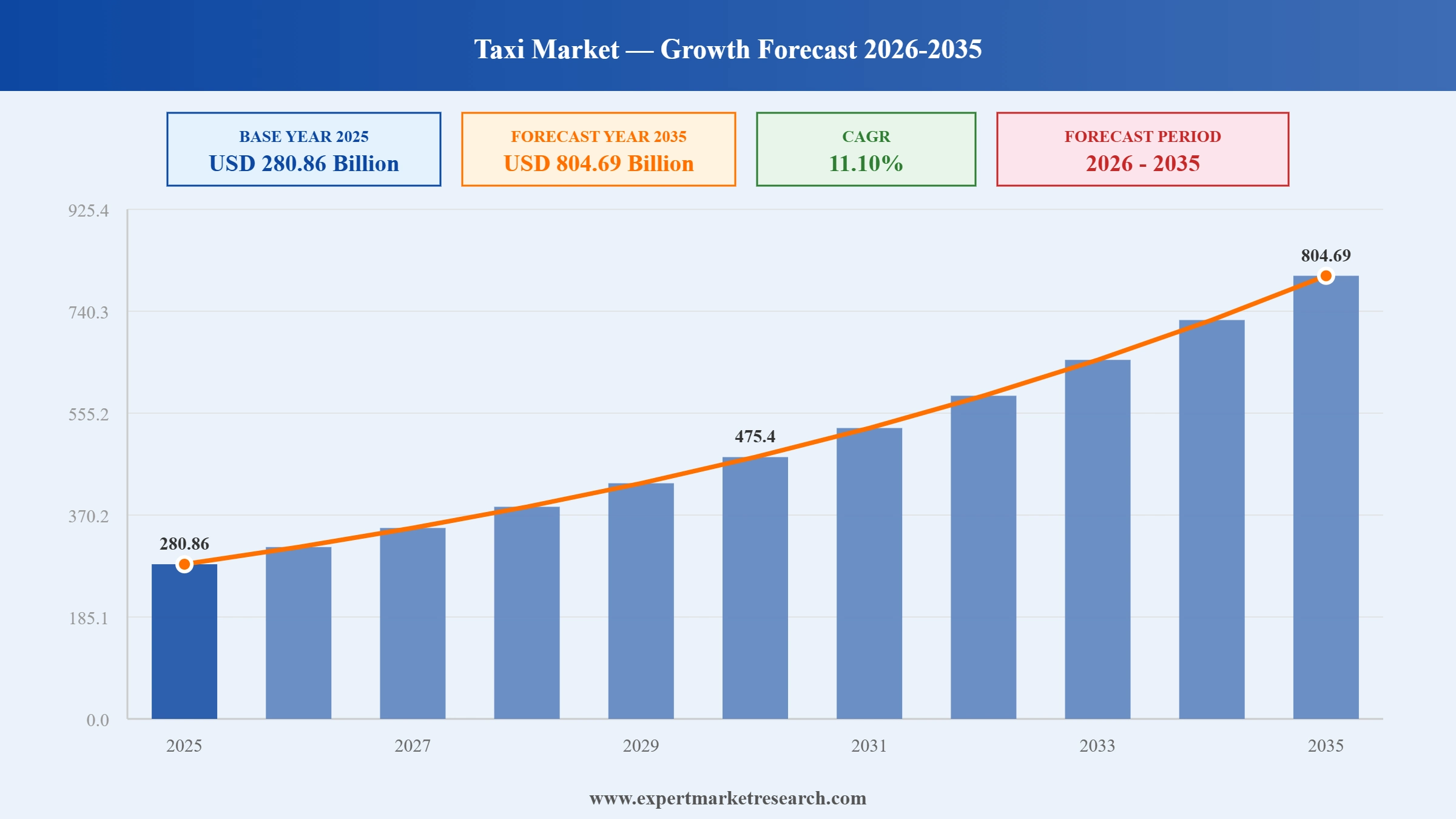
The taxi market attained a value of USD 280.86 Billion in 2025 and is projected to expand at a CAGR of 11.10% through 2035. The market is further expected to reach USD 804.69 Billion by 2035. Rising smartphone penetration, expanding ride hailing app adoption, and growing demand for convenient point to point transportation are driving overall growth in the market, with autonomous vehicle pilots and electric fleet transitions reshaping how operators approach urban mobility worldwide.
The taxi market encompasses ride hailing and ride sharing services booked through online and offline channels across cars, motorcycles, and other vehicle types worldwide. Demand continues to be shaped by rising urbanisation, smartphone penetration, and evolving consumer preferences toward on demand mobility, with ride hailing accounting for the largest service type share given widespread app-based platform adoption across the market.
Established mobility platforms are increasingly pursuing large scale funding rounds to expand regional scale rather than relying solely on organic growth, reflecting intensifying competition for market leadership across international markets. In May 2026, Rapido raised 240 million dollars in Series F funding led by Prosus at a 3-billion-dollar valuation, accelerating its expansion across smaller Indian cities.
The taxi market is increasingly directing investment toward autonomous vehicle partnerships and electric fleet transitions rather than relying solely on conventional driver networks, reflecting a strategic shift toward technology led differentiation as competition intensifies across major metropolitan markets. Companies are pursuing parallel investment across subscription loyalty programmes, multimodal platforms, and premium chauffeur services rather than remaining narrowly focused on standard ride hailing, while strengthening partnerships with autonomous vehicle developers to accelerate deployment timelines. Consolidation of this scale gives combined platforms broader geographic coverage while drawing renewed competitive pressure toward smaller independent regional operators.
Read more about this report - REQUEST FREE SAMPLE COPY IN PDF
Bolt announced plans to deploy at least 25,000 autonomous Lucid vehicles across major European cities, powered by NVIDIA's Hyperion autonomous driving platform, in one of the largest robotaxi commitments made by a European operator to date. Committing to large autonomous fleet numbers upfront lets platforms signal scale to regulators and infrastructure partners well ahead of the actual vehicle deployment schedule that follows.
Curb Mobility launched its open dispatch network integration in Los Angeles, the first market outside New York to connect licensed taxi drivers with riders booking through partner ride hailing applications. Expanding open dispatch technology to new metropolitan markets lets traditional taxi networks across the taxi market compete more directly with app native platforms without requiring drivers to abandon their familiar in vehicle dispatch systems entirely.
Uber, Lucid, and Nuro unveiled their jointly developed production intent robotaxi at CES 2026, confirming that autonomous on road testing had already begun in the San Francisco Bay Area ahead of a planned commercial launch. Combining electric vehicle manufacturing, autonomy software, and ride hailing platform scale lets partners across the taxi market bring robotaxi services to market faster than any single company working alone.
Ola moved to a zero-commission model across India, shifting drivers toward a flat daily subscription fee of approximately 67 rupees instead of a percentage-based cut on individual rides. Restructuring driver economics in this way helps platforms retain driver loyalty amid intensifying competition for available supply in major Indian cities and surrounding metropolitan regions across the taxi market over time and beyond.
Established mobility platforms across the taxi market are increasingly completing cross border acquisitions, rather than pursuing organic market entry, to gain instant regional presence and established user bases. This is helping platforms enter new markets without years of driver and rider recruitment. In February 2025, Bolt confirmed it was exploring a public listing in 2026, weighing venues in both the United States and Europe to fund continued international expansion and technology investment across its driver network, safety systems, and autonomous vehicle research initiatives nationwide.
Established ride hailing platforms across the taxi market are increasingly adjusting driver fee structures, rather than maintaining static commission models, as regulators in key markets impose new requirements on platform worker compensation. This is helping platforms remain compliant while managing driver retention pressures. In May 2026, Indonesia's government introduced a commission fee cap, prompting operators to review compensation structures for drivers nationwide and across neighbouring Southeast Asian markets facing broadly similar regulatory and political pressure on worker classification rules and platform accountability standards.
Established ride hailing applications across the taxi market are increasingly increasing platform fees, rather than absorbing rising driver compensation costs internally, to maintain margins amid regulatory changes. This is helping platforms sustain profitability as worker protection requirements expand across Southeast Asian markets. In January 2026, Grab raised its Singapore transport platform fee by 30 cents, citing higher mandatory contributions required for drivers under new legislation affecting all registered platform workers across the city state, part of a broader regional trend toward stronger worker protections.
Established ride hailing companies across the taxi market are increasingly restructuring loyalty programmes, rather than maintaining tiered membership structures, to simplify the rewards experience for riders. This is helping companies reduce administrative complexity while maintaining customer engagement incentives. In November 2025, Grab replaced its tiered GrabRewards programme with GrabCoins, removing membership tiers entirely from January 2026 onward across every participating market where the loyalty programme currently operates, simplifying redemption for millions of active riders across the platform and its wider international user base overall.
Established ride hailing platforms are increasingly expanding autonomous vehicle pilots, rather than limiting deployment to single test cities, as self-driving technology matures across metropolitan markets. This is helping platforms build operational experience ahead of wider commercial rollout. In December 2025, Uber and Baidu announced plans to bring robotaxi testing to London, expanding autonomous vehicle partnerships into a major new European market ahead of planned commercial rollout across the wider region in the years that follow this initial testing phase.
The Expert Market Research's report titled “Taxi Market Report and Forecast 2026-2035” offers a detailed analysis of the market based on the following segments:
Market Breakup by Service Type
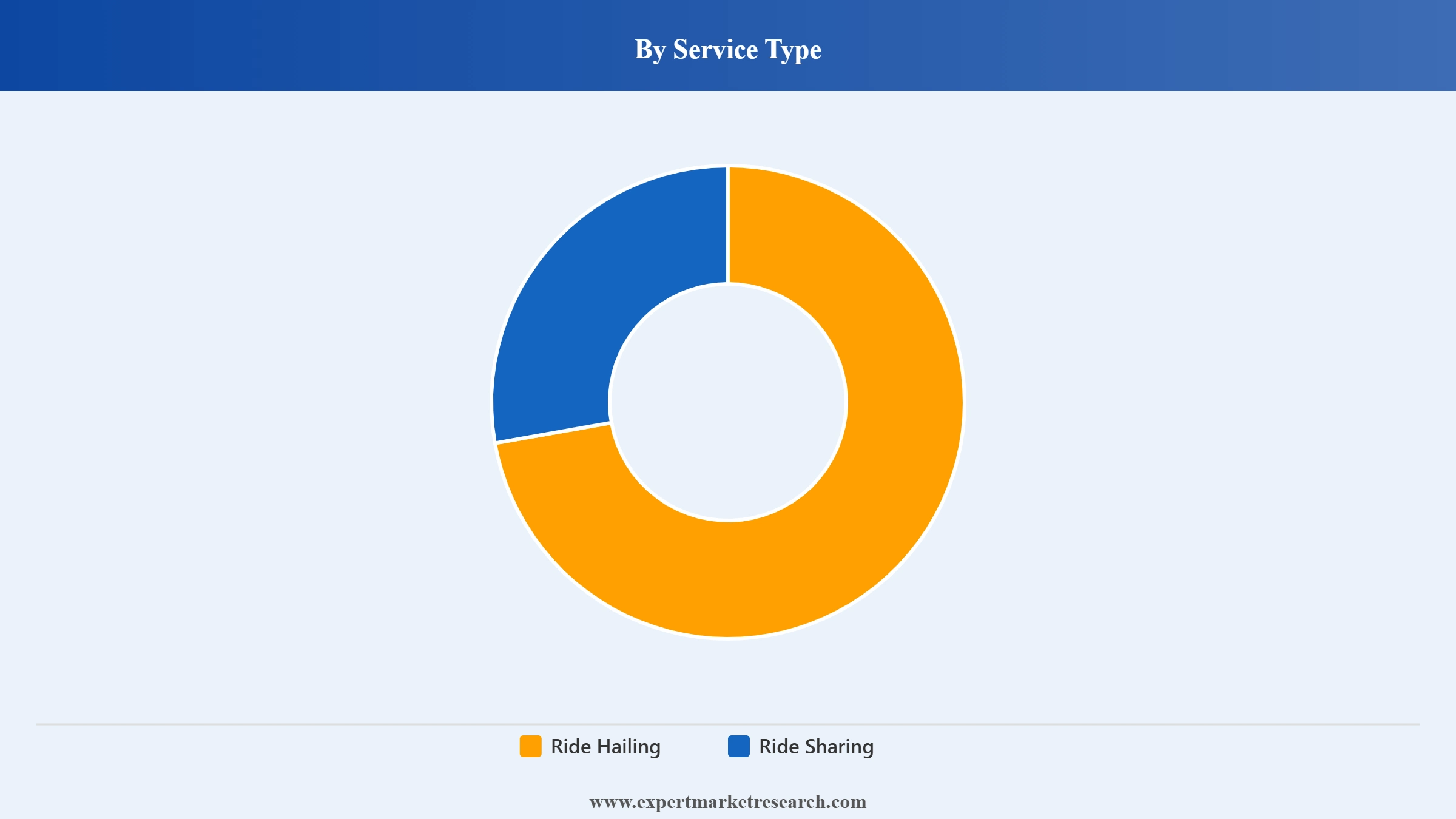
Key Insight: Widespread app-based platform adoption and door to door convenience keep ride hailing as the largest service type category across the taxi market. Established platforms continue to expand app-based dispatch and route optimisation features, reinforcing this category's lead across most urban and suburban markets. Ride sharing continues to serve cost conscious commuters seeking to split fares across shared routes, with steady growth supported by corporate sustainability initiatives encouraging pooled commuting options in dense metropolitan areas.
Market Breakup by Booking Type
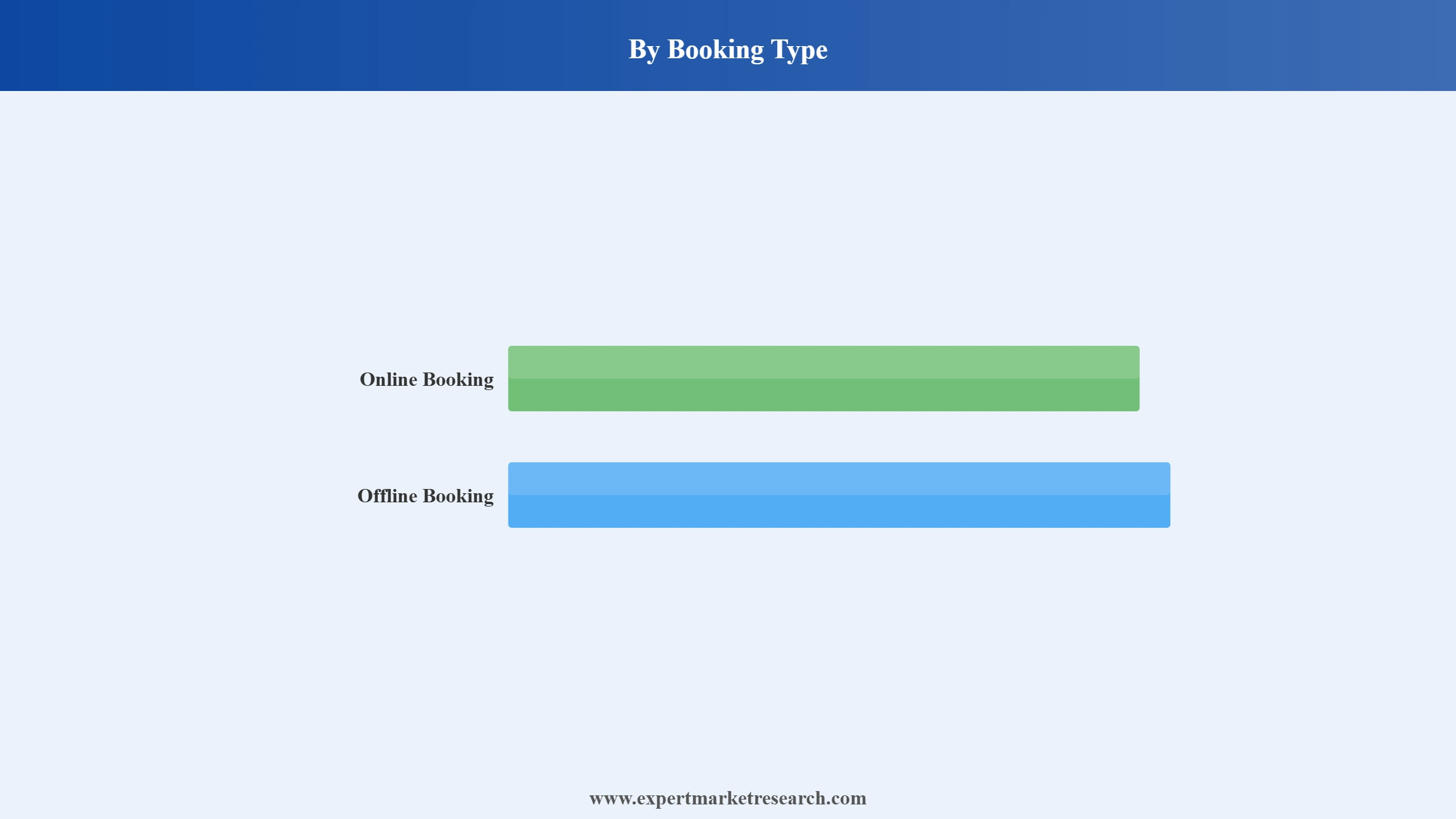
Key Insight: Smartphone penetration, transparent pricing, and real time tracking keep online booking as the dominant channel across the taxi market. Offline booking, including street hailing and telephone dispatch, continues to serve markets with lower smartphone penetration and older demographic segments, though its share is gradually narrowing as digital infrastructure expands into previously underserved regions.
Market Breakup by Vehicle Type
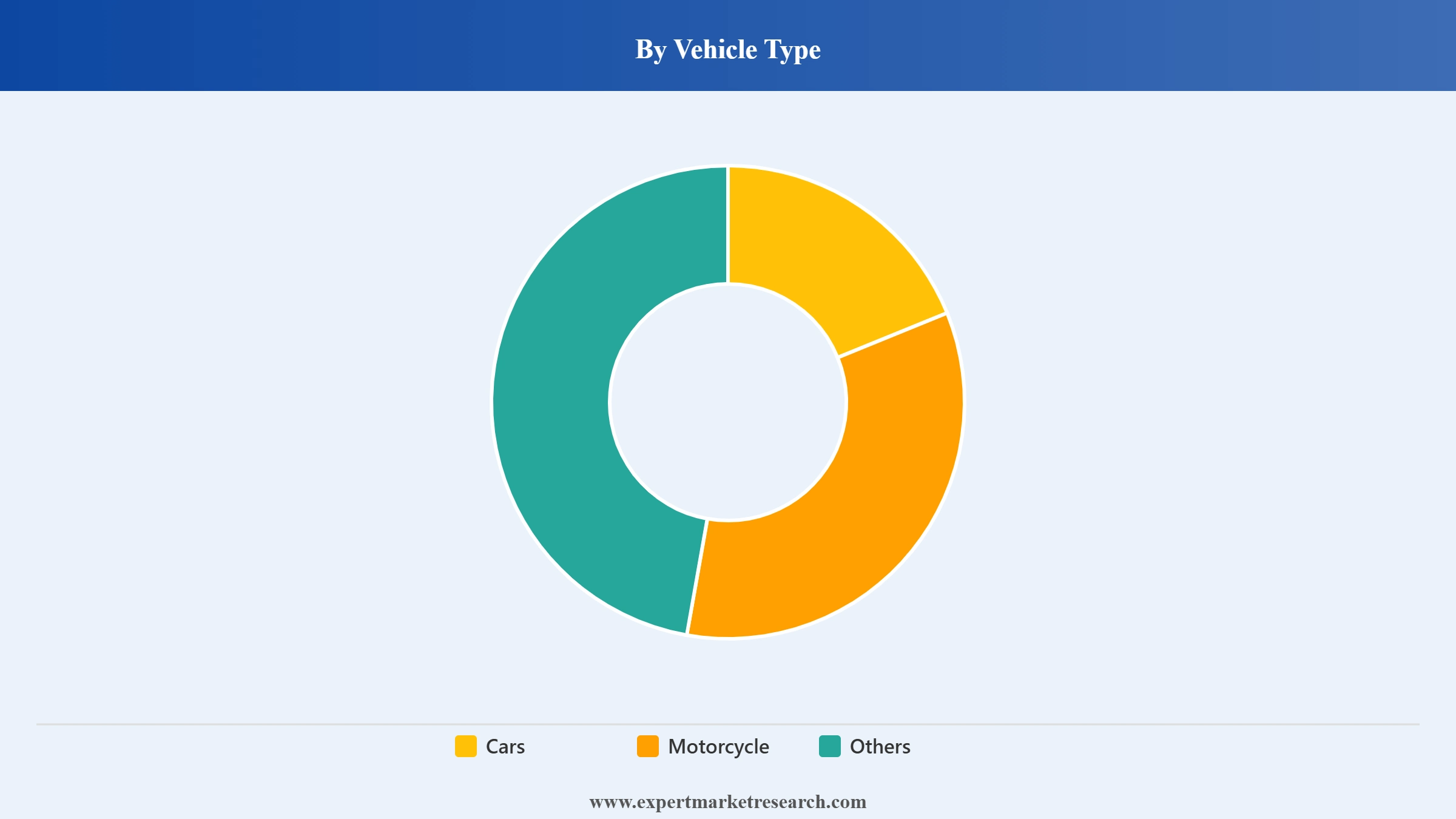
Key Insight: Passenger comfort and broad route suitability keep cars as the dominant vehicle type across most global taxi markets, illustrated by Waymo's September 2026 agreement with Nihon Kotsu and GO to launch Tokyo's first fully autonomous commercial taxi service by 2027. Motorcycles are registering the fastest growth as congested Asian and Latin American cities favour two wheeled transport for speed and manoeuvrability, while the Others category, spanning auto rickshaws and shared vans, continues to serve niche regional transport needs.
Market Breakup by Region
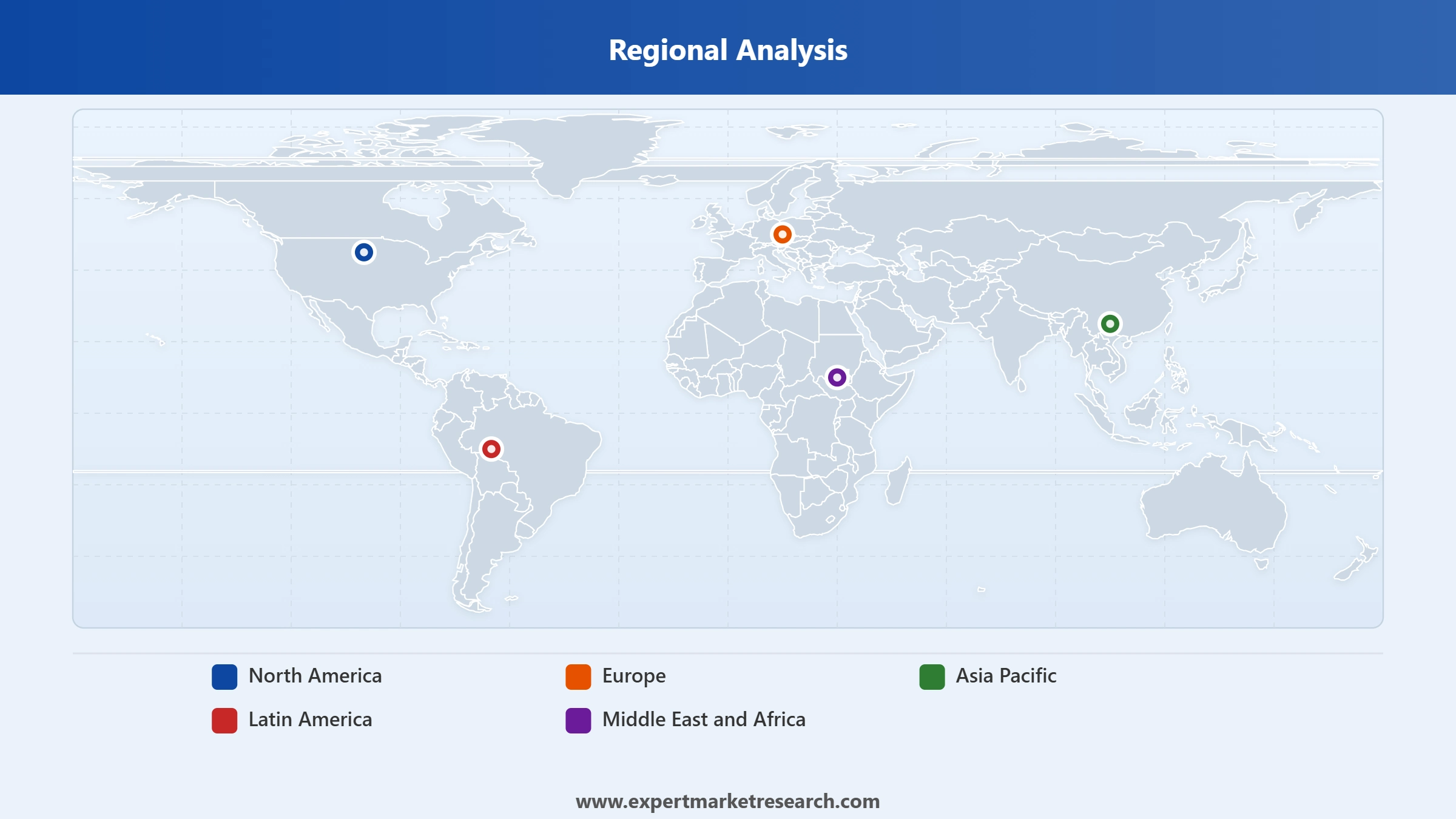
Key Insight: Regional dynamics in the taxi market continue to shape competitive strategies. Dense urban populations and rapid ride hailing app adoption keep Asia Pacific at the front of global demand, while North America benefits from established platform infrastructure and high smartphone penetration. Europe continues to see steady demand supported by regulated taxi networks, Latin America is expanding through growing urbanisation, and the Middle East and Africa region is registering strong growth as smart city and tourism led mobility investment accelerates.
Ride hailing accounts for the largest service type share of the taxi market, supported by widespread app-based platform adoption and door to door convenience across most urban markets worldwide. In February 2025, Uber reported that its Mobility segment gross bookings grew 24 percent year on year, driven by product innovation including new low-cost options, expanded teen focused ride offerings, and continued growth in advertising revenue across the wider platform, merchant network, and subscription programmes spanning every major market.
Read more about this report - REQUEST FREE SAMPLE COPY IN PDF
Ride sharing continues to serve cost conscious commuters seeking to split fares across shared routes, supported by corporate sustainability initiatives encouraging pooled commuting options. Established taxi companies continue to develop carpooling features and fixed route options, capturing this steady demand across budget conscious urban commuter segments worldwide, particularly among younger riders prioritising affordability over exclusivity, private vehicle ownership, and the environmental cost of single occupancy trips across increasingly congested metropolitan road networks throughout the country, region, and beyond overall.
Online booking accounts for the largest channel share of the taxi market, driven by smartphone penetration, transparent pricing, and real time tracking capabilities across most urban markets. In July 2026, Dubai Taxi Company extended its autonomous ride hailing service into a public facing offering across select Dubai neighbourhoods, expanding rider access beyond the initial commercial trial phase and building on continued investment in digital booking infrastructure and app-based dispatch systems across the wider emirate and its surrounding areas.
Read more about this report - REQUEST FREE SAMPLE COPY IN PDF
Offline booking, including street hailing and telephone dispatch, continues to serve markets with lower smartphone penetration and older demographic segments, though its share is gradually narrowing. In July 2026, Curb Mobility expanded its open dispatch network integration to New York City, allowing riders booking through partner apps to be matched directly with licensed street taxis without requiring drivers to install any new hardware, keeping onboarding costs low for smaller independent operators joining the rapidly growing network each passing month steadily.
Cars account for the largest vehicle type share of the taxi market, supported by passenger comfort and broad route suitability across most global markets. In April 2026, Baidu's Apollo Go commenced fully driverless commercial ride hailing in Dubai through a partnership with Dubai Taxi Company, marking one of the first fully autonomous car based commercial services operating anywhere across the wider Middle East and North Africa region achieved by any single operator to date so far.
Read more about this report - REQUEST FREE SAMPLE COPY IN PDF
Motorcycles are registering the fastest growth across the taxi market as congested Asian and Latin American cities favour two wheeled transport for speed and manoeuvrability through dense traffic. Established taxi companies continue to expand motorcycle taxi fleets across South and Southeast Asian cities, capturing this accelerating demand where traffic delays make car travel comparatively slower and less predictable for short urban trips during peak commuting hours across most major cities, suburbs, and surrounding regional areas throughout the country.
Read more about this report - REQUEST FREE SAMPLE COPY IN PDF
Asia Pacific leads the taxi market, anchored by dense urban populations and rapid ride hailing app adoption across major cities including Jakarta, Mumbai, and Singapore. Established taxi companies continue to expand driver networks and app-based platforms across Asia Pacific, reinforcing the region's position as the world's largest taxi demand centre by both trip volume and active user base across every major national market within the broader Asia Pacific region taken as a whole today.
The Middle East and Africa region is registering strong growth as smart city and tourism led mobility investment accelerates across the Gulf states. In November 2025, Dubai's Hala taxi service partnered with Fujairah Transport Corporation to launch a pilot expansion of its e-hailing platform into Fujairah and Dibba, extending coverage beyond its traditional Dubai base into neighbouring emirates with growing tourism sectors, expanding residential populations, and rising demand for reliable point to point transport across the entire country and beyond.
The global industry is becoming increasingly competitive as major taxi companies invest in autonomous vehicle partnerships, driver fee restructuring, and app-based dispatch technology to differentiate their platforms across ride hailing and ride sharing categories. Companies are prioritising cross border acquisitions, loyalty programme simplification, and regulatory compliance to appeal to increasingly price sensitive and technology-oriented riders. Established taxi companies are also deepening autonomous vehicle development partnerships, electric fleet transitions, and multimodal platform expansion to strengthen market positioning, while investing in driver retention programmes to defend market share against rising worker protection regulation.
Major taxi market players are also focusing on regional scale acquisitions and public listing exploration to capture growing demand across evolving mobility segments. Strategic emphasis on autonomous vehicle commercialisation and driver economics reform is allowing established companies to capture market share as consumer expectations around convenience, pricing transparency, and technological sophistication evolve. The market players continue to pursue partnerships with autonomous vehicle developers and regional mobility platforms, particularly across North America, Europe, and Southeast Asia, to diversify service offerings beyond traditional ride hailing while smaller regional operators compete on local market knowledge to retain price sensitive customers.
Founded in 2009 and headquartered in San Francisco, California, United States, Uber is a global mobility platform offering ride hailing, food delivery, and freight services across more than 70 countries. The company operates through Mobility, Delivery, and Freight segments, maintaining its position as the world's largest ride hailing platform by trip volume.
Founded in 2012 and headquartered in San Francisco, California, United States, Lyft is a ride hailing and multimodal mobility platform serving riders primarily across the United States and Canada. The company also offers bike and scooter sharing services alongside its core ride hailing business, competing directly with Uber across most of its operating markets.
Founded in 2010 and headquartered in Bengaluru, India, ANI Technologies operates Ola, India's largest mobility platform connecting riders to bikes, auto rickshaws, and cabs across more than 200 cities. The company also operates a supplementary electric vehicle arm and one of India's largest fleet management businesses.
Founded in 2013 and headquartered in Tallinn, Estonia, Bolt is a mobility platform offering ride hailing, food delivery, and micromobility services across dozens of countries in Europe and Africa. The company has positioned itself as a lean, driver focused alternative to larger global platforms, particularly in price sensitive regional markets.
Other key players in the market include Curb Mobility, LLC, Dubai Taxi Company, Flywheel Software, Inc., Free Now, Nihon Kotsu Co., Ltd., and Roppen Transportation Services Private Limited, among others.
*Please note that this is only a partial list; the complete list of key players is available in the full report. Additionally, the list of key players can be customized to better suit your needs.*
Unlock the latest insights with our taxi market trends 2026 report. Discover regional growth patterns, service type and vehicle type economics, and key industry players. Stay ahead of competition with trusted data and expert analysis. Download your free sample report today and drive informed decisions in the market.
Electric Vehicle (EV) Taxi Market
Advanced Driver Assistance Systems Trends
Autonomous Vehicle Technology Analysis
EV Charging Infrastructure Industry Outlook


Upto 15% Off
USD
$2499 $2249
$3999 $3599
$4999 $4249
$5999 $5099


*While we strive to always give you current and accurate information, the numbers depicted on the website are indicative and may differ from the actual numbers in the main report. At Expert Market Research, we aim to bring you the latest insights and trends in the market. Using our analyses and forecasts, stakeholders can understand the market dynamics, navigate challenges, and capitalize on opportunities to make data-driven strategic decisions.*
In 2025, the market reached an approximate value of USD 280.86 Billion.
The market is projected to grow at a CAGR of 11.10% between 2026 and 2035.
The market is estimated to witness a healthy growth in the forecast period of 2026-2035 to reach USD 804.69 Billion by 2035.
Key strategies driving the market include expansion of app-based ride-hailing, adoption of electric and autonomous vehicles, strategic partnerships, micro-mobility integration, and AI-driven route optimization.
Key trends aiding the market expansion include the technological advancements, such as ride-hailing apps and digital payment systems, adoption of electric and hybrid taxis, and expansion of taxi services into package delivery.
Regions considered in the market are North America, Europe, Asia Pacific, Latin America, and Middle East and Africa.
Based on service type, the market segmentations include ride hailing, ride sharing.
Cars, motorcycle, and others are considered in the report.
The key players in the market include Uber Technologies Inc., ANI Technologies Private Limited, Bolt Technology OÜ, Curb Mobility, LLC, Dubai Taxi Company, Flywheel Software, Inc., Free Now, Lyft, Inc., Nihon Kotsu Co., Ltd., and Roppen Transportation Services Private Limited, among others.
Asia Pacific dominates the market, supported by dense urban populations and rapid ride hailing app adoption.
Ride hailing holds the largest share, supported by widespread app-based platform adoption and door to door convenience.
Explore our key highlights of the report and gain a concise overview of key findings, trends, and actionable insights that will empower your strategic decisions.
| REPORT FEATURES | DETAILS |
| Base Year | 2025 |
| Historical Period | 2019-2025 |
| Forecast Period | 2026-2035 |
| Scope of the Report |
Historical and Forecast Trends, Industry Drivers and Constraints, Historical and Forecast Market Analysis by Segment:
|
| Breakup by Service Type |
|
| Breakup by Booking Type |
|
| Breakup by Vehicle Type |
|
| Breakup by Region |
|
| Market Dynamics |
|
| Competitive Landscape |
|
| Companies Covered |
|
Datasheet
One User
USD 2,499
USD 2,249
tax inclusive*
Single User License
One User
USD 3,999
USD 3,599
tax inclusive*
Five User License
Five User
USD 4,999
USD 4,249
tax inclusive*
Corporate License
Unlimited Users
USD 5,999
USD 5,099
tax inclusive*
*Please note that the prices mentioned below are starting prices for each bundle type. Kindly contact our team for further details.*
Flash Bundle
Small Business Bundle
Growth Bundle
Enterprise Bundle
*Please note that the prices mentioned below are starting prices for each bundle type. Kindly contact our team for further details.*
Flash Bundle
Number of Reports: 3
20%
tax inclusive*
Small Business Bundle
Number of Reports: 5
25%
tax inclusive*
Growth Bundle
Number of Reports: 8
30%
tax inclusive*
Enterprise Bundle
Number of Reports: 10
35%
tax inclusive*
How To Order

Select License Type
Choose the right license for your needs and access rights.

Click on ‘Buy Now’
Add the report to your cart with one click and proceed to register.

Select Mode of Payment
Choose a payment option for a secure checkout. You will be redirected accordingly.
Strategic Solutions for Informed Decision-Making
Gain insights to stay ahead and seize opportunities.

Get insights & trends for a competitive edge.

Track prices with detailed trend reports.

Analyse trade data for supply chain insights.

Leverage cost reports for smart savings

Enhance supply chain with partnerships.

Connect For More Information
Our expert team of analysts will offer full support and resolve any queries regarding the report, before and after the purchase.
Our expert team of analysts will offer full support and resolve any queries regarding the report, before and after the purchase.
We employ meticulous research methods, blending advanced analytics and expert insights to deliver accurate, actionable industry intelligence, staying ahead of competitors.
Our skilled analysts offer unparalleled competitive advantage with detailed insights on current and emerging markets, ensuring your strategic edge.
We offer an in-depth yet simplified presentation of industry insights and analysis to meet your specific requirements effectively.




