

Consumer Insights
Uncover trends and behaviors shaping consumer choices today
Procurement Insights
Optimize your sourcing strategy with key market data
Industry Stats
Stay ahead with the latest trends and market analysis.
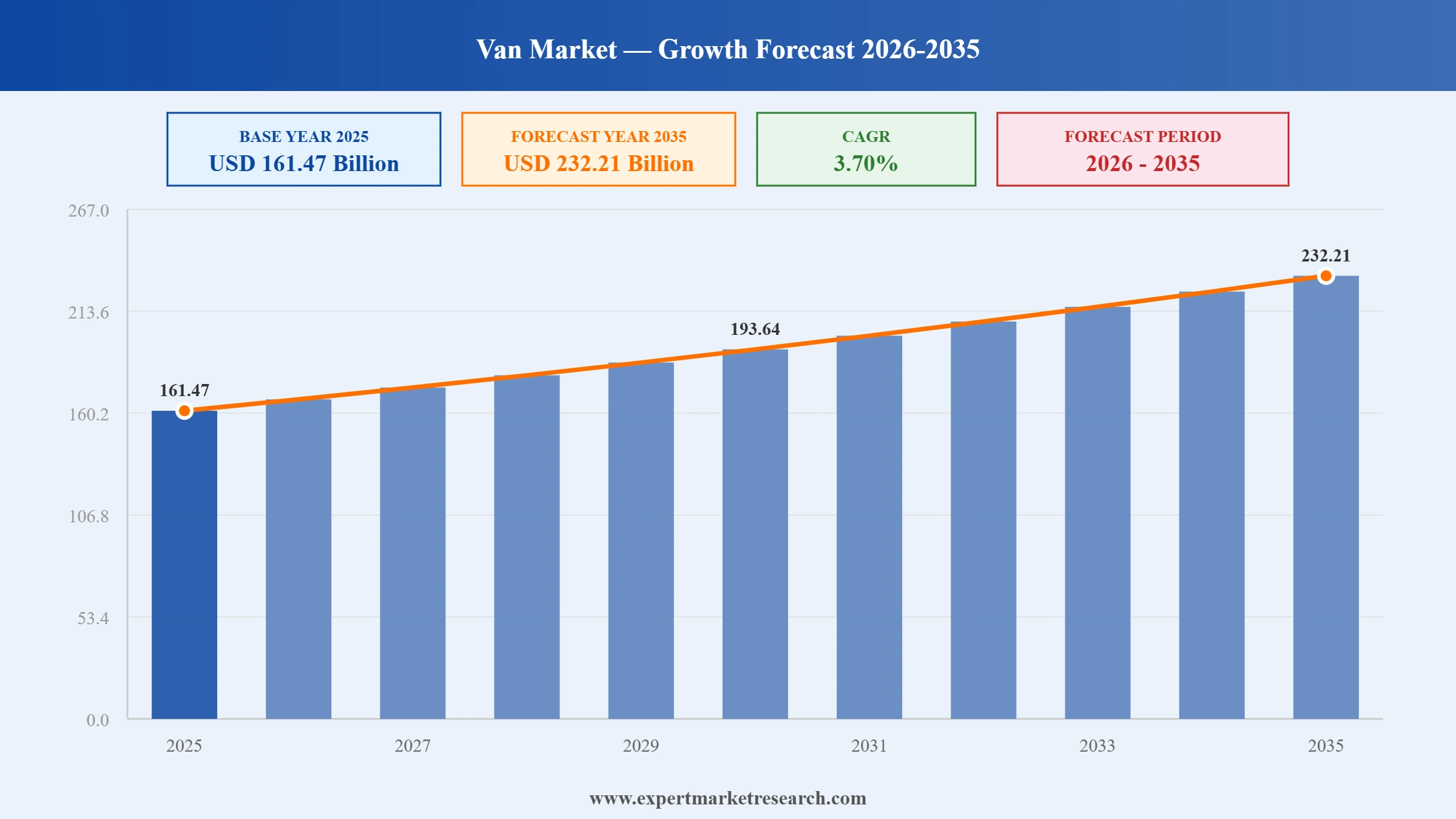
The global van market size reached around USD 161.47 Billion in 2025. The market is projected to grow at a CAGR of 3.70% between 2026 and 2035 to reach nearly USD 232.21 Billion by 2035.
A van is a box-bodied motor vehicle larger than a car but smaller than a truck, available in a wide range of configurations including cargo vans, passenger vans, panel vans, crew vans, and minivans. Cargo vans are engineered specifically for the transportation of goods and are widely used across last-mile delivery, postal services, trade services, and urban freight operations. Passenger vans, also called people movers, are designed to transport groups of up to fifteen people and serve shuttle services, hospitality, healthcare transport, and public sector fleets. Panel vans offer seamless sidewalls and configurable interiors suited to mobile business operations, while crew vans combine seating and cargo capacity for construction, landscaping, and field service teams.
The van market encompasses the global production, sale, and operation of these vehicles across commercial and personal end-use segments, spanning internal combustion, hybrid, and battery electric drivetrains. It serves a broad range of industries including logistics, e-commerce, healthcare, hospitality, public sector services, construction, and utilities, making vans one of the most commercially versatile vehicle categories in the global automotive market. As electrification accelerates and fleet operators face tightening zero-emission mandates, the market is undergoing a structural shift in powertrain composition, with manufacturers including Ford, Mercedes-Benz, Stellantis, Renault, Kia, and Volkswagen Commercial Vehicles all expanding dedicated electric van lineups to meet evolving fleet and regulatory requirements.
Read more about this report - REQUEST FREE SAMPLE COPY IN PDF
| Global Van Market Report Summary | Description | Value |
| Base Year | USD Billion | 2025 |
| Historical Period | USD Billion | 2019-2025 |
| Forecast Period | USD Billion | 2026-2035 |
| Market Size 2025 | USD Billion | 161.47 |
| Market Size 2035 | USD Billion | 232.21 |
| CAGR 2019-2025 | Percentage | XX% |
| CAGR 2026-2035 | Percentage | 3.70% |
| CAGR 2026-2035 - Market by Region | Asia Pacific | 4.3% |
| CAGR 2026-2035 - Market by Country | India | 4.9% |
| CAGR 2026-2035 - Market by Country | China | 4.1% |
| CAGR 2026-2035 - Market by Tonnage Capacity | 2 to 3 Tons | 5.1% |
| CAGR 2026-2035 - Market by End Use | Commercial | 5.3% |
| Market Share by Country 2025 | Japan | 4.4% |
The van market is growing because of the structural and simultaneous expansion of e-commerce, tightening government emission regulations, and the accelerating electrification of commercial fleets. Online retail has fundamentally changed the last-mile logistics landscape, creating sustained and growing demand for cargo vans capable of making high-frequency urban and suburban deliveries. According to the US Census Bureau, US retail e-commerce sales reached approximately USD 289 billion in the first quarter of 2024 alone, a figure that continues to grow and directly translates into van fleet expansion requirements for delivery operators. At the same time, government policies including the EU's mandate for zero tailpipe emissions from new vans by 2035 and the UK's Zero Emission Vehicle mandate are compelling fleet operators to accelerate replacement cycles, generating incremental van market demand as older internal combustion vehicles are retired ahead of regulatory deadlines.
Beyond e-commerce and regulation, the rise of mobile business models is creating new van demand across professional services, healthcare, and utilities. Panel vans are increasingly being converted into mobile workshops, medical units, and on-site service vehicles, broadening the van market's end-use base beyond traditional logistics. Ford Pro's research conducted by the Centre for Economics and Business Research found that operating an electric fleet over three years delivers average net savings, confirming that total cost of ownership economics are now supporting electric van adoption beyond compliance-driven purchasing, further reinforcing the commercial case for continued van market expansion globally.
E-Commerce Expansion and Last-Mile Delivery Demand
The single most consistent structural driver of van market growth is the global expansion of e-commerce and the resulting surge in demand for last-mile delivery capacity. Online retail platforms including Amazon, Walmart, and major grocery chains have dramatically increased delivery frequency and service area coverage, requiring large and continuously expanding fleets of cargo and panel vans. The US Census Bureau reported that e-commerce sales accounted for approximately 16% of total US retail sales in 2024, a share that continues to grow, while parcel volumes across Europe and Asia Pacific are rising in parallel. Logistics operators including DPD, DHL, UPS, and FedEx are expanding van fleets to meet this demand, with electric van variants increasingly preferred for urban delivery zones subject to low-emission restrictions.
Government Emission Mandates and ZEV Policy
Binding government regulations are accelerating van fleet replacement cycles and directly driving market revenue. The European Commission requires a 100% reduction in tailpipe CO2 emissions from new vans sold in the EU by 2035, while more than 200 European cities restrict internal combustion vehicle access in designated clean air zones. The UK's Zero Emission Vehicle mandate sets escalating annual targets for electric van sales as a share of total registrations, creating predictable and growing demand for electric van models. In response, Mercedes-Benz has announced plans to move half of its global van sales onto its new VAN.EA electric platform after 2026, while Ford, Stellantis, Kia, and Renault have all committed significant investment to expanding electric van portfolios.
Fleet Electrification and Total Cost of Ownership Improvements
The improving economics of electric van ownership are removing a key barrier to adoption and driving fleet conversion at scale. Ford Pro research conducted across five European markets found that operating an electric van fleet over three years generates average net savings compared to diesel equivalents, with a sole trader saving an average of EUR 14,000 over the period. Telematics, predictive maintenance, and route optimisation technologies are further improving van fleet efficiency, reducing operating costs by up to 20% according to fleet management research, making modern electric and connected vans increasingly attractive to both large logistics operators and small and medium-sized businesses across all major van market geographies.
The van market growth can be attributed to the expansion of the e-commerce sector, rapid urbanisation and infrastructure development, the growing adoption of electric vehicles, and rising applications of vans in the commercial sector
Tata Motors Limited announced that its domestic small commercial vehicle (SCV) cargo and pickup segment reached 12,799 units sold in April 2026, marking a 40.2% year-over-year growth compared to 9,131 units in April 2025.
Ford Pro was awarded the 2026 Commercial Van of the Year by Work Truck at Work Truck Week 2026 in Indianapolis on March 10, 2026. This marked the third consecutive year the Ford Transit line earned top honors from North American fleet operations readers.
During Rivian's Q4 2025 earnings call, CEO Robert Scaringe confirmed that two new electric delivery van variants are in development: an all-wheel drive layout and a version equipped with a larger battery pack. Rivian currently supplies EDV 500 and EDV 700 electric delivery vans to commercial fleet operators including Amazon.
Kia Corporation was awarded the 2026 International Van of the Year title for its all-electric PV5 by a jury of 26 commercial vehicle journalists at SOLUTRANS in Lyon, France. The PV5 became the first Korean model and Asia's first electric van to receive the award.
The growth of e-commerce significantly increases the demand for last-mile delivery services, necessitating efficient transportation solutions for goods. This phenomenon is driven by a heightened dependence on online shopping, which, in turn, requires dependable and adaptable vehicles to tackle logistical challenges in both urban and suburban environments.
The surge in urban populations, coupled with ongoing infrastructure development, amplifies the necessity for flexible transportation options such as vans. Their capability to accommodate both passenger and cargo transport renders them vital for meeting mobility needs in urban settings and facilitating logistics related to construction activities.
The global transition towards sustainability is propelling the demand for electric vans, bolstered by governmental incentives and a growing awareness of environmental issues. These sustainable alternatives are particularly appealing to businesses seeking to lower their emissions and adhere to eco-friendly transportation regulations.
The capacity of vans to be tailored for a variety of commercial applications, including cargo transport, mobile services, and passenger transport, enhances their attractiveness. This flexibility establishes vans as a crucial solution for enterprises across multiple sectors.
The market is experiencing consistent growth, primarily due to the rising need for efficient transportation solutions in logistics and last-mile delivery, which is being propelled by the expansion of e-commerce. The shift towards electric vehicles is significantly altering the market landscape, as governments provide incentives for environmentally friendly alternatives and businesses pursue sustainable practices. The customisation of vans for various commercial applications, including mobile services and cargo transport, adds to their attractiveness. Additionally, advancements in technology related to safety, fuel efficiency, and connectivity are contributing to the market's expansion.
The Expert Market Research's report titled “Global Van Market Report and Forecast 2026-2035” offers a detailed analysis of the market based on the following segments:
Market Breakup by Tonnage Capacity
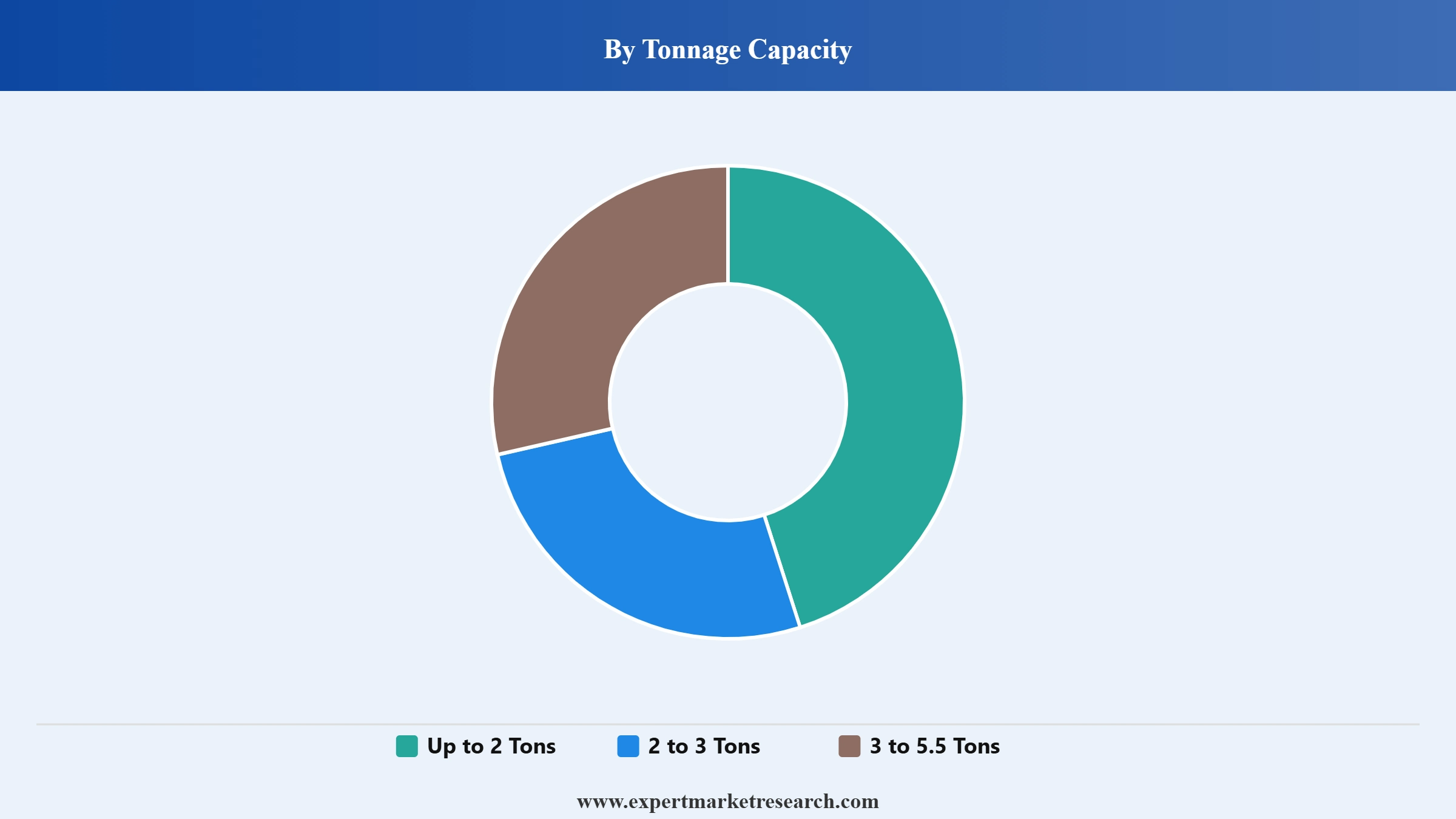
Key Insight: The up to 2 ton segment holds the largest share of the van market by tonnage capacity, driven by the dominance of compact and light cargo vans in urban last-mile delivery, retail logistics, and small business operations where manoeuvrability and low operating costs take priority over payload volume. The 2 to 3 ton segment is the fastest-growing tonnage category, reflecting growing demand from mid-sized logistics operators, food distribution networks, and mobile service businesses that require greater payload flexibility. The 3 to 5.5 ton segment serves heavy-duty trade, construction material delivery, and refrigerated transport applications where maximum payload capacity is essential, with diesel powertrains continuing to dominate this class due to limited availability of electric models capable of meeting range and payload requirements simultaneously at this weight rating.
Market Breakup by Propulsion Type
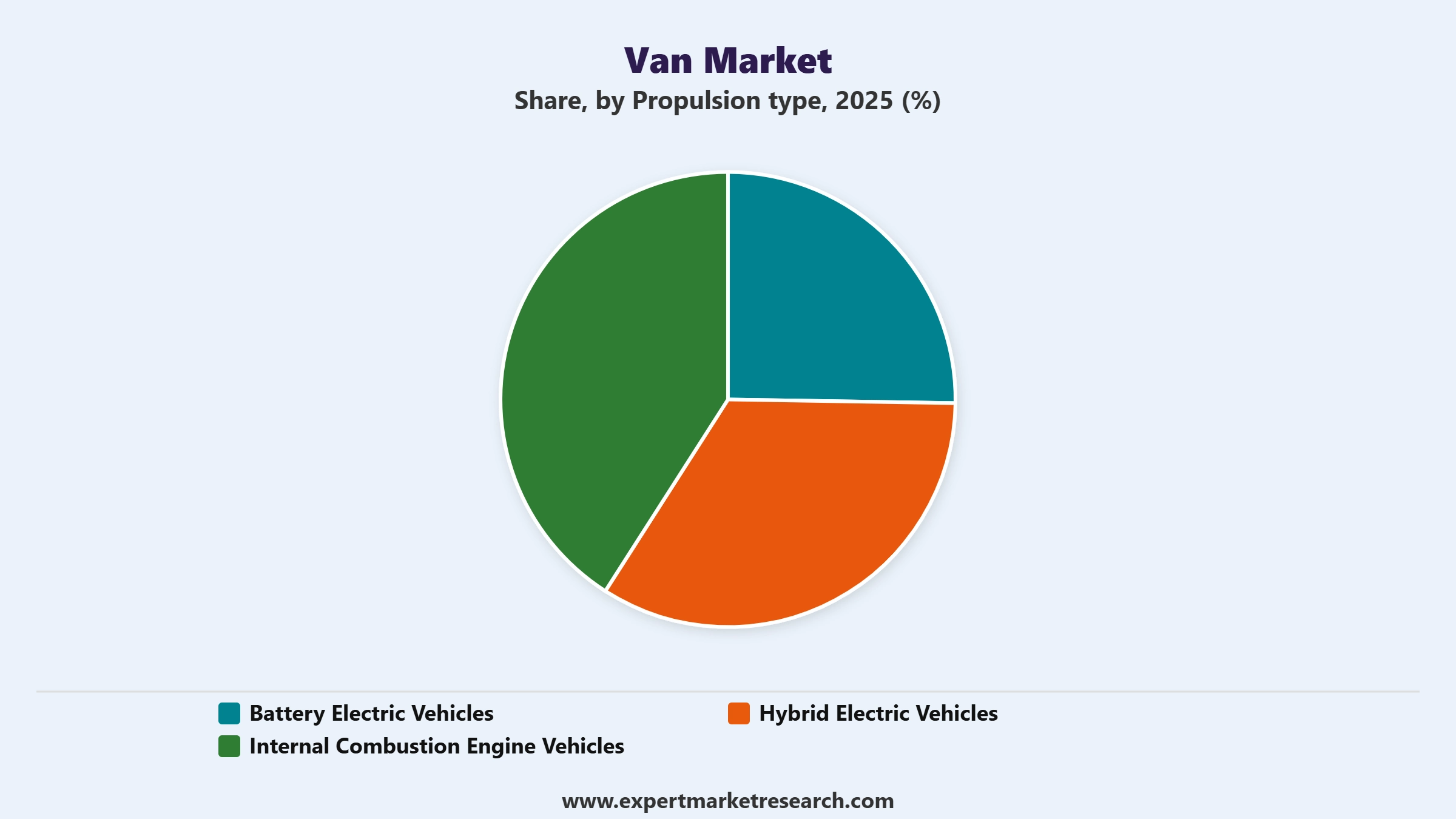
Key Insight: Internal combustion engine vehicles continue to account for the dominant share of the global van market by propulsion type, with the European Automobile Manufacturers' Association reporting that diesel vans represented the majority of EU van registrations in 2024, reflecting the technology's established refuelling network, lower upfront acquisition cost, and operational reliability across high-utilisation and long-distance duty cycles. Battery electric vans are the fastest-growing propulsion segment, supported by binding government zero-emission mandates including the EU's 2035 tailpipe emissions ban for new vans and the UK's Zero Emission Vehicle quota system. The BVRLA's 2026 Road to Zero Report Card confirmed that 26 electric van models were available under £50,000 in 2026 compared to 17 in 2025, broadening accessible electric van choice for fleet buyers. Hybrid electric vehicles occupy a bridging position, providing an intermediate step for fleet operators managing the transition from diesel where depot charging infrastructure is not yet fully in place.
Market Breakup by End Use
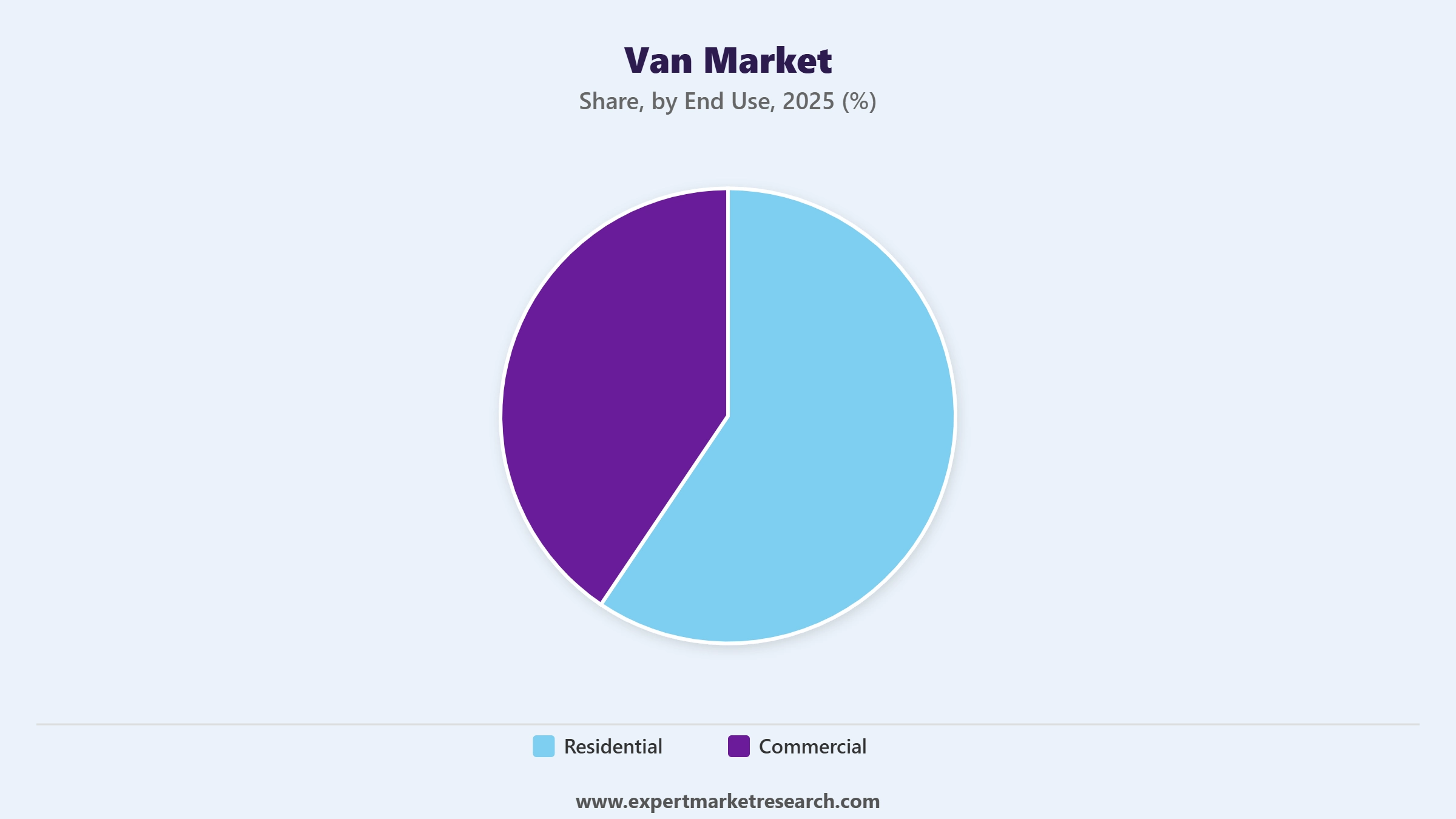
Key Insight: The commercial segment is the dominant end-use category in the van market by a significant margin, driven by the essential role of cargo and panel vans across logistics, e-commerce delivery, trade services, healthcare, utilities, and public sector operations. Commercial fleets account for the substantial majority of all van registrations globally, with fleet procurement cycles, zero-emission compliance obligations, and total cost of ownership considerations driving purchasing decisions. The residential segment, while smaller in absolute volume, is a growing end-use category driven by the rising popularity of campervan and leisure vehicle conversions. According to the National Caravan Council in the United Kingdom, the conversion and motorhome sector sustained strong consumer demand through 2024 and 2025, with base van platforms increasingly purchased directly by private buyers for lifestyle conversion projects.
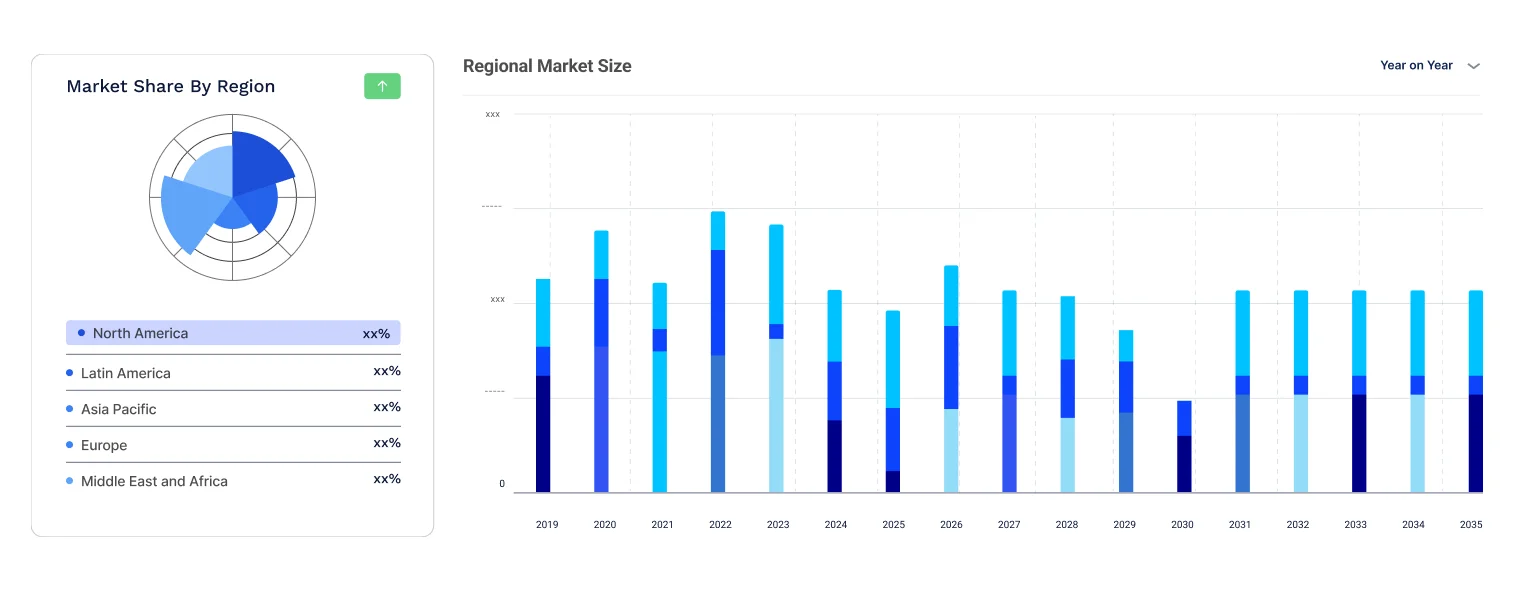
Market Breakup by Region

Read more about this report - REQUEST FREE SAMPLE COPY IN PDF
Lightweight Vans Lead Market Share While Mid-Range Tonnage Records Fastest Growth
The up to 2 ton segment commands the largest market share within the tonnage capacity breakup, supported by the high volume of compact urban delivery and trade vans procured by commercial fleets globally, while the 2 to 3 ton segment is gaining share at the fastest rate as logistics operators scale up from compact to mid-size platforms to meet growing parcel and distribution volumes.
Read more about this report - REQUEST FREE SAMPLE COPY IN PDF
Internal Combustion Engine Vehicles Holds the Largest Propulsion Share While Battery Electric Records the Fastest Adoption Growth
Internal combustion engine vans retain the dominant share of the propulsion type segment globally, with diesel commanding the majority of EU commercial van registrations in 2024 according to ACEA data, while battery electric vans are gaining share at the fastest rate as zero-emission mandates and expanding model availability accelerate fleet conversion decisions across North America and Europe.
Read more about this report - REQUEST FREE SAMPLE COPY IN PDF
Commercial End Use Dominates Market Share While Residential Segment Grows Through Lifestyle Conversions
The commercial end-use segment holds the overwhelming majority of global van market share, supported by sustained fleet procurement across logistics, trade, and public sector applications, while the residential segment is recording steady share growth driven by expanding consumer interest in campervan conversions and leisure vehicle customisation across key markets including the United Kingdom, Germany, and Australia.
Read more about this report - REQUEST FREE SAMPLE COPY IN PDF
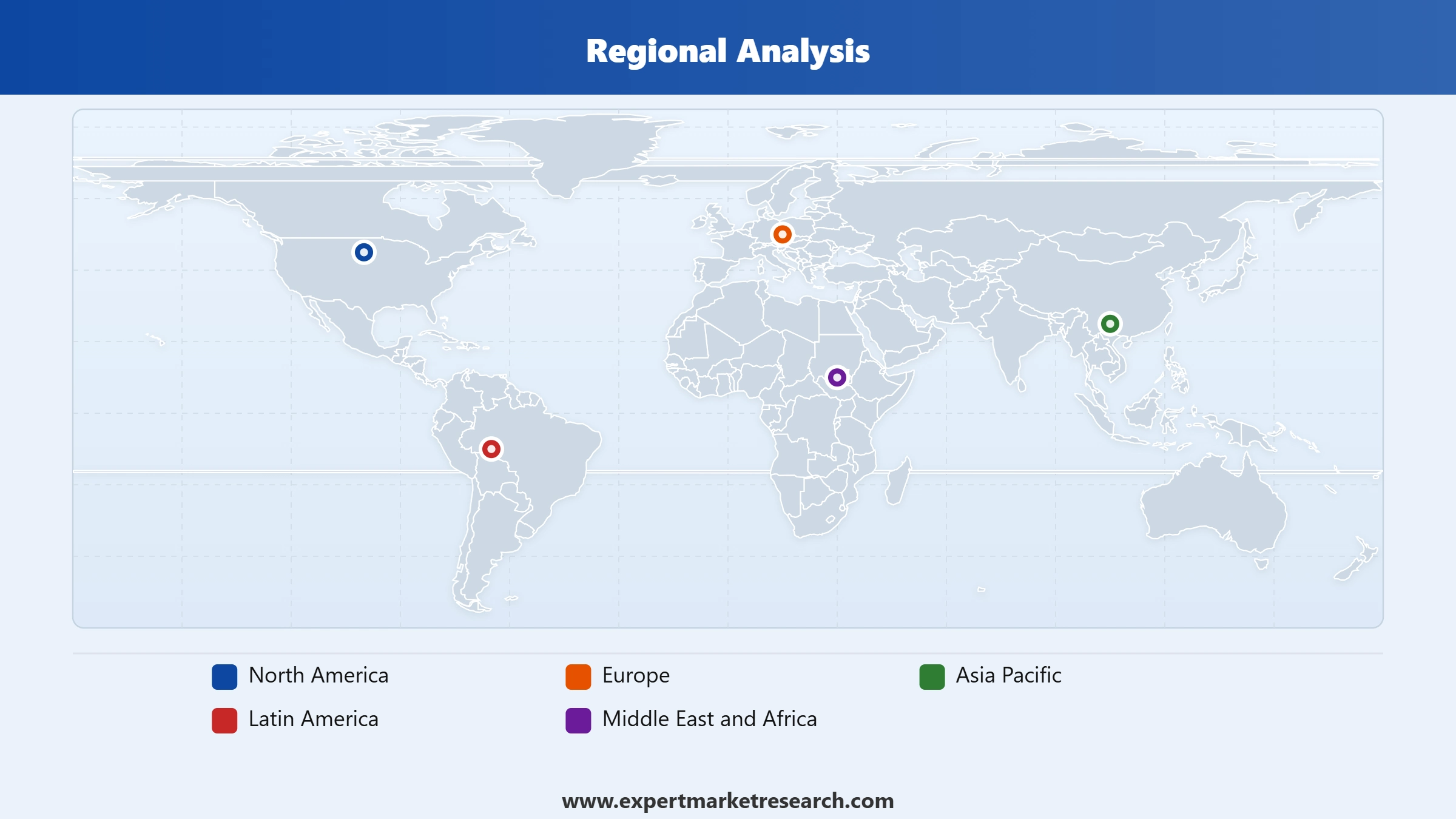
Record Sales and Fleet Electrification Mandates Define North America's Van Market
North America is one of the largest regions in the global van market, led by the United States where the Ford Transit retained its position as the top-selling van in 2025, recording a new annual sales record, according to Ford's January 2026 announcement. The US commercial van segment is driven by sustained e-commerce growth, expanding last-mile delivery networks, and federal and state-level clean fleet procurement programmes. The Zero Emission Vehicle standards across multiple US states are compelling fleet operators to accelerate electric van adoption, while Canada contributes additional regional demand through provincial infrastructure programmes and growing urban logistics activity. General Motors, Ford, and Stellantis dominate North American van sales, with electric variants including the Ford E-Transit and GM BrightDrop expanding their share of new fleet procurement contracts.
Emission Regulations and Platform Electrification Drive Europe's Van Market
Europe is the most regulation-driven region in the global van market, with the European Commission's mandate requiring zero tailpipe emissions from all new vans sold in the EU by 2035 compelling manufacturers and fleet operators to accelerate the transition away from internal combustion powertrains. According to the European Automobile Manufacturers' Association, new van registrations across the EU have maintained an upward trajectory, with commercial fleets accounting for the majority of demand driven by scheduled replacement cycles and zero-emission procurement rules entering force from 2026. Germany, France, the United Kingdom, and Italy represent the largest national markets within the region, with more than 200 European municipalities operating low-emission zones that restrict internal combustion van access in city centres. The Renault Master was named Van of the Year at the Motor Trader Commercial Industry Awards 2026, while new entrants from China including BYD and SAIC Maxus are intensifying competitive pressure on established European brands.
E-Commerce Expansion and Domestic Manufacturing Anchor Asia Pacific's Van Market
Asia Pacific is the largest region in the global van market, accounting for the dominant share of global sales volume, driven by rapid urbanisation, expanding e-commerce logistics networks, and strong domestic manufacturing ecosystems across China, Japan, South Korea, and India. China is the single largest national market, supported by government incentives for new energy commercial vehicles under the PM E-DRIVE equivalent programmes and a highly competitive domestic electric van manufacturing base that includes BYD, SAIC Maxus, Changan, Dongfeng, and GAC. India is the fastest-growing major market within the region, driven by expanding last-mile delivery demand from e-commerce platforms and government-backed electric vehicle adoption programmes. Japan and South Korea contribute meaningfully through established automotive manufacturers with strong van portfolios, with Kia's PV5 electric van generating significant fleet demand following its commercial launch in 2025 and selling out its entire 2026 UK production run within four months.
Mining, Agribusiness, and Urban Logistics Fuel Latin America's Van Market
Latin America is a growing region in the global van market, anchored by Brazil and Mexico as the two largest national markets, with Argentina, Colombia, and Chile contributing additional demand across commercial and personal van segments. Brazil drives the highest van procurement volumes through expanding urban logistics operations, agribusiness supply chains, and public sector fleet programmes, while Mexico is benefiting from nearshoring-related industrial activity that is generating new demand for cargo and crew vans across manufacturing and construction sectors. The region's van market remains predominantly internal combustion engine driven, with electric van adoption at an early stage due to limited charging infrastructure and higher upfront vehicle costs relative to average fleet budgets. However, growing e-commerce penetration across major Brazilian and Mexican cities is creating sustained demand for light cargo vans in urban last-mile delivery applications, laying the foundation for gradual fleet electrification as infrastructure and total cost of ownership economics improve.
Vision 2030 Infrastructure Projects and Urban Logistics Drive Middle East and Africa's Van Market
The Middle East and Africa is an emerging but growing region in the global van market, supported by large-scale government infrastructure investment programmes, expanding urban populations, and growing e-commerce and logistics activity across Gulf Cooperation Council states and Sub-Saharan Africa. Saudi Arabia and the UAE are the largest national markets within the region, with Vision 2030 mega-projects and smart city developments generating sustained demand for cargo, crew, and passenger vans across construction, logistics, and hospitality sectors. The region's van market is predominantly served by Japanese manufacturers including Toyota and Nissan, whose high-roof cargo and passenger van platforms are widely used across commercial and public sector fleets. In Sub-Saharan Africa, vans serve a critical role in informal public transportation and goods distribution, with South Africa, Nigeria, Kenya, and Ethiopia representing the most active markets, driven by population growth, urbanisation, and expanding retail and logistics infrastructure.
Read more about this report - REQUEST FREE SAMPLE COPY IN PDF
The global van market is moderately consolidated, with a small group of established manufacturers collectively dominating global sales volumes across cargo, passenger, and panel van segments. Competition is shifting from traditional powertrain performance toward total cost of ownership, telematics integration, fleet management software capabilities, and battery supply security, compelling established players to pursue platform consolidation, technology sharing, and strategic partnerships to defend market share. Manufacturers are increasingly developing shared electric architectures across multiple brand nameplates to reduce development costs and accelerate time to market, while joint ventures focused on software-defined vehicle platforms and modular last-mile logistics solutions are becoming central to long-term competitive positioning. New entrants from Asia, particularly from China, are intensifying competition in European and emerging markets by offering price-competitive electric van alternatives, further pressuring established Western and Japanese manufacturers to accelerate electrification investment and broaden their fleet service and financing offerings alongside core vehicle sales.
Established in 1903, Ford Motor Company is headquartered in Dearborn, Michigan, United States. As a trailblazer in the automotive sector, the company is renowned for its legendary models, including the Mustang and F-150, as well as its expanding range of electric vehicles.
Founded in 1898, Renault Group is headquartered in Boulogne-Billancourt, France. Recognised for its commitment to innovation and sustainability, Renault stands as a prominent player in the global automotive landscape, particularly in the realm of electric mobility, bolstered by collaborations such as the Renault-Nissan-Mitsubishi Alliance.
Originally established as Chrysler Corporation in 1925, FCA US LLC is now a subsidiary of Stellantis and is headquartered in Auburn Hills, Michigan, United States. The company is well-known for its brands, including Jeep and Dodge, and plays a vital role in the international automotive market.
Founded in 1937, Volkswagen AG is headquartered in Wolfsburg, Germany. As one of the world's leading automotive manufacturers, it oversees a diverse portfolio of brands, including Volkswagen, Audi, Porsche, and Lamborghini, with a strong emphasis on innovative and sustainable mobility solutions, such as electric vehicles and autonomous driving technologies.
Other major players in the van market are Mercedes-Benz Group AG, Nissan Motor Co Ltd., Hyundai Motor Company, Toyota Motor Corp., General Motor Company, and BYD Ord Shs A, among others.
*Please note that this is only a partial list; the complete list of key players is available in the full report. Additionally, the list of key players can be customized to better suit your needs.*
The van market is navigating a complex transition as fleet operators face the dual pressure of rising electrification expectations and the operational realities of an infrastructure network that has not yet scaled to meet commercial vehicle needs. The British Vehicle Rental and Leasing Association's 2026 Road to Zero Report Card found that for most operators, electric vans still do not make clear economic sense, citing higher upfront costs, uncertain residual values, and a charging network that is frequently at odds with how commercial vans are actually used in daily operations. The report noted that the average range across electric van models fell slightly in 2026 compared to 2025, while limited suitable van-friendly public charging points, few pre-bookable charging slots, and patchy payment options continue to add operational risk and productivity loss for fleet managers considering the switch from diesel.
Alongside infrastructure gaps, the high upfront purchase cost of battery electric vans remains a structural restraint that disproportionately affects small and medium-sized fleet operators. The US Section 45W commercial clean vehicle federal tax credit, which had partially offset acquisition costs for commercial electric vehicles, expired on September 30, 2025, reducing the financial incentive available to smaller US fleet buyers at a critical moment in the adoption curve. In Europe, the European Automobile Manufacturers' Association reported that diesel vans accounted for the majority of EU van registrations in 2024, with electrically chargeable vans representing a comparatively small share, confirming that internal combustion engine platforms continue to dominate commercial van procurement due to their lower acquisition costs, mature refuelling networks, and operational predictability across long-distance and high-utilisation duty cycles.
Despite these headwinds, the van market holds substantial long-term opportunity driven by e-commerce growth, tightening zero-emission mandates, and improving total cost of ownership economics. The US Department of Energy has documented that lithium-ion battery prices have fallen significantly since 2010, steadily reducing the upfront cost gap between electric and diesel vans, while the International Council on Clean Transportation has found that electric vans can deliver meaningful annual fuel cost savings for fleet operators, strengthening the commercial case for electrification. Battery-as-a-service and van leasing models are also gaining traction in Europe, reducing capital barriers for smaller operators, while the EU's binding 2035 zero-emission van mandate and the UK's Zero Emission Vehicle quota system are creating a predictable long-term demand pipeline that is underpinning manufacturer investment in next-generation electric van platforms across all major vehicle size classes.


Upto 15% Off
USD
$3999 $3599
$2499 $2249
$4999 $4249
$5999 $5099


*While we strive to always give you current and accurate information, the numbers depicted on the website are indicative and may differ from the actual numbers in the main report. At Expert Market Research, we aim to bring you the latest insights and trends in the market. Using our analyses and forecasts, stakeholders can understand the market dynamics, navigate challenges, and capitalize on opportunities to make data-driven strategic decisions.*
In 2025, the market attained a value of nearly USD 161.47 Billion.
The market is assessed to grow at a CAGR of 3.70% between 2026 and 2035.
The market is estimated to witness a healthy growth in the forecast period of 2026-2035 to reach about USD 232.21 Billion by 2035.
The major drivers of the market are rapid urbanisation, infrastructure development, and the growing adoption of electric vehicles.
As per the EMR report, the different end uses of vans are residential and commercial.
The major regions considered in the market are North America, Europe, the Asia Pacific, Latin America, and the Middle East and Africa.
The major players in the market are Ford Motor Company, Renault Group, FCA US LLC, Volkswagen AG, Mercedes-Benz Group AG, Nissan Motor Co Ltd., Hyundai Motor Company, Toyota Motor Corp., General Motor Company, and BYD Ord Shs A, among others.
Explore our key highlights of the report and gain a concise overview of key findings, trends, and actionable insights that will empower your strategic decisions.
| REPORT FEATURES | DETAILS |
| Base Year | 2025 |
| Historical Period | 2019-2025 |
| Forecast Period | 2026-2035 |
| Scope of the Report |
Historical and Forecast Trends, Industry Drivers and Constraints, Historical and Forecast Market Analysis by Segment:
|
| Breakup by Tonnage Capacity |
|
| Breakup by Propulsion type |
|
| Breakup by End Use |
|
| Breakup by Region |
|
| Market Dynamics |
|
| Competitive Landscape |
|
| Companies Covered |
|
Single User License
One User
USD 3,999
USD 3,599
tax inclusive*
Datasheet
One User
USD 2,499
USD 2,249
tax inclusive*
Five User License
Five User
USD 4,999
USD 4,249
tax inclusive*
Corporate License
Unlimited Users
USD 5,999
USD 5,099
tax inclusive*
*Please note that the prices mentioned below are starting prices for each bundle type. Kindly contact our team for further details.*
Flash Bundle
Small Business Bundle
Growth Bundle
Enterprise Bundle
*Please note that the prices mentioned below are starting prices for each bundle type. Kindly contact our team for further details.*
Flash Bundle
Number of Reports: 3
20%
tax inclusive*
Small Business Bundle
Number of Reports: 5
25%
tax inclusive*
Growth Bundle
Number of Reports: 8
30%
tax inclusive*
Enterprise Bundle
Number of Reports: 10
35%
tax inclusive*
How To Order

Select License Type
Choose the right license for your needs and access rights.

Click on ‘Buy Now’
Add the report to your cart with one click and proceed to register.

Select Mode of Payment
Choose a payment option for a secure checkout. You will be redirected accordingly.
Strategic Solutions for Informed Decision-Making
Gain insights to stay ahead and seize opportunities.

Get insights & trends for a competitive edge.

Track prices with detailed trend reports.

Analyse trade data for supply chain insights.

Leverage cost reports for smart savings

Enhance supply chain with partnerships.

Connect For More Information
Our expert team of analysts will offer full support and resolve any queries regarding the report, before and after the purchase.
Our expert team of analysts will offer full support and resolve any queries regarding the report, before and after the purchase.
We employ meticulous research methods, blending advanced analytics and expert insights to deliver accurate, actionable industry intelligence, staying ahead of competitors.
Our skilled analysts offer unparalleled competitive advantage with detailed insights on current and emerging markets, ensuring your strategic edge.
We offer an in-depth yet simplified presentation of industry insights and analysis to meet your specific requirements effectively.




