

Consumer Insights
Uncover trends and behaviors shaping consumer choices today
Procurement Insights
Optimize your sourcing strategy with key market data
Industry Stats
Stay ahead with the latest trends and market analysis.
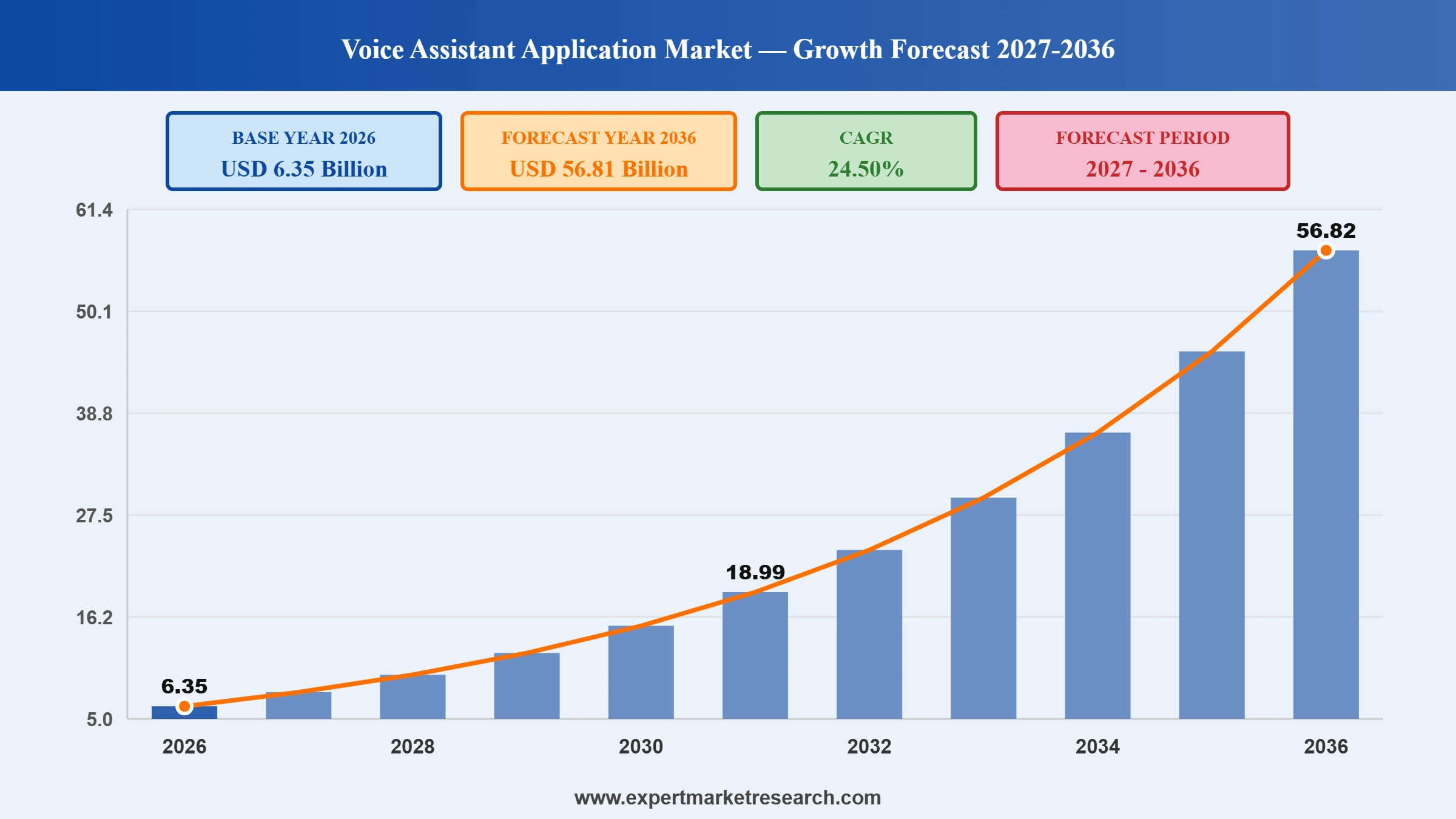
The global voice assistant application market attained a value of USD 5.10 Billion in 2025 and is projected to expand at a CAGR of 24.50% through 2035. The market is expected to achieve USD 45.63 Billion by 2035. Investments in natural language processing, generative AI models, multilingual speech recognition, and conversational interfaces across devices are widening adoption across banking, healthcare, retail, and manufacturing sectors.
The voice assistant application market covers software letting users interact with devices, applications, and enterprise systems through spoken language instead of typed commands. Coverage spans consumer assistants in smartphones, speakers, and wearables, plus enterprise tools in contact centers, banking, healthcare, and vehicle infotainment. Adoption is broadening as natural language understanding improves toward multiturn conversation.
Demand is concentrating around assistants embedded directly into existing software stacks rather than standalone applications, letting banks, hospitals, and retailers add voice capability without replacing core systems. Automakers are extending this demand into vehicles, illustrated when General Motors announced in October 2025 plans to introduce an AI powered voice assistant across its lineup starting in 2026.
Manufacturers and software vendors across the voice assistant application market are widening portfolios beyond basic command recognition toward agentic capabilities that complete multi step tasks and hand off complex queries to human agents. Investment is flowing into domain specific voice models trained on banking, healthcare, and retail vocabulary, reshaping how voice assistant capability reaches these buyers through bundled implementation and managed services.
Read more about this report - REQUEST FREE SAMPLE COPY IN PDF
The Midlands region of England's National Health Service procured ambient voice documentation technology covering roughly seventy thousand clinicians, among the largest coordinated healthcare deployments of voice assisted note taking recorded to date. The system listens during consultations and drafts structured notes automatically, reducing manual typing. Such large-scale procurement signals across the voice assistant application market strong institutional confidence in voice assistant reliability for clinical workflows.
Azerbaijan's Bank ABB launched two AI powered conversational banking assistants, AI Nur and AI Khan, giving retail customers a voice and chat-based channel for account inquiries, transfers, and everyday banking tasks. The assistants handle high volumes of routine requests without routing customers to call center staff. This rollout shows regional banks outside major hubs in the voice assistant application market building meaningful conversational banking capability.
Deutsche Telekom unveiled its Magenta AI Call Assistant at Mobile World Congress, introducing network level voice features such as live translation and call summaries that activate during an ordinary phone call without any app download. Customers trigger the assistant by voice command, and call participants receive notification when active. The launch pushes voice assistant capability into the telecom network itself.
Travelers unveiled an AI Claim Assistant to guide policyholders through filing and tracking insurance claims using spoken or typed interaction instead of lengthy paper forms or long held queues. The assistant walks customers carefully through documentation requirements and status updates. This launch reflects insurers using voice interfaces to compress claim intake time and reduce dependence on call center staffing across the voice assistant application market.
Latin American banks across the voice assistant application market are increasingly layering generative AI assistants onto mobile banking apps to cut call center dependence and speed up routine account servicing for retail customers. In July 2026, Itau Unibanco is expanding its generative AI assistant, iAi, beyond an initial limited preview toward a broader customer rollout, extending conversational access to three hundred thousand clients. The assistant is handling account inquiries and guiding transactions through natural language rather than static menus, reflecting the region's shift toward conversational banking.
Government and private technology providers across the Middle East are prioritizing Arabic language voice recognition as a gap in global voice assistant coverage limiting adoption among Arabic speaking users. In May 2026, CNTXT AI is introducing Munsit Edge, extending its Arabic voice platform with private, real time speech recognition running directly on phones, cars, and smart devices. The expansion positions Munsit as a more accurate alternative for transcription and conversational tasks in formal and dialectal Arabic, supporting government digitization programs.
Large retail chains across the voice assistant application market test voice-based phone systems to resolve routine calls without lengthy hold times or scripted phone menus. In April 2026, Home Depot is rolling out an AI voice agent phone system across its US stores, built on Google Cloud's Gemini Enterprise, after a fifty-store pilot found it identifies why a customer is calling about four times faster than a phone menu. Complex calls route to store associates, keeping staff involved where the assistant cannot assist.
Warehouse operators across the voice assistant application market are replacing handheld scanning and manual order sheets with spoken commands to speed up picking accuracy in distribution centers. In February 2026, LIS is integrating AI voice assistants into its LWM warehouse management system, letting workers confirm picks, locations, and quantities by speaking instead of clicking through handheld terminal screens. The company positions the update as reducing training time for new warehouse staff and lowering picking errors compared with keypad-based terminals used widely across logistics operations today.
Streaming platforms across the voice assistant application market are adding conversational search so viewers can describe what they want to watch instead of scrolling through crowded menus and thumbnails. In October 2025, Roku is upgrading its existing Roku Voice feature with a new AI engine that answers open ended questions about movies, shows, and actors, while keeping conversational context so viewers can ask natural follow up questions afterward. The update is aimed at cutting the time viewers spend browsing before settling on what to watch tonight.
The Expert Market Research's report titled “Global Voice Assistant Application Market Report and Forecast 2026-2035” offers a detailed analysis of the market based on the following segments:
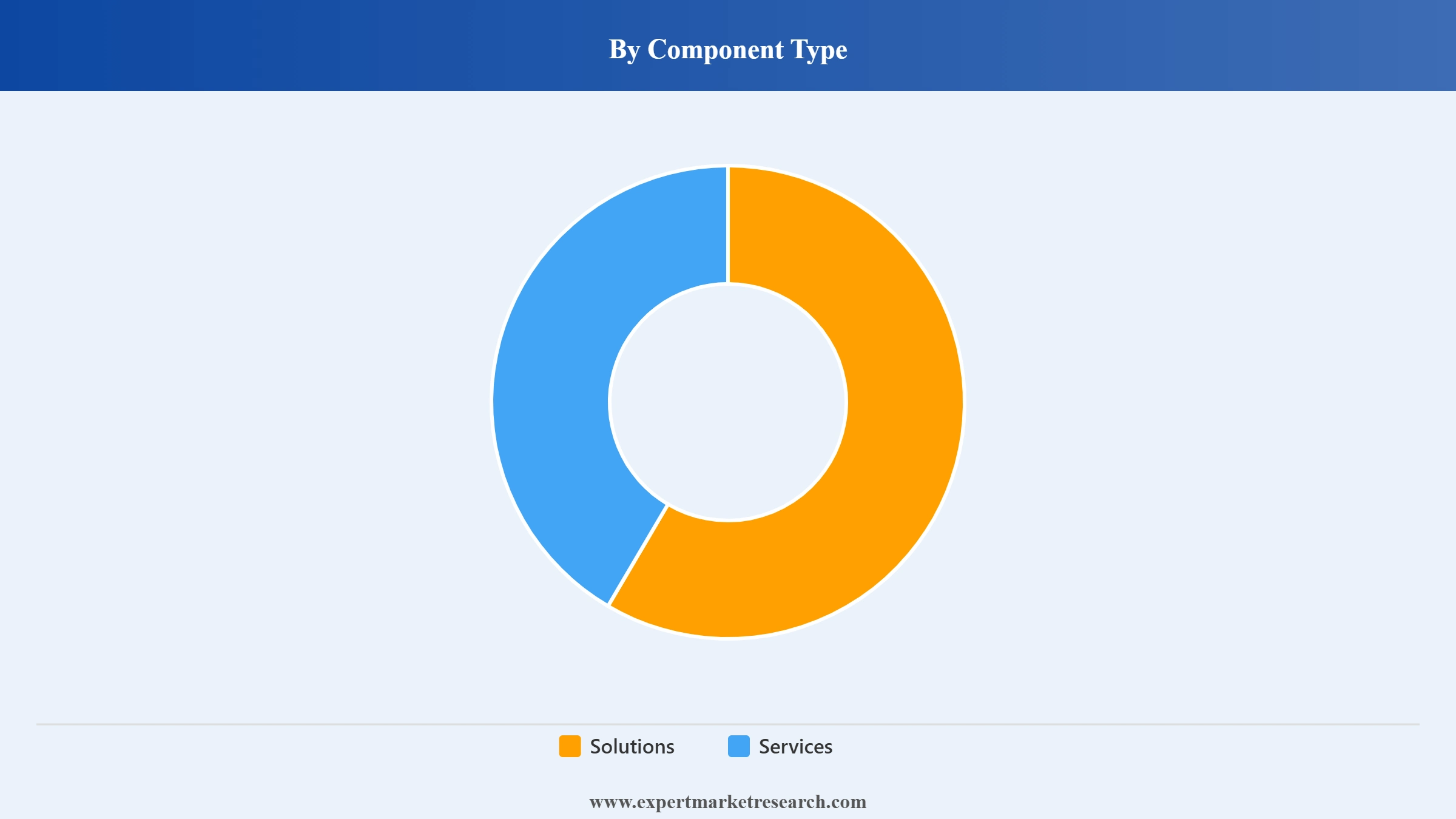
Market Breakup by Component Type
Key Insight: Solutions account for the larger share of the voice assistant application market, as enterprises purchase speech recognition engines, natural language understanding platforms, and conversational design tools forming the technical core of any deployment. These platforms increasingly bundle pretrained language models with analytics dashboards that track conversation outcomes. Services, covering integration, customization, and ongoing support, are growing quickly as organizations need help connecting voice assistants to existing databases, customer relationship systems, and compliance workflows without maintaining specialized engineering staff.
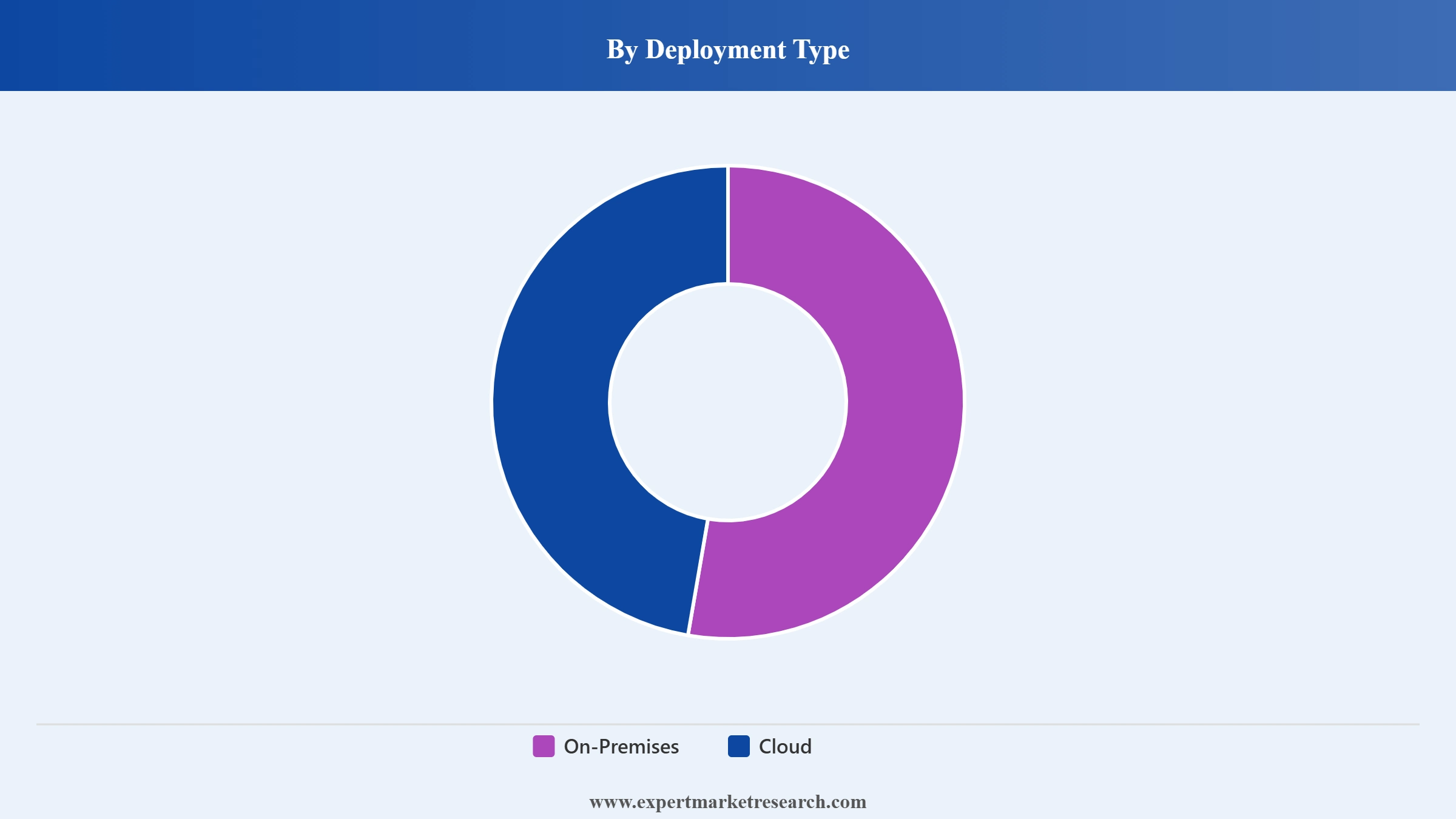
Market Breakup by Deployment Type
Key Insight: Cloud deployment leads to the voice assistant application market because it lets organizations scale conversational capability quickly, update language models remotely, and avoid the upfront infrastructure spending on premises systems required. On-Premises deployment remains important for banking, healthcare, and government buyers that must keep voice data within their own infrastructure for regulatory reasons. Fintech providers are also building cloud-based voice tools for retail banking; in September 2025, Directo launched an AI voice agent aimed at transforming customer service inside Mexican banking.
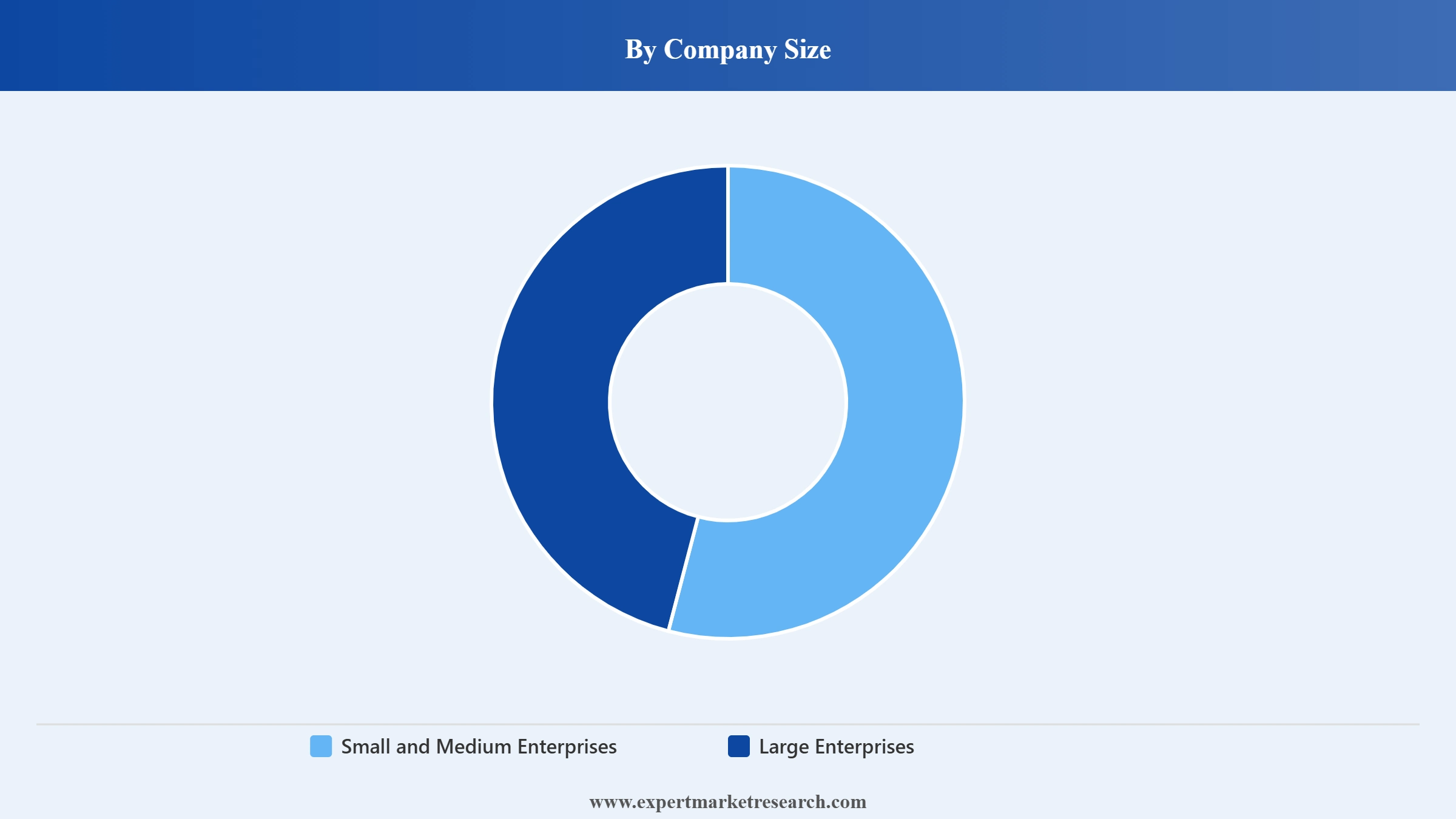
Market Breakup by Company Size
Key Insight: Large Enterprises account for the bigger share of voice assistant application market spending because they can fund custom natural language model training, dedicated integration teams, and enterprise-wide rollouts across multiple business units. Their existing contact center and customer relationship infrastructure also makes voice assistant integration more straightforward. Small and Medium Enterprises are adopting voice assistants at a faster pace as cloud based, subscription priced platforms lower the cost of entry, letting smaller retailers, clinics, and service businesses add conversational capability without hiring specialized staff.
Market Breakup by Application
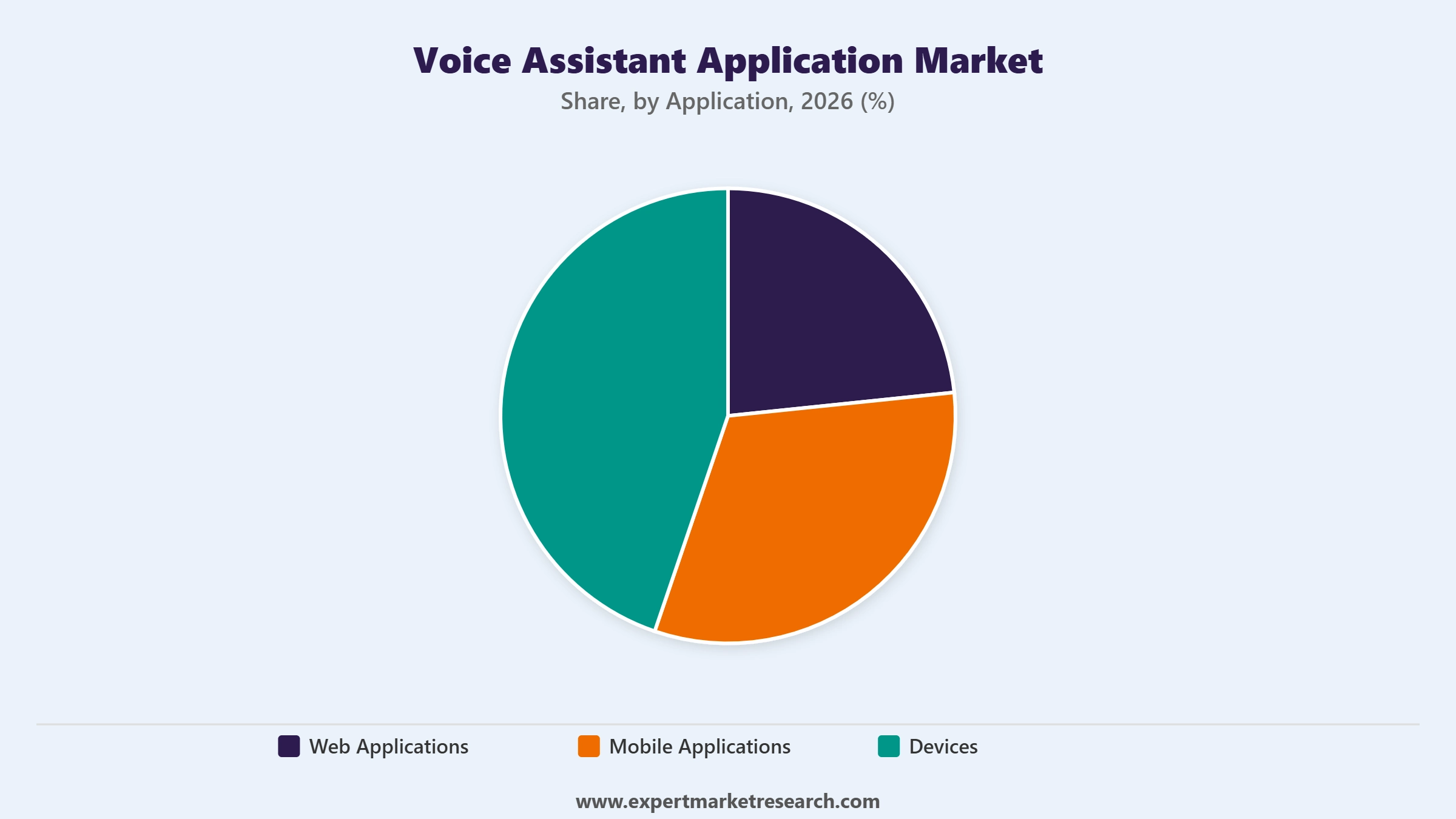
Key Insight: Mobile Applications hold the largest share of voice assistant application market because smartphones remain the primary device through which consumers and employees access banking, retail, and productivity tools, making built in voice features a natural extension of existing habits. Web Applications are expanding as browser-based customer portals add voice search and conversational support without requiring a separate download. Devices, including smart speakers, wearables, and in vehicle systems, are carving out a growing niche as manufacturers embed always listening assistants directly into hardware.
Market Breakup by End Use
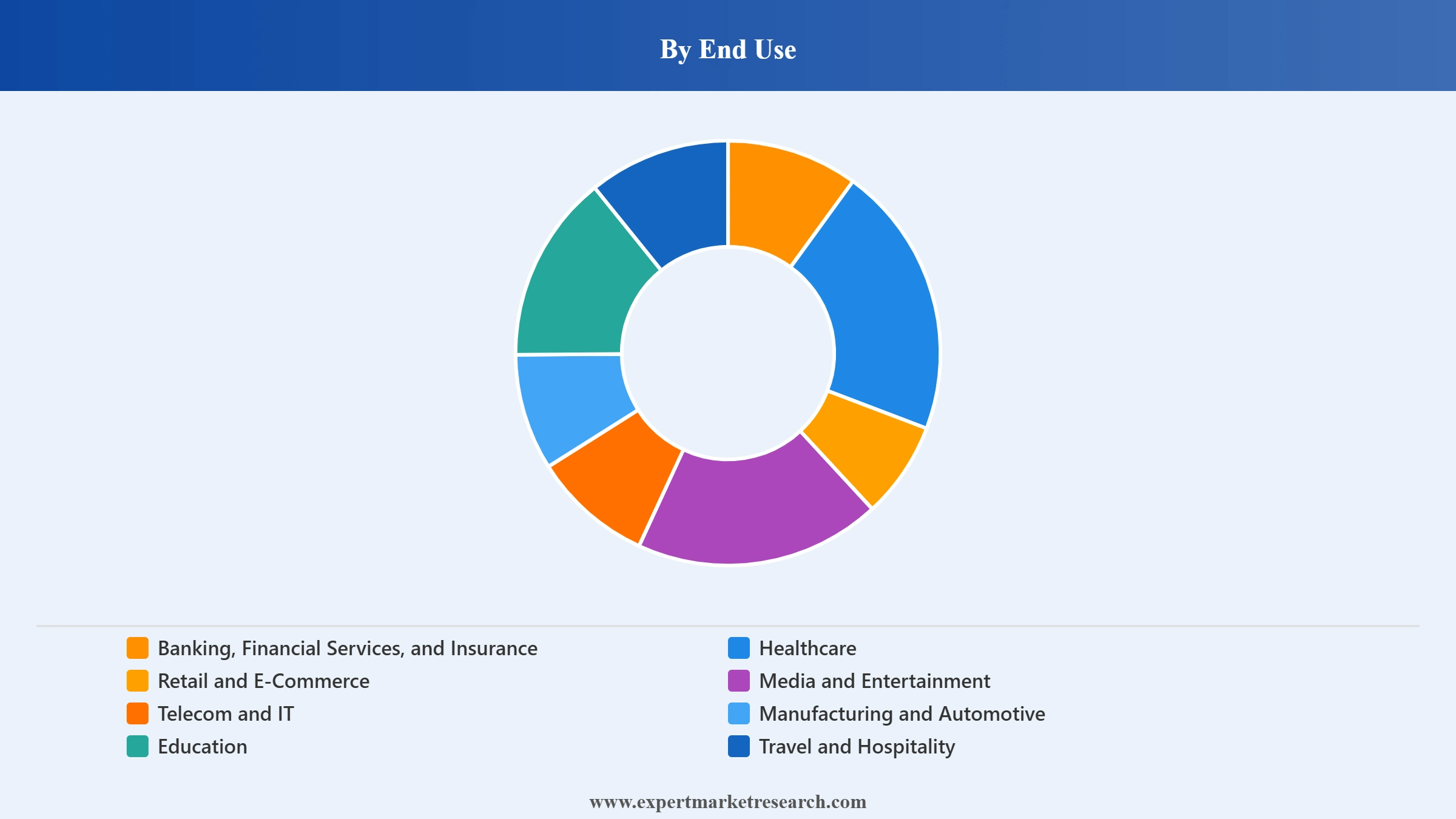
Key Insight: Banking, Financial Services and Insurance lead adoption via account servicing and claims support, and Healthcare follows via clinical documentation and scheduling. Retail and E-Commerce firms track orders by voice, while Media and Entertainment, Telecom and IT, and Manufacturing and Automotive firms use assistants for content discovery, customer support, and vehicle control. Education deploys assistants for student services, and Travel and Hospitality use them for guest requests; in February 2025, Canary Technologies introduced voice assistants for hotel guests. Others cover smaller verticals such as legal and real estate.
Market Breakup by Region
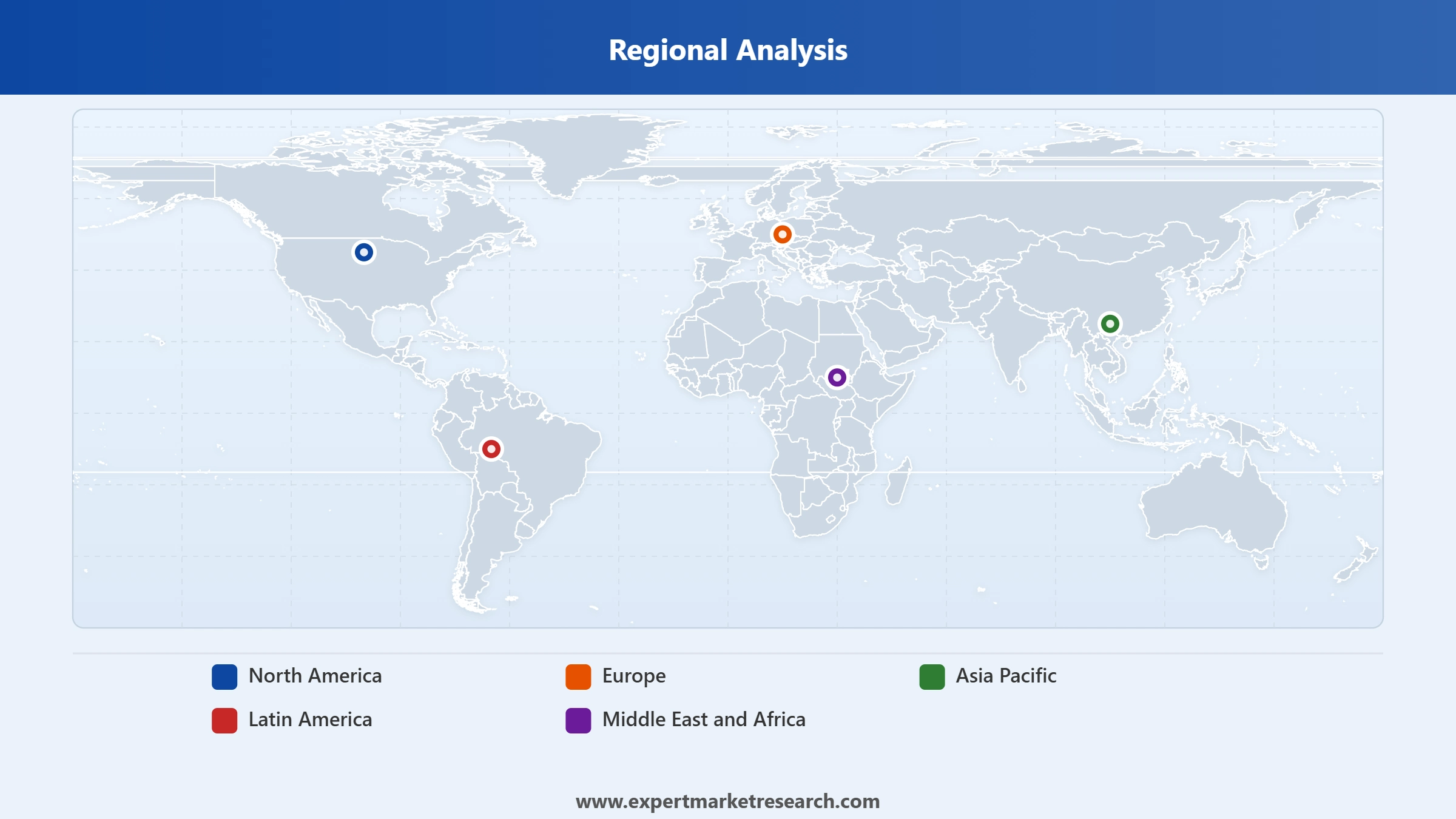
Key Insight: North America leads the voice assistant application market through early enterprise adoption, cloud infrastructure, and technology budgets across banking, healthcare, and retail. Europe follows with growing deployment inside telecom and healthcare systems under strict data protection rules. Asia Pacific is expanding quickly as smartphone penetration and local language models widen use across China, India, and Southeast Asia. Latin America is adding voice capability within banking and retail, while the Middle East and Africa region invests in Arabic voice platforms. In January 2025, BayCare piloted AI assisted voice technology for nurses.
Read more about this report - REQUEST FREE SAMPLE COPY IN PDF
Solutions dominate the voice assistant application market due to core platform demand
Solutions make up a larger share of the market because they form the technical foundation that every deployment depends on, including speech recognition engines, natural language understanding modules, and conversation design tools. Enterprises purchase these core platforms first, then layer services on top as deployments mature over time across many industries. Vendors continue to refine model accuracy, add support for additional languages, and expand pretrained industry vocabularies, keeping platform spending the largest component of overall market budgets.
Read more about this report - REQUEST FREE SAMPLE COPY IN PDF
Services are the fastest growing component in the voice assistant application market as organizations need help connecting voice assistants to existing databases, ticketing systems, and compliance workflows rather than running conversational software in isolation. Universities and smaller enterprises like lean on vendor-led integration rather than building internal engineering teams of their own. In May 2025, the University of Houston worked with its AI Solutions team and vendor partner Ivy.ai to board and integrate a new AI assistant, Shasta, across admissions, financial aid, and registrar offices.
Cloud deployment leads to the voice assistant application market on scalability and lower upfront cost
Cloud deployment accounts for the largest share of the market because it lets organizations scale conversational capacity up or down without purchasing dedicated servers, and because language models can be updated centrally and pushed to every client at once. Smaller banks, retailers, and healthcare providers favor cloud delivery since it avoids large upfront infrastructure spending and shortens the time between purchase and go live. Cloud providers are also bundling voice capability alongside existing contact center software today.
Read more about this report - REQUEST FREE SAMPLE COPY IN PDF
On premises deployment is the fastest growing delivery model in the voice assistant application market as regulated sectors seek to keep voice data and model processing inside their own infrastructure rather than sending audio to external servers. In June 2026, voice technology provider Deepgram partnered with Fortanix to offer a confidential computing-based voice AI product aimed at healthcare, finance, and legal organizations, protecting audio and model data while processing occurs entirely on premises. Such partnerships are making compliant on premises deployment achievable for regulated buyers.
Large enterprises dominate the voice assistant application market through bigger technology budgets
Large enterprises account for the bigger share of market spending because they can fund dedicated integration teams, custom model training, and enterprise-wide rollouts across multiple business units and geographies worldwide. Their existing contact center, customer relationship, and electronic record infrastructure also makes voice assistant integration more straightforward than for smaller organizations starting from scratch today. Large banks, hospital networks, and retail chains continue to commit the biggest individual contracts within the market overall.
Read more about this report - REQUEST FREE SAMPLE COPY IN PDF
Small and medium enterprises are the fastest growing buyer segment as subscription priced, cloud delivered voice platforms lower the cost of entry for smaller retailers, clinics, and service businesses across many regions. A May 2025 survey of small and medium business owners found that ninety seven percent of those already using AI voice agents reported higher revenue, while thirty one percent of non-users planned to invest within the following one to two years, encouraging wider adoption among smaller buyers.
Mobile applications lead the voice assistant application market through everyday smartphone use
Mobile applications hold the largest share of voice assistant application usage because smartphones remain the primary device through which consumers and employees reach banking, retail, and workplace tools, making built in voice features a natural extension of habits already formed around everyday mobile apps. Banking and retail mobile apps are adding conversational search and account servicing features, while employee facing mobile apps are adding voice input for field service and logistics staff who cannot easily type while working.
Read more about this report - REQUEST FREE SAMPLE COPY IN PDF
Devices are the fastest growing application category as manufacturers embed always listening assistants directly into hardware rather than relying on a connected phone nearby. In July 2026, wearable maker Nirva raised funding to launch an AI powered smart necklace that runs voice AI in the background to analyze tone and conversation patterns throughout the day. Such wearable launches show voice assistant capability expanding beyond phones and speakers into always worn personal devices that people now carry throughout their waking hours.
Banking, financial services, and insurance lead the voice assistant application market through high call volumes
Banking, financial services, and insurance organizations account for the largest end use share of the market because they handle extremely high volumes of routine customer inquiries, account servicing requests, and claims related calls that are well suited to conversational automation. Voice assistants help these institutions manage balance checks, transfers, and policy questions without routing every call to a live agent, lowering staffing pressure across retail banking and insurance customer service operations in general across the wider industry.
Read more about this report - REQUEST FREE SAMPLE COPY IN PDF
Healthcare is the fastest growing end use segment as hospitals and clinics adopt voice assistants for clinical documentation and patient scheduling to reduce the administrative burden on doctors and nurses across busy hospital departments nationwide and beyond. In March 2026, Speech Processing Solutions launched Philips SpeechLive Health, an AI assistant built specifically for modern clinical documentation workflows. Such purpose-built clinical tools are helping healthcare providers reduce time spent on note taking and redirecting that time toward direct patient care.
North America leads the voice assistant application market through deep enterprise technology adoption
North America accounts for the largest share of the global market because of its concentration of large technology budgets, early enterprise adoption, and advanced cloud infrastructure across banking, healthcare, and retail sectors. United States based banks, hospital networks, and retail chains were among the first to deploy conversational interfaces at scale, and continued investment in contact center modernization keeps the region ahead of others in both enterprise and consumer facing voice assistant spending across the broader economy.
Read more about this report - REQUEST FREE SAMPLE COPY IN PDF
Asia Pacific is the fastest growing regional market as rising smartphone penetration and expanding local language model support widen both consumer and enterprise adoption across China, India, Japan, and Southeast Asia. In April 2026, Volkswagen announced plans to equip its China market vehicle lineup with AI voice agents designed to give its cars distinct conversational personalities and close the technology gap with domestic competitors. Such automotive scale commitments are accelerating voice assistant adoption across the region's manufacturing and automotive sectors.
Voice assistant application companies compete primarily on natural language accuracy, language coverage, and integration ease with existing banking, healthcare, retail, and contact center systems. Established vendors expand pretrained industry specific models, while smaller vendors differentiate through narrower capabilities such as Arabic language accuracy or warehouse voice picking.
Voice assistant application players increasingly package speech recognition and natural language understanding engines with implementation services, since enterprise buyers often lack in house conversational AI expertise. Players are also investing in multilingual and dialect specific models to capture faster growing demand across Asia Pacific, Latin America, and the Middle East.
Founded in 1911 and headquartered in Armonk, New York, United States, IBM Corporation pairs its hybrid cloud and data governance platforms with conversational AI tooling for regulated industries such as banking and insurance. The company continues expanding systems integrator partnerships to connect voice assistants to legacy enterprise environments.
Founded in 1969 and headquartered in Suwon, South Korea, Samsung Electronics Co. Ltd. extends its presence through deep integration across its smartphones, televisions, and home appliance lineup. The company's manufacturing scale gives it a built-in distribution channel, letting new voice features reach connected devices through firmware updates.
Founded in 1972 and headquartered in Walldorf, Germany, SAP SE embeds conversational interfaces directly into supply chain, finance, and human resources modules already used by large manufacturers and retailers. This lets SAP customers add voice capability to existing business processes without adopting a separate platform.
Founded in 1984 and headquartered in San Jose, California, United States, Cisco embeds conversational features into contact center and unified communications products already deployed across large enterprises. Its carrier and enterprise IT relationships give its offerings a distribution advantage within call center modernization projects.
Other key players in the market include Alphabet Inc., Amazon Web Services Inc., Microsoft Corporation, Apple Inc., Oracle, and Verint Systems Inc., among others.
*Please note that this is only a partial list; the complete list of key players is available in the full report. Additionally, the list of key players can be customized to better suit your needs.*
Unlock the latest insights with our global voice assistant application market trends 2026 report. Discover regional growth patterns, enterprise adoption drivers, and key industry players shaping conversational technology. Stay ahead of competition with trusted data and expert analysis. Download your free sample report today and drive informed decisions in the global market.


Upto 15% Off
USD
$2499 $2249
$3999 $3599
$4999 $4249
$5999 $5099


*While we strive to always give you current and accurate information, the numbers depicted on the website are indicative and may differ from the actual numbers in the main report. At Expert Market Research, we aim to bring you the latest insights and trends in the market. Using our analyses and forecasts, stakeholders can understand the market dynamics, navigate challenges, and capitalize on opportunities to make data-driven strategic decisions.*
In 2025, the market reached an approximate value of USD 5.10 Billion.
The market is projected to grow at a CAGR of 24.50% between 2026 and 2035.
The revenue generated from the voice assistant application market is expected to reach USD 45.63 Billion in 2035.
Expanding multilingual and dialect specific language models, bundling voice capability with implementation and managed services, deepening cloud and on premises deployment options, and widening integration with banking, healthcare, retail, and contact center systems.
The market is categorised according to its component types, which include solutions and services.
The key players profiled in the report include IBM Corporation, Alphabet Inc., Amazon Web Services Inc., Microsoft Corporation, Apple Inc., Samsung Electronics, Cisco, Oracle, SAP SE and Verint Systems Inc., alongside other leading enterprise technology providers.
Based on the deployment type, the market is divided into on-premises and cloud.
The major areas include North America, Europe, the Asia Pacific, Latin America, and the Middle East and Africa.
Based on the industry, the market is divided into banking, financial services, and insurance, healthcare, retail and e-commerce, media and entertainment, telecom and IT, manufacturing and automotive, education, travel and hospitality and others.
Companies face accuracy gaps across regional languages and dialects, rising data privacy and security expectations, integration complexity with legacy enterprise systems, and the operational cost of maintaining accurate conversational models at scale.
Explore our key highlights of the report and gain a concise overview of key findings, trends, and actionable insights that will empower your strategic decisions.
| REPORT FEATURES | DETAILS |
| Base Year | 2025 |
| Historical Period | 2019-2025 |
| Forecast Period | 2026-2035 |
| Scope of the Report |
Historical and Forecast Trends, Industry Drivers and Constraints, Historical and Forecast Market Analysis by Segment:
|
| Breakup by Component Type |
|
| Breakup by Deployment Type |
|
| Breakup by Company Size |
|
| Breakup by Application |
|
| Breakup by End Use |
|
| Breakup by Region |
|
| Market Dynamics |
|
| Competitive Landscape |
|
| Companies Covered |
|
| Report Price and Purchase Option | Explore our purchase options that are best suited to your resources and industry needs. |
| Delivery Format | Delivered as an attached PDF and Excel through email, with an option of receiving an editable PPT, according to the purchase option |
Datasheet
One User
USD 2,499
USD 2,249
tax inclusive*
Single User License
One User
USD 3,999
USD 3,599
tax inclusive*
Five User License
Five User
USD 4,999
USD 4,249
tax inclusive*
Corporate License
Unlimited Users
USD 5,999
USD 5,099
tax inclusive*
*Please note that the prices mentioned below are starting prices for each bundle type. Kindly contact our team for further details.*
Flash Bundle
Small Business Bundle
Growth Bundle
Enterprise Bundle
*Please note that the prices mentioned below are starting prices for each bundle type. Kindly contact our team for further details.*
Flash Bundle
Number of Reports: 3
20%
tax inclusive*
Small Business Bundle
Number of Reports: 5
25%
tax inclusive*
Growth Bundle
Number of Reports: 8
30%
tax inclusive*
Enterprise Bundle
Number of Reports: 10
35%
tax inclusive*
How To Order

Select License Type
Choose the right license for your needs and access rights.

Click on ‘Buy Now’
Add the report to your cart with one click and proceed to register.

Select Mode of Payment
Choose a payment option for a secure checkout. You will be redirected accordingly.
Strategic Solutions for Informed Decision-Making
Gain insights to stay ahead and seize opportunities.

Get insights & trends for a competitive edge.

Track prices with detailed trend reports.

Analyse trade data for supply chain insights.

Leverage cost reports for smart savings

Enhance supply chain with partnerships.

Connect For More Information
Our expert team of analysts will offer full support and resolve any queries regarding the report, before and after the purchase.
Our expert team of analysts will offer full support and resolve any queries regarding the report, before and after the purchase.
We employ meticulous research methods, blending advanced analytics and expert insights to deliver accurate, actionable industry intelligence, staying ahead of competitors.
Our skilled analysts offer unparalleled competitive advantage with detailed insights on current and emerging markets, ensuring your strategic edge.
We offer an in-depth yet simplified presentation of industry insights and analysis to meet your specific requirements effectively.




