

Consumer Insights
Uncover trends and behaviors shaping consumer choices today
Procurement Insights
Optimize your sourcing strategy with key market data
Industry Stats
Stay ahead with the latest trends and market analysis.
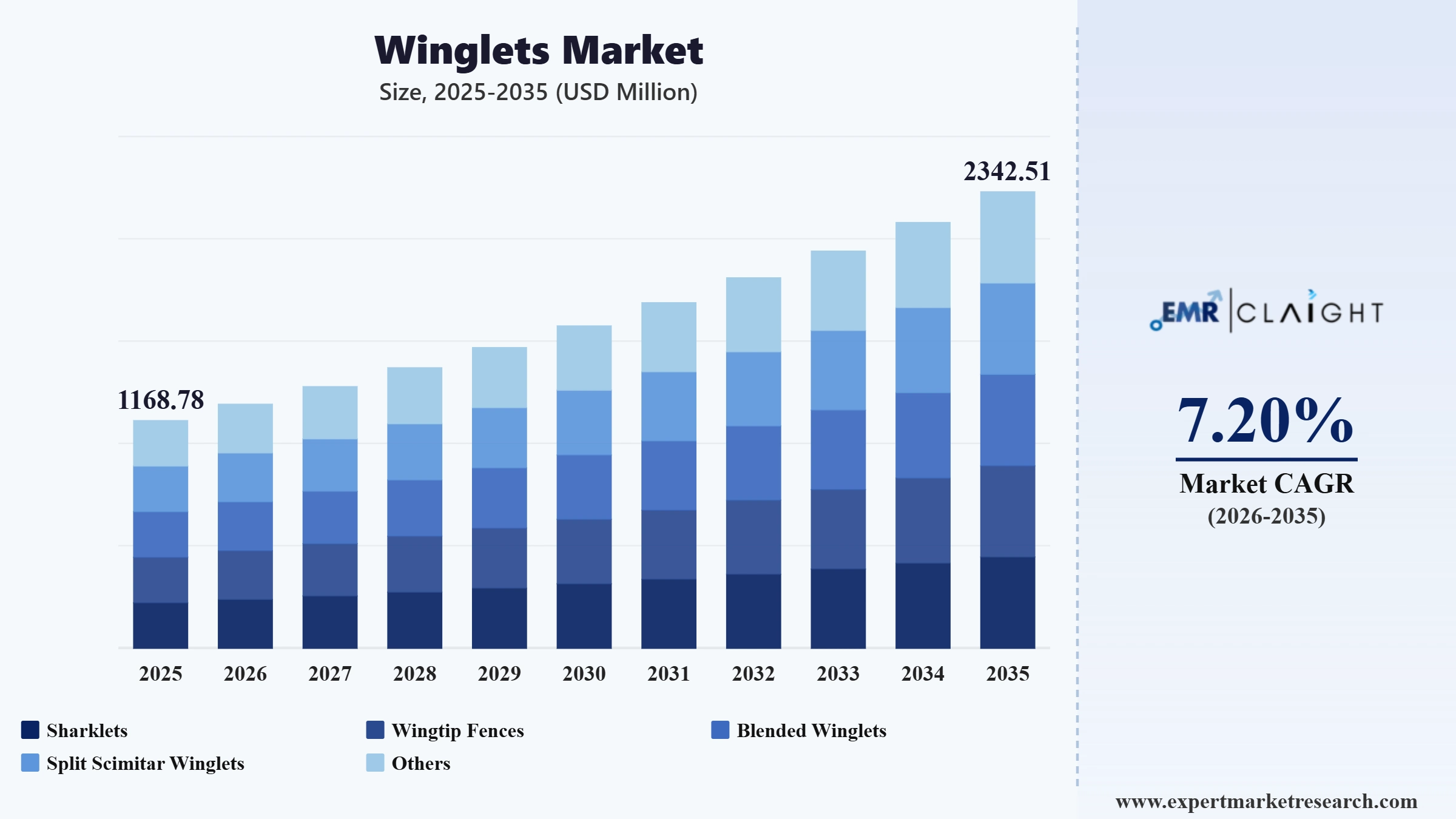
The global winglets market attained a value of USD 1168.78 Million in 2025 and is projected to expand at a CAGR of 7.20% through 2035. The market is further expected to reach USD 2342.51 Million by 2035. Rising aircraft deliveries, tightening environmental regulation and sustained pressure on airline fuel costs are pushing manufacturers and operators toward wingtip devices across new production aircraft and retrofit programmes on both civil and military fleets worldwide.
Winglets cover the vertical and blended wingtip extensions fitted to fixed wing aircraft to reduce induced drag and wingtip vortex formation, spanning sharklets, wingtip fences, blended winglets, split scimitar winglets and other emerging designs installed as line fit on new production aircraft or as retrofit on in-service fleets. Adoption has moved from a differentiating feature to a near-default specification across most commercial narrow body and wide body programmes. Rising aircraft deliveries, persistent fuel cost pressure and tightening emissions regulation continue to widen the buyer base for the global winglets market.
Demand is concentrating around manufacturers able to hit major production milestones at scale, converting decades of supply relationships into a track record airline can point to when selecting a wingtip programme. In April 2026, Korean Air marked delivery of its 5,000th Sharklet for the Airbus A320 family at a ceremony in its Busan Tech Centre, a milestone the carrier has built since being selected as the programme's sole manufacturer in 2010. Production runs of this scale are converting a single manufacturing contract into a durable, decade-spanning revenue stream across the global winglets market.
Suppliers are converging on a common development direction, widening MRO and installation capacity in step with rising aircraft deliveries rather than developing an entirely new wingtip geometry for each platform. In June 2026, Collins Aerospace confirmed a USD 63 million expansion of its maintenance, repair and overhaul facility at Subang Aerotech Park in Malaysia, more than tripling the site's footprint to serve rising component support demand across the Asia Pacific aviation market. Investment of this kind signals where suppliers expect winglet-adjacent demand to concentrate over the coming decade.
Read more about this report - REQUEST FREE SAMPLE COPY IN PDF
American Airlines confirmed plans to receive roughly 55 new mainline aircraft during 2026, the highest annual intake among domestic carriers, with winglet-equipped narrow body jets forming a meaningful share as older aircraft retired. Suppliers can leverage this trend by prioritising line fit relationships with high-volume domestic carriers, since delivery-linked winglet demand is now outpacing incremental retrofit orders.
Reporting confirmed that Delta Air Lines had spent a decade progressively replacing blended winglets on part of its Boeing 737 fleet with an alternative wingtip configuration, affecting aircraft within a fleet of more than 200 737-family jets. Suppliers can leverage this trend by treating wingtip specification as a recurring sales opportunity, not a one-time decision made only at aircraft delivery.
Jet2 finished a two-year programme fitting split scimitar winglets to 74 Boeing 737-800 aircraft, cutting annual fuel burn by more than 11 million litres and yearly carbon emissions by over 28,000 tonnes. Suppliers can leverage this trend by scheduling upgrades alongside routine maintenance, turning a discretionary project into a reportable sustainability outcome for the winglets market.
EasyJet began retrofitting sharklets to its last unmodified A320ceo aircraft, targeting completion by summer 2026 and an added fuel saving of 2,156 tonnes. Suppliers can leverage this trend by prioritising the final tranche of a fleet for retrofit, since incremental savings compound fastest on aircraft upgraded last across the winglets market.
Airlines are increasingly treating winglet retrofit as a formally budgeted capital line rather than a discretionary efficiency project scheduled loosely around maintenance events. Multi-year programmes covering dozens of aircraft are now competing directly with other capital priorities, including new aircraft deposits, for the same budget cycle. In June 2026, KKR committed a further USD 1.4 billion in equity alongside its partner Altavair to expand their aircraft leasing portfolio, underscoring how much structured capital is now flowing into aviation asset financing that airlines can draw on for large-scale retrofit programmes across the winglets market.
Passenger-to-freighter conversion is becoming one of the fastest-growing sources of retrofit demand, as leasing companies and conversion specialists take older wide body airframes out of passenger service and prepare them for a second operating life carrying cargo. In July 2026, AerCap signed lease agreements with China Southern Air Logistics for three converted Boeing 777-300ERSF freighters, the first passenger-to-freighter conversion programme for that aircraft type. This is turning freighter conversion into a meaningful secondary retrofit channel across the winglets market alongside passenger fleet upgrades.
Retrofit programmes covering dozens of wide body aircraft need physical shop capacity large enough to handle the structural components involved, a constraint that has historically limited how many providers could take on major wingtip and wing panel work at once. In January 2026, AerSale opened a new 90,000 square foot aerostructures MRO facility in Hialeah Gardens, Florida, roughly three times larger than its previous site and built to accommodate larger wide body components including Boeing 777 and Airbus A330 airframe structures. Expansions of this kind are widening where large-scale wingtip and wing component work can physically be performed.
Every gram added at the wingtip is carrying a structural cost further back along the wing, a constraint that has historically limited how large or aerodynamically ambitious a winglet design could be before the weight penalty offset the drag benefit. In April 2026, Toray Composite Materials America and Syensqo signed a long-term agreement covering aerospace-grade carbon fibre supply, reinforcing the raw material base that wingtip manufacturers draw on for lighter, larger composite structures. This shift is widening the design space available to engineers developing the next generation of split, blended and active geometries across the winglets market.
Supplemental type certification for wingtip modifications is increasingly extending beyond the commercial narrow body and wide body programmes that have historically dominated certification volume. In April 2026, the FAA approved Mammoth Freighters' conversion system for the Boeing 777-200, the first-ever certification of that aircraft type for all-cargo operation, opening a new widebody category to aerodynamic and structural modification work. This broadening base is reshaping which aircraft categories certification authorities are prioritising for review.
The Expert Market Research’s report titled "Global Winglets Market Report and Forecast 2026-2035" offers a detailed analysis of the market based on the following segments:
Market Breakup by Winglet Type
Key Insight: Blended winglets hold the leading share of the winglets market, reflecting their long-established position as the reference wingtip design across both new production and retrofit fleets. Split scimitar winglets form the fastest-growing type as operators upgrade existing blended installations for further drag reduction without replacing the underlying wing structure. Sharklets serve upswept-wingtip aircraft families specifically, wingtip fences remain in service on older narrow body designs that predate blended geometry, and the others category covers active load alleviation, and raked wingtip designs still moving through certification.
Market Breakup by Aircraft Type
Key Insight: Narrow body aircraft account for the leading share of the winglets market, since single aisle fleets represent the largest share of global aircraft deliveries and carry the highest cumulative retrofit potential across ageing in-service jets. Wide body aircraft form the fastest-growing category as long-haul operators prioritise fuel efficiency on routes where drag reduction compounds significantly over flight duration. Both categories increasingly specify winglets as standard rather than optional equipment at the production stage.
Market Breakup by Fit
Key Insight: Line fit holds the leading share of the winglets market because most current aircraft programmes now integrate winglets into the production specification rather than treating them as a post-delivery option. Retrofit is the faster-growing category as airlines extend the operational life of existing fleets and prioritise near-term fuel savings over waiting for new aircraft delivery slots. Certification breadth across multiple aircraft generations is widening which retrofit programmes airlines can pursue without a full fleet replacement.
Market Breakup by End Use
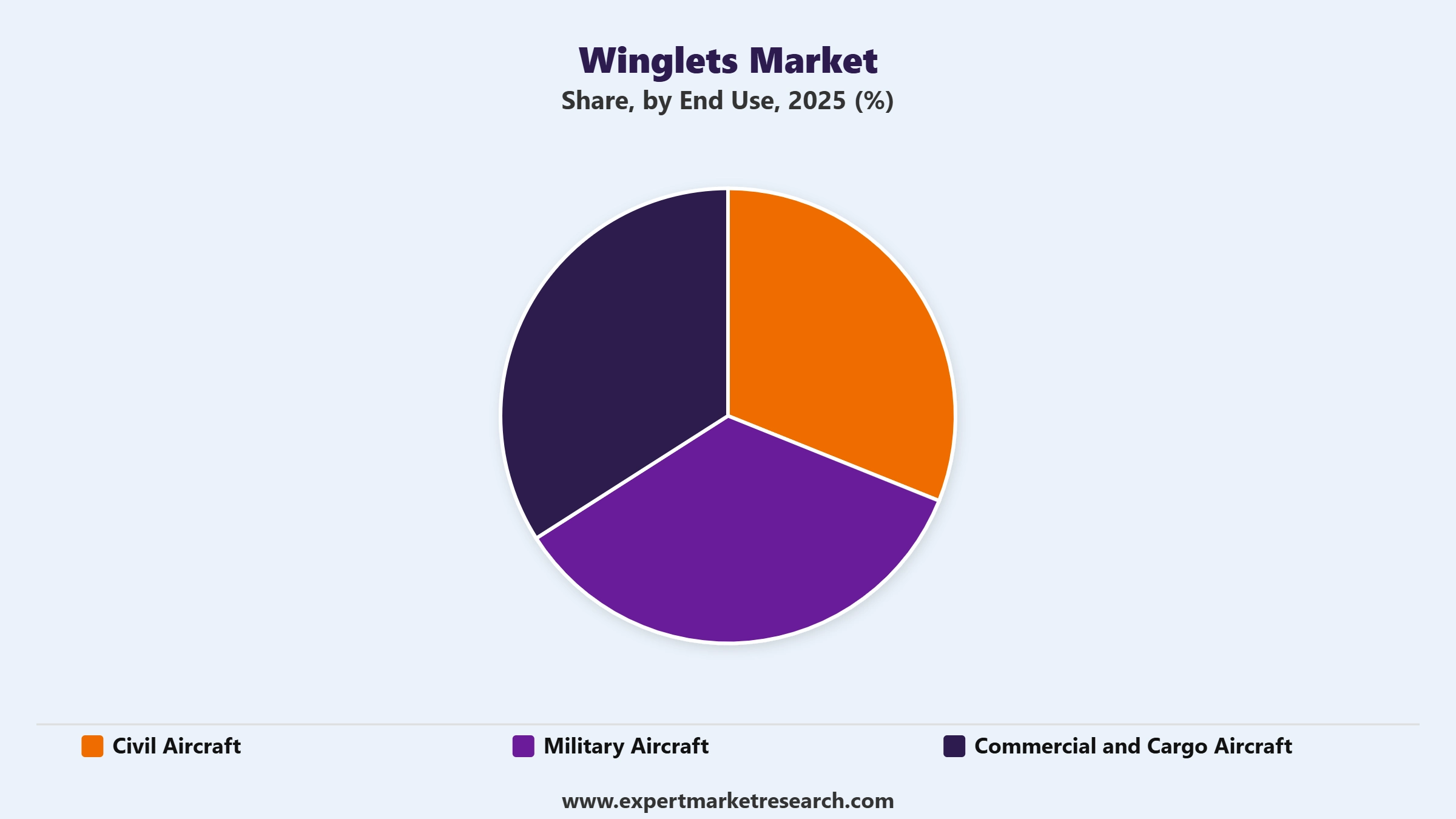
Key Insight: Civil aircraft account for the leading end-use share of the winglets market, covering passenger narrow body and wide body fleets where fuel efficiency directly affects airline operating margins. Certification volume reflects that concentration directly, and one aviation regulatory database recorded more than 82,000 approved supplemental type certificates in its searchable inventory as of May 2026, the large majority tied to civil aircraft modification. Commercial and cargo aircraft form the fastest-growing end-use category as freight operators pursue the same drag reduction gains already standard across passenger fleets. Military aircraft remain the smallest end-use category, since several long-serving transport types have yet to be fitted with winglet technology despite mission profiles that could benefit from reduced drag.
Market Breakup by Region
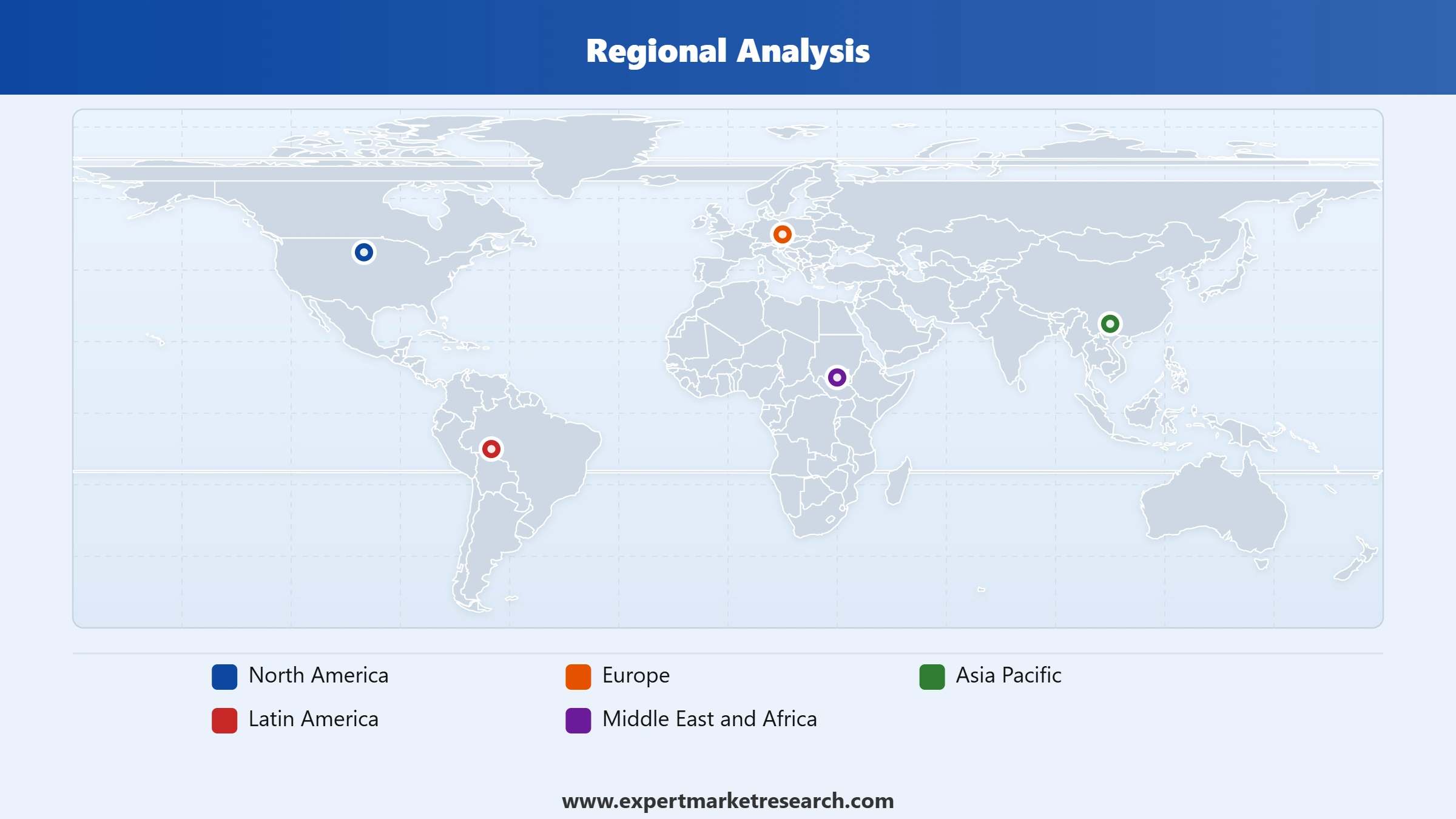
Key Insight: Regional dynamics in the winglets market continue to shape supplier strategies. North America leads on the strength of its large narrow body retrofit base and deep MRO network capable of executing multi-aircraft programmes. Europe combines dense short haul route networks with strict environmental regulation that rewards fuel efficiency gains. Asia Pacific grows fastest as expanding airline fleets and rising aircraft deliveries across the region's largest markets outpace retrofit activity elsewhere, while Latin America and the Middle East and Africa build on expanding regional carrier networks.
By winglet type, blended winglets dominate the market through their established position across mature single aisle fleets
Blended winglets hold the largest share of the winglets market because they have served as the reference wingtip geometry across commercial aviation for more than three decades, giving airlines, maintenance organisations and regulators a deep base of installation and certification experience to draw on. That maturity keeps blended designs the default choice whenever an aircraft type offers no newer alternative, and the resulting scale of the in-service fleet gives suppliers a stable, high-volume aftermarket to service well into the next decade.
Split scimitar winglets are the fastest-growing type as operators upgrade existing blended installations to capture further drag reduction without a full wing modification. The upgrade path is attractive precisely because it builds on wing structure already certified and installed, letting an airline capture additional fuel savings without the cost of a full retrofit from a wingtip fence or older design. Reported in October 2025, Qantas is running a comparable programme, converting the blended winglets across its 23 Boeing 737-800 aircraft to split scimitar winglets, illustrating how this upgrade path is proving especially popular with fleets already carrying blended geometry, since marginal certification and installation cost is far lower than starting from an unmodified wingtip across the winglets market.
By fit, line fit leads the market as new aircraft deliveries increasingly arrive with winglets as standard equipment
Line fit accounts for the largest share of the winglets market because most current narrow body and wide body production programmes now specify winglets as standard equipment rather than a post-delivery option, shifting the purchasing decision to the manufacturer. This shift concentrates commercial leverage with original equipment manufacturers, since a winglet locked into a new programme stays there for its entire production run. In May 2026, AirAsia Group signed a firm order for 150 Airbus A220-300 aircraft, the largest firm order for the type placed by any airline, each of which arrives from the factory with its wingtip device already fitted, standard across the winglets market.
Retrofit is the fastest-growing fit category as airlines extend the service life of existing fleets rather than waiting for constrained new aircraft delivery slots. Airlines increasingly target the last unmodified aircraft in a fleet first, since those airframes have gone the longest without a wingtip upgrade and typically offer the largest incremental fuel saving per aircraft retrofitted. Prioritising the oldest remaining tranche also simplifies programme planning, since it closes out a fleet-wide retrofit on a single, predictable completion date rather than leaving scattered aircraft unmodified indefinitely across the winglets market.
By end use, civil aircraft lead the market while commercial and cargo aircraft grow fastest on freighter conversion demand
Civil aircraft account for the largest end-use share of the winglets market because passenger narrow body and wide body fleets carry the highest aggregate flight hours, giving fuel efficiency gains from winglets the greatest cumulative financial impact of any end-use category. This concentration of flight hours is why airlines, rather than manufacturers, ultimately drive most retrofit decisions across the segment, since it is the operator's own fuel bill, not the original equipment specification, that determines when an ageing aircraft in the winglets market finally gets scheduled for a wingtip upgrade.
Read more about this report - REQUEST FREE SAMPLE COPY IN PDF
Commercial and cargo aircraft form the fastest-growing end-use category as dedicated freighter fleets expand alongside belly-cargo capacity on passenger aircraft. In January 2026, Emirates SkyCargo confirmed plans to take delivery of up to 10 factory-built Boeing 777 freighters by the end of the year, doubling its dedicated fleet to at least 21 aircraft, a new-production route to added cargo capacity that sits alongside the conversion route already used elsewhere in the industry. Winglet-equipped freighters of this kind carry the same fuel efficiency case across the winglets market that has already reshaped passenger fleets.
By aircraft type, narrow body aircraft dominate the market while wide body aircraft grow fastest on long haul fleet renewal
Narrow body aircraft hold the largest share of the winglets market because single aisle jets represent the largest share of global aircraft deliveries and carry the greatest cumulative retrofit potential across ageing in-service fleets operating short and medium haul networks worldwide. Ryanair Group illustrated that scale in February 2026, closing its financial year with an operating fleet of 647 aircraft after completing a USD 22 billion delivery programme covering 210 winglet-equipped Boeing 737-8200 aircraft, cementing its position as one of the largest single-type narrow body operators in the winglets market.
Wide body aircraft are the fastest-growing aircraft type as long-haul carriers renew their fleets with newer, winglet-equipped equipment. LATAM Airlines Group confirmed in March 2026 that its fleet would grow to around 410 aircraft by the end of the year, with new Boeing 787 Dreamliners forming a central part of that expansion alongside the group's existing Airbus A350 wide body fleet, reinforcing how long-haul carriers across the winglets market are treating wide body renewal as inseparable from their broader winglet-equipped fleet strategy.

Read more about this report - REQUEST FREE SAMPLE COPY IN PDF
North America leads the market through its large in-service retrofit base and deep maintenance infrastructure
North America commands the largest share of the winglets market, supported by a large in-service narrow body fleet, an extensive maintenance and retrofit network, and airlines with the balance sheet scale to commit to multi-year wingtip programmes. Analysis published in April 2026 illustrated the flip side of that maturity, confirming that the modernisation programme for a long-serving North American military transport type, in service for nearly six decades, still excludes winglet technology despite extensive parallel engine and avionics upgrades.
Read more about this report - REQUEST FREE SAMPLE COPY IN PDF
Asia Pacific is the fastest-growing regional winglets market as rapidly expanding airline fleets and rising aircraft deliveries across the region's largest economies outpace retrofit activity seen elsewhere. Airlines across the region are increasingly specifying winglet-equipped aircraft from first delivery rather than scheduling retrofit for a later maintenance cycle, as fleet growth alone is reshaping the region's wingtip mix faster than retrofit programmes can be scheduled.
The global industry is consolidating around integrated aerostructure producers as leading winglets companies invest in active load alleviation research, certification breadth and retrofit programme capacity to defend both line fit and aftermarket accounts. Producers are prioritising structural certification speed, cross-fleet compatibility and installation network reach to differentiate offerings in a segment where the underlying aerodynamic function is broadly comparable across suppliers. Deep original equipment relationships remain a decisive advantage, since new aircraft programmes lock in a supplier's line fit position for the life of that aircraft family.
Major winglets market players are also competing on retrofit economics, offering airlines financing structures and installation scheduling that let a multi-year programme run alongside routine maintenance rather than requiring dedicated aircraft downtime. Opportunities are emerging in active winglet systems for business jets, cargo conversion programmes, and military transport retrofit where adoption still lags commercial fleets significantly. Suppliers combining fast certification turnaround with proven fuel savings data and flexible retrofit scheduling are positioned to strengthen their standing as airlines continue treating wingtip upgrades as a standard fleet efficiency lever.
Founded in 1970 and headquartered in Leiden, Netherlands, with its principal commercial aircraft operations based in Toulouse, France, the company fits Sharklet wingtip devices as standard equipment across its A320 family and other current production aircraft. Its winglet design followed a patent dispute with Aviation Partners over similarity to existing blended winglet geometry, which the two companies later settled. Airbus continues to integrate wingtip devices into new aircraft development as a core fuel efficiency feature across its narrow body and wide body ranges.
Founded in 1985 and headquartered in Everett, Washington, United States, the company specialises in aerodynamic performance modifications including winglet kits for turboprop and regional aircraft, alongside vortex generators and other drag reduction systems. Its winglet products are marketed primarily for retrofit installation, targeting operators seeking improved climb performance, payload capacity and fuel efficiency on smaller commercial and utility aircraft platforms outside the mainline narrow body and wide body segments.
Founded in 1991 and headquartered in Seattle, Washington, United States, the company pioneered Blended Winglet technology and holds foundational patents in the design, which it has licensed and developed further through its joint venture with Boeing. Its winglet systems are fitted across business jets and, through that joint venture, commercial narrow body aircraft, with the company's Split Scimitar Winglet programme extending the original blended design through additional aerodynamic surfaces.
Founded in 1916 and headquartered in Arlington, Virginia, United States, the company offers Blended Winglets and Split Scimitar Winglets across its 737 family through its joint venture with Aviation Partners, alongside raked wingtip designs on its wide body 777 and 787 programmes. Boeing integrates winglet technology into new aircraft production specifications and supports retrofit programmes through its own service organisation and authorised installation partners across its global customer base.
Other key players in the market include GKN plc, Textron Aviation Inc., Winglet Technology, LLC, RUAG group, and Tamarack Aerospace, among others.
*Please note that this is only a partial list; the complete list of key players is available in the full report. Additionally, the list of key players can be customized to better suit your needs.*
Unlock the latest insights with our winglets market trends 2026 report. Discover regional growth patterns, fit economics, and key industry players. Stay ahead of competition with trusted data and expert analysis. Download your free sample report today and drive informed decisions in the market.


Upto 15% Off
USD
$2499 $2249
$3999 $3599
$4999 $4249
$5999 $5099


*While we strive to always give you current and accurate information, the numbers depicted on the website are indicative and may differ from the actual numbers in the main report. At Expert Market Research, we aim to bring you the latest insights and trends in the market. Using our analyses and forecasts, stakeholders can understand the market dynamics, navigate challenges, and capitalize on opportunities to make data-driven strategic decisions.*
In 2025, the market reached an approximate value of USD 1168.78 Million.
The market is projected to grow at a CAGR of 7.20% between 2026 and 2035.
The market for winglets is estimated to witness a healthy growth in the forecast period of 2026-2035 to reach USD 2342.51 Million by 2035.
Expanding active load alleviation research, broadening certification across business jet and cargo platforms, offering flexible retrofit financing and scheduling, deepening original equipment manufacturer relationships, and pursuing underserved military transport retrofit opportunities.
The key trends fuelling the growth of the market include superior product characteristics and increasing retrofitting of winglets in aircrafts.
The significant aircraft types in the market are wide body aircraft, and narrow body aircraft.
The various winglet types in the market are sharklets, wingtip fences, blended winglets, and split scimitar winglets, among others.
The key players in the market include Airbus SE, BLR Aerospace, L.L.C., Aviation Partners, Inc., The Boeing Company, GKN plc, Textron Aviation Inc., Winglet Technology, LLC, RUAG group, and Tamarack Aerospace, among others.
Manufacturers face lengthy supplemental type certification timelines, retrofit installation downtime costs for airlines, structural integration challenges on older airframes, competition between original wingtip designs and upgrade paths, and slow adoption across military transport fleets.
Explore our key highlights of the report and gain a concise overview of key findings, trends, and actionable insights that will empower your strategic decisions.
| REPORT FEATURES | DETAILS |
| Base Year | 2025 |
| Historical Period | 2019-2025 |
| Forecast Period | 2026-2035 |
| Scope of the Report |
Historical and Forecast Trends, Industry Drivers and Constraints, Historical and Forecast Market Analysis by Segment:
|
| Breakup by Winglet Type |
|
| Breakup by Aircraft Type |
|
| Breakup by Fit |
|
| Breakup by End Use |
|
| Breakup by Region |
|
| Market Dynamics |
|
| Competitive Landscape |
|
| Companies Covered |
|
Datasheet
One User
USD 2,499
USD 2,249
tax inclusive*
Single User License
One User
USD 3,999
USD 3,599
tax inclusive*
Five User License
Five User
USD 4,999
USD 4,249
tax inclusive*
Corporate License
Unlimited Users
USD 5,999
USD 5,099
tax inclusive*
*Please note that the prices mentioned below are starting prices for each bundle type. Kindly contact our team for further details.*
Flash Bundle
Small Business Bundle
Growth Bundle
Enterprise Bundle
*Please note that the prices mentioned below are starting prices for each bundle type. Kindly contact our team for further details.*
Flash Bundle
Number of Reports: 3
20%
tax inclusive*
Small Business Bundle
Number of Reports: 5
25%
tax inclusive*
Growth Bundle
Number of Reports: 8
30%
tax inclusive*
Enterprise Bundle
Number of Reports: 10
35%
tax inclusive*
How To Order

Select License Type
Choose the right license for your needs and access rights.

Click on ‘Buy Now’
Add the report to your cart with one click and proceed to register.

Select Mode of Payment
Choose a payment option for a secure checkout. You will be redirected accordingly.
Strategic Solutions for Informed Decision-Making
Gain insights to stay ahead and seize opportunities.

Get insights & trends for a competitive edge.

Track prices with detailed trend reports.

Analyse trade data for supply chain insights.

Leverage cost reports for smart savings

Enhance supply chain with partnerships.

Connect For More Information
Our expert team of analysts will offer full support and resolve any queries regarding the report, before and after the purchase.
Our expert team of analysts will offer full support and resolve any queries regarding the report, before and after the purchase.
We employ meticulous research methods, blending advanced analytics and expert insights to deliver accurate, actionable industry intelligence, staying ahead of competitors.
Our skilled analysts offer unparalleled competitive advantage with detailed insights on current and emerging markets, ensuring your strategic edge.
We offer an in-depth yet simplified presentation of industry insights and analysis to meet your specific requirements effectively.




