The global helium market reached a volume of about 6976.42 MMCF in 2025 and is expected to grow at a CAGR of 3.60% from 2026 to 2035, reaching a volume of around 9936.43 MMCF by 2035. As per the analysis by Expert Market Research, the market is driven by the diverse applications that helium serves across multiple end-use industries such as healthcare, semiconductor manufacturing and applications in aerospace, among others.
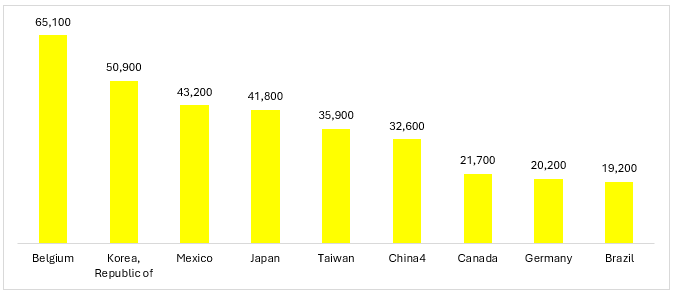
U.S. EXPORTS OF HELIUM BY COUNTRY (Thousand Dollars)
Looking for Market Size, Pricing & Forecast: Get Free Sample Report
Helium is a colourless, odourless, tasteless, non-toxic chemical element with atomic number 2. It is a noble gas which is not reactive and has the lowest boiling point among all the elements. The primary factors propelling the helium market growth are the growing applications of liquid helium and cryogenics in MRI scanners, as well as the development of the healthcare industry. Helium finds frequent applications in the following areas, too: cryogenics, breathing mixtures, leak detection, controlled atmospheres, welding, pressurizing and purging, and other operations. Applications for the chemical also include semiconductors, welding, metalworking, nuclear power, electronics, and electronic gadgets.
Additionally, helium is frequently utilized to promote various businesses on blimps. The defense forces are developing further uses for lifting gas to identify cruise missiles that are flying at low altitude. Liquid helium is used by military submarine detectors to reduce noise in their transmissions. This is accelerating the helium market expansion.
In June 2024, Helium One Global Ltd raised GBP 8 million through the issue of new shares. The investment will go toward financing Helium One's operations in the Rukwa rift basin during its development phase. Also, in April 2024, Pulsar Helium Inc., a company dedicated to the production and exploration of helium, announced plans to ramp up production in the United States and Greenland plants to alleviate the global shortage.
Recent Developments Among Leading Helium Companies:
In June 2026, Air Liquide announced a nearly EUR 200 million investment in South Korea to supply high-purity gases to SK hynix’s advanced AI-memory packaging facility.
In April 2026, Air Liquide reported first-quarter sales of nearly EUR 6.8 billion and record investment decisions of EUR 1.5 billion following the DIG Airgas acquisition.
In February 2026, Air Liquide reported recurring net profit above EUR 3.5 billion for 2025 and confirmed that its ADVANCE strategic plan had been completed successfully.
In January 2026, Air Liquide completed its acquisition of DIG Airgas, becoming South Korea’s leading industrial-gas supplier with combined local sales of around EUR 900 million.
In July 2026, Helium One announced its first helium sale from the Galactica project in the United States, marking its transition from explorer to producer.
In May 2026, Helium One held the mining-licence ceremony for its Southern Rukwa project in Tanzania following the execution of project agreements.
Read more about this report - REQUEST FREE SAMPLE COPY IN PDF
Top Helium Companies Worldwide (2026)
1. Air Liquide
| Headquarters: |
Paris, France |
| Establishment: |
1902 |
| Website: |
https://www.airliquide.com/ |
| Chief Executive Officer: |
François Jackow |
| Stock Ticker: |
Euronext Paris: AI |
| Key Business Areas: |
Industrial gases, healthcare gases, electronics gases, engineering and helium distribution |
Air Liquide deals in gases and technologies in gases such as oxygen, helium, nitrogen and hydrogen. With a presence in over 72 countries and over 68000 employees, the company serve more than 4 million individuals across the globe. The company recorded a revenue of EUR 27.5 billion in 2023, and with its strategic plan ‘ADVANCE’ for 2025, the company aspires to improve its performance in the global arena. In January 2026, Air Liquide completed the acquisition of DIG Airgas, becoming the industrial gas leader in the South Korean market. The company also completed its 2022–2025 ADVANCE strategic plan, achieving record-high recurring net profit surpassing EUR 3.5 billion in 2025, along with a 13% reduction in CO2 emissions compared to 2020.
2. Air Products and Chemicals Inc.
| Headquarters: |
Pennsylvania, United States |
| Establishment: |
1940 |
| Website: |
http://www.airproducts.com |
| Global Presence: |
Operations across nearly 50 countries |
| Key Products: |
Helium, hydrogen, oxygen, nitrogen, argon and specialty gases |
| Key End-Use Industries: |
Chemicals, metals, electronics, manufacturing, healthcare and food processing |
Air Products is a company that engages in the development, engineering, construction, ownership, and operation of major industrial gas projects globally. These projects include gasification projects, which aim to produce syngas—a high-value fuel, power, and chemical—by sustainably converting abundant natural resources. In the fiscal year 2023, Air Products and Chemicals Inc. recorded sales of USD 12.6 billion from its operations in close to 50 countries across the world. The company supplies essential industrial gases, equipment, and application expertise in industries like chemicals, metals, electronics, manufacturing, and food. In September 2025, Air Products and Chemicals Inc. launched a new initiative focused on developing sustainable helium extraction technologies, as part of the company's broader strategy to integrate sustainability into its operations and reduce the environmental impact of helium extraction.
3. Exxon Mobil Corporation
| Headquarters: |
Texas, United States |
| Establishment: |
1972 |
| Website: |
http://www.exxonmobil.com |
| Global Presence: |
Operations and employees across more than 60 countries |
| Key Helium Asset: |
LaBarge natural gas processing facility in Wyoming |
| Key Business Areas: |
Energy, chemicals, lubricants, lower-emission technologies and helium production |
Exxon Mobil Corporation has over 62,000 researchers, technicians, scientists, engineers, and other employees working in more than 60 countries. The primary businesses of the company entails providing lubricants, chemicals, energy, and lower-emissions technologies to clients. The company states that its LaBarge facility in Wyoming serves close to 20% of the world's helium supply for industries like healthcare and technology. In early 2026, ExxonMobil emerged as the primary source of six-nines purity helium (99.9999% pure) required by leading-edge semiconductor manufacturers, positioning the oil giant as a critical materials supplier beyond its traditional energy business. The company's LaBarge facility in Wyoming continues to supply approximately 20% of global helium output.
4. Gazprom
| Headquarters: |
St. Petersburg, Russia |
| Establishment: |
1989 |
| Website: |
http://gazprom.com/ |
| Key Helium Asset: |
Amur Gas Processing Plant |
| International Presence: |
Oil and gas projects across Algeria, Libya, Vietnam, Uzbekistan, Bangladesh and Bolivia |
| Key Business Areas: |
Natural gas production, processing, transportation, LNG, oil and liquid helium |
Gazprom Group specializes in the acquisition and production of oil and gas in friendly countries, and through its subsidiaries, the company owns 14 petroleum assets in 8 countries, including projects in Algeria, Libya, Vietnam, Uzbekistan, Bangladesh, and Bolivia. As of February 2024, Gazprom began the transportation of liquid helium and LNG to China. Amur Gas processing plant, which is a Gazprom enterprise, shipped 470 tons of liquid helium to foreign clients in September 2023. In April 2026, Russia imposed temporary export controls on helium until the end of 2027, requiring special permission from top government officials for exports outside the Eurasian Economic Union, citing the need to ensure domestic supply stability amid global shortages intensified by Middle East conflict. Gazprom's Amur Gas Processing Plant remains Russia's largest helium production site.
5. Gulf Cryo
| Headquarters: |
Dubai, United Arab Emirates |
| Establishment: |
1953 |
| Website: |
http://www.gulfcryo.com |
| Global Presence: |
Operations across more than 10 countries |
| Number of Employees: |
Approximately 1,200 employees |
| Key End-Use Industries: |
Healthcare, electronics, metal fabrication, manufacturing and industrial processing |
Boasting 70 years in the business, Gulf Cryo is a leader in the gas manufacturing and distribution industry in the Middle East, offering specialized solutions to clients in healthcare for MRI scans, metal fabrication, electronics, and manufacturing. The company has a presence in over 10 countries worldwide and with a workforce of 1200 individuals, it supplies liquid helium in tube trailers and cylinders. In 2025–2026, Gulf Cryo, along with other major industrial gas distributors including Linde, Air Liquide, Air Products, and Messer, has been at the centre of critical helium allocation decisions, controlling the distribution of scarce supply across semiconductor fabs, hospitals, laboratories, and aerospace customers amid the global helium shortage.
6. Iwatani Corporation
| Headquarters: |
Osaka, Japan |
| Establishment: |
1930 |
| Website: |
https://www.iwatani.co.jp/jpn/ |
| Incorporation: |
1945 |
| Key Products: |
Helium, hydrogen, argon, oxygen, nitrogen and liquefied petroleum gas |
| Market Position: |
One of Japan’s leading helium suppliers with established domestic and international supply networks |
Iwatani Corporation was founded in 1930 and incorporated in 1945 and has ever since provided products and services for consumers for daily use and in the industrial sector. The company handles a wide variety of industrial gases ranging from argon, oxygen and nitrogen to hydrogen and helium for which it has safe and reliable supply chain networks established. As of May 2022, Iwatani claimed to be the number one supplier of helium in Japan. In March 2024, Iwatani Corporation, Buzwair Gases, and LNG Japan formed a partnership and signed a memorandum of understanding to create helium transfill and ISO container stations in Ras Laffan Industrial City, Qatar, increasing storage capacity and improving international distribution networks.
7. Linde PLC
| Headquarters: |
Woking, England |
| Establishment: |
1879 |
| Website: |
http://www.linde.com |
| Key Helium Facility: |
Helium production plant in Ulysses, Kansas, United States |
| Helium Network: |
More than 50 helium production, storage and packaging facilities worldwide |
| Key Business Areas: |
Industrial gases, engineering, helium distribution, clean hydrogen and carbon-capture technologies |
Linde PLC is a global leader in industrial gases and engineering, which recorded sales of USD 33 billion in 2023. The company provides technological solutions in various applications, including carbon capture systems and clean hydrogen production. Linde operates one of the world's largest helium production plants in Ulysses, Kansas and has over 50 helium facilities around the globe where liquid helium is repackaged into tube trailers, regular cylinders, portable cylinders, or multi-cylinder packs (MCPs). In July 2025, Linde commissioned one of the world's largest helium storage caverns in Beaumont, Texas, with a capacity of more than three billion cubic feet — one of only three helium salt caverns in the world — designed to store and extract helium to help balance natural supply and demand cycles.
8. Messer SE & Co. KGaA
| Headquarters: |
Bad Soden, Hessen, Germany |
| Establishment: |
1898 |
| Website: |
http://corporate.messergroup.com |
| Ownership: |
Privately owned industrial gas company |
| Number of Employees: |
Approximately 11,500 employees worldwide |
| Key Products: |
Helium, medical gases, specialty gases and industrial gases |
With consolidated sales of over EUR 4.4 billion in 2023, Messer SE & Co. KGaA is one of the world’s largest privately owned companies that specializes in medical, industrial, and specialty gases. With an international workforce that spans 11,500 highly qualified individuals, the company is focused on enhancing sustainability. In 2025, the Messer Helium Cliffside (MHC) facility, operated by Messer, has been acting as a flywheel in the global helium market, reinjecting excess production into storage fields to absorb oversupply — playing a stabilizing role similar to the prior U.S. federal helium system.
9. Acail Group
| Headquarters: |
Souto, Portugal |
| Establishment: |
1996 |
| Website: |
https://www.acailgas.pt/en |
| Business Division: |
Acail Gás |
| Key Products: |
Helium, high-pressure gases and specialty gas mixtures |
| Key End-Use Industries: |
Healthcare, electronics, aerospace, manufacturing and laboratory applications |
Acail Gás was established in 1996 as part of the bigger Acail Group as a company that focuses on the production of high-pressure gases. The company is dedicated to meeting the needs of consumers in different industries through the efficient production of helium, among other gases, which is used heavily in the healthcare, electronics, aerospace, manufacturing, and other sectors. Acail Group continues to expand its industrial gas operations in Europe. The company remains focused on supplying high-pressure helium and specialty gases to sectors including healthcare, electronics, and aerospace, leveraging its established distribution network across Portugal and broader European markets.
10. HeliumOne
| Primary Country of Operation: |
Tanzania |
| Establishment: |
2015 |
| Website: |
http://www.helium-one.com |
| Project Area: |
Approximately 2,840 square kilometres across three project areas |
| Flagship Project: |
Southern Rukwa Helium Project |
| Key End-Use Markets: |
Space exploration, quantum computing, data centres, electronics, energy and leak testing |
HeliumOne is hailed as a high-grade, primary helium project that has a major presence in Tanzania and has licences for 3 distinct project areas spanning 2,840 KM square. Helium is a high-value commodity which sees applications in a multitude of end-use industries, such as space exploration, data centres, quantum computing, electronics, energy, and industrial usages such as leak testing. In July 2026, Helium One announced its first helium sale from the Galactica project, marking its transition from exploration into commercial production.










Share