

Consumer Insights
Uncover trends and behaviors shaping consumer choices today
Procurement Insights
Optimize your sourcing strategy with key market data
Industry Stats
Stay ahead with the latest trends and market analysis.
Age-related vision dysfunction (ARVD) refers to a group of age-related conditions, including presbyopia, that impair visual function over time. According to Maria Markoulli et al., 2024, the global all-ages prevalence of functional presbyopia is projected to stabilize at 24.1% by 2030, impacting approximately 2.1 billion people due to population growth and rising myopia. As per the age-related vision dysfunction pipeline analysis by Expert Market Research, therapeutic developments are increasingly focused on gene therapies, complement inhibitors, and long-acting ocular treatments. The growth in the treatment landscape is expected in the coming years, particularly driven by technological advancements, rising awareness, and the expanding aging population.
Major companies involved in the age-related vision dysfunction pipeline analysis include Adverum Biotechnologies, Inc., Novartis Pharmaceuticals, and others.
Leading drugs currently in the pipeline include Iptacopan (LNP023), ADVM-022, and others.
The pipeline is expanding due to increased focus on novel gene therapies, innovative ocular drug delivery systems, and targeted treatments for retinal degeneration.
The Age-Related Vision Dysfunction Pipeline Analysis Report by Expert Market Research gives comprehensive insights into age-related vision dysfunction therapeutics currently undergoing clinical trials. It covers various aspects related to the details of each of these drugs under development for age-related vision dysfunction. The age-related vision dysfunction report assessment includes the analysis of over 100 pipeline drugs and 50+ companies. The age-related vision dysfunction pipeline landscape will include an analysis based on efficacy and safety measure outcomes published for the trials, including their adverse effects on patients suffering from the condition, and alignment with age-related vision dysfunction treatment guidelines to ensure optimal care practices.
The assessment part will include a detailed analysis of each drug, drug class, clinical studies, phase type, drug type, route of administration, and ongoing product development activities related to age-related vision dysfunction.
Read more about this report - Request a Free Sample
Age-related vision dysfunction refers to a decline in visual function due to aging, commonly including conditions such as age-related macular degeneration (AMD), cataracts, and presbyopia. It results from retinal cell degeneration, oxidative stress, and reduced ocular blood flow, leading to blurred or distorted vision and difficulty in low-light conditions.
Treatments for age-related vision dysfunction include anti-VEGF injections, cataract surgery, and corrective lenses. Pharmacological strategies focus on slowing disease progression and improving visual acuity through targeted therapies. According to J Jesus Rodriguez-Cruz et al., 2025, Brolucizumab is a notable pipeline drug. It is a small, humanized antibody fragment targeting all VEGF-A isoforms, providing enhanced retinal penetration, high binding affinity, reduced ocular inflammation, and improved best-corrected visual acuity.
The pipeline is expanding to address the growing prevalence of presbyopia and other vision impairments. According to Maria Markoulli et al., 2024, functional presbyopia affected 1.8 billion people globally in 2015, with prevalence projected to reach 2.1 billion by 2030 due to population growth. Prabhakar Singh et al., 2025, reported that presbyopia accounted for 71.8% of near visual impairment in the Brazilian Amazon, with symptomatic onset typically between ages 40 and 45 and near-universal prevalence by 60. Rising life expectancy, an aging global population, and increased digital screen usage are driving demand for novel therapeutic interventions and innovative drug candidates targeting this condition.
This section of the report covers the analysis of age-related vision dysfunction drug candidates based on several segmentations, including:
By Phase
The pipeline assessment report covers 50+ drug analyses based on phase:
By Drug Class
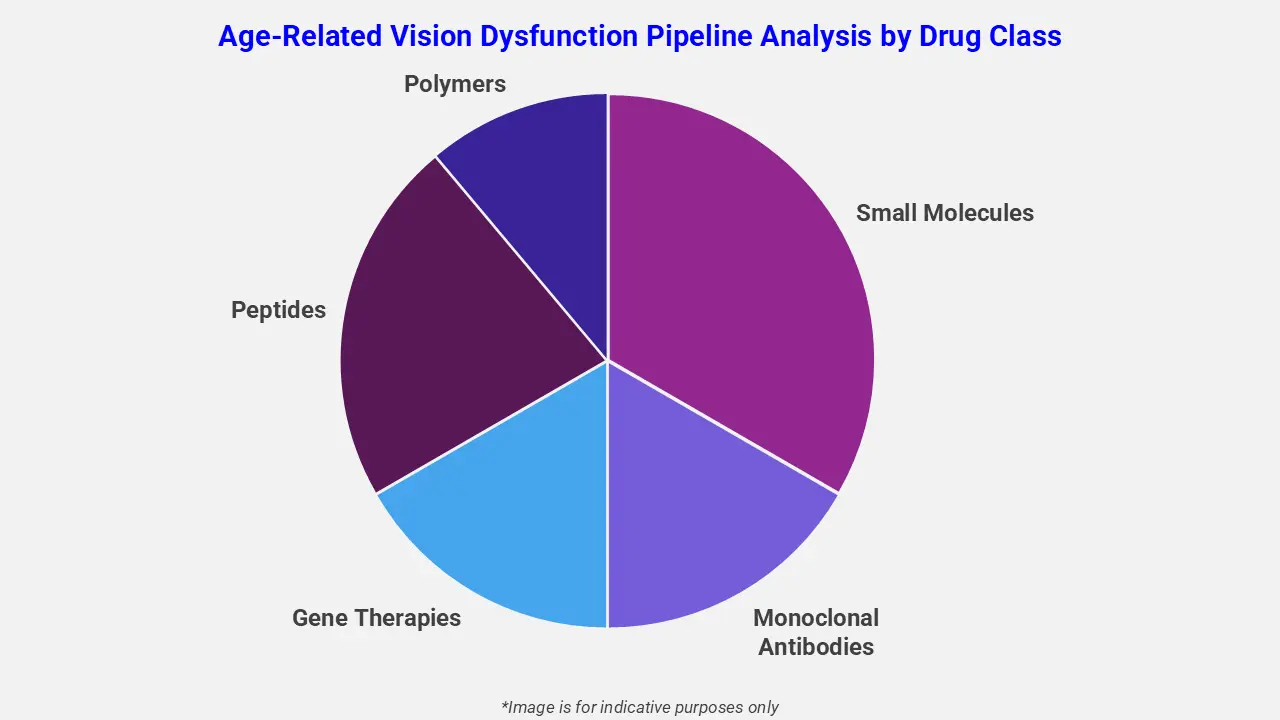
The age-related vision dysfunction pipeline analysis report covers 50+ drug analyses based on drug classes:
By Route of Administration
The pipeline assessment report covers 50+ drug analyses based on the route of administration.
The report covers phase I, phase II, phase III, phase IV, and early-phase drugs. The coverage includes an in-depth analysis of each drug across these phases. According to EMR analysis, phase II covers a major share of the total age-related vision dysfunction clinical trials of 50%. It is followed by phase III at 33% and phase I at 16%. This distribution underscores the pivotal role of phase II in advancing therapeutic candidates, with phase III focusing on efficacy and safety validation.
The drug molecule categories covered under the age-related vision dysfunction pipeline analysis include small molecules, monoclonal antibodies, gene therapies, peptides, and polymers. The age-related vision dysfunction report provides a comparative analysis of the drug classes for each drug in various phases of clinical trials for age-related vision dysfunction. According to Macular Degeneration Research in July 2025, tyrosine kinase inhibitors are emerging as a promising drug class for wet age-related macular degeneration. These drugs target enzymes upstream of vascular endothelial growth factor to prevent abnormal blood vessel growth. Implants delivering these inhibitors have shown potential to reduce the frequency of injections. Moreover, combination therapies targeting VEGF and inflammatory pathways, including interleukin-6 or the complement system, are under evaluation to enhance visual outcomes and retinal protection.
The EMR report for the age-related vision dysfunction pipeline covers the profile of key companies involved in clinical trials and their drugs under development. It provides a detailed age-related vision dysfunction therapeutic assessment, analyzing the competitive dynamics of the clinical trial landscape. Below is the list of a few players involved in age-related vision dysfunction clinical trials:
This section covers the detailed analysis of each drug under multiple phases, including phase I, phase II, phase III, phase IV, and emerging drugs for age-related vision dysfunction. It includes product description, trial ID, study type, drug class, mode of administration, and recruitment status of age-related vision dysfunction drug candidates.
Iptacopan (LNP023) is a highly potent oral factor B inhibitor being developed by Novartis Pharmaceuticals for the treatment of age-related macular degeneration (AMD). This Phase 2, multicenter, randomized, participant and investigator-masked, placebo-controlled study is examining Iptacopan’s safety and efficacy in preventing the progression of early or intermediate AMD to incomplete retinal pigment epithelium and outer retinal atrophy (iRORA) or late AMD. The study is enrolling approximately 146 participants worldwide, focusing on high-risk patients.
ADVM-022 is a gene therapy drug sponsored by Adverum Biotechnologies, Inc., and it is designed for treating neovascular (wet) age-related macular degeneration (nAMD). This Phase 2 study is examining the safety, tolerability, and efficacy of a single intravitreal injection of ADVM-022 at two different doses, alongside prophylactic corticosteroid regimens. The drug encodes aflibercept, an anti-VEGF protein, enabling retinal cells to continuously produce it, aiming to reduce frequent injections and improve long-term vision outcomes in nAMD patients.
*Please note that this is only a partial list; the complete list of drugs will be available in the full report.*
The Age-Related Vision Dysfunction Pipeline Analysis Report provides a strategic overview of the latest and future landscape of treatments for age-related vision dysfunction. It provides necessary information for making informed investment decisions along with research, development, and strategic planning efforts. The stakeholders will benefit from the essential insights into age-related vision dysfunction collaborations, regulatory environments, and potential growth opportunities.
Age-Related Macular Degeneration Market
Macular Degeneration Drug Pipeline Analysis Report
Dry Age-Related Macular Degeneration Pipeline Analysis Report


Upto 15% Off
USD
$1999 $1799
$3099 $2789
$4599 $3909
$5999 $5099


*While we strive to always give you current and accurate information, the numbers depicted on the website are indicative and may differ from the actual numbers in the main report. At Expert Market Research, we aim to bring you the latest insights and trends in the market. Using our analyses and forecasts, stakeholders can understand the market dynamics, navigate challenges, and capitalize on opportunities to make data-driven strategic decisions.*
Explore our key highlights of the report and gain a concise overview of key findings, trends, and actionable insights that will empower your strategic decisions.
|
Scope of the Report |
Details |
|
Drug Pipeline by Clinical Trial Phase |
|
|
Route of Administration |
|
|
Drug Classes |
|
|
Leading Sponsors Covered |
|
|
Geographies Covered |
|
Mini Report
One User
USD 1,999
USD 1,799
tax inclusive*
Single User License
One User
USD 3,099
USD 2,789
tax inclusive*
Five User License
Five User
USD 4,599
USD 3,909
tax inclusive*
Corporate License
Unlimited Users
USD 5,999
USD 5,099
tax inclusive*
*Please note that the prices mentioned below are starting prices for each bundle type. Kindly contact our team for further details.*
Flash Bundle
Small Business Bundle
Growth Bundle
Enterprise Bundle
*Please note that the prices mentioned below are starting prices for each bundle type. Kindly contact our team for further details.*
Flash Bundle
Number of Reports: 3
20%
tax inclusive*
Small Business Bundle
Number of Reports: 5
25%
tax inclusive*
Growth Bundle
Number of Reports: 8
30%
tax inclusive*
Enterprise Bundle
Number of Reports: 10
35%
tax inclusive*
How To Order

Select License Type
Choose the right license for your needs and access rights.

Click on ‘Buy Now’
Add the report to your cart with one click and proceed to register.

Select Mode of Payment
Choose a payment option for a secure checkout. You will be redirected accordingly.
Strategic Solutions for Informed Decision-Making
Gain insights to stay ahead and seize opportunities.

Get insights & trends for a competitive edge.

Track prices with detailed trend reports.

Analyse trade data for supply chain insights.

Leverage cost reports for smart savings

Enhance supply chain with partnerships.

Connect For More Information
Our expert team of analysts will offer full support and resolve any queries regarding the report, before and after the purchase.
Our expert team of analysts will offer full support and resolve any queries regarding the report, before and after the purchase.
We employ meticulous research methods, blending advanced analytics and expert insights to deliver accurate, actionable industry intelligence, staying ahead of competitors.
Our skilled analysts offer unparalleled competitive advantage with detailed insights on current and emerging markets, ensuring your strategic edge.
We offer an in-depth yet simplified presentation of industry insights and analysis to meet your specific requirements effectively.




