

Consumer Insights
Uncover trends and behaviors shaping consumer choices today
Procurement Insights
Optimize your sourcing strategy with key market data
Industry Stats
Stay ahead with the latest trends and market analysis.
The next-generation sequencing diagnostics market was valued at USD 16.61 Billion in 2025 and is expected to reach USD 57.90 Billion by 2035, expanding at a CAGR of 13.30%. Growth is driven by comprehensive genomic profiling in oncology, companion diagnostic approvals, rare disease and prenatal testing, and the falling cost of sequencing a genome.
Patent filing has strengthened since 2020, led by cell-free DNA assay chemistry, targeted enrichment panels, automated library preparation and machine-learning variant interpretation. Regulatory approvals of distributable sequencing kits in 2024 and 2025 and the commercial launch of new high-throughput platforms confirm the clinical and commercial relevance of these clusters.
This Next-Generation Sequencing Diagnostics Patent Landscape Analysis Report maps assignee portfolios, filing trends, jurisdiction activity and technology segments to support R&D, licensing and freedom-to-operate decisions.
The next-generation sequencing diagnostics market is experiencing strong growth, driven by precision oncology and companion diagnostic demand, rare disease and prenatal genomic testing, and falling cost per sequenced genome. The FDA approval of Illumina's TruSight Oncology Comprehensive in 2024 and of the Oncomine Dx Express Test on the Genexus Dx system in July 2025, both with companion diagnostic claims, moved multi-gene sequencing from reference laboratories into distributable in vitro diagnostic kits.
Patent activity is accelerating, with 1,900+ next-generation sequencing diagnostics patents granted in 2025, reflecting strong innovation momentum in comprehensive genomic profiling panels, cell-free DNA liquid biopsy assays, automated library preparation and target enrichment, and machine-learning variant calling and clinical interpretation.
Top assignees in the next-generation sequencing diagnostics patent landscape include Illumina, Roche, Thermo Fisher Scientific, BGI Genomics, and Guardant Health, with the United States, China, and Europe as the dominant patent jurisdictions.
Next-generation sequencing diagnostics convert tumour, blood and germline samples into clinically actionable genomic reports. Demand comes from oncology, inherited disease, reproductive health and infectious disease laboratories that need many markers read in a single run. Targeted panels dominate routine use, and whole-genome testing is gaining ground in paediatric and critical care settings. Reimbursement coverage and in vitro diagnostic approvals decide how fast each test format reaches routine practice.
Market growth is driven by comprehensive genomic profiling in oncology, where one sequencing run replaces a series of single-gene tests. Cancer accounted for about 20 million new cases worldwide in 2022 according to GLOBOCAN, so each additional biomarker-guided therapy enlarges the tested population.
Regulatory approvals show that distributable kits now qualify as companion diagnostics. TruSight Oncology Comprehensive gained FDA approval in 2024 with NTRK and RET claims, and Medicare coverage followed, which opened reimbursed access for community oncology. The Oncomine Dx Express Test on the Genexus Dx system, approved in July 2025 with an EGFR exon 20 claim for sunvozertinib, shortens turnaround and lets hospital laboratories run tests in house. Both approvals pull sequencing volume from reference laboratories into hospitals and increase demand for panel, chemistry and software patents.
Read more about this report - REQUEST FREE SAMPLE COPY IN PDF
Next-generation sequencing diagnostics attract patent filings from instrument makers, assay developers, liquid biopsy companies, clinical laboratories and universities. Filings concentrate on library preparation, hybrid-capture and amplicon enrichment, error-suppression chemistry, cell-free DNA methylation analysis and variant interpretation software.
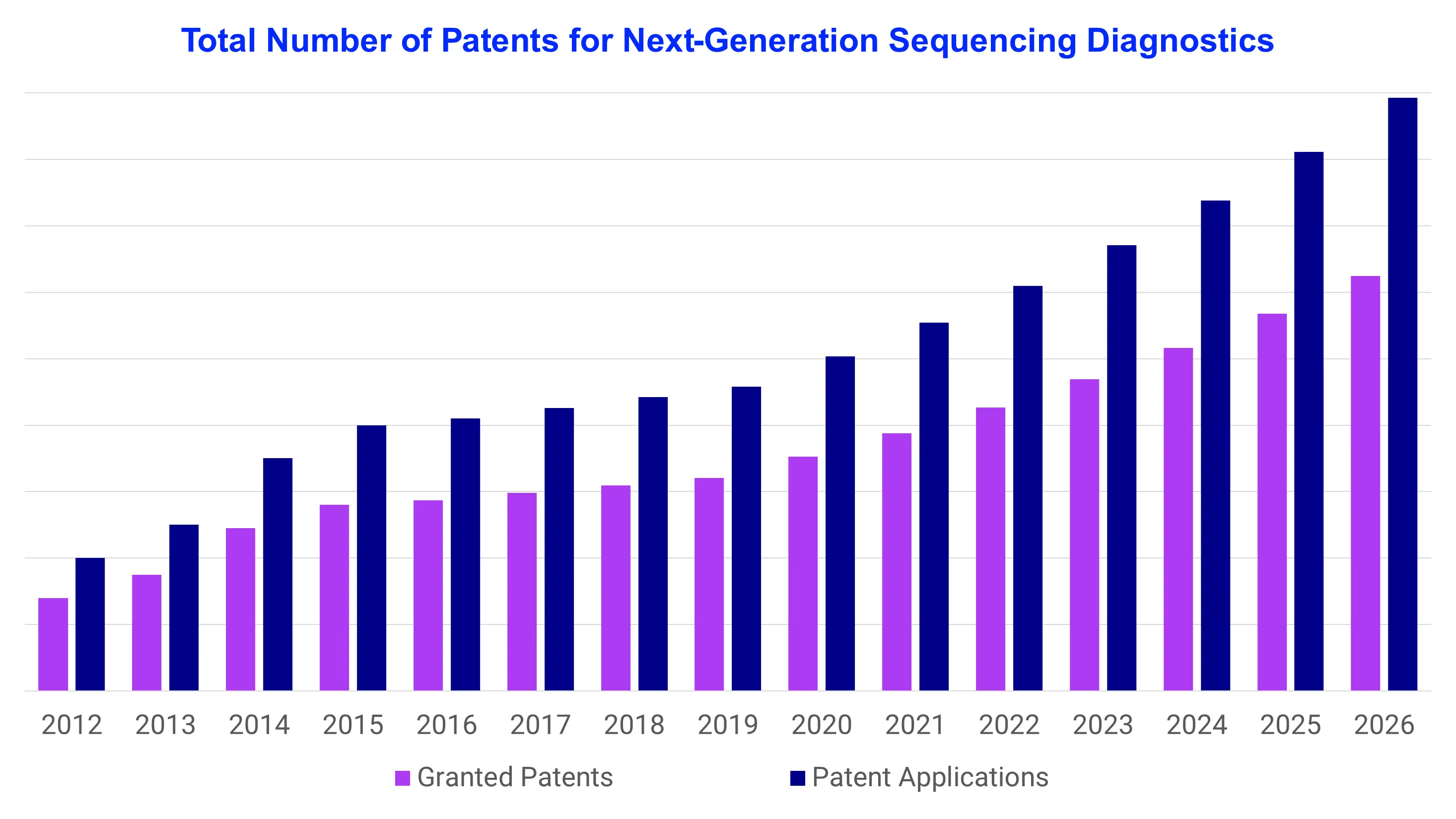
The dataset contains more than 16,500 patent families, with filing activity peaking between 2021 and 2024. That peak follows the maturing of cell-free DNA assays and the first wave of FDA-approved sequencing kits with companion diagnostic claims.
Growing demand for tumour profiling, early cancer detection and inherited disease testing has translated into sustained filings on enrichment chemistry, assay design and bioinformatics.
The report covers patents on sequencing chemistry and instruments used for clinical testing, targeted gene panels, whole exome and whole genome workflows, transcriptome assays and cell-free DNA liquid biopsy methods. Sample preparation, unique molecular identifier tagging and target enrichment claims are included.
Bioinformatics claims on alignment, variant calling, copy number detection, fusion detection and clinical report generation fall inside the scope. Patents on research-only sequencing instruments are included where claims address diagnostic sample types or clinical workflows.
Assignees analysed include sequencing instrument makers, in vitro diagnostic companies, liquid biopsy developers, clinical laboratory networks, universities and research institutes holding granted patents and pending applications.
The report will cover the following sections in detail:
Analysis by Technology
Analysis by Application
Analysis by Test Format
Next-Generation Sequencing Diagnostics Patent Filing Trend Analysis
Annual patent filings in next-generation sequencing diagnostics grew at an estimated 8 to 10 percent per year between 2020 and 2024. Cell-free DNA assay development, tumour-informed monitoring tests and the rise of machine-learning variant callers drove this growth.
Grants in 2025 exceeded 1,900, with a rising share covering methylation-based detection, error-corrected enrichment and automated sample-to-report workflows. Publication lags of 18 months mean that 2025 and 2026 filings continue to appear in the data.
Among the players with next-generation sequencing diagnostics patent families, new entrants have been identified, which can be either established companies or startups developing novel technology in the field. Some of the major companies mentioned in this report (a non-exhaustive list) are as follows:
Illumina holds the largest portfolio in next-generation sequencing diagnostics, built on sequencing by synthesis chemistry, patterned flow cells, optical detection and the DRAGEN secondary analysis engine. Its clinical offer includes the MiSeq Dx and NextSeq 550Dx instruments, the NovaSeq X series and TruSight Oncology Comprehensive, which received FDA approval in 2024 with companion diagnostic claims for NTRK fusion tumours and RET fusion lung cancer. The company also supports Pillar Biosciences' oncoReveal CDx on the MiSeq Dx system. Illumina reported full-year 2025 revenue of USD 4.34 billion, flat on 2024, while China placed the company on its unreliable entity list and restricted sequencer imports in 2025. The IP strategy relies on dense continuation filings around chemistry, flow cell and informatics claims, supported by active enforcement in major jurisdictions. Its acquisition of SomaLogic extends the commercial position into proteomics.
Roche builds its position through Roche Sequencing Solutions, Foundation Medicine and the KAPA library preparation reagent line. FoundationOne CDx and FoundationOne Liquid CDx carry multiple FDA-approved companion diagnostic indications, and Ariosa supplies the Harmony prenatal test. The sequencing by expansion technology, acquired with Stratos Genomics in 2020 and unveiled in February 2025, reached commercial launch as the AXELIOS 1 platform in June 2026. Roche positions the instrument first for research use, with same-day whole-genome results and a path to clinical applications. Its filing strategy pairs chemistry and nanopore-sensor claims with assay and reporting claims that protect the full diagnostic workflow.
Other Key Players include Thermo Fisher Scientific, BGI Genomics and Guardant Health.
*Please note that this is only a partial list; the complete list of key players is available in the full report. Additionally, the list of key players can be customized to better suit your needs.*
The report assesses patent activity across major jurisdictions, including:
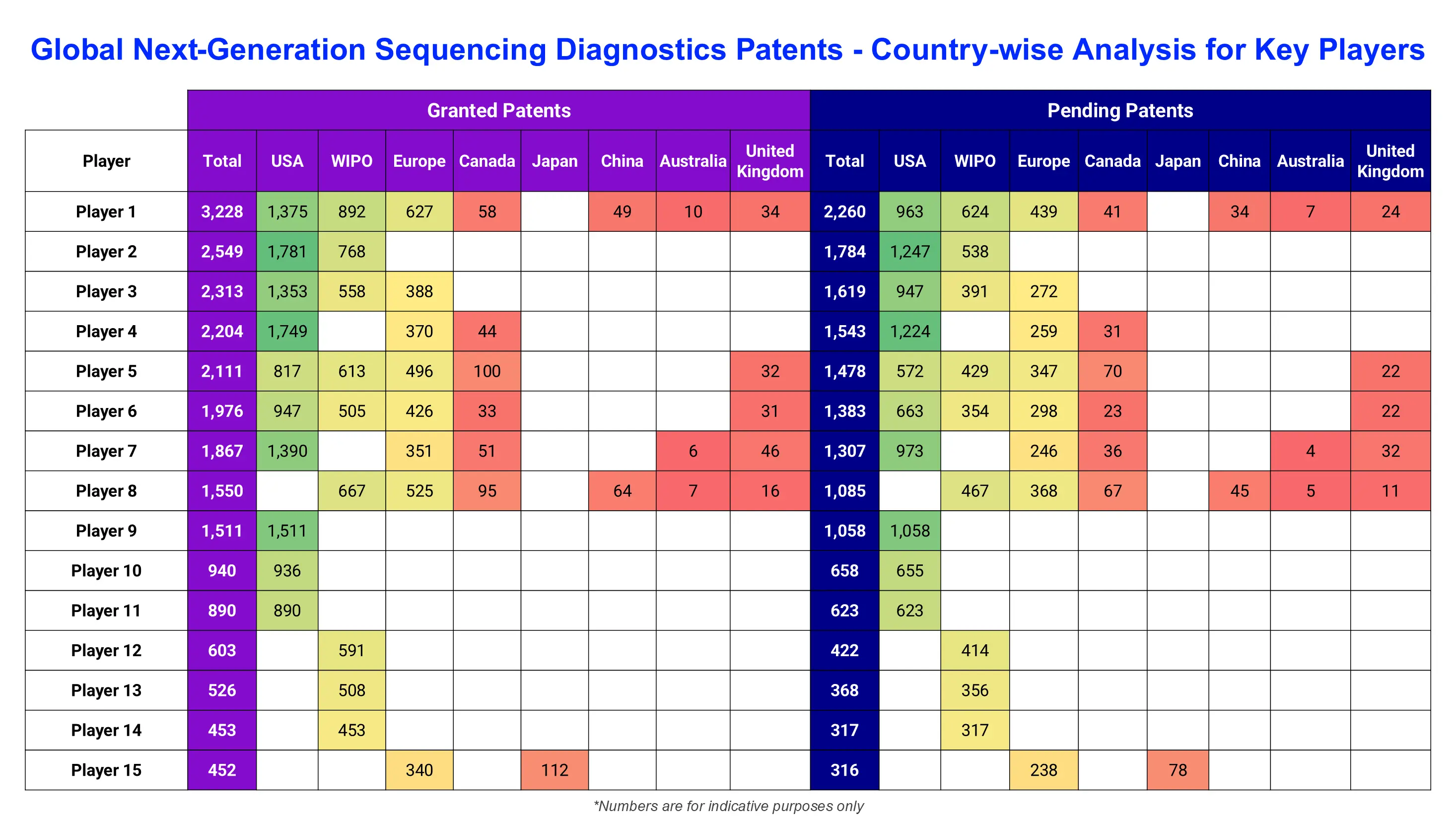
The United States leads in filing volume, supported by the concentration of instrument makers, liquid biopsy developers and academic medical centres. China ranks second through BGI Genomics, MGI Tech and a growing set of domestic assay developers, and Europe ranks third with activity from Roche, Qiagen and university groups.
Read more about this report - REQUEST FREE SAMPLE COPY IN PDF
The report segments patent activity by the following technology clusters:
Among these, sequencing chemistry and clinical instruments hold the largest share of patent families because of the long filing history of sequencing by synthesis and semiconductor platforms.
Competition combines instrument incumbents with assay-led specialists. Illumina, Thermo Fisher Scientific and BGI Genomics defend chemistry and platform claims, while Roche extends its position through Foundation Medicine panels and a new sequencing by expansion platform. Guardant Health builds around cell-free DNA enrichment and methylation claims, and its Shield test gained FDA approval in July 2024 for colorectal cancer screening.
Companies are focusing on:
Emerging innovation themes include multi-cancer early detection assays built on methylation signatures and tumour-informed minimal residual disease monitoring. Long-read clinical sequencing for structural variants, same-day whole-genome workflows and foundation-model approaches to variant interpretation are also gaining claims.
Patent activity is moving from single-gene tests toward multi-analyte sequencing kits that carry companion diagnostic claims. Platform owners protect chemistry and instrument claims, and assay developers file on enrichment, methylation and software, which creates both licensing opportunities and overlap risk in cell-free DNA workflows.
Technology segments, assignee portfolios and jurisdiction trends are analysed across the full dataset. The report provides actionable intelligence supporting:
Patent data were collected from the USPTO, EPO, WIPO PATENTSCOPE, CNIPA, JPO and KIPO databases, with family consolidation based on priority claims. Queries combined CPC classes C12Q 1/6869, C12Q 1/6886, C12Q 1/6806 and G16B 30/00 with keyword sets for sequencing, genomic profiling and diagnostic testing.
Records were screened by title, abstract and claims to remove agricultural, forensic and pure research sequencing patents. Assignee names were normalised for subsidiaries and acquisitions, and counts were rounded to reflect search uncertainty.
The market side draws on regulatory databases such as FDA premarket approval records and EUDAMED, company filings, clinical trial registries and peer-reviewed oncology and genetics literature. These inputs confirm commercial relevance for each technology cluster.


Upto 15% Off
USD
$2699 $2429
$4299 $3869
$5799 $4949
$6999 $5949


*While we strive to always give you current and accurate information, the numbers depicted on the website are indicative and may differ from the actual numbers in the main report. At Expert Market Research, we aim to bring you the latest insights and trends in the market. Using our analyses and forecasts, stakeholders can understand the market dynamics, navigate challenges, and capitalize on opportunities to make data-driven strategic decisions.*
EMR’s Next-Generation Sequencing Diagnostics Patent Landscape Analysis provides a comprehensive assessment of patent filings, innovation clusters, assignee portfolios, and geographic filing patterns across the next-generation sequencing diagnostics landscape. The report identifies 16,500+ patent families, evaluates leading jurisdictions including the United States, China, and Europe, and profiles the top assignees by portfolio size.
The global next-generation sequencing diagnostics market was valued at USD 16.61 Billion in 2025. The market is projected to reach USD 57.90 Billion by 2035, expanding at a CAGR of 13.30% during 2026 - 2035.
The report analyses approximately 16,500+ patent families related to next-generation sequencing diagnostics. These include filings from the United States, China, Europe, and international WIPO filings.
Key companies operating within the landscape include Illumina, Roche, Thermo Fisher Scientific, BGI Genomics, and Guardant Health, among others. These organisations collectively account for a significant portion of patent activity analysed in this report.
The report evaluates patent activity across the United States, Europe, China, Japan, South Korea, India, and international WIPO filings. The United States leads in filing volume, with an estimated 38 percent of next-generation sequencing diagnostics patent families, followed by China and Europe.
Yes. The report scope can be customised based on geography, technology segment, assignee selection, time period, or specific innovation cluster focus. Please connect with the EMR team to define the customisation scope.
Patent landscape analysis helps organisations understand innovation trends, competitive activity, technology whitespace, and IP risk across a defined domain. For next-generation sequencing diagnostics, this report supports strategic decisions in R&D prioritisation, licensing evaluation, competitive benchmarking, and market entry planning.
Explore our key highlights of the report and gain a concise overview of key findings, trends, and actionable insights that will empower your strategic decisions.
|
Scope of the Report |
Details |
|
Analysis by Technology |
|
|
Analysis by Application |
|
|
Analysis by Test Format |
|
|
Analysis by End User |
|
|
Key Players Mentioned |
|
|
Geographies Covered |
|
Mini Report
One User
USD 2,699
USD 2,429
tax inclusive*
Single User License
One User
USD 4,299
USD 3,869
tax inclusive*
Five User License
Five User
USD 5,799
USD 4,949
tax inclusive*
Corporate License
Unlimited Users
USD 6,999
USD 5,949
tax inclusive*
*Please note that the prices mentioned below are starting prices for each bundle type. Kindly contact our team for further details.*
Flash Bundle
Small Business Bundle
Growth Bundle
Enterprise Bundle
*Please note that the prices mentioned below are starting prices for each bundle type. Kindly contact our team for further details.*
Flash Bundle
Number of Reports: 3
20%
tax inclusive*
Small Business Bundle
Number of Reports: 5
25%
tax inclusive*
Growth Bundle
Number of Reports: 8
30%
tax inclusive*
Enterprise Bundle
Number of Reports: 10
35%
tax inclusive*
How To Order

Select License Type
Choose the right license for your needs and access rights.

Click on ‘Buy Now’
Add the report to your cart with one click and proceed to register.

Select Mode of Payment
Choose a payment option for a secure checkout. You will be redirected accordingly.
Strategic Solutions for Informed Decision-Making
Gain insights to stay ahead and seize opportunities.

Get insights & trends for a competitive edge.

Track prices with detailed trend reports.

Analyse trade data for supply chain insights.

Leverage cost reports for smart savings

Enhance supply chain with partnerships.

Connect For More Information
Our expert team of analysts will offer full support and resolve any queries regarding the report, before and after the purchase.
Our expert team of analysts will offer full support and resolve any queries regarding the report, before and after the purchase.
We employ meticulous research methods, blending advanced analytics and expert insights to deliver accurate, actionable industry intelligence, staying ahead of competitors.
Our skilled analysts offer unparalleled competitive advantage with detailed insights on current and emerging markets, ensuring your strategic edge.
We offer an in-depth yet simplified presentation of industry insights and analysis to meet your specific requirements effectively.




