

Consumer Insights
Uncover trends and behaviors shaping consumer choices today
Procurement Insights
Optimize your sourcing strategy with key market data
Industry Stats
Stay ahead with the latest trends and market analysis.
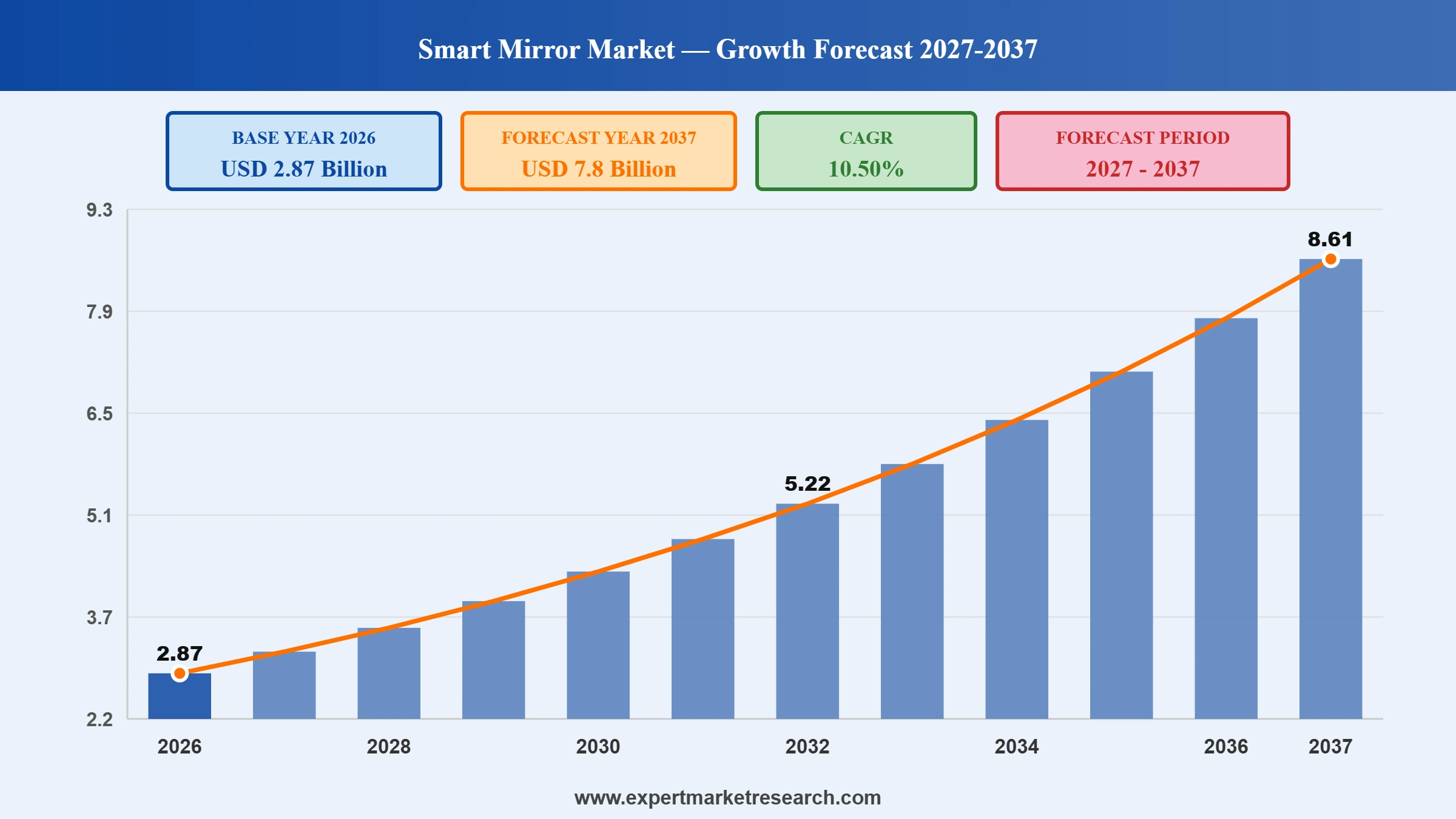
The smart mirror market was valued at USD 2.60 Billion in 2025. The market is expected to grow at a CAGR of 10.50% during the forecast period of 2026-2035 to reach a value of USD 7.06 Billion by 2035. Rising vehicle safety content, expanding smart home adoption, and growing use of interactive mirrors in retail and hospitality are collectively driving the market growth.
The current smart mirror market dynamics reflect strong momentum from connected vehicles, connected homes, and interactive retail, as suppliers pair displays, cameras, and software behind reflective glass. Technology showcases are accelerating product launches: CES 2026 in Las Vegas in January drew 148,000 attendees and more than 4,100 exhibitors, including about 1,200 startups, across 2.6 million net square feet of exhibit space. Such scale signals sustained investment in sensing, display, and artificial intelligence, encouraging suppliers to bring mirrors with health, beauty, and safety functions to market quickly. Automakers, appliance brands, and beauty companies are also using these stages to announce partnerships that extend reach.
The overall smart mirror industry dynamics through 2025 and 2026 are also being shaped by bathroom and building trade events. In February 2026, the Kitchen and Bath Industry Show, held with the International Builders' Show as Design and Construction Week in Orlando, drew 117,000 registrants and 2,250 exhibitors. This turnout shows how installers, designers, and builders are exposed to connected lighted mirrors, supporting specification in new homes and renovations, while encouraging manufacturers to refine installation, voice control, and lighting features. Hospitality buyers and distributors also use these events to compare suppliers and plan upcoming renovation cycles.
Read more about this report - Request a Free Sample
|
Smart Mirror Market Report Summary |
Description |
Value |
|
Base Year |
USD Billion |
2025 |
|
Historical Period |
USD Billion |
2019-2025 |
|
Forecast Period |
USD Billion |
2026-2035 |
|
Market Size 2025 |
USD Billion |
2.60 |
|
Market Size 2035 |
USD Billion |
7.06 |
|
CAGR 2019-2025 |
Percentage |
XX% |
|
CAGR 2026-2035 |
Percentage |
10.50% |
|
CAGR 2026-2035 - Market by Region |
Middle East and Africa |
13.5% |
|
CAGR 2026-2035 - Market by Product Type |
Tabletop and Vanity Smart Mirrors |
13.0% |
|
CAGR 2026-2035 - Market by Application |
Fitness and Healthcare |
14.0% |
|
2025 Market Share by Region |
Asia Pacific |
34.0% |
The smart mirror market is being reshaped by next-generation digital mirrors in vehicles, AI skin analysis in beauty devices, and interactive installations in retail stores. Tightening driver monitoring rules in Europe and rising luxury retail and hospitality investment in Asia Pacific and the Middle East are further reshaping the competitive landscape.
Kiehl's launched permanent interactive smart mirror installations that began in New York, then went live at Westfield London and Dubai Festival City, with Singapore, Malaysia, and China confirmed next. Motion sensing activated the display as shoppers approached, and facial scanning delivered a personalized skincare introduction. Retailers across the smart mirror market can adapt this model to convert passing foot traffic into guided, memorable engagement widely.
Magna secured a driver and occupant monitoring program with a European automaker, placing the camera behind the mirror glass at the driver's natural line of sight. The unit combined sensing, illumination, electronics, and software for centralized, software defined vehicle architectures. Component makers across the smart mirror market may replicate the approach by bundling sensors and software into mirrors that satisfy tightening global safety requirements worldwide.
Gentex unveiled a next-generation Full Display Mirror with Dynamic View Assist, which widens the digital view at low speeds, tilts downward in reverse, and monitors pickup cargo beds. The company said its mirror was already available on more than 140 vehicle models worldwide. Rival suppliers across the smart mirror market can respond by pairing camera mirrors with adaptive views that automakers differentiate across trim levels.
Samsung showcased an AI Beauty Mirror embedding skin analysis technology from Amorepacific, which assessed pores, redness, pigmentation, and wrinkles through a camera based optical system. Recommendations drew on a dataset of more than 450,000 cases and linked to LED mask devices. Other electronics and beauty brands could form alliances that add trusted analytics and recurring product advice to household mirrors.
Safety regulators across the smart mirror market are tightening requirements for in-cabin sensing, and suppliers are placing driver-facing cameras behind interior mirror glass, where the line of sight is natural. Carmakers are redesigning cabins around software-defined platforms and asking for compact, integrated modules. The second phase of the European Union General Safety Regulation took effect from July 2026 for newly manufactured cars and vans, making a camera-based driver distraction warning mandatory and creating a large, regulated demand base for mirror and camera suppliers worldwide.
Hoteliers across the smart mirror market are specifying lighted, decorative, and television mirrors for guest rooms and public areas to elevate design while adding entertainment and convenience. Designers want shorter lead times and consistent finishes across large renovation programs. In August 2025, Seura Contract partnered with WE Hospitality, a representative agency, to present its mirrors to designers and hotel groups across Southern California and Nevada, with assembly in Green Bay supporting reduced lead times for large hotel renovation and new build programs across both states.
Pharmacies and beauty counters across the smart mirror market are installing interactive mirrors that analyze skin in real time, helping staff start conversations and recommend suitable products. Shoppers receive customized profiles that reduce guesswork. In February 2025, Perfect Corp. and Inovshop equipped Amazon's first parapharmacy in Milan with mirrors covering 15 skin concerns, alongside a sensor surface that shows product details whenever an item is placed on it, supporting guided selling by pharmacy staff, and helping shoppers choose products confidently without lengthy trial and error.
Automotive suppliers across the smart mirror market are forming alliances to bring larger, brighter, and more transparent displays into cabins, which widens the surface area available to interactive glass. Optical specialists, adhesive makers, and glass producers are joining system integrators. In February 2026, Hyundai Mobis formed a four-company group with ZEISS, tesa, and Saint-Gobain Sekurit for a holographic windshield display offering 92% transparency, targeting serial production from 2029 and promising much larger interactive surfaces for future vehicles across premium and mass market vehicle segments.
Luxury beauty brands are placing artificial intelligence layers behind real glass, so shoppers see an ordinary mirror until they interact. Touch interfaces guide visitors through scans and tailored advice, and appointments with makeup artists follow. In July 2026, shu uemura unveiled a permanent installation at its Omotesando Hills flagship in Tokyo, built on the LOOOK.AI platform, offering a three-dimensional face scan and a personalized face summary, with plans to let visitors download their personalized results straight to their phones.
The Expert Market Research's report titled "Smart Mirror Market Report and Forecast 2026-2035" offers a detailed analysis of the market based on the following segments:
Market Breakup by Product Type
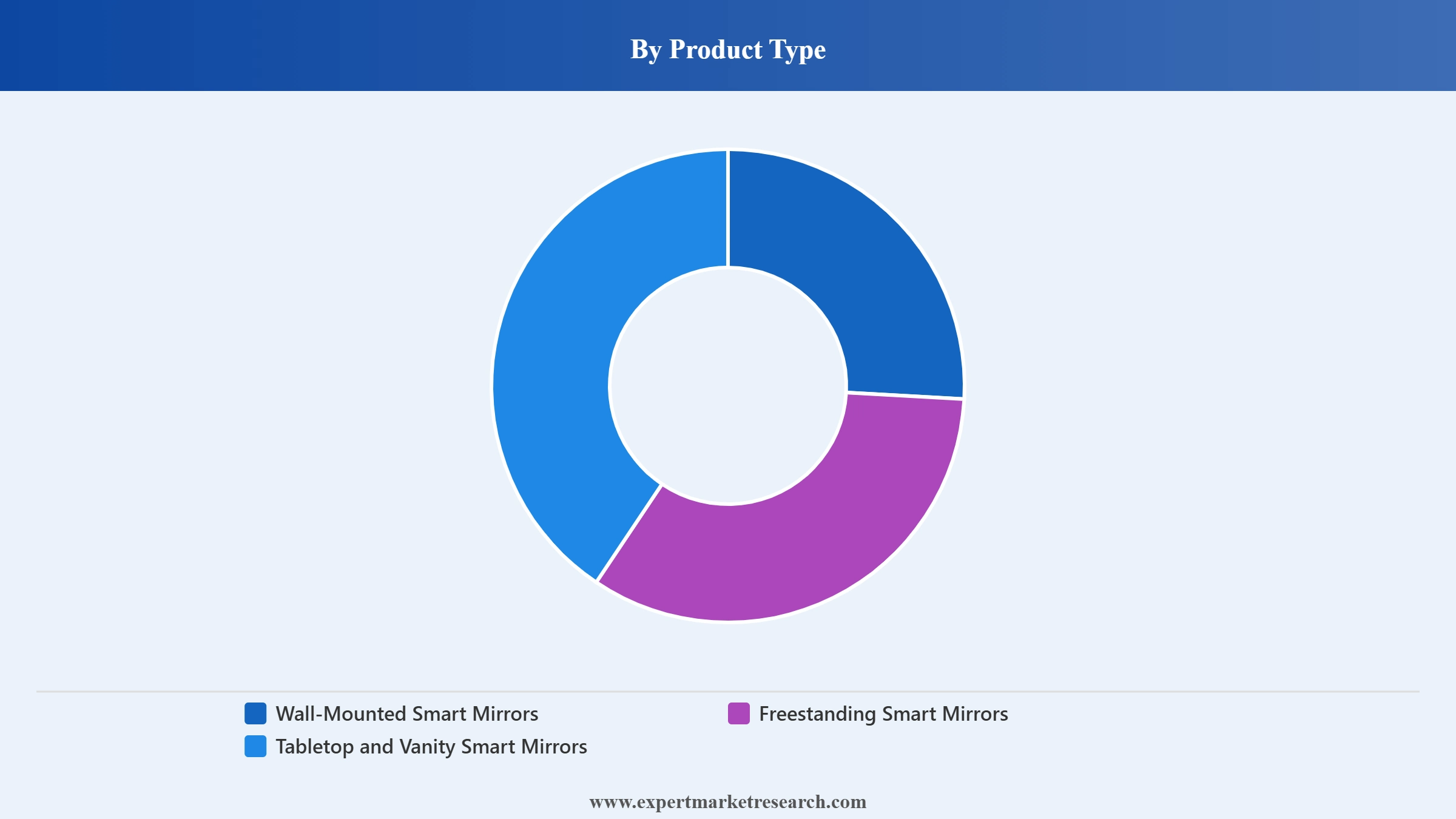
Key Insight: Wall-mounted smart mirrors dominate the smart mirror market by product type, offering space efficiency and easy integration into bathrooms, fitting rooms, and hotel suites. Freestanding smart mirrors serve gyms, showrooms, and large retail floors, while tabletop and vanity smart mirrors are the fastest-growing type as skin analysis and makeup guidance reach the dressing table. Others include mirror cabinets and portable units. Reflecting bathroom demand, in April 2026, UK bathroom brand Roxor reported mirror sales up about 25% by volume and 10% by value over the past year.
Market Breakup by Technology
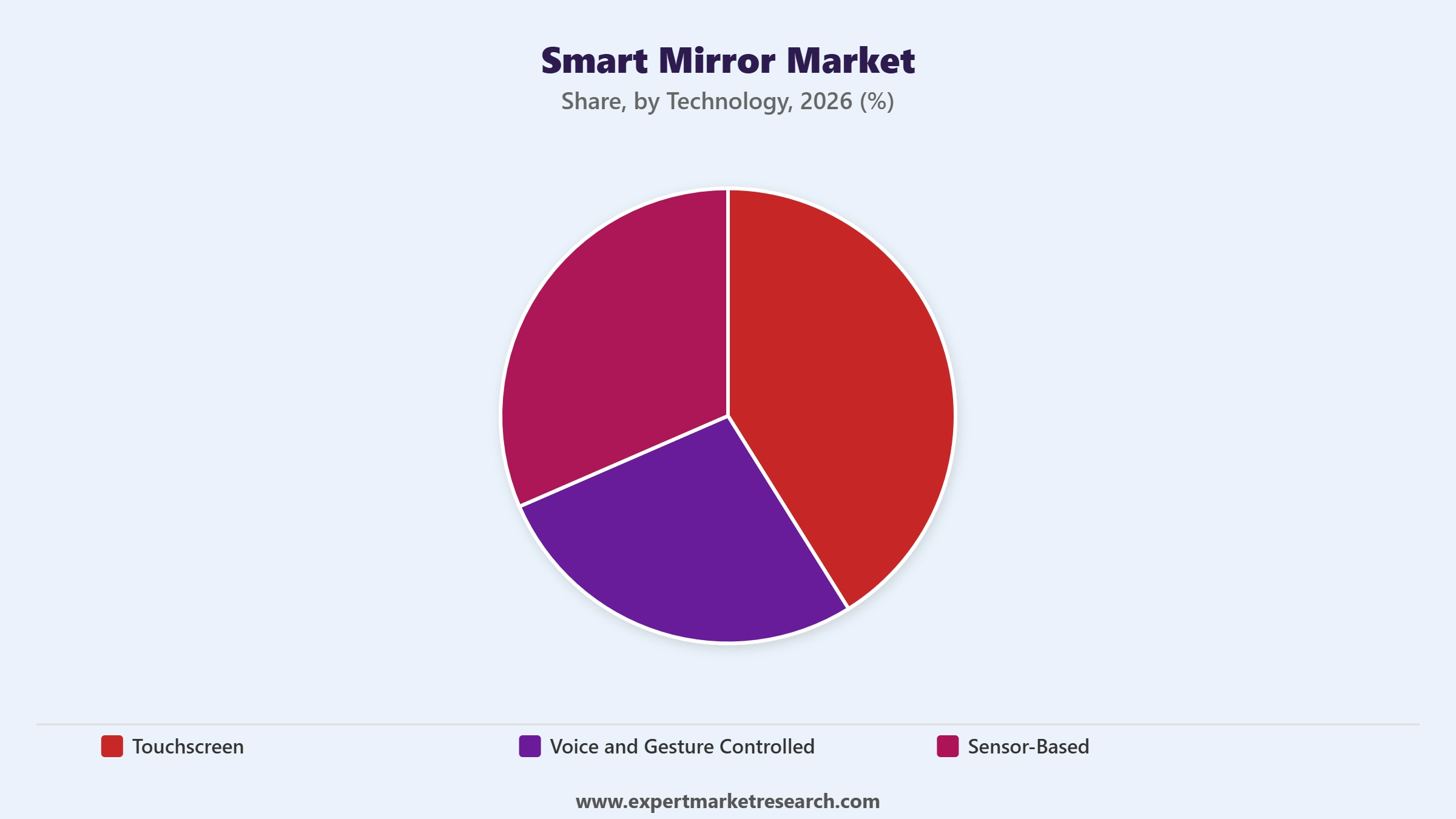
Key Insight: Touchscreen technology leads the smart mirror market because tapping and swiping are familiar and components are mature and affordable. Voice and gesture-controlled mirrors are the fastest-growing technology, suited to wet bathrooms, workouts, and hygiene-sensitive public spaces. Sensor-based mirrors that react to presence, light, or proximity support energy saving and ambient features, while others such as eye tracking and biometric recognition remain smaller but are developing steadily as accuracy improves and component costs fall.
Market Breakup by Application
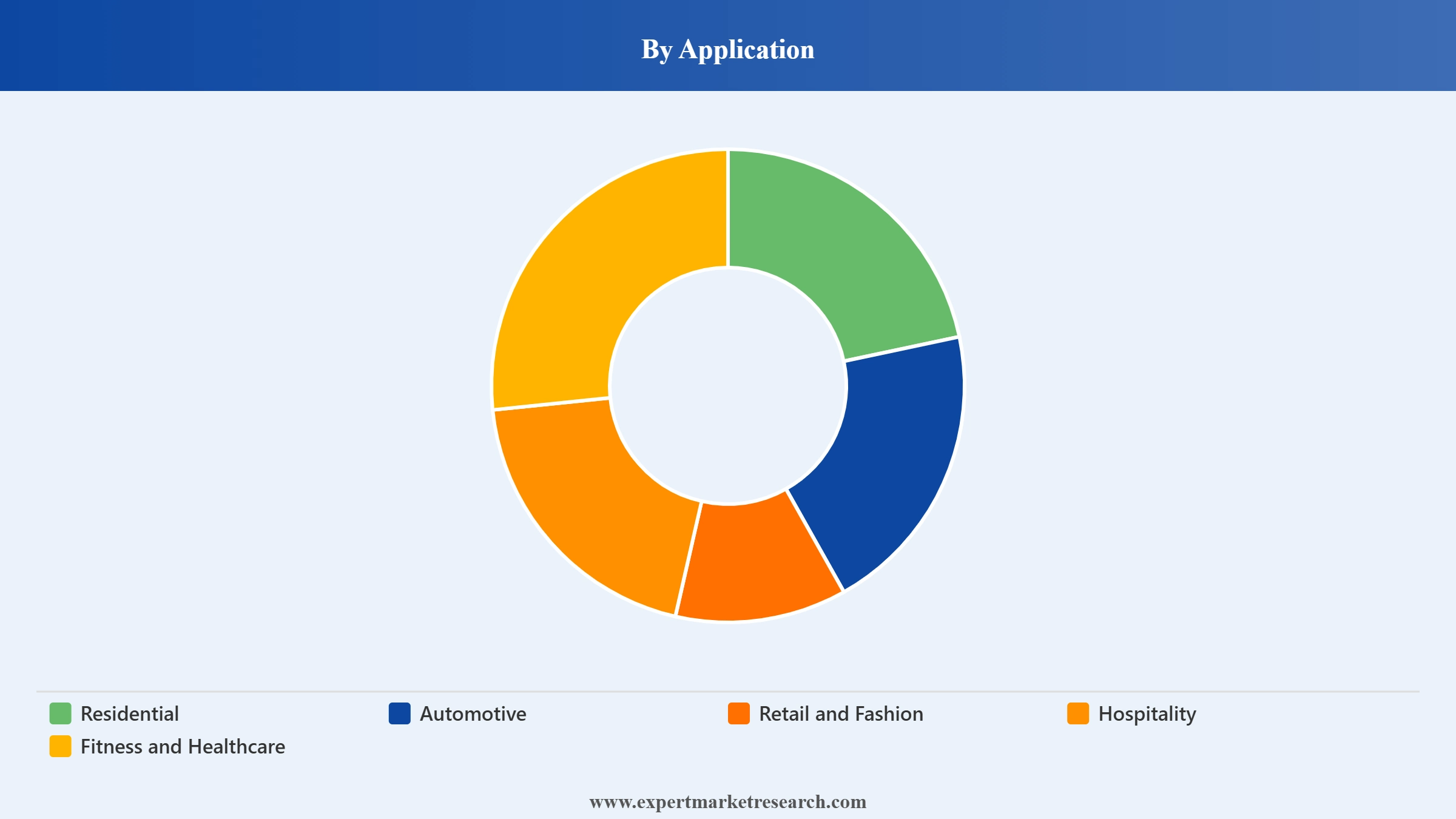
Key Insight: Automotive dominates the smart mirror market by application, led by auto-dimming, full display, and driver monitoring mirrors. Fitness and healthcare are the fastest-growing application, covering coached workouts and health scans. Residential demand rises with connected bathrooms, retail and fashion uses grow through fitting rooms and beauty counters, and hospitality adds lighted and television mirrors for guest rooms. Others include education, corporate offices, and public information points, which adopt interactive mirrors for wayfinding and branding.
Market Breakup by Region
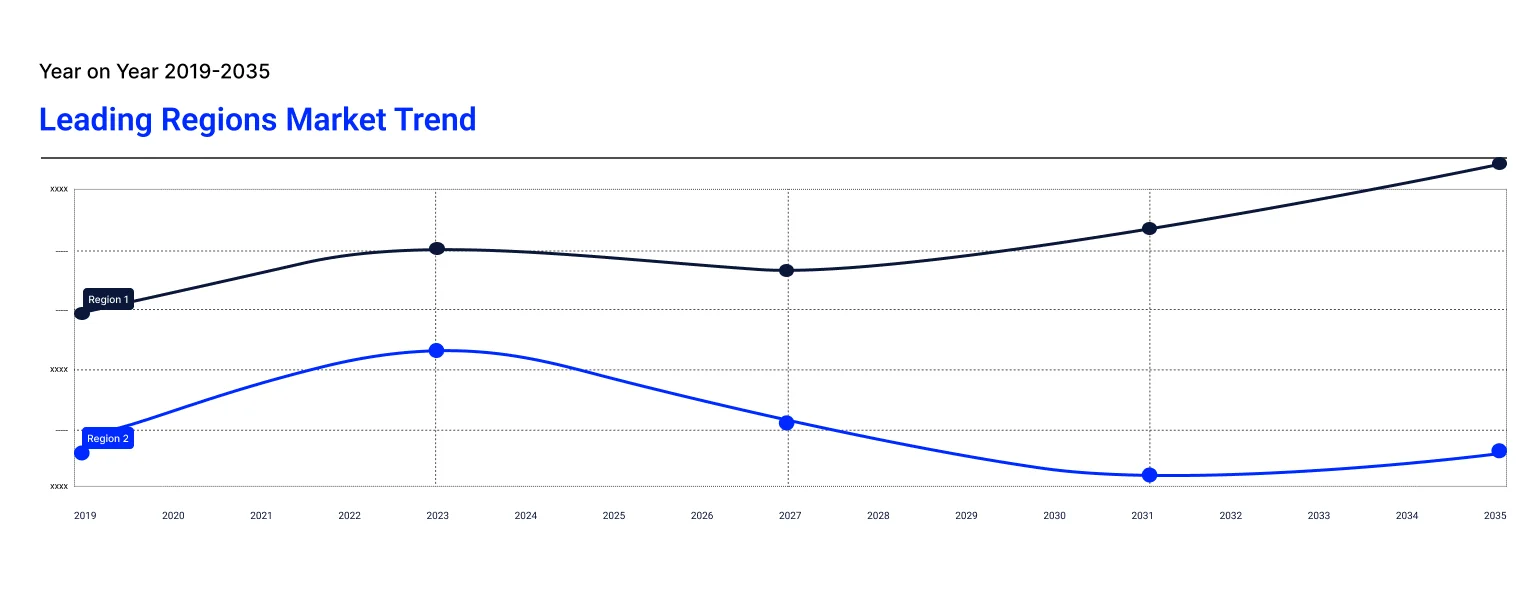
Key Insight: Asia Pacific dominates the smart mirror market, supported by vehicle production, electronics manufacturing, and retail digitalization. North America and Europe are mature regions shaped by smart home adoption and strict vehicle safety rules, Latin America grows steadily on retail modernization, and Middle East and Africa is the fastest-growing region. Illustrating Asia Pacific innovation, in October 2026, a Qualcomm Dragonwing based smart mirror running a seven billion parameter vision-language model on the device was demonstrated at India Mobile Congress, priced at about USD 300.
Read more about this report - Request a Free Sample
By product type, wall-mounted smart mirrors dominate the market due to space efficiency and easy integration into rooms
Wall-mounted smart mirrors account for the largest share of the smart mirror market by product type, because they save floor space, blend into bathrooms, bedrooms, fitting rooms, and hotel suites, and connect easily to building power and networks. Installers favor flush designs that look like ordinary mirrors until activated, and commercial buyers value tamper resistance and tidy cabling. Premium finishes, framed lighting, and home automation compatibility keep demand strong across renovations, new construction, and hospitality refurbishment programs across global markets.
Read more about this report - Request a Free Sample
Tabletop and vanity smart mirrors are the fastest-growing product type as beauty routines move toward guided, data-rich experiences at the dressing table. Consumers want lighting, skin analysis, and tutorials in one compact device. The SWAN Beauty Mirror, revealed in January 2026 with luxury retailer Cos Bar, combines a 15.6-inch OLED touchscreen, a 4K camera, and augmented reality makeup guidance for USD 795, showing how premium vanity devices are opening new spending. Freestanding units serve busy gyms, studios, and showrooms.
By technology, touchscreen leads the market due to familiar interaction and mature, affordable display components
Touchscreen smart mirrors account for the largest share of the smart mirror market by technology, because users already understand tapping and swiping, and capacitive panels are mature, durable, and affordable. Manufacturers can add multi-touch, anti-fingerprint coatings, and moisture protection without major redesign, which suits bathrooms, hotel rooms, and retail aisles. Software ecosystems built around touch also make third party applications easier to develop, helping device makers offer calendars, weather, music, and routines on one convenient surface for everyday household users.
Read more about this report - Request a Free Sample
Voice and gesture-controlled mirrors are the fastest-growing technology as hands-free operation suits wet bathrooms, workouts, and hygiene-conscious public spaces. Better microphones, on-device language models, and compact depth sensors are improving accuracy. Withings introduced its Omnia mirror in January 2025 with an artificial intelligence vocal companion that answers health questions, alongside scans of weight, heart, and metabolic health, showing how conversational control can turn a mirror into a daily wellness coach. Sensor-based mirrors add ambient features such as presence detection.
By application, automotive leads the market due to wide adoption of auto-dimming and digital rear-view mirrors
Automotive accounts for the largest share of the smart mirror market by application, led by auto-dimming interior mirrors, full display mirrors, and mirror-integrated driver monitoring that carmakers fit across mainstream and premium models. Long production runs, strict safety standards, and supplier relationships built over decades sustain volumes. Growing camera, display, and software content per vehicle raises the value of each mirror, while retail, hospitality, and residential uses add smaller but steadily expanding layers of demand beyond passenger vehicles and fleets.
Read more about this report - Request a Free Sample
Fitness and healthcare are the fastest-growing application as mirrors deliver coached workouts, posture feedback, and health scans at home and in clinics. Falling hardware prices and lower subscription barriers are widening adoption. In September 2026, Magic AI raised USD 11 million in Series B funding to scale its artificial intelligence fitness mirror in the United States, cutting the price to USD 1,499 with lifetime class access, while residential, retail, and hospitality uses continue growing steadily alongside it across many regions.
Asia Pacific dominates the market due to large vehicle production, electronics manufacturing, and rapid retail digitalization
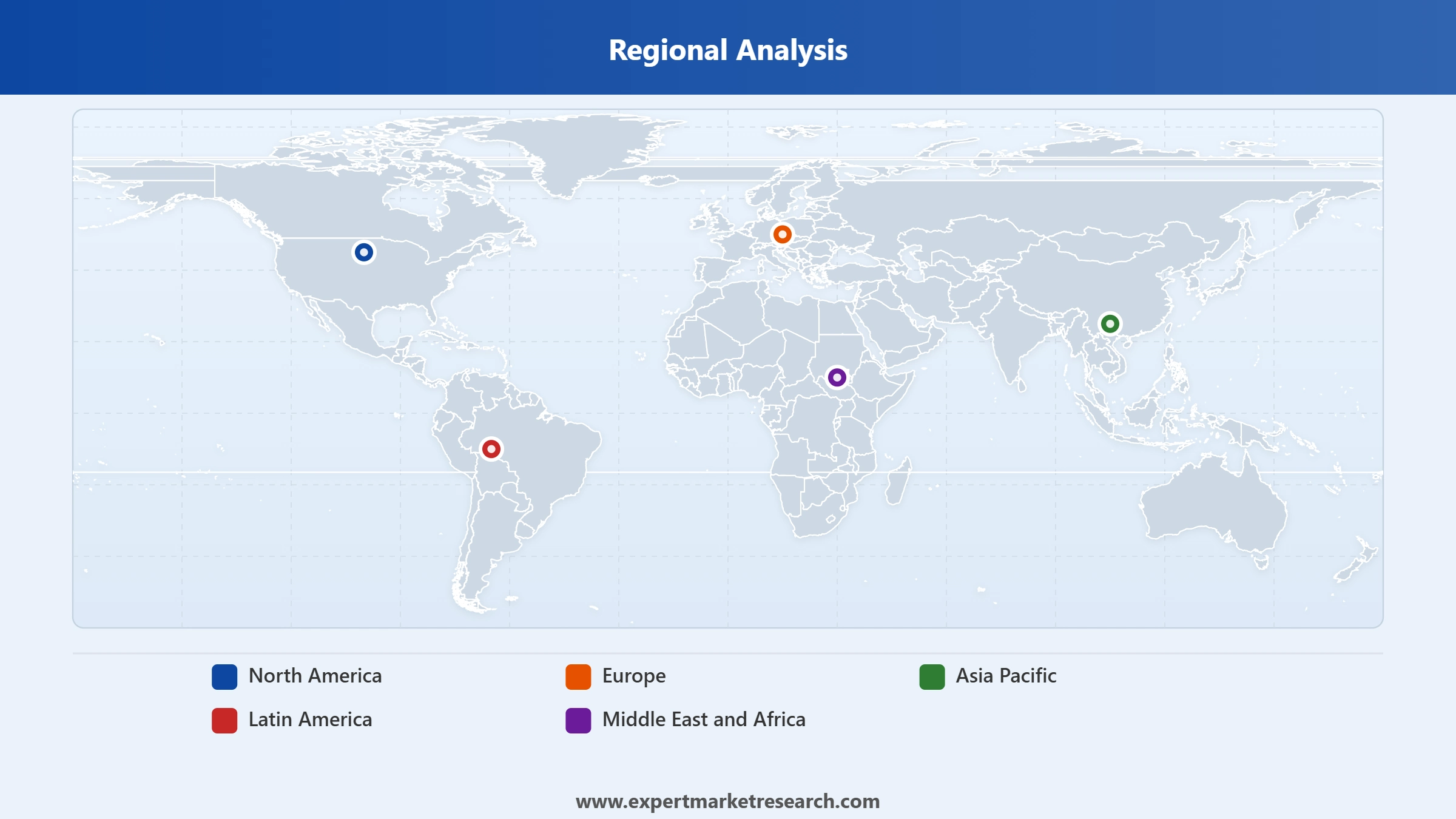
Asia Pacific dominates the smart mirror market, supported by large automotive production, deep electronics supply chains, and fast retail and hospitality digitalization in China, Japan, South Korea, and India. Domestic manufacturers supply competitively priced displays, sensors, and modules, lowering costs for device makers. Rising urban incomes and strong smartphone habits encourage consumers to accept connected home products, while shopping malls and hotels adopt interactive mirrors to attract younger visitors and differentiate customer experiences, while regional hubs export to buyers worldwide.
Read more about this report - Request a Free Sample
Middle East and Africa are the fastest-growing region from a smaller base, as luxury retail, hospitality investment, and smart city programs lift demand for interactive surfaces. In August 2025, Saudi luxury sportswear brand Kayanee upgraded its Riyadh store with Deneva's Mirandda smart mirror, which shows garment details, makes recommendations, and lets shoppers buy from the fitting room. North America and Europe remain mature, while Latin America grows steadily on retail modernization, rising middle class spending, and expanding shopping mall construction.
|
CAGR 2026-2035 - Market by |
Region |
|
North America |
10.5% |
|
Europe |
9.8% |
|
Asia Pacific |
12.5% |
|
Latin America |
10.8% |
|
Middle East and Africa |
13.5% |
The smart mirror companies are moderately fragmented, with automotive mirror specialists, bathroom and hospitality mirror makers, and consumer electronics firms competing on display quality, sensing accuracy, software ecosystems, and installation partnerships. Companies like Gentex Corporation, Magna International Inc., Panasonic Holdings Corporation, and Kohler Co. lead through broad portfolios and global customer relationships, while Electric Mirror, Seura, Duravit, Murakami, and Capstone strengthen positions through focused ranges and channel alliances.
Leading smart mirror market players are focusing on camera integration, artificial intelligence features, moisture resistant designs, and partnerships with automakers, builders, and retailers to strengthen their competitive position. Increasing emphasis on data privacy, energy efficient displays, and easier installation is also enabling companies to broaden portfolios, deepen customer loyalty, and support sustained long term market growth across several end uses.
Gentex Corporation, headquartered in Zeeland, Michigan, United States, was founded in 1974 and is listed on the Nasdaq. The company designs auto-dimming mirrors, electronic systems, and dimmable glass for automakers, and supplies camera-based mirrors and driver monitoring technology through long standing relationships with vehicle manufacturers across North America, Europe, and Asia.
Magna International Inc., headquartered in Aurora, Ontario, Canada, was founded in 1957 and is listed on the Toronto and New York stock exchanges. The mobility technology supplier produces interior and exterior mirrors, lighting, seating, and vehicle systems for global automakers through manufacturing operations spread across dozens of countries.
Panasonic Holdings Corporation, headquartered in Osaka, Japan, was founded in 1918 and is listed on the Tokyo Stock Exchange. The group makes home appliances, bathroom and lighting products, electronic components, and automotive systems, supplying mirrors and vanity equipment to residential and commercial customers across Asia, Europe, and the Americas.
Kohler Co., headquartered in Kohler, Wisconsin, United States, was founded in 1873 and remains privately held. The company manufactures kitchen and bath products, engines, and energy systems, and its connected bathroom lines include lighted and voice-controlled mirrors sold through showrooms, builders, and online retailers across North America and international markets.
Other key players in the market report include Electric Mirror, LLC, Seura, Inc., Duravit AG, Murakami Corporation, and Capstone Companies, Inc., among others.
*Please note that this is only a partial list; the complete list of key players is available in the full report. Additionally, the list of key players can be customized to better suit your needs.*
Explore the latest trends shaping the smart mirror market 2026-2035 with our in-depth report. Gain strategic insights, future forecasts, and key market developments that can help you stay competitive. Download a free sample report or contact our team for customized consultation on the market trends 2026.


Upto 15% Off
USD
$2499 $2249
$3999 $3599
$4999 $4249
$5999 $5099


*While we strive to always give you current and accurate information, the numbers depicted on the website are indicative and may differ from the actual numbers in the main report. At Expert Market Research, we aim to bring you the latest insights and trends in the market. Using our analyses and forecasts, stakeholders can understand the market dynamics, navigate challenges, and capitalize on opportunities to make data-driven strategic decisions.*
In 2025, the smart mirror market reached an approximate value of USD 2.60 Billion.
The market is projected to grow at a CAGR of 10.50% between 2026 and 2035.
The key players in the market include Gentex Corporation, Magna International Inc., Panasonic Holdings Corporation, Kohler Co., Electric Mirror, LLC, Seura, Inc., Duravit AG, Murakami Corporation, and Capstone Companies, Inc., among others.
Leading companies are pursuing sensor fusion, on-device intelligence, hospitality and retail partnerships, and lower priced consumer models to widen adoption.
Key challenges include data privacy concerns, high upfront device costs, complex installation, and competition from cheaper non-connected lighted mirrors.
Explore our key highlights of the report and gain a concise overview of key findings, trends, and actionable insights that will empower your strategic decisions.
|
Report Features |
Details |
|
Base Year |
2025 |
|
Historical Period |
2019-2025 |
|
Forecast Period |
2026-2035 |
|
Scope of the Report |
Historical and Forecast Trends, Industry Drivers and Constraints, Historical and Forecast Market Analysis by Segment:
|
|
Breakup by Product Type |
|
|
Breakup by Technology |
|
|
Breakup by Application |
|
|
Breakup by Region |
|
|
Market Dynamics |
|
|
Competitive Landscape |
|
|
Companies Covered |
|
Datasheet
One User
USD 2,499
USD 2,249
tax inclusive*
Single User License
One User
USD 3,999
USD 3,599
tax inclusive*
Five User License
Five User
USD 4,999
USD 4,249
tax inclusive*
Corporate License
Unlimited Users
USD 5,999
USD 5,099
tax inclusive*
*Please note that the prices mentioned below are starting prices for each bundle type. Kindly contact our team for further details.*
Flash Bundle
Small Business Bundle
Growth Bundle
Enterprise Bundle
*Please note that the prices mentioned below are starting prices for each bundle type. Kindly contact our team for further details.*
Flash Bundle
Number of Reports: 3
20%
tax inclusive*
Small Business Bundle
Number of Reports: 5
25%
tax inclusive*
Growth Bundle
Number of Reports: 8
30%
tax inclusive*
Enterprise Bundle
Number of Reports: 10
35%
tax inclusive*
How To Order

Select License Type
Choose the right license for your needs and access rights.

Click on ‘Buy Now’
Add the report to your cart with one click and proceed to register.

Select Mode of Payment
Choose a payment option for a secure checkout. You will be redirected accordingly.
Strategic Solutions for Informed Decision-Making
Gain insights to stay ahead and seize opportunities.

Get insights & trends for a competitive edge.

Track prices with detailed trend reports.

Analyse trade data for supply chain insights.

Leverage cost reports for smart savings

Enhance supply chain with partnerships.

Connect For More Information
Our expert team of analysts will offer full support and resolve any queries regarding the report, before and after the purchase.
Our expert team of analysts will offer full support and resolve any queries regarding the report, before and after the purchase.
We employ meticulous research methods, blending advanced analytics and expert insights to deliver accurate, actionable industry intelligence, staying ahead of competitors.
Our skilled analysts offer unparalleled competitive advantage with detailed insights on current and emerging markets, ensuring your strategic edge.
We offer an in-depth yet simplified presentation of industry insights and analysis to meet your specific requirements effectively.




