Consumer Insights
Uncover trends and behaviors shaping consumer choices today
Procurement Insights
Optimize your sourcing strategy with key market data
Industry Stats
Stay ahead with the latest trends and market analysis.
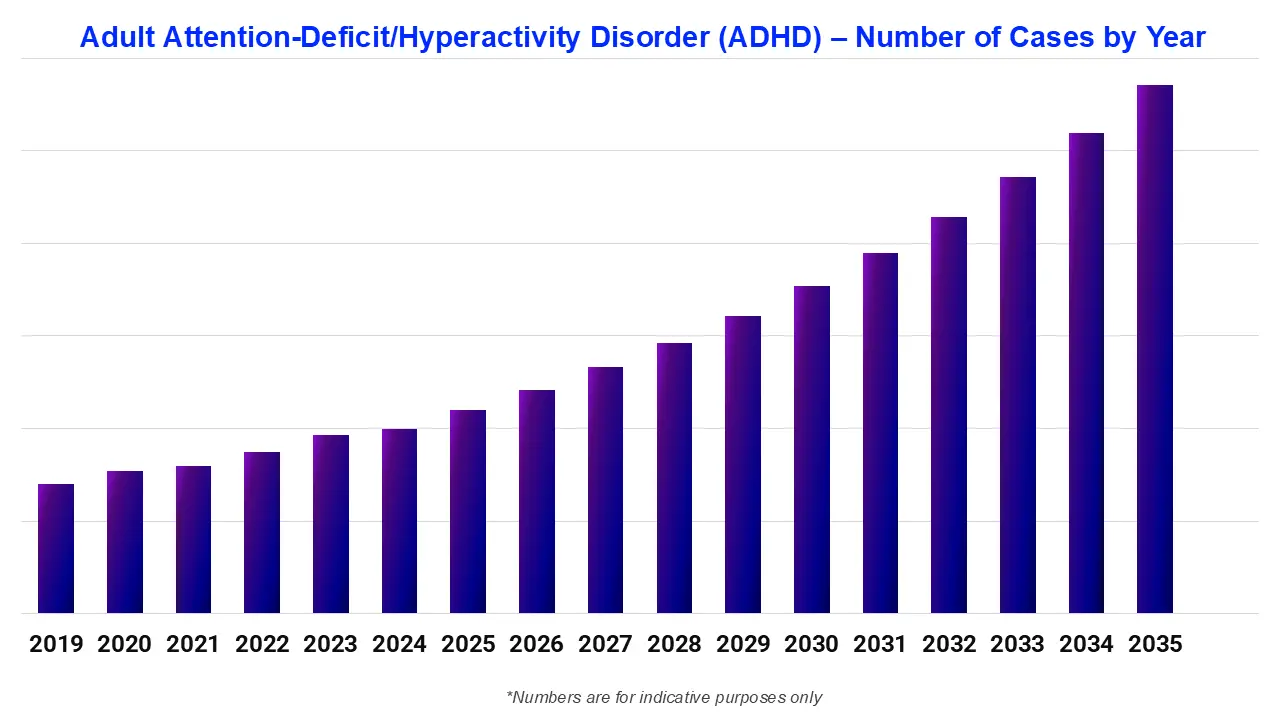
Adult attention-deficit/hyperactivity disorder (ADHD) is a neurodevelopmental disorder marked by persistent inattention, hyperactivity, and impulsivity that impair daily functioning. A 2024 U.S. CDC analysis estimated that 6.0% of adults, or approximately 15.5 million people, had a current ADHD diagnosis. A 2024 systematic review found that prevalence estimates varied by ascertainment method, with register-based studies generally reporting lower estimates than survey and clinical studies. According to adult attention-deficit/hyperactivity disorder (ADHD) by Expert Market Research (EMR), adult ADHD remains an active therapeutic development area, with growing focus on stimulant optimization, non-stimulant therapies, and extended-release formulations. Improved diagnosis is also increasing recognition of the adult ADHD population.
Base Year
Historical Period
Forecast Period
Read more about this report - Request a Free Sample
Expert Market Research's “Adult Attention-Deficit/Hyperactivity Disorder (ADHD) Epidemiology Forecast Report 2026-2035” offers comprehensive information on the prevalence and demographics of Adult Attention-Deficit/Hyperactivity Disorder (ADHD). It projects the future incidence and prevalence rates of Adult Attention-Deficit/Hyperactivity Disorder (ADHD) cases across various populations. The study covers age, gender, and type as major determinants of the Adult Attention-Deficit/Hyperactivity Disorder (ADHD) population. The report highlights patterns in the prevalence of Adult Attention-Deficit/Hyperactivity Disorder (ADHD) over time and projects future trends based on multiple variables.
The report provides a comprehensive overview of the disease, as well as historical and projected data on the epidemiology of Adult Attention-Deficit/Hyperactivity Disorder (ADHD) in the 8 major markets.
Regions Covered
Adult attention-deficit/hyperactivity disorder (ADHD) is a neurodevelopmental disorder characterized by persistent patterns of inattention, hyperactivity, and impulsivity that cause clinically significant impairment in occupational, social, academic, or daily functioning. Although symptoms originate during childhood, they frequently persist into adulthood and may remain undiagnosed for years. Adult ADHD is associated with impairments in executive functioning, attention regulation, working memory, emotional regulation, time management, and behavioral inhibition. Symptoms may be present differently from childhood ADHD, with overt motor hyperactivity often becoming less prominent while internal restlessness, disorganization, distractibility, impulsivity, and difficulties maintaining occupational or interpersonal functioning become more apparent. Psychiatric comorbidities are common, particularly anxiety, mood disorders, substance-use disorders, and sleep disorders.
|
Parameter |
Insight |
|
Largest Patient Pool |
United States |
|
Fastest Growing Region |
India |
|
High-Risk Population |
Adults with childhood ADHD persisting into later life, individuals with family histories of ADHD, people with psychiatric comorbidities, and adults experiencing occupational, educational, or social impairment represent important high-risk groups. Women may remain disproportionately under-recognized because inattentive manifestations can be less conspicuous. |
|
Key Diagnostic Method |
Diagnosis is primarily clinical and requires comprehensive developmental, psychiatric, psychosocial, and functional assessment using DSM-5 or ICD-11 criteria. Validated instruments such as the Adult ADHD Self-Report Scale (ASRS) are useful adjuncts but should not independently establish diagnosis. |
|
Major Risk Factor |
Genetic susceptibility is the major established underlying risk determinant, with environmental and developmental factors contributing to symptom expression and persistence. Prematurity, prenatal exposures, psychosocial adversity, and coexisting neurodevelopmental or psychiatric conditions may further influence clinical presentation. |
|
Major gap in the market |
Major gaps include delayed adult diagnosis, inadequate specialist capacity, limited standardized diagnostic pathways, under-recognition of women and predominantly inattentive presentations, medication-access problems, inconsistent long-term follow-up, and insufficient integration of pharmacological and psychological care. |
The Adult Attention-Deficit/Hyperactivity Disorder (ADHD) epidemiology division offers information on the patient pool from history to the present as well as the projected trend for each of the 8 major markets. Expert Market Research provides both current and predicted trends for the Adult Attention-Deficit/Hyperactivity Disorder (ADHD) epidemiology scenario by examining a wide range of studies. Additionally, the report covers the diagnosed patient pool for Adult Attention-Deficit/Hyperactivity Disorder (ADHD) and their trends. The data is broken down into specific categories, such as total prevalent cases in males and females, and total diagnosed cases across different age groups and patient pools.
|
Epidemiology Segment |
Key Insights |
|
Diagnosed Prevalent Cases of the Disease |
A 2024 U.S. CDC analysis based on October-November 2023 data estimated that 6.0% of adults, approximately 15.5 million people, had a current ADHD diagnosis. A 2024 systematic review and meta-analysis covering clinically diagnosed ADHD found prevalence estimates varying according to ascertainment method, with register-based studies generally producing substantially lower estimates than survey and clinical studies. |
|
Gender-Specific Cases of the Disease |
Adult ADHD is diagnosed in both sexes, with the historical male predominance becoming substantially narrower in adulthood. In the 2023 U.S. CDC survey, males represented 55.8% and females 44.2% of adults with current ADHD. Contemporary research indicates that women are frequently under-recognized, particularly when predominantly inattentive symptoms, emotional dysregulation, anxiety, or mood symptoms dominate the presentation. |
|
Age-Specific Cases of the Disease |
Adult ADHD is concentrated in younger and middle-aged adults but remains clinically relevant throughout later adulthood. In the 2023 U.S. CDC dataset, 21.7% of adults with current ADHD were aged 18-24 years, 62.8% were aged 25-49 years, 10.6% were aged 50-64 years, and 4.9% were aged 65 years or older. |
|
Ethnicity-Wise Cases of the Disease |
U.S. surveillance demonstrates differences in the distribution of diagnosed adult ADHD across racial and ethnic groups, although these figures reflect diagnosis rather than underlying biological prevalence. In 2023, non-Hispanic White adults accounted for 70.4% of adults with current ADHD in the CDC sample, compared with 7.4% non-Hispanic Black adults and other racial and ethnic groups. Differences may reflect access, recognition, socioeconomic conditions, and diagnostic practices. |
|
Mortality and Survival Analysis of the Disease |
Adult ADHD is not generally associated with mortality through a single disease-specific mechanism, but observational evidence indicates elevated all-cause mortality, particularly through unnatural causes and suicide. A 2024 longitudinal Taiwanese study reported an adjusted all-cause mortality hazard ratio of 1.45 for individuals with ADHD. Psychiatric comorbidities substantially amplified suicide mortality risk, emphasizing the importance of integrated psychiatric assessment and treatment. |
|
Disease Type |
Prevalence |
|
Predominantly Inattentive Presentation |
Predominantly inattentive ADHD is characterized by persistent difficulties with attention, organization, task completion, memory, and distractibility. It may be less externally visible in adults and remain undiagnosed. Women may be particularly affected by delayed recognition. In the 2023 U.S. CDC data, females accounted for approximately 44.2% of adults with current ADHD, highlighting the importance of recognizing less overt presentations. |
|
Predominantly Hyperactive/Impulsive Presentation |
Predominantly hyperactive/impulsive ADHD involves excessive activity, restlessness, excessive talking, impatience, and impulsive decision-making. In adults, childhood hyperactivity may present primarily as internal restlessness or difficulty relaxing and can impair occupational and interpersonal functioning. |
|
Combined Presentation |
Combined ADHD involves clinically significant symptoms of both inattention and hyperactivity/impulsivity. It may cause broad impairment in employment, relationships, finances, driving, and time management, with symptom expression potentially changing with age. |
|
Other Specified ADHD |
Other specified ADHD applies when clinically significant symptoms cause impairment but do not fully meet criteria for a specific ADHD presentation. This may occur when symptom counts, developmental history, or available collateral information are insufficient for classification. |
Read more about this report - Request a Free Sample
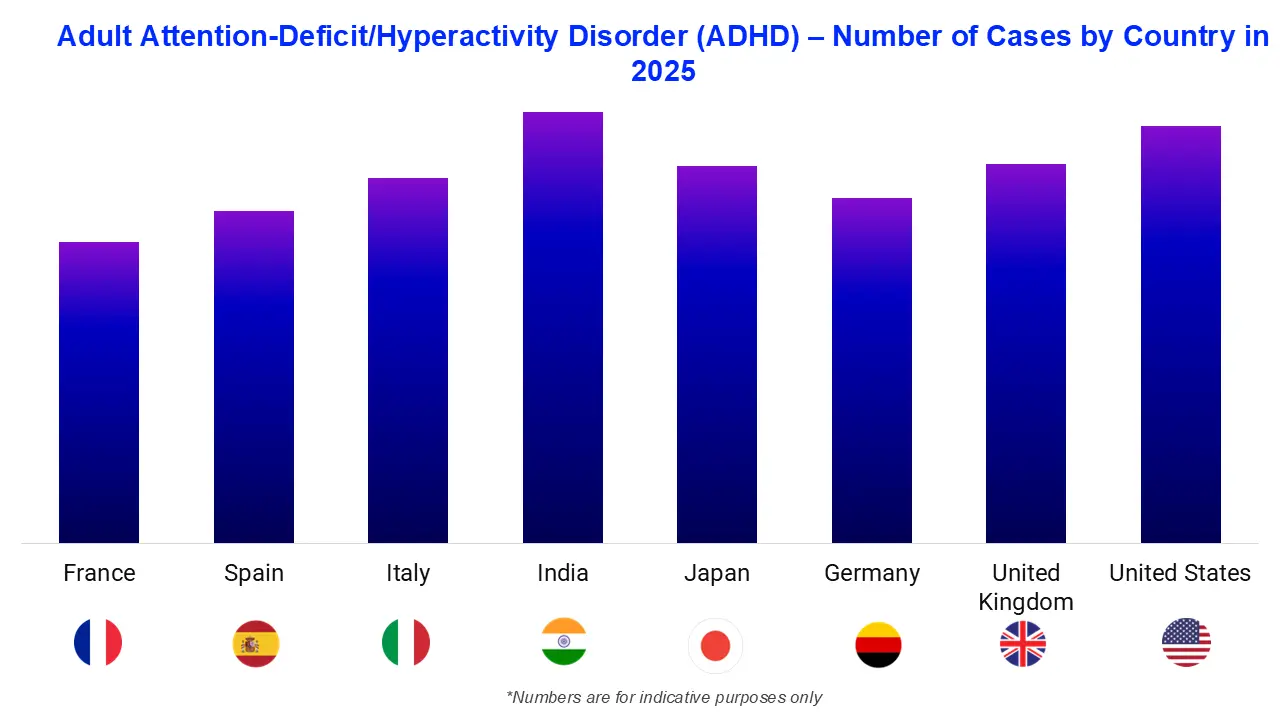
The Adult Attention-Deficit/Hyperactivity Disorder (ADHD) epidemiology data and findings for the United States, Germany, Spain, Italy, France, the United Kingdom, Japan, and India are also provided in the epidemiology section.
|
Country |
Key Insights |
|
United States |
The United States has one of the strongest adult ADHD epidemiological datasets. CDC data from 2023 estimated 15.5 million adults, or 6.0% of adults, with a current ADHD diagnosis. Approximately 55.9% had received their diagnosis during adulthood. Among adults with ADHD, 36.5% were receiving no ADHD treatment, while medication and counseling or behavioral treatment were both used by 35.2%. |
|
Germany |
Recent German health-insurance data covering 2017-2023 identified an administrative adult ADHD prevalence of 0.6% in 2023. Among adults with ADHD, 44.4% received no treatment, 38.0% received medication alone, 7.6% psychotherapy alone, and 10.0% multimodal therapy. These figures indicate a substantial treatment gap despite increasing recognition and healthcare utilization. |
|
France |
A 2023 French review and meta-analysis estimated adult ADHD prevalence at approximately 5.5%, although the authors emphasized limitations in the quality and heterogeneity of available studies. The analysis estimated that approximately 1.4 million adults in metropolitan France could have ADHD, illustrating the potential scale of the condition despite limited population-level adult epidemiological surveillance |
|
Italy |
Recent Italian adult ADHD research continues to identify clinically meaningful sex differences, psychiatric comorbidity, emotional dysregulation, and differences in symptom presentation. A 2026 tertiary-service study of 212 adults with ADHD included 119 men and 93 women and found greater inattentive presentation, mood and anxiety comorbidity, and emotional dysregulation among women, supporting improved sex-sensitive recognition of adult ADHD. |
|
Spain |
Spain has developed increasing recognition of adult ADHD within psychiatric and neurodevelopmental services, although nationally representative adult prevalence estimates remain less robust than U.S. surveillance. Current European evidence indicates substantial heterogeneity in ADHD prevalence according to diagnostic methodology, healthcare access, and population characteristics, limiting direct country-to-country comparisons. |
|
United Kingdom |
Adult ADHD prevalence in the United Kingdom is commonly estimated at approximately 3-4%, although robust contemporary national surveillance remains limited. NICE recommends specialist assessment for adults presenting with persistent ADHD symptoms and significant impairment, with diagnosis based on comprehensive clinical and psychosocial assessment rather than rating scales alone. |
|
Japan |
Japanese nationwide data show increasing ADHD prevalence from 2017 to 2021, while adult prevalence remained substantially lower than childhood and adolescent prevalence. In adults, mood disorders were the most frequent psychiatric comorbidity, affecting 60.9% of adults with ADHD in the 2019 dataset, demonstrating the importance of identifying ADHD within broader psychiatric care. |
|
India |
A 2024/2025 systematic review and cross-sectional study of young adults in Delhi-NCR identified a 14% positive screening rate among 1,665 participants aged 18-25 years. The systematic review found reported adult ADHD prevalence ranging from 5.48% to 25.7% across Indian general and specific populations. These findings indicate a substantial recognition gap but should not be interpreted as a nationally representative prevalence estimate. |
Adult ADHD epidemiology remains constrained by substantial differences between symptom-screening prevalence, clinically diagnosed prevalence, administrative prevalence, and treatment-based estimates. The 2024 systematic review and meta-analysis demonstrated that prevalence estimates vary markedly according to ascertainment methodology, while country-specific datasets show similarly large differences. Delayed diagnosis is particularly important: U.S. data indicate that more than half of adults currently diagnosed with ADHD received the diagnosis only after reaching adulthood. Under-recognition among women, limited developmental records, psychiatric comorbidity, fragmented specialist services, and unequal access to assessment further complicate identification. Medication availability is another current healthcare-system gap, with 71.5% of U.S. adults taking stimulant medication reporting difficulty filling prescriptions because the medication was unavailable.
Management of adult ADHD primarily combines pharmacological treatment with individualized psychosocial and environmental interventions. NICE recommends lisdexamfetamine or methylphenidate as first-line pharmacological options for adults, with atomoxetine recommended when stimulants are not tolerated or do not provide sufficient benefit after appropriate trials. Non-pharmacological treatment should be considered when medication is declined, ineffective, or poorly tolerated and may include structured ADHD-focused psychological interventions and cognitive behavioral therapy. Treatment planning should also address sleep, occupational functioning, substance use, anxiety, mood disorders, and other neurodevelopmental or psychiatric comorbidities. Regular treatment review is required to assess efficacy, adverse effects, adherence, and continuing clinical need.
Attention-Deficit/Hyperactivity Disorder (ADHD) Treatment Market


Upto 15% Off
USD
$2699 $2429
$4299 $3869
$5799 $4949
$6999 $5949


*While we strive to always give you current and accurate information, the numbers depicted on the website are indicative and may differ from the actual numbers in the main report. At Expert Market Research, we aim to bring you the latest insights and trends in the market. Using our analyses and forecasts, stakeholders can understand the market dynamics, navigate challenges, and capitalize on opportunities to make data-driven strategic decisions.*
Explore our key highlights of the report and gain a concise overview of key findings, trends, and actionable insights that will empower your strategic decisions.
|
Report Features |
Details |
|
Base Year |
2025 |
|
Historical Period |
2019-2025 |
|
Forecast Period |
2026-2035 |
|
Epidemiology Statistics Provided |
|
|
Segmentation Provided |
|
|
Geographies Covered |
|
Datasheet
One User
USD 2,699
USD 2,429
tax inclusive*
Single User License
One User
USD 4,299
USD 3,869
tax inclusive*
Five User License
Five User
USD 5,799
USD 4,949
tax inclusive*
Corporate License
Unlimited Users
USD 6,999
USD 5,949
tax inclusive*
*Please note that the prices mentioned below are starting prices for each bundle type. Kindly contact our team for further details.*
Flash Bundle
Small Business Bundle
Growth Bundle
Enterprise Bundle
*Please note that the prices mentioned below are starting prices for each bundle type. Kindly contact our team for further details.*
Flash Bundle
Number of Reports: 3
20%
tax inclusive*
Small Business Bundle
Number of Reports: 5
25%
tax inclusive*
Growth Bundle
Number of Reports: 8
30%
tax inclusive*
Enterprise Bundle
Number of Reports: 10
35%
tax inclusive*
How To Order

Select License Type
Choose the right license for your needs and access rights.

Click on ‘Buy Now’
Add the report to your cart with one click and proceed to register.

Select Mode of Payment
Choose a payment option for a secure checkout. You will be redirected accordingly.
Strategic Solutions for Informed Decision-Making
Gain insights to stay ahead and seize opportunities.
Get insights & trends for a competitive edge.
Track prices with detailed trend reports.
Analyse trade data for supply chain insights.

Leverage cost reports for smart savings
Enhance supply chain with partnerships.
Connect For More Information
Our expert team of analysts will offer full support and resolve any queries regarding the report, before and after the purchase.
Our expert team of analysts will offer full support and resolve any queries regarding the report, before and after the purchase.
We employ meticulous research methods, blending advanced analytics and expert insights to deliver accurate, actionable industry intelligence, staying ahead of competitors.
Our skilled analysts offer unparalleled competitive advantage with detailed insights on current and emerging markets, ensuring your strategic edge.
We offer an in-depth yet simplified presentation of industry insights and analysis to meet your specific requirements effectively.