

Consumer Insights
Uncover trends and behaviors shaping consumer choices today
Procurement Insights
Optimize your sourcing strategy with key market data
Industry Stats
Stay ahead with the latest trends and market analysis.
Amyloidosis remains a rare but potentially life-threatening systemic disorder characterized by extracellular deposition of misfolded amyloid proteins, causing progressive dysfunction of affected organs. According to Laires et al., 2025, the estimated incidence of AL amyloidosis in the United States was 16.7 cases per million person-years among adults in 2021, while prevalence reached 69.0 cases per million adults. Recent evidence also indicates increasing recognition of transthyretin amyloidosis, with prevalence estimates varying substantially across populations. According to the amyloidosis epidemiology forecast by Expert Market Research, the disease continues to represent a significant clinical burden because of multisystem involvement, diagnostic challenges, progressive organ dysfunction, and associated mortality.
Base Year
Historical Period
Forecast Period
Read more about this report - REQUEST FREE SAMPLE COPY IN PDF
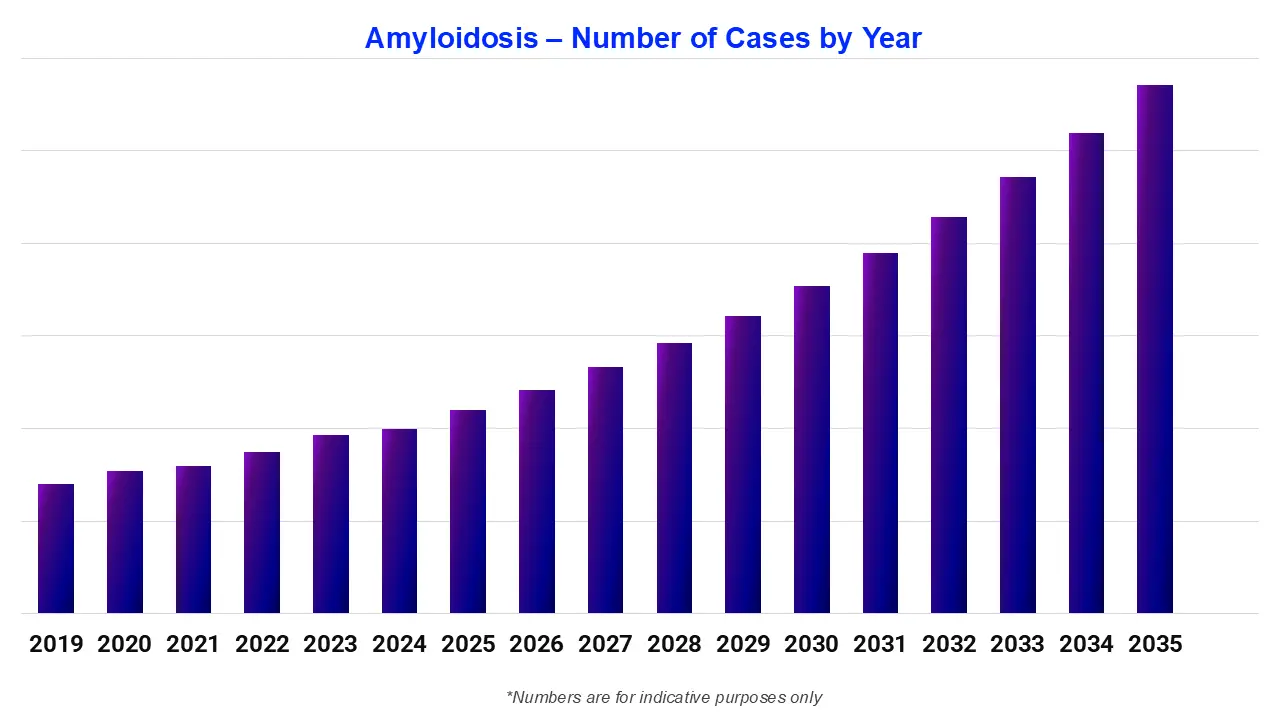
Expert Market Research's “Amyloidosis Epidemiology Forecast Report 2026-2035” offers comprehensive information on the prevalence and demographics of Amyloidosis. It projects the future incidence and prevalence rates of Amyloidosis cases across various populations. The study covers age, gender, and type as major determinants of the Amyloidosis population. The report highlights patterns in the prevalence of Amyloidosis over time and projects future trends based on multiple variables.
The report provides a comprehensive overview of the disease, as well as historical and projected data on the epidemiology of Amyloidosis in the 8 major markets.
Regions Covered
Amyloidosis is a rare and potentially life-threatening multisystem disorder caused by the extracellular deposition of misfolded amyloid proteins, resulting in progressive tissue and organ dysfunction. Systemic forms, particularly immunoglobulin light-chain (AL) and transthyretin (ATTR) amyloidosis, can involve the heart, kidneys, peripheral and autonomic nerves, liver, and gastrointestinal tract. According to Cook et al., 2026, clinical manifestations vary substantially by amyloid subtype, with fatigue, dyspnea, edema, neuropathy, weight loss, and carpal tunnel syndrome representing important diagnostic red flags. The condition is associated with substantial morbidity and mortality because diagnosis is frequently delayed until irreversible organ impairment has developed.
|
Parameter |
Insight |
|
Largest Patient Pool |
United States |
|
Fastest Growing Country |
Japan |
|
High-Risk Population |
Older adults and individuals with plasma-cell disorders, hereditary TTR variants, or age-associated ATTR amyloidosis |
|
Key Diagnostic Method |
Amyloid tissue confirmation with Congo-red staining and definitive protein typing by mass spectrometry |
|
Major Risk Factor |
Underlying disease-specific amyloid precursor abnormality |
|
Major gap in the market |
Delayed diagnosis and incomplete access to specialized amyloid typing and disease-modifying treatment |
The Amyloidosis epidemiology division offers information on the patient pool from history to the present as well as the projected trend for each of the 8 major markets. Expert Market Research provides both current and predicted trends for the Amyloidosis epidemiology scenario by examining a wide range of studies. Additionally, the report covers the diagnosed patient pool for Amyloidosis and their trends. The data is broken down into specific categories, such as total prevalent cases in males and females, and total diagnosed cases across different age groups and patient pools.
|
Epidemiology Segment |
Key Insights |
|
Diagnosed Prevalent Cases of the Disease |
According to Laires et al., 2025, the estimated incidence of immunoglobulin light-chain (AL) amyloidosis in the United States was 16.7 cases per million adults, while prevalence was 69.0 cases per million adults in 2021, demonstrating a substantial diagnosed disease burden. |
|
Gender-Specific Cases of the Disease |
According to Laires et al., 2025, AL amyloidosis occurs in both sexes, with epidemiological analyses indicating a higher incidence among males. The sex distribution varies according to amyloidosis subtype, particularly between AL and transthyretin amyloidosis. |
|
Age-Specific Cases of the Disease |
As per Laires et al., 2025, AL amyloidosis predominantly affects older adults, with incidence increasing with advancing age. ATTR amyloidosis is also strongly age-associated, particularly wild-type ATTR, which is predominantly diagnosed in elderly individuals. |
|
Ethnicity-Wise Cases of the Disease |
According to available epidemiological evidence, amyloidosis occurs across multiple ethnic populations, although the distribution of specific subtypes and hereditary variants differs geographically and ethnically. ATTRv amyloidosis, for example, exhibits marked geographic and genetic heterogeneity because pathogenic TTR variants are unevenly distributed among populations. |
|
Mortality and Survival Analysis of the Disease |
Amyloidosis is associated with substantial mortality, particularly when cardiac involvement is present. Prognosis varies considerably by amyloid subtype, disease stage, and extent of organ involvement. In AL amyloidosis, cardiac biomarkers and hematologic response are major determinants of survival, while effective plasma-cell-directed therapy has substantially improved outcomes compared with historical treatment approaches. |
|
Disease Type |
Prevalence |
|
Immunoglobulin Light-Chain (AL) Amyloidosis |
According to recent epidemiological evidence, AL amyloidosis is the most common systemic amyloidosis subtype and has an estimated incidence of approximately 8–15.2 cases per million persons per year. A 2025 U.S. real-world analysis estimated an incidence of 16.7 cases per million adults and prevalence of 69.0 cases per million adults in 2021. |
|
Transthyretin (ATTR) Amyloidosis |
ATTR amyloidosis comprises wild-type ATTR (ATTRwt) and variant/hereditary ATTR (ATTRv) and represents an increasingly recognized component of the amyloidosis burden. A 2025 systematic review reported ATTR prevalence ranging from 6.1 per million in the United States to 232 per million in Portugal, with higher prevalence observed among older adults, men, and patients with cardiac disease. |
|
AA (Serum Amyloid A) Amyloidosis |
AA amyloidosis develops secondary to chronic inflammatory or infectious disorders and predominantly causes renal involvement. Recent reviews indicate that its incidence has declined in many settings because of improved treatment of underlying inflammatory diseases, although it remains clinically important in populations with persistent chronic inflammation and infection. |
|
Others |
Other forms include hereditary and localized amyloidosis, as well as rarer types associated with proteins such as apolipoprotein A-I, fibrinogen Aα, lysozyme, β2-microglobulin, and gelsolin. Current classification recognizes 42 amyloidogenic proteins, demonstrating substantial biological and clinical heterogeneity beyond AL, ATTR, and AA amyloidosis. |
Read more about this report - REQUEST FREE SAMPLE COPY IN PDF
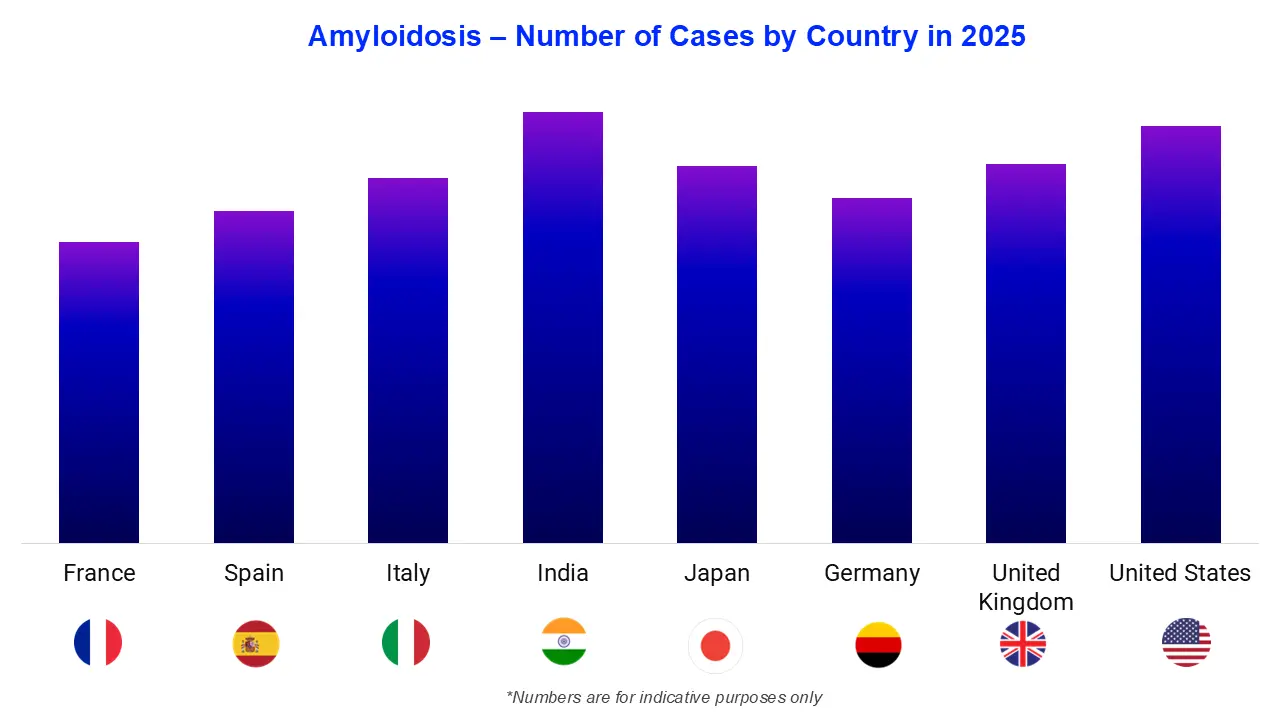
The Amyloidosis epidemiology data and findings for the United States, Germany, Spain, Italy, France, the United Kingdom, Japan, and India are also provided in the epidemiology section.
|
Country |
Key Insights |
|
United States |
According to Laires et al., 2025, the estimated incidence of AL amyloidosis was 16.7 cases per million person-years, while prevalence reached 69.0 cases per million adults in 2021, representing a substantial diagnosed disease burden. A separate 2025 analysis estimated the prevalence of ATTR amyloidosis at 59.8 cases per million people in 2022 using a narrow case definition. |
|
Germany |
Germany has established specialist diagnostic and treatment networks for systemic amyloidosis, particularly AL and ATTR amyloidosis. Published European evidence indicates that the recognized burden is increasing with improved disease awareness and detection of cardiac ATTR, although a directly comparable contemporary national prevalence estimate is not firmly established. |
|
France |
France has reported substantial clinical experience with systemic amyloidosis, particularly AL and ATTR. Contemporary European evidence indicates increasing recognition of transthyretin-related cardiac disease, but country-level estimates vary according to case definition and diagnostic ascertainment, making direct comparison with U.S. registry estimates inappropriate. |
|
Italy |
Italy represents an important European amyloidosis population, particularly for ATTR amyloidosis, reflecting the presence of hereditary transthyretin variants and specialized amyloidosis referral centres. Epidemiological estimates remain heterogeneous because registry, hospital, and genetic-screening studies capture different segments of the disease population. |
|
Spain |
Spain has a significant recognized burden of both AL and ATTR amyloidosis, with hereditary transthyretin amyloidosis contributing to regional clustering of disease. Available evidence indicates substantial geographic variation in ATTRv prevalence because of founder TTR variants, while broader national estimates remain dependent on diagnostic ascertainment. |
|
United Kingdom |
The United Kingdom has extensive specialist amyloidosis services and national diagnostic pathways, with increasing recognition of both AL and ATTR disease. The expanding identification of ATTR cardiac amyloidosis has increased the recognized patient population, although a single contemporary national prevalence figure covering all amyloidosis subtypes is not reliably available. |
|
Japan |
Japan has one of the strongest contemporary national datasets for systemic amyloidosis. According to Kubota, 2026, registered systemic amyloidosis cases increased from 2,304 in 2015 to 8,168 in 2024, a 3.5-fold increase, while the population-adjusted rate rose from 0.18 to 0.65 per 10,000 population. ATTR was the predominant subtype in a Japanese pathological-autopsy analysis, accounting for 44.4% of classified systemic amyloidosis cases, compared with 38.8% for AL. |
|
India |
India has a clinically important but incompletely quantified amyloidosis burden. Published evidence is particularly limited by underdiagnosis, heterogeneous access to amyloid typing, and the absence of a comprehensive nationwide registry covering all amyloidosis subtypes. Consequently, a reliable contemporary national prevalence or incidence estimate cannot presently be stated without substantial uncertainty. |
According to published studies, substantial gaps remain in the epidemiological characterization, recognition, and early diagnosis of amyloidosis, particularly for transthyretin (ATTR) disease, where prevalence estimates vary considerably between regions and diagnostic delays remain common. Recent evidence indicates that ATTR amyloidosis is frequently diagnosed at advanced stages, while inconsistent laboratory and pathological workflows can further delay accurate amyloid typing. Emerging opportunities include systematic screening of high-risk populations, multidisciplinary diagnostic pathways, improved amyloid typing, and wider implementation of cardiac imaging and validated biomarkers. Advances in disease-specific therapies, including plasma-cell-directed treatment for AL amyloidosis and transthyretin-targeted stabilizing and gene-silencing approaches for ATTR, together with emerging biomarkers and improved prognostic models, may facilitate earlier intervention and improve long-term outcomes.
The management of amyloidosis primarily focuses on suppressing production or deposition of the amyloidogenic protein, treating the underlying disease process, and controlling affected-organ dysfunction. Treatment is subtype-specific: systemic AL amyloidosis is managed with plasma-cell-directed therapy, including daratumumab in combination with cyclophosphamide, bortezomib, and dexamethasone, whereas ATTR amyloidosis is treated with transthyretin stabilizers or gene-silencing therapies. As per the 2025 ACC guidance, tafamidis, acoramidis, and vutrisiran are disease-modifying therapies for ATTR cardiomyopathy, with vutrisiran demonstrating a significant reduction in mortality and cardiovascular events in the HELIOS-B trial. Ongoing research is evaluating TTR gene-editing approaches and amyloid-depleting monoclonal antibodies, while earlier diagnosis and treatment remain important because current therapies are most effective before substantial irreversible organ damage occurs.


Upto 15% Off
USD
$2699 $2429
$4299 $3869
$5799 $4949
$6999 $5949


*While we strive to always give you current and accurate information, the numbers depicted on the website are indicative and may differ from the actual numbers in the main report. At Expert Market Research, we aim to bring you the latest insights and trends in the market. Using our analyses and forecasts, stakeholders can understand the market dynamics, navigate challenges, and capitalize on opportunities to make data-driven strategic decisions.*
Explore our key highlights of the report and gain a concise overview of key findings, trends, and actionable insights that will empower your strategic decisions.
|
Report Features |
Details |
|
Base Year |
2025 |
|
Historical Period |
2019-2025 |
|
Forecast Period |
2026-2035 |
|
Epidemiology Statistics Provided |
|
|
Segmentation Provided |
|
|
Geographies Covered |
|
Datasheet
One User
USD 2,699
USD 2,429
tax inclusive*
Single User License
One User
USD 4,299
USD 3,869
tax inclusive*
Five User License
Five User
USD 5,799
USD 4,949
tax inclusive*
Corporate License
Unlimited Users
USD 6,999
USD 5,949
tax inclusive*
*Please note that the prices mentioned below are starting prices for each bundle type. Kindly contact our team for further details.*
Flash Bundle
Small Business Bundle
Growth Bundle
Enterprise Bundle
*Please note that the prices mentioned below are starting prices for each bundle type. Kindly contact our team for further details.*
Flash Bundle
Number of Reports: 3
20%
tax inclusive*
Small Business Bundle
Number of Reports: 5
25%
tax inclusive*
Growth Bundle
Number of Reports: 8
30%
tax inclusive*
Enterprise Bundle
Number of Reports: 10
35%
tax inclusive*
How To Order

Select License Type
Choose the right license for your needs and access rights.

Click on ‘Buy Now’
Add the report to your cart with one click and proceed to register.

Select Mode of Payment
Choose a payment option for a secure checkout. You will be redirected accordingly.
Strategic Solutions for Informed Decision-Making
Gain insights to stay ahead and seize opportunities.

Get insights & trends for a competitive edge.

Track prices with detailed trend reports.

Analyse trade data for supply chain insights.

Leverage cost reports for smart savings

Enhance supply chain with partnerships.

Connect For More Information
Our expert team of analysts will offer full support and resolve any queries regarding the report, before and after the purchase.
Our expert team of analysts will offer full support and resolve any queries regarding the report, before and after the purchase.
We employ meticulous research methods, blending advanced analytics and expert insights to deliver accurate, actionable industry intelligence, staying ahead of competitors.
Our skilled analysts offer unparalleled competitive advantage with detailed insights on current and emerging markets, ensuring your strategic edge.
We offer an in-depth yet simplified presentation of industry insights and analysis to meet your specific requirements effectively.




