

Consumer Insights
Uncover trends and behaviors shaping consumer choices today
Procurement Insights
Optimize your sourcing strategy with key market data
Industry Stats
Stay ahead with the latest trends and market analysis.
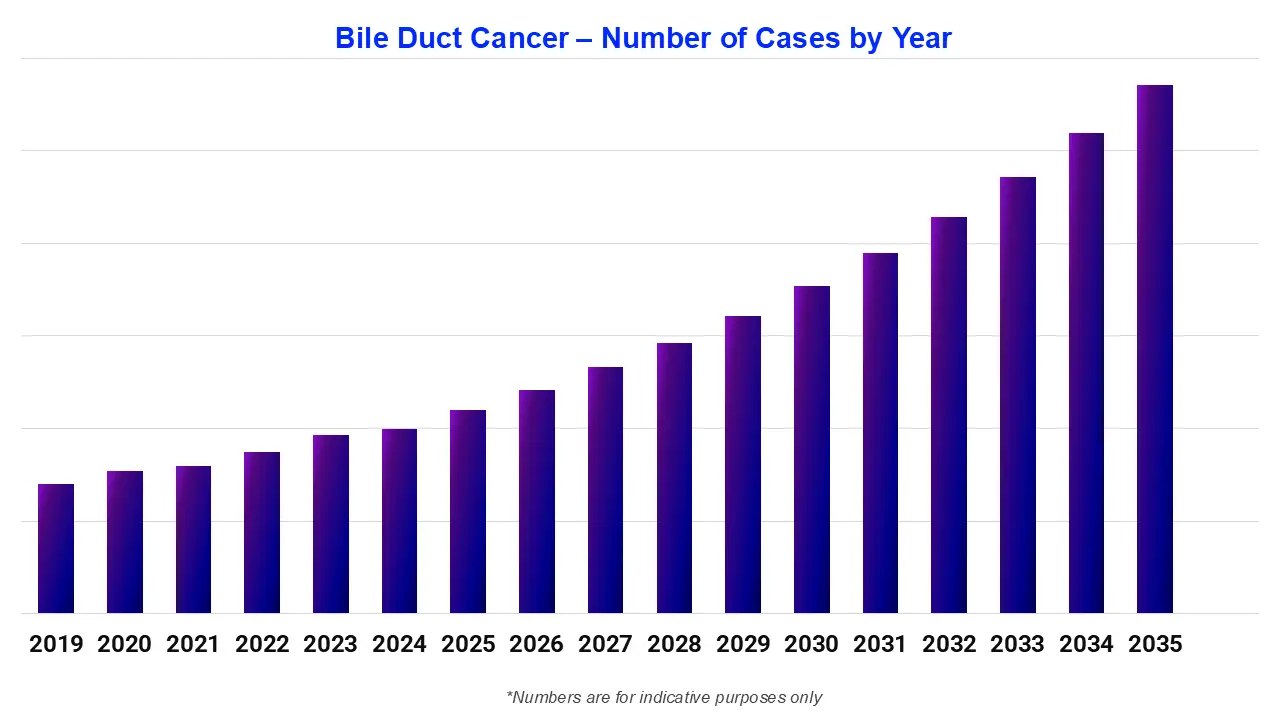
Bile duct cancer, also known as cholangiocarcinoma, is a rare cancer that begins in the bile ducts. According to the American Cancer Society, about 8,000 people in the United States are diagnosed with this malignancy each year. According to bile duct cancer epidemiology forecast by Expert Market Research, epidemiological trends continue to influence the disease landscape and demand for diagnosis and treatment.
Base Year
Historical Period
Forecast Period
Read more about this report - REQUEST FREE SAMPLE COPY IN PDF
Expert Market Research's “Bile Duct Cancer Epidemiology Forecast Report 2026-2035” offers comprehensive information on the prevalence and demographics of bile duct cancer. It projects the future incidence and prevalence rates of bile duct cancer cases across various populations. The study covers age, gender, and type as major determinants of the bile duct cancer population. The report highlights patterns in the prevalence of bile duct cancer over time and projects future trends based on multiple variables.
The report provides a comprehensive overview of the disease, as well as historical and projected data on the epidemiology of bile duct cancer in the 8 major markets.
Regions Covered
Bile duct cancer, or cholangiocarcinoma, is a malignant tumor that develops in the bile ducts, which transport bile from the liver and gallbladder to the small intestine. It occurs when abnormal cells in the bile duct grow uncontrollably and form tumors, potentially obstructing bile flow. Based on its anatomical location, the disease is classified into intrahepatic, perihilar, and distal bile duct cancer. Risk factors include chronic bile duct inflammation, primary sclerosing cholangitis, certain liver diseases, and congenital abnormalities. Cholangiocarcinoma can vary in biological behavior and prognosis depending on its location and stage.
|
Parameter |
Insight |
|
Largest Patient Pool |
United States |
|
Fastest Growing Country |
India |
|
High-Risk Population |
Older adults and individuals with chronic biliary conditions |
|
Key Diagnostic Method |
Imaging-based diagnosis, particularly MRI/MRCP and CT |
|
Major Risk Factor |
Primary sclerosing cholangitis and other chronic biliary diseases |
|
Major gap in the market |
Late diagnosis and limited early-detection strategies |
The bile duct cancer epidemiology division offers information on the patient pool from history to the present as well as the projected trend for each of the 8 major markets. Expert Market Research provides both current and predicted trends for the bile duct cancer epidemiology scenario by examining a wide range of studies. Additionally, the report covers the diagnosed patient pool for bile duct cancer and their trends. The data is broken down into specific categories, such as total prevalent cases in males and females, and total diagnosed cases across different age groups and patient pools.
|
Epidemiology Segment |
Key Insights |
|
Diagnosed Prevalent Cases of the Disease |
Bile duct cancer is rare globally. According to the American Cancer Society (2026), about 8,000 people are diagnosed annually in the United States. Medanta reported fewer than 1,000 cases annually in India. |
|
Gender-Specific Cases of the Disease |
As per Pojsakorn Danpanichkul et al. (2025), early-onset liver and intrahepatic bile duct cancer incidence increased significantly among females, with an annual percent change of 3.07%, while rates remained stable in males. |
|
Age-Specific Cases of the Disease |
According to the American Cancer Society (2026), bile duct cancer occurs mainly among older adults, with the average age at diagnosis in the United States in the 70s. OT&P Limited noted a higher occurrence after age 50. |
|
Ethnicity-Wise Cases of the Disease |
As per Pojsakorn Danpanichkul et al. (2025), non-Hispanic American Indian and Alaska Native individuals had the highest early-onset liver and intrahepatic bile duct cancer incidence, at 2.67 per 100,000 population. |
|
Mortality and Survival Analysis of the Disease |
According to American Liver Foundation (2024), liver and intrahepatic bile duct cancer accounted for 29,840 estimated deaths in the United States in 2024, while five-year survival was approximately 22% during 2013–2019. |
|
Disease Type |
Prevalence |
|
Intrahepatic Cholangiocarcinoma (iCCA) |
Bile duct cancer arising within the liver. According to Gael S. Roth et al. (2024), intrahepatic cholangiocarcinoma has shown an increasing incidence in France, indicating a significant and growing share of the cholangiocarcinoma burden. |
|
Perihilar Cholangiocarcinoma (pCCA) |
Bile duct cancer arising at the hepatic hilum. It represents a major anatomical subtype of cholangiocarcinoma and contributes to the overall bile duct cancer burden across affected populations. |
|
Distal Cholangiocarcinoma (dCCA) |
It is the bile duct cancer that arises in the distal extrahepatic bile duct. It represents a significant anatomical subtype of cholangiocarcinoma and contributes to the overall epidemiological burden of bile duct cancer. |
Read more about this report - REQUEST FREE SAMPLE COPY IN PDF
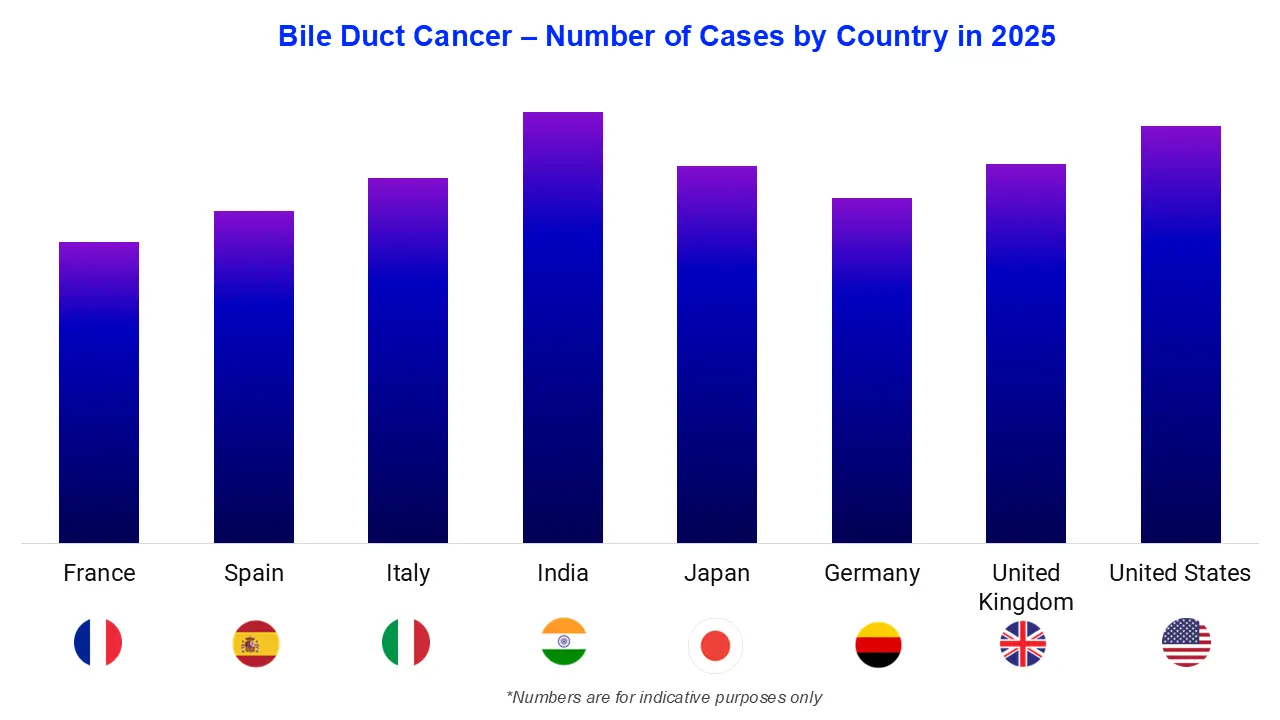
The bile duct cancer epidemiology data and findings for the United States, Germany, Spain, Italy, France, the United Kingdom, Japan, and India are also provided in the epidemiology section.
|
Country |
Key Insights |
|
United States |
According to American Cancer Society (2026), about 8,000 people are diagnosed with bile duct cancer annually. American Liver Foundation (2024) reported 9.4 cases per 100,000 for liver and intrahepatic bile duct cancer during 2017–2021. |
|
Germany |
Bile duct cancer represents a relatively uncommon cancer burden in Germany, with epidemiological patterns primarily concentrated among older adults. The available information supports assessment of incidence and prevalence alongside age-related disease distribution. |
|
France |
According to Gael S. Roth et al. (2024), biliary tract cancer incidence in 2018 was 2.1 per 100,000 men and 1.4 per 100,000 women, with incidence rising sharply from age 50. |
|
Italy |
Bile duct cancer remains an uncommon malignancy in Italy. Epidemiological assessment focuses on its occurrence across adult and older populations, alongside variations in incidence and disease burden within the broader biliary tract cancer population. |
|
Spain |
According to MD Anderson Cancer Center, more than 3,000 liver cancer cases are diagnosed annually in Spain, with rates of 14 per 100,000 men and 4 per 100,000 women; cholangiocarcinomas represent approximately 10–20% of liver cancer cases. |
|
United Kingdom |
Bile duct cancer epidemiology in the United Kingdom is characterized by occurrence predominantly among adults, particularly older populations. Assessment includes incidence patterns, age distribution, and differences in disease burden across demographic groups. |
|
Japan |
Bile duct cancer epidemiology in Japan is evaluated through incidence patterns and demographic distribution, with particular attention to disease occurrence among adult and older populations and variations in biliary tract cancer burden. |
|
India |
According to Medanta, fewer than 1,000 bile duct cancer cases are reported annually in India. Gael S. Roth et al. (2024) also identified Northern India as an area with a high incidence of gallbladder carcinoma. |
The bile duct cancer landscape across the United States, Germany, France, Italy, Spain, the United Kingdom, Japan, and India faces major gaps in early detection and timely diagnosis. Bile duct cancer is often identified at advanced stages, limiting curative treatment options and contributing to poor outcomes. Opportunities exist to strengthen surveillance among high-risk populations, improve access to advanced imaging and molecular diagnostics, and expand awareness of symptoms and risk factors. India represents an important emerging opportunity because improving cancer diagnosis and specialist access may increase case identification, while developed markets can benefit from precision diagnostics and personalized treatment approaches.
Treatment for bile duct cancer depends on the tumor’s location, stage, resectability, and the patient’s overall health. Surgical resection is the primary potentially curative approach for localized, operable disease and may involve removing part of the liver, bile duct, or surrounding tissues. For unresectable or advanced disease, systemic therapy commonly includes chemotherapy, targeted therapy, and immunotherapy. Radiation therapy may be used for selected patients to control localized disease or relieve symptoms. Biliary drainage procedures, including stent placement, can help restore bile flow and manage obstruction. Systemic therapy is increasingly guided by molecular testing and tumor biomarkers.


Upto 15% Off
USD
$2699 $2429
$4299 $3869
$5799 $4949
$6999 $5949


*While we strive to always give you current and accurate information, the numbers depicted on the website are indicative and may differ from the actual numbers in the main report. At Expert Market Research, we aim to bring you the latest insights and trends in the market. Using our analyses and forecasts, stakeholders can understand the market dynamics, navigate challenges, and capitalize on opportunities to make data-driven strategic decisions.*
Explore our key highlights of the report and gain a concise overview of key findings, trends, and actionable insights that will empower your strategic decisions.
|
Report Features |
Details |
|
Base Year |
2025 |
|
Historical Period |
2019-2025 |
|
Forecast Period |
2026-2035 |
|
Epidemiology Statistics Provided |
|
|
Segmentation Provided |
|
|
Geographies Covered |
|
Datasheet
One User
USD 2,699
USD 2,429
tax inclusive*
Single User License
One User
USD 4,299
USD 3,869
tax inclusive*
Five User License
Five User
USD 5,799
USD 4,949
tax inclusive*
Corporate License
Unlimited Users
USD 6,999
USD 5,949
tax inclusive*
*Please note that the prices mentioned below are starting prices for each bundle type. Kindly contact our team for further details.*
Flash Bundle
Small Business Bundle
Growth Bundle
Enterprise Bundle
*Please note that the prices mentioned below are starting prices for each bundle type. Kindly contact our team for further details.*
Flash Bundle
Number of Reports: 3
20%
tax inclusive*
Small Business Bundle
Number of Reports: 5
25%
tax inclusive*
Growth Bundle
Number of Reports: 8
30%
tax inclusive*
Enterprise Bundle
Number of Reports: 10
35%
tax inclusive*
How To Order

Select License Type
Choose the right license for your needs and access rights.

Click on ‘Buy Now’
Add the report to your cart with one click and proceed to register.

Select Mode of Payment
Choose a payment option for a secure checkout. You will be redirected accordingly.
Strategic Solutions for Informed Decision-Making
Gain insights to stay ahead and seize opportunities.

Get insights & trends for a competitive edge.

Track prices with detailed trend reports.

Analyse trade data for supply chain insights.

Leverage cost reports for smart savings

Enhance supply chain with partnerships.

Connect For More Information
Our expert team of analysts will offer full support and resolve any queries regarding the report, before and after the purchase.
Our expert team of analysts will offer full support and resolve any queries regarding the report, before and after the purchase.
We employ meticulous research methods, blending advanced analytics and expert insights to deliver accurate, actionable industry intelligence, staying ahead of competitors.
Our skilled analysts offer unparalleled competitive advantage with detailed insights on current and emerging markets, ensuring your strategic edge.
We offer an in-depth yet simplified presentation of industry insights and analysis to meet your specific requirements effectively.




